
Specs are compiled from manufacturer listings and verified buyer reviews and can change over time — please confirm the key details on the product page before buying.
Digging a trench to a garage, shed, or mobile home is expensive, and buying the wrong cable means digging it twice. Here is the short answer: for most underground runs, the Nassau 100-foot direct burial quadplex at 155 amps is the pick to beat. The Wirenco 25-foot SER cut wins for short above-ground service work. The Relaxweex 25-foot coil is the tidy choice for a mobile home feeder or a shop run.
I’m Mohammad Maruf — the founder and writer behind KitchPrep. This guide is built by comparing the manufacturers’ published specifications and the patterns across verified customer reviews, so you get each pick’s real strengths and trade-offs instead of marketing spin.
Aluminum feeder cable is a fitment-critical, code-sensitive purchase. Ampacity (how much current the cable can carry before it overheats), insulation type, and length matter more than anything printed on the spool. This guide to the best 2-2-2-4 aluminum wire breaks down ampacity, burial ratings, and real-world length so you buy right once.
Our Picks at a Glance

How To Choose The Best 2-2-2-4 Aluminum Wire
Every spool on this list carries the same conductors: three size-2 aluminum wires plus a size-4 ground. So the choice depends on four things. Which insulation type do you need? Is it rated to be buried? How many amps can it carry? And is the length you order the length you get? Get those four right and the rest is paperwork.
Burial Rating And Insulation Type Come First
Direct burial cable goes straight into the ground without conduit (the plastic pipe you would otherwise pull wire through). That saves you the cost of pipe and the labor of pulling through it. URD quadplex, like the Nassau 100-foot roll, is made for exactly that job. SER cable is a service entrance type meant for above-ground runs — from a meter base to a panel, or along a wall into a sub panel. SER and URD interchange poorly: SER in a trench, or URD for an indoor panel feed, is the mistake that gets a job red-tagged (failed by the inspector). Match the cable type to where the wire will physically live before you compare anything else.
Ampacity Depends On How You Install It
The same cable carries more current in open air or direct burial than inside a duct (a sealed pipe). Buried, the soil pulls heat away. In a sealed pipe, heat builds up. The Nassau 100-foot roll shows this plainly: 155 amps direct burial versus 115 amps in duct. Plan your load against the installation method you are actually using, not the higher number on the label. If your load sits near the in-duct figure, step up a size rather than run the cable hot.
Length Discipline Saves A Second Trip
Aluminum feeder cable is stiff, and a short cut cannot be spliced underground. Measure your run twice. Add slack at both ends for terminating, and account for the vertical rise into each panel. Residential 2-2-2-4 aluminum service cable typically runs 600 volts (the maximum voltage its insulation is built to withstand), which covers standard residential service. If your run is long, remember voltage drop (voltage lost as current travels down the wire) grows with distance — a cable rated for your load at 50 feet may need a larger size at 200 feet.
Quick Comparison
| Model | Best For | Cable Type | Max Current | Length | Amazon |
|---|---|---|---|---|---|
| Nassau 100 FT URD Dyke 2-2-2-4★ Best Overall | Long underground runs to a detached building | URD Quadruplex, direct burial | 155 A direct burial | 100 ft | Amazon |
| Wirenco 2-2-2-4 SER (25FT Cut)Best for Short Runs | Short above-ground service entrance work | SER, above ground | 100 A | 25 ft | Amazon |
| Relaxweex 25Ft 2-2-2-4 Mobile Home Feeder | Mobile home feeder and garage sub panels | URD Quadruplex, UL listed, direct burial | 100 A | 25 ft | Amazon |
| Nassau 2-2-2-4 SER (100FT) | Full-length SER runs to a 100 amp sub panel | SER, above ground | — | 100 ft | Amazon |
In‑Depth Reviews
1. Nassau Electrical Supply 100 FT Aluminum URD Dyke 2-2-2-4 Cable Direct Burial Quadruplex Secondary Wire
Our pick — over 4.5★ from 450+ verified ratings; the strongest balance of quality and price.
A full 100-foot underground roll that handles a detached building without a splice.
This one earns the top spot on a single number: 155 amps direct burial. That is enough current to feed a garage, shop, or second building in one 100-foot pull. It is URD quadruplex, meaning four conductors twisted together for underground use — three size-2 aluminum conductors plus a size-4 neutral, per the 2-2-2-4 designation. Pull it through duct instead and the rating drops to 115 amps, so plan your load around your actual installation method, not the higher label figure. It is the crowd favorite here at 4.7 stars across 400+ ratings.
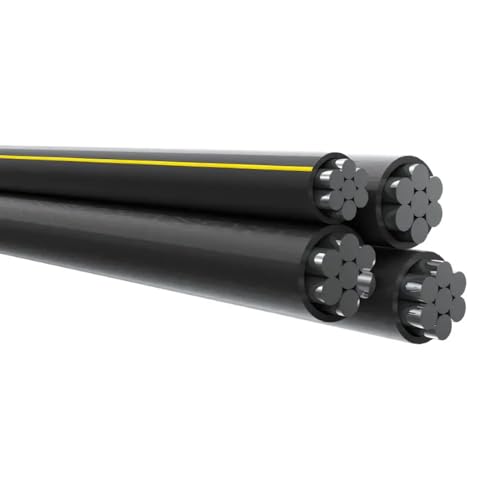
What wins people over is the build itself. The insulation is 60 mils thick (a mil is one-thousandth of an inch, so that is a heavy jacket around each conductor). Buyers describe it as heavy, stiff wire that resists accidental shorts. The seven-strand construction at 0.973 inches overall diameter pulls cleanly when waxed. The phases carry A, B, and C markings plus a yellow stripe, so you can identify each leg at the panel. It arrives on a spool, and one reviewer even received 125 feet a day earlier than promised. Buyers report the length came in correct every time.
The honest catch is handling. This is genuinely stiff cable — several buyers mutter about how hard it is to bend and pull through pipe. It tends to twist when you unroll it, easing up only once it is fully off the spool. The other recurring gripe is identification: the neutral conductor is not clearly marked, so it is easy to confuse yourself at the panel. Neither issue is a dealbreaker for a buried run, but both reward patience. If your entire run lives inside pipe, the Wirenco 25-foot SER cut saves you from paying for a burial rating you never use.
The Underground Advantage
- 155 A direct buries without conduit, so no pipe to buy or pull
- Thick 60 mil insulation guards against accidental shorts
- Phases marked A/B/C with a yellow stripe for easy panel ID
Where It Fights You
- Rated at only 115 A once you put it in duct
- Heavy and stiff, awkward to bend on tight runs
- Neutral conductor is not clearly marked
Your best bet: a long direct-burial run to a detached garage or shop where you want to skip conduit entirely.
Second-guess it: if your whole run lives inside pipe, you are paying for a burial rating you never use and only getting 115 A.
2. Wirenco 2-2-2-4 SER Aluminum Service Entrance Cable (25FT Cut)
A pre-cut 25-foot SER stub for the meter-to-panel hop that rarely needs more.
At 0.359 pounds per foot, this is a cable you can carry and feed into a panel alone — no helper needed. That light build is why it lands here for short above-ground work. It is rated for 600 volts and 100 amps, and it is built for wet and dry locations, so a damp basement or a covered exterior run is fine. The construction is four wires total: three insulated conductors and one bare neutral. Owners mention running it for a 90-foot shop feed and for a 70-amp sub panel, both without trouble. The reliable winner here is quality, with functionality close behind.
Why the 25-foot cut makes sense for a lot of jobs: you stop paying for a full spool when your run is short. The size-2 conductors carry a standard 100-amp service, which covers the usual sub panel and RV hookup work. With RV hookups it holds 50 amps comfortably, and owners see no heat building up during use. Stranding is seven per conductor, the same count you get on the Nassau roll, so terminating behaves the same way. This is a straightforward, no-drama cable.
Two things to know before you order. First, SER is not a direct burial cable — bury this one and you invite an inspection problem, so it stays above ground only. Second, it ships as a cut length rather than on a spool, and owners note it can take a few days to arrive. Neither is a fault in the wire; they are just planning items.
Plain-English verdict: a compact 25-foot SER cut that covers standard 100-amp service entrance and RV feed work, light enough at 0.359 pounds per foot to handle solo.
What to watch: it is strictly an above-ground cable, and the cut length can take a few days to ship.
Reach for this if: your run is above ground and short, and you want the cable rated for 100 amps without buying extra footage.
Look past it if: your wire needs to go underground, where SER is the wrong type.
3. Relaxweex 25Ft 2-2-2-4 Aluminum Mobile Home Feeder Cable
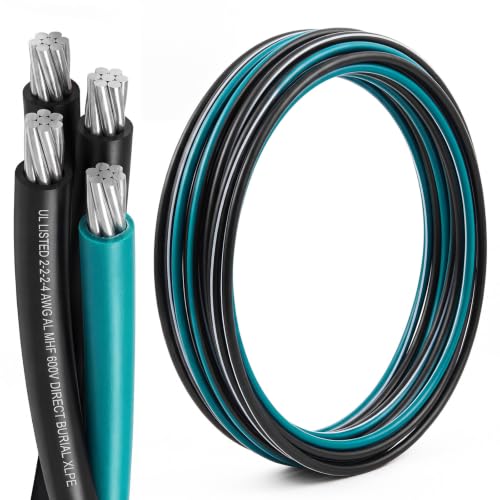
A UL listed 25-foot coil for a mobile home feeder or a shop run in the ground.
Only one cable here carries UL listing (a safety certification from Underwriters Laboratories) and can also go straight into the ground: this one. It carries 600 volts and 100 amps, and it is designed to be direct-buried without conduit. The sheath is made to shrug off moisture, corrosion, and sunlight exposure. The conductors are AA-8000 series aluminum alloy — that is a specific alloy blend made to meet ASTM standards (published industry material standards). The tight stranding keeps the cable’s overall weight down, which helps when you are wrestling it into a trench. It also operates continuously at temperatures up to 90°C, or 194°F, so a hot summer run is no worry.
The 25-foot length is the practical hook here. It is a pre-cut coil, professionally wound, so you don’t buy a full spool or pay for footage you never use. That makes it a natural fit for a short mobile home feeder or a small sub panel run. Customers note it working great on a 90-foot shop feed, and it is a genuine substitute for a big-box store run — Home Depot did not stock it, but Amazon had it. The quality and value both land as positives, and it arrived on schedule.
Now the honest part. This is direct burial URD, so it is the wrong type for an indoor panel or a meter-to-panel knock inside a wall. On length specifically, there is a real complaint to note: at least one buyer measured their cut and found it short of the advertised 25 feet, so check your coil before you start the dig. It is the newest cable here with the thinnest review history, so if you want a deep track record, the Nassau 100-foot roll has the longer one.
What earns its spot: a UL listed, 600V, 100A direct burial feeder with a 90°C continuous temperature rating, sold as a pre-cut 25-foot coil so there is no wasted spool.
Take note: it is direct burial only, and cut length has come up short for at least one buyer, so measure before you trench.
Pick this one: for a mobile home service entrance or a short garage feeder you plan to bury, where 25 feet is the right amount.
Pass it over: if you need an above-ground SER run or a longer single pull, where the Nassau roll wins.
4. NASSAU ELECTRICAL SUPPLY 2-2-2-4 SER Aluminum Service Entrance Cable Wire (100FT)

A hundred feet of 600V SER for the full-length sub panel run you keep putting off.
This is the only cable here that reaches 100 feet above ground in one piece — the distance an EV charger at the far end of a garage or a sub panel across a property actually needs. The build is the standard 2-2-2-4: three size-2 aluminum conductors (2 AWG, the wire gauge) plus a separate bare size-4 ground, four conductors total, rated 600V. It is a heavy-grade aluminum cable. Shoppers say using it for an EV charger feed and for powering a home office out in a purchased shed, running it to a sub panel in each case. They warmed the coil in the sun to make unspooling easier — a smart move with stiff aluminum.
The company behind it has its loyalists. Buyers describe Nassau as trustworthy and consistent. Several note they have ordered multiple rolls and keep coming back. It ships sooner than expected, well packaged, at a price lower than local purchase. The 600V rating and aluminum construction match the Nassau 75-foot SER cut in build, and the extra 25 feet is what makes this the pick for long runs.
One caution worth respecting: cut length on this listing is not guaranteed perfect. At least one buyer ordered 100 feet and received 85, which stalled a project — so measure your delivered cable before you start pulling. It is the lower-rated option on this list at 4.5 stars, and it is SER only, so it should stay above ground. For a full-length indoor or covered service run, though, it does the job at a fair value.
At its core: a 100-foot 600V SER service entrance cable — 2-2-2-4 with a bare 4 AWG ground — built heavier than a stub, for full-length sub panel and EV charger feeds.
The one to respect: cut length has come up short for at least one buyer, so verify your footage on arrival before trenching or pulling.
Buy it for: a long above-ground SER run to a sub panel, EV charger, or outbuilding where 100 feet in one piece is the point.
Skip it for: any buried run, since SER is above-ground cable, and check your cut length the moment it lands.
Understanding the Specs
What 2-2-2-4 Actually Means
The four-number designation is a shorthand for the conductors inside the cable. The first three numbers — 2-2-2 — mean three aluminum conductors sized 2 AWG (the wire thickness gauge), which are your two hots and your neutral. The final 4 is the ground conductor, at 4 AWG. In plain terms, a 2-2-2-4 cable gives you a full set of service conductors sized to carry a standard residential feeder load, with a smaller dedicated ground alongside them. That is why the same designation fits mobile home feeders, sub panels, and service entrance work alike.
Ampacity, And Why You See Two Numbers
Ampacity is the current a cable can carry before it heats up past its insulation rating. The same cable often carries two ratings because installation changes how well heat escapes. The Nassau 100-foot roll, for example, is rated 155 amps direct burial and 115 amps in duct. Buried, the surrounding soil pulls heat away; sealed inside pipe, heat builds up. So size your cable for the way you are actually installing it. A load that is fine when buried may need a step up in size once it is confined to a duct.
URD Versus SER: Pick The Right Type
URD quadplex and SER cable are different products for different jobs. URD is a direct burial type — it goes into the ground without a conduit and handles moisture and soil contact. SER is a service entrance type meant for above-ground runs from a meter to a panel or along a wall. Picking URD for an indoor wall run, or SER for a buried one, is among the most common mistakes in this category. Match the type to the environment the cable will live in, and the rest falls into place.
Length, Weight, And Voltage Drop
Buying the right footage matters because aluminum feeder cable is stiff and does not splice well underground. Measure the run. Add slack for terminating at both ends, and account for the vertical rise into a panel. Watch voltage drop (voltage lost as current travels down the wire) on long pulls too: the farther the current travels, the more the voltage falls. A long run may need a larger conductor size than a short one. Finally, weight matters — aluminum is lighter than copper, but a 100-foot roll of 2-2-2-4 is still a two-person lift, so plan how you will move it.
FAQ
Can 2-2-2-4 aluminum wire handle a 100 amp sub panel?
What is the difference between 2-2-2-4 URD and 2-2-2-4 SER cable?
Why does the same cable have two different amp ratings?
Is 2-2-2-4 aluminum wire rated for direct burial?
Can I run aluminum feeder wire inside conduit?
How do I know the cut length is correct when it arrives?
What does 600V rating mean for this cable?
Can I use 2-2-2-4 aluminum wire to feed a detached garage or shop?
Does aluminum feeder cable need to be marked for phase identification?
Why is aluminum wire used for service feeders instead of copper?
Final Thoughts: The Verdict
For most underground projects, the 2-2-2-4 aluminum wire winner is the Nassau Electrical Supply 100 FT URD Dyke Quadruplex, because its 155 amp direct-burial rating and 100-foot length cover a full run to a detached building without conduit or a splice. If value is your priority, the Wirenco 2-2-2-4 SER (25FT Cut) gives you a 100 amp above-ground service stub for short runs. For a mobile home feeder or a compact buried shop run, the UL listed Relaxweex 25Ft 2-2-2-4 Mobile Home Feeder is the one to grab — and the Nassau roll is the pick most buyers land on, with 4.7 stars across 400+ ratings behind it.
How We Picked
We do not accept paid placement. Every pick is matched to a real buyer and a real use-case; we do not hands-on test units.
Sources & Methodology
Specifications: manufacturer listings and product documentation. Review insights: verified customer reviews, as of September 2026. Pricing: not shown on this page (it changes often); check the current price via the retailer link.
As an Amazon Associate, KitchPrep earns from qualifying purchases. This does not affect which products we feature.
Related Guides
