
Specs are compiled from manufacturer listings and verified buyer reviews and can change over time — please confirm the key details on the product page before buying.
If you need a 2 1/2-inch pipe, you already know the real problem: almost nobody stocks it. This is the oddball size that big-box stores skip, and when you do track it down, it is usually sold in long lengths you will never use. So the guide below focuses on the three things that actually matter when you buy online — that the outside diameter (the measurement across the outside of the pipe) matches the fittings you already own, that the wall thickness (how thick the pipe wall is) can handle your pressure, and that the cut length arrives as ordered.
I’m Mohammad Maruf — the founder and writer behind KitchPrep. This guide is built by comparing the manufacturers’ published specifications and the patterns across verified customer reviews, so you get each pick’s real strengths and trade-offs instead of marketing spin.
Schedule 40 PVC is the standard wall thickness for most home plumbing and yard projects, and the outside diameter is what determines whether your fittings will glue on. That number is the same on every pick here, but the inside diameter, pressure rating, wall thickness, and cut length are not — and those are what separate a pipe that works from one that leaks. Here is how the 2 1/2-inch pipe options stack up against each other.
Our Picks at a Glance

How To Choose The Best 2 1/2-Inch Pipe
The single mistake that ruins most 2 1/2-inch pipe orders is buying on the nominal number alone. You read “2 1/2 inch,” you picture a two-and-a-half-inch opening, and then the pipe shows up measuring roughly 2.87 inches across the outside with an opening closer to 2.44 inches. That is not a defect — it is how nominal pipe sizing works, and once you understand it, the whole category makes sense.
Match the Outside Diameter to Your Fittings, Not the Label
Your fittings grip the outside of the pipe, so the outside diameter is the number that decides whether this job goes smoothly. Every pipe on this list lands at roughly 2.87 to 2.88 inches across, which is why standard Schedule 40 and Schedule 80 fittings slide on with the usual primer and solvent cement. If you are replacing an existing pipe, measure what you are pulling out before you order anything — especially if that old pipe was a thin-walled sleeve set into the ground.
Decide Your Pressure Ceiling Before You Buy
Pressure rating is where these three picks genuinely diverge. One carries a maximum of 150 psi at 73F, another is rated to 300 psi, and the third publishes no pressure figure at all because it is built for gravity-fed work such as drainage and irrigation. For a flag pole sleeve or a tape dispenser bar, pressure is irrelevant. For anything tied into a pressurized water line, it is the first spec you read and the last one you compromise on.
Pick Clear or White Based On Sight Lines
Clear pipe costs more because you can watch what moves through it — handy for checking flow, spotting clogs, or showing off a build. White pipe is cheaper and blends into walls, ground, and pool equipment. Neither is stronger than the other at the same wall thickness; the difference is purely if you need to see inside.
Measure Twice On Cut Length
These ship in fixed cuts rather than full sticks, which is the entire reason this size is buyable online at all. A two-foot cut suits a sleeve or a short repair. A four-foot cut suits a longer run without a coupling in the middle. Order the cut that matches your project, because splicing two shorter pieces with a coupling costs you both a fitting and another glue joint to get wrong.
Quick Comparison
| Model | Best For | Cut Length | Max Pressure | Wall Thickness | Amazon |
|---|---|---|---|---|---|
| Jumpanny Clear PVC Schedule 40 Pipe, 2 1/2 Inch★ Best Overall | Sight-line builds and sleeve replacements | 2 feet | 150 psi | 0.135 inches | Amazon |
| 2-1/2″ Schedule 40 PVC Pipe, White, Custom Cut | Pressurized lines and irrigation work | 2 feet | 300 psi | 0.2 | Amazon |
| VENTRAL Schedule 40 PVC Pipe 2 1/2 Inch | Longer runs, drainage, and pool or spa plumbing | 48 inches | — | 0.13 inches | Amazon |
In‑Depth Reviews
1. Jumpanny Clear PVC Schedule 40 Pipe, 2 1/2 Inch (2.875 OD), 2-Foot Cut
Our pick — 4.5★ from 100+ verified ratings; the strongest balance of quality and price.
A see-through two-footer that solves the hardest part of this size — actually finding it.
This is the pick for anyone whose project needs to be watched, not just plumbed. The clear bluish body lets you see flow, spot debris, or show off an internal build, and it arrives as a single rigid piece — not flexible tubing that kinks. The 2-foot cut suits a sleeve, a short repair, or a display section without leaving you holding a full stick you will never finish.
The sizing is where buyers get their money’s worth. The outside measures 2.88 inches, which means standard Schedule 40 and Schedule 80 fittings glue straight on with the usual primer and cement. The inside is not a true 2 1/2 inches — it measures roughly 2.445 inches, which is simply how nominal pipe sizing behaves. If your project depends on a genuine two-and-a-half-inch opening, measure the inside before you commit rather than trusting the label.
The wall thickness runs 0.135 inches and the pipe is rated for a maximum pressure of 150 psi at 73F. That ceiling is half the rating of the white 300 psi pick below, so treat this one as the sight-line option and let the higher-rated pipe carry anything pressurized. Buyers report it working well as a flag pole sleeve where the old pipe had rusted out; the occasional complaint is about cost, not the pipe. It holds 4.5 stars across 100+ ratings, the highest of the three picks.
What It Nails
- Clear bluish wall lets you see flow — useful for diagnostics and display builds
- 2.88-inch outside diameter accepts standard SCH40 and SCH80 fittings
- Rigid, not flexible, so it holds its shape and stays true over length
- Ships as a 2-foot cut, so you get exactly what the project needs
Where It Trades Off
- 150 psi maximum is half the pressure rating of the white alternative
- Inside diameter lands near 2.445 inches, not a literal 2 1/2 inches
- Fragility is the honest trade-off — clear PVC asks for careful handling and storage
Reach for this if: you need to see inside the pipe, you are replacing a thin sleeve in the ground, or you want a display-quality piece.
Look elsewhere if: your line runs pressurized — the 300 psi white pipe below is the safer call.
2. 2-1/2″ Schedule 40 PVC Pipe, White, Cut to Custom Lengths (2-Foot Cut)

The pressure king of the group — double the rating of the clear pipe for pressurized work.
If your project involves water under real pressure, this is the one to order. It carries a maximum rating of 300 psi, which is exactly twice the 150 psi ceiling of the clear pick above — that is the whole reason it sits here rather than anywhere else. The pipe measures 2.875 inches outside and 2.4375 inches inside, and the makers describe it as built for high-flow capacity and high-impact strength across plumbing, irrigation, pool, and spa work.
The wall is thicker too. Nominal wall thickness comes in at 0.2 inches against the clear pipe’s 0.135 inches, and that extra material is what lets the pressure rating climb. It is also corrosion-resistant and NSF certified, which speaks to the material being suitable for both indoor and outdoor use. Custom sizing runs from 1 foot up to 8 feet, so you can fit the run rather than cut a long stick down.
What wins people over is the fit — the 2.875-inch outside diameter matches existing Schedule 40 fittings, which is what makes or breaks the job. The other honest note is that the cut you receive is what you ordered, not a bonus length.
The value read: This is the middle of the three on cost, and it buys you the highest pressure rating and the thickest wall in the lineup — the strongest performance-per-piece here.
The one catch: Returns on a short cut are rarely worth the shipping, which is a fit-mismatch problem, not a flaw in the pipe.
Pick this one if: you are tying into a pressurized line, an irrigation zone, or pool and spa plumbing where the PSI figure actually matters.
Choose differently if: you want to see inside the pipe — only the clear option above gives you that.
3. VENTRAL Schedule 40 PVC Pipe 2 1/2 Inch (2.875 OD), White, 48-Inch Length
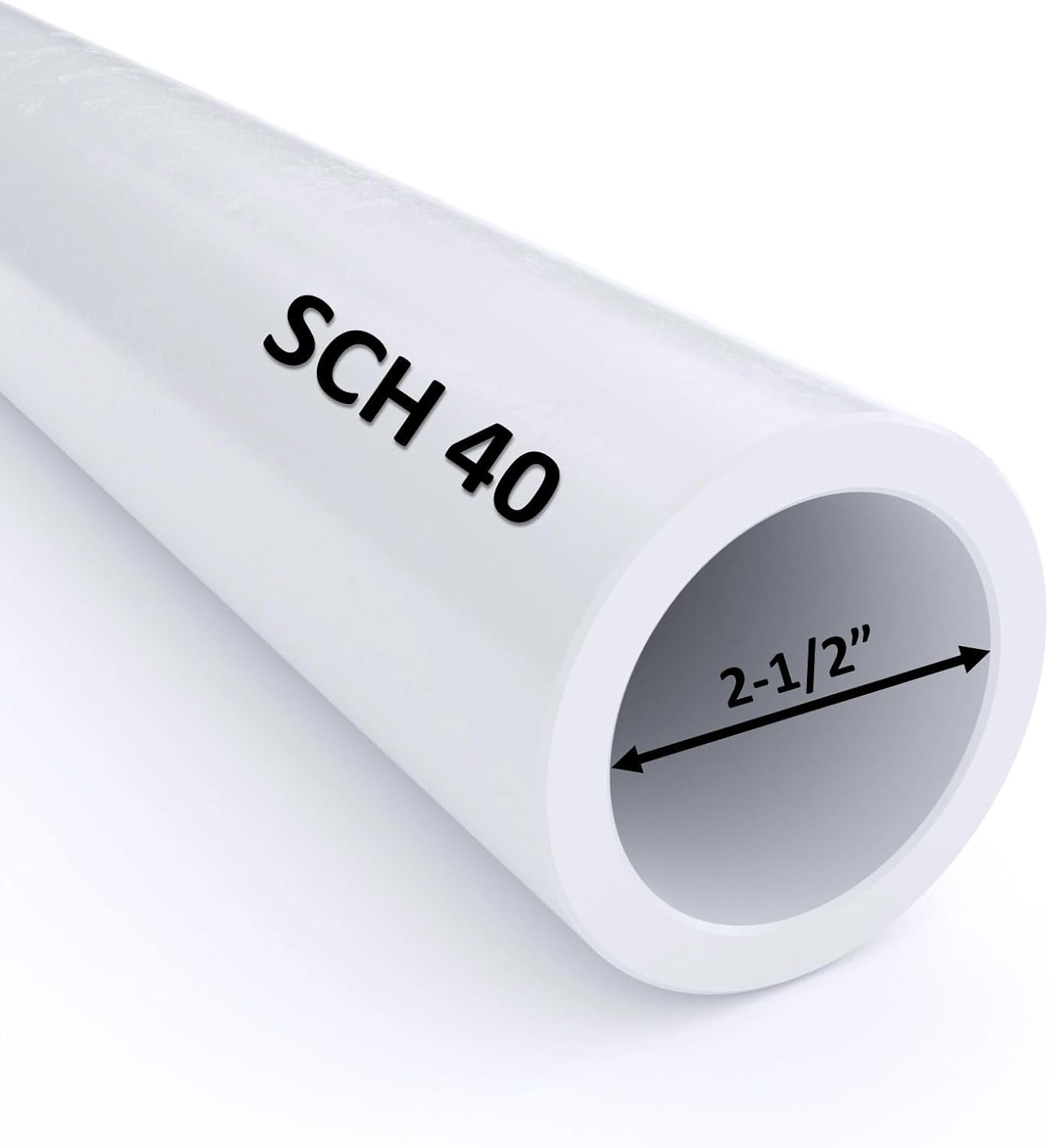
Twice the pipe in one piece — the pick when your run needs real distance between joints.
Forty-eight inches is the headline here. That is double the 24-inch cut on both other picks, and it means a longer run with no coupling buried in the middle of it. For drainage, underground sprinkler runs, or a custom build where a splice would be a weak point, that single-piece length is worth more than any other number on this page.
At 4.3 pounds it is the heaviest of the three — the lightest weighs 2.1 pounds — the cost of the extra length. The wall measures 0.13 inches nominal, close to the clear pipe’s 0.135 inches, and it is built for systems that will not exceed 140 degrees F. Ventral describes it as a low-cost alternative to metal piping for irrigation, sprinkler, drainage, pool and spa, and cold water supply lines, and it is made and designed in the USA.
Sizing notes worth knowing before you order: this listing quotes an outside diameter of 2.5 inches in its spec sheet, while the product description itself states the pipe is 2.5 inch nominal with a 2.875 OD. A few buyers flagged that the inside diameter did not match expectations, so if your build depends on an exact internal dimension, measure on arrival. Installing it takes primer and solvent cement, and it is non-toxic and lightweight enough to handle on your own.
For a tape dispenser center bar, this length is the winner by a wide margin — rolls of packing, painter’s, and duct tape fit over it with room to spare, which is a use case the shorter cuts cannot match. That 48-inch reach is also why it is the right pick for anything structural or buried.
Reading the size: Double the length of the other cuts, with a 0.13-inch wall and a 2.875 OD that maintains compatibility with standard Schedule 40 fittings. The only spec to verify yourself is the inside diameter.
Best for: longer runs, buried drainage, sprinkler systems, and builds where a single uncut piece beats two spliced ones.
Skip if: weight and cut length matter more than reach — the lighter, shorter picks above are easier to handle.
Understanding the Specs
Nominal Size vs Actual Diameter
The number on the label — 2 1/2 inch — is a naming convention, not a measurement. In practice, every Schedule 40 pipe in this size lands around 2.87 to 2.88 inches across the outside, which is what your fittings grip. The inside ranges from roughly 2.4375 to 2.445 inches depending on wall thickness. Before ordering, decide which number your project actually depends on — the one your fittings slide over, or the one your contents must pass through.
Pressure Rating and Wall Thickness
Higher pressure ratings come from thicker walls, and these two specs move together. In this lineup, the 0.2-inch wall pairs with a 300 psi rating, while the 0.135-inch and 0.13-inch walls sit at 150 psi or carry no published pressure figure at all. If your project is gravity-fed — drainage, sleeves, decorative bars — pressure is not a factor. If it runs under pressure, the two specs are the first and last thing you check.
FAQ
Will 2 1/2-inch Schedule 40 fittings fit all three of these pipes?
What is the actual inside diameter of a 2 1/2-inch Schedule 40 pipe?
Which of these is best for a pressurized water line?
Can I use these pipes for a flag pole sleeve in the ground?
How do I glue Schedule 40 PVC pipe properly?
Is clear PVC stronger or weaker than white PVC?
How long can I order, and can I get a longer single piece?
Is it worth cutting and shipping a short piece rather than buying a full stick?
What temperature range can these pipes handle?
Can I use 2 1/2-inch pipe for a tape dispenser or similar build?
Final Thoughts: The Verdict
For most buyers chasing a 2 1/2-inch pipe, the answer is the Jumpanny Clear PVC Schedule 40 Pipe, because it solves the hardest part of this size — actually finding it — and it does it with a see-through body that fits standard Schedule 40 and Schedule 80 fittings. If your line runs under pressure, reach for the 2-1/2″ Schedule 40 PVC Pipe in white, which carries the highest rating here at 300 psi (pounds per square inch, a measure of pressure). And when your run simply needs more distance between joints, the 48-inch VENTRAL Schedule 40 PVC Pipe gives you double the length of the other two in a single uncut piece. Whichever you choose, measure your outside and inside diameters before you order — this is one size where the label alone will not tell you what you are getting.
How We Picked
We do not accept paid placement. Every pick is matched to a real buyer and a real use-case; we do not hands-on test units.
Sources & Methodology
Specifications: manufacturer listings and product documentation. Review insights: verified customer reviews, as of September 2026. Pricing: not shown on this page (it changes often); check the current price via the retailer link.
As an Amazon Associate, KitchPrep earns from qualifying purchases. This does not affect which products we feature.
Related Guides
