
Specs are compiled from manufacturer listings and verified buyer reviews and can change over time — please confirm the key details on the product page before buying.
An 18×18 access panel is a simple thing, and that is exactly why buying the wrong one hurts. You cut a clean square hole in your drywall for a shower valve or a water shut-off, press in a cheap plastic door, and a year later the hinge has snapped, the latch will not catch, or the whole panel has bowed away from the wall. Three things separate a panel that disappears into your wall from one you regret: the frame material, the hinge and latch build, and whether the panel size matches your real opening. This guide covers nine 18×18 panels — plastic and metal, budget and commercial-grade — so you can pick one that stays closed, opens when you need it, and looks built in.
I’m Mohammad Maruf — the founder and writer behind KitchPrep. This guide is built by comparing the manufacturers’ published specifications and the patterns across verified customer reviews, so you get each pick’s real strengths and trade-offs instead of marketing spin.
Cutout size, frame material, and hinge design decide whether an 18×18 panel blends into your wall or sags loose — here is a straight comparison for plumbing, wiring, and ceiling jobs.
Our Picks at a Glance

How To Choose The Best 18X18 Access Panel
Most people buy an access panel once every few years, so the mistakes repeat across thousands of kitchens and basements. Here is what actually decides whether your panel looks built-in or looks like a patch.
Measure your rough opening before anything else
An 18×18 panel almost never means an 18×18 hole. The number that matters is the cutout the frame is designed to cover. The BOZZON, for instance, carries an 18″ x 18″ cutout size but measures 20.25″ x 20.25″ overall, because the flange needs to overlap the drywall on every side. The Joogto metal panel is the opposite case — it is sold as 18×18 while the actual hole size it wants is 17.5 inches x 17.5 inches. Measure the opening twice, then match it to the panel’s stated cutout, not its title.
Plastic, ABS, or steel — pick for the room
Plastic panels are light, cheap, and easy to cut and paint, which makes them a reasonable fit for a closet or a low-traffic ceiling. The catch is hinge and latch longevity. High-impact ABS, like the PLA 150, is a step up from basic polystyrene, while galvanized or galvannealed steel is the material that shrugs off repeated opening, moisture, and temperature swings in a garage, attic, or exterior wall. If the panel will be opened more than once a year, steel is the safer call.
Hinge and latch decide whether it stays shut
A panel that will not stay closed is the most common complaint in this category. Concealed and removable hinges let you take the door fully off for maximum clearance, which is handy when you are reaching in with both hands. For the latch, a screwdriver-operated cam or a snap latch beats a thin plastic tab every time — tabs are the first thing to break, and a panel with a broken tab never sits flush again.
Quick Comparison
| Model | Best For | Material | Cutout / Opening | Weight | Amazon |
|---|---|---|---|---|---|
| BOZZON Access Panel 18×18 Insulated★ Best Overall | Winter walls and ceilings | Plastic, foil-backed insulated | 18″ x 18″ cutout | 2.7 lb | Amazon |
| Fengze Thicken Access Panel 18×18Best Value | Paintable ceiling tile | Plastic, textured | 18″ x 18″ (overcut by 5mm) | 2.3 lb | Amazon |
| Linhdor PLA 150 Access PanelTop Performer | Removable-door access | High-impact ABS | Cutout 3/8″ larger than panel | — | Amazon |
| Donext 18″x18″ Plastic Access Panel | Fast DIY closet and ceiling jobs | High-strength polystyrene | Measured to fit wall opening | 3.3 lb | Amazon |
| Acudor PA-3000 PA1818 | Indoor and outdoor utility access | UV-stabilized high-impact styrene | 18″ x 18″, 20″ overall height | — | Amazon |
| Joogto Thicken 1mm 18×18 Metal | Attic and crawlspace access | Aluminium and galvannealed steel | 17.5″ x 17.5″ hole | 5 lb | Amazon |
| EXCELFU 18×18 Metal Access Panel | Lockable wall and attic doors | Aluminum frame, galvanized steel door | 18″W x 18″H opening | 4.5 lb | Amazon |
| Acudor Z91818SCWH UF-5500 | Tile and masonry surfaces | Metal, white finish | 18″ x 18″, 20″ overall height | 7.3 lb | Amazon |
| Premier FL-5000 Flush Access Panel | Commercial-duty walls and ceilings | 16-gauge galvanized steel | 18″ x 18″, 7/8″ flange | — | Amazon |
In‑Depth Reviews
1. BOZZON Access Panel for Drywall 18 x 18 in — Insulated
Our pick — over 4.5★ from 450+ verified ratings; the strongest balance of quality and price.
The insulated panel that keeps a cold exterior wall from leaking air behind your pipes.
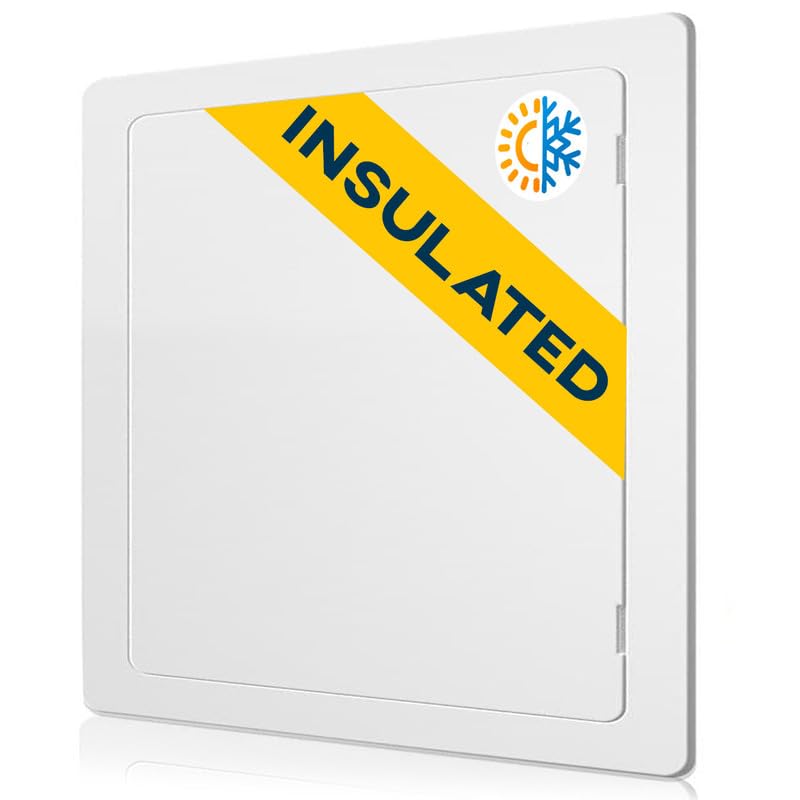
If your access hole sits on an outside wall or in a cold basement corner, this is the one to beat — it is the panel that climbs to the top of this list on a 4.7-star average across 400+ ratings. Its 7 mm foil-backed insulation layer behind the door is what buyers keep coming back for. That thin backing does two jobs: it slows heat from escaping in winter and blocks it in summer, and the foil also softens sound coming through the opening. For a wall that hides a water shut-off or a duct, that added barrier is the difference between a hole that whistles cold air and one you forget is there.
Installation is straightforward once you respect the numbers. The panel measures 20.25″ x 20.25″ overall but wants an 18″ x 18″ cutout, so the extra width is the flange that overlaps your drywall and hides a slightly ragged cut. Trace around the flange with a pencil, keep it square with a level, and cut just slightly larger than the marked line. There is no framing, no screws, and no latch hardware to fit — you bed the back of the frame in construction adhesive and press it home.
What wins people over most is the overall build quality, and the function follows close behind — the hinged door swings open a full 180° and lifts completely off when you need both hands in the cavity. It sits nearly flush against the wall when closed, and any flat tool, including a screwdriver or putty knife, pops it open. The honest catch is the hinge and the two mounting points: buyers report that a panel can sag slightly if both hinges are not fully seated, so check that they are properly inserted before the adhesive sets. Treat the hinge gently on a plastic door and it holds; the durability is the one area where feedback splits.
What earns it the top spot
- 7 mm foil-backed insulation layer that slows heat transfer and dulls sound through the opening.
- 180° hinged door that lifts completely off the frame for full clearance.
- No framing, screws, or separate hardware — adhesive mount into an 18″ x 18″ cutout.
- Impact-resistant, UV-stabilized plastic that resists fading and rust, indoor or outdoor.
Where it asks for care
- Both hinges must be fully seated or the door can sag — verify before the adhesive cures.
- Plastic hinges are the wear point on any panel in this tier; open it gently.
Grab this one if: your opening is on an exterior wall, a garage, or a cold utility room and you want the insulation layer working for you.
Think twice if: you plan to open the door constantly — a steel commercial panel will outlast a plastic hinge in a high-traffic spot.
2. Fengze Plastic Thicken Access Panel 18×18 inch
A light, paintable ceiling tile that hides the hole without hiding your budget.
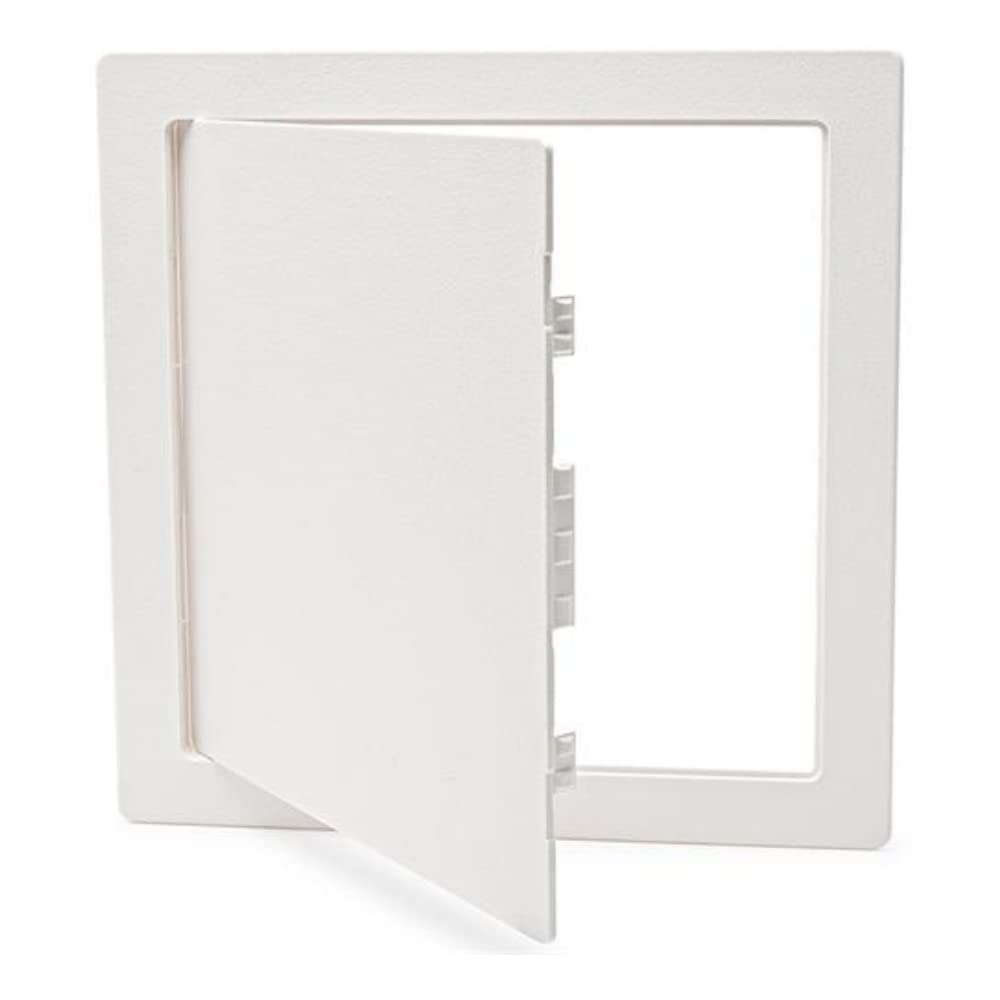
The Fengze takes a different approach to the same job. At 2.3 lb it is lighter in the hand than most panels here, and the white textured face is made to be left bare or painted to match your ceiling. For someone covering a hole left behind by a cable run or an old fixture, that paintable surface is the whole point — it lets the panel disappear into a finished ceiling rather than announce itself.
The install is adhesive-only, same as the rest of the field. Rough your opening for an 18×18 space and overcut by about 5mm for the best fit, because the actual panel is larger than 18″ x 18″ and needs a little slack to seat. Hinged door, removable from the frame cover, and the panel tolerates heat up to 90° Celsius. Set it level and straight the first time — tilt is the enemy here.
Build quality is what people write about most with this panel, and the function holds up across wall, ceiling, and valve-cover jobs. The recurring gripe is the small plastic tabs on the frame: owners mention they snap off if they are stressed, and one buyer’s advice is blunt — “Ensure you install perfectly level and straight.” The good news is the tabs are not structural, so a broken tab does not stop the panel working; it just means treating the frame gently during the press-in. Fit this one in a low-traffic ceiling or closet and it does its job quietly for years.
Straight read: the lightest, cheapest-feeling panel in this lineup, and that is fine — it is priced and built for covering a hole you will rarely open, on a surface you want to blend and forget.
One practical note: because the paintable face is the star here, plan your paint before you install — spraying or rolling a loose panel on a bench is far easier than working around it on the wall.
Reach for this if: you want a light, paintable panel for a ceiling or closet hole and you are comfortable cutting the opening a hair oversize.
Look elsewhere if: the panel sits on an exterior wall or under constant use — the plastic tabs and lack of insulation put it behind the BOZZON and the steel options for those jobs.
3. Linhdor PLA 150 High Impact ABS Plastic Access Panel 18×18
A one-piece ABS frame with radius corners that installs without a stud behind it.
Most plastic panels stop at “basic.” The PLA 150 is a notch above because it is molded from high-impact ABS with UV stabilizers rather than ordinary polystyrene, and the frame is a single piece with no mitered corners to split. The door runs on floating hinges plus five support tabs that keep it sitting solid when closed, and it lifts off the hinge entirely when you need full opening. Rounded corners on every side mean no sharp edges — a small thing until you are the one reaching in.
Where this panel earns its keep is the mounting depth. It carries a 3/4″ deep mounting frame, so it can go straight onto drywall, ceiling, or wall without a wood or metal stud behind it — you bed adhesive on the inside of the frame and press it to the surface. That one-piece frame with radius corners is why it holds a 4.6-star average across 100+ ratings. Finishing is easy too: white textured faces that can be left alone or painted.
The caveat worth knowing is the latch. Snap latches are convenient and fast, but the plastic is the weak link under repeated use — customers note the latches can go brittle and break when the door is opened often to reach behind it, which is why one owner asked for turnkey replacement latches. Size is the other thing to check: this panel wants a cutout roughly 3/8″ larger than the panel itself, so measure your opening against that, not against 18 inches flat. Treat it as a low-to-medium-traffic panel and it does its job well.
Why it holds up
- High-impact ABS construction with UV stabilizers and a scratch-resistant matte finish.
- One-piece frame with no mitered corners and a 3/4″ deep mount — no stud required.
- Floating hinges plus five support tabs for a solid closed position.
- Radius corners on all sides to prevent sharp edges.
What to plan around
- Snap latches are the wear point — plastic can go brittle under frequent opening.
- The cutout needs to be about 3/8″ larger than the panel, so measure before you cut.
Best fit: a stem-wall or pump-access panel on a wall you open a few times a year — the no-stud mount is the real selling point here.
Consider another door if: you will be in and out of this panel weekly, since the snap latches will not love that schedule.
4. Donext 18″x18″ Plastic Access Panel for Drywall and Ceiling

The slimmest panel here, built for a fast cut-and-adhere job in a garage or bath ceiling.
If you want the hole covered today, this is the panel that gets you there fastest. It is made from high-strength polystyrene with a textured, rough surface that takes paint readily — you can match it to your wall color and stop thinking about it. The design is deliberately minimal: one panel, no framing, no screws, no fasteners. You measure your cut, fix it with adhesive, and you are done.
The obvious trade-off is depth. It is a thin panel, and that shows up in how you mount it — reviewers point out you need a thin double-sided tape or caulk to hold it, and the panel is not deep enough to screw into a frame behind it. That is fine in a closet or a garage ceiling where the panel sits flat against drywall, less ideal if you are bridging tile or masonry. Its narrow depth is also why it stays so unobtrusive once installed.
Opening the door is the recurring friction point. Most owners find it easy to install and clean-looking, with a hinged cover that gives real access for future repair work. But a few mention the door is stiff enough that it wants a screwdriver or a flat tool to pry open, and one reviewer noted the panel’s execution does not match its good looks. It is a genuine caveat — not a dealbreaker for a panel you will open once a season, but a real consideration if you want tool-free access at a glance.
Good to know: the “cut and pop in” reputation is earned — this is the panel most likely to be installed by a first-timer without a level or a helper.
Pick this if: you want the cheapest path to covering a ceiling or wall hole and you are fine with a slim panel that needs its own adhesive.
Skip this if: you want tool-free access or a panel deep enough to screw into a frame — the Linhdor or a steel panel serves that better.
5. Acudor PA-3000 PA1818 Access Panel 18 x 18 Inch
The contractor’s default: a straightforward snap-latch door that installs in minutes with a caulk gun.
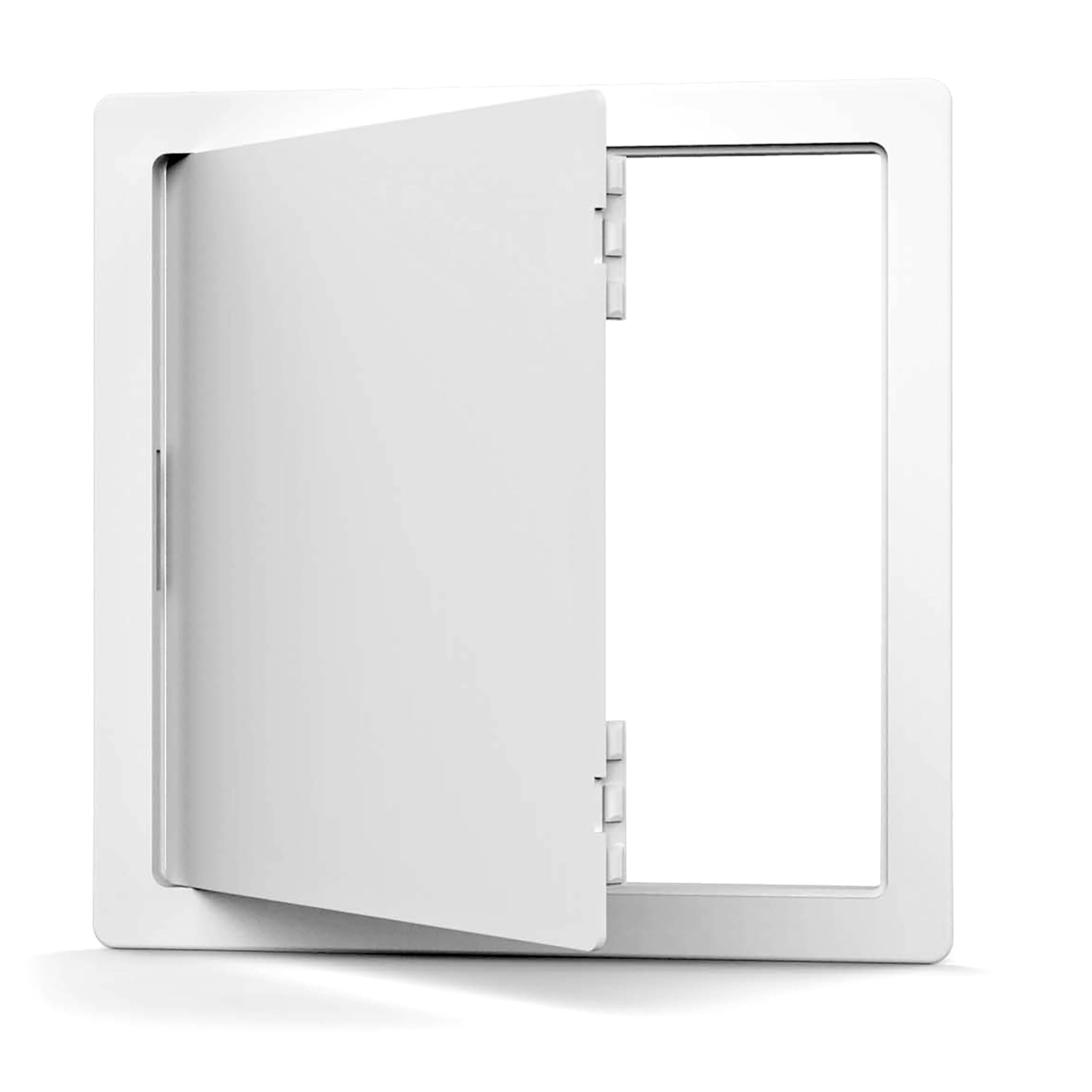
Acudor is the name you see on commercial job sites for a reason — this is the panel that just works, and the review pattern backs it. Most owners point to how fast it goes in: no framing, no screws, no fasteners. You run a bead of caulking adhesive around the back of the frame, press it in, and tape it until the glue sets. The door opens on a concealed hinge and the whole panel can be lifted off for maintenance. It is built from high-impact styrene plastic that resists fading, cracking, and corrosion, and the manufacturer calls out a waterproof design that suits bathrooms, basements, and utility areas.
It ranks here on volume: 850+ ratings at 4.6 stars, mostly from buyers who picked it over a metal panel for the lighter weight. One long commenter sums up the value: fitting it into a plasterboard hole closes tightly enough to stop cold air leaks, and the textured face paints to blend with the wall. That is the whole promise of this category delivered without fuss.
There is an honest catch on the latch. Shoppers say that the snap closure occasionally does not hold the door shut the way they would like, and a size mismatch crops up too — so measure your opening against the panel’s 20″ overall height before you cut. The fix in most cases is a slightly deeper set or a dab of adhesive at the frame edge, not a return. For a panel you open seasonally to reach a valve or a junction box, the trade is fair.
What stands out: the sheer install speed — most buyers describe going from bare hole to finished panel in the time it takes adhesive to grab.
The catch: the snap latch does not always land closed on the first press, so be ready to fine-tune the fit.
The right call for: bathroom, basement, and utility-room openings where you want a plastic panel that installs in minutes and can live near moisture.
Choose something else if: you need the door to snap shut with certainty every time — the Joogto metal panel’s latching is more positive.
6. Joogto Thicken 1mm 18×18 Metal Access Panel

A thicker-gauge metal door for the ceiling holes you actually crawl through.
When the access panel is your attic hatch, plastic stops being the right answer. This one is built from aluminum and galvannealed steel with a rust-resistant coating, and the door is thickened to 1mm to fight the fragility that plagues thin panels. The whole thing weighs 5 pounds, so you feel the substance when you lift it, and the outer frame carries two stiffeners that keep it from bowing under its own span. For a garage ceiling or a crawlspace hatch, that stiffness is the difference between a door that stays flush and one that dips.
The finishing touches are considered. Advanced baking paint gives the surface a uniform color with no bubbles, and you can leave it as-is or field-paint it to match your ceiling. smooth welding on the frame and smooth, radiused edges mean no sharp corners catching your shoulder as you climb through. It arrives with predrilled holes on the ends, though you will want to add screws into a joist for extra rigidity.
Two things worth knowing before you buy. First, the hole size is the trap: this is sold as 18×18 but wants a 17.5″ x 17.5″ opening with a 1.18″ inset depth, so measure tightly — many buyers deliberately sized up to a 20×20 to match the space between their trusses. Second, the lock. The key-operated latch has its own quirks: the key slides out in either position, so you cannot keep it seated, and buyers report the latch is short enough to possibly vibrate loose. Neither stops the panel from doing its job; both are worth knowing on day one.
Why it holds up
- Aluminum and galvannealed steel construction with a rust-resistant coating.
- Door thickened to 1mm and frame reinforced with two stiffeners to resist bowing.
- Baking-paint finish is uniform and can be field-painted to match your ceiling.
- smooth welding and radiused edges — no sharp corners.
Know before you buy
- Wants a 17.5″ x 17.5″ hole with 1.18″ inset depth — a snug, non-standard opening.
- The key slips out in either position, and the latch is short enough to potentially rattle loose.
Best used for: attic, garage ceiling, and crawlspace hatches where the door gets real use and plastic would show its age fast.
Double-check first: your opening must be near 17.5″ square — if you have a true 18″ hole, this is the wrong panel.
7. EXCELFU 18×18 Metal Access Panel with Key Lock
A lockable metal panel for anyone who does not want the door pushed open by accident.
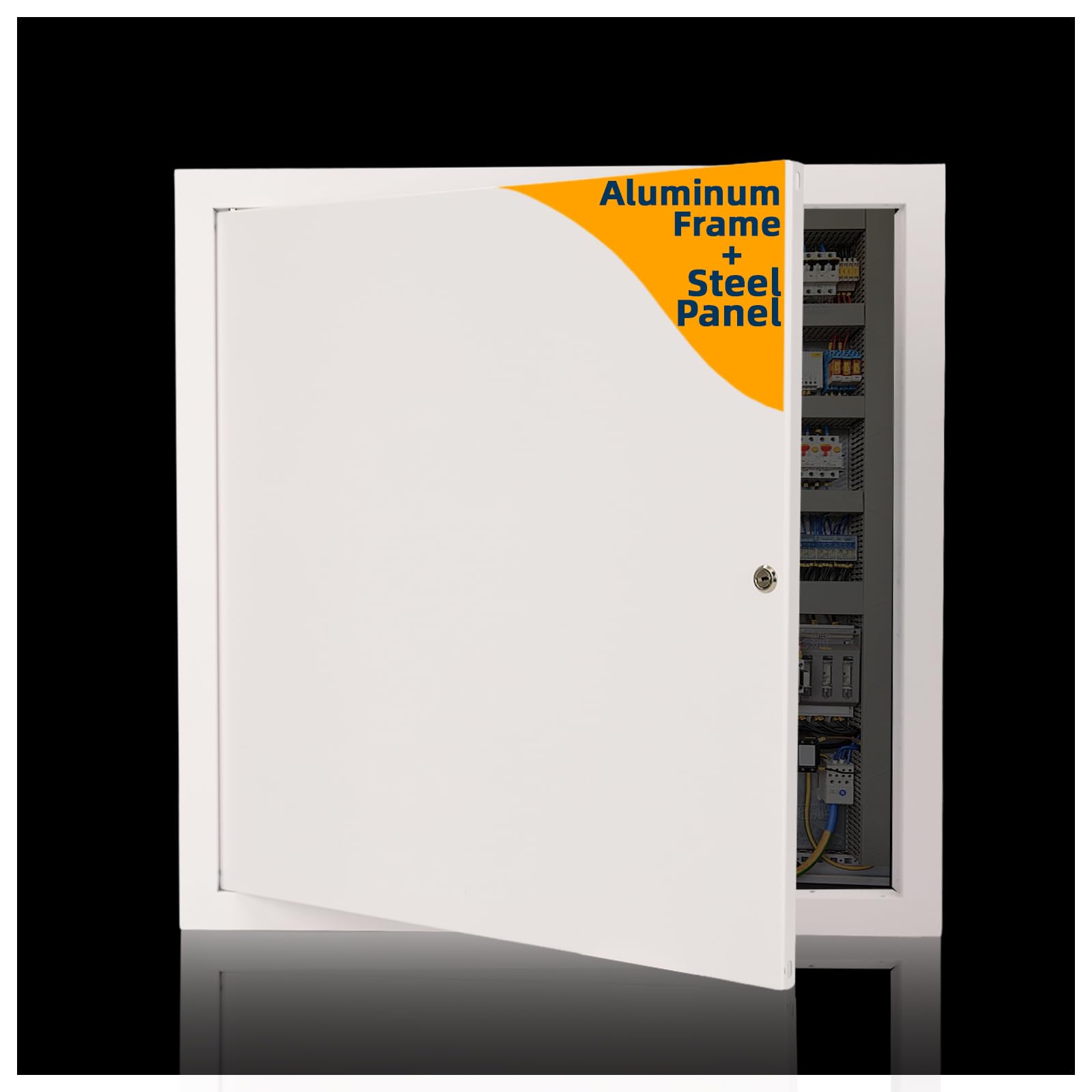
Here is the panel for the job where access needs to be controlled. It carries a key lock built into the door, so the panel cannot be nudged open by a child, a pet, or a curious hand — useful for a wall covering a water shut-off valve or an electrical junction box in a busy hallway or a home theatre setting. The frame is welded from rust-resistant, water-resistant aluminum, and the smooth paintable door face is galvanized steel with a white powder-coated finish, so it blends into drywall or ceiling without shouting for attention.
The numbers to hold onto are the fit spec: it is sized for an 18″W x 18″H wall hole or ceiling opening, and its overall dimensions are 19.5″ x 19.5″. That 1.5″ of extra width is the flange that laps your cut and hides any wobbles. It installs surface-mounted or flush-mounted, and the panel weighs 4.5 pounds — enough steel in the hand to feel rigid without being a wrestling match overhead.
The pattern that comes through loudest is how cleanly it drops into familiar jobs. People use it for home theatre cable access, attic entryways, and valve covers, and the general verdict is that it is easy to install and sturdy. Two owners get specific about getting it right: measure the actual opening, because drywall patching may be needed if your hole is oversized, and take a hard look at the door on arrival, since the metal can arrive with a corner bent from the factory. Inspect it before you cut anything.
what separates it: that built-in lock is the reason to pick this over the cheaper metal panels here — no key, no accidental opening.
Reach for this if: you need a metal panel with a lockable door over a valve or junction box in a household with kids or pets.
Look elsewhere if: you want the simplest open up-free access — the plain Acudor or Premier panels skip the key entirely.
8. Acudor UF-5500 Z91818SCWH Metal Access Door 18 x 18

A metal door built for surfaces you cannot easily cut twice — tile, plaster, and masonry.
This Acudor is the panel for the walls you would rather not disturb. It installs in most flat surfaces — drywall, but also plaster, tile, and masonry — which is a real advantage if you have already finished a tiled shower surround and do not want to re-tile it. The one-piece trim flange is the reason: a single continuous edge resists sagging and distorting, so the panel stays flat across a big 18-inch opening instead of dipping in the middle. The hidden-hinge design helps prevent binding, and rounded corners stay safe on a hard wall edge.
In the hand it feels like the heaviest panel in this lineup, and that is deliberate — at 7.3 pounds there is genuine metal where the cheaper plastic panels have thin molding. Owners reach for it for the same reason: covering a wall over a water main in a redone closet, following a washer-faucet replacement, or finishing a project in one clean move. It is built for the surfaces that punish a soft or flimsy panel, and it looks good when it is finally set.
The honest notes come down to shipping and the lock. Owners mention that the corners can arrive bent from poor packaging — the fix is a few minutes with a pair of pliers, and the panel straightens back easily. And a few mention that their unit did not come with a key, or came with the lock missing entirely; if a key matters to you, verify the hardware is in the box before you commit. Neither issue touches the door’s core job, which it performs well.
Built for hard surfaces: the one-piece flange and heavier gauge are what let this panel sit flush over tile and masonry where a light plastic panel would rock.
Watch the delivery: corners occasionally arrive bent — open the box and check before the return window closes.
Good match for: tiled or plastered walls and ceilings where you need a rigid metal panel and cannot easily cut the opening a second time.
Not the one for: a budget ceiling cover — its 7.3-pound build and price put it toward the heavy-duty end of this list.
9. Premier FL-5000 Flush Access Panel 18×18 Steel

The commercial-grade door you install once and forget for the next twenty years.
If the access panel is going somewhere that gets opened for maintenance over and over, this is the panel that stops the cycle of replacing it. It is built from 16-gauge galvanized steel — genuinely thick metal, not a folded sheet — finished in a white prime coat that you can leave or paint. The door closes on a screwdriver latch, so anyone with a flat tool can open it and no one without one can nudge it loose. The continuous concealed hinge opens to 110° and stays smooth across years of use.
Installation is clean in a way that matters on a finished wall. It mounts to drywall, plaster, tile, or masonry, and the 18″ x 18″ size carries a 7/8″ flange and a 1-3/8″ deep mounting frame — that depth is what lets it sit flush rather than proud. It arrives as a complete kit with the mounting components included. In practice, owners describe framing an opening to suit, screwing the frame to the framing, and watching the flange lap over the drywall cut for a clean edge.
Two honest notes. The screwdriver latch is a deliberate design choice, not a flaw, but it does mean tool-free opening is off the table — if you want snap-open convenience, the Acudor PA-1818 is the easier panel. And the fit spec deserves a careful read: the opening sits slightly wider than some buyers expected, which is the kind of thing to verify against your framing before you cut. On a wall that has to look factory-finished and open reliably, though, this is the panel to beat.
Where the money goes
- 16-gauge galvanized steel frame and door built for commercial-grade use.
- Continuous concealed hinge opening to 110° for smooth long-term access.
- 7/8″ flange and 1-3/8″ deep mounting frame deliver a true flush fit.
- White prime coat you can paint to match any interior.
Plan on this
- Screwdriver latch means no fast, tool-free opening — bring a flat tool every time.
- Verify the opening size against your framing; it runs slightly wider than some buyers expect.
Go with this for: a finished wall or ceiling that needs to look built-in and will be opened for maintenance over many years.
Not the easiest budget pick: the heavier steel, screwdriver latch, and higher-grade build mean it is the most serious panel here — pick it if durability outranks convenience.
Understanding the Specs
Cutout size vs overall size
The most common mistake with any 18×18 panel is buying to the outer dimensions instead of the cutout. The hole you cut in the wall should match the panel’s stated cutout — for the BOZZON that is 18″ x 18″, even though the panel measures 20.25″ x 20.25″ overall because the flange needs the extra width. Other panels swing the other way: the Joogto metal door is sold as 18×18 but wants a 17.5″ x 17.5″ hole. Measure your opening, then match it to the cutout spec, not the title.
Frame material and why it matters
Plastic panels — polystyrene, ABS, or high-impact styrene — are the light and budget-friendly tier. They install fast, paint easily, and are fine for low-traffic closets and ceilings. Move up to galvanized, galvannealed, or 16-gauge steel and you get a frame that will not bow across an 18-inch span and a latch or hinge that will not go brittle under repeated opening. That is why the panels built for utility areas, garages, and commercial rooms tend to be metal.
FAQ
Will an 18×18 access panel cover an 18-inch hole exactly?
Can I install an 18×18 access panel in a ceiling instead of a wall?
What is the difference between a hinged and a removable access panel door?
Should I choose a plastic or a metal access panel for an exterior wall or garage?
How much does a typical 18×18 access panel weigh?
Can I paint an 18×18 access panel to match my wall?
How do I stop an access panel door from sagging or not staying closed?
Is it safe to install an access panel near a shower valve or water shut-off?
How do I size an access panel to fit a hole left over from a drywall repair?
Do steel 18×18 access panels rust in bathrooms or basements?
Final Thoughts: The Verdict
For most rooms, the 18×18 access panel winner is the BOZZON Access Panel, because the 7 mm foil-backed insulation and the 180° removable hinge make it the strongest all-around pick — the thing buyers praise most is its build quality, and the function follows right behind. If you want a light, paintable panel for a ceiling hole and want to save money, reach for the Fengze Access Panel — it covers the same size opening in a lighter, paintable form. And for a garage or attic where the panel will get real use, the Premier FL-5000 is the one to reach for, since 16-gauge galvanized steel and a concealed hinge are built to outlast a plastic door by years. Start with the BOZZON: it is the highest-rated panel here at 4.7 stars across 400+ ratings.
How We Picked
We do not accept paid placement. Every pick is matched to a real buyer and a real use-case; we do not hands-on test units.
Sources & Methodology
Specifications: manufacturer listings and product documentation. Review insights: verified customer reviews, as of September 2026. Pricing: not shown on this page (it changes often); check the current price via the retailer link.
As an Amazon Associate, KitchPrep earns from qualifying purchases. This does not affect which products we feature.
Related Guides
