
Specs are compiled from manufacturer listings and verified buyer reviews and can change over time — please confirm the key details on the product page before buying.
If you already own an 18V drill or impact driver, the smartest blower you can buy is the one that runs on the batteries already sitting in your garage. The catch is that “18V compact blower” covers everything from a 180 MPH handheld to a 450 CFM jobsite air broom, and the spec sheet rarely tells you which one actually fits your porch, your truck bed, or your workshop floor. This guide breaks down the battery-platform compatibility, airflow numbers in CFM (cubic feet per minute — a measure of how much air volume moves per minute) and MPH (miles per hour — the speed that air exits the nozzle), and the real trade-offs owners live with daily so you can pick the right one the first time.
I’m Mohammad Maruf — the founder and writer behind KitchPrep. This guide is built by comparing the manufacturers’ published specifications and the patterns across verified customer reviews, so you get each pick’s real strengths and trade-offs instead of marketing spin.
Whether you’re clearing sawdust from a garage or chasing wet leaves off a walkway, the right tool depends on matching air volume, weight, and battery fit to your actual jobs. This breakdown of the best 18v compact jobsite blower picks covers nine real options so you can choose with confidence.
Our Picks at a Glance


How To Choose The Best 18V Compact Jobsite Blower
The single biggest decision with any 18V compact blower isn’t the brand name — it’s the battery platform you’re already invested in. An 18V cordless blower runs on a rechargeable lithium-ion pack, and every major brand uses a different battery shape and connector. Buy the wrong platform and you’re paying for a battery and charger you don’t need. Buy the right one and you’re running a bare tool on packs you already own.
Match the platform first, then the numbers
A “bare tool” ships with no battery and no charger, so it only makes sense if you already own compatible packs. If you’re on Makita 18V batteries, look for a blower built for that system. On Milwaukee M18, same logic. On Ryobi ONE+, Bosch 18V, or Metabo HPT 18V, the same rule applies. The HEINPRO blowers in this guide are built specifically to slot into Makita or Milwaukee packs respectively, while the Makita DUB185Z, Bosch GBL18V-450N, Ryobi RY18BLCXA-0, and Metabo HPT RB18DCQ4 all run on their own brand’s 18V line.
CFM, MPH, and what you actually feel
CFM (cubic feet per minute) measures air volume — how much air the blower moves. MPH (miles per hour) measures air speed — how fast it exits the nozzle. High CFM moves big, loose piles of dry leaves. High MPH dislodges stuck debris from cracks and crevices. A jobsite blower that lists 500 CFM and 150 MPH moves more physical air than one rated 124 CFM and 213 MPH, even though the second one is faster. Match the number to the job.
Runtime is a battery decision, not a blower decision
Two owners with the same blower can get wildly different runtimes based on which pack they slot in. A small 2.0Ah pack on high speed might be gone in minutes. A 4Ah pack gets noticeably further, and large 8Ah packs go longer still. That’s why the Makita-compatible HEINPRO’s real-world note about draining a 4Ah pack in 35-40 minutes on high is worth knowing before you buy — it tells you the pack you need, not a flaw in the tool.
Quick Comparison
| Model | Best For | Air Volume (CFM) | Max Speed (MPH) | Weight | Amazon |
|---|---|---|---|---|---|
| RIDGID 18V R8604301B★ Best Overall | RIDGID owners wanting a yard-capable tool | — | 105 MPH | 7.4 lb | Amazon |
| HEINPRO (Makita 18V)Top Performer | Makita owners wanting the best power-to-weight | 500 CFM | 150 MPH | 4.3 lb | Amazon |
| YAWV (Milwaukee M18)Most Versatile | Milwaukee owners who want blower + vacuum + inflator | — | 180 MPH | 1.66 kg | Amazon |
| Makita DUB185Z | Makita 18V owners cleaning patios and garages | — | 18000 rpm | 570 g | Amazon |
| Metabo HPT RB18DCQ4 | Shop and garage dust with MultiVolt flexibility | 124 CFM | 213 MPH | 2.6 lb | Amazon |
| Ryobi RY18BLCXA-0 | ONE+ owners wanting the lightest compact compact tool | — | — | 1.1 kg | Amazon |
| Bosch GBL18V-450N | Bosch 18V owners tackling heavy debris | 450 CFM | 112 MPH | 8.4 lb | Amazon |
| HEINPRO (Milwaukee M18) | Milwaukee owners needing 2-in-1 versatility | 500 CFM | 150 MPH | 4.3 lb | Amazon |
| Ryobi P755K Kit | First-time buyers who need battery and charger included | — | 160 MPH | 3.2 lb | Amazon |
In‑Depth Reviews
1. RIDGID 18V Cordless 105 MPH Jobsite Handheld Blower R8604301B
Our pick — 4.5★ from 400+ verified ratings; the strongest balance of quality and price.
The Ridgid-pack veteran that turns your existing orange batteries into a year-round jobsite and snow tool
The reason RIDGID’s R8604301B is the top pick here isn’t a flashy spec — it’s that the tool plays well with the batteries RIDGID owners already carry. It runs on 18V RIDGID packs that also drive your drill and impact driver, and it’s built for the kind of mixed work that rarely makes it onto a spec sheet: snow off a car hood in January, sawdust off a bench in March, leaves off a porch in October. What wins people over is pure performance — that’s the aspect owners praise most, especially for a handheld this size.
Buyers report half-day-plus runtime on a full charge. RIDGID’s own customers note it runs on existing RIDGID batteries and chargers, with runtime that stretches to a half-day or more and a fast charge that tops packs back up in about 15 minutes. That combination — half-day runtime plus fast turnaround — is exactly what separates a jobsite blower from a weekend-only tool. The 7.4-pound body is heavier than most competitors listed here, and for a handheld, that weight is real after a few minutes of one-handed overhead work. It’s the trade for a blower that shrugs off snow, workshop debris, and light yard work.
The honest catch owners surface: the airflow is diffuse and wide at full trigger, which makes it harder to control in tight spots. That’s a real limitation for detail work — you’ll want to feather the trigger rather than pin it. Battery and charger sell separately, and this model isn’t eligible for RIDGID’s Lifetime Service Agreement, so plan on the packs you already own. Note that it also carries only a 30-day limited warranty, which is shorter than the Ryobi ONE+ kit’s coverage further down this list.
What earns it the top spot
- Existing RIDGID 18V batteries run it — no extra pack purchase required
- Half-day-plus runtime on a full charge, with a fast charge that gets packs back in about 15 minutes
- 105 MPH is enough for snow, sawdust, porch clutter, and light leaf work
- Compact handheld form factor with a 19.8″L x 8.1″W x 12.4″H envelope that stashes on a shelf
Where it asks for patience
- 7.4 pounds is the heaviest in this lineup — noticeable on long one-handed jobs
- Airflow runs wide at full trigger, so tight, precise cleanups take more control
- Bare tool only, with a 30-day limited warranty
Reach for this if: you’re already on the RIDGID 18V platform and want one blower that handles snow, shop dust, and quick porch cleanups without buying another battery system.
Think twice if: you need featherlight one-handed control for long stretches — the Makita-compatible HEINPRO below shaves more than three pounds off the RIDGID’s carry weight.
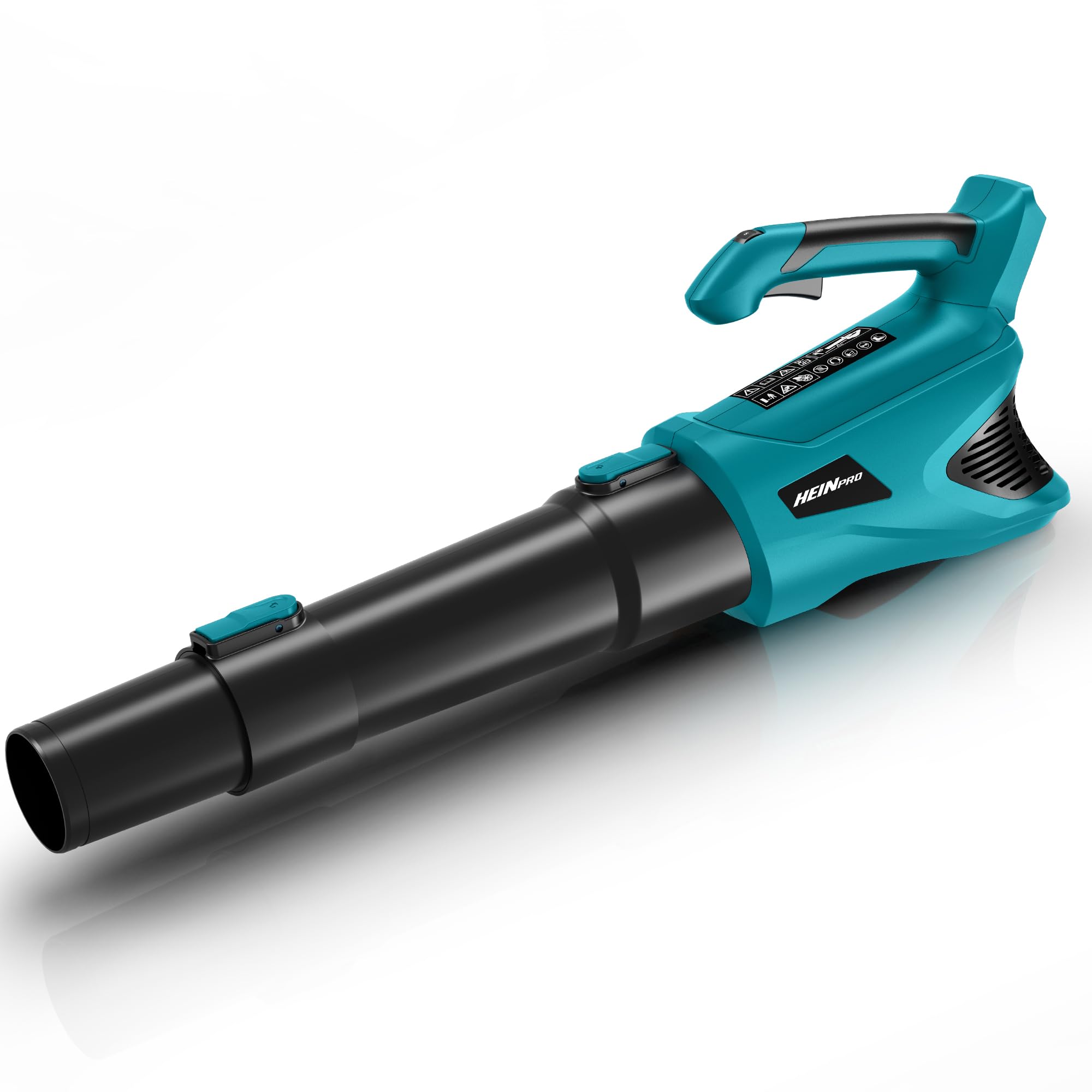
2. HEINPRO Cordless Leaf Blower Compatible with Makita 18V Battery
The Makita-battery bargain that hits 500 CFM at just 4.3 pounds
Here’s the number that matters if you’re on the Makita 18V platform: 500 CFM. That’s air volume — the raw quantity of air the HEINPRO pushes per minute — and it’s the top figure in this guide. Matched to a 150 MPH top speed, the airflow is strong enough that owners describe it clearing wet leaves and debris in a single pass. And it does all that at 4.3 pounds, backed by a rubber-wrapped non-slip handle and a bottom hook hole for hanging on a workshop pegboard.
The 31.8-inch length is where this blower’s character really lives. Compare that to the YAWV blower further down this list, which lists a 1″L x 1″W x 1″H dimension — a numeric snapshot that effectively reflects a fully collapsed or listing-side package measurement, but the point stands: the HEINPRO is a genuinely lengthened tool with a real nozzle reach that helps you clear debris from a comfortable standing distance. At 4.3 pounds against the RIDGID’s 7.4 pounds, this is a meaningfully lighter platform to swing one-handed across a porch or shop floor.
Budget awareness matters here too, and the honest trade is battery drain. Owners mention a 4Ah pack drains in roughly 35-40 minutes on level 5 high speed, so a small pack buys a short session per charge. Level 5 is also where this blower gets aggressive: customers note it moves small rocks and sticks, which means you’ll want to dial back to level 1 or 2 for delicate tasks. The 5-speed thumb wheel is stepless, so the transition between low and high is smooth. Battery and charger sell separately — this is a bare tool aimed squarely at people who already own Makita packs.
Editor’s take on the platform play: For Makita owners, this is the standout value in the lineup. You’re getting the highest CFM and the lightest 4.3-pound carry weight against the price point without needing another battery ecosystem investment.
Where it will frustrate you: the 35-40 minute run on a 4Ah pack when you pin it to level 5. Owners recommend stopping before the pack is fully drained — leave one bar of charge to avoid overheated batteries and extend their lifespan.
Best for: Makita 18V owners who want top-end airflow without buying into a new battery system, and who already carry 4Ah or larger packs.
Look elsewhere if: you need multi-hour runtime on a single small pack — this blower is honest about wanting capacity behind it.
3. YAWV Cordless Leaf Blower for Milwaukee M18 Battery — 2-in-1 Blower & Vacuum with 6 Speeds
One M18 blower that swaps into a vacuum, dust collector, and inflator in seconds
Most compact blowers on this list move air in one direction and stop there. The YAWV does more: it’s a 2-in-1 blower and vacuum that switches between modes at will, and the accessory kit turns it into a dust and pet-hair cleaner, a car blower, and an inflator for camping pads, boat tubes, or pool floats. That flexibility lives on the Milwaukee M18 platform, and the blower reaches up to 180 MPH with a 18000 RPM brushless motor that draws more usable power out of the M18 pack than a brushed equivalent.
The 6-speeds adjustment is where YAWV beats most of the field on control. It spans 70 MPH at the low end and 180 MPH at the top — a wider low-to-high ratio than the HEINPRO Makita’s 5-speed dial or the RIDGID R8604301B’s single trigger ramp — so you can drop into a feather-soft stream for cleaning a keyboard or an air vent, then open it up for driveway debris. The included kit is genuinely full: flexible pipe, dust collection bag, small suction nozzle, large suction nozzle, extension tube, two general tubes, and an inflatable nozzle.
The honest trade is durability along the way. This blower has built-in low-voltage and over-current protection that shuts the tool down automatically when the M18 pack drops too low, which is real protection for expensive red batteries. But YAWV is a brand-new budget entry, and not every unit holds up: the review pages note that one unit developed heavy vibration and serious noise after under an hour of use, likely from loosened fan blades, and gave out completely after about two months of light use. The flexible pipe and suction nozzle are good for delicate tasks, but the tool isn’t built to take jobsite abuse the way the Bosch further down this list is.
The standout feature you won’t find elsewhere: the inflator function — using the same nozzle tube to top off an air mattress or pool float makes this a camp-and-cabin crossover tool, not just a garage blower.
One owner’s honest picture: a 4/5 review calls it “powerful with many attachments” but notes it lacks a variable trigger — speed is set by a dial instead. That means the ramp from low to high is stepped rather than smooth, a real adjustment if you’re used to trigger-based control.
Worth owning if: you’re on the Milwaukee M18 platform and want one tool that does blower, vacuum, dust collector, and inflator duty — especially for cars, campers, and RV trips.
Skip the reach for it if: you need jobsite-marathon durability; the vibration issue that shows up on a small number of units makes it a light-duty tool, not a contractor workhorse.
4. Bosch GBL18V-450N 18V Brushless Cordless Leaf Blower (Bare Tool)
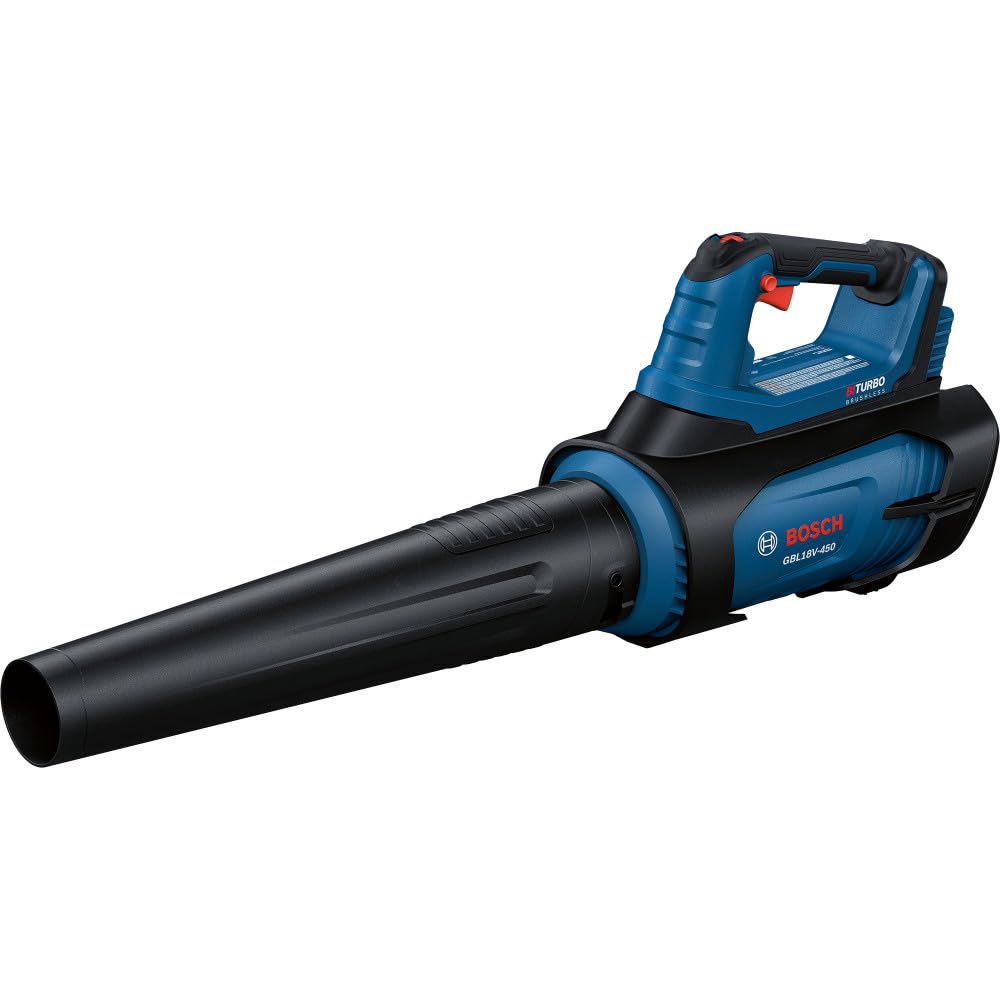
The 450 CFM jobsite air broom built for both wet leaves and contractor jobsites
Bosch’s GBL18V-450N throws 450 CFM of air volume and 112 MPH through a brushless motor, and the two nozzles make the range genuinely useful. The standard nozzle is for wide-area leaf and debris clearing; the tapered nozzle concentrates the airstream for cleaning out cracks and crevices. Bosch built this as a bare tool for people who already own BOSCH 18V Li-Ion batteries — it also slots into the AMPShare system, which Bosch designed for multi-brand compatible batteries and chargers, so it can share packs with a growing list of AMPShare cordless products.
Reviewers point out the 450 CFM rating undersells the tool in real use. What shows up repeatedly is that the 450 CFM number on paper undersells the tool — One owner reports it clears wet leaves and blossoms easily, and that one bar of an 8Ah pack handled a small yard twice plus a 50-foot house frontage and a 25-foot sidewalk. Compared to the previous Bosch GBL18V-71N, the new blower’s jobs come in meaningfully faster, and one buyer says it kept pace with a friend’s Makita blower running a 4Ah pack. That’s the kind of real-world performance a spec sheet won’t tell you.
Now the friction points. This is a 242.78-price-tier tool at 8.4 pounds — the heaviest in the lineup, and the extra weight is felt when you carry it one-handed across a job site. Owners also warn it drains packs fast at full throttle, with recommendations to pair it with 6Ah or larger batteries for real jobs. The bare-tool design means you’ll need matching BOSCH 18V packs already in your kit, and Bosch’s own warranty page is the source for coverage registration details. For a professional using the AMPShare platform, all of that is a fair trade for regular jobsite capability.
Verdict on the upper-tier pick: at 450 CFM it’s the strongest airflow-per-nozzle performer here, and Bosch’s AMPShare compatibility makes it easy to add to an existing pro kit without a battery-system switch. That’s why it lands higher than the cheaper Makita-compatible HEINPRO despite running less raw CFM — it earns its tier on build quality and the multi-brand battery ecosystem.
The weight caveat: 8.4 pounds is a lot of tool in one hand. Owners describe the balance as fine once you’re supported, but the heavy carry is the trade for that heavy power.
Built for: Bosch 18V and AMPShare owners who want to add serious jobsite cleanup power to a thriving battery ecosystem.
Pass on this one if: portability comes before raw power, or you don’t already own BOSCH 18V packs — this is a bare tool with a serious weight commitment behind it.
5. Makita DUB185Z Cordless Handheld Leaf Blower, 18V LXT Li-Ion (Bare Tool)

The featherweight LXT legend that clips on a wall and disappears until you need it
Makita’s DUB185Z is the definitive answer if you’re already on the LXT 18V platform and want a small tool that handles dust, patio cleanups, and garage floors with almost no effort. It weighs 570 grams — roughly 1.26 pounds — which makes it one of the lightest blowers in this entire lineup, and it does all of this in a package measuring 11.02″L x 6.89″W x 8.46″H. The reversible nozzle is a small bonus that punches above its weight: flip it and the same tool inflates or deflates air mattresses and pool toys.
The feature set is simple but well thought through. There are 3 air volume settings — Low, Medium, and High — plus a variable speed trigger for fine control between them. The 18000 RPM brushless motor is quiet enough that owners describe it as suitably gentle for around-the-house tasks, and the whole thing runs on Makita 18V LXT batteries that also power the rest of your Makita kit. A battery protection circuit shuts things down automatically if the pack gets too hot, over-discharges, or hits an overload current, which keeps your LXT batteries healthy.
The bare-tool caveat is worth understanding before buying because the Makita DUB185Z is priced as a bare tool and does not include a battery or charger. The trade-off owners flag is that the power and battery life sit in a mixed-response zone — great for small jobs like patios, driveways, and sawdust cleanup, not powerful enough for heavy outdoor leaf piles or heavy weed-whacking debris. There’s also a small quirk: the air inlet on the side pulls in large leaves and even loose clothing if you hold it too close to the tool.
The one to grab when: you already own Makita LXT 18V batteries and want a compact tool that handles porch dust, garage sawdust, basement debris, and inflating camping air mattresses.
Wrong tool for: a full yard with heavy leaves. The DUB185Z doesn’t pretend to be a 500 CFM machine — it’s a precision cleanup tool, not a leaf vacuum on the heavy end.
Right for you if: lightness and a small storage footprint beat raw air volume, and you’re already invested in Makita’s 18V LXT ecosystem.
Don’t pick this: if you need wet-leaf-mound clearing or heavy yard debris removal — the airflow here is tuned for controlled precision, not yard-wide blasting.
6. Metabo HPT 18V Cordless Compact Blower RB18DCQ4

At 2.6 pounds with 213 MPH, this is the featherweight that punches hardest for its size
Metabo HPT’s RB18DCQ4 is the number-check first: 213 MPH max air velocity paired with 124 CFM air volume, all on a body that weighs 2.6 pounds. That’s the fastest airstream in this entire lineup by MPH, and at 2.6 pounds it’s also one of the lightest. The compact form is what earns the attention — owners mention size more than any other trait when describing why the tool works for them, and combined with the 124 CFM airflow, that airflow-to-weight ratio is why people describe it as more capable than its size suggests.
Runs on Metabo HPT 18V batteries, this blower also accepts the company’s 18V/36V MultiVolt packs for longer runtime — a real flexibility bonus if you’re already invested in that ecosystem. The variable-speed trigger with a thumb-actuated lock-on button is designed to fight hand fatigue during long cleanup sessions, which is the kind of detail that matters when you’re working a garage or a truck bed for 20 minutes straight. Metabo HPT also covers the tool body with a Lifetime Lithium-Ion warranty — the most generous coverage listed in this guide by a wide margin.
The genuine trade is battery life, and it’s worth flagging clearly. Shoppers say the blower drains small packs quickly — one 5/5 review says “Drains the small batteries quick but great for what it is.” Step up to MultiVolt packs for longer runs. There’s also a quirky design detail that shows up in more than one review: the air intake on the left side can snag a bee suit or loose clothing for right-handed users — nothing you can’t work around, but worth knowing if you’ll be moving fast in tight clothing or a full-coverage suit.
What separates it from the field: the balance of 213 MPH top speed against just 2.6 pounds of weight. That combination is why reviews call it “more capable than many reviews suggest” — the tool doesn’t feel like a toy in the hand.
In its element — garages, workshop floors, truck beds, acorns — it’s a standout.
Ideal for: shop and garage owners who want the strongest MPH-per-pound in the lineup and the backing of a lifetime tool warranty.
Not the fit if: your main job is heavy yard cleanup; at 124 CFM the Metabo HPT is a precision tool that wants more airflow than a compact nozzle can throw.
7. Ryobi 18-Volt ONE+ Cordless Compact Workshop Blower Kit with Battery & Charger (P755K)

The one blower on this list that shows up ready to run with battery and charger in the box
Every other pick here assumes you already own the right batteries. The Ryobi P755K kit doesn’t — it arrives with a battery and charger included, which makes it the most plug-and-play option for someone just entering the ONE+ platform or adding a spare blower for a second location. The 3-speed setup tops out at 160 MPH, enough to clear a workshop floor, a truck bed, or a jobsite corner. Ryobi is upfront about the intent: this tool is designed for workshops and jobsites and is not recommended for yard or driveway cleanup. Owners who used it for garages and truck interiors say it does exactly what it claims.
Where it shines in real life is quick turnaround tasks. Buyers report it clears sawdust and light debris off a three-car garage floor in minimal time, and the fast charging keeps downtime short. Its 3.2-pound body sits between the featherweight Makita DUB185Z and the heavier RIDGID, making it comfortable for sustained one-handed work. The compact size earns the most attention among owners — described as just-the-right-size for bench, floor, and trunk-level cleanup.
Be aware of the packaging, which is a real Ryobi quirk on this listing: the kit ships in bulk packaging without retail boxing, so it arrives in a plain shipping box or bag — the tool itself is new. The obvious trade is battery capacity. Owners mention the included pack drains quickly on high speed, and some wish for a larger ONE+ pack for longer sessions. If you already have larger ONE+ packs, drop one in and the runtime improves; if not, plan to add a spare later.
The straightforward purchase: for anyone who doesn’t already own an 18V battery system, this is the single answer in the lineup that doesn’t leave you hunting for a compatible pack and charger.
Trade you should know: the included battery is more of a starter than a marathon pack. If your cleanup runs longer than 15-20 minutes at high speed, budget for a bigger Ryobi ONE+ battery.
Great for: first-time buyers and anyone who wants a ready-to-run workshop and jobsite blower without platform shopping.
Wrong call if: you already own plenty of ONE+ packs and want the higher-performance bare tool — the Ryobi RY18BLCXA-0 below is the better fit there.
8. Ryobi RY18BLCXA-0 18V ONE+ Brushless Compact Blower (Bare Tool)

Ryobi’s lightest and most compact 18V blower, with a rubber-tipped nozzle that coddles paint
Ryobi calls the RY18BLCXA-0 its lightest and most compact leaf blower, and the numbers back it up: it weighs 1.1 kilograms — about 2.4 pounds — and packages down to 16.93″L x 6.3″W x 9.65″H, which makes it easy to stash on a shelf or hang on a wall peg. An HP brushless motor drives the airflow, controlled through a variable-speed trigger with a lock-on setting for long runs. Two rubberized-tip nozzles — a concentrator and an extension — let you customize the length for different tasks, and the rubber tips protect delicate surfaces like car paint.
Owners lean on one specific use case over all others: car drying. The focused airflow and rubber-tipped nozzle make it a natural fit for blowing water off a freshly washed car without scratching paint, and customers note it holds its own against much pricier handheld blowers for that job. The balanced, low-fatigue feel and the trigger lock mean you can work one-handed for longer without hand cramp. Compact patio and small-shop cleanup is the other balance — an apartment patio or a small workshop is where this tool feels most at home.
Two honest limits come through clearly. First, the noise: some owners find this blower very loud on high, which is common for high-airflow compact tools. You’ll want hearing protection for extended work sessions. Second — and this is the one to plan around — the battery life varies widely, with some owners reporting it lasts long enough for quick jobs and others finding it surprisingly short. The right Ryobi ONE+ pack changes everything here, and this is a bare tool, so no battery or charger ships in the box. Plan a 4Ah pack or larger for anything beyond a car wash or small patio.
Editor’s pick for car care: the combination of a brushless motor, variable-speed trigger, and rubber-tipped nozzles makes this the standout pick if you wash cars at home — it beats the cheaper YAWV blower on paint safety because of those rubber nozzle tips.
The honest catch: it’s a bare tool, so the total cost depends heavily on which ONE+ battery you drop in. Small packs sputter, larger packs shine.
Perfect for: ONE+ owners who want the smallest, most nimble blower in their kit — especially for drying cars and small patio or shop cleanups.
Not the one for: zero-setup buyers or anyone expecting big-yard clearing; it’s a compact specialist and asks that you bring your own battery.
9. HEINPRO Cordless Leaf Blower Compatible with Milwaukee M18 Battery
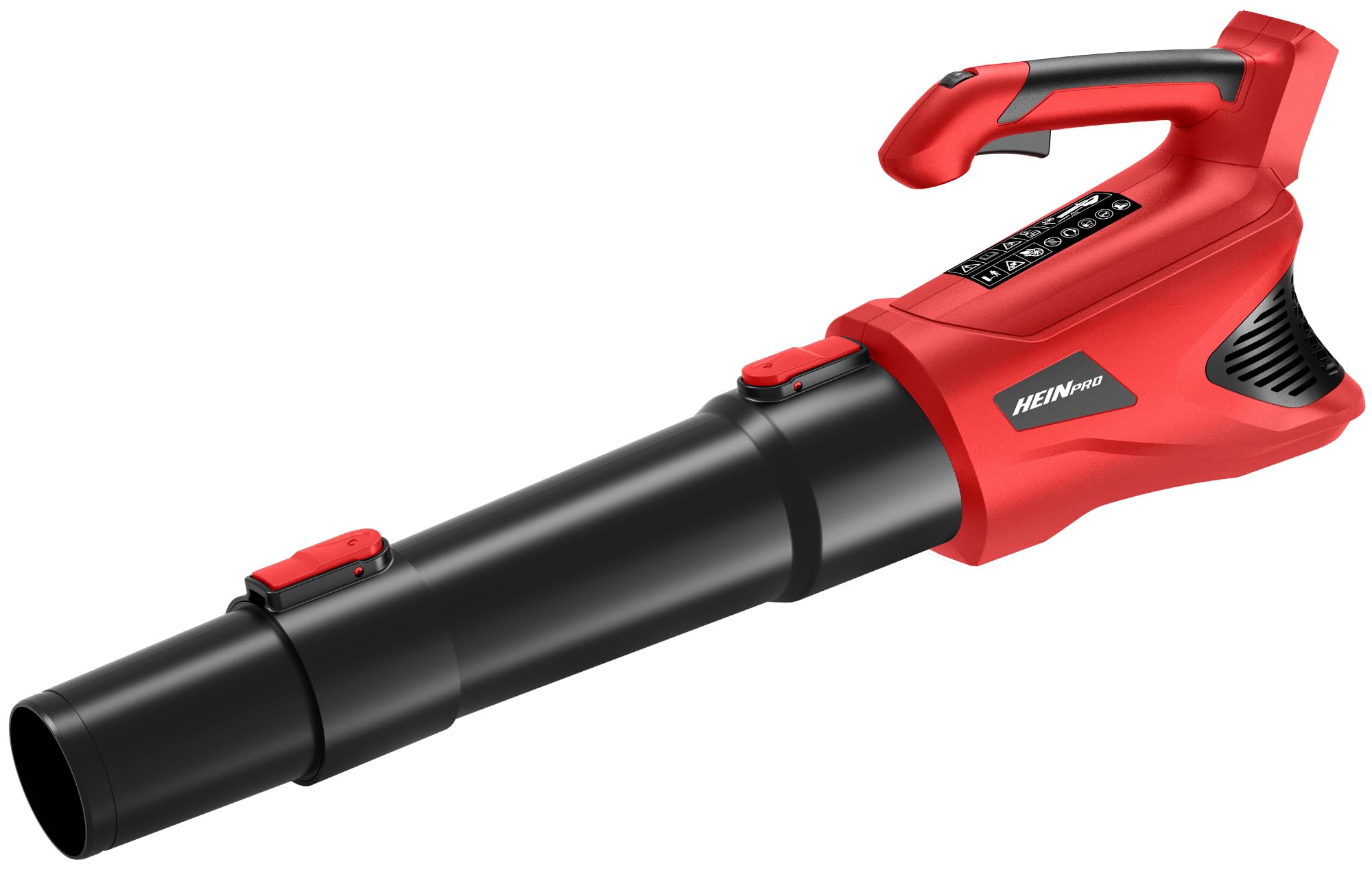
The red-battery twin of the top HEINPRO, returning the same 500 CFM on Milwaukee M18 packs
Same tool, different platform: this HEINPRO runs on Milwaukee M18 batteries instead of Makita, and it holds the same 500 CFM air volume and 150 MPH top speed. The HEINPRO’s upgraded high-power copper motor and large-volume air intake are the reason for those numbers, and the 5-speed mode dial lets you drop to whatever airflow the job calls for — porch, garage, light yard work — without wasting energy on lower-speed tasks. It’s 4.3 pounds, matching the Makita-compatible twin, with the same rubber-wrapped non-slip handle and bottom hook hole for hanging storage.
Owners specifically like it for garages and backyards. The high-power motor is repeatedly described as matching corded-level airflow, and the fit with M18 packs wins people over — the 4.3-pound body is light enough for one-handed leaf clearing and long enough (31.8″L) to reach debris without crouching. A simple storage hook on the back lets it hang on a wall when not in use, and owners note the well-formed plastic build and clean battery fit — no error codes from the pack.
The trade is battery life, and it’s worth hearing clearly. The M18-compatible HEINPRO’s battery life is a mixed-response zone — some owners get strong runtime and some find it surprisingly short depending on which M18 pack they use. Small 2.0Ah packs will get you through a porch; larger 4Ah or 6Ah packs are the right pairing for anything longer. It’s a bare tool, so factor that into your battery supply. If you have Milwaukee M18 packs and want the highest CFM available in the HEINPRO family, this is the version to pick.
Platform pick logic: this is the same 500 CFM HEINPRO chassis on M18 batteries, so if you’re invested in red packs, this beats buying the Makita version and hunting down a separate battery system. It’s practically the same tool, just plug-and-play with your existing M18 charger.
What to plan for: a 4Ah or larger M18 pack, since a small 2.0Ah pack is gone in minutes under load. Buy the tool, use the pack you already have, and step up later if you need longer runtime.
Best for: Milwaukee M18 owners who want the highest airflow in this HEINPRO family and don’t want to buy another battery system.
Look elsewhere if: you need a battery and charger in the box — this is a bare tool, and you’ll need your own M18 packs to use it.
Understanding the Specs
CFM and MPH explained for the jobsite
CFM (cubic feet per minute) measures the volume of air the blower pushes — that’s how much physical air moves in a minute, which is what clears big piles of dry leaves or fills a wide broom pattern across a garage floor. MPH (miles per hour) measures how fast the airstream exits the nozzle — that’s the speed that knocks debris out of cracks, off a truck bed, or away from a fence line. High CFM with modest MPH (like the Bosch GBL18V-450N’s 450 CFM at 112 MPH) is your broad-sweep jobsite broom; high MPH with modest CFM (like the Metabo HPT RB18DCQ4’s 213 MPH at 124 CFM) is your tight-target cleaning tool. Neither number beats the other on its own — match each to the job in front of you.
Battery platform and amp-hours
The battery platform is the physical and electrical system that a tool runs on. Every major brand — Makita 18V, Milwaukee M18, Ryobi ONE+, Bosch 18V, Metabo HPT 18V, RIDGID 18V — uses its own battery shape and connector, so a blower built for Makita packs will not run on Milwaukee packs and vice versa. Amp-hours (Ah) measure how much charge the pack holds — a 2.0Ah pack will drain faster than a 4Ah pack, which drains faster than an 8Ah pack on the same blower and same speed. This is why the same compact blower can give one owner a half-hour session and another a full morning. Buy the platform you own, then match the amp-hour rating to your typical session length.
FAQ
Will a Makita-compatible HEINPRO blower run on my old Makita batteries?
How long does a compact 18V blower actually run on one battery?
Is CFM or MPH more important on a jobsite blower?
Will a Ryobi ONE+ 18V blower work with batteries from my other Ryobi tools?
Are these compact blowers loud enough to need hearing protection?
Can I use a compact blower to dry my car without scratching the paint?
Does a bare tool blower make sense if I already own batteries in that platform?
Are these blowers strong enough to move wet leaves or heavy debris?
How is the Metabo HPT RB18DCQ4 different from the Makita DUB185Z?
Should I get a kit with battery and charger or a bare tool blower?
Final Thoughts: The Verdict
If you want one dependable pick, the best 18v compact jobsite blower winner is the RIDGID 18V Cordless 105 MPH Jobsite Handheld Blower R8604301B because it runs on the RIDGID 18V batteries you likely already own and delivers the half-day-plus runtime and fast 15-minute charge that turn a handheld into a daily tool. If you want the highest airflow per pound in this lineup, grab the Makita-compatible HEINPRO, whose 500 CFM and 4.3-pound body beat the RIDGID on airflow and shave pounds off the carry. And for a first purchase with battery and charger in the box, the Ryobi RY18BLCXA-0 is the one to reach for if you’re entering the ONE+ platform fresh.
Here’s the honest nudge before you click: the batteries you already own are worth more to you than any single specification here. Whichever pick above matches your current platform is the one that ends up in your hand the most.
How We Picked
We do not accept paid placement. Every pick is matched to a real buyer and a real use-case; we do not hands-on test units.
Sources & Methodology
Specifications: manufacturer listings and product documentation. Review insights: verified customer reviews, as of September 2026. Pricing: not shown on this page (it changes often); check the current price via the retailer link.
As an Amazon Associate, KitchPrep earns from qualifying purchases. This does not affect which products we feature.
Related Guides
