
Specs are compiled from manufacturer listings and verified buyer reviews and can change over time — please confirm the key details on the product page before buying.
If you are shopping for an 1800 watt power inverter, the real question isn’t wattage — it’s waveform, efficiency, and battery draw. The most critical choice is between pure sine wave (clean, grid-like power) and modified sine wave (a cheaper, stepped approximation). For motors, microwaves, CPAP machines, or modern electronics, pure sine wave is the only safe choice—modified wave risks buzzing, overheating, and damage.
I’m Mohammad Maruf — the founder and writer behind KitchPrep. This guide is built by comparing the manufacturers’ published specifications and the patterns across verified customer reviews, so you get each pick’s real strengths and trade-offs instead of marketing spin.
If you are shopping for an 1800 watt power inverter, you will get the most reliable performance from a 2200W pure sine wave unit that leaves room for motor start-up surges, while the budget-friendly pick is a 2000W model that owners run daily without complaint.
Our Picks at a Glance


How To Choose The Best 1800 Watt Power Inverter
An inverter is the middleman between your 12V battery and your 120V appliances. It takes the direct current (DC) stored in your battery and converts it into the alternating current (AC) your household devices expect. The three things that decide whether you’ll be happy are the output waveform, the continuous wattage, and the size of your battery bank.
Pure Sine Wave vs Modified Sine Wave
Pure sine wave delivers AC power that matches the utility grid’s smooth waveform. This is the type you need for sensitive electronics, induction motors, and anything with a digital clock or variable speed drive. Modified sine wave suits simple resistive loads like incandescent lights and basic tools, but can cause devices to run hotter, noisier, or fail. Never use a modified wave unit for a refrigerator compressor or CPAP machine.
Continuous Wattage vs Peak Surge
Continuous wattage is the inverter’s sustained output, which must exceed your appliances’ running draw. Peak or surge wattage covers the brief start-up spike motors need, like a fridge compressor’s kick when cycling on. A 2200W continuous/4400W peak unit provides real margin for momentary spikes that a tightly-rated 1800W unit lacks.
Battery Bank Reality Check
The inverter is only half the system. To pull 2000W from a 12V system you are drawing roughly 180 amps from the battery — that is a serious current that demands thick cables and a large battery. A typical 100Ah battery won’t run a 2000W load for long. Most experienced owners pair these units with 200Ah or larger battery banks, and many specifically recommend lithium batteries for sustained, high-draw use.
Quick Comparison
| Model | Best For | Output Waveform | Continuous Power | Weight | Amazon |
|---|---|---|---|---|---|
| GIANDEL 2200W★ Best Overall | Heavy RV loads & hardwired | Pure Sine Wave | 2200W | 10.5 lbs | Amazon |
| Ampeak 2000WQuiet Value Pick | Quiet campsite power | Modified Sine Wave | 2000W | 7.1 lbs | Amazon |
| VOLTWORKS 2000WFast-Charge Pick | Fast USB-C charging | Pure Sine Wave | 2000W | 9.9 lbs | Amazon |
| BESTEK 2000W | Whole-home backup | Pure Sine Wave | 2000W | — | Amazon |
| OLTEANP 2200W | Lithium battery systems | Pure Sine Wave | 2200W | 11 lbs | Amazon |
| BELTTT 2000W | Easy remote monitoring | Pure Sine Wave | 2000W | 7.7 lbs | Amazon |
| ZETAWALE 2000W | Off-grid shop power | Pure Sine Wave | 2000W | 8.2 lbs | Amazon |
| BELTTT 3000W | Heavy continuous loads | Pure Sine Wave | 3000W | 9.9 lbs | Amazon |
| VEVOR 5000W | Whole-home off-grid power | Pure Sine Wave | 5000W | 21 lbs | Amazon |
In‑Depth Reviews
1. GIANDEL Pure Sine Wave Power Inverter 2200Watt
Our pick — over 4.5★ from 450+ verified ratings; the strongest balance of quality and price.
The heavy-duty pick that powers a whole RV — or your house — without breaking a sweat.
This is the one buyers report using as a true house-circuit power source, not just a tailgate toy. Owners describe running a microwave and a soft-start AC unit (at separate times) in an RV, and even feeding house circuits through a transfer switch during outages — with 10 months of flawless service on a solar setup. That flexibility comes from the 20-amp hardwire terminal blocks, which let you wire it directly into your electrical system instead of plugging appliances into the front.
You get 2200W of continuous pure sine wave output, which means the power is clean enough for sensitive electronics like motors and medical devices. The total harmonic distortion (THD — how much the power waves deviate from a perfect grid sine wave; lower is cleaner) sits at just 3%. A 15-foot wired remote with an LED display shows input voltage and output power, so you can mount the unit out of sight and still control it from the driver’s seat.
Reviewers steady the power output claims with a dose of reality: one owner notes it only used 900 watts of its 2200W capacity in their setup, so the full rating depends on your battery cabling. The included pure copper cable is 35mm² (thicker than 2 AWG) and runs 2 feet, but several owners still recommend stepping up to even larger cables for maximum draw. The dedicated cooling fan stays quiet at low loads and the low idle draw of around 6W means you are not wasting battery when nothing is plugged in. It ships with a 3-year warranty — 36 months of coverage that beats most rivals’ 12 or 18.
What wins owners over
- Handles heavy simultaneous loads — microwave, AC, even a 15A table saw with a big battery bank
- ETL listed to UL458, meaning it meets a recognized safety standard for RV and marine use
- Runs cool and nearly silent at light loads
Where to be careful
- Full 2200W output demands a serious battery bank — maker suggests 200Ah or above
- The hardwire terminals mean it’s not truly portable from the start; you’ll want it mounted
Reach for this one if: you’re wiring an RV, boat, or off-grid system and want clean power plus real surge headroom.
Think twice if: you only need occasional tailgate power — the hardwire focus is overkill for simple plug-in use.
2. Ampeak 2000W Power Inverter with Remote Controller
The library-quiet workhorse that keeps running day after day without complaint.
Mobile professionals are the ones singing this unit’s praises — locksmiths report powering drills, grinders, and laptops daily from a van, and truckers say the same about their coffee pots. The brand’s own spec sheet claims 89% conversion efficiency, which means less of your battery’s energy is wasted as heat and more actually reaches your devices. At 7.1 pounds, this is one of the lighter full-size units on the list, so it’s easier to lift into a truck cab or move between vehicles.
The defining trade-off is the waveform. This produces a modified sine wave, not pure sine — the manufacturer says it’s compatible with 99% of equipment on the market, and owners confirm it runs microwaves, coffee makers, and heat guns without issue. But a modified wave isn’t the right match for sensitive electronics or variable-speed motors, so if your load list includes a modern refrigerator or a CPAP machine, scroll up to the pure sine options. The 52dB operating volume is genuinely quiet — “always 5 stars with Ampeak. No noise,” as owners put it.
Safety is covered by 11 built-in protections, including overload, over/under-voltage, short circuit, and over-temperature, so you can run it without constant worry. The included 2 feet of 4AWG battery cable reduces power loss at the connection. Owners running a 12V 100Ah AGM battery report it handles an 1800W heat gun and a 12k BTU AC unit. The smart cooling fan only spins when internal temperature exceeds 122°F, which keeps dust out and noise down during normal use. The vivid orange chassis makes it easy to spot in a dark trunk or garage.
What wins owners over
- 87% of reviewers would buy again — “Haven’t had any problems yet” is the recurring chorus
- Runs real tools daily: a small 2-gallon air compressor filled four flat tires
- Compact 7.1-pound frame is genuinely portable
The honest trade-off
- Modified sine wave — skip it for sensitive medical or variable-speed devices
- Durability gets mixed notes; some owners mention roughly nine months before issues
Grab it for: daily tool power in a work vehicle or quiet campsite operation where cost matters.
Look elsewhere for: clean grid-quality power for sensitive electronics — that demands a pure sine unit.
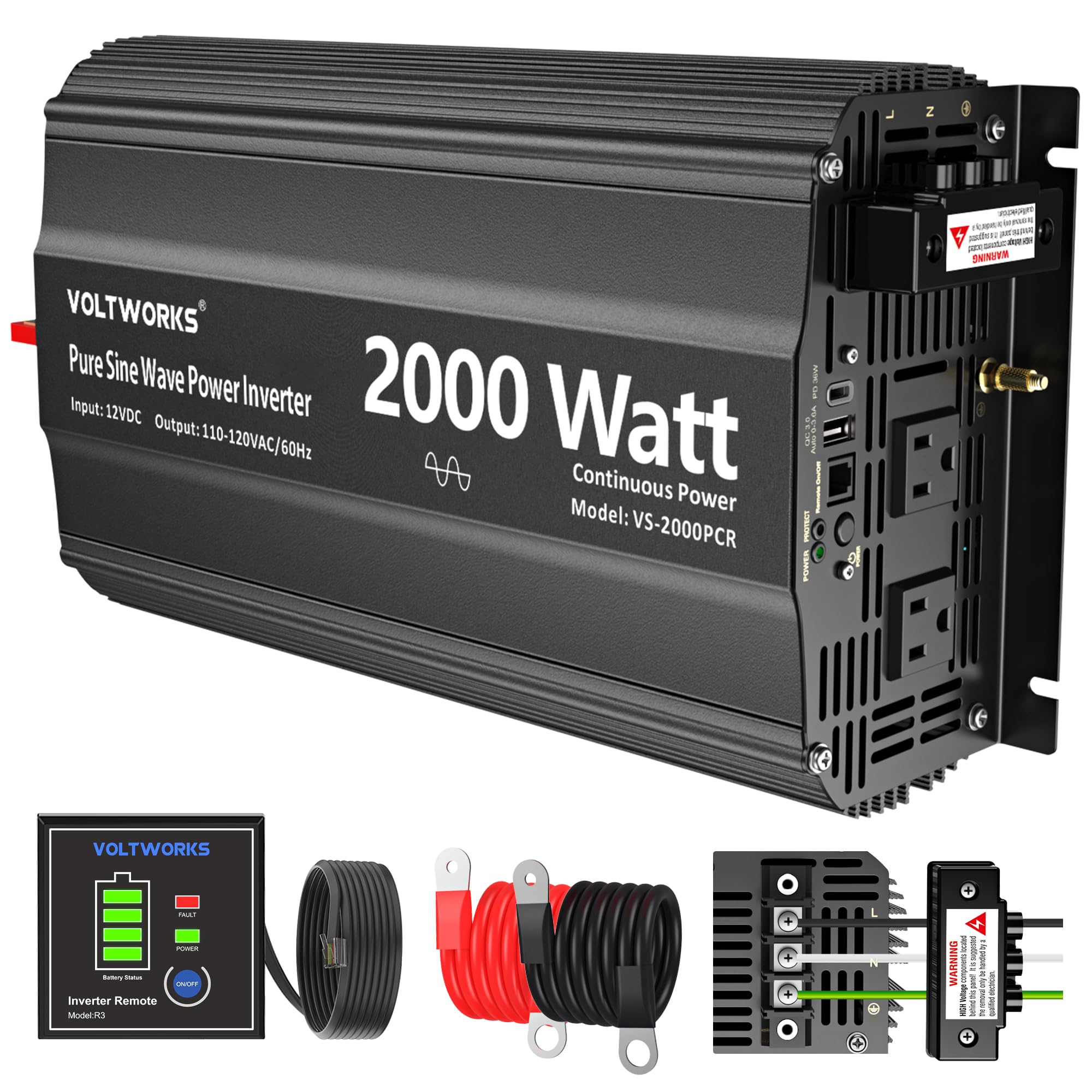
3. VOLTWORKS 2000 Watt Pure Sine Wave Inverter
A pure sine wave converter that charges your phone at 60% speed boost while the AC runs.
The standout spec here isn’t the 2000W continuous power — it’s the upgraded USB array. This unit carries a 3.6A USB-A port and a PD36W USB-C port, with the manufacturer claiming a 60% charging speed increase over ordinary USB ports. For a family in an RV or an off-grid cabin, that means laptops and tablets actually fast-charge while the inverter quietly handles the refrigerator or microwave on the other side.
Off-grid cabin owners are the core audience here. One reviewer replaced a 10-year-old major-brand inverter with this unit and reports it holds 900W at 120V easily, with a fan that runs rarely under light load. The all-metal housing and included 5AWG battery cables — which owners value at roughly on their own — speak to a build that’s meant to be hardwired in and forgotten. It runs pure sine wave at up to 90% conversion efficiency, and the 15-foot remote uses an RJ10 connector you can extend yourself with standard cable.
With the power comes a bonded neutral — meaning the neutral and ground are connected internally — so owners stress you must connect a good ground to earth or your vehicle frame. The idle draw sits around 0.7A, which translates to roughly 24Ah per day if left on, so the smart move is switching it off when unused. The cooling fan is temperature-triggered and only spins once heat reaches 104°F — another reason this unit runs silently at partial load. An 18-month warranty and product liability insurance through AIG back the purchase.
Why it earns its spot
- True 2000W pure sine wave at up to 90% efficiency
- PD36W USB-C port fast-charges modern laptops and tablets
- Comes with quality battery cables and a 15ft extendable remote
What to know first
- Bonded neutral means you MUST connect a proper ground — do not skip it
- An occasional unit arrives defective; the service team replaces it quickly
Best matched for: off-grid cabins and RVs where both heavy AC loads and fast device charging share one box.
Not ideal if: you’re not comfortable wiring a ground connection — that step is non-negotiable here.
4. BESTEK 2000 Watt Pure Sine Wave Power Inverter
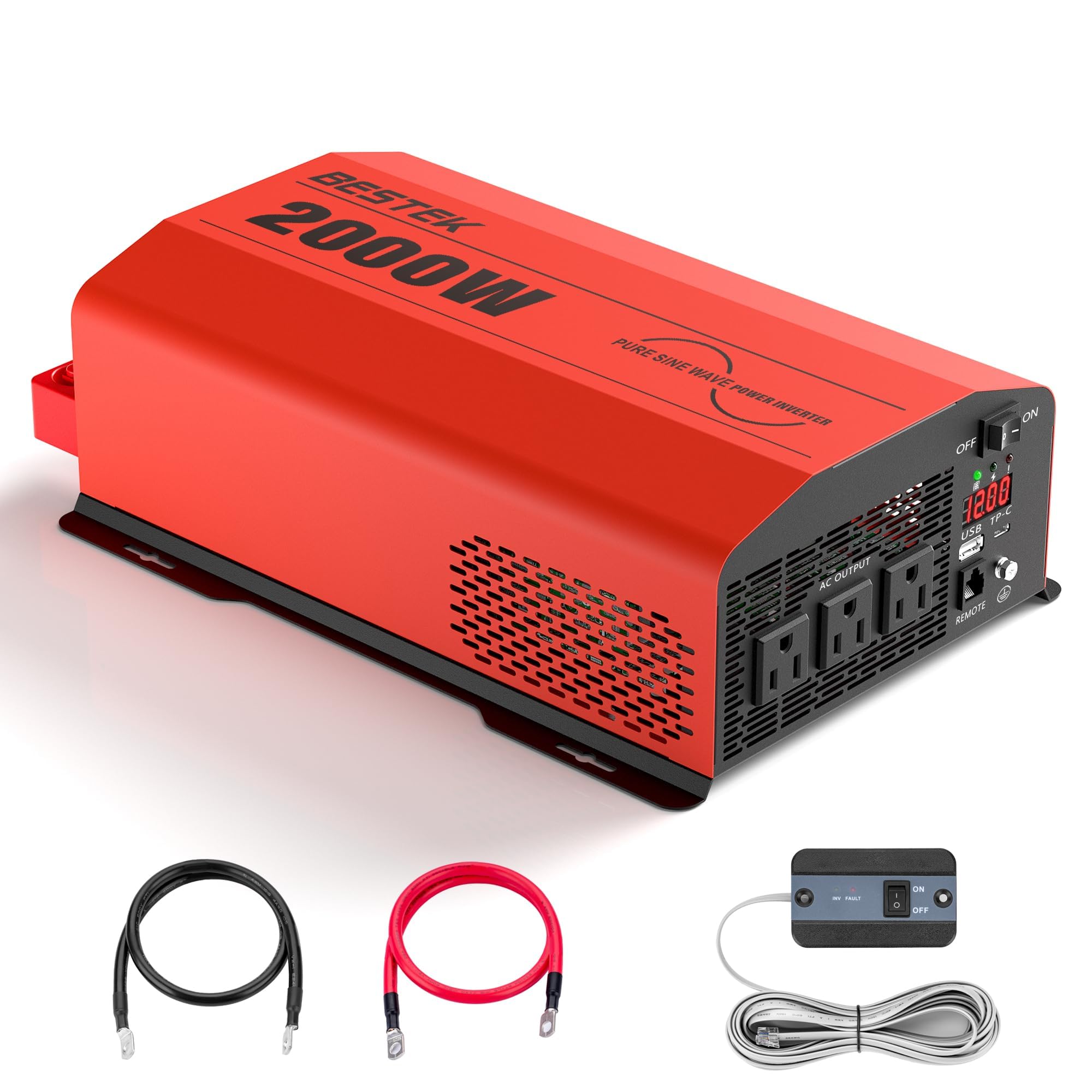
The “beast” owners say can pull 1600 watts straight from an EV battery with zero struggle.
Buyers describe this unit in terms you don’t usually hear for inverters — “turns on like a beast, really powerful and well made” — and one owner reports running their entire home from it. The pure sine wave output at 2000W continuous protects sensitive electronics from the damage that dirty power can cause over time. It’s ETL certified, which means an independent lab has vetted the safety of the design.
The stand-out real-world test came from an owner who pulled a sustained 1600 watts from an electric vehicle’s battery with no struggle at all. That kind of headroom matters because it shows the internal components — the high-speed ventilation fans, the durable metal housing — are actually rated for sustained near-maximum output, not just short bursts. A mobile professional confirmed the build quality of the included 4 AWG cables, calling them genuinely good.
The caveats are minor but real. The LED indicators can be hard to read in direct sunlight, and the included 4 AWG cables are adequate but not ideal for a full 2000W draw — experienced owners recommend sizing up for continuous heavy loads and keeping sustained use around 50% of rated capacity for longevity. The idle draw is roughly 18W (just over 1Ah), so factor that into overnight battery planning. A second unit for a spouse’s car is a common follow-up purchase, a strong signal of satisfaction. The 1-year warranty is shorter than the 3-year coverage on our top pick, so weigh that if you are buying for permanent installation.
What owners rave about
- Proven 1600W sustained draw from an EV battery — real headroom
- Reliability and build quality are the two most-praised aspects
- Compact enough to fit snug in a case for car use
The fine print
- Screen is hard to read in bright sunlight
- Cables included are fine for moderate loads but not full 2000W continuous
Choose it for: a dependable backup that can genuinely run a chunk of your house from a battery or EV.
Consider elsewhere if: you need a longer warranty — this one stops at 12 months.
5. OLTEANP 2200W Pure Sine Wave Inverter with LCD Remote

The blue unit with an adjustable low-voltage cutoff built specifically for lithium batteries.
If you’ve upgraded your battery bank to LiFePO4 — the lithium iron phosphate chemistry favored in modern RVs — this is the inverter that speaks your language. Its key differentiator is an adjustable low-voltage shutdown range of 9.5V to 11V. That matters because lithium batteries hold their voltage high until they’re nearly empty; a fixed cutoff tuned for lead-acid batteries can shut down your inverter while your lithium bank still has plenty of juice left. Being able to dial in the cutoff protects the battery and extends its usable range.
At 2200W continuous and 4400W peak, this unit sits in the same performance class as our top pick, with room for motor start-up surges. One owner tested a 7-1/4″ Skilsaw — which draws roughly 1800W at start-up and 1000W while cutting — and reported the AC voltage held steady at 118-120V under load, with fans rarely spinning and the unit running cool. The 15-foot LCD remote is a real-time monitoring station, showing input voltage, output voltage, load wattage, battery level, and warning alerts for overload, short circuit, or overheat.
Four AC outlets plus USB and Type-C ports let you power a mix of devices at once. Customers note running a 1200W microwave and a 1500W coffee maker simultaneously without issue. At 5 kg (about 11 pounds), it is not the lightest, but the build quality justifies the heft. The main caution from review pages: sustained pulls around 1500W demand a serious battery bank, and a few owners note the fans can spin up more often in hot climates. A 12-month warranty with 24/7 support is shorter than the leaders, so weigh that against the lithium-specific feature set.
Why lithium owners love it
- Adjustable low-voltage cutoff (9.5V–11V) is rare and perfect for LiFePO4 banks
- AC voltage holds steady at 118–120V even under saw load
- Fans stay quiet and rarely spin at moderate loads
Before you buy
- Fan noise gets mixed reviews — some units spin up more than others
- 12-month warranty trails the 36-month coverage on the top pick
Made for: RV and solar owners on lithium batteries who want to squeeze every usable amp-hour.
Pass if: you’re on a standard lead-acid bank and don’t need the adjustable cutoff — simpler units cost less.
6. BELTTT 2000W Pure Sine Wave Inverter, 4000W Surge
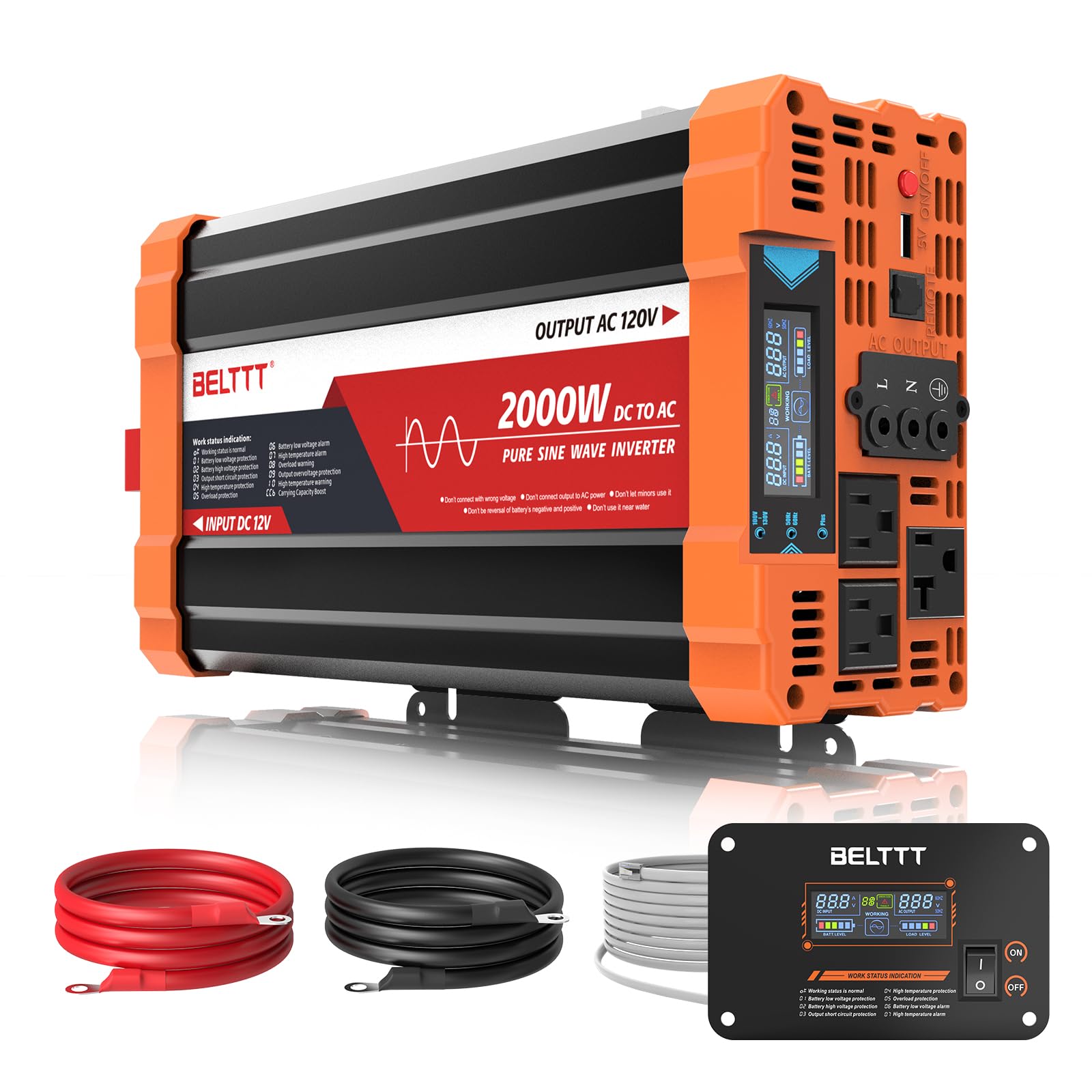
Twenty-three feet of remote cable puts total control of a 2000W system in your hand.
The single most useful feature here is the 23-foot remote controller cable — the longest on this list. That reach means you can mount the inverter deep in a truck bed, boat locker, or RV compartment and still have the control panel and status readout right where you need it. The remote connects via a standard RJ-11 jack, and owners have extended it even further with common telephone cable.
Cooling is where this unit surprises people. Reviewers report the board runs just 24°F above ambient temperature even under load, and the fans are quiet enough that you barely notice them. One owner ran a 10,000 BTU air conditioner for a full hour without issue, and another let it hum along at 1kW for 16 hours straight. The intelligent LCD display shows input and output voltage, battery status, and fault codes simultaneously, and the output voltage itself is adjustable in small increments — a feature that helps match slightly unusual electrical systems.
The build quality has two sides. The unit is UL and ETL listed, and owners who opened it up found soldered board tabs that prevent fire risk from loose connections. But the plastic end caps feel less premium than full-aluminum rivals, and some units ship with undersized 6 AWG cables rather than the 2 AWG advertised — a mismatch several owners flagged and solved by ordering their own thicker cable. It draws zero current when switched off, a genuine battery-saving win. At 7.7 pounds with 93%+ conversion efficiency, it delivers serious power without the bulk.
Standout strengths
- 23-foot remote cable is the longest here — mount it anywhere
- Runs remarkably cool: just 24°F above ambient under load
- Adjustable output voltage and zero draw when off
Where it cuts corners
- Plastic end caps feel cheaper than all-metal rivals
- Some units ship with undersized 6 AWG cables — budget for a replacement pair
Reach for it when: the inverter must live far from where you’ll actually press the buttons.
skip it if: you want a tank-like all-metal chassis — the GIANDEL above feels more armored.
7. ZETAWALE 2000W Pure Sine Wave Inverter with LCD Remote

The full-time off-grid runner that one owner says has been “flawless” for months on end.
Sustained daily operation is where this unit separates itself. Owners describe running it full-time in an off-grid shop with no surges and no complaints, and another built an entire pet power station around a 1500W version of the same design with a 300Ah LiFePo4 battery. The quality score is the most-praised aspect in the review data by a wide margin — buyers consistently describe the build as top-tier and worth the money.
The 14.76-foot wired remote with LCD readout was a pleasant surprise for many owners, showing battery voltage, AC output voltage, and live load wattage at a glance. One RV owner found it drops straight into a travel trailer’s inverter prep, replacing both a previous inverter and a separate transfer switch thanks to a neutral-ground bonding switch that can be turned off for RV use. There’s no need for a separate automatic transfer switch — the hardwire AC terminals handle the connection.
The one recurring complaint is the cooling fan. It’s a two-speed unit that runs louder than some owners expected, even though others say it’s quieter than they feared. The included battery cables are widely described as “worthless” for full-power use — owners uniformly recommend replacing them with quality 2/0 AWG cable for any serious draw. The CE certification (a European safety mark) covers the electronics, but the 12-month warranty is on the shorter side. At 8.2 pounds and roughly 12 inches long, it’s compact enough for tight RV compartments while still delivering a clean 2000W.
What earns its premium spot
- Top-tier build quality — the most-cited praise in its reviews
- Clean sine wave output some owners rate above major generator brands
- Neutral-ground bonding switch suits RV installations perfectly
The honest catches
- Fan can run loud at higher speeds
- Included cables are not up to full 2000W — budget for 2/0 AWG replacements
Pick this for: permanent off-grid installs where the unit runs for months without being touched.
Reconsider if: you’re sensitive to fan noise in a living space — the BELTTT units run quieter.
8. BELTTT 3000W Pure Sine Wave Inverter, 6000W Peak

The step-up that runs an AC refrigerator in a motorhome and air conditioning 24/7 off-grid.
Why include a 3000W unit in a guide built around 1800 watts of power? Because the single biggest cause of inverter disappointment is buying too small. If your real-world load is a microwave (often 1200W), a coffee maker, and a few other appliances, a 2000W unit runs near its ceiling constantly. Owners power a 12,000 BTU mini-split and even an AC refrigerator around the clock.
Performance is the most-mentioned positive aspect by a wide margin, with owners specifically praising the ability to run a 1200W microwave (peaking around 140A draw from the battery) alongside a crock pot. Truckers run it daily for microwaves and coffee makers. The full-featured remote shows system status at a glance, and startup current settles from 2.5A down to 1A quickly, which is gentle on your battery.
The included cabling tells you this unit means business: 1/0AWG battery cables and nine 45A fuses come in the box, along with a 23-foot remote cable. The dual AC sockets plus a 20A outlet and 5V 2.1A USB port cover your plug-in needs, and there’s a hardwire port for permanent installation. Owners do note that a sustained 3000W draw needs a serious battery bank — 200Ah lithium or marine batteries are the realistic minimum, and one owner runs 400Ah without issues. The standby draw sits around 1A, so switch it off when not in use to protect your bank.
Why it earns a premium spot
- Performance is the single most-praised aspect in its reviews
- 1/0AWG cables and nine 45A fuses included — ready to hardwire
- Runs AC appliances 24/7 that smaller units cannot sustain
Before you commit
- Real 3000W output demands a 200Ah+ battery bank — plan the whole system
- Some delivery units arrive with issues; reliability gets mixed notes
Buy it if: your load list includes an AC unit, refrigerator, or multiple kitchen appliances running at once.
Skip if: you’re on a modest 100Ah battery — this unit will outrun your power source.
9. VEVOR Pure Sine Wave Inverter, 5000 Watt
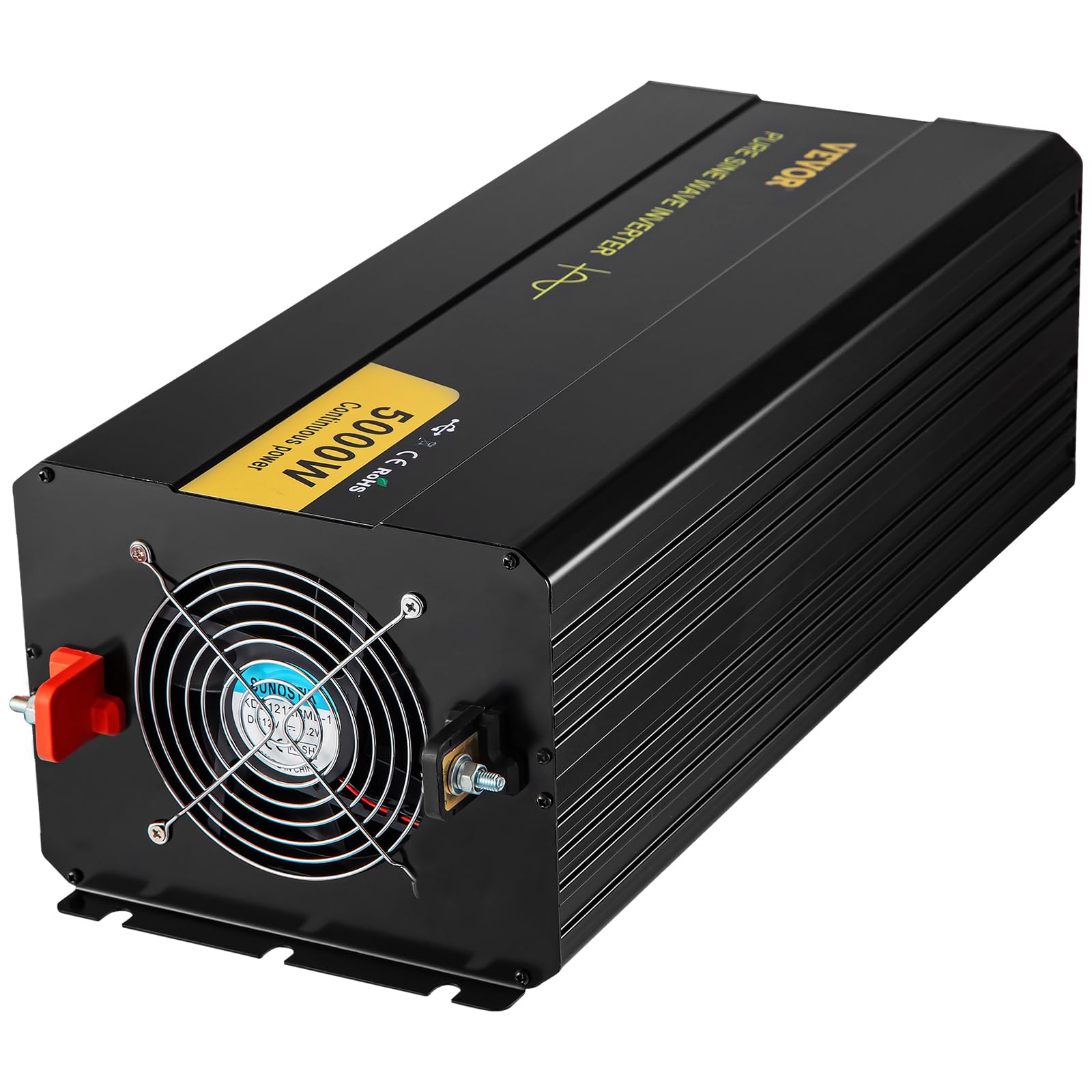
The 21-pound powerhouse that runs a 13,500 BTU AC in brutal heat and powers a whole house.
This is the serious end of the spectrum — a 5000W continuous unit with a 10,000W surge rating that redefines what an “1800 watt power inverter” search can deliver. The real-world proof is dramatic: one owner runs a 13,500 BTU air conditioner through it in hot weather, in a setup where a previous 3000W unit failed above 90°F. Another cut their monthly electric bill by powering the house through a transfer switch with 2200W of solar feeding it, running 24/7 except on cloudy days.
The high-temperature cutoff at 175°F (versus the competition that failed at 90°F) is the engineering story here. The temperature-controlled cooling fan only spins when internal temperature reaches 113°F, and the noise level is rated at just 20-40 dB — quiet enough that one owner reports the fan ran once in three days of use. The LCD display shows input voltage, frequency, output voltage, battery power, and waveform simultaneously, with 12 x 40A fuses and 4 battery cables included in the box.
This unit holds multiple safety certifications — CE, FCC, RoHS, and PSE — and the aluminum alloy shell resists heat, cold, and corrosion. On a 5000W continuous draw at 12V, you’re pulling over 400 amps, which is why the included 4 battery cables and 21-pound frame speak to serious marine or off-grid installations. Owners running oscilloscope tests confirm a clean full sine wave with no noise interference, and one long-time solar user calls it the fix for erratic power that threatened their refrigerator. The realistic caution: at this power level, your battery bank is the real limiting factor, and the no-load current stays under 1A to protect it when idle.
What justifies the jump
- Powers a 13,500 BTU AC unit that killed smaller inverters
- High-temp cutoff at 175°F handles brutal environments
- 4 AC outlets, USB, and a 9.8-foot remote controller included
Serious considerations
- At 21 pounds, this is a permanent installation, not a portable
- Full 5000W draw demands a massive battery and cable system
For the buyer: running a whole home, a big RV, or a workshop off solar or a serious battery bank.
Not for: portable car use — you cannot feed this much power through a 12V accessory socket.
Understanding the Specs
Pure Sine Wave vs Modified Sine Wave
The output waveform is the deepest technical decision you’ll make. Pure sine wave reproduces the smooth, rolling curve of utility grid power, which is what motors, compressors, and sensitive electronics are designed to expect. Modified sine wave is a stepped approximation that works for simple resistive loads — basic tools, lights, heating elements — but can cause buzzing in audio gear, overheating in some motors, and failures in variable-speed appliances. For a microwave, refrigerator, or CPAP machine, pure sine is the only safe call.
Continuous Wattage and Surge Rating
The continuous wattage is what an inverter can supply indefinitely, and it must exceed the running draw of everything you plug in at once. The surge (or peak) rating covers the brief spike that motors draw at start-up — a refrigerator compressor might run at 600W but spike to 1800W when it kicks on. A 2200W unit with a 4400W peak gives you comfortable margin; an 1800W unit running near its ceiling leaves no room for these momentary demands.
Battery Draw and Cable Sizing
Every 100W of AC output pulls roughly 9 amps from a 12V battery. That means a 2000W load is drawing close to 180 amps — a current that demands thick cables (2 AWG or larger) to avoid voltage drop and heat buildup. Your battery bank is the true bottleneck: a typical 100Ah battery can’t sustain heavy draws for long. Experienced owners pair these units with 200Ah or larger banks, and many prefer lithium for sustained high-draw service.
Remote Control and Monitoring
Most full-size inverters include a wired remote that lets you mount the unit out of sight while keeping the controls accessible. Remote cable lengths range from 9.8 feet to 23 feet on the units here. The better remotes add an LCD display showing input voltage, output wattage, and fault codes in real time, which helps you spot an overloading situation before it trips a breaker.
FAQ
Can an 1800 watt power inverter run a refrigerator or microwave?
What is the difference between pure sine wave and modified sine wave inverters?
Will a 2000W inverter work if I searched for 1800 watts of power?
How long will a 2000W inverter run on a 100Ah battery?
What size battery cables do I need for a 2000W inverter?
Is a modified sine wave inverter safe for a CPAP machine?
Why does my inverter shut down when I plug in a power tool?
Can I leave my power inverter turned on when nothing is plugged in?
What is the difference between a 2000W and a 2200W power inverter?
Do I need a special battery for a pure sine wave inverter?
Which is better: a hardwired inverter or one with AC outlets?
Final Thoughts: The Verdict
For most buyers, the winner is the GIANDEL 2200W because it delivers the clean pure sine wave power your appliances demand, with 2200W of continuous output and a 4400W surge that absorbs motor start-ups without flinching — plus a 36-month warranty that beats every rival on this list. If you want the quietest value play for a work truck or campsite, grab the Ampeak 2000W at just 7.1 pounds. And for the buyer running a whole home, a big RV, or a serious off-grid workshop, the VEVOR 5000W is the one to reach for — it powers a 13,500 BTU AC unit that literally killed smaller inverters.
How We Picked
We do not accept paid placement. Every pick is matched to a real buyer and a real use-case; we do not hands-on test units.
Sources & Methodology
Specifications: manufacturer listings and product documentation. Review insights: verified customer reviews, as of September 2026. Pricing: not shown on this page (it changes often); check the current price via the retailer link.
As an Amazon Associate, KitchPrep earns from qualifying purchases. This does not affect which products we feature.
Related Guides
