
Specs are compiled from manufacturer listings and verified buyer reviews and can change over time — please confirm the key details on the product page before buying.
When your driveway is grimy or your car is coated in winter film, you need more than a big PSI number on the box — you need the right combo of spray force and water volume (called cleaning units) to actually lift the dirt. This guide ranks the best 1800 PSI-class electric washers by what real owners say about living with them daily.
I’m Mohammad Maruf — the founder and writer behind KitchPrep. This guide is built by comparing the manufacturers’ published specifications and the patterns across verified customer reviews, so you get each pick’s real strengths and trade-offs instead of marketing spin.
We’ve matched every unit to the exact task it handles best, separating the true 1800 PSI performers from the models that merely print the number on the label. 1800 psi pressure washer options here are ranked on real cleaning power, portability, and honest owner reports of longevity.
Our Picks at a Glance


How To Choose The Best 1800 PSI Pressure Washer
An 1800 PSI electric washer hits the residential balance: it can strip moss off a patio yet stay gentle enough for car paint. The trick is to ignore marketing hype and focus on the physics that actually move dirt — water flow and pressure together.
Understand Cleaning Units, Not Just PSI
Pressure (PSI) is the force of the water, while flow (GPM) is the volume. Multiply them together and you get cleaning units — the true scrubbing power. A machine with 2.0 GPM is nearly twice as fast at rinsing soap off a large surface than one with 1.1 GPM, even when the PSI is identical.
Match Nozzle Angles to the Surface
The quick-connect nozzles are color-coded by spray angle, not just color. A 0-degree nozzle is a laser that can gouge wood, while a 40-degree nozzle is a wide, gentle fan perfect for windows. The turbo nozzle spins the stream for stubborn spots but should never touch a car.
Assess Your Power Source Reality
Every electric washer needs a live outlet nearby. A 35-foot power cord with a GFCI (a safety plug that cuts power if water gets in) gives you room to move, but battery-powered units swap that tether for about 40 minutes of runtime and noticeably softer pressure than a corded motor.
Quick Comparison
| Model | Best For | Pressure (PSI) | Flow (GPM) | Power Source | Amazon |
|---|---|---|---|---|---|
| CAT 1800 PSI★ Best Overall | Fast, high-volume washing | 1800 | 2.0 | Corded Electric | Amazon |
| SENIX HPWE13-LBudget Champion | Entry-level cars and patios | 1700 | 1.2 | AC | Amazon |
| Greenworks 1800Compact Pick | Light-duty value and portability | 1800 | 1.1 | Corded Electric | Amazon |
| Worx WG605 | Onboard storage and DIY use | 1800 | 1.2 | Corded Electric | Amazon |
| Kärcher K1800PS | Rolling mobility and tough grime | 1800 | 1.2 | Electric | Amazon |
| RYOBI RY141802 | Compact home maintenance | 1800 | 1.2 | Corded Electric | Amazon |
| RYOBI RY141820 | Small storage footprint | 1800 | 1.2 | Corded Electric | Amazon |
| RYOBI RY141802 (Reed) | Lighter hose handling | 1800 | 1.2 | Corded Electric | Amazon |
| Ikewzbk Cordless | Portable, hose-free tasks | 1800 | — | Battery Powered | Amazon |
In-Depth Reviews
1. CAT Electric Pressure Washer 1800 PSI
Our pick — over 4★ from 750+ verified ratings; the strongest balance of quality and price.
The high-volume king that finishes driveways before other electrics get the soap rinsed.
Pick this CAT model when speed matters most. While most electric washers trickle out 1.1 or 1.2 gallons per minute (GPM), this one pushes a full 2.0 GPM at 1800 PSI — an 82% flow advantage over the Greenworks above — giving you roughly 3600 cleaning units of rinse power. You feel it washing a long fence or a full-size SUV: suds and grime leave in wide sheets, not thin streaks.
The secret is its patented aluminum 5-piston pump, which The maker claims this 5-piston pump boosts power by 30% and cuts vibration by 30% versus standard 3-piston designs. In plain terms, that means a smoother stream and a unit that sits quieter while it works — owners coming from cheaper electrics consistently note the calm operation. The 20-foot rubber hose uses an M22-15mm fitting, and the brand is explicit that M22-14mm hoses can cause leaks, so stick with the recommended size when you upgrade.
Long-term owners who have run this unit for two full years of car detailing report the 15-amp outlet handles it fine, and the flow stays strong and consistent. The stock attachments are the weak link — the included gun, hose, and foam cannon work but feel basic, and detailers say swapping them for better ones transforms the experience.
The Flow Advantage
- 2.0 GPM rinses large surfaces in record time
- Quiet, low-vibration 5-piston operation
- Compact enough to fit in a car trunk
- 2-year residential warranty on the whole unit
Honest Trade-Offs
- Stock hose, gun, and foam cannon feel basic
- GFCI plug needs a reset each time you plug in
- Not built for stripping paint or heavy stains
Reach for this if: you wash vehicles or large surfaces often and want the fastest rinse of any electric in this class.
Look elsewhere if: you need a machine for industrial-scale grime — you will want a gas model instead.
2. SENIX HPWE13-L 1700 PSI
A low-slung, stable little washer that surprises with genuine punch for the price.
On a tight budget, this SENIX undercuts most rivals while still delivering a real 1700 PSI of cleaning force — and Independent testing shows it peaks at 2100 PSI, a 17% spike over its rating., so it punches above its weight on stubborn grime. Its low, wide stance keeps it from tipping when you yank the hose, a small detail that matters on uneven driveways.
The 13-amp motor pairs with a 20-foot kink-resistant hose and a 35-foot GFCI-protected cord, which gives you a solid 55 feet of reach before you need a new outlet. A total stop system shuts the pump off the moment you release the trigger, which saves energy and extends the pump’s life. The included 15 fl. oz. foam cannon aerates detergent for a thick pre-wash layer, though owners note the cannon’s plastic build is a step below aftermarket units.
Buyers praise the quality for the money, with detailers saying it beats the smaller RYOBI units they used before. The catch is reliability — a few buyers report the motor dying after just a few uses, so treat it as a capable budget tool rather than a lifetime investment. One owner’s unit gave out after three sessions, an experience that sits against the brand’s 3-year limited warranty.
Best value read: this is the entry-level pick for cars, RVs, and patio furniture where the price tag matters more than decades of service life.
Who should pass: anyone planning heavy weekly use — consider spending up for a longer-track record.
3. Greenworks 1800 PSI PWMA Certified
The no-maintenance starter that owners call a phenomenal punch in a tiny frame.
Greenworks built this one for the buyer who wants to wash a car without ever touching a gas can or an oil dipstick. There is no gas, no oil, no spark plug, and no pull cord — just a push-button start and a 20-foot hose, so the whole ritual is plug in, squeeze, and spray. At just 1.1 GPM it has the slowest flow here, but the 1800 PSI makes short work of winter grime on cars, patio furniture, and decks.
Long-time pressure washer users rave that this little unit handles quick jobs with more competence than its size suggests. The included 40-degree nozzle gives a gentle fan for windows and paint, while the turbo nozzle brings the heavy-duty scrub for concrete and moss. A 35-foot power cord with an integrated GFCI safety plug protects you from electrical shock if water splashes the connection.
The honest caveat is durability over time and a wand hose that tends to kink and feels thin in the hand. Owners who push it hard recommend replacing the stock hose with a sturdier one and adding a clip to ease hand fatigue, since you must hold the trigger continuously.
Buy it for: easy light-duty residential cleaning with zero engine maintenance.
Think twice if: you need high water volume to rinse large areas quickly.
4. RYOBI RY141802 1800 PSI

A compact RYOBI workhorse that fits neatly on a shelf and sprays above its size.
This yellow RYOBI earns its place as a favorite among lawn and landscape professionals who need a dependable electric for odds-and-ends jobs around the yard. The 1800 PSI and 1.2 GPM combo delivers what owners describe as more pressure than expected, and the compact 16.7-pound body carries easily from the garage to the fence line. At just 11.88 inches long, it tucks into tight storage spots where a full-frame unit will not fit.
Homeowners use it to wash house siding, sidewalks, vehicles, and even the fence, with consistent reports that it sprays hard enough for everyday residential tasks. Setup is minimal — attach the hose, plug in the cord, and go. The PWMA certification means the pressure and flow numbers were independently verified rather than just printed on a box, which is rare at this tier.
The honest mixed note is reliability: for every owner who calls it a favorite tool, there is another who reports the motor quitting without warning after light use. This makes it a solid value for occasional weekend cleaning, but a gamble if you need it for frequent commercial-style duty. Buyers explicitly warn it is not for commercial purposes.
Why Owners Grab It
- Genuinely compact for shelf storage
- Easy carry and quick setup
- Verified PWMA pressure rating
- More spray force than the size implies
Reliability Reality
- Reports of motors dying suddenly
- Quality feedback runs genuinely mixed
- Light-duty only — not for commercial jobs
Reach for it if: you want a small, verified 1800 PSI washer for home surfaces.
Pass it by if: you need a tool you can depend on weekly for years.
5. Ikewzbk Cordless 1800 MAX PSI
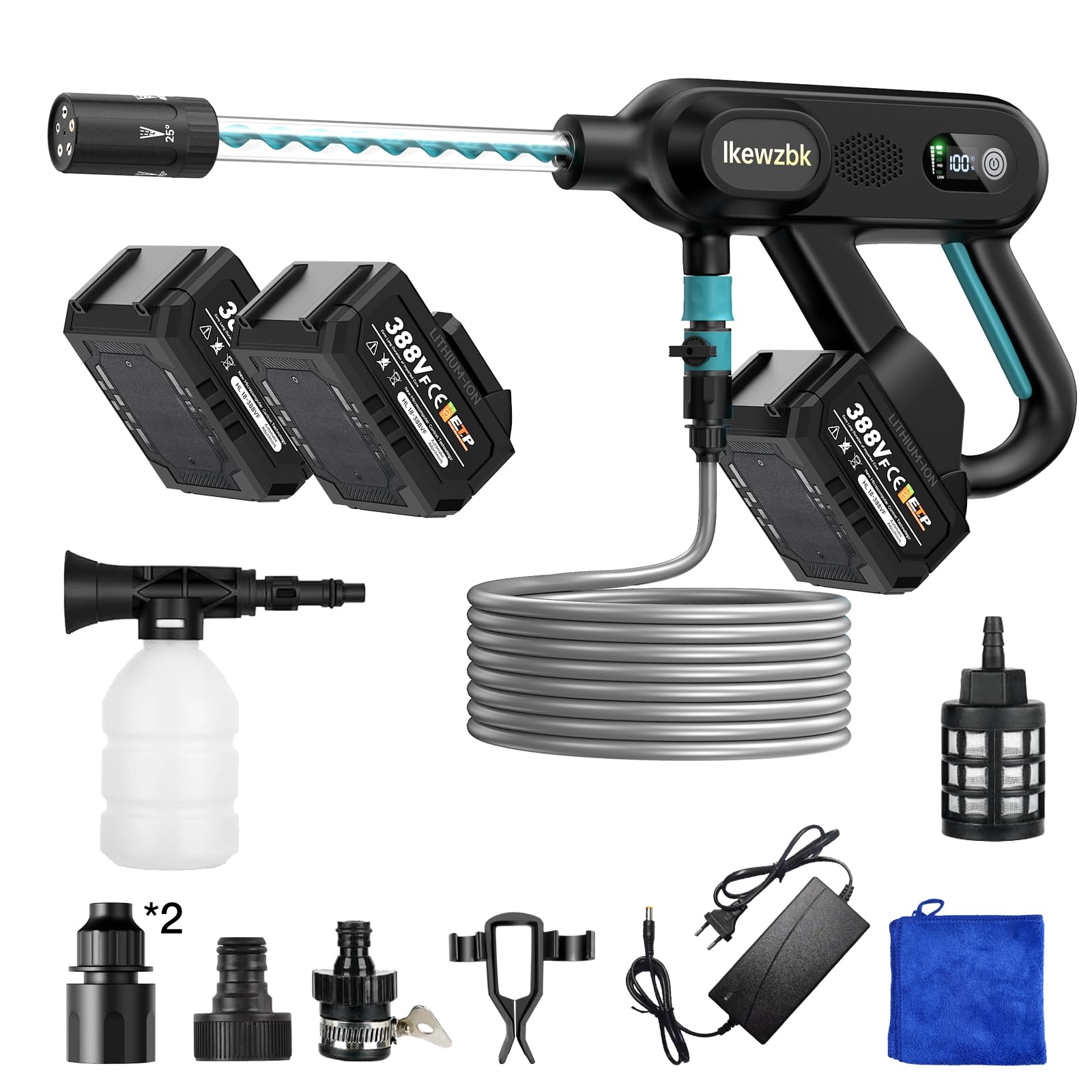
The cord-free freedom machine that washes a full car then packs into a briefcase.
This is the washer for the buyer whose dirt is never near an outlet. The battery-powered Ikewzbk delivers 1800 MAX PSI with no cord and no heavy unit to drag, drawing water from a faucet, bucket, or even a pool through its universal adapter. Owners consistently describe the convenience as the headline feature — a briefcase-style storage case holds the whole kit, and the 20-foot kink-resistant, crush-proof hose reaches where you need it.
A 10-cell rechargeable battery runs up to 40 minutes on a charge, which owners say is enough for a full car wash plus the driveway, and the kit ships with two batteries for quick swaps mid-job. The 5-in-1 adjustable nozzle and three power levels let you dial from a gentle plant-watering mist to a blast that lifts brake dust and mud. The spiral turbo nozzle is the standout attachment for tough grime.
The trade-off is physics: battery power simply cannot match a corded motor’s sustained pressure. A few owners mention the soap dispenser fails to spray foam properly and that the unit needs the water turned off to switch between soap and rinse modes. The maker also warns the built-in battery may enter a low-charge sleep state, so charge it for at least 5 hours right after unboxing.
Cordless verdict: outstanding for mobility and detailing, but temper your expectations on raw pressure versus a wall-powered unit.
The catch: quality control varies — some units arrive missing connectors or with weak batteries.
6. RYOBI RY141820 1800 PSI

The gas-alternative that fits on a shelf yet powers through redwood grime.
This RYOBI exists for the owner who is done wrestling a gas engine to life but still wants genuine cleaning muscle. The 1800 PSI unit pairs with a 1.2 GPM flow, and owners who ran larger gas models before say the convenience compared to gas is nonpareil — no fuel mixing, no pull cord, no winterizing. Delivering the full advertised pressure, it safely cleans house siding, bins, and concrete walks without the surface damage risk of a gas monster.
At just 12.5 inches long and about 9 inches tall, it is among the most storage-friendly units here, slipping onto a garage shelf between uses. Its leak-proof hose connections and trigger handle with M22 fittings (standard threaded connectors) earn steady praise, and the included 15-degree, soap, and turbo nozzles cover everything from wide rinsing to concentrated stain work. Owners say it outperforms larger models they have used and handled a redwood deck without complaint.
The honest notes are about included extras rather than the core unit: the foam cannon and wand feel cheap, and one owner called the unit excellent but underpowered for genuinely tough baked-on dirt. It is ideal for light-to-moderate residential jobs, and the few gripes center on the turbo nozzle’s reliability over time.
Choose this for: a compact, powerful gas alternative for everyday home and car cleaning.
skip it if: you face heavy professional grime — step up to a gas unit.
7. RYOBI RY141802 Green 1800 PSI

The 13-amp green machine whose ultra-flex hose makes dragging it around feel easy.
This green-and-yellow RYOBI focuses on the daily frustration most washers ignore — the stiff, heavy hose that fights you as you work. Its ultra-flex hose is 50% lighter than a standard high-pressure hose., so moving around a car or along a fence line feels genuinely easier on the arms. The 13-amp motor drives 1800 PSI and 1.2 GPM, and the 15-degree and turbo nozzles promise 50% faster cleaning on stubborn spots.
Owners who use it for home and yard maintenance call it a real deal, with one noting they have run it at least a dozen times with zero issues and another praising the value for the money. The spray wand uses a 1/4-inch quick-connect coupler, so swapping nozzles takes seconds, and the compact build stores easily when the job is done. It is purpose-built for car washing and small projects around the house.
The two honest constraints are the hose length — owners call it a bit short for large properties — and a durability question mark, since one owner’s motor seized on the second use. The included soap applicator makes detergent work simple, though buyers warn against expecting commercial longevity from a compact electric.
What Shines
- Ultra-flex hose is 50% lighter to handle
- Quick-connect nozzle swaps in seconds
- Soap applicator for detergent jobs
- Compact and easy to store
Watch Outs
- Hose runs a bit short for big yards
- A rare motor failure reported early on
Best for: homeowners who want a lighter hose and car-focused cleaning without gas hassles.
Not for: buyers needing a long reach or heavy commercial reliability.
8. Worx WG605 1800 PSI

The DIY favorite that cleans a 2500-square-foot home without breaking a sweat or a nozzle.
Worx built this for the weekend warrior who wants everything stored on the machine and ready to go. Its 13-amp motor delivers 1800 PSI (peaking at 1980 PSI max) and 1.2 GPM (up to 1.4 GPM max), and the compact frame packs an onboard soap tank, carry handle, cord-wrap, and nozzle storage. A metal-framed base with rubber feet keeps it planted, and One owner reports it cleaned a 2500-square-foot home exterior in hours with no scrubbing. — a job they said beat their old 4000 PSI gas washer for convenience.
The universal 1/4-inch quick-connect on the spray wand makes nozzle changes tool-free, and the included turbo, 40-degree, and soap nozzles span the cleaning range from delicate to aggressive. Owners praise the quality and ease of use, noting it is particularly suited to auto detailing and light residential jobs. The integrated storage means no hunting for lost nozzles between uses.
The honest friction point is the hoses: the long power cord and 20-foot pressure hose have no onboard wrap, leaving them unruly during storage. A handful of owners also report the wand developing a heavy leak at the connection after the first few uses, which cuts pressure dramatically — so check the fittings before you commit to a big job.
DIY verdict: the best-organized unit for homeowners who value onboard storage and tool-free nozzle changes.
Main caveat: watch the wand connection — a few units leak there after light use.
9. Kärcher K1800PS

The wheeled German workhorse that rolls across any terrain and runs for hours straight.
Kärcher built the K1800PS for the owner who moves the washer a lot. Never-flat wheels and a tall, 24.1-pound frame roll easily across gravel, grass, and patios, saving your back from lugging it between jobs. Its 1800 PSI TruPressure rating is CETA certified — an independent body verified the output, not just the marketing sheet — and the 1.2 GPM flow pairs with three nozzles (15°, turbo, and a wide 65°) for precision across surfaces.
The back-friendly design extends to an on/off foot switch, so you can power up without bending, and the unit auto-stops when you release the trigger to save the pump. A 0.5-gallon detergent tank keeps soap ready for those algae-heavy carports and patios — one owner ran the unit for hours straight across multiple days to clear a mossy surface. The long cord and hose reach, and customers note it cleaned cars, porches, and siding with ease right after a simple five-minute assembly.
The honest notes center on the hose fitting: several reviewers point out it needs filing or lubrication to connect smoothly, and disconnecting under pressure can be difficult. Pressure feedback also runs mixed — plenty of buyers find it powerful, while a few expected more punch than 1800 PSI delivers. One owner measured it at 1875 PSI, outperforming their old 2000 PSI gas unit in real terms.
Why It Rolls Ahead
- CETA-certified 1800 PSI output you can trust
- Never-flat wheels for easy terrain moves
- Foot switch saves your back
- 0.5-gallon onboard detergent tank
Setup Friction
- Hose fitting can need filing or lube
- Hose disconnect is tough under pressure
- Some buyers expected more force
Choose it for: rolling convenience and marathon cleaning sessions on large outdoor areas.
Reconsider if: you want plug-and-go assembly with zero fitting fuss.
Understanding the Specs
PSI vs GPM vs Cleaning Units
PSI (pounds per square inch) is the water’s force, while GPM (gallons per minute) is its volume. Multiply the two and you get cleaning units — the truest measure of how fast a washer blasts dirt away. High PSI with low GPM cleans slowly; balanced numbers clean quickly.
Nozzle Angles Decoded
The numbers on quick-connect nozzles are spray angles: 0° is a pin-point jet for the toughest stains, 15° is a narrow fan for concrete, 40° is a wide, safe fan for cars and windows, and 65° is the gentlest mist for delicate rinsing. Turbo nozzles spin the stream for extra bite but can damage paint, so keep them away from your car’s finish.
Pump Types and Power Sources
Corded electric motors give sustained pressure but need an outlet, while battery units offer mobility with softer output. Standard 3-piston pumps are common, but 5-piston designs like the CAT reduce vibration and run smoother. GFCI plugs cut power instantly if water reaches the connection.
PWMA and CETA Certification
These stamps mean an independent body actually tested the pressure and flow claims rather than trusting the manufacturer. A certified 1800 PSI rating delivers the real advertised force, while uncertified numbers can be optimistic marketing figures that wash weaker in practice.
FAQ
Can an 1800 PSI electric washer clean a concrete driveway?
Is 1800 PSI safe for washing a car?
What does GPM mean and why does it matter?
Do I need a special electrical outlet for these washers?
How long do electric pressure washers typically last?
What is the difference between a 3-piston and 5-piston pump?
Can I use a bucket instead of a garden hose?
Why does my electric washer keep shutting off?
What nozzles come with these washers and what are they for?
Are battery-powered washers as strong as corded ones?
Final Thoughts: The Verdict
Across the board, the 1800 psi pressure washer winner is the CAT Electric Pressure Washer because its 2.0 GPM flow makes rinsing dramatically faster than any 1.1 or 1.2 GPM rival. If you want the budget-friendly entry point with genuine punch, grab the Worx WG605. And for rolling mobility across a large property, the Kärcher K1800PS is the one to reach for with its certified pressure and never-flat wheels.
How We Picked
We do not accept paid placement. Every pick is matched to a real buyer and a real use-case; we do not hands-on test units.
Sources & Methodology
Specifications: manufacturer listings and product documentation. Review insights: verified customer reviews, as of September 2026. Pricing: not shown on this page (it changes often); check the current price via the retailer link.
As an Amazon Associate, KitchPrep earns from qualifying purchases. This does not affect which products we feature.
Related Guides
