
Specs are compiled from manufacturer listings and verified buyer reviews and can change over time — please confirm the key details on the product page before buying.
If your board slides while you chop, warps after a hot rinse, or leaves a puddle of chicken juice on the counter, you are shopping for the wrong board. The fix is simple: an 18 x 12 inch board (about the size of a sheet of paper plus an inch) with the right thickness, the right surface, and the right non-slip base for how you cook. This guide covers nine boards sorted by what they are actually good at, so you can match one to your kitchen in a couple of minutes rather than a couple of weekends.
I’m Mohammad Maruf — the founder and writer behind KitchPrep. This guide is built by comparing the manufacturers’ published specifications and the patterns across verified customer reviews, so you get each pick’s real strengths and trade-offs instead of marketing spin.
One quick note before the picks: not every board on this list is stamped exactly 18 by 12 inches. Some listings offer that size as a selectable option, and a few run a fraction of an inch off in either direction. The nearest same-type size serves the same job at the counter, and each entry below states its own real measurements. This list covers the 18 x 12 cutting board options that hold up best in a working kitchen.
Our Picks at a Glance


How To Choose The Best 18 X 12 Cutting Board
Almost every complaint about cutting boards depends on three things: the board moves, the board warps, or the board holds onto a smell. Pick a board that fights those three problems and you rarely go wrong.
Thickness is your anti-warp insurance
A thicker board takes more heat and pressure before it curls at the edges. A plastic board measured at 3/4 of an inch thick — that is about the width of two stacked pencils — holds its shape far better than a thin sheet. A wood board at 1.25 inches thick is a genuinely heavy slab, which is why it stays flat but also why it is a chore to lift.
Material decides your cleanup routine
High-density polypropylene (HDPP) and high-density polyethylene (HDPE) are both dense food-service plastics — HDPP resists staining and knife scarring slightly better, which is why commercial kitchens stamp it. Composite wood fiber boards and bamboo boards feel like wood on the knife but skip the oiling ritual. A solid maple board is the classic option, and it needs hand washing and regular oil. Check the care line on any listing before you buy, because one dishwasher cycle can ruin a wood board.
Non-slip backing and juice grooves earn their keep
Rubber feet or silicone corner grips keep the board planted so your knife stays where you aim it. A perimeter juice groove — the channel cut around the edge — catches runoff from a roasted chicken or a pile of tomatoes. If you carve meat more than you dice onions, the groove matters more than the grip; if you are a fast chopper, the reverse is true.
Quick Comparison
| Model | Best For | Material | Thickness | Dishwasher Safe | Amazon |
|---|---|---|---|---|---|
| Thick White 18×12 Plastic Restaurant Cutting Board★ Best Overall | Heavy daily prep, NSF kitchens | High Density Polypropylene | 0.75″ | Yes | Amazon |
| Winco 12″ x 18″ White Grooved Cutting BoardBudget Champion | Juicy meat, carving turkey | Plastic (copolymer) | 0.56″ | Yes | Amazon |
| Norpro Professional Cutting BoardMost Versatile | Reversible daily prepping | High Density Polyethylene | 0.5″ | Yes | Amazon |
| CURTA Cutting Board, 18″ x 12″ | Color-coded HACCP prep | Polyethylene (PE) | 0.5″ | Yes | Amazon |
| Belwares Dishwasher Safe Cutting Board, Wood Composite | Plastic-free lightweight prep | Composite Fiber Wood | 0.25″ | Yes | Amazon |
| Belwares Slate Black Composite Board with Juice Groove | Carving with non-slip feet | Composite Fiber Wood | 0.25″ | Yes | Amazon |
| Totally Bamboo Malibu Bamboo Cutting Board | Wood feel without plastic | Bamboo | 0.75″ | No | Amazon |
| San Jamar Saf-T-Grip Cutting Board | Staying planted while carving | Co-Polymer | 0.5″ | Yes | Amazon |
| John Boos Block Prestige Maple Cutting Board | Serving and charcuterie | Maple Wood | 1.25″ | No | Amazon |
In‑Depth Reviews
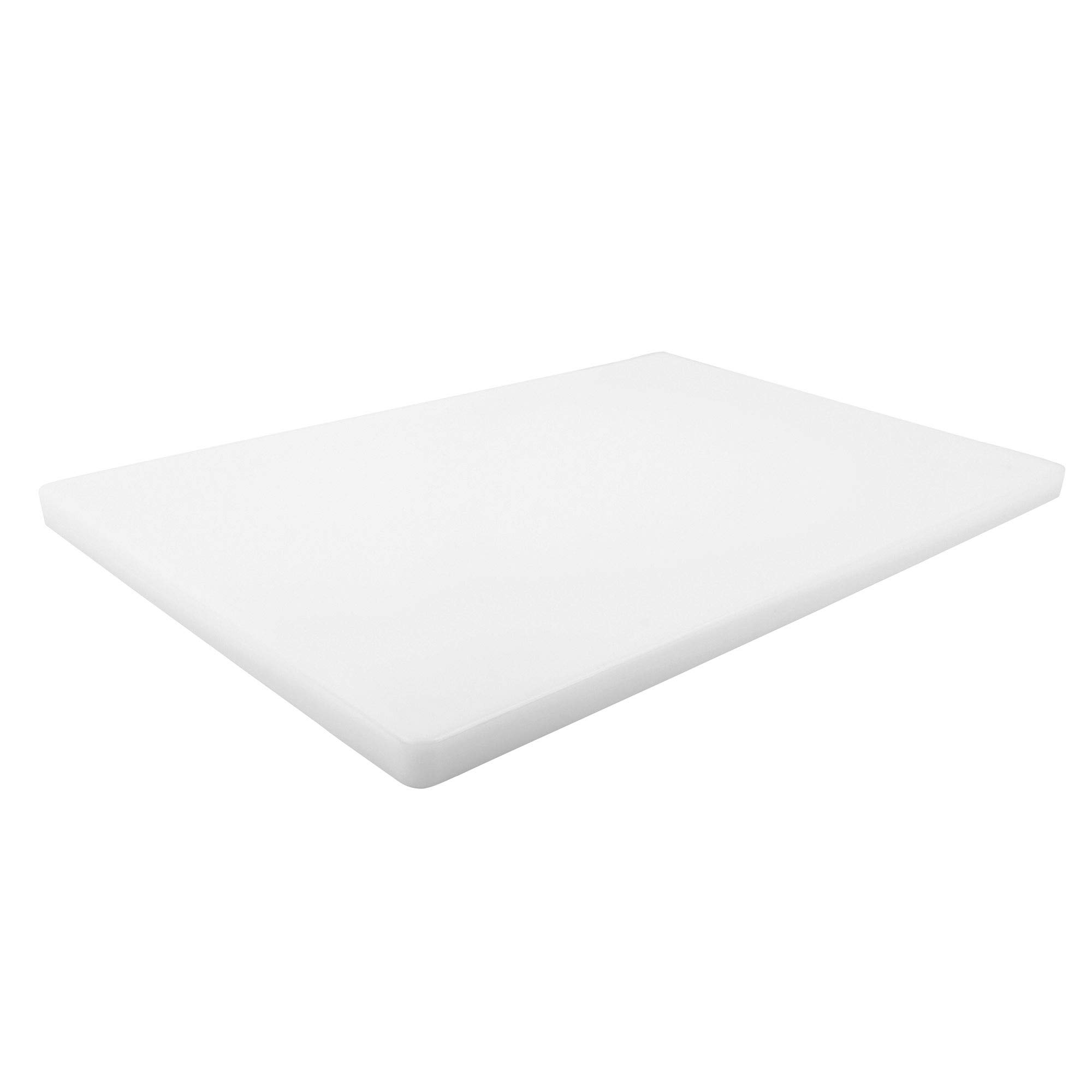
1. Thick White 18×12 Plastic Restaurant Cutting Board, 0.75 Inch Thick HDPP
Our pick — over 4.5★ from 800+ verified ratings; the strongest balance of quality and price.
The thickest plastic board here, and the one that refuses to bow under a cleaver.
This is the board to buy if you want one surface that does everything and never warps on you. It measures 18 by 12 inches at 0.75 inch thick in high density polypropylene (HDPP) — a dense, food-service plastic that resists staining and knife scarring better than the softer polyethylene used on cheaper boards. That thickness is the number that matters: it gives the board the stiffness to stay flat through 200F dishwasher cycles, and it is why the edges do not curl the way thin sheets do. You can cut a pile of mushrooms, then break down a brisket, then rinse it off and stand it in the rack.
You get a board that is easy to trust for food safety: it carries an NSF mark (the food-service hygiene certification stamped on gear sold to commercial kitchens) and it is BPA free (made without the chemical bisphenol A). It carries an NSF mark, the certification stamped on gear sold to commercial kitchens. Owners single out the surface: a lightly textured diamond pattern that grips food while you slice instead of letting a tomato skate away. One buyer puts the work it takes: “Handles 5 lbs carrots, large mushroom batches; bright white aids visibility.” That bright white also means you can actually see whether the board is clean, which is not true of dark boards.
The honest catch is weight and slide. It weighs about 3 pounds according to the listing, and it has no feet, so on a smooth counter it can creep unless you set a towel or a damp mat underneath — a point that comes up repeatedly in the review pages. Several buyers also note that the fine dimples catch a knife tip when you scoop food up, so keep a scraper or bench knife nearby. If your wrists are weak or you want to hang the board, the lighter Winco below is the friendlier shape. And like any plastic board, it will scar under a serrated knife, and hot pans will melt it — this is a prep surface, not a trivet.
What earns it first place
- 0.75 inch thick HDPP — a full half-inch more material than the 0.5 inch Norpro, so it stays flat far longer
- NSF certified and rated for commercial dishwashers up to 200F
- Textured surface holds food in place while you chop
- No oiling, no waxing, no maintenance routine — just wash and stand it up
Where it asks something of you
- No feet, so it can slide on bare countertops without a towel or mat underneath
- Around 3 pounds, which is a real lift for weaker wrists
- Sharp and serrated knives will leave ridges in the surface over time
Buy it if: you cook most days, want one board that handles raw meat and heavy vegetable prep, and want it to still be flat next year.
Look elsewhere if: you need a board light enough to hang on a hook or you are not willing to park a towel under it.
2. Winco 12″ x 18″ White Grooved Cutting Board
A cheap commercial board whose juice groove does the work of a carving tray.
If your problem is the puddle of juice that spreads across the counter every time you rest a roast, this is the board for you. A channel runs around the outer edge specifically to catch liquid before it reaches your benchtop, which is the whole reason it exists. It is cut at 17.94 by 11.88 inches and 0.56 inch thick, so it lands just under a full 18 by 12 — close enough that it still swallows a whole chicken or a large roast, and thin enough to slide into most dishwashers. The board is NSF certified (meets commercial kitchen hygiene standards) and BPA free (made without bisphenol A), and the maker backs it with a 1 year warranty against defects in workmanship.
The plastic is a copolymer blend built to resist cracking, warping, rot, and staining, and the maker says the surface is designed to reduce knife dulling. Owners back that up in plain terms — the sturdiness and the size carry the feedback, and the board is repeatedly described as the easy, no-drama pick for cutting juicy meat and carving turkey. Day-to-day it does exactly what you expect, with none of the fuss of a wood board.
Because it is thin relative to the 0.75 inch Thirteen Chefs board, it will flex a touch more if you put real weight behind a cleaver — that is the trade for the lower thickness. It also has no non-slip feet, so it relies on a damp cloth or a mat the same way most commercial boards do. One note that has nothing to do with the board itself: shipping is inconsistent, and at least one buyer received a compromised package with other items in the order missing, so open the box the day it lands and check it over.
The case for the groove: a perimeter channel turns this into a carving board and a prep board at once, and its 17.94 by 11.88 inch footprint still fits the dishwasher.
What you give up: at 0.56 inch it is the thinner of the two plastic picks, so heavy cleaver work will feel the difference.
Worth it for: anyone carving meat, turkey, or roasts and tired of wiping juice off the counter.
Not the one if: you want the thickest slab on the counter or you need feet to stop it moving.
3. Norpro Professional Cutting Board, 18 in x 12 in
Two boards in one slab — a grooved side for meat, a flat side for produce.
You get a flat face for dicing onions and a grooved face for catching carving runoff, which is why this one suits a kitchen that does a bit of everything. It measures 18 by 12.25 inches and is half an inch thick in high-density polyethylene (HDPE) — a dense plastic that holds up to heavy chopping without chipping or dulling your blades. A cutout handle at the edge lets you carry a loaded board to the stove or hang it when you are done.
The board is NSF certified for professional food service (meets commercial kitchen hygiene standards) and rated dishwasher safe, so it does not carry the hand-wash burden that the bamboo and maple boards do. Owners describe it as well made, easy to clean, and big enough to push ingredients off to one side while you keep cutting — as the review pages sum it up, it is the pick people replace heavy wooden boards with. The sizing earns its keep on a whole chicken or 4 to 5 pound cuts of meat.
The catch is exactly that 3.7 pounds. Hanging it or sitting it on a lightweight shelf is a genuine challenge, and if the board lives in a cabinet above your head you will feel it every time. Owners who slice vegetables most days will also notice the juice trough eats into the working area — the grooved face gives you less flat room than the flat face does. Neither is a flaw so much as a fit note: this is a board for someone who wants substance on the counter, not a featherweight they can flick around one-handed.
The reversible trick: a deep perimeter groove on one face traps meat juice, a smoothed flat face handles cheese and herbs, and the handle makes the whole thing portable.
Pick this one if: you want one board to flip between meat and produce without dragging out a second surface.
Think twice if: you hang your boards on a wall or store them overhead — at 3.7 pounds it is the heaviest plastic here.
4. CURTA Cutting Board, 18″ x 12″ x 0.5″ White

Built for kitchens that separate raw chicken from the salad bowl.
Where this board differs from the rest is the color system behind it. It is designed around HACCP (a food-safety system where each food group gets its own assigned board color), and in that system white is reserved for dairy and bakery items. So if you cook for anyone with a compromised immune system, or you just want a hard line between raw meat and everything else, this is the structural pick. It is a full 18 by 12 inches at half an inch thick in polyethylene (PE), weighs 16 ounces, and carries an NSF-Listed mark — the same food-service certification family as the commercial boards above.
The practical details hold up in daily use. There is a non-skid surface that keeps it from sliding while you cut, and the maker states the surface is knife-friendly. Cleanup is basic: it takes home and commercial dishwasher heat up to 205F, and it also forgives soap, baking soda, or a bleach solution if you prefer to wash by hand. Owners lean on the size and the look of it — the board handles big jobs, and people describe it as a restaurant-style board in their home kitchen.
There is one honest limit to know. This same footprint that makes room for a large pizza can be too big for a compact dishwasher, which owners of smaller machines do run into. One buyer also describes warping the board by holding it against the rim of a still-hot pot while scraping vegetables in — heat, not the board itself, was the problem, so keep it off hot cookware. Treated as a cutting surface rather than a scoop and heat shield, it holds its shape.
Reasons this earns a slot
- White color coding aligns with HACCP board systems, so you can dedicate it to one food group
- NSF-Listed and rated for dishwasher temperatures up to 205F
- Anti-slip surface keeps the board fixed while you work
- Light at 16 ounces, so it is easy to lift and move around the kitchen
Reasons it may not fit your kitchen
- 18 by 12 inches can be too wide for a compact dishwasher
- Holding it against hot cookware can deform the surface
Right for you if: you keep separate boards for separate foods, or you just want a certified white surface for dairy and bread work.
Skip the fit if: your dishwasher is a narrow model — measure before you commit.
5. Belwares Dishwasher Safe Cutting Board, Wood Composite, 18 x 12 Inch

The board for anyone who wants to stop cutting on plastic without taking up wood maintenance.
If you have been reading about microplastics and want off plastic boards, this is the easiest swap on the list. It is made from compressed wood fiber composite rather than polyethylene, so there is no plastic cutting surface under your knife — and unlike a solid wood board, it needs no oiling, no seasoning, and no waxing. It goes in the dishwasher, dries quickly, and comes out ready for the next meal. The size is a full 18 by 12 inches at 0.25 inch thick, and it is engineered to be heat resistant up to 350°F, which covers a hot roast set down to rest.
Owners come back to the same two things: it cleans off easily and it does not warp in the dishwasher, and the material gets a lot of love as a replacement for plastic. The board is light enough to lift with one hand and to slide into a cabinet slot or drawer. Durability tracks well too — people report it holding up over repeated washes rather than delaminating the way some composite boards do. It is priced as a mid-range board, and buyers generally call it money well spent.
Here is the trade you are making. Composite wood fiber is thinner and lighter than a plastic slab, so it will not feel as planted as the 0.75 inch Thirteen Chefs board, and one buyer notes the board can slide on the counter because it does not have rubber feet. There is also the standard knife reality: it shows cut marks, and one buyer observes that a serrated bread knife leaves visible scoring. A few owners describe slight warping after many dishwasher runs — the price of the dishwasher convenience. If you prize a rock-steady, thick plastic board, the plastic picks above still win on that front; if plastic-free is the point, this is your board.
What sold buyers: it is the rare board that gives you a wood-like feel and a dishwasher-safe routine in the same product.
The honest cost: composite fiber is thinner than a plastic slab, so expect cut marks and slight give rather than a solid, immovable surface.
Best for: kitchens trying to cut plastic out of food prep without committing to hand-washing wood every week.
Not for you if: you want the thick, dead-weight feel of a solid commercial board.
6. Belwares Slate Black Composite Wood Cutting Board with Juice Groove & Non-Slip Feet

The step-up Belwares: same wood-fiber body, now with a groove and feet that hold.
This is the version for anyone who wants the plastic-free composite build of the Belwares above but needs the board to stay put. It adds rubber non-slip feet and a deep juice groove, so it solves the two most common complaints about thin boards in one move. It is a full 18 by 12 inches at 0.25 inch thick, and it is dishwasher safe with a non-porous surface that resists absorbing liquids, stains, and odors. There is a built-in handle cut into the edge for carrying it to the table, and the slate black finish makes it presentable enough to double as a serving board for brisket or a spread of cheese.
The four rubber feet are the headline. Owners describe the board as staying fixed while carving and improving control, which is exactly what you want under a knife. The material earns praise for being plastic-free, and people cutting raw chicken often note how quickly they can move it from counter to dishwasher. The board also earns favorable comparisons to the premium Epicurean-style composite boards at a fraction of the discomfort.
Two things to go in with open eyes. First, feet change the geometry — this board sits raised off the counter, so it is stable but not completely flush the way the flatter plastic boards are, and it can sound a little hollow under a knife. Second, the composite surface will show scratches over time; some owners notice visible marks from regular use, so this is not the board to baby as a display piece. If you carve often and hate chasing a sliding board, the feet and groove together make this the more useful of the two Belwares entries — and unlike the flat Belwares above, it comes in the black slate finish the lime-green no.3 board doesn’t offer.
Why the upgrade lands: the rubber feet and juice groove turn a decent lightweight composite board into one you can trust while carving.
What to accept: it sits raised on its feet with a slightly hollow sound, and the surface will show light scratches from steady use.
Reach for this if: you carve meat regularly and want a plastic-free board that will not creep across the counter.
Look past it if: you prefer a completely flat, flush board with no raised feet.
7. Totally Bamboo Malibu Bamboo Cutting Board with Juice Groove, 18″ x 12″
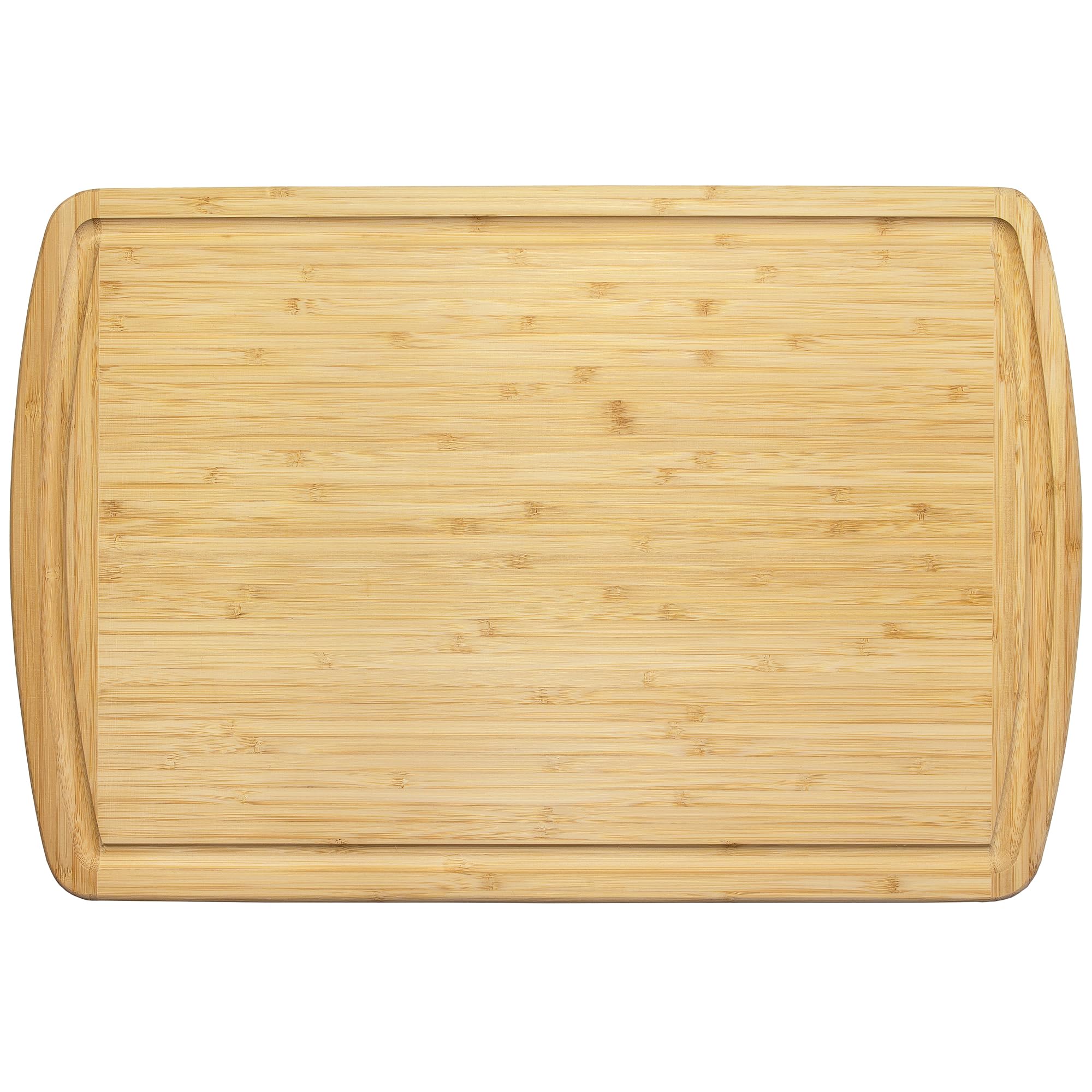
The board that behaves like wood without the plastic, at a full three-quarter inch thick.
If what you actually want is the soft, warm feel of chopping on wood but you do not want a heavy slab you have to oil constantly, bamboo is the middle path. This board is crafted from vertical-grain Moso bamboo (bamboo cut so the fibers run vertically, which makes it denser and more stable), which makes it lighter than a maple board of the same size while still feeling solid under the knife. It measures 18 by 12 inches at 0.75 inch thick — the same thickness as the top pick, but in wood rather than plastic — and it carries a built-in juice groove around the edge to channel liquid away from your counter. That combination of thickness and a groove is unusual at this size, and it is why it earns a spot here rather than in a generic bamboo roundup.
Owners describe it as a workhorse for chopping vegetables and fruit, and buyers report it does not dull their knives — several people compare the feel favorably against other materials and against ceramic boards they have owned. It looks good enough to leave on the counter, and it is light enough to move around easily. The size is a good fit for a household cooking for three to four people.
Here is the one thing you cannot skip: this is a hand-wash board. It is explicitly not dishwasher safe, and owners who take care of it say the reward is a board that lasts — one buyer sticks to their own routine of a coconut-oil rub before first use and after every third wash. It also has an honest surface caveat: bamboo is a dense, hard wood, and some owners find it rougher and harder than expected, with a few reporting small splinters or heavy knife scoring. If you want a set-and-forget dishwasher board, the composite picks above beat this one; if you want real wood feel at a mid-range position, this is the one to pick.
Why the bamboo stays in the running
- 0.75 inch thick — the same thickness as the top plastic pick, but in wood rather than HDPP
- Built-in juice groove channels runoff to keep countertops clean
- Lightweight for a wood board and gentle on fine knives
Where the bamboo asks more
- Hand wash only — it is not dishwasher safe
- Bamboo is dense and hard, so it can feel rougher and score more readily than softer woods
Your board if: you want the look and feel of wood, a juice groove, and a board you’re willing to wash and oil by hand.
Pass on it if: you want to stack it in the dishwasher with the plates — bamboo will not survive that.
8. San Jamar Saf-T-Grip Plastic Cutting Board with Safety Hook, 12″ x 18″ x 0.5″

Silicone-cornered and safety-hooked — the board built for a wet, fast commercial kitchen.
Fixating on a sliding board? This is the answer. San Jamar’s Saf-T-Grip board has silicone grippers at each corner that lock it to the counter, and a safety hook built into the edge for hanging it out of the way when the shift ends. It measures 18 by 12 inches, nomimally 0.5 inch thick, and it is molded from co-polymer plastic — a blend that resists cracking and stays stable under heat. It is the choice for anyone who has ever had a board scoot out from under them mid-carve.
What owners rave about is stability and grip more than anything else. The board is used in a teaching kitchen, and swapping between grippers, high-temp dishwasher, and regular solvent cleaning keeps the surface in reliable shape for the long haul. The silicone corner feet keep it from slipping on the counter, and owners mention the board is easy to handle and to move around the kitchen between tasks. A chef’s family member calls it close to best on the market after using it at home.
The public spec here is thin — the manufacturer lists little beyond dimensions, so what you get is mostly a reputation board rather than a spec-rich one, and that is worth knowing going in. It is also at the top end of the plastic boards in price, though owners argue it earns the extra. And like any working plastic surface, it will show cut scars over its life — that is expected, not a defect. If you want a densely specced board with more detail to compare, the Thirteen Chefs at the top gives you more to work with; if you want the board that simply will not move, this is the one.
Where the Saf-T-Grip stands out
- Silicone corner grippers hold the board firm on wet countertops
- Safety hook integrates with commercial kitchen storage
- Co-polymer build and high-temp dishwasher tolerance make it a genuine all-day-use board
What you should know first
- Very little public spec beyond 18 by 12 inches at about 0.5 inch thick
- The plastic surface will show cut scars over time
Buy it if: your board sliding mid-chop is the single thing you want to fix and you are willing to pay for grip.
Buy differently if: you want more published specification detail to compare before you decide.
9. John Boos Block MPL1812125-FH-GRV Prestige Maple Wood Cutting Board, 18 x 12 x 1.25 Inches
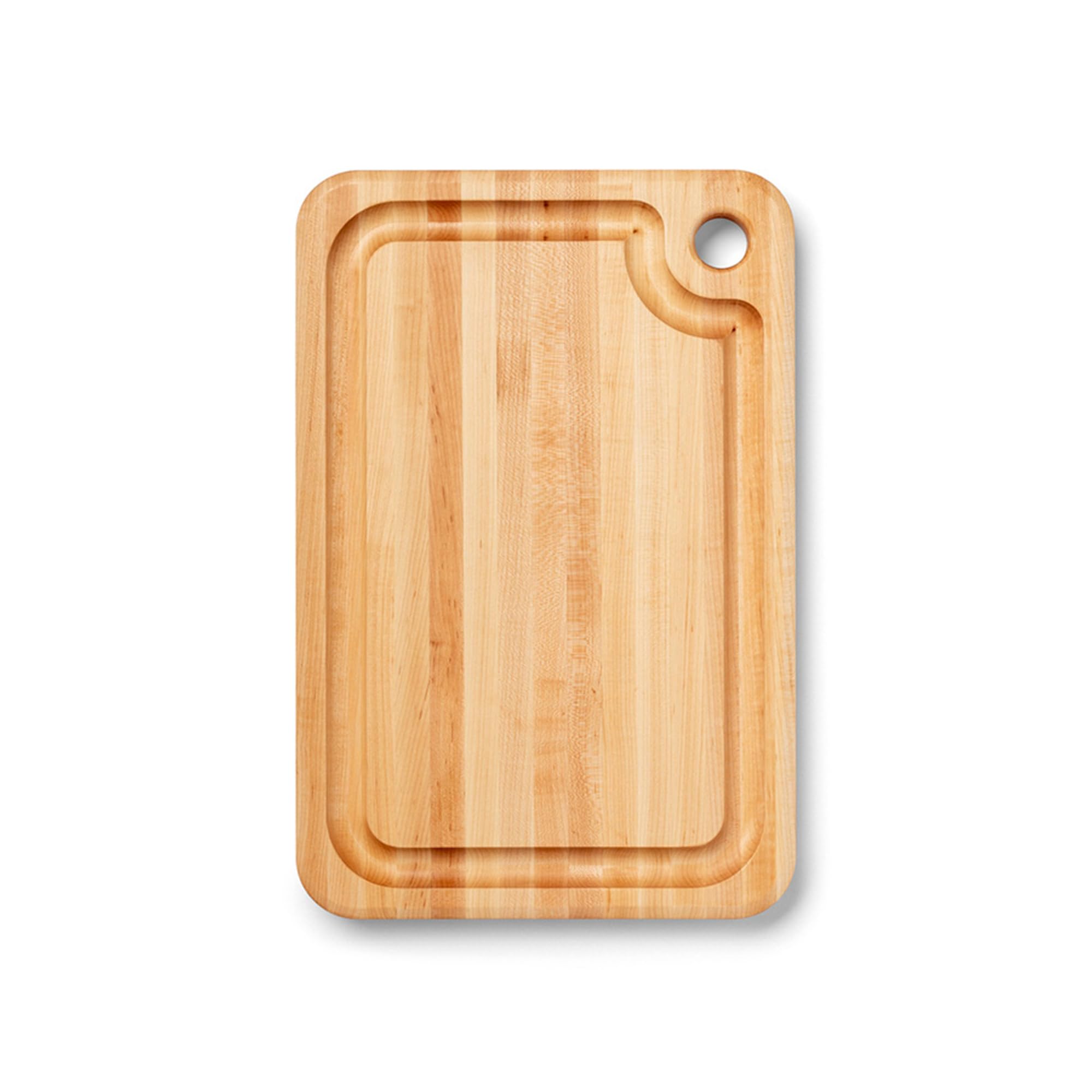
A 1.25-inch-thick maple slab that turns cutting into serving.
This is the heirloom board of the group — a full inch and a quarter thick in edge-grain maple, from an American maker that has been making gourmet wood and stainless products since 1887. It measures 18 by 12 inches, is reversible, and has a juice groove plus a finger-hole grip cut into the edge for lifting. The brand finish is an oil finish, and it is handmade to serve both as a cutting surface and as a cheese or charcuterie display board for a dinner party. Nothing else on this list comes close on presence.
What buyers consistently love is the look and the substance: the appearance draws the most positive attention, followed by its size, which is generous enough to tackle onions and garlic at once without crowding. It feels heavy and solid under the knife, and owners file it away as a premium choice they are happy to keep on display. A chef relative or a serious home cook will recognize the make. If you have ever wanted a board that looks like it cost real money and will become a family hand-me-down, this is that board.
You do need to know two things before choosing it. First, this is strictly hand wash — the maker requires it, and the maker sells its own oil and board cream to keep the wood fed. Second, this board demands real maintenance, and a small portion of customers note splitting or separation within months when the routine slips. Others use theirs for years without issue and describe it holding up beautifully, so treat it as a board that rewards care. If you are not going to oil a board regularly, one of the composite or plastic picks above is the smarter call for your kitchen.
The thing about this board: it is as much a serving piece as a cutting surface, and the 1.25-inch thickness and reversible maple grain are why.
The price of it: hand wash only, oil-treated, and a small number of buyers see splitting if the maintenance routine lapses — so plan for the care it asks for.
Buy it if: you want a substantial maple board that doubles as a charcuterie platter and you will commit to oiling it.
Think twice if: you want dishwasher-safe and zero-maintenance, or something you can grab mid-week with no upkeep.
Understanding the Specs
Thickness: Why It Decides Everything
Thickness is the spec that predicts how long a board stays flat. A 0.75 inch plastic board carries roughly half again the material of a 0.5 inch board, which is why it resists warping and sliding better. A 1.25 inch map board is thicker still — but the trade is weight. Thicker boards don’t just last longer; they also raise the surface higher off the counter, which changes your cutting angle. If you are still shopping, look at thickness once you have chosen a material and size — it is the fastest way to spot the real workhorse among a dozen near-identical listings.
Material: Plastic vs. Composite Wood vs. Bamboo vs. Maple
HDPP and HDPE are the two food-service plastics most kitchen boards use, and the main reason to pick them is simple: they go in the dishwasher and need no upkeep. Composite wood fiber boards (like the two Belwares above) give you a wood-like feel and dishwasher safety, though they are thinner. Bamboo gives you real wood feel at moderate thickness but must be hand washed. Maple is the top shelf — heavy, beautiful, and demanding of oil and a hand wash only. Check the care line on any board before you buy into a low maintenance pitch.
FAQ
Is a plastic or wood cutting board better for a home kitchen?
Will an 18 x 12 inch cutting board fit in my dishwasher?
How thick should a plastic cutting board be?
Do I need a juice groove on a cutting board?
Will a plastic cutting board dull my knives?
What does NSF certified mean on a cutting board?
Can I put a bamboo or wood cutting board in the dishwasher?
Does a cutting board with non-slip feet mark my countertop?
How often should I oil a wooden cutting board?
Is a 0.25 inch composite cutting board too thin?
Final Thoughts: The Verdict
For most kitchens, the 18 x 12 cutting board that wins is the Thick White 18×12 Plastic Restaurant Cutting Board — its 0.75 inch HDPP body (high-density polypropylene, a tough food-safe plastic) is the thickest plastic slab here, it is NSF certified (meets commercial kitchen hygiene standards), it goes in the dishwasher, and it simply refuses to warp. That much thickness at a budget-friendly price is the balance most buyers are hunting for. If you carve meat often and want the groove, grab the Winco 12″ x 18″ White Grooved Cutting Board. And for serving-at-the-table duty or a board you’ll pass down, the hand-washed maple feel of the John Boos Prestige Maple Board is the one to reach for. Pick the thickness that matches the weight you’re willing to lift — that, more than brand, decides whether you’ll actually reach for it every day.
How We Picked
We do not accept paid placement. Every pick is matched to a real buyer and a real use-case; we do not hands-on test units.
Sources & Methodology
Specifications: manufacturer listings and product documentation. Review insights: verified customer reviews, as of September 2026. Pricing: not shown on this page (it changes often); check the current price via the retailer link.
As an Amazon Associate, KitchPrep earns from qualifying purchases. This does not affect which products we feature.
Related Guides
