
Specs are compiled from manufacturer listings and verified buyer reviews and can change over time — please confirm the key details on the product page before buying.
An 18 kW whole-home generator keeps your heat, fridge, and well pump running through a storm instead of leaving you in the dark. This shortlist covers three portable tri-fuel and gas machines in that output class and explains which fits your home, your fuel supply, and your back.
Not every pick here is stamped at exactly 18 kW. A machine rated a bit lower or higher in the same output class can serve the same purpose in your driveway.
I’m Mohammad Maruf — the founder and writer behind KitchPrep. This guide is built by comparing the manufacturers’ published specifications and the patterns across verified customer reviews, so you get each pick’s real strengths and trade-offs instead of marketing spin.
You will see how tri-fuel flexibility, transfer-switch readiness, and clean low-THD power separate a genuine home-backup machine from a jobsite tool, so you can choose the right 18 kw portable generator for your house.
Our Picks at a Glance
How To Choose The Best 18 kW Portable Generator
Buying generator power for a house is not about chasing the biggest number on the box. It is about matching a machine to the loads you refuse to live without, then making sure it can be fueled, started, and wired in when the grid drops.
Start with running watts, not peak watts
Peak watts are a short surge the generator can handle for a moment, which is what gets a compressor motor spinning. Running watts are the steady load it holds indefinitely. Your central air, well pump, and furnace blower all draw a hard surge at startup, so the running figure is your real ceiling and the peak figure is your headroom for those motor starts.
Decide your fuel before you decide your model
Gasoline gives the most raw output per engine but goes stale and needs stabilizing. Propane stores for years and burns cleaner. Natural gas never runs out during an outage, but it produces slightly less power from the same engine. A tri-fuel machine lets you pick per storm rather than committing to one supply.
Check that it can actually be connected
Transfer-switch-ready and interlock-kit-ready outlets mean a licensed electrician can tie the generator into your home panel safely, so you stop running extension cords through the kitchen. Confirm the outlet types on the machine line up with the inlet your electrician would install, and check whether the top output requires hardwiring rather than a cord.
Quick Comparison
| Model | Best For | Peak Watts (Gas) | Running Watts (Gas) | Engine | Amazon |
|---|---|---|---|---|---|
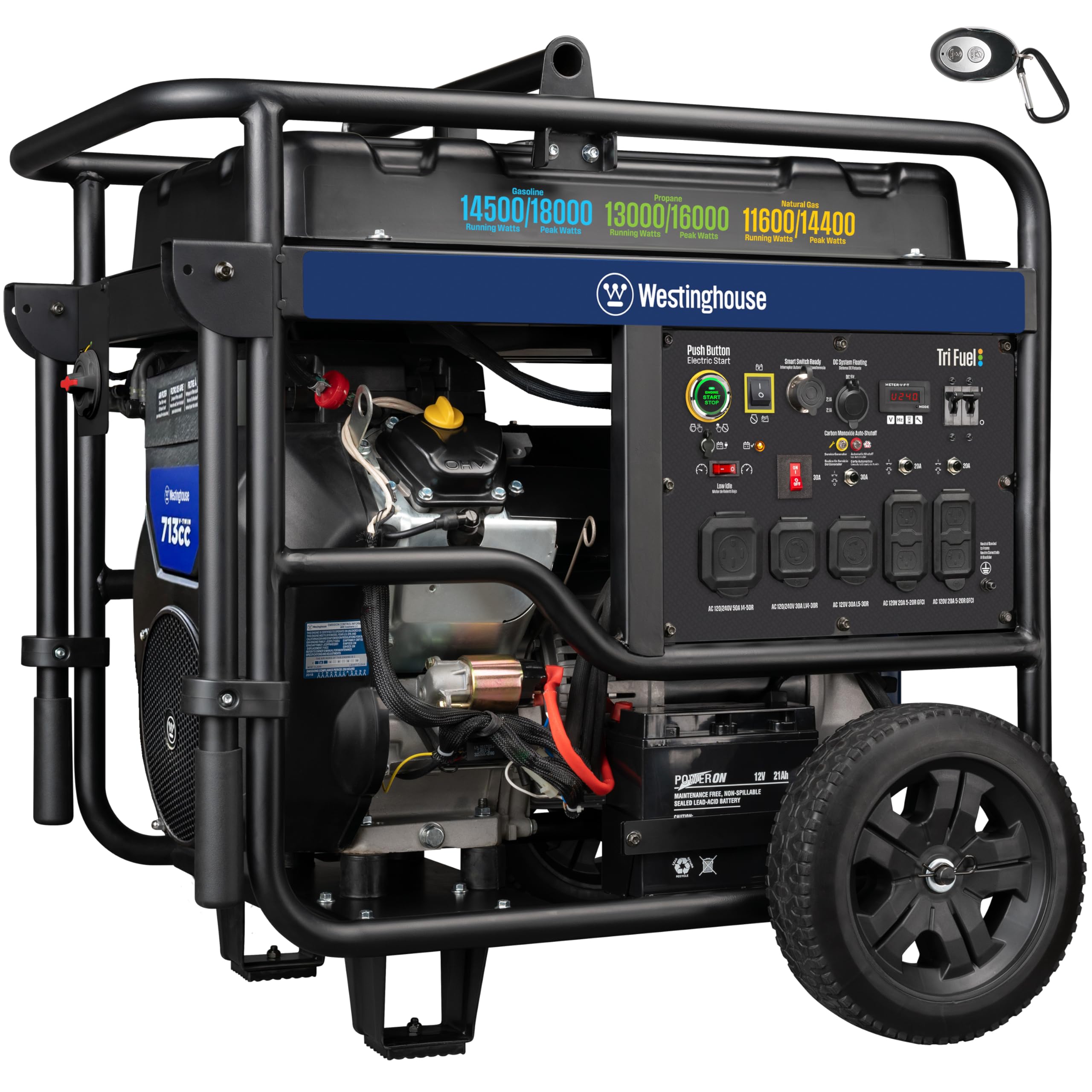
| Westinghouse 18000 Peak Watt Tri-Fuel★ Best Overall | Tri-fuel whole-home backup | 18,000 | 14,500 | 713cc V-Twin | Amazon |
| Champion 16,875-Watt Electric Start | RV and camper power | 16,875 | 13,500 | 739cc V-Twin | Amazon |
| Westinghouse 28000 Peak Watt Tri-Fuel | Large-home hardwired backup | 28,000 | 20,000 | 999cc V-Twin | Amazon |
In‑Depth Reviews
1. Westinghouse 18000 Peak Watt Tri-Fuel Home Backup Portable Generator
Our pick — over 4★ from 100+ verified ratings; the strongest balance of quality and price.
The tri-fuel workhorse that switches fuels instead of switching homes
The real selling point here is that you are not locked to one fuel when the storm hits. This Westinghouse produces 18,000 peak watts and 14,500 running watts on gasoline — peak watts being the brief surge for motor starts, running watts the steady load it holds all night. Switch to propane and you get 16,000 peak and 13,000 running; switch to natural gas and it settles at 14,400 peak and 11,600 running. A 10.5-gallon tank keeps it going up to 16 hours at 25% load, and the 713cc V-Twin OHV engine handles that load without straining.
You can safely plug in phones, computers, and TVs alongside the big appliances because it runs at less than 5% THD (total harmonic distortion — a lower number means cleaner, smoother electricity). Copper windings help it run cooler over long outages. The outlet panel is genuinely complete: one 120/240V 14-50R 50A outlet and one 120/240V L14-30R 30A outlet, both transfer-switch and interlock-kit ready, plus a 120V L5-30R 30A, two GFCI 120V 5–20R 20A duplex outlets, and two USB ports, all under rubber covers. Push-button and remote start mean you do not have to walk out in the rain to fire it up. A CO shutdown (a sensor that cuts the engine if carbon monoxide builds), low-idle mode, and a VFT display showing voltage, frequency, and lifetime hours round out the package.
Owners consistently describe it as easy to assemble with a self-explanatory manual, and the most-praised quality is exactly that build. As buyers report: “Powers AC units; brief power dip on natural gas, resolved on gasoline (higher BTU).” That matches the spec sheet — natural gas delivers fewer BTU per unit, so you lose some output on that fuel and regain it on gasoline. The one genuinely mixed area is starting performance: most units fire right up, but a small share arrive refusing to start at all, so a seller with easy returns and a warranty you trust matters. Note the rating pattern too — the reviews land around 4.4 stars. Tipping the scales the other way, the smaller Westinghouse runs a 713cc engine against the 28000’s 999cc, so it is the more manageable machine if you do not need to feed a very large house.
Why Owners Keep It
- Runs on gas, propane, or natural gas, so an outage never leaves you stranded on one supply
- Sub-5% THD protects laptops, routers, and TVs from dirty power
- Up to 16 hours of run time at 25% load on the 10.5-gallon tank
- Remote and push-button start plus CO shutdown for safer, hands-off restarts
Where It Trips Up
- Natural gas drops output to 11,600 running watts, so gauge your loads on that fuel
- A small share of units arrive with start problems
Reach for this if: you want one generator that can run on whatever fuel you have, back up a larger home, and start from a remote in the dry.
Look elsewhere if: your house needs the full 20,000 running watts of hardwired maximum output — that is the 28000’s job.
2. Champion 16,875-Watt Electric Start Portable Generator
Gas-only, wheel-ready, and built to roll from driveway to campsite
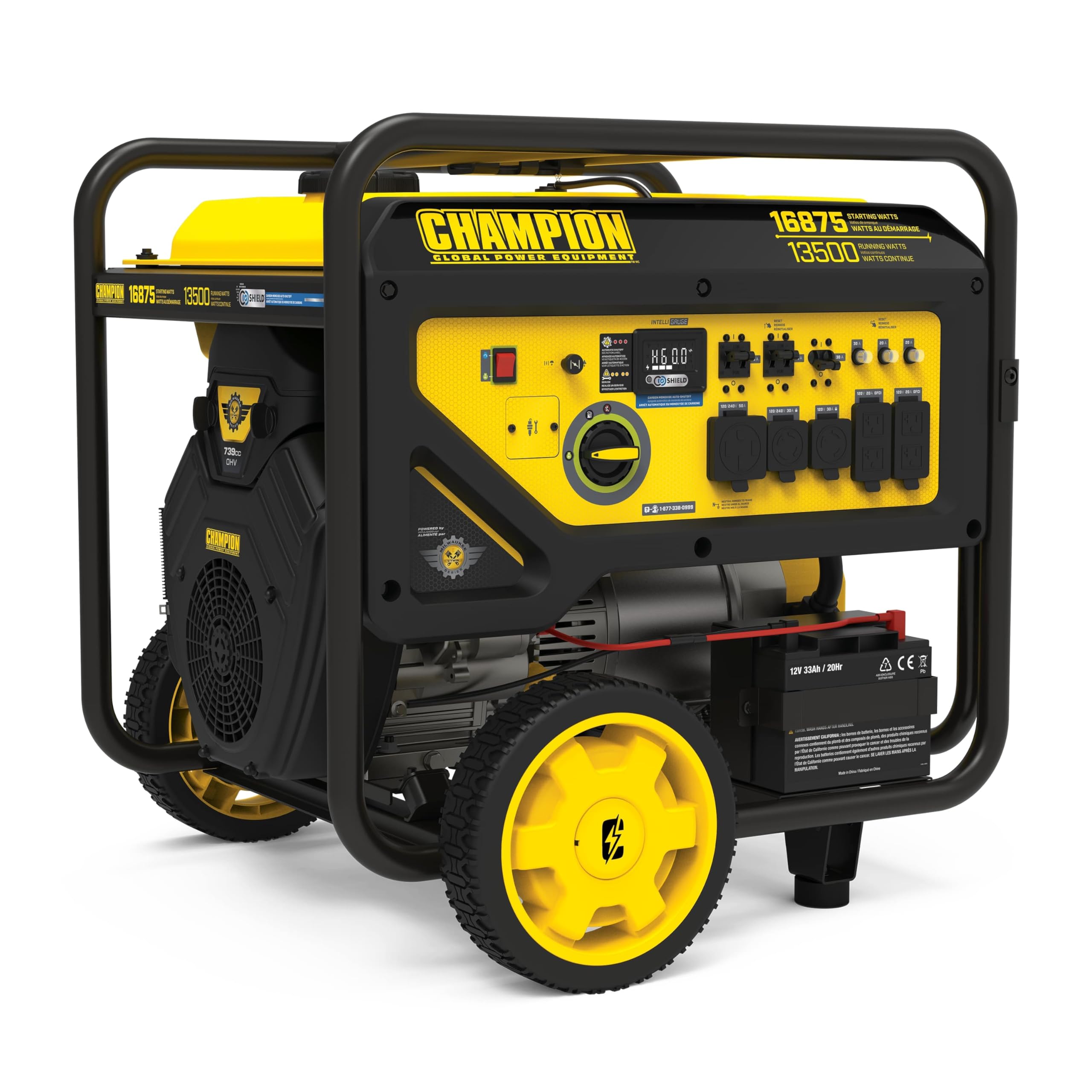
If you are powering an RV or a camper rather than a whole subdivision, this Champion is the more sensible size. It delivers 16,875 starting watts and 13,500 running watts on gasoline, giving it room to start big appliances without demanding the bulk of a full home-backup unit. A full tank of gasoline runs it up to 8 hours, and it sits at 79 dBA from 23 feet — dBA being a sound-pressure reading, so expect a real conversation-annoying hum when it is close to you.
It is not tri-fuel. This is a gasoline-only machine (Fuel Type: Gasoline), so no propane or natural gas option here. That is the honest trade-off, but it keeps the machine simpler and it does the RV job extremely well. Its 739cc Milwaukee Series V-Twin engine is actually larger in displacement than the 18000 Westinghouse’s 713cc, and it pairs with a battery-included push-button electric start plus CO Shield carbon monoxide auto shutoff. The Intelligauge with Power Meter tracks voltage, hertz, run time, and output to help you plan maintenance. Transport is genuinely friendly: a built-in lift hook, 12-inch never-flat tires, and a foldaway handle make loading and storing it far easier than the bigger units, and it carries a 3-year limited warranty with lifetime technical support.
Owners using it in campers are the clearest signal — as owners mention: “Runs almost 12 hours on a tank of fuel.” That outlasts the 8-hour spec in real use. Durability comes up repeatedly and positively, and it also holds up for emergency home use — it kept water and heat running through a multi-day ice-storm outage. The recurring nuisance is the fuel filter design, which owners describe as slow to fill and prone to splash-back, so a funnel is worth keeping on hand. There is also one longer-term reliability concern reported around a faulty switch and a warranty runaround, which is worth weighing if easy local service matters to you over the 3-year coverage window. Roll it if you want camper power and a machine you can actually move; buy bigger if you need tri-fuel.
Size Where It Counts: 338 pounds against the 28000’s 557 pounds makes this a machine you can genuinely handle yourself — that 219-pound difference is the difference between a two-person job and a solo one. The 12-inch never-flat tires and foldaway handle add to that.
It beats the others for: camper and RV duty, thanks to real 12-hour tank life, an easy fuel-and-go setup, and simple transport.
It falls short if: you need to run on propane or natural gas — this one is gasoline only.
3. Westinghouse 28000 Peak Watt Tri-Fuel Home Backup Portable Generator

The one that powers a two-AC house, a pool pump, and everything else
When “backup power” means running a genuinely large home, this is the machine other generators get compared against. On gasoline it delivers 28,000 peak watts and 20,000 running watts; on propane, 25,200 peak and 18,000 running; on natural gas, 22,400 peak and 16,000 running. That output ceiling is meaningfully above the 18000 Westinghouse’s 18,000 peak, and it comes from a larger heart — a heavy-duty 999cc Westinghouse V-Twin OHV engine with a cast-iron sleeve, against the smaller unit’s 713cc. A 17.2-gallon tank with gauge keeps it running up to 15 hours at 25% load.
You get full power without outlet limits thanks to a 125A 240V AC terminal block that lets a licensed electrician hardwire the generator straight into your home panel. The outlet array is doubled up compared to its smaller sibling: two 120/240V 14-50R 50A outlets and two 120/240V L14-30R 30A outlets, all transfer-switch and interlock-kit ready, plus a 120V L5-30R 30A and four GFCI 120V 5–20R 20A duplex outlets. Sub-5% THD keeps electronics safe, and it adds carbon monoxide shutdown, low-idle mode, remote start, and a digital readout of lifetime hours, volts, and frequency. Owners describe it powering a two-4-ton-AC 7,000-square-foot house and running a pool pump on natural gas — as customers note: “Runs the whole house.”
The critical catch is that size comes with hardwiring complexity. To extract the full 20,000 running watts you need to hardwire it, not simply plug into a 50-amp circuit — and on a 50-amp breaker the ceiling is much lower. That requirement trips people up, and the setup is not as plug-and-play as the marketing implies. It is also a physical commitment: 557 pounds and 38″L x 35″W x 40.4″H, which is 219 pounds heavier than the Champion and larger in every dimension than the 18000 Westinghouse. There is a plan-ahead cost for propane or gas hookups too. For a house this size, though, the power is class-leading here, and the reputation for effective, easy-to-set-up performance holds up across owners.
what separates it
- 20,000 running watts on gasoline can carry a large home with two AC units plus a pool pump
- 125A terminal block for direct hardwiring to a home panel by an electrician
- 999cc engine with a cast-iron sleeve and a 17.2-gallon tank good for up to 15 hours at 25% load
- Doubled outlet array with four GFCI duplex outlets and lifetime-hours monitoring
The Honest Hurdles
- Full output requires hardwiring, not a simple 50-amp cord connection
- At 557 pounds, moving it is a two-person job
- A few units have been reported cutting out under sustained load, so plan for service support
The verdict: if your home is genuinely large, this is the only pick with the headroom to run it all, and the hardwiring requirement is the price of that power.
Know before you buy: budget for an electrician and a second set of hands — this is not a roll-out-and-go machine.
Understanding the Specs
Peak Watts vs Running Watts
Peak watts are the surge a generator can handle for a few seconds, which is what starts a compressor or a well pump turning. Running watts are the steady draw it holds indefinitely. If your steady load sits above the running rating, the breaker trips — so add up what stays on and compare that to running watts, then use peak headroom for startup surges.
Tri-Fuel Flexibility
Running on gasoline, propane, and natural gas means you match the fuel to the situation. Gasoline gives the most output, propane stores indefinitely, and natural gas never runs out during an outage — but the same engine typically produces less power on natural gas than on gasoline, so your usable wattage shifts with the fuel.
THD and Sensitive Electronics
THD, or total harmonic distortion, measures how clean the electricity is. Lower is better for anything with a circuit board — a fridge control panel, a furnace board, a router, or a laptop charger. A low-THD unit protects devices that a dirty waveform can damage over time.
Transfer Switch and Hardwiring
A transfer switch or interlock kit is what lets a generator feed your home panel safely instead of running extension cords. It also matters that “ready” does not always mean the same thing: some outlets cap your output on a breaker, while a direct terminal-block hardwire is often what open up the machine’s true maximum.
FAQ
Is an 18 kW generator enough to run my whole house?
What does tri-fuel mean on a portable generator?
Do I need a transfer switch to connect a generator to my house?
What is THD and does it matter for my appliances?
Can I run a generator on natural gas and still get full power?
How long will this size of generator run on a full tank?
What is the difference between peak watts and running watts?
Is a carbon monoxide shutdown feature important on a generator?
How do I move a generator this heavy?
Does full generator output require hardwiring instead of an outlet?
Final Thoughts: The Verdict
For most buyers, the 18 kw portable generator winner is the Westinghouse 18000 Peak Watt Tri-Fuel because it blends 18,000 peak watts, sub-5% THD clean power, and switchable gas-propane-natural-gas fueling into one machine that backs up a larger home without forcing a hardwire job. It is the crowd favorite — holding a 4.4-star rating across more than 100 ratings — and it earns that by being easy to assemble, easy to start from a remote, and flexible enough to run on whatever fuel the storm leaves you. If your house is genuinely large and needs every watt, step up to the Westinghouse 28000 Peak Watt Tri-Fuel and budget for an electrician to hardwire it. And if you are powering a camper or RV rather than a house, the Champion 16,875-Watt Electric Start is the one to wheel out — lighter, easier to transport, and happy running for hours at a time.
How We Picked
We do not accept paid placement. Every pick is matched to a real buyer and a real use-case; we do not hands-on test units.
Sources & Methodology
Specifications: manufacturer listings and product documentation. Review insights: verified customer reviews, as of September 2026. Pricing: not shown on this page (it changes often); check the current price via the retailer link.
As an Amazon Associate, KitchPrep earns from qualifying purchases. This does not affect which products we feature.
Related Guides
