
Specs are compiled from manufacturer listings and verified buyer reviews and can change over time — please confirm the key details on the product page before buying.
If you are installing tongue-and-groove hardwood, the whole job lives or dies on one small thing: whether the staple sinks to the exact right depth in the tongue without cracking it. An 18 gauge flooring stapler (the tool that fires thin 18-gauge fasteners through the tongue of each board) is the machine that does that job, and picking the wrong one means bent staples, split tongues and boards that squeak six months later.
I’m Mohammad Maruf — the founder and writer behind KitchPrep. This guide is built by comparing the manufacturers’ published specifications and the patterns across verified customer reviews, so you get each pick’s real strengths and trade-offs instead of marketing spin.
Every tool below fires genuine 18-gauge fasteners into the tongue of a board, so the real question is depth control, jam behaviour and how it feels after hour four. These picks cover the entire spread, from a value entry tool to a pro-grade trigger-pull unit, and each one is a tool you can rely on to lay real flooring.
Our Picks at a Glance


How To Choose The Best 18 Gauge Flooring Stapler
Three things decide whether a flooring stapler makes your install easier or turns it into a repair job: fastener size, depth control, and how the tool behaves over hundreds of shots. Get those right and the rest is detail.
Match the staple to the board, not the other way round
An 18 gauge flooring stapler drives thin staples, 18 gauge being the wire thickness (thinner than the heavier 15.5 and 16 gauge cleats used on solid strip flooring). Narrow crown staples bend easily if they hit dense material, so the tool has to seat them into the tongue at the right angle. Board thickness is your starting point: thin engineered planks call for shorter staples, and thicker solid boards take longer ones. The tools here list their usable fastener ranges, so check that range against the flooring you actually bought before anything else.
Depth control is the feature that saves your boards
Set the staple too deep and you blow through the tongue; set it too shallow and the head sits proud and stops the next board seating. A tool-free depth adjustment wheel lets you dial the drive depth by hand mid-job, which matters when one bundle of boards runs slightly thicker than the last. Adjustable foot bases do a similar job from the other side, letting the tool sit flat on different plank profiles.
Weight, exhaust and grip decide how long you last
You hold this tool at chest height for hours, so a lighter body and a low-fatigue grip genuinely matter. A rotating exhaust port keeps cold compressor air out of your face, and a reload indicator stops you dry-firing into an empty magazine. Look at these before you commit to a heavier build.
Quick Comparison
| Model | Best For | Staple Range | Tool Weight | Depth Control | Amazon |
|---|---|---|---|---|---|
| 3PLUS HFS509040SP★ Best Overall | Whole-room hardwood on a budget | 5/8″ – 1-1/2″ (1/4″ crown) | 3.5 pounds | Tool-free adjustable depth control | Amazon |
| NuMax SFBC940Best Value | Flooring plus finish trim with one tool | 1/2″ – 1-5/8″ (1/4″ crown) | 3.4 pounds | Tool-free depth adjustment wheel | Amazon |
| Freeman PFBC940 | Homeowners mixing floors, trim and baseboards | 3/8″ – 1-5/8″ (1/4″ crown) | 3.8 pounds | Tool-free depth adjustment wheel | Amazon |
| Metabo HPT N4004AB | Pros laying solid hardwood all week | 1/2″ – 1-9/16″ (1/4″ crown) | 3.1 pounds | Tool-less adjustable base, 5/16″ – 7/16″ and 1/2″ – 5/8″ | Amazon |
| Powernail 1845F | Tight spaces and interlocking plank profiles | 7/8″ – 1-1/2″ (1/4″ crown) | — | FLEX adjustable foot, no tools required | Amazon |
In‑Depth Reviews
1. 3PLUS HFS509040SP 4-in-1 Pneumatic 18 Gauge Flooring Stapler/Nailer
Our pick — over 4.5★ from 400+ verified ratings; the strongest balance of quality and price.
The all-rounder that runs an entire room of engineered hardwood and then swaps to trim duty.
What you get here is a full-strip pneumatic tool that drives 18 gauge narrow crown staples with a 1/4″ crown from 5/8″ to 1-1/2″ long, and switches to 18 gauge brad nails from 3/4″ to 2″ when the flooring is done. The manufacturer rates it for 1/4″ to 5/8″ engineered or solid hardwood, which covers the two thickness of plank most home installs actually use. At 3.5 pounds it is a touch heavier than the NuMax SFBC940 at 3.4 pounds, but that extra weight sits in a body made from alloy steel, aluminum and rubber, so it feels settled rather than tiring in your hands.
Three design touches do the real work. A tool-free depth control device lets you set the nail head height by hand, so you can dial in a flush seat without hunting for an Allen key. A 360° multi-directional exhaust cover rotates to point cold compressor air away from your face. And a quick-clear jam release opens the nose fast if a staple ever misbehaves. Owners also lean on it for edge work where a manual hammer nailer fails — the manufacturer designed the tool to sit close to walls, and the fasteners land flat because the shoe keeps the tongue supported.
Owners speak with unusual conviction: as one verified buyer put it, “I installed 2400 square feet of flooring without a failure.” Others report no misfires or doubles at 100 psi, easy adjustment, and a setting that holds once dialled in. The honest caveat is build feel. The recurring gripe is the plastic nose and the depth wheel — a few find the drive depth inconsistent and the construction light compared with professional brands, so treat it as a serious DIY tool rather than a commercial workhorse. It still has plenty of converters who run it just as happily as a brad nailer on baseboards afterwards.
Where it earns its keep
- Two tools in one — 18 gauge 1/4″ crown staples from 5/8″ to 1-1/2″ and 18 gauge brad nails from 3/4″ to 2″
- Tool-free depth control plus quick-clear jam release and a 360° rotating exhaust cover
- Buyers report clean, flush fastening across engineered and solid hardwood with no misfires
Where it asks a little patience
- A few owners find the plastic nose and depth wheel feel light next to pro-grade brands
- Drive depth can run inconsistent on dense boards until you find the right pressure setting
- You need a compressor with a regulator — it is pneumatic only
Reach for this if: you are laying a full room of engineered or solid hardwood and want one tool that also handles trim and baseboards afterwards.
Know going in: you must follow the shoe setup instructions before firing — skip them and staples scatter.
2. NuMax SFBC940 Pneumatic 4-in-1 18-Gauge 1-5/8″ Mini Flooring Nailer/Stapler with Bag
Light and quick to set up — a genuine 18 gauge floor tool without the pro-grade haul.
If your flooring job sits between 3/8″ and 1/2″ thick, this NuMax covers it in one tool and then keeps going into cabinetry, paneling, upholstery and picture frames. Its multi-purpose magazine takes 1/4″ narrow crown staples from 1/2″ to 1-5/8″ and 18 gauge brad nails from 5/8″ to 1-5/8″. It is the lightest tool in this lineup at 3.4 pounds — a hair under the Freeman PFBC940 at 3.8 pounds — so holding it along a long wall run is easy on the arms.
What earns its keep day to day is the adjustability. A depth adjustment wheel turns by hand to change how deep the fastener drives, an adjustable exhaust dials air away from your face, and a reload indicator shows how many fasteners are left so you never dry-fire. It also scores on the small details: comfort grip handle, one piece hardened steel drive blade, a die-cast aluminum body, and a 45 degree angle flooring attachment plus a canvas bag in the box. NuMax backs the tool with a 1 Year Limited Tool Warranty and a 30 Day Wearable Parts Warranty.
Owners who work it hard are the strongest evidence. Verified owners mention laying 1850 sq ft of engineered flooring without trouble, and one ran two of these twelve hours a day for two weeks without a failure. The one repeat criticism is in the magazine: as one owner put it, “The only thing I didn’t like was not being able to put a full rack of staples in it.” You have to break off roughly a 1/4 inch to get the latch to close. On a per-row basis that is a small annoyance, but on an 1850 sq ft job it adds a few minutes of loading.
Verdict in a line: the smoothest tool to set up and run of the value options here, and the firm flooring attachment plus carry bag make it a practical starter for a mid-size project.
Look here first if: your plank is between 3/8″ and 1/2″ and you want the lightest pneumatic option in this set.
Think twice if: you are running thousands of square feet — the magazine reload will slow the long-haul pace.
3. Freeman PFBC940 4-in-1 Pneumatic 18-Gauge Mini Flooring Nailer

One tool that installs floors, hangs trim and finishes cabinetry without a swap.
Freeman’s PFBC940 is the true three-layer tool: flooring from 1/4″ to 5/8″, 18 gauge brad nails from 5/8″ to 1-5/8″, and 18 gauge 1/4″ narrow crown staples from 3/8″ to 1-5/8″. That range is wider than the NuMax SFBC940 at the top end of the magazine, which stops at 1-5/8″ on both counts but starts at 5/8″ for brads and 1/2″ for staples rather than the Freeman’s 3/8″ staple floor. The body is anodized aluminum with a one piece hardened steel drive blade, and the tool ships with air tool oil and adjustment tools — everything you need to get going the day it arrives.
Where it stands out is the running cost of ownership. Customers note putting this tool through engineered hardwood, small jobs, moulding and paneling without fuss, and the anodized cylinder and magazine shrug off the kind of dings that would dent a cheaper frame. The reload indicator and the 360 degree adjustable exhaust cover are both present. The tool-free depth adjustment wheel sits on the body, so if one bundle of boards runs thicker you turn it by hand rather than fetching a wrench.
How it handles dense material is the one angle to plan around. Engineered hardwood and ordinary tongue-and-groove take it happily. Dense composite boards can bend the thin 18 gauge staple rather than have it bite, so if you are laying the heaviest strand-woven material you want a heavier gauge tool. Otherwise, the home enthusiast crowd — the builder who runs weekend rooms, cabinets and baseboards — is exactly who this tool was designed around.
Why homeowners keep it in rotation
- Widest flooring band here — engineered or solid hardwood from 1/4″ to 5/8″
- Anodized aluminum cylinder and magazine resist dents and stay light at 3.8 pounds
- Reviewers point out zero jams on 3/8″ engineered hardwood and consistent depth
The honest trade-off
- Thin 18 gauge staples can curl on very dense strand-woven planks
- Requires a compressor — no cordless mode
- Heavier than the Metabo HPT at 3.1 pounds, so long shifts take more arm
Best for: DIY installs where one tool crosses flooring, trim, baseboards and cabinetry rather than a pure floor-only job.
Look elsewhere if: your plank is a very dense strand-woven product — that material needs a stronger fastener than 18 gauge can offer.
4. Metabo HPT N4004AB Pneumatic 18 Gauge Flooring Stapler
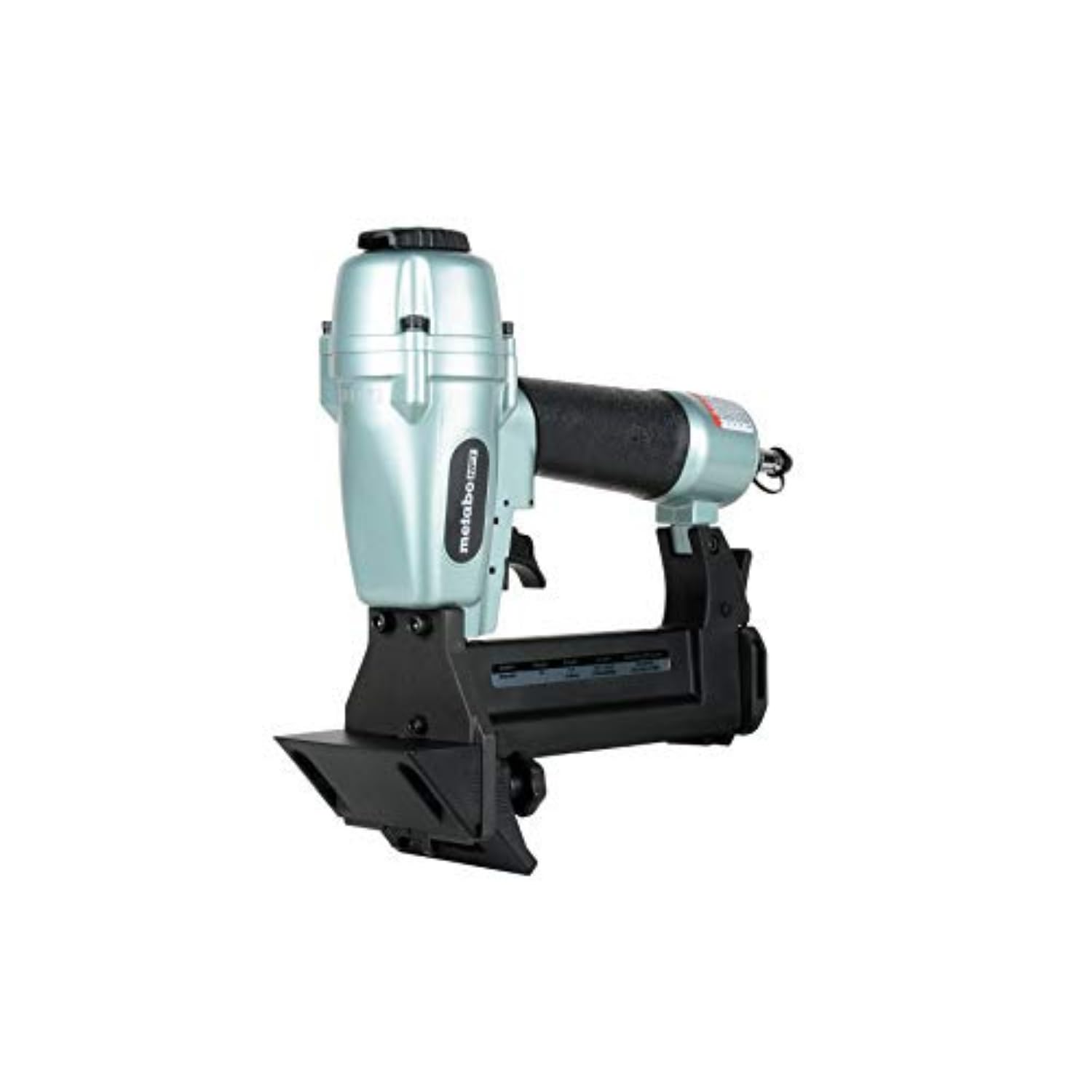
A purpose-built hardwood stapler with the depth range, weight and grip of a pro tool.
Metabo’s N4004AB is the only tool here rated by Builder and Developer Magazine as the Pro Preferred Nailer for twelve years running, from 2014 through 2025. It drives 1/4-in 18-gauge staples from 1/2-in to 1-9/16-in, and the tool-less adjustable base changes between 5/16” to 7/16” for solid hardwood and 1/2” to 5/8” for engineered hardwoods. That two-range base is the key: the same tool covers both the thinner engineered plank and the thicker solid strip you would normally reach for a different tool to handle.
Weight is where it pulls ahead. At 3.1 pounds it is lighter than the Freeman PFBC940 at 3.8 pounds and the 3PLUS HFS509040SP at 3.5 pounds, and the over-molded rubber grip keeps the arm from tiring over long shifts. The high grade composite magazine adds strength while keeping weight down, and the 360 degree adjustable exhaust port lets you point air away from your face. Sequential actuation means the trigger must be pulled for each staple in turn, which the maker uses to keep placement accurate — you cannot rapid-fire through a row.
Day-to-day, the adjustable flooring base with two hand-tightening screws is what most owners praise — it holds tight without slipping while you run row after row of staples into the tongue. Shoppers say running 1,200+ sq ft in a single day without a jam, provided the tool is oiled before and after each use. The one recurring annoyance is the base plate: it is a small, thin plate that a few find flexes slightly, and the occasional staple can bend in the tongue every eighteen feet or so. That is a single-block touch-up, not a re-lay of the board.
Why it splits the field: the lightest body, two depth ranges on one base, and a decade-plus of industry recognition make this the tool to reach for when the flooring is real hardwood rather than ply-backed engineered plank.
Pick this if: you are laying solid hardwood and want one tool that flips between solid and engineered thicknesses via a hand-tightened base.
skip it if: the small base plate flex is a dealbreaker — lighter tools have smaller footprints but less stable shoes.
5. Powernail 1845F Pneumatic Trigger-Pull 18 Gauge Flooring Stapler

Built to sit flat on awkward plank profiles and keep firing when other tools punch through.
Powernail’s 1845F is aimed at the flooring job nobody else wants: interlocking plank profiles, mixed board thicknesses and the last nine inches before the wall. It fires 18-gauge 1/4” narrow crown staples in a fixed range of 7/8”, 1”, 1-1/8”, 1-1/4” and 1-1/2 (22 to 38 mm), and it installs 3/8”, 1/2”, 9/16” and 5/8” tongue & groove hardwood. Unlike the Metabo HPT N4004AB, whose adjustability lives in a tool-less base, this tool’s adjustability is a FLEX foot — a base you fine-tune to different wood profiles and thicknesses with no shims and no tools.
Two design choices set it apart. Trigger-pull actuation means you pull the trigger to fire and use no mallet, which puts the tool squarely in the compact camp for reaching tight spaces. And the nozzle is shaped to fit the wide range of today’s tongue-and-groove and interlocking plank profiles. The compact body gets closer to walls than a full-size stapler, so you need less face-nailing at the end of a run. The kit includes a large tapping block, lubricant and an owner’s manual, so you have what you need to start immediately.
What buyers consistently report is that it has no tolerance for drama — zero malfunctions across long jobs, fast foot adjustment, and an open magazine design that makes reloading easy. One reviewer sums up the field nicely: “I have used several similar products this One best by far.” The one recurring note is about brand-matched fasteners — this tool performs best with Powernail staples and is pickier about third-party ones, so plan to buy from that ecosystem.
Where it pulls ahead
- FLEX adjustable foot fine-tunes to different wood profiles with no shims or pads
- Compact body reaches near walls — less end-of-run face-nailing on 9″ planks
- Buyers report zero malfunction across jobs from 130 sq ft up to commercial-scale runs
What to expect
- Staple range is fixed — 7/8″ to 1-1/2″ only, with no shorter or longer options
- Works best with Powernail’s own staples rather than third-party fasteners
- Steel, ABS and aluminum body is sturdy but not the lightest option here
The pick for: pros and committed DIYers with tongue-and-groove or interlocking plank and awkward wall edges to reach.
Not the pick for: anyone laid up with the wrong staple brand — match the fasteners or the tool will fight you.
Understanding the Specs
Staple gauge and crown width
Gauge is the thickness of the metal wire in the staple — 18 gauge is thinner than 15.5 or 16 gauge, which is why 18 gauge tools are the standard for engineered and laminate flooring and much lighter to handle. Crown width is the top of the staple, and the 1/4″ narrow crown is the industry standard for flooring so the legs pass through the tongue without splitting it. Anything wider tends to crack the tongue and show at the seam.
Depth adjustment and base plates
Depth adjustment is how you control where the staple head stops. A wheel or screw mechanism lets you dial in a flush seat so the next board sits tight rather than riding over the staple. An adjustable base plate does a similar job for thickness changes: the tool sits flat on planks of different heights. Without it, you would need shims or a different tool for each board size.
Actuation and trigger type
Trigger-pull actuation fires one staple per trigger pull and uses no mallet, which makes it simpler to aim. Sequential actuation on a pneumatic tool means the trigger must be reset between shots, which reduces misfires at the cost of speed. On hardwood, a misplaced staple costs you a board, so sequential fire is worth the slower pace.
Weight, exhaust and reload indicators
Weight matters because you hold the tool above the floor for the whole job — the lighter the body, the longer you can run before arm fatigue sets in. A 360 degree adjustable exhaust lets you point cold air away from your face. A reload indicator shows how many fasteners remain so you never fire a dry row into the tongue.
FAQ
Will an 18 gauge flooring stapler work on my plank?
Can I use 18 gauge floor staples instead of 15.5 gauge cleats?
Do I need a compressor for these tools?
What staple length should I use?
How long will an 18 gauge flooring stapler last?
What psi should I run a flooring stapler at?
Will 18 gauge staples stop a board from squeaking?
Do these staplers work on laminate flooring?
How close to a wall can a flooring stapler get?
Final Thoughts: The Verdict
For anyone installing a full room of engineered or solid hardwood, the 18 gauge flooring stapler that earns first place here is the 3PLUS HFS509040SP — it drives both 18 gauge staples and brad nails, has tool-free depth control, and owners push it through entire rooms of engineered and solid hardwood without a jam. The Freeman PFBC940 is the pick for anyone whose weekend project also includes trim, baseboards and cabinetry, since its 1/4″ to 5/8″ flooring band and 3/8″ to 1-5/8″ staple range give you one tool for the whole job.
If you are laying solid hardwood professionally, the Metabo HPT N4004AB is the tool builders reach for, thanks to its two-range depth base, 3.1-pound body and over-molded grip. And for anyone working interlocking plank near walls, the Powernail 1845F’s compact body and FLEX foot are worth the step up. Match the tool to the plank, size the staple to the board thickness, and keep the air line oiled and regulated.
How We Picked
We do not accept paid placement. Every pick is matched to a real buyer and a real use-case; we do not hands-on test units.
Sources & Methodology
Specifications: manufacturer listings and product documentation. Review insights: verified customer reviews, as of September 2026. Pricing: not shown on this page (it changes often); check the current price via the retailer link.
As an Amazon Associate, KitchPrep earns from qualifying purchases. This does not affect which products we feature.
Related Guides
