
Specs are compiled from manufacturer listings and verified buyer reviews and can change over time — please confirm the key details on the product page before buying.
If your flooring job keeps stalling because the tongue splinters the moment a nail touches it, the fix is almost always the gauge. A dedicated 18-gauge floor nailer drives a thinner, glue-collated L-cleat (an L-shaped flooring nail, held together in a strip with glue) that slips into the tongue pocket on dense hardwood and bamboo without blowing the board apart. That single spec — 18 gauge — is what separates a flooring nailer from the 15.5 and 16-gauge tools that split brittle tongues on strand bamboo, teak, and engineering boards. This guide covers eight air-powered 18-gauge floor nailers, from entry-level to professional grade, so you can pick the one that matches your floor and your compressor.
I’m Mohammad Maruf — the founder and writer behind KitchPrep. This guide is built by comparing the manufacturers’ published specifications and the patterns across verified customer reviews, so you get each pick’s real strengths and trade-offs instead of marketing spin.
Every pick here is pneumatic, meaning it runs off an air compressor rather than a battery or a mallet, and every one accepts 18-gauge cleats between 1-1/4″ and 1-3/4″ long. The one you want depends on your floor thickness and how much you value a jam-free run — matching those two things to your project is exactly what this 18 gauge floor nailer guide breaks down for you.
Our Picks at a Glance


How To Choose The Best 18 Gauge Floor Nailer
Before you compare models, lock in your floor thickness and your floor material — those two facts eliminate most of the field immediately. A nailer that only accepts one plate size or tops out at 1-1/4″ cleats will fight you on a 3/4″ solid oak job, no matter how well reviewed it is.
Match the base plate to your flooring thickness
The base plate sits between the nailer and the board, and it sets how deep the cleat fires. A plate sized for 3/8″ flooring sits the tool higher so the cleat hits the tongue cleanly; a 3/4″ plate drops it lower. Tools that ship with three interchangeable no-mar plates (a soft-faced plate that won’t scratch prefinished boards) cover more thicknesses without you buying extras. If you’re laying 1/2″ engineered hardwood one weekend and 3/4″ solid oak the next, three plates is the difference between one tool and two.
Mallet-actuated versus trigger-pull
You drive the cleat by tapping the bumper with the included mallet — place the tool, tap, move on. A trigger-pull nailer fires from a handle-mounted trigger instead, so you skip the mallet and some users find the rhythm faster once the tool is seated. Neither wins on paper; it depends on how you like to work. First-time installers often pick the trigger because there’s one less motion to coordinate, while high-volume installers who’ve swung a mallet for years tend to stay with it.
Air pressure and jam behavior
These tools run at relatively low pressure, and mismatched pressure is the single most common cause of jams. Drop too low and the cleat won’t fully seat; run too high and you drive the nail through the tongue. A swivel air fitting lets the gun tuck closer to the wall for your final rows, where a straight fitting tends to bang the drywall. Oil the tool every few magazines and listen for the empty-bang that tells you the magazine is out — those two habits prevent most of the headaches.
Quick Comparison
| Model | Best For | Fastener Type | Actuation | Weight | Amazon |
|---|---|---|---|---|---|
| Freeman PF18GLCN★ Best Overall | All-around value on dense and exotic flooring | 18-gauge L-cleats, 1-1/4″–1-3/4″ | Mallet-actuated | 9.68 pounds | Amazon |
| Estwing EF18GLCNPremium Pick | Prefinished hardwood with a generous warranty | 18-gauge L-cleats, 1-1/4″–1-3/4″ | Mallet-actuated | 9.2 pounds | Amazon |
| Powernail 50FTop Performer | Trigger-pull speed on engineered and solid boards | 18-gauge L-cleats | Trigger-pull | 14 pounds | Amazon |
| CFL4518 | Tight spaces and short repair runs | 18-gauge L-cleats | Mallet-actuated | 9.15 pounds | Amazon |
| Metabo HPT N4004AB | Staple-down hardwood, high-volume work | 18-gauge 1/4″ staples | Sequential trigger | 3.1 pounds | Amazon |
| Powernail PALM001 | Starting rows, final rows, and tight spots | 16 and 18-gauge cleats | Pressure-activated palm | 16 ounces | Amazon |
| NuMax S18GLCNDH | Budget entry with dual-handle flexibility | 18-gauge L-cleats, 1-1/4″–1-3/4″ | Mallet-actuated | 7.8 pounds | Amazon |
In‑Depth Reviews
1. Freeman PF18GLCN Pneumatic 18-Gauge 1-3/4″ L-Cleat Flooring Nailer
Our pick — over 4★ from 350+ verified ratings; the strongest balance of quality and price.
The reliable workhorse that turns dense bamboo and exotic hardwood into a one-pass job.
Strand-woven bamboo, teak, and engineered hardwood all go down with one tool: it fires 18-gauge glue-collated L-cleats (thin flooring nails held together in a strip by glue) from 1-1/4″ to 1-3/4″, the range that covers everything from 3/8″ engineered boards up to 3/4″ solid hardwood. What wins people over is the drop in frustration — owners repeatedly describe hundreds of square feet going down without a single jam, with the occasional misfire traced back to a light mallet tap rather than the tool itself.
It survives job-site abuse without weighing you down, thanks to a high-strength aluminum body, an anodized magazine (a hardened coating that resists scratches and rust), and heat-treated steel parts. At 9.68 pounds it’s a touch heavier than the NuMax S18GLCNDH at 7.8 pounds, but that extra mass sits in a tool that includes a long-reach fiberglass mallet and three interchangeable no-mar base plates in the box — you’re not buying accessories separately. The plates swap to handle 3/8″ through 3/4″ flooring, so one tool covers a mixed-project floor plan.
The trade-off is honesty-worthy: the customers-say pattern flags durability as mixed, with a few owners reporting tongue breakage during bamboo installs and the alignment to the nail pocket taking practice. The adjustable foot also takes a few minutes to dial in. Once set, though, the extended-reach ergonomic handle and light-strike bumper cut fatigue through long shifts, and the price-to-quality ratio lands it firmly as the all-around pick here.
What earns it the top spot
- Fires 18-gauge L-cleats from 1-1/4″ to 1-3/4″ across 3/8″ to 3/4″ flooring with three interchangeable no-mar base plates
- Long reach fiberglass mallet with padded grip and three plates are included
- Aluminum body with anodized magazine and heat-treated steel parts holds up on job sites
Where it needs a little patience
- Tongue breakage during bamboo installation comes up in some feedback
- Aligning the nail to the tongue pocket takes a few boards to dial in
Reach for this if: you’re laying dense, exotic, or engineered hardwood and want one tool that covers the full 3/8″ to 3/4″ range with the mallet and plates already in the box.
Think twice if: your job is mostly thin soft pine where a lighter, more forgiving tool would do fine.
2. Estwing EF18GLCN Pneumatic 18-Gauge 1-3/4″ L-Cleat Flooring Nailer
A professional-grade 18-gauge nailer with a tool-free jam release and a warranty that backs it.
Estwing’s offering handles the same 3/8″ to 3/4″ tongue-and-groove range as the Freeman but adds a durable lightweight aluminum body with a light-strike bumper and a tool-free quick release — meaning if a cleat jams, you clear it without hunting for tools. For prefinished flooring, the interchangeable no-mar base plates match your floor thickness so cleats seat accurately without marring the surface. It’s built for solid, engineered, bamboo, and dense exotic flooring, and it’s warrantied in the USA.
The cleats themselves seat cleanly — the recurring praise is depth consistency and speed. It runs at 85 psi based on owner experience, and installs of 300 square feet of 1/2″ oak and even 1,400 square feet of CaliBamboo nail-down went down without a single misfire, apart from the occasional easy-to-clear jam. The strike bumper needs only a light tap, so you’re not fighting the tool through a long day. It’s a solid step up for anyone who wants a smoother finish than a rental can deliver.
The honest catch is depth adjustment. Owners note there’s no fine-tuning screw, so a 3/8″ plate can blow out the groove while the 5/8″-9/16″ plate can leave cleats high enough to need a nail set. That’s the one place a picky finisher will wish for more control. Still, for the majority of hardwood and engineered installs, the Estwing hits the right depth more times than not — and the 5-year body warranty outlasts the price tag.
Where the money goes: a 5-year professional tool warranty with a 90-day wearable parts guarantee, a tool-free jam release, and USA service and support.
One gap to size correctly: the lack of a fine depth adjustment means if you’re working with prefinished boards where every cleat has to sit flush, expect to set a few by hand.
Best for: the installer who wants a professional-grade 18-gauge nailer with a long warranty and a jam-clearing system that doesn’t need tools.
Look elsewhere if: you need fine depth tuning on every cleat across different floor thicknesses.
3. Powernail 50F Pneumatic Trigger Pull 18 Gauge L-Cleat Flooring Nailer
No mallet required — the trigger-pull nailer that sets a faster rhythm on hardwood and bamboo.
For anyone who dislikes the tap-move-tap cadence of a mallet nailer, the 50F swaps the mallet for a handle-mounted safety trigger. It fires 18-gauge L-cleats into tongue-and-groove solid hardwood, exotic, bamboo, and engineered flooring, and the patented lever-actuated FLEX adjustable foot fine-tunes to different wood profiles and thicknesses without shims or pads. The no-mar foot protects delicate finishes, and the ratcheting lever repositions easily as you work down the row.
Owners who use it tend to report it installs fast: 800-plus square feet of 1/2″ Mercier engineered red oak went down at 75 psi with no misfires or jams, cleats loaded easily, and the adjustable non-marring nose plate held firm. A retired 45-year professional described it as exceeding expectations for both pro and DIY work across the 3/8″ to 3/4″ range. The easy-access gate plate and directional exhaust round out the practical details.
The honest caveat is that at 14 pounds it’s the heaviest tool on this list, and a small number of buyers report an intermittent stuck rear head that needed oil and disassembly. That’s the rare report, not the pattern, but it’s worth heeding the lubrication schedule. The price reflects professional-grade construction, so if you’re installing two rooms of standard oak, a lighter tool may serve just as well.
what separates it
- Trigger-pull actuation fires without a mallet, cutting steps from every board
- Patented lever-actuated FLEX adjustable foot works without shims or pads
- No-mar foot protects even delicate prefinished and engineered surfaces
The reality of ownership
- At 14 pounds it’s the heaviest pick here, so long shifts are more tiring
- A small number report an occasional rear-head stick that requires oiling and disassembly
The right call for: installers who want a no-mallet trigger rhythm on solid, exotic, engineered, and bamboo flooring and value a fine-tuning flex foot.
Not for you if: you’d rather a lighter tool for a smaller, softer-wood project.
4. CFL4518-18 Gauge L Cleat Flooring Nailer with Mallet
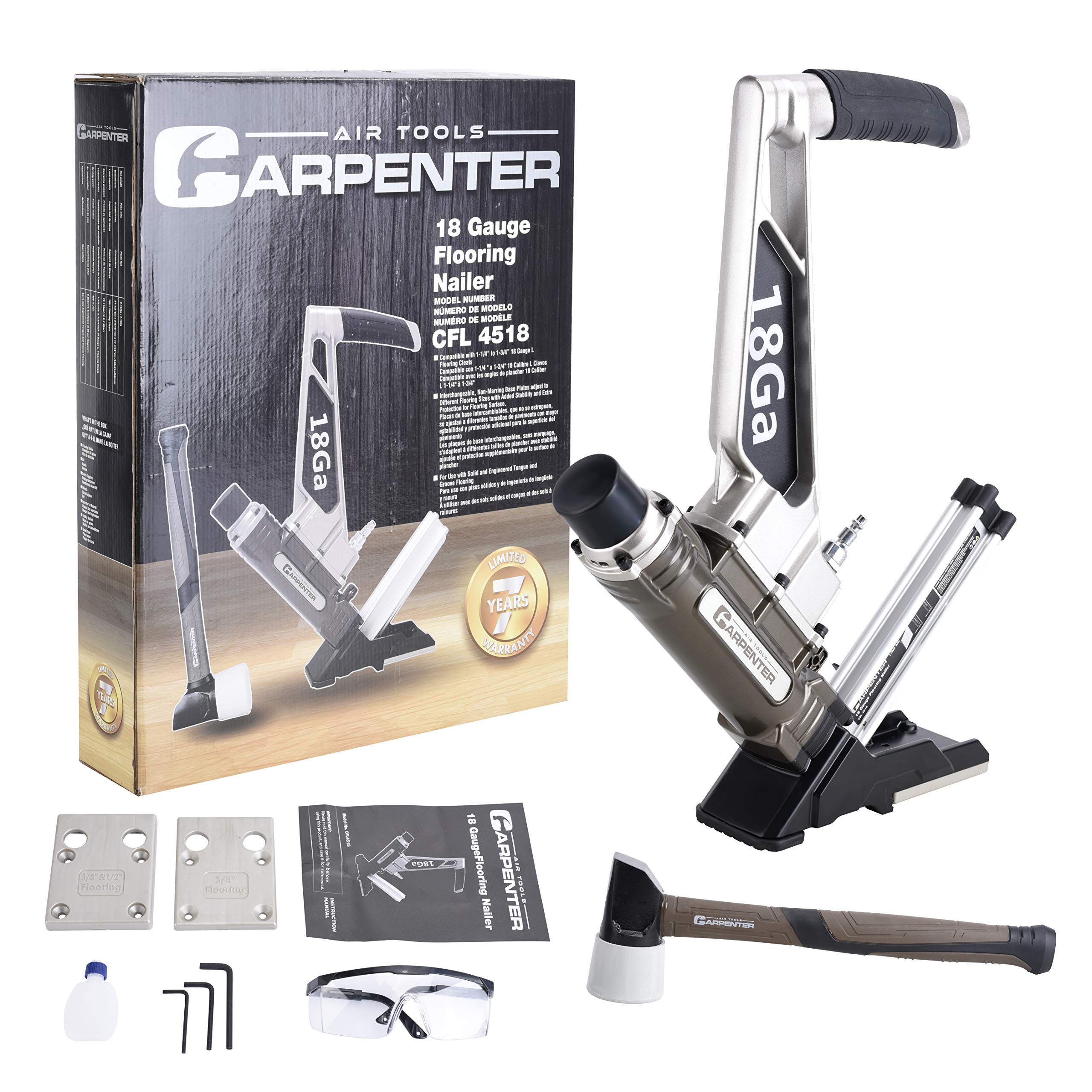
A durable aluminum-bodied 18-gauge nailer with three plates and a mallet in the box.
The CFL4518 is compatible with 3/8″ to 3/4″ engineered or solid hardwood tongue-and-groove flooring, and it ships with three interchangeable non-marring base plates so you can move between floor thicknesses. The heavy-duty heat-treated aluminum housing is built to last, and the lightweight design keeps installer fatigue down on long runs. A high-quality fiberglass rubber mallet, goggles, oil, and wrenches all come included, so the box is genuinely ready to work.
The story here is mixed, and honest shoppers should know it going in. Owners who have the tool running smoothly describe it as smoother than a rental and precise, with strand bamboo and 8″ engineered planks going down with no jams or tongue splits at 90 psi. Others report the hammer stopped returning or the nailer failed to fully sink nails after a few hundred. The customers-say pattern is genuinely split on this one, which means it’s a fit question: if your floor is one clean run of boards and your compressor holds steady pressure, the CFL4518 does the job.
The 7-year limited warranty on the aluminum housing contains the risk, but this isn’t the pick for a two-week install where downtime costs you the schedule. It’s a strong candidate for a small to mid-size job, or a backup nailer for your crew.
A warranty that punches above its class: the 7-year limited warranty on the heat-treated aluminum housing is the longest body coverage here, beating the Estwing and Freeman terms.
Read the reviews yourself: because the reliability feedback genuinely splits both ways, this is the one pick where you should weigh your project size against the risk of a warranty claim.
A good fit if: you want an 18-gauge nailer with a long housing warranty for a small or medium install, and your compressor holds steady pressure.
Consider a different pick if: your project can’t absorb a delay from a warranty claim.
5. Metabo HPT N4004AB Pneumatic 18 Gauge Flooring Stapler
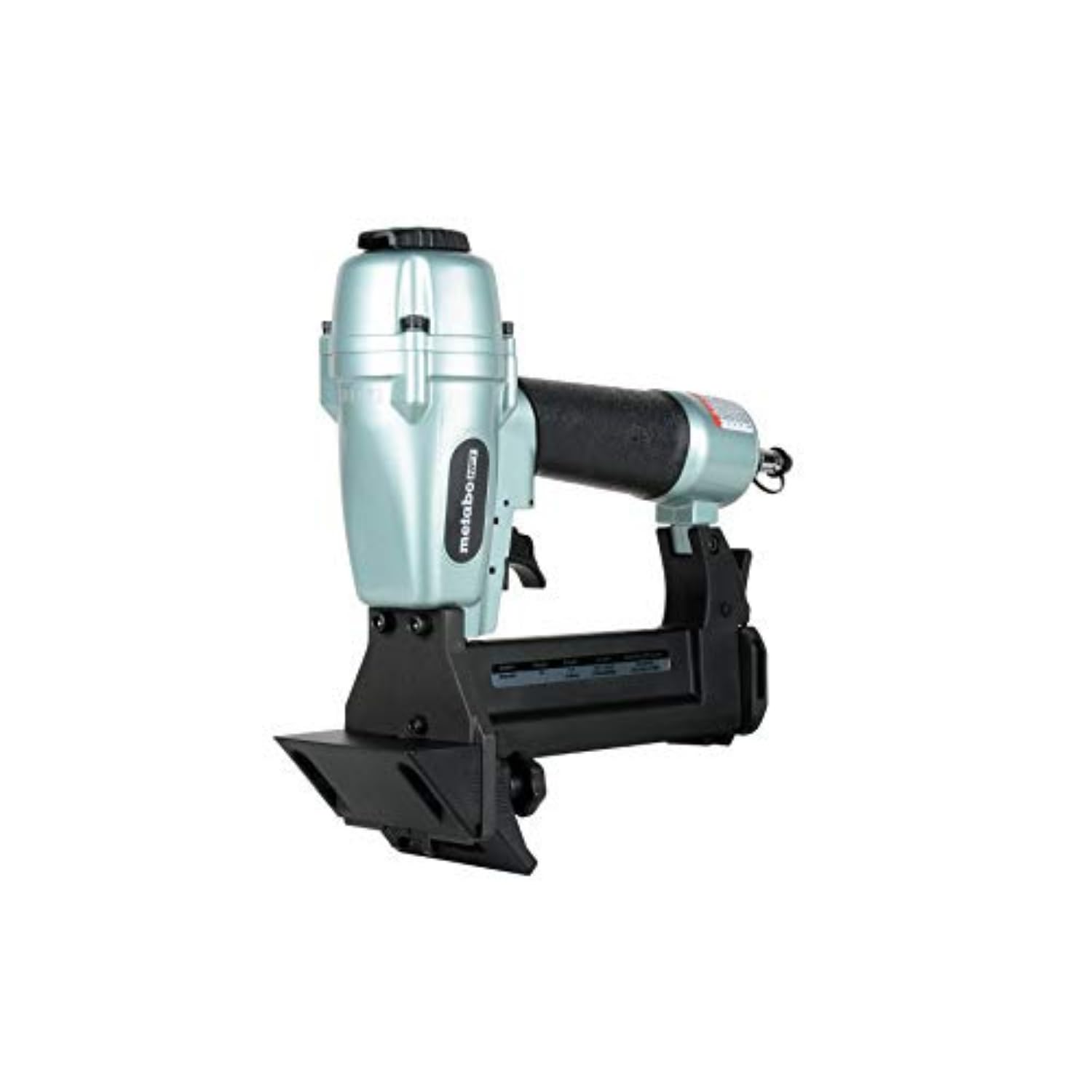
The featherweight flooring stapler that earned its reputation on pro job sites for over a decade.
Before you decide this is the same tool as the L-cleat nailers above, note the difference: the N4004AB fires 1/4″ 18-gauge staples from 1/2″ to 1-9/16″ long, not L-cleats. For solid hardwood and engineered staple-down jobs, that’s exactly what you want. Builder and Developer Magazine has named it the Pro Preferred Nailer for 12 years running.
You match the staple depth to the board without tools, thanks to a tool-less depth adjustable base that moves from 5/16″ to 7/16″ for solid hardwood and from 1/2″ to 5/8″ for engineered hardwoods. Sequential actuation places one staple at a time, which trades a little speed for accurate placement. A 360-degree adjustable exhaust points air away from your work, and the over-molded rubber grip plus the 3.1-pound frame mean you can run this all day with minimal fatigue — literally pounds lighter than the L-cleat nailers in this lineup.
The high-grade composite magazine protects against jams and further trims the weight, though it means the housing isn’t all-metal like the Freeman or Estwing. The trade-off is a tool that’s fast and light at the cost of a stapler’s slightly different fastening profile. For anyone whose install calls for staples rather than cleats, this is the pick to beat.
Why it stands out
- Named Pro Preferred Nailer by Builder and Developer Magazine for 12 straight years
- Tool-less depth adjustment spans 5/16″ to 7/16″ for solid and 1/2″ to 5/8″ for engineered hardwoods
- At 3.1 pounds it’s the lightest full-size tool on this list, with a 360-degree adjustable exhaust
Know before you buy
- Fires 1/4″ 18-gauge staples, not L-cleats, so it only suits staple-down jobs
- Sequential actuation is accurate but slower than a bump-fire rhythm
Choose it when: your floor spec calls for 1/4″ 18-gauge staples and you want a light, pro-trusted tool that runs all day.
skip it if: your flooring requires L-cleats instead of staples.
6. Powernail PALM001 PowerPalm 16/18 Gauge Flooring Cleat Nailer

The tiny palm-sized nailer that saves your starting rows, final rows, and every tight corner.
This isn’t the tool that installs your whole floor — it’s the one that saves you on the edges. The PowerPalm is pressure-activated and fits in the palm of your hand at just 16 ounces, and it drives both 16-gauge and 18-gauge L-style and T-style cleats. The specially designed tip is angled to fit into the nail pocket, magnetic to hold cleats securely, and it rotates to fit into tight spaces. It almost eliminates top nailing on hardwood and engineered tongue-and-groove flooring by letting you blind-nail the areas your floor nailer can’t reach.
The palm actuation takes some adjusting. Because the piston hammers continuously until the cleat is sunk, you have to aim carefully — it fires fast and isn’t forgiving of a crooked hold. The internal piston also tends to arrive with manufacturing lube causing a brief air blast on first use, which clears after a few cycles. Once you’ve learned the rhythm, though, it’s the difference between clean starting and final rows and hand-nailing that shows.
Owners describe it as invaluable in tight spots and worth having on hand for cabinets, doorways, and any row where your full-size nailer simply won’t fit. The value concern is legitimate — it’s a small tool at a full-tool price — but its utility on a real install is difficult to match with anything else. It also thoughtfully countersinks unset cleat nails, cleaning up after your main nailer’s misses.
The unsung hero of a flooring job: the rotating magnetic tip and pressure activation make it possible to blind-nail board-by-board in spaces where your full-size nailer physically can’t reach — niches, door frames, final rows near walls.
The learning curve is real: pressure activation fires fast, and if you’re not aiming well, cleats will bend. It rewards patience on the first few boards.
Get it if: you’re installing hardwood or engineered flooring and want to eliminate top nailing on starting and final rows and in tight spaces.
Pass if: your budget can’t stretch to a second, specialist tool on top of a full-size nailer.
7. NuMax S18GLCNDH Pneumatic 18-Gauge 1-3/4″ Dual Handle Flooring Nailer

The budget entry that lets you kneel or stand, with the full 18-gauge cleat range covered.
If you’re watching the budget and want to try a flooring nailer before committing to a pro-grade tool, the NuMax S18GLCNDH is the natural starting point. It fires 18-gauge glue-collated L-cleats from 1-1/4″ to 1-3/4″, covering the same flooring types as the top picks here, and it ships with a long-reach fiberglass mallet and three interchangeable no-mar base plates. The dual-handle design is the standout — you can kneel or stand during the install, which takes a real load off your back on a long floor.
At 7.8 pounds, it’s the lightest full-size L-cleat nailer in this lineup. Compare that to the Freeman PF18GLCN at 9.68 pounds, or the Estwing at 9.2 pounds, and the difference is noticeable over the course of a day. Owners mention firing over 1,500 cleats without issue and finishing over 1,600 square feet of work, and the dual-handle grip keeps fatigue low at long stretches. It runs around 50 psi based on owner experience, so pressure is easier to dial in on a small compressor.
Two honest notes. First, the foot adjustment for floor thickness is difficult to set — the plate needs care, and once set it’s still touchy, so aligning the tongue accurately takes practice. Second, a few owners have hit jamming, so oiling discipline matters. Overall, that’s a fair trade at the entry-level end of the price range, and the warranty covers the body for a year, with a separate 30-day wearable parts term.
What you actually pay for: the dual-handle design is the real selling point — kneeling or standing changes how long you can work without back pain, and it’s a feature the pricier picks here don’t offer.
The one thing to watch: the foot adjustment for floor thickness takes effort to dial in and stays touchy — plan on a few practice boards before the real install.
Worth it if: you’re a first-time or occasional installer who wants the full 18-gauge L-cleat range and the option to kneel or stand during the job.
Step up if: you need fine base-plate tuning for mixed floor thicknesses on the same install.
Understanding the Specs
Gauge and fasteners
Gauge measures the thickness of the fastener — thinner means smaller number. An 18-gauge L-cleat is the thinner of the flooring options versus a 15.5 or 16-gauge nail, and that thinness is exactly why it’s the standard for brittle flooring. A thicker nail displaces more wood fiber and tends to split the tongue on dense material like strand bamboo or Brazilian teak; the 18-gauge cleat slips into the tongue pocket with less risk of splitting.
Pneumatic power and air pressure
Pneumatic floor nailers run on compressed air, usually between about 50 and 90 psi depending on the tool and floor softness. Lower pressures (around 50-60 psi) suit softer engineered hardwood; harder materials often feel better at 70-90 psi. Dropping too low risks incomplete drive and jams; going too high risks blowing through the tongue. A swivel air fitting helps the tool sit closer to the wall for final rows, where a straight fitting tends to collide with the drywall.
FAQ
What is an 18 gauge floor nailer actually used for?
Can I use an 18 gauge floor nailer on solid 3/4 inch hardwood?
Will an 18 gauge nailer split bamboo or exotic flooring?
What air compressor PSI do these flooring nailers run at?
Do I need both a full-size nailer and a palm nailer?
Is a trigger-pull floor nailer better than a mallet-actuated one?
How often should I oil a pneumatic flooring nailer?
Will an 18-gauge L-cleat nailer work on prefinished engineered flooring?
What is the difference between a floor nailer and a flooring stapler?
What is the difference between an 18-gauge and a 15.5-gauge floor nailer?
Final Thoughts: The Verdict
For most tongue-and-groove installs, the winner in the search for the best 18 gauge floor nailer is the Freeman PF18GLCN — it covers the full 1-1/4″ to 1-3/4″ cleat range, ships with three plates and a long-reach mallet, and has the track record of owners running hundreds of square feet of dense and exotic flooring without jams. If you want a professional-grade tool with a longer warranty and a tool-free jam release, reach for the Estwing EF18GLCN. And for the edges and tight spots a full-size nailer can’t reach, the Powernail PowerPalm is the specialist tool that turns a two-tool job into a clean finish. Buy the right gauge for your floor and oil the tool on schedule — that’s the whole game.
How We Picked
We do not accept paid placement. Every pick is matched to a real buyer and a real use-case; we do not hands-on test units.
Sources & Methodology
Specifications: manufacturer listings and product documentation. Review insights: verified customer reviews, as of September 2026. Pricing: not shown on this page (it changes often); check the current price via the retailer link.
As an Amazon Associate, KitchPrep earns from qualifying purchases. This does not affect which products we feature.
Related Guides
