
Specs are compiled from manufacturer listings and verified buyer reviews and can change over time — please confirm the key details on the product page before buying.
A 16-gauge finish nailer that sinks nails flush every time is the key to professional trim, and the main choice is cordless versus pneumatic. Cordless models offer freedom from hoses and compressors, while pneumatic models provide the most consistent driving force at a lower cost. This guide compares the trade-offs to help you choose the right tool for your specific work style and budget.
I’m Mohammad Maruf — the founder and writer behind KitchPrep. This guide is built by comparing the manufacturers’ published specifications and the patterns across verified customer reviews, so you get each pick’s real strengths and trade-offs instead of marketing spin.
You need a 16 gauge finish nailer that sinks nails cleanly into trim without splitting the wood, and the right pick depends on if you want to drag a hose or go cordless. Your choice depends on power source, weight, runtime, and the types of wood you’ll be nailing.
Our Picks at a Glance


How To Choose The Best 16 Gauge Finish Nailer
The three main power types are pneumatic (air-powered), battery-powered cordless, and gas fuel-cell cordless. Choose pneumatic if you have a compressor in a workshop, or cordless for job sites without power outlets.
Understand Your Power Source Trade-off
Pneumatic nailers are cheaper and lighter but require a compressor and hose, which can snag and scratch your work. Cordless models eliminate the hose but are heavier and require charged batteries.
Check the Weight and Balance, Not Just Power
Extended overhead work on crown molding or ceilings will punish an unbalanced, heavy gun. Look for a model that sits at or under 5-6 pounds if you plan long days, and check that the grip shape allows one-handed operation on a ladder.
Match the Nail Range to Your Projects
These tools handle 1-inch to 2-1/2-inch 16-gauge straight finish nails. Make sure the tool’s range covers the longest nails you plan to sink, especially if you’re driving through hardwood like oak that resists penetration and often needs a deeper drive capability.
Quick Comparison
| Model | Best For | Power Source | Weight | Max Nail Length | Amazon |
|---|---|---|---|---|---|
| DEWALT DCN662B★ Best Overall | Cordless convenience in an existing 20V Max ecosystem | 20V Battery | 6 lbs | 2-1/2″ | Amazon |
| Metabo HPT NT1865DMSTPro Power | Pneumatic-like power without a compressor | 18V Battery | 6.5 lbs | 2-1/2″ | Amazon |
| Makita XNB02ZPro Grade | Tough cordless jobs using the 18V LXT system | 18V Battery | 8.12 lbs | 2-1/2″ | Amazon |
| Makita AF601 | Precision pneumatic driving on hardwood | Pneumatic | 3.8 lbs | 2-1/2″ | Amazon |
| Bostitch BTFP71917 | Frustration-free pneumatic nailing on big jobs | Pneumatic | 7.3 lbs | 2-1/2″ | Amazon |
| DEWALT DWFP71917 | Smart-point precision for one-handed overhead nailing | Pneumatic | 16 oz | 2-1/2″ | Amazon |
| Paslode 916000 | Lightweight gas-powered mobility | Gas Fuel Cell | 4.6 lbs | 2-1/2″ | Amazon |
| Ridgid R09892B | Budget-conscious battery nailing | 18V Battery | 8.95 lbs | 2-1/2″ | Amazon |
| Freeman PFN64 | Entry-level pneumatic value for softwood trim | Pneumatic | 4.2 lbs | 2-1/2″ | Amazon |
In‑Depth Reviews
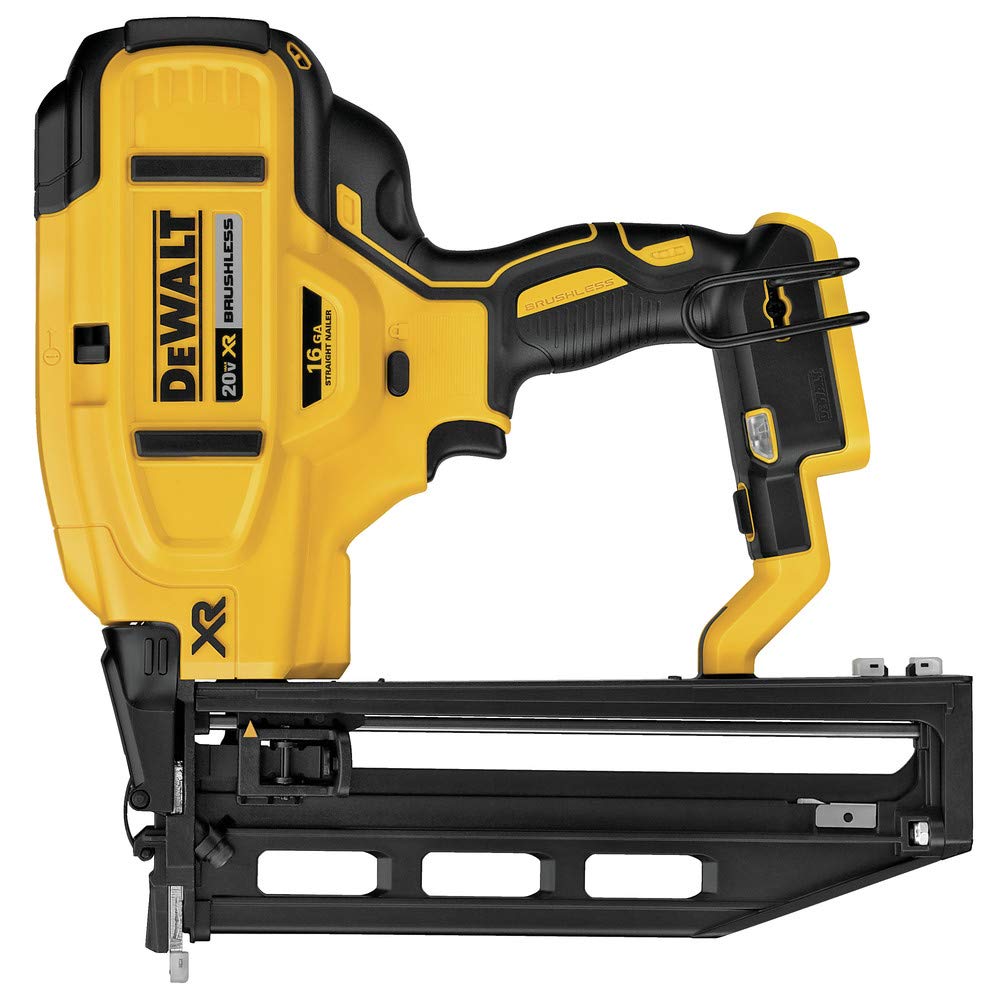
1. DEWALT 20V MAX XR Finish Nailer, Straight, 16GA (DCN662B)
Our pick — over 4.5★ from 300+ verified ratings; the strongest balance of quality and price.
Drop the hose entirely — this 20V brushless nailer delivers gas-free, compressor-free finishing in one quiet 6-pound package.
You get total freedom from the air hose here. The brushless motor (a motor without brushes that need replacing, so it runs longer and lasts longer) boost runtime and durability, and because it’s 100% battery powered, there’s no gas cell, no compressor, and no hose dragging across your work. Owners already in the DEWALT 20V Max family are especially happy, reporting that it uses batteries they already own and that ditching the cord feels liberating on a trim job.
You see exactly where each nail lands thanks to a micro nose that improves line of sight. A tool-free selectable trigger flips between sequential and contact actuation (single precise shots or rapid bump-firing), and a tool-free depth adjustment lets you dial in countersinking without reaching for a wrench. At 6 pounds, it stays manageable for an afternoon of casing and baseboard work.
Reliability is the standout across owner feedback — this is the quality play, backed by a broad 4.7-star consensus from over 300 buyers. The only mixed note is battery life, which makes sense on a brushless tool: runtime depends on the amp-hour size of the battery you slot in. If you’re not already holding DEWALT 20V batteries, factor that into your decision.
Pro trim jobs: you want to finish rooms without the hiss and drag of an air compressor, and you’re invested in the DEWALT 20V battery system.
DIY occasional use: you need a bargain bare-bones tool and don’t already own compatible 20V Max batteries.
2. Metabo HPT 18V MultiVolt Brushless Cordless Finish Nailer Kit, 16 Gauge (NT1865DMST)
The closest a battery nailer gets to pneumatic punch — an air spring drive system that fires like a hose-fed gun without the hose.
Pros who have never liked a cordless nailer until now will appreciate this kit. The air spring drive system delivers performance similar to a pneumatic tool, and the specs back the claim: up to 3 nails per second with no ramp-up time, and roughly 950 finish nails per charge on the included compact 2.0Ah battery. A 30-year carpenter puts it plainly — it works like an air gun without the hose, better balanced than he expected, and he chose it over a rival cordless because it’s actually serviceable.
Adjustments are genuinely tool-free: a depth-of-drive adjuster and selective actuation with bump or contact drive dial in exactly how deep each nail sinks, while a side lock switch prevents accidental firing when you set the gun down. The included 18V 2.0Ah battery carries a fuel gauge (a small display that shows remaining charge), and the whole kit ships with a charger, contractor bag, safety glasses, and a no-mar nose cap to protect your trim. At 6.5 pounds it is heavier than an air gun, though even a lighter-framed user reports handling it without issue.
The thing everyone raves about is genuine pneumatic-level driving force with zero compressor upkeep. It’s a premium investment, but you’re paying for a sealed system that skips gas refills entirely and runs clean off a brushless motor with a longer per-charge runtime.
MultiVolt power punch: serious finish carpenters who want cordless mobility but refuse to give up pneumatic driving depth and speed, especially on crown and casing.
Heavier head weight: occasional DIYers who would balk at the premium price for a tool that gets light use.
3. Makita XNB02Z 18V LXT Straight Finish Nailer, 16 Gauge, 2-1/2″
A cordless workhorse that will run a full day of ceiling and shiplap work on a single 5.0Ah charge.
Makita’s cordless finish nailer drives standard 16-gauge straight nails from 1″ to 2-1/2″ and claims up to 1,000 nails per charge on a 5.0Ah 18V LXT battery (sold separately). The compact center height lets you view around the nose tip in tight spots — a real advantage when fastening inside cabinets or toe-kicks. An anti-dry fire mechanism helps prevent driving blanks and damaging the work surface when the magazine runs low.
Real-world endurance is the story here: one owner installed 525 sq ft of tongue-and-groove ceiling plus 400 sq ft of shiplap on a single charge, using 1.5″ stainless nails and finishing the day without swapping batteries. The trade-off shows up in the numbers — at 8.12 pounds this is a heavy gun, and multiple owners flag that they keep hearing protection on because it is very loud. Depth adjustment also earned mixed feedback, with some turning to pliers rather than trusting the dial.
The honest fit note: nail depth is less consistent than a pneumatic gun — the review pages sum it up — with a few nails per several hundred needing a manual tap from a punch. It stops short of being a fault for trim work, but it means this shines brightest on high-volume, high-mobility jobs where its battery endurance outweighs the occasional proud nail.
Cordless crews: you live on a ladder doing ceilings and long trim runs where hose management is the enemy and battery life is everything.
Budget buyers: you demand dead-perfect countersink on every nail for high-end cabinetry — a pneumatic gun will beat it on consistency.
4. Makita AF601 16 Gauge, 2-1/2″ Straight Finish Nailer
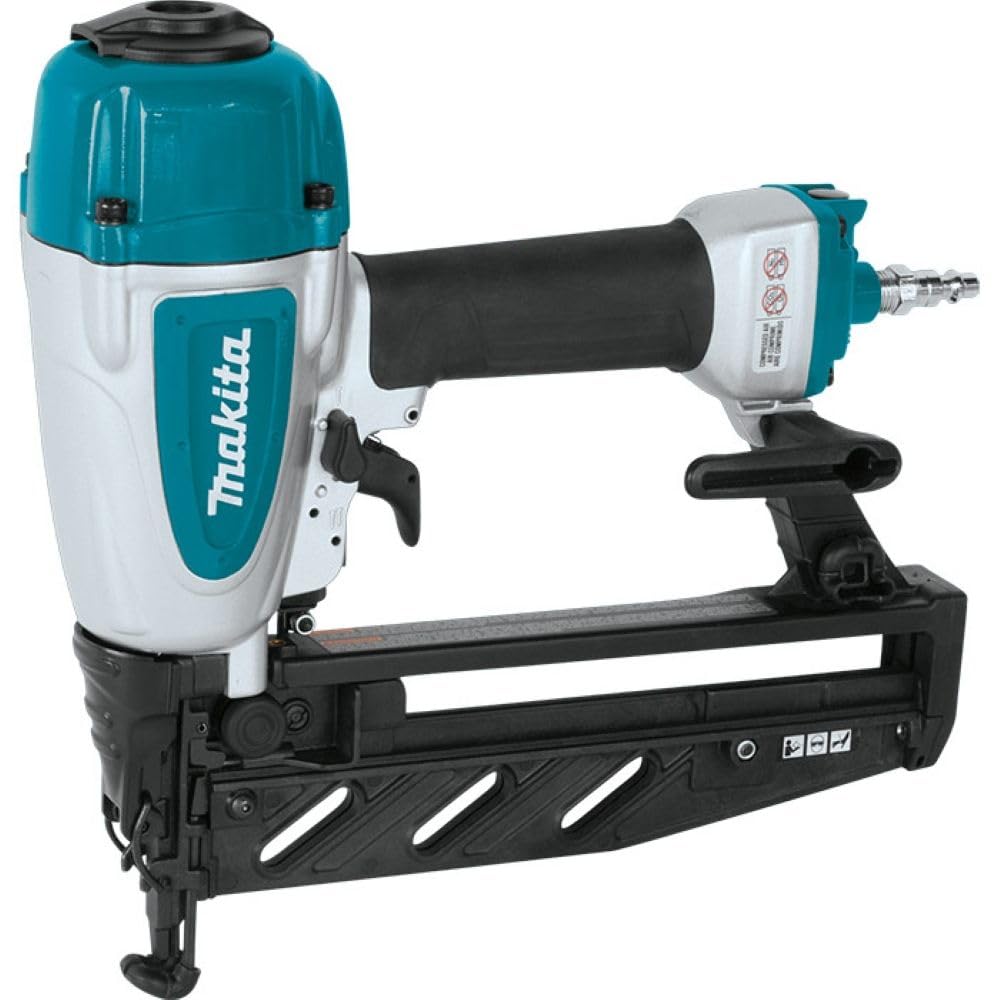
The pneumatic featherweight at 3.8 pounds that powers clean through 3/4″ oak where pricier cordless guns struggle.
The AF601 reads like a checklist for pros who hate fuss: an efficient motor design offers leading power performance, a nail lock-out mechanism stops dry-fires that can damage both tool and work surface, and a tool-less depth adjustment handles flush and countersink precise nailing. The built-in air duster even clears sawdust from your work line as you go — a small touch that keeps your nail seats clean.
The defining trait is raw pneumatic power at a forgiving weight. Buyers report the gun “sets nails accurately and consistently even through 3/4″ oak” — the exact hardwood scenario that trips up budget guns. The grip is a known weak point: it can start rolling after a few hundred nails, and the rubber nose foot occasionally comes off too easily. But the enthusiasm is loud about the power-to-weight ratio, with one impressed owner calling it superior in overall quality to a DEWALT pneumatic they tried first.
At 3.8 pounds, this gun is barely half the heft of the Makita XNB02Z cordless, though it trades that lightness for a hose tether and the need for an air supply in the 70-120 PSI range. For stationary shop trim work, few pneumatic 16-gauge guns feel this agile.
Pneumatic workhorse: hardwood trim and casing where you need consistent countersink depth and can work near a compressor.
Air hose needed: you have no air compressor yet — factor that whole setup cost into the real price.
5. Bostitch 2.5-in X 16-Gauge Clip Head Finishing Pneumatic Nail Gun (BTFP71917)
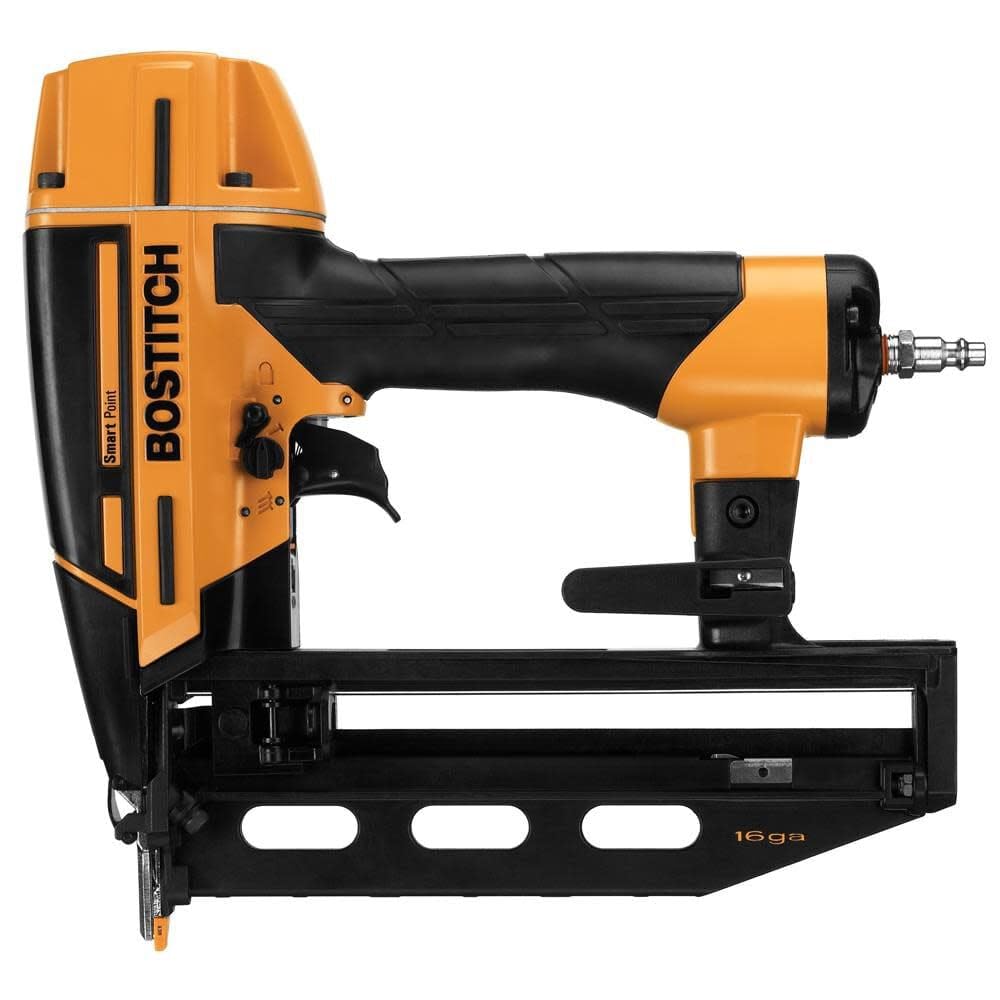
The pneumatic floor-and-trim marathoner — Smart Point tech and oil-free guts that survived thousands of nails without a single jam.
Bostitch packs this gun with its Smart Point technology, which shrinks the nose so you see exactly where each nail lands without compressing the contact trip to fire. The result is precision placement that owners describe as frustration-free, and the oil-free operation removes the risk of oily stains bleeding into your trim. It drives 16-gauge finish nails from 1-inch to 2-1/2-inch lengths, and the selectable trigger flips between sequential and contact modes for either careful or rapid-fire nailing.
The endurance proof is hard to argue with: one owner took it through nearly 2,000 sq ft of custom flooring, sinking thousands of nails “without missing a beat” — no jams, no frustration. That is the top thing everyone raves about, with the smaller nose and easy jam clearing (you simply pop the magazine open) earning consistent praise. The one critique to be honest about is durability being mixed, with a single account of an early failure after about 20 minutes of use — rare against the overwhelmingly positive pattern.
The trade-off to name here is weight. At 7.3 pounds, this is the heaviest pneumatic on this list — roughly double the Makita AF601 at 3.8 pounds — so it is better on a floor or bench than dangling overhead all day. If you’re covering large horizontal surfaces like flooring and decks, the reliability is worth the heft.
Production nailing: you’re nailing down flooring or long trim runs where a jam-free, oil-free gun saves you hours of frustration.
Standard fasteners: your work is mostly overhead crown molding — 7.3 pounds will wear out your arms by lunch.
6. DEWALT Finish Nailer with Precision Point, 16GA (DWFP71917)
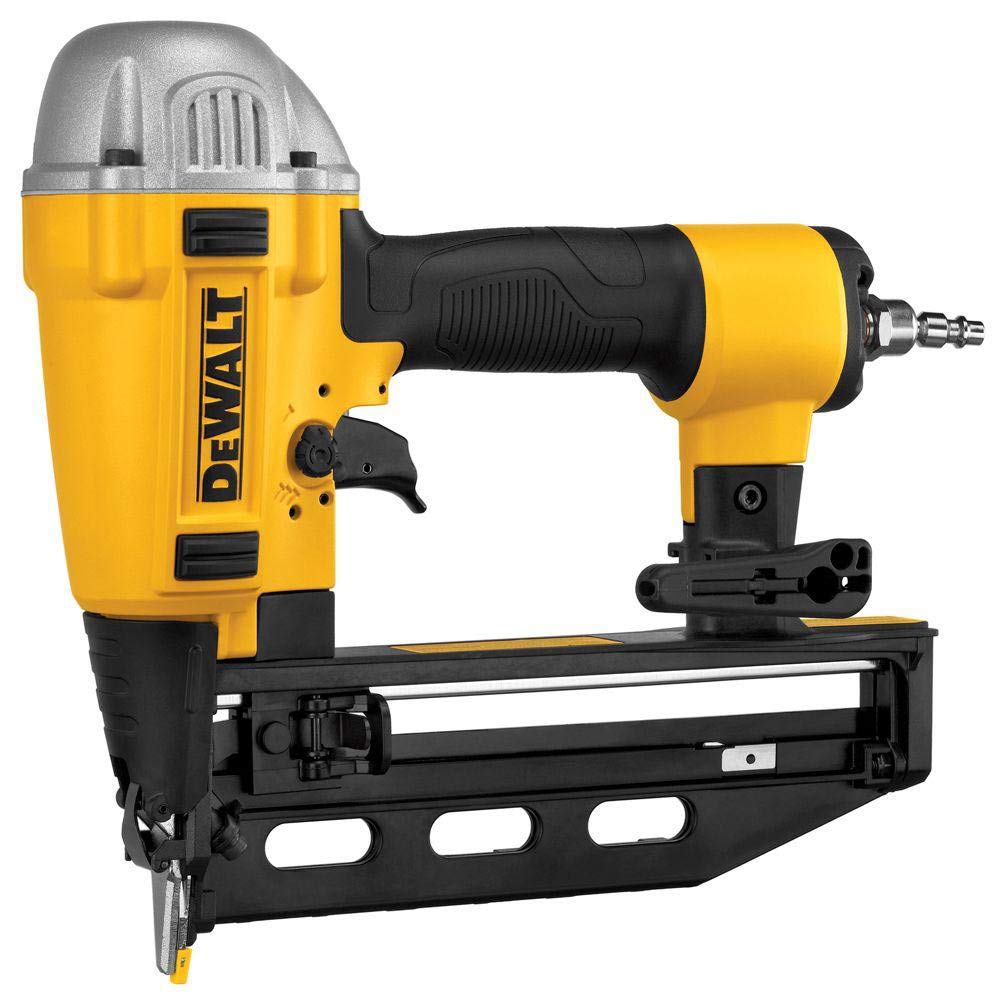
One-handed overhead hero — the Precision Point nose that delivered a full overhead job without a single nail needing manual setting.
DEWALT’s pneumatic Precision Point design earns its name in the exact scenario that frustrates trim carpenters: working overhead with one hand holding the board. The slim nose improves sight lines dramatically, and one owner reports completing an entire overhead project using only a small compressor and light air hose without ever needing to hand-set a nail. For those weighing DEWALT’s pneumatic line against their cordless DCN662B above, this is the budget air-powered sibling that holds its own.
The value story is strong — buyers consistently call it a great deal and a great investment, highlighting easy operation and clean finishing. But the honest trade-off in the feedback is the micro tip itself: several owners note that the tiny nose surface can dent soft material easily, even when you’re not trying to press it tight. It’s a precision-versus-pressure catch: you gain visibility, but a larger-shoe gun gives you more surface to clamp the material before firing.
Owners mention mixed jamming and durability, which reads like a quality-control lottery rather than a design flaw. It holds a 4.6-star consensus across a few hundred buyers, making it a solid mid-range pneumatic for anyone who already owns a DEWALT compressor and wants the brand’s Precision Point placement without paying the cordless premium — though the fine print is that it depends on the nails you feed it.
Lightweight is the headline here at just 16 ounces, which makes it friendly for extended overhead work where a 7.3-pound gun like the Bostitch would be pure misery. It runs best on a modest compressor for trim tasks, not production framing.
Detailed trimwork: one-handed overhead nailing and tight spots where the slim Precision Point nose gives you a clear view of the fastener.
Outdoor mobility: heavy production use on hardwoods where the delicate tip can mar the surface — treat the nose with care.
7. Paslode Cordless Finish Nailer 916000, 16 Gauge

The lightest true cordless finish nailer at 4.6 pounds — gas-powered power that handles overhead work with ease.
Paslode’s cordless approach skips batteries for heavy lifting and instead uses a fuel cell system: a small gas canister provides the combustion power to drive nails, while a 7.4V Li-ion battery powers the firing mechanism. The result is a lightweight 4.6-pound tool that one owner calls the lightest cordless nailer available — a serious advantage for overhead crown molding work. It’ll sink 1-1/4-inch to 2-1/2-inch 16-gauge straight finish nails into hardwood, with the battery rated for up to 12,000 nails per charge.
This gun has proven itself in field use with continuous work weeks and 700+ nails fired without a misfire or jam, and it handles 1.5″ to 2″ nails perfectly. It’s a replacement for an older Paslode model for many owners, who find the newer tool much easier to load and use. The trade-offs are the same ones every gas nailer buyer must accept: it needs both a fuel cell and a battery, produces a faint gas smell as it fires, and requires regular cleaning and maintenance to keep the combustion chamber happy.
Despite its positioning as a step below the pro cordless tier, this Paslode turns heads with its quality and value. It’s the go-to for tradespeople who need the freedom of cordless without the heft of a battery-powered gun.
Fuel-cell freedom: gas power in a 4.6-pound frame, delivering real cordless freedom that overhead work demands.
Gas cartridge cost: you must keep a fuel cell stocked and stay on top of cleaning — skip the maintenance and the combustion system will remind you.
8. Ridgid HyperDrive 16 Gauge 18v Brushless 2-1/2 In. Straight Finish Nailer (R09892B)

Cordless speed that an owner says outperforms DEWALT — but this 8.95-pound bruiser rewards forearm strength.
Ridgid’s 18V brushless entry in the cordless finish nailer space impresses with speed and power, with buyers reporting it saves real time compared to setting up a compressor, particularly for ladder work. Its brushless motor keeps runtime strong on heavy jobs like fence boards and attic bird-blocking — work where you’d rather not drag a hose up a ladder. Owners directly note it outperforms DEWALT and cheaper alternatives in speed and reliability.
Two honest caveats frame this pick. First, the weight — at 8.95 pounds it is heavy for a trim gun, a recurring note from owners who find it a bit of a workout for finish work. Second, it arrives as a bare tool: the battery and charger are sold separately, which is a significant consideration if you are not already in the Ridgid 18V ecosystem. It is also sold in refurbished condition, certified to look and work like new after functionality testing.
The value angle is still the headline for buyers already holding Ridgid batteries — they call it a real bang for the buck and a nice tool to have. It is a man’s-tool proposition: not the most refined trim gun, but a rugged, fast cordless option for tough jobs where finesse yields to brute-force cordless power.
Heavy gauge work: you own Ridgid 18V batteries and need a fast cordless gun for outdoor and ladder work — not delicate interior trim.
Small hands: fine finishing or extended overhead work is your game, where its weight wears you out and a nimble 3.8-pound pneumatic shines instead.
9. Freeman PFN64 Pneumatic 16-Gauge 2-1/2″ Straight Finish Nailer

The budget pneumatic that nails softwood trim beautifully for a fraction of what big-brand pro guns cost.
Freeman positions itself as the entry-level value king, and the PFN64 supports the claim with a build that refuses to feel cheap. It drives 16-gauge straight finish nails from 1″ to 2-1/2″ and comes loaded with pro touches: tool-free depth adjustment wheel, quick jam release, a no-mar safety tip to protect surfaces, and a comfortable grip. The anodized aluminum magazine and a one-piece hardened steel drive blade are quality touches that explain why owners call it a performer that beats hand nailing.
At 4.2 pounds, this gun is featherweight compared to the 7.3-pound Bostitch — almost exactly half the heft — but matches it on 2-1/2-inch nail capacity. The catch is real, though: it struggles to drive 2-inch nails through dense 3/4-inch oak, jamming and refusing to countersink unless you feed it very high compressor pressure around 135 PSI. For standard softwood trim and casing, customers note it’s exceptional; it’s only the hardwood test that trips it up.
The price-to-value read is where this gun wins marketshare — it’s the budget pick for DIYers doing baseboards and crown in pine and poplar, backed by a rock-solid 4.3-star pattern across over a hundred buyers who mostly call it a steal against -300 pro guns. It includes a belt hook, 360-degree swivel exhaust to direct air away from your face, and a 7-year limited warranty with a 90-day wearable parts warranty — an impressive safety net for the entry tier.
Just be clear-eyed about what you’re getting: this is the gun for trim on softwoods where it delivers outstanding value, not a hardwood flooring monster. If oak and mahogany are daily materials, the Makita AF601 at 3.8 pounds is worth the jump up.
Starter kits: first-time buyers and weekend renovators installing pine and poplar trim who want pro-grade features at an entry-level price.
Daily abuse: your projects center on dense hardwoods like oak — this gun strains exactly where a pro-grade pneumatic excels.
Understanding the Specs
Nail Gauge and Length Range
16-gauge refers to the thickness of the nail shaft — thicker than an 18-gauge brad nailer but thinner than a 15-gauge angled nailer. That’s why 16-gauge is the balance for trim: it holds strongly without splitting the wood. The length range, usually from 1 inch up to 2-1/2 inches, determines what materials you can join. Longer nails are for thicker stock like door casing into framing; if the tool caps at 2 inches, you lose the ability to sink a 2-1/2-inch nail into a solid door jamb. A longer max length on the spec sheet is always a flexibility win.
Magazine Style
Finish nailers come with either a straight or angled magazine (the part that holds the nails). A straight magazine is standard for most trim work and feels balanced in the hand. Angled magazines let you fit the tool into tight corners, but they also limit which nails you can buy — angled nails won’t feed in a straight-magazine gun. When the spec says “straight finish nailer,” it means you need to buy 16-gauge straight nails, not the angled variety used by some framing-adjacent tools.
FAQ
Will a 16-gauge finish nailer work with my existing air compressor?
What is the difference between a 16-gauge and an 18-gauge finish nailer?
How do I fix a jammed 16-gauge finish nailer?
Why does my finish nailer leave nail heads sticking out of hardwood?
How many nails can i expect from a cordless finish nailer battery charge?
Can a 16-gauge finish nailer be used for flooring installation?
Is a brushless motor worth paying extra for in a cordless finish nailer?
Do cordless finish nailers have the same driving power as pneumatic nailers?
Final Thoughts: The Verdict
For most buyers, the 16 gauge finish nailer winner is the DEWALT DCN662B because it delivers cordless, gas-free convenience in a reliable 6-pound package — ideal for anyone already inside the DEWALT 20V ecosystem. If you want pneumatic-level power without a compressor and refuse to compromise on driving depth, grab the Metabo HPT NT1865DMST. And for the budget-minded who already own an air compressor and work mostly with softwoods, the Freeman PFN64 delivers dependable trim nailing at a price that’s tough to argue with.
How We Picked
We do not accept paid placement. Every pick is matched to a real buyer and a real use-case; we do not hands-on test units.
Sources & Methodology
Specifications: manufacturer listings and product documentation. Review insights: verified customer reviews, as of September 2026. Pricing: not shown on this page (it changes often); check the current price via the retailer link.
As an Amazon Associate, KitchPrep earns from qualifying purchases. This does not affect which products we feature.
Related Guides
