
Specs are compiled from manufacturer listings and verified buyer reviews and can change over time — please confirm the key details on the product page before buying.
A 16-foot ladder is the point where household reach meets real danger. You need it for ceiling work, gutter cleaning, roof access, or tall attic hatches — but you also need it to stay rigid under you and store without taking over your garage. This guide ranks 16-foot ladders by material, weight capacity, collapse mechanism, and stability at full extension.
I’m Mohammad Maruf — the founder and writer behind KitchPrep. This guide is built by comparing the manufacturers’ published specifications and the patterns across verified customer reviews, so you get each pick’s real strengths and trade-offs instead of marketing spin.
If you need to reach a 20-foot ceiling or clean your gutters, a 16 foot ladder is the tool that gets you there safely. The best pick for most people is the UC UP CLIMBER Telescoping Ladder because it is light enough for one person to handle, while the Louisville Fiberglass Twin Front offers maximum stability for two-person jobs.
Our Picks at a Glance


How To Choose The Best 16 Foot Ladder
16-foot ladders come in three distinct types: rigid extension, twin-front step, and telescoping. You have rigid extension ladders that lean against a wall, twin-front step ladders that stand on their own, and telescoping models that collapse into a compact bundle. Your storage space and typical tasks determine which type fits.
Choose the ladder type based on your tasks
A telescoping ladder is the choice if storage space is tight — most collapse to around 37 to 40 inches, meaning they fit in a car trunk, closet, or behind a door. The trade-off is that they flex slightly at full extension and must lean against a support; they cannot stand alone in the middle of a room. A rigid extension ladder is heavier and longer to store, but it feels more solid and is the standard for roof and gutter work.
Load capacity defines your safety margin
Check the load capacity before anything else. Most telescoping models in this range support 300 to 330 pounds, while a heavy-duty fiberglass twin step ladder can carry 375 pounds. If you are a larger person or plan to carry tools up with you, aim for the higher number — that extra margin is what keeps the ladder from feeling like it is working too hard.
Material dictates weight and portability
Aluminum ladders are lighter and rust-resistant, which is why nearly every telescoping model uses it; the trade-off is that aluminum flexes more than fiberglass. Fiberglass is heavier (the twin-step pick here weighs 85 pounds) but stiffer and non-conductive, which matters if you ever work near electrical lines. If you move the ladder alone, weight should be a top consideration — a 30-pound aluminum extension ladder is manageable, while an 85-pound fiberglass unit genuinely needs two people.
Quick Comparison
| Model | Best For | Max Height | Load Capacity | Weight | Amazon |
|---|---|---|---|---|---|
| Louisville FM1414HD★ Best Overall | Two-person household projects | 168 inches | 375 pounds | 85 pounds | Amazon |
| Louisville AE2216Premium Pick | Classic extension work | 16 feet | 300 pounds | 30 pounds | Amazon |
| UC UP CLIMBER Telescoping | Roof and RV access | 16.5 feet | 330 pounds | 15 pounds | Amazon |
| Treemoo Telescoping | Compact attic access | 16 feet | 330 pounds | — | Amazon |
| JADDUO Telescoping | Van life and RV owners | 16.5 feet | 330 pounds | — | Amazon |
| SINMEIRUN Telescoping | Budget-friendly home use | 16.5 feet | 330 pounds | 25 pounds | Amazon |
In‑Depth Reviews
1. Louisville Ladder 14-Foot Fiberglass Twin Front Step Ladder
Our pick — over 4.5★ from 450+ verified ratings; the strongest balance of quality and price.
The heavyweight champion that stands on its own and lets two people climb at once.
The raptor boot feet with slip-resistant bonded tread are what win people over; buyers report feeling completely secure on the non-slip footing even on smooth floors.
The main drawback is its 85-pound weight. At 85 pounds, this is not a one-person ladder for most people — as owners mention, “it is pretty heavy for one person to move and you definitely need a second person.” That heft is the price of fiberglass, but it also means the ladder does not wobble or flex the way lighter aluminum units can. The SHOX system (Louisville’s built-in shock absorption for accidental drops) and heavy-gauge steel hinges add durability that owners on construction sites say holds up to daily abuse.
This one reaches a maximum height of 168 inches — technically 14 feet — but with a person’s reach added on top, it handles the same 20-foot ceiling jobs that prompted several owners to call it “great value” and “well worth the money.” It meets or exceeds ANSI and OSHA safety standards, which matters if you are using it for work rather than just home projects.
What wins people over
- 375-pound capacity — the sturdiest rating in this guide
- Double-sided steps let two people work at once
- Non-slip raptor boot feet feel planted on smooth floors
- Fiberglass build resists flex and survives construction sites
The honest trade-off
- 85 pounds is genuinely a two-person carry
- Stores tall — no collapsing to a compact size
Reach for this if: you prioritize a rock-solid, freestanding platform and have a second person (or a strong back) to move it.
Look elsewhere if: you need something that collapses small enough for a car trunk or closet.
2. Louisville Ladder 16-Foot Aluminum Extension Ladder
The traditional extension ladder done right — light enough for one person to manage alone.
For classic roof and gutter work, this aluminum extension ladder hits the balance between strength and portability. At 30 pounds with a 300-pound load capacity, it is dramatically lighter than the fiberglass twin step above — nearly a third of the weight — which is exactly why owners say they can carry and position it by themselves. The 16-foot maximum height comes from modified I-Beam side rails made from full 3-inch extrusions, so it stays stiff without the bulk.
The QuickLatch system is the standout feature here. It secures both the fly and base sections during extension with a straightforward mechanism that owners describe as smooth to extend and retract — several note it operates more cleanly than traditional sliding stops that can pinch fingers. The steel swivel safety shoe with metal shield grips well even on uneven or soft ground; as owners put it, the feet “grip well in dirt.”
What makes this the premium pick for many is the combination of an established brand, ANSI and OSHA compliance, and real-world confidence. One larger owner who needed a ladder that would “hold me safely and solidly” found this one worked great. The only recurring note is that some units arrive with minor cosmetic damage from freight shipping, so inspect yours on delivery.
Why it stands out: The QuickLatch system replaces the dangerous sliding stops of older extension ladders, and at 30 pounds it is a realistic one-person carry for a 16-foot rigid ladder.
Fair warning: As a leaning ladder, it cannot stand alone — you need a wall or eave to rest it against.
3. UC UP CLIMBER Telescoping Ladder
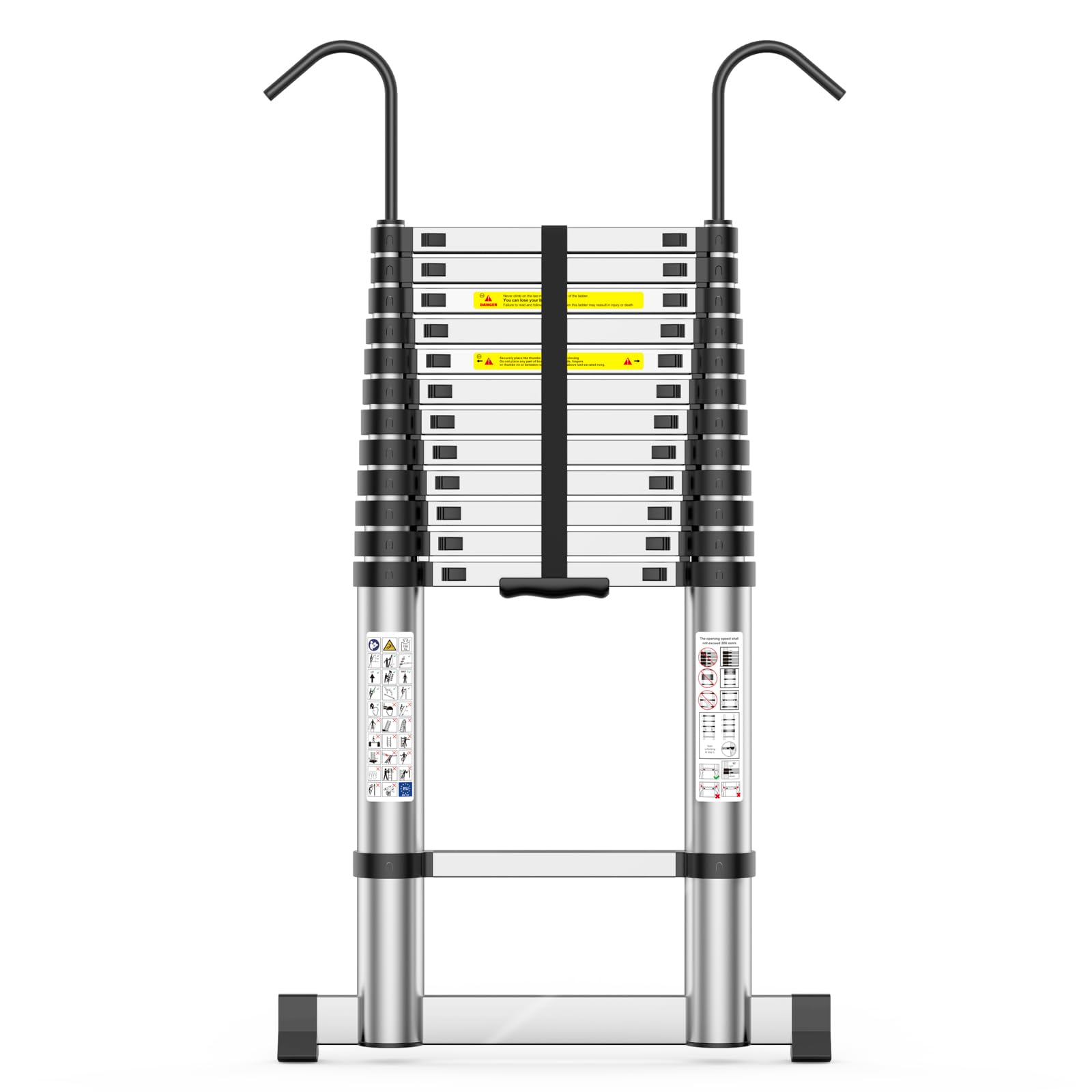
The 15-pound telescoping ladder light enough that a spouse can set it up solo.
This is the ladder that replaces the “heavy dangerous ones” — as customers note, it is “a great unit that my wife can set up and use without my help.” At just 15 pounds, it is the lightest full-size option in this guide, yet it still supports 330 pounds over its 16.5-foot maximum height. The all-aluminum build is rust-resistant, which makes it practical for both indoor jobs and outdoor roof or RV work.
The design has two notable upgrades over basic telescoping models. First, the double hook system adds two detachable hooks at the top that grip roof corners or ledges for extra security — and they still work indoors if you turn them toward you. Second, the overlapping section design makes the legs thicker at the joints, which owners say provides better stability at full extension than they expected from a telescoping unit.
There are caveats worth knowing. The 16 rungs are spaced wider than a standard ladder, which some shorter climbers find awkward. And telescoping ladders inherently flex slightly in the middle — one owner noted it “bends slightly in the middle no matter what length you have adjusted it to,” which is a trait of the category rather than a defect of this unit. The trade-off for 15 pounds of portability is that it will never feel as rigid as the 85-pound fiberglass twin step.
Where it shines
- 15 pounds — easiest full-height ladder to carry and maneuver
- 330-pound capacity in a featherweight aluminum frame
- Double top hooks add roof and ledge security
- Collapses compact for RV, trunk, or closet storage
Where it gives ground
- Wider rung spacing than standard ladders
- Noticeable mid-section flex at full extension
Best suited for: anyone who needs a real 16.5-foot reach but cannot handle lifting a heavy rigid ladder.
Think twice if: you are tall and dislike wide rung spacing, or you want zero flex at full height.
4. Treemoo Telescoping Ladder 16FT
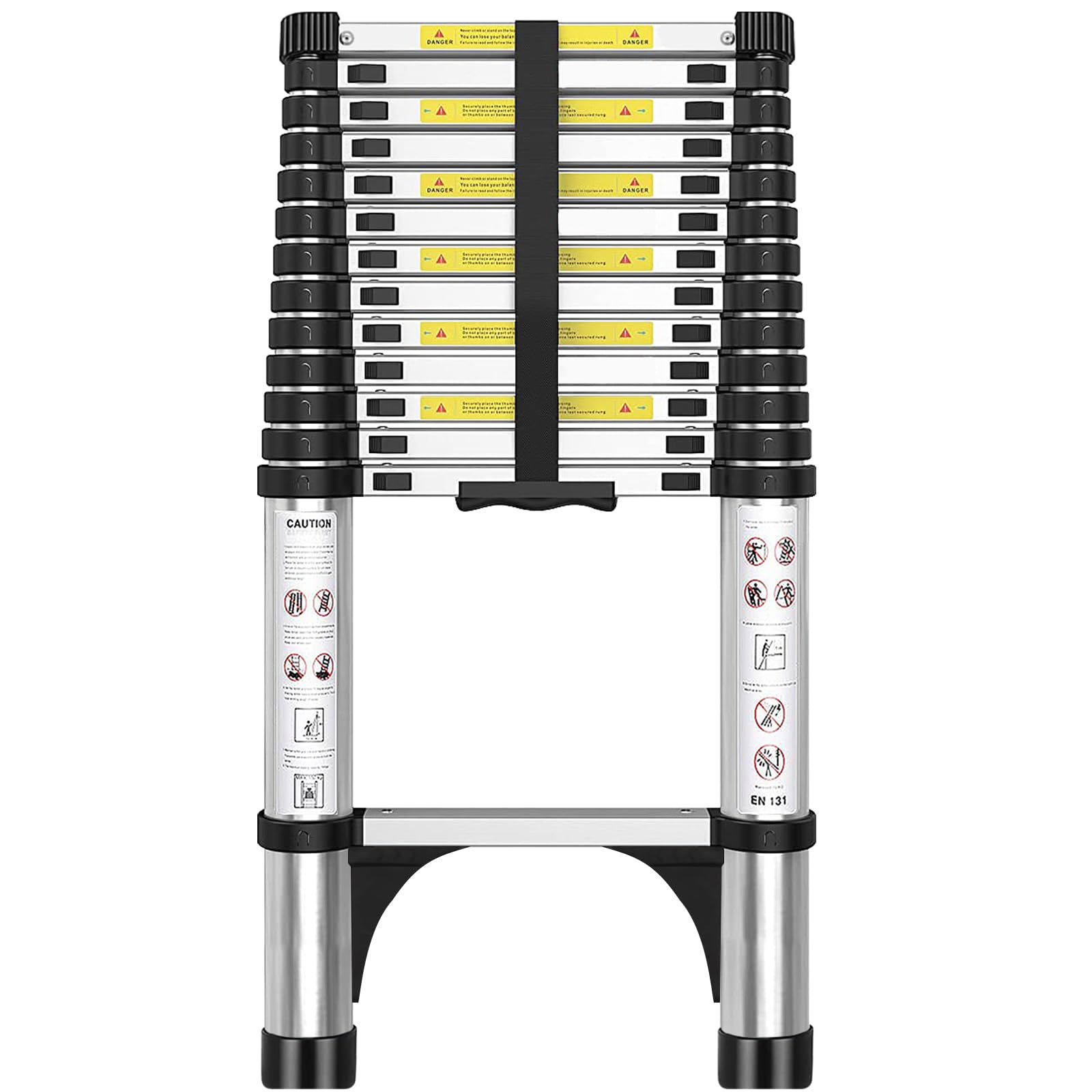
The attic-access specialist that folds to 39 inches and tucks behind a door.
This is the ladder owners describe in terms that border on devotion — “can’t imagine doing without it” and “stop looking, get this ladder” are the kinds of reactions it draws from people who use it for attic and loft access. The Treemoo extends from its collapsed height of 39.37 inches up to 16 feet, with a 330-pound capacity. The compact folded size is the whole point: it stores behind a door, under a bed, or in a car trunk, which is a genuine space-saver for anyone without a dedicated ladder storage area.
What sets this one apart is the stabilizer bar and the rubberized hooks. The hooks secure onto attic openings or roof edges without damaging the surface, which owners specifically praise. The non-slip strips on every pedal surface and the anti-slip foot pad add grip, and the whole unit carries EN131 certification (the European safety standard for portable ladders), which signals it has passed independent stability and strength testing.
The one limitation to know: this is a leaning ladder, not a freestanding one. As owners note, it “cannot stand alone — must lean against support,” which means changing a light bulb in the middle of a room is not its job. Also, the stabilizer bar makes the folded bundle slightly less compact than models without one, though owners say it is removable and worth it for the added stability on uneven ground.
The standout trait: EN131 certification plus rubberized hooks make this the most confidence-inspiring telescoping ladder for attic hatches and camper roofs.
The limitation: You need something to lean it against — this is not a freestanding step ladder.
5. JADDUO Telescoping Ladder 16.5 FT
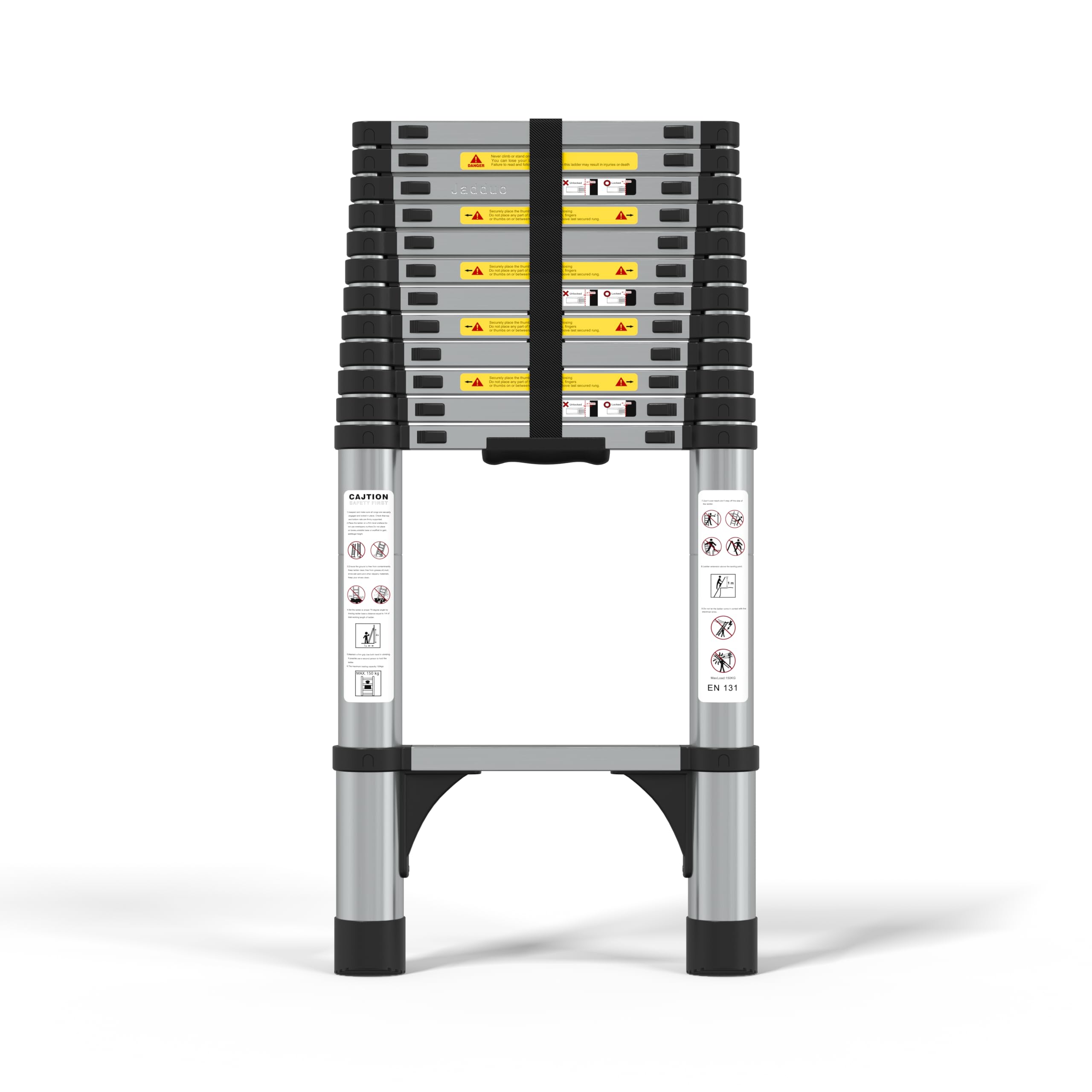
The van-life favorite that collapses to roughly four feet and rides along in a small trunk.
This is the ladder owners specifically call out for van and RV life — one described it as “perfect for van life,” and another noted they fit it in a small trunk with room to spare. The JADDUO retracts to approximately 37.2 inches high by 20.9 inches wide, which is the most compact folded footprint of the telescoping options here. For someone living on the road or in a tight apartment, that storage size is the deciding factor.
At 16.5 feet with a 330-pound aluminum build, it handles the standard home jobs: changing high smoke alarms, attic access, stairwell painting, and gutter work. Owners found it “reaches high ceiling smoke alarm with extension to spare” and useful for trees and roof access. The individual rung locks are controlled — each one secures independently, and you must confirm every lock is fully engaged before climbing, which is standard for telescoping safety.
Reviewers point out two main drawbacks. The top steps are thinner, which one owner found “scary for heights” — a common trait of telescoping ladders where the uppermost rungs are less substantial. And the steps sit roughly 2 feet apart, which another owner jokingly called “a workout” and noted can be tiring on long climbs. The quality, functionality, and portability all earn consistent praise, but it is best thought of as an occasional-use ladder rather than a daily construction tool.
Why it earns a spot: The 37.2-inch collapsed height makes it the best true space-saver for vehicle-based and small-home storage.
Know before you buy: The wider rung spacing and thinner top steps mean it suits occasional reach jobs better than frequent heavy climbing.
6. SINMEIRUN Telescoping Ladder 16.5 FT

The budget-friendly telescoping ladder that still carries EN131 CE certification and a 330-pound load.
For buyers who want a legitimate 16.5-foot reach without spending premium money, this SINMEIRUN delivers the essentials with proper safety credentials. It is EN131 CE certified (meeting the European portable ladder safety standard) and supports up to 330 pounds, matching the load capacity of ladders costing more. Owners consistently praise the quality and sturdiness of the build, describing it as having “no cheap feel” and noting the sections lock securely when extending.
The practical details are well handled. It compacts to 40 inches with storage straps and a carrying handle, and at 25 pounds it is manageable for most adults to move. The double height-locking latch on each step is designed to prevent pinching while allowing easy height adjustment — a real safety upgrade over single-latch designs. The oxidized aluminum surface with reinforced nylon fiber in the plastic parts adds durability where cheaper ladders typically wear out.
The honest caveats: retraction tabs are stiff when new, which several owners noted takes some learning (and in one case, required a replacement unit — though the replacement worked perfectly). And at 220 pounds, one owner reported minimal flex at full extension, which is typical for the category but worth knowing if you are a heavier climber. The ease of climbing gets mixed feedback, with some finding the process fiddly until the locking mechanism becomes familiar.
The value proposition: EN131 CE certification and a 330-pound capacity at a budget-tier price make this the smart pick for cost-conscious home users.
The learning curve: Stiff retraction tabs when new mean your first few collapses take patience — work them gently.
Understanding the Specs
Maximum Height vs. Working Height
A “16-foot” ladder’s maximum height is measured from the ground to the top of the ladder, not how high your hands can reach. When you stand on the ladder, your body adds roughly another 5 to 6 feet of reach depending on your height. So a 16.5-foot telescoping ladder lets someone around average height comfortably change bulbs or clean gutters at a 20-foot ceiling line. If you are working on a roof edge, remember your feet need to be below the gutter line — the ladder must extend at least 3 feet above the surface you are stepping onto.
Load Capacity and Duty Rating
Load capacity is the total weight the ladder is engineered to support, including your body weight plus anything you carry up. In this category, 300 pounds is the entry point for household use, 330 pounds is the common telescoping standard, and 375 pounds is the heavy-duty tier found on the fiberglass twin step. Ratings like Type IA and Type IAA (industry classifications tied to ANSI standards) indicate heavier-duty construction — Type IAA typically means 375 pounds, while Type IA often means 300 pounds. Ladders that meet ANSI and OSHA standards are tested to hold far more than their rated load, but the rated number is your safety planning figure.
Telescoping Rung Locks
Telescoping ladders rely on individual locks for each rung that must click into place as you extend the ladder section by section. The two main styles are button-activated locks (you press a button on each side of the rung to release it) and latch-style locks that snap automatically when the rung reaches its position. The critical safety habit with any of them is confirming both the left and right locks are fully engaged before you climb — a half-latched rung can slip under load. Collapsing requires releasing the locks in a specific order, which is why manufacturers stress reading the instructions and keeping your hands clear of the rung path.
Material: Aluminum vs. Fiberglass
Aluminum is the default for telescoping and most extension ladders because it is light, rust-resistant, and inexpensive — the trade-off is that aluminum flexes more at height and conducts electricity, so it is not for electrical work. Fiberglass is heavier (the 85-pound twin step here shows the difference) but stiffer and non-conductive, which is why electricians and anyone working near power lines choose it. As a rule of thumb: aluminum if you carry the ladder often and store it in a vehicle, fiberglass if you want maximum stability and work near electrical hazards and don’t mind the weight.
FAQ
How much reach does a 16-foot ladder actually give me?
Are telescoping ladders as safe as traditional extension ladders?
What does load capacity like 300 or 330 pounds really mean?
Will a telescoping 16-foot ladder fit in my car trunk?
What is the difference between a step ladder, extension ladder, and telescoping ladder?
What is EN131 certification and why does it matter?
Why does a telescoping ladder feel like it bends in the middle?
Can one person safely carry a 16-foot extension ladder?
Is a 16-foot ladder overkill for a two-story house?
Final Thoughts: The Verdict
Across the board, the 16 foot ladder winner is the UC UP CLIMBER Telescoping Ladder because it pairs a genuine 16.5-foot reach with a 15-pound frame that nearly anyone can handle, plus 330 pounds of load capacity for real work. If you want a rock-solid freestanding platform for two-person household projects and don’t mind the weight, the Louisville Fiberglass Twin Front is the sturdiest choice in the lineup. And for classic lean-against gutter and roof work from a trusted brand, the Louisville Aluminum Extension Ladder delivers the smoothest extension mechanism at just 30 pounds. Whatever you pick, confirm the load capacity covers your weight and check every rung lock before you climb.
How We Picked
We do not accept paid placement. Every pick is matched to a real buyer and a real use-case; we do not hands-on test units.
Sources & Methodology
Specifications: manufacturer listings and product documentation. Review insights: verified customer reviews, as of September 2026. Pricing: not shown on this page (it changes often); check the current price via the retailer link.
As an Amazon Associate, KitchPrep earns from qualifying purchases. This does not affect which products we feature.
Related Guides
