
Specs are compiled from manufacturer listings and verified buyer reviews and can change over time — please confirm the key details on the product page before buying.
The hard part of a 16-channel recorder is not buying cameras — it is finding a box that actually powers and records all sixteen without dropping frames or drowning you in false alerts. Most 16-channel network video recorders (NVRs — the brain that pulls video from IP cameras over your network and stores it on a hard drive) sound identical on paper. In real use they are not. Some lock you into one camera brand, some cap you at fewer powered ports than the sticker promises, and some charge a monthly cloud fee you never agreed to.
I’m Mohammad Maruf — the founder and writer behind KitchPrep. This guide is built by comparing the manufacturers’ published specifications and the patterns across verified customer reviews, so you get each pick’s real strengths and trade-offs instead of marketing spin.
This guide walks through what actually matters when you are wiring a multi-camera property: port count, power budget, compression, storage bays, and whether the thing plays nicely with cameras you already own. My picks for the best 16-channel network video recorder below favor recorders that hold up to real camera loads.
Our Picks at a Glance

How To Choose The Best 16-Channel Network Video Recorder
An NVR (network video recorder) is a recorder and a power source in one box. It sends electricity to your cameras over the same Ethernet cable that carries the video, then saves everything to a hard drive you install yourself. Four things decide which one fits you: how many cameras it can power, how much video it can handle, how much storage it holds, and whether it works with the cameras you already own.
Count the powered ports, not the channel number
A 16-channel NVR can record from 16 cameras. But that does not guarantee 16 powered PoE (Power over Ethernet) ports — the sockets that supply electricity to a camera so you do not need a separate power adapter at each one. Some units carry only 8 powered ports, which means half your cameras need their own power source or a separate PoE injector. If you are running cable through a building, more powered ports means less wiring and less time on a ladder.
The bandwidth number is your real ceiling
Incoming bandwidth, measured in megabits per second (Mbps), is the pipe the recorder uses to pull video in. A recorder with 160 Mbps of incoming bandwidth can handle a full roster of high-resolution cameras. A recorder with less will start downgrading resolution or frame rate as you add cameras — the picture gets softer before it stops entirely.
Storage bays decide how long you keep footage
The number of SATA bays (the slots inside for standard hard drives) and the maximum drive size tell you how far back your footage goes. Two bays supporting large drives buy you weeks or months of continuous recording. One bay with a small cap fills up fast. Almost none of these recorders include a hard drive, so budget for one separately.
Quick Comparison
| Model | Best For | Max Resolution | Storage / Bays | PoE Ports | Amazon |
|---|---|---|---|---|---|
| Anpviz 16CH POE NVR★ Best Overall | Plug-and-play Anpviz setups | 12MP | 16TB internal (no HDD) | 16 PoE | Amazon |
| XMARTO WNP816-W6Best for Cable-Free Setup | Cable-free WiFi installs | 4K (XMARTO cams only) | 6TB (no HDD) | None (WiFi) | Amazon |
| ONWOTE 12MP 16 Channel PoE NVRCommercial-Grade Pick | Commercial-grade recording | 12MP | 20TB / 2 SATA bays | 16 PoE | Amazon |
| AMLINK ALN-4216E | AMLINK AI ecosystem | 12MP | 20TB / 2 SATA bays | 16 PoE | Amazon |
| Real HD DS-7616NI-Q2/16P | Responsive tech-support buyers | 8MP | 6TB (no HDD) | 16 PoE | Amazon |
| RICHSECU DS-7616NXI-K2/16P | Hik-compatible AcuSense builds | 12MP | 32TB / 2 SATA bays | 16 PoE | Amazon |
| Swann SRNVR-168580H | All-in with HDD included | 12MP | 2TB included / expandable | 16 PoE | Amazon |
| Synology DVA1622 | VMS power users | 4K (H.264/H.265) | Drive bays (no HDD) | None (LAN) | Amazon |
In‑Depth Reviews
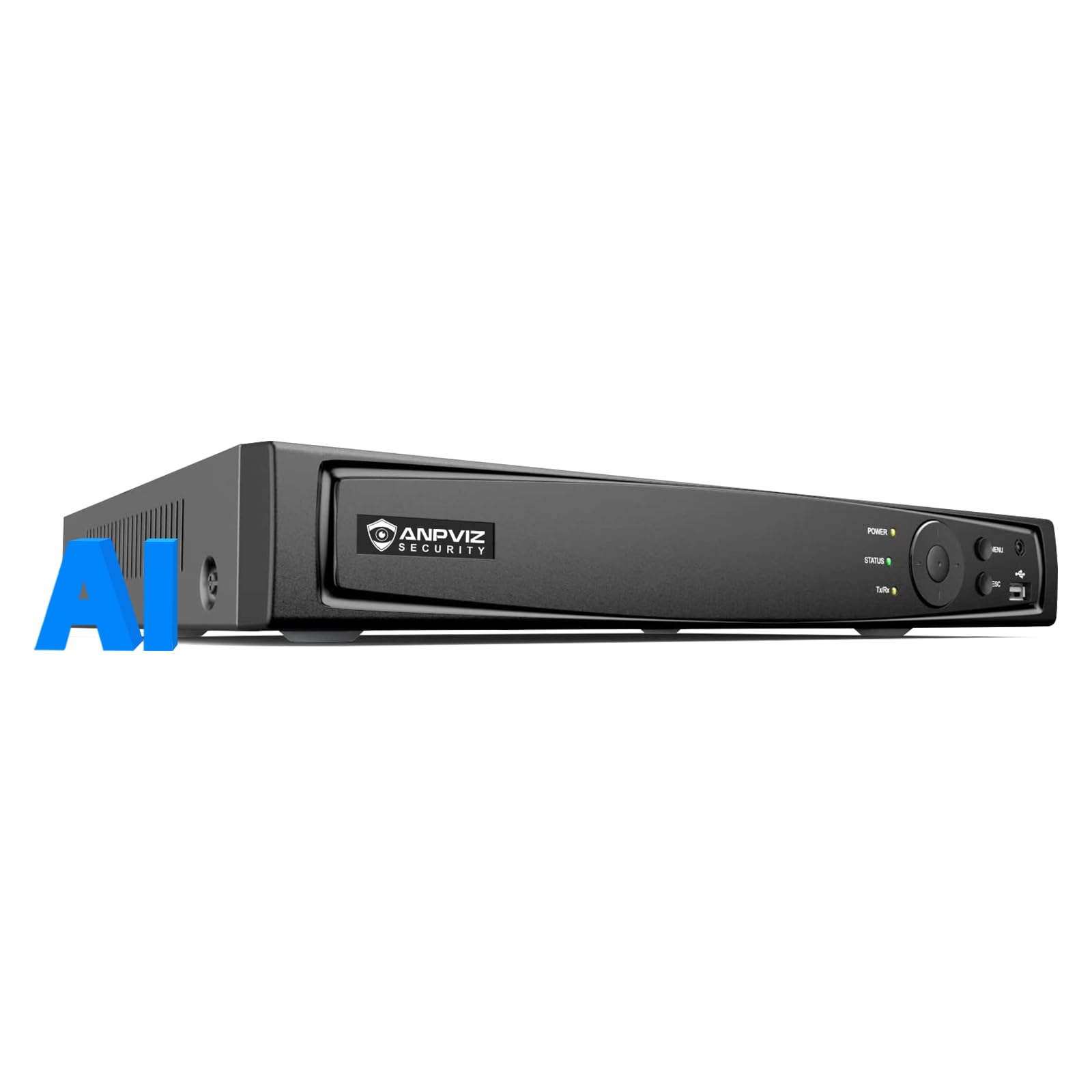
1. Anpviz 16CH POE NVR for Home Security Camera System with Motion Detection
Our pick — over 4★ from 100+ verified ratings; the strongest balance of quality and price.
Sixteen powered ports and no monthly fee — the workhorse most home builds settle on.
If you are wiring a whole house or a small business and want every camera powered off one box, this is the pick to beat. It puts out 190W across all 16 PoE ports, so you are not hunting for a separate power source for camera fifteen and sixteen. Setup is the part buyers rave about most — it is genuinely plug-and-play once you connect Anpviz U-series cameras. As owners put it, the whole thing goes from box to recording in one sitting.
Storage is handled by a single internal bay that swallows up to a 16TB drive, which is more than most home builds ever fill. H.265+ compression cuts the space your video takes by up to 75% compared with older formats, so a mid-size drive stretches noticeably further. On the software side, the Hikvision-based interface recognizes Hikvision and Dahua cameras over ONVIF (a universal camera language, not a brand lock-in), which is a big deal if you are mixing cameras you already own with new ones. The human-and-vehicle detection is smart, but only fires when paired with Anpviz PoE cameras — a real limitation to weigh before buying.
The catch is the fan. A steady stream of owners flag it as loud, and the web interface runs best in Internet Explorer, which feels dated next to modern browsers. Support has been mixed — some buyers get answers in twelve hours, others wait longer and find the manual thin. But the bones are solid: 160 Mbps incoming bandwidth, 12MP max input, and a form factor that has stayed stable across generations. The listing also notes 12MP is the ceiling across all 16 ports, so plan accordingly if you are pushing 4K across the board.
What keeps owners loyal
- All 16 PoE ports powered, so no separate adapters needed
- H.265+ compresses video to save storage space
- Recognizes Hikvision and Dahua cameras over ONVIF
- Plug-and-play with Anpviz U-series cameras
Details worth knowing
- AI motion detection only works with Anpviz cameras
- Fan noise is a recurring note in owner reports
- Web interface runs best in Internet Explorer
- Hard drive is not included
Reach for this if: you are building a home or small-business system around Anpviz cameras and want all 16 ports powered from day one.
Think twice if: you already own a mixed bag of third-party cameras and need AI detection — that feature will not work here.
2. XMARTO H.265 16-Channel 4K Ultra HD Long Range Wi-Fi 6 NVR/DVR (WNP816-W6)
The cord-cutter of the group — dual WiFi 6 routers inside, and zero Ethernet runs to worry about.
If running cable through walls is the thing standing between you and a full 16-camera setup, this is the answer. It hides two WiFi router modules inside: one talks to your cameras, the other connects the recorder to your internet, so your home network does not get bogged down. For an apartment, a rental, or a finished building where you cannot pull wire, that is a genuine problem-solver. The catch is the camera lock — it only works with XMARTO WiFi 6 cameras, so it is a system buy, not a kit you can sprinkle other brands into.
Compression here saves you real money on storage: H.265+ HEVC (a video format that shrinks files) records at roughly half the bitrate of H.264, so the same drive holds nearly double the days of footage. Storage tops out at 6TB in a single bay, which is plenty for a WiFi-first box but well short of what 16 cameras recording nonstop will eat. Buyers upgrading from smaller systems report the same thing — it handles 16 channels well, but the hard drive is a separate purchase you need to plan for. Size matters too: at 10″L x 8″W x 1.5″H it is the most compact recorder in this group, roughly 52% smaller on the width and depth than the Anpviz above, so it tucks easily onto a shelf.
Where the value wobbles is support and documentation. Reviews are clear that no instructions ship in the box, and customer service is email-only. One longtime user with prior NVR experience still needed phone support to connect two new cameras to the Android app. Add the embedded Linux OS and free mobile app, which are genuinely capable, and you have a strong standalone recorder held back by thin onboarding.
Where it lands: a compelling pick for anyone who values installation freedom over maximum storage — the embedded Linux OS runs the whole thing without needing internet at all.
The trade-off: 6TB max storage, no included drive, and email-only support mean you need to be comfortable troubleshooting on your own.
Pick this when: wireless installation matters more than storage headroom, and you are happy to commit to XMARTO WiFi 6 cameras.
Look elsewhere if: you need phone-based support or plan to run more than a few days of high-resolution continuous recording.
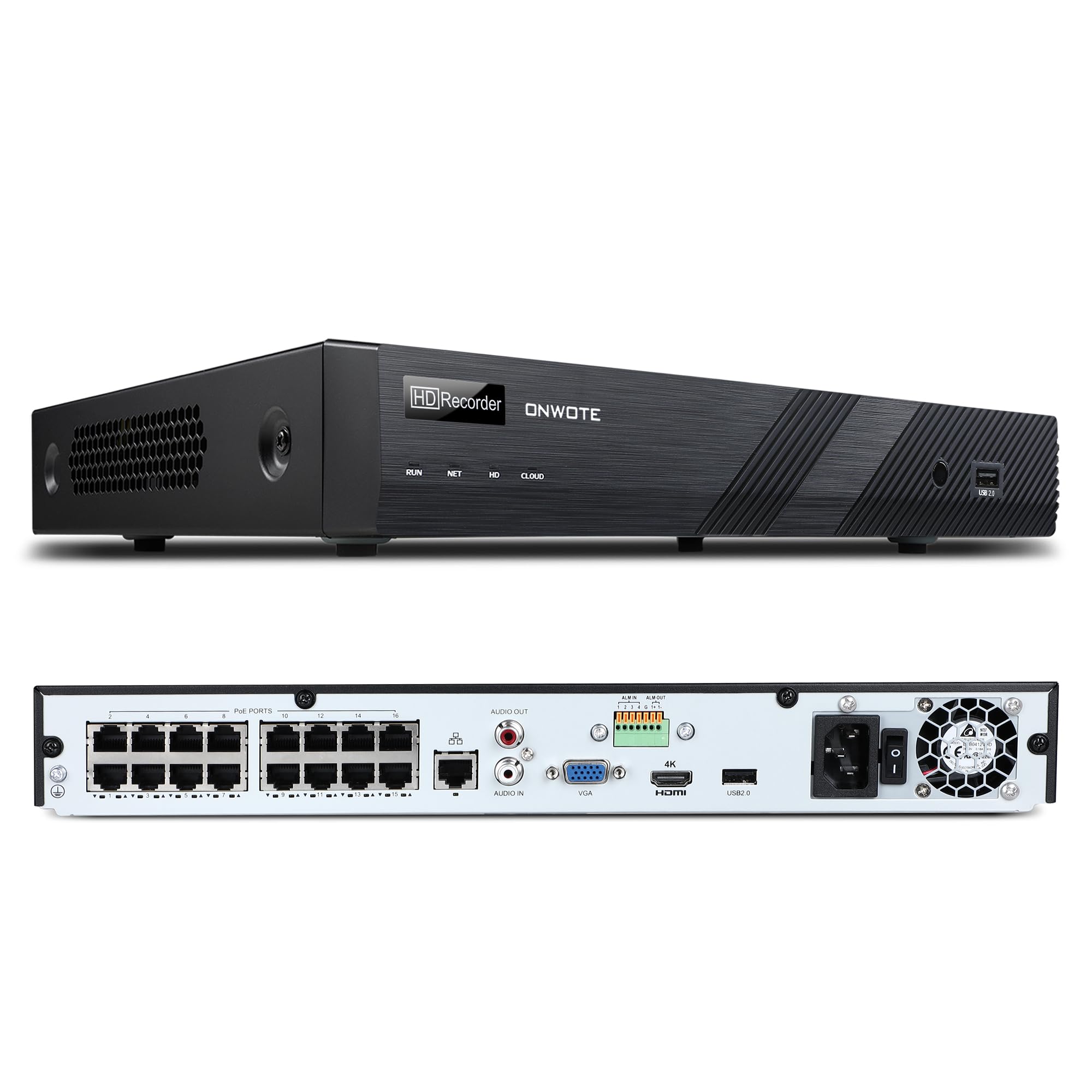
3. ONWOTE 12MP 16 Channel PoE NVR
Twenty terabytes of storage and 16-camera playback in one commercial-grade box.
For a facility that keeps footage for months and needs to scrub through 16 cameras at once, this is the recorder that stops you from upgrading next year. Two SATA bays hold up to 20TB total, and the same video that fills a 6TB unit for a couple of weeks stretches into a genuine archive here. Owners running it at a storage-locker facility report the footage helped curb vandalism and identify thieves. That is what 20TB of retained footage buys you.
The 16-channel synchronous playback is the other standout. You can pull up all 16 camera feeds at once on an HD monitor, which is what makes this feel commercial-grade rather than a home-store special. HEVC with H.265+ compression keeps the bitrate low without sacrificing quality. AcuSearch gives you fast video search across all those hours. Dual-stream handles weak networks gracefully. Support is 24/7 by phone or Amazon Messages, with a stated 0.5–2 hour phone response. By comparison with the XMARTO above, the storage gap is dramatic — 20TB versus 6TB is a 3.3x difference, and it is the difference between a security system and a weekend hobby.
The honest caveat is camera lock-in: it only works with ONWOTE cameras, and the listing says mixing other brands results in complete loss of functionality. That is stricter than most. A small number of owners also note the decoder stresses out as more cameras are added, dropping resolution or frame rate, and some flag the manual as thin. But the pattern across long-term users is clear — systems running for years across multiple sites without failures is a strong signal for business use.
Built for footage you actually keep
- 20TB across two SATA bays for a real archive
- 16-camera synchronous playback on one screen
- AcuSearch rapid review across recorded video
- 24/7 phone and message support with 0.5–2h response
Caveats before you buy
- Only officially supports ONWOTE cameras
- Decoding can drop resolution or frame rate under full load
- Hard drive is not included
- Manual quality is a repeated note from owners
The right call for: businesses and serious homeowners who need months of footage retained and want 16-camera review on one screen.
The wrong call for: anyone hoping to mix ONWOTE with off-brand cameras — this system expects a matched lineup.
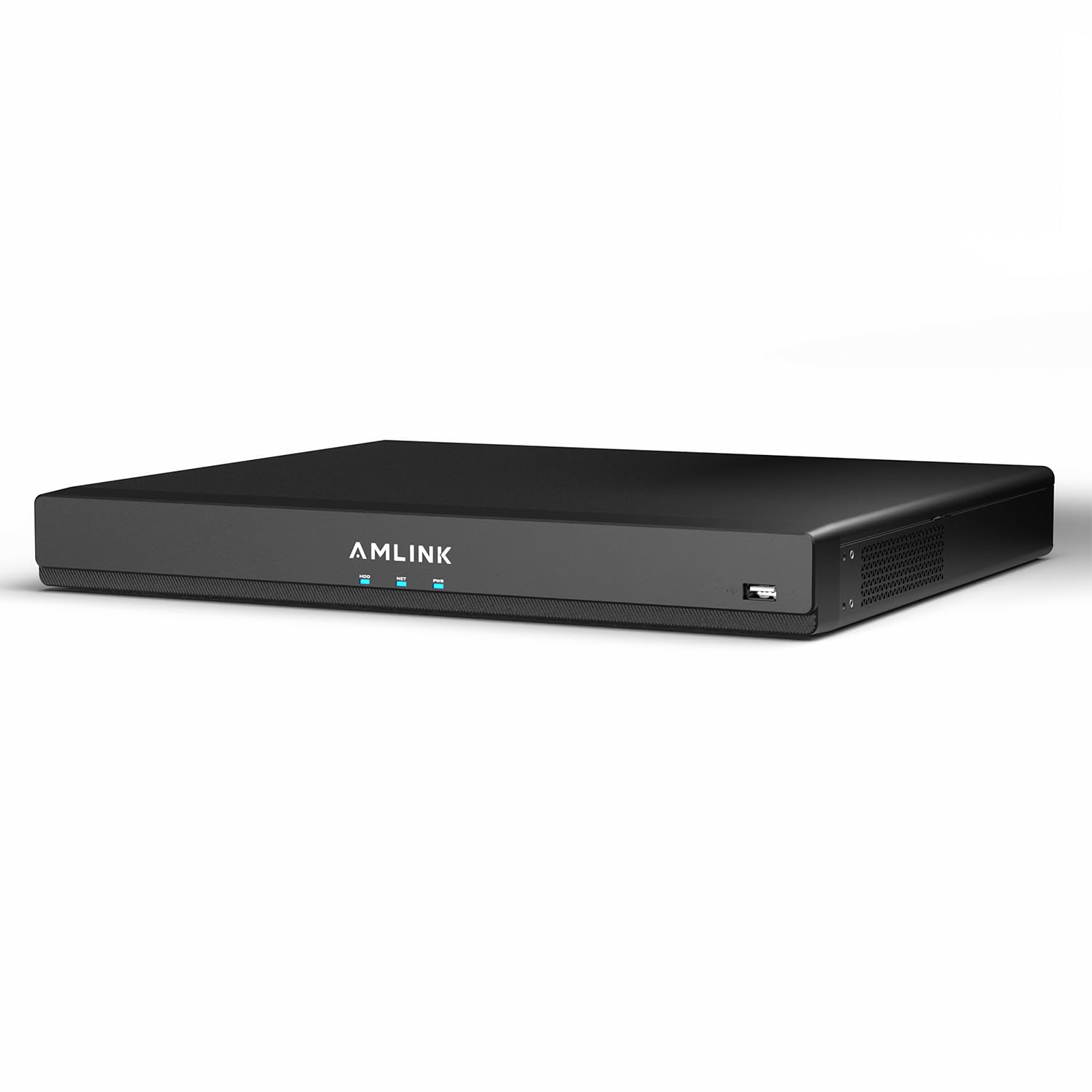
4. AMLINK 12MP 16CH AI NVR (ALN-4216E)
Sixteen 12MP cameras at full 30fps, and the rare recorder that reports more ports than its listing admits.
Buyers expecting 8 powered ports on this unit keep reporting the same happy discovery: it actually ships with 16 PoE ports. That is the kind of mismatch you want to fall in your favor. The bigger draw is the recording math — 16-channel recording and live view up to 12MP resolution at real-time 30 frames per second, with two SATA bays supporting up to 20TB. For a home setup that wants crisp, high-framerate footage of driveways and deliveries, that is serious capability.
On the AI side, the story is nuanced. With AMLINK cameras, the built-in tripwire, intrusion, and human/vehicle detection work as billed, and owners using AMLINK hardware describe the setup as easy and the AI search as a genuine time-saver for review. ONVIF support means third-party PoE cameras will connect, but they get downgraded to continuous recording with no AI — a hard trade to swallow if you bought the box for its intelligence. The NDAA compliance (no components from FCC Covered List manufacturers) matters for government, education, and regulated buyers in a way most home users will not care about, but it is a real differentiator for the ones who do.
The honest caveat is that non-PoE and wireless cameras are the weak spot. Buyers report timeline disconnects and live view “not enough resources” errors when trying to add them, even on a single stream. If your build is entirely wired AMLINK PoE cameras, this is a clean, subscription-free setup that uses H.265 compression to keep storage manageable.
Where it shines: AI detection with AMLINK cameras — human and vehicle recognition that saves real review time when scrubbing hours of footage.
What to plan for: 16-channel 12MP at 30fps file sizes, which eat through the 20TB max quickly if you run the full roster hot.
Best if: you are building a fully wired AMLINK ecosystem, need NDAA compliance, and want AI search that actually works.
Skip if: you have a shelf of non-AMLINK wireless cameras to reuse — those will connect but lose their smart features.
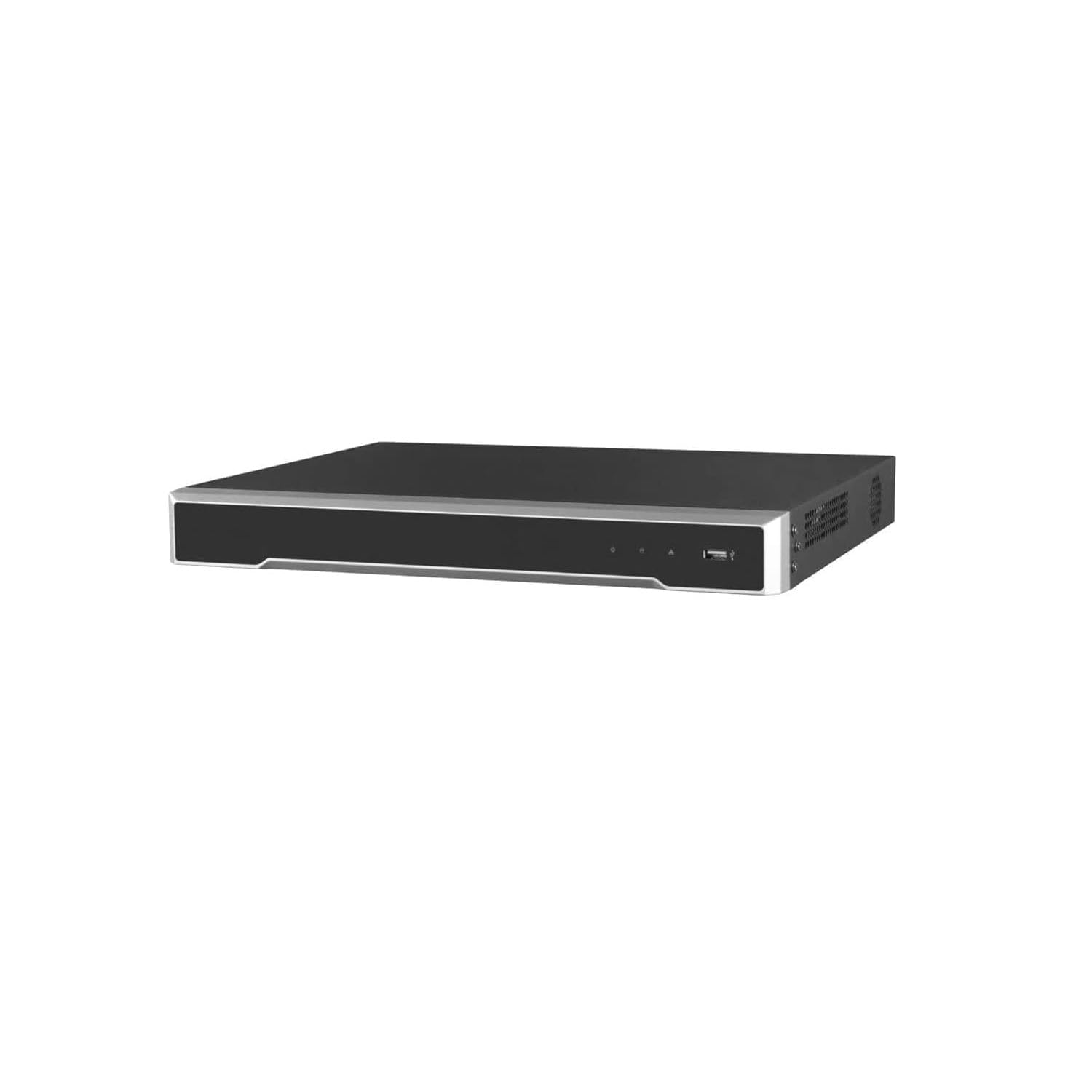
5. Real HD DS-7616NI-Q2/16P 16 Channel PoE 4K NVR
The NVR owners themselves credit for getting them unstuck — support calls answered by people who know the box.
Sixteen independent PoE ports and 8MP max resolution make this a solid mid-range pick on paper, but the reviews keep circling back to a differentiator: the people behind it pick up the phone. One buyer called Jay professional, patient, and considerate during setup, then ordered a second unit for another location. Repeat purchases for the support, not just the recorder, are a recurring theme in these reviews. For a first NVR, phone support when cameras fail to connect is worth paying for.
The specs are reassuring too. The HDMI output runs 4K (3840 x 2160) at 30Hz, alongside 1080p at 60Hz and lower standards, so you can drive a modern display without downscaling your footage. Incoming bandwidth sits at 160 Mbps, matching the Anpviz above and giving you plenty of pipe for high-resolution recording. The unit works with non-Hikvision cameras as well, which is a point in its favor compared with tighter brand-locked recorders. With six independent PoE interfaces and simultaneous 16-channel support, wiring is straightforward.
One thing to verify before buying: the listing describes this as an International version rather than a US version, covered by a one-year warranty and lifetime tech support through the seller. If you need a specific regional version, that is a real question to ask first. Storage is 6TB via a single internal drive slot, which is workable for home use but not the long-archive capacity the ONWOTE above delivers.
The case for it
- Owners consistently praise the phone-based tech support
- 16 independent PoE ports power every camera directly
- 4K HDMI output at 30Hz without downscaling
- Works with non-Hikvision cameras via ONVIF
Points to weigh
- International version, not US-version stock
- Single drive slot capped at 6TB
- Hard drive is not included
- 8MP ceiling, lower than several picks above
Buy it for: the rare combination of a capable 16-port PoE recorder and support that owners say actually answers the phone.
Move on if: you need more than a 6TB drive slot or specifically require US-version hardware.
6. RICHSECU DS-7616NXI-K2/16P 16CH 4K AcuSense NVR

Thirty-two terabytes of storage and AcuSense smarts — the top-tier pick for serious Hikvision-compatible builds.
The headline here is the archive: two SATA bays swallowing up to 16TB each, for 32TB total. That is the largest storage ceiling in this lineup, and it is what makes months of full-resolution 16-camera footage realistic instead of theoretical. Round that out with decoding in the range of 3-channel 12MP, 5-channel 8MP, 10-channel 4MP, or 20-channel 1080p, and you have a recorder that can genuinely play back what it captures at the resolution you shot it in. 160 Mbps incoming and outgoing bandwidth keeps the pipe clean.
AcuSense is the marketing term, but the features behind it are concrete: motion detection 2.0 on all 16 channels, 1-channel facial detection and analytics at 8MP, 4-channel face picture comparison, and up to 16 face libraries. H.265+ compression trims storage by up to 75%, and the smart search feature lets you zero in on a selected area of the video rather than scrubbing the whole timeline. Buyers running 16 live channels with five swappable cameras praised the per-port PoE wattage monitoring, which flags a failing camera before it drops out.
Here is where it gets real: this is not a universal recorder. The listing is explicit that it is designed for Hik camera systems, and non-Hik cameras must support ONVIF Profile S/G to work at all — partial ONVIF or Profile T will not cut it. Third-party ONVIF cameras also get zero AI features. That means your ecosystem decision happens before you buy the box. This is also an International English version, so support comes through the vendor rather than a US manufacturer channel. And the boot process gets flagged as slow, with a UI that takes some learning.
What separates it: 32TB of storage and per-port PoE wattage monitoring — the latter a rare, genuinely useful diagnostic tool for spotting cameras that are straining.
Who it is not for: mixed-brand builds and buyers who need a friendly out-of-the-box UI — the ecosystem lock and the learning curve are real.
Ideal for: buyers committing to a Hikvision-compatible camera lineup who need the longest archive this list offers.
Not for you if: you are running older or off-brand IP cameras that do not support ONVIF Profile S/G — they will not connect.
7. Swann SRNVR-168580H 4K 16-Channel PoE NVR with 2TB HDD

The only recorder here with a hard drive already installed — plug in and start recording immediately.
Every other pick on this list asks you to buy a drive separately. This one ships with a 2TB drive installed, so the moment it hits your shelf you have continuous 24/7 recording. That is a genuine convenience, and for someone who does not want to open a case and swap a SATA drive on day one, it matters. Swann also supports PoE setups out to 330ft per camera, with built-in DHCP so the system keeps running independently when your internet drops — no router babysitting required.
The camera features are strong if you commit to Swann IP cameras. Human and vehicle detection with playback, auto-tracking on compatible cams, two-way talk, and motion-triggered spotlights round out a full ecosystem. The Swann app is free across iOS, Android, Windows, and Mac with no monthly charges, and supports local and remote access. For a turnkey build, the package hangs together well.
Now the honest part: this is the lowest-rated pick in the grouping, and reliability is the recurring theme in owner feedback. Some units stopped working after extended use, one arrived with only two of 16 PoE ports powering cameras, and a couple of buyers received refurbished-looking stock that was password-locked. Add a fan-noise gripe that owners describe as noticeable enough to locate the box, and you have real-world friction. If you buy here, verify the unit is new and test every port in the first week — that is the practical defense.
What works in its favor
- 2TB hard drive already installed — no extra purchase needed
- Free Swann app with no monthly fees
- PoE range up to 330ft per camera
- Runs without internet thanks to built-in DHCP
Honest friction
- Reliability is the dominant note in owner feedback
- Some units shipped with ports not powering cameras
- Fan noise is a repeated complaint
- Refurbished stock has occasionally gone out
For buyers who want: a recorder with storage already in the box and a free app, and who will test every port right after delivery.
For buyers who want: rock-solid reputation and longer-term reliability — look to the ONWOTE above.
8. Synology DVA1622 16-Channel Deep Learning Video Analytics NVR

A full video management platform that scales from one NVR to hundreds — with the hardware tax that comes with that ambition.
This is the pick for anyone running a serious multi-site security operation. The Synology DVA1622 supports over 8,300 cameras across ONVIF profiles S, T, and G, plus H.264, H.265, and 4K resolutions. Its real superpower is Surveillance Station Centralized Management — you can manage, update, and protect hundreds of Synology NVR and NAS devices from one central server. If you are administering a growing chain of locations and want a single pane of glass, this is the only pick on the list built for that job.
On analytics, the DVA1622 runs up to two Deep Learning tasks at a time out of facial recognition, people and vehicle detection, license plate recognition, people counting, and intrusion detection. Across 16 channels, with eight default licenses from the start (add more as your build grows). Local and remote access run through HDMI output to a monitor or TV, the free DS cam app, or a web browser. If you are already inside the Synology ecosystem, this slots in like a native component.
The honest trade-off: this is the pick that buyer feedback pushes back on hardest. Deep Learning analytics have drawn repeated complaints of false positives — phantom cars and shadow triggers — and one 3-star note flags the hardware as under-resourced for reliable license plate capture. The AI functions not being able to run facial recognition and intrusion detection at the same time is also a real limitation versus the marketing. If you buy here, treat the analytics as a promising but imperfect layer on top of very solid core recording.
Best reason to buy: Surveillance Station CMS, which lets one admin manage a fleet of Synology recorders across locations.
Best reason to pause: the “deep learning” analytics are the weakest part of the package and the price reflects the platform, not the AI accuracy.
Target buyer: multi-location operators already in the Synology ecosystem who value centralized management over AI headline features.
Wrong fit for: single-home users who want hands-off AI — the analytics need tuning and the price reflects the enterprise platform.
Understanding the Specs
PoE ports vs. channels
A channel is a camera slot the recorder can record. A PoE port is a physical socket that powers a camera over the same cable. A perfectly reasonable-sounding 16-channel NVR can carry only 8 PoE ports, which means half your cameras need to be powered separately — often via a PoE switch or a wall adapter. If you are running a fully wired build, count the powered ports first. The Anpviz, ONWOTE, RICHSECU, Real HD, and Swann picks here all carry 16 powered PoE ports.
Resolution, compression, and storage math
Resolution in megapixels (MP) tells you how much detail is captured per frame. Compression determines how much of your hard drive that detail eats. H.265+ is the most efficient common format — it can cut storage needs by up to 75% versus older H.264, especially helpful for 16-camera continuous recording. When you compare recorders, weigh the max resolution and the compression format together. A 12MP recorder with H.265+ will stretch a 6TB drive noticeably further than the same resolution on H.264.
FAQ
Do all 16-channel NVRs actually have 16 PoE ports?
Can I mix cameras from different brands on the same NVR?
How long does a 16-camera system record on a 6TB drive?
Does H.265+ compression affect picture quality?
Do I need to pay for cloud storage on a 16-channel NVR?
Will my existing IP cameras work on a new 16-channel NVR?
Is a 16-channel NVR overkill for a normal home?
Do these NVRs come with a hard drive installed?
What is the difference between 8MP, 12MP, and 4K on a recorder?
Final Thoughts: The Verdict
If you are wiring a 16-camera system and want the best balance, the 16-channel network video recorder to buy is the Anpviz 16CH POE NVR — all 16 ports powered, H.265+ compression, ONVIF support (a standard that lets it work with Hikvision and Dahua cameras), and no monthly fee. If you need months of footage and 16-camera playback at once for a business, reach for the ONWOTE 12MP 16 Channel PoE NVR, with 20TB of storage across two bays. And if running cable is the blocker, the XMARTO WNP816-W6 is the one to consider — just plan for the 6TB storage ceiling. Whichever you pick, check that your cameras are compatible and buy the hard drive on day one so your system records the moment you power it on.
How We Picked
We do not accept paid placement. Every pick is matched to a real buyer and a real use-case; we do not hands-on test units.
Sources & Methodology
Specifications: manufacturer listings and product documentation. Review insights: verified customer reviews, as of September 2026. Pricing: not shown on this page (it changes often); check the current price via the retailer link.
As an Amazon Associate, KitchPrep earns from qualifying purchases. This does not affect which products we feature.
Related Guides
