
Specs are compiled from manufacturer listings and verified buyer reviews and can change over time — please confirm the key details on the product page before buying.
Most people shopping for a 15 gallon air compressor get confused by one thing: the gallon number on the box is not the number that decides whether the tool keeps up with your work. What matters more is how much air the pump can push back into the tank while your nailer, spray gun, or impact wrench is draining it. A bigger tank holds more air, but a slow pump still leaves you standing around waiting. That single mismatch is why some shop owners love their compressor and others regret buying it. This guide ranks all nine on airflow, tank size, and noise so you can match one to your tools.
I’m Mohammad Maruf — the founder and writer behind KitchPrep. This guide is built by comparing the manufacturers’ published specifications and the patterns across verified customer reviews, so you get each pick’s real strengths and trade-offs instead of marketing spin.
Whether you are topping up truck tires or running a paint gun, the specs below separate the high-CFM machines from the ones that stall under load. This shortlist compares the leading 15 gallon air compressor picks on tank size, airflow, and noise so you can buy with confidence.
Our Picks at a Glance

How To Choose The Best 15 Gallon Air Compressor
None of these tanks is exactly 15 gallons, and that is normal. Manufacturers sell the nearest handy size, so you will see 14, 14.5, 15, and a couple of 13-gallon models here. A half gallon either way changes almost nothing in how the machine performs. What changes everything is the balance of three things: how much air the pump can deliver, how loud it runs, and whether you can move it where you need it.
Air flow is the real headline
Every air tool has a “thirst” — the airflow it needs to run without slowing down. Your compressor covers that thirst with its airflow rate, measured in CFM (cubic feet per minute). If the pump delivers more CFM than the tool drinks, the compressor refills the tank while you keep working. If it delivers less, the tank drains and the motor kicks on constantly. A 15-gallon tank gives you a bigger reserve than a 6-gallon pancake, but it is the pump speed that keeps you from hearing it cycle every few seconds.
Decibels decide where you can use it
Traditional compressors run around 85 to 90 dB (decibels, the scale we use to measure loudness). A standard quiet model drops into the 70s, and the very quietest here drop to 66 dB. That gap is why some of these machines can sit in a garage with a baby monitor nearby and others cannot. If noise is your main worry, the dB rating is the number to check first.
Oil-free versus oil-lubricated
Oil-free motors skip the oil changes entirely — you just drain condensation and go. Oil-lubricated motors run cooler and longer in heavy continuous duty, but they need their oil checked and changed on schedule. For occasional home and auto work, oil-free is simpler. For a shop running tools all day, the oiled motor can be worth the extra upkeep. Match this to how often you actually use the thing.
Check your outlet before you buy
One of these machines runs on 220 volts, not the standard 110-to-120-volt household outlet. Buying it without a matching outlet means a compressor you cannot plug in. Read the voltage line on the spec sheet and match it to the circuit you will draw from. It is the single easiest mistake to avoid.
Quick Comparison
| Model | Best For | Tank Size | Airflow | Noise Level | Amazon |
|---|---|---|---|---|---|
| California Air Tools 15020C★ Best Overall | Quiet all-round shop use | 15 gallons | 6.4 cfm | 70 dB | Amazon |
| VEVOR 14-GallonBest Value | Budget auto-repair starter | 14 gallons | 4.3 cfm | Not listed | Amazon |
| BairDplusL 14.5 GallonTop Performer | High-CFM painting work | 14.5 gallons | 14.83 cfm | 70 dB | Amazon |
| VEVOR 10-Gallon | Compact garage detailer | 10 gallons | 5.3 cfm | 78 dB | Amazon |
| WIILAYOK 13 Gallon | Spray painting and nailing | 13 gallons | 6.5 cfm | 70 dB | Amazon |
| RyanTek 15-Gallon | Tight space, vertical footprint | 15 gallons | 4.5 cfm | 66 dBa | Amazon |
| WTRAVEL 15 Gallon | Continuous home duty | 15 gallons | 6 cfm | 70 dB | Amazon |
| Pulsar PCE6150VK | Tool-kit bundle buyers | 15 gallons | 5.2 cfm | Not listed | Amazon |
| California Air Tools 15020C-22060 | 220V shop installs | 15 gallons | 6.4 cfm | Ultra-quiet | Amazon |
In‑Depth Reviews
1. California Air Tools 15020C Powerful 2.0 HP Ultra Quiet and Oil-Free Air Compressor
Our pick — over 4★ from 150+ verified ratings; the strongest balance of quality and price.
The one that lets you hold a normal conversation while it runs beside you
If quiet is the reason you are shopping, this is where to start. The California Air Tools 15020C pairs a full 15-gallon steel tank with a 2.0 HP oil-free motor that runs at a 70 dB noise level. That 70 decibel figure is quieter than a lot of household vacuum cleaners, which is exactly why owners describe talking to someone standing next to it while it fills. The pump moves 6.4 cfm of air, so it recovers the tank at a steady pace rather than gasping between nails. For a garage, a workshop, or a home auto bay, that combination of a big reserve and low noise is what most buyers are actually chasing.
This compressor moves more air than anything else here, which means your tools keep running without waiting for the tank to catch up. It pushes 6.4 cfm (cubic feet per minute — how much air the pump moves), above the 4.5 cfm of the RyanTek and the 4.3 cfm of the VEVOR 14-Gallon, so the tank refills sooner under a running tool. It holds 15 gallons, and the VEVOR 14-Gallon holds 14. At 90 pounds it is the heaviest pick here and noticeably heavier than the 63.1-pound VEVOR 14-Gallon below — a real number if you plan to load it into a truck bed. Buyers report the fill is steady and the tank holds pressure without leaks, with one early owner noting a wheel hub that ran 1/16″ too thick and locked the axle nut until it was drilled out — a one-off assembly snag, not a pattern. An intake filter install reportedly tames the noise even further.
What earns it the top spot
- 70 dB rating makes it genuinely usable indoors without ear defenders
- 6.4 cfm pump keeps up better than the cheaper 4.3 cfm and 4.5 cfm rivals
- 15-gallon steel tank gives a large reserve between motor cycles
- Oil-free motor means no oil changes, only condensation draining
Where it asks patience
- Heaviest model here at 90 pounds, so it is a two-person lift into a truck
- The drain plug sits tucked in, and owners commonly add an extension to reach it
- One buyer wished for a bigger 20-gallon horizontal version
Best for: anyone who works near the compressor and refuses to shout over it — the 70 dB rating and 15-gallon tank make it the easiest to live with daily.
Think twice if: you need to haul it up stairs or into a truck often, because 90 pounds is a real load.
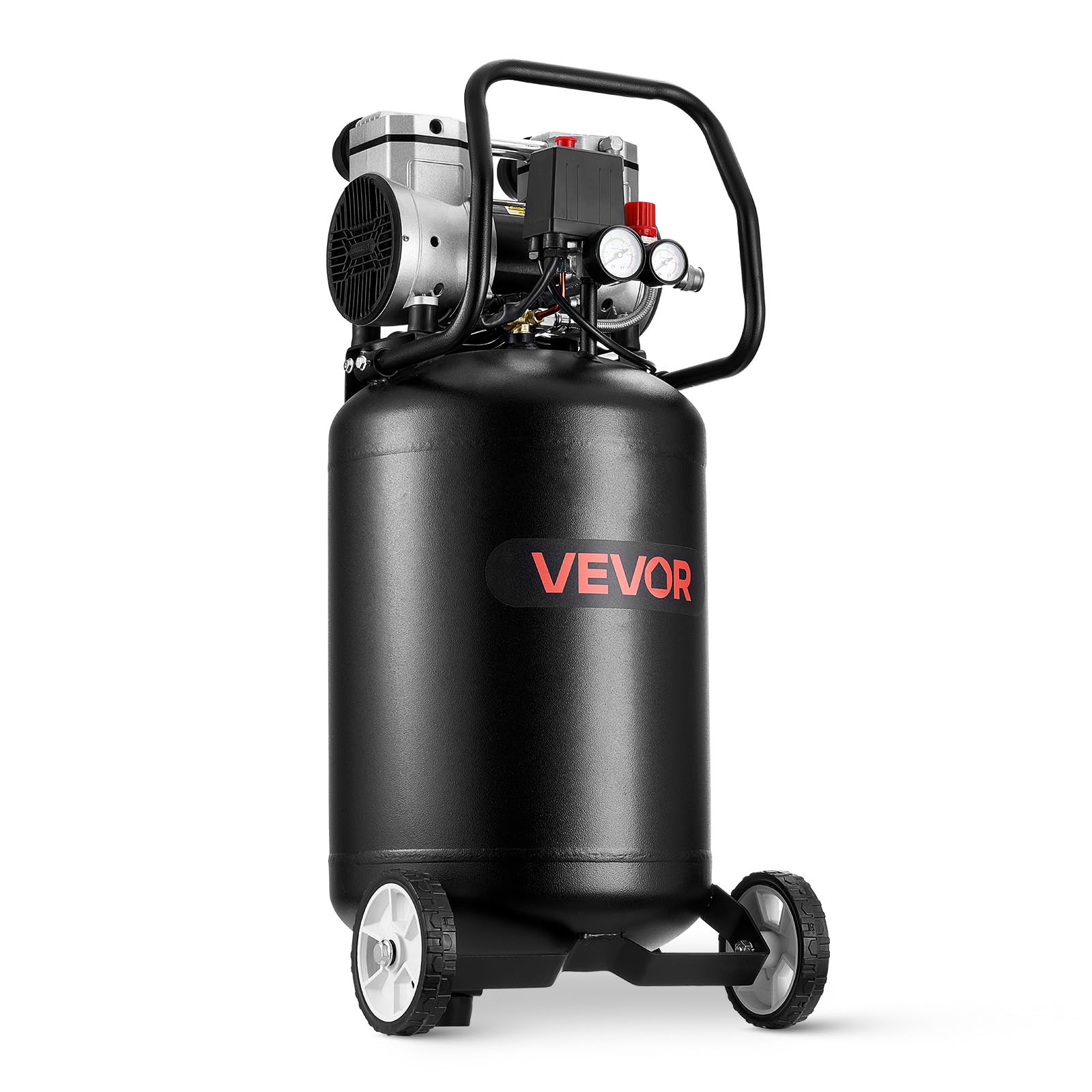
2. VEVOR 14-Gallon Air Compressor, 2HP 4.3 SCFM at 90PSI, Max 125PSI
A light, cheap entry into oil-free power for tires and light nailing
For a first compressor that lives on the garage floor and rolls out for tire top-ups, this VEVOR 14-Gallon covers the basics without much fuss. Its 2 HP motor delivers 4.3 SCFM at 90 PSI (airflow at a typical working pressure) and reaches a 125 PSI max, so it handles nail guns, spray guns, blow guns, and tire inflators. The oil-free design skips oil changes, and at 63.1 pounds it is the lighter of the two VEVOR tanks here — noticeably easier to wheel around than the 90-pound California model above. The carbon steel tank is built from 2.5 mm thick steel with a powder coating, and it ships with noise mufflers you install yourself.
The honest catch shows up in the owner feedback. The recurring gripe is the little regulator knob — it is slick plastic and stiff to turn at first, so plan on a firm grip until it loosens up. There is also a small pocket of complaints about packaging: a few units arrived with a cracked pressure gauge and, in one case, a machine that quit after four uses. On a compressor with a modest review base, that is a caution, not a rule — most buyers describe it as quiet and competent for light-duty work, and the mufflers help once fitted.
If your tasks are occasional and light — inflating tires, quick nail runs, small spray jobs — the price-to-capability ratio here is hard to argue with. Step up only if you need a much higher cfm for constant painting or sanding.
Reach for this if: you want oil-free tire and nailing duty on a small budget and can live with a stiff regulator knob.
Look elsewhere if: you need a big airflow number for finishing tools, because 4.3 SCFM at 90 PSI tops out at light-to-medium jobs.
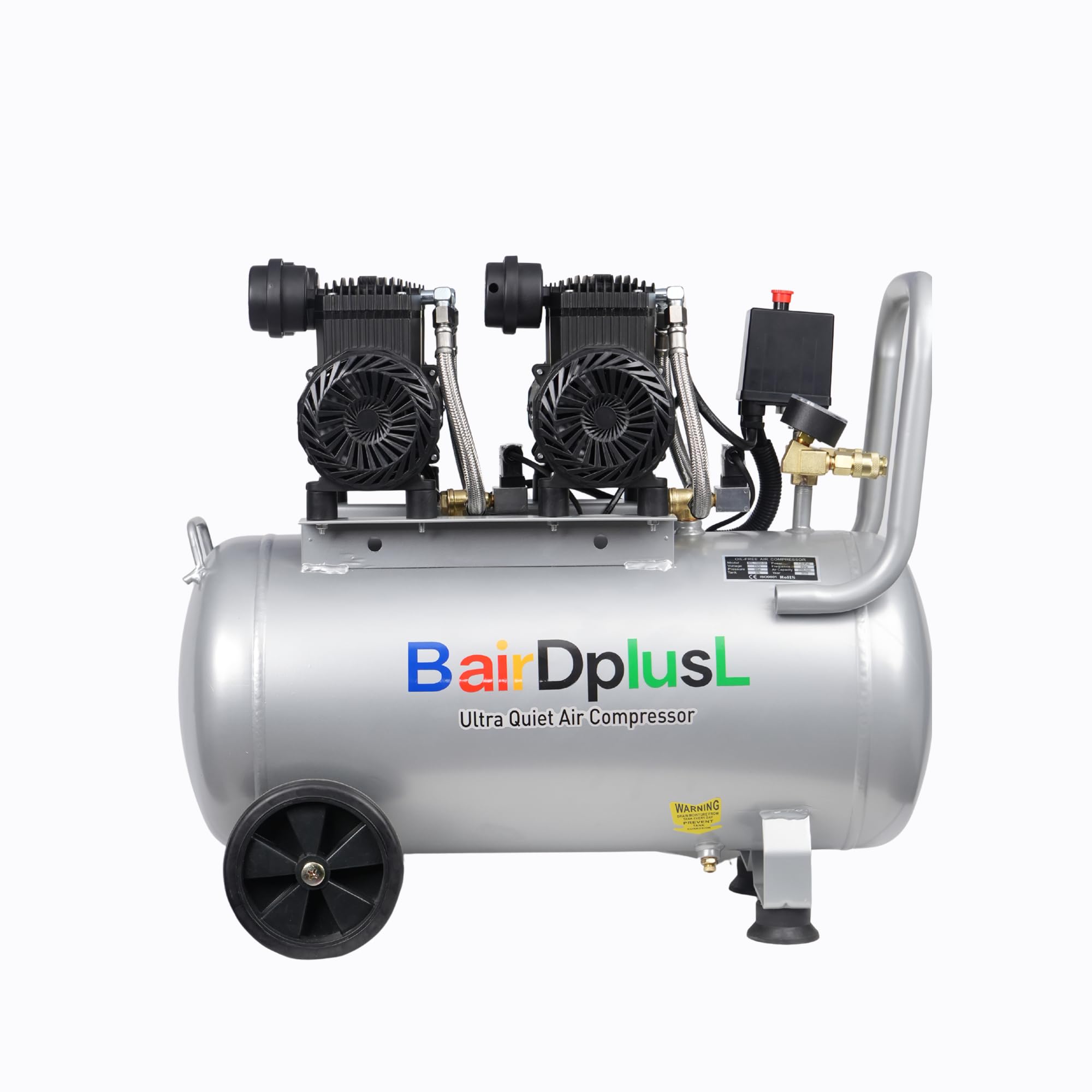
3. BairDplusL 14.5 Gallon Ultra Quiet Air Compressor 110V/60Hz 1.5HP 8.8CFM
The airflow number that makes the others look slow on paper
Here is the standout figure. The BairDplusL lists an air flow capacity of 14.83 cfm — far above the 4.3 cfm of the VEVOR 14-Gallon. That is the biggest airflow rating in this group, and for buyers who run thirsty tools like spray guns, it is the number that matters. Feeding that flow is a 14.5-gallon steel tank and a 3400 r/min motor rated at 1.5 HP, holding 115 PSI max. The unit is fitted with dual silencers and thick filter cotton for a 70 dB quiet rating, and it ships oil-free with a 110V 60Hz motor. It is compact, too — its footprint measures 13″L x 26″W x 24″H.
You get a lot of compressor for the money, and owners say so. Reviewers describe it as “Excellent compressor!” and note it climbs from no pressure to 125 PSI (pounds per square inch — the air pressure pushing your tool) in an 8-gallon tank in about 45 seconds — while being honest that “it’s an air compressor, it’s going to make some noise!” The tank is built from three-layer protective Q235B steel (a structural steel grade) for rust and wear resistance. The one real trade-off is quality control variance: a couple of buyers received units with a bent housing bolt or a damaged air-filter thread, so it is worth a slow inspection on arrival before you fire it up. A plasma-cutter user found it solid for their application but noted it has no output regulator, which matters if you need to dial pressure down for a specific tool.
Where it wins: with 14.83 cfm of airflow and a 14.5-gallon tank, this is the pick for spray painting and any task that drains air fast — it out-flows the field by a wide margin.
Worth knowing: no output regulator and occasional factory QC slips mean checking the unit closely when it arrives.
Pick this one when: your tools demand big airflow and 70 dB keeps the workshop livable — the 14.83 cfm spec seals it.
Pass if: you need a built-in output regulator, since this model does not include one.
4. VEVOR Air Compressor, 10 Gallon Steel Tank, 2HP 5.3 CFM@90 PSI

A tight-footprint tank that punches above its 10-gallon size on refill speed
If you detail cars in a tight garage bay, this VEVOR’s smaller footprint is the point. The steel tank holds 10 gallons — under the 15-gallon target, so treat it as the compact option here. A 1.32KW oil-free motor (no oil to change) spins at 1680 r/min and pushes 5.3 CFM at 90 PSI up to a 125 PSI max, and at 70.6 pounds it rolls around more easily than the heavier tanks. The build uses a three-layer rust-and-wear process over Q235B structural steel with smooth welding, plus automatic overheating protection and pressure relief that kicks in if the current or stored pressure climbs too high. It runs at a 78 dB rating (decibels — how loud it is) with a multi-piece muffler that also keeps fine dust out of the motor.
What buyers fixate on is how fast the tank comes back up. Reviewers describe filling 6.5 gallons at 120 PSI in under a minute, and one owner reports it handles three cars, six bikes, and air shocks without overheating. The portability wins mentions too — wheels and a compact body make it easy to reposition. The recurring caution is its voltage sensitivity. The same owners note it will refuse to start on multiple linked extension cords, working only on a single cord, so run it close to a proper outlet. A rare complaint mentions the short cord and one unit tipping on undersized wheels; both are setup issues rather than design flaws, but worth a glance before you buy.
Suited to: detailers and small-garage owners who want fast refills and easy mobility in tight quarters.
skip it if: you need a full 15-gallon reserve for long continuous spraying, because 10 gallons fills the gap for lighter loads only.
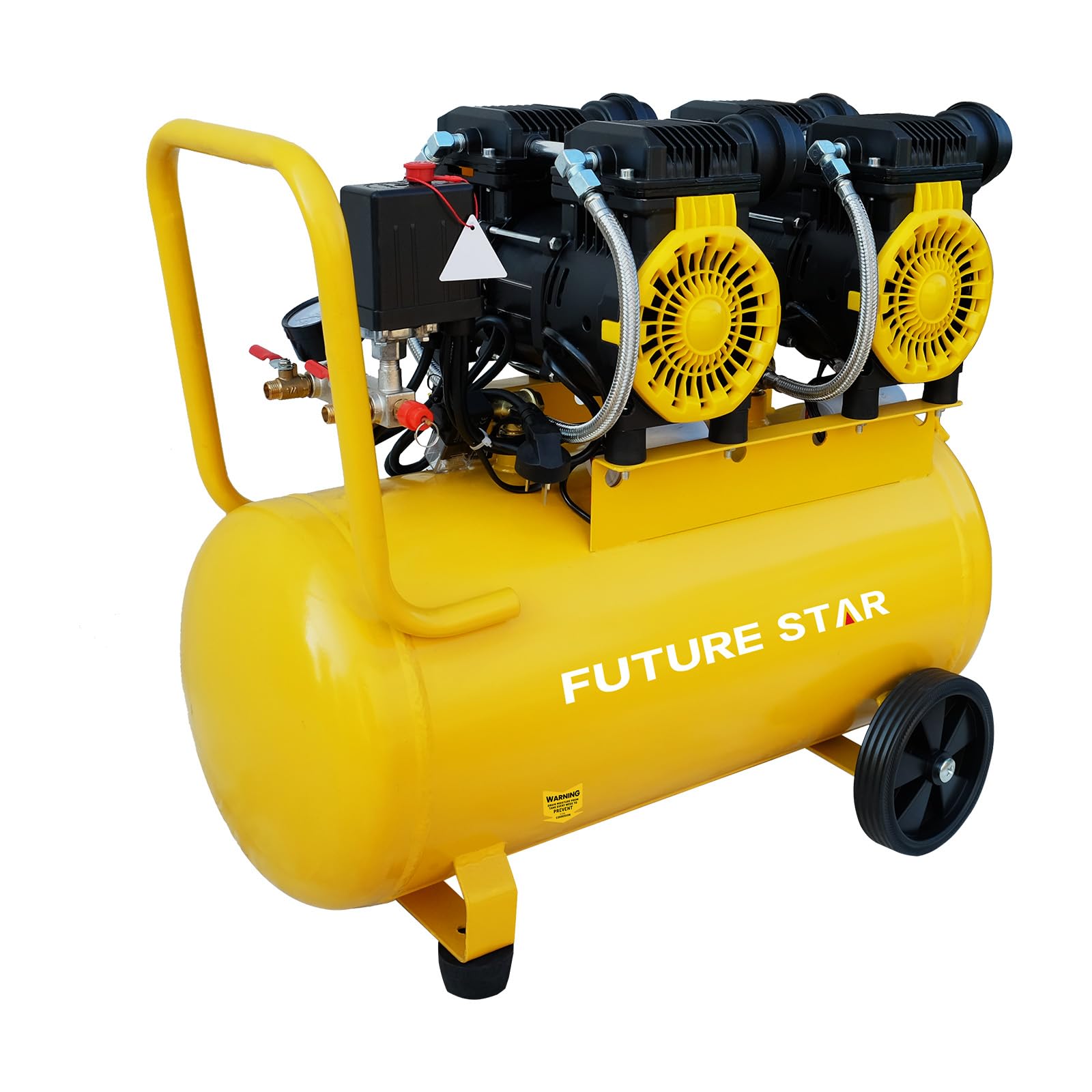
5. WIILAYOK 13 Gallon Portable Air Compressor, 3.7 HP, 6 CFM, 115 PSI
An oiled motor and dual outlets built for spray work that runs long
If your compressor mainly feeds a paint gun or a framing nailer, this WIILAYOK brings something the oil-free crowd does not: an oil lubrication system, which can mean longer motor life under heavy use. That motor is rated at 3.7 HP (horsepower — the motor’s power output) — the highest horsepower figure in this group, above the 2 HP of the VEVOR 14-Gallon and the 1.5 HP of the BairDplusL — and it drives 6 CFM of airflow up to a 115 PSI max. Two outlets let you run paired tools, and the 13-gallon horizontal tank sits on a top handle with bottom wheels for rolling around the shop. A 3-layer reinforced steel structure with smooth welding keeps it leak-tight.
Owners most often point to performance — solid, fast filling, and a powerful pull for its size. One reviewer sprayed a whole car with Raptor bedliner and reported it filled quickly with no interruptions, and the build quality gets called well-made and solid. On noise, the reports split: the 70 dB rating is listed, and many find it relatively quiet next to a red pancake compressor, while others say it runs louder than they expected. A couple of buyers flagged finishing touches — a scratched tank on arrival and, in one case, a part broken in shipment. These are isolated, and the asking strength here is horsepower-to-airflow value in a wheeled, oiled package.
Why painters like it: the 3.7 HP oiled motor and 6 CFM airflow keep a spray gun fed, with dual outlets for a second tool.
The fine print: the oil system needs regular checks, and noise feedback is genuinely mixed — some love how quiet it is, others expect less rumble.
Made for: DIY painters and nailing jobs that run long enough to value the oiled motor and dual air outlets.
Think again if: you want zero maintenance, since oil-lubricated motors need their oil attended to.
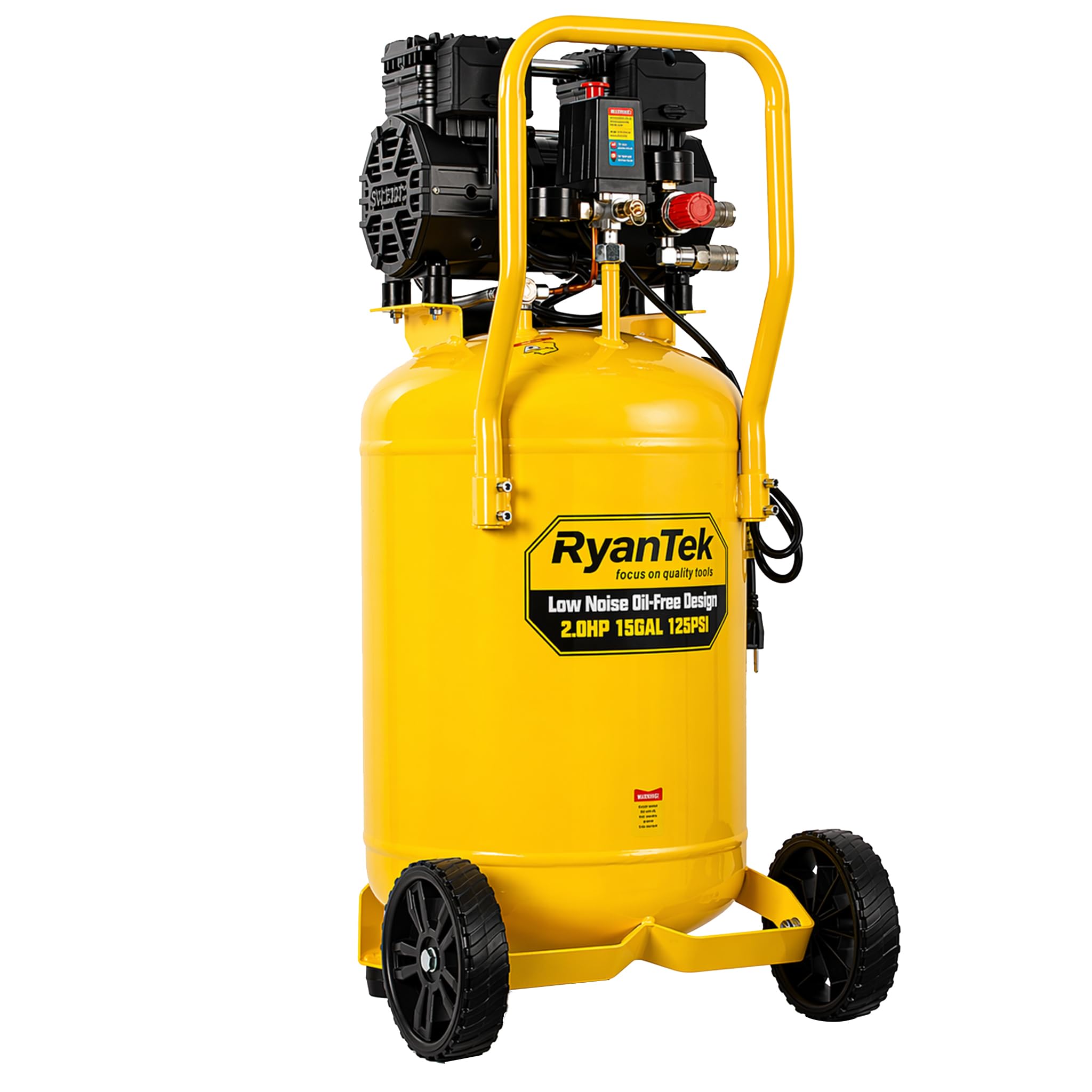
6. RyanTek 15-Gallon Air Compressor, 2HP, Quiet 66dB, 4.5CFM@90PSI
The lowest noise rating here, wrapped in a corner-squeezing vertical tank
Quiet-seekers should look at this number first: the RyanTek lists its noise at 66 dBa at 4m, the lowest sound rating in this whole group and a few decibels below the 70 dB crowd. It gets there with a dual-cylinder oil-free pump and a vertical 15-gallon tank that takes up less floor space than a horizontal unit — handy if your garage is already crowded. A 2 HP motor delivers 4.5 CFM at 90 PSI and reaches 125 PSI max, enough to run nail guns, spray painting, and inflation tasks. Setup touches help too: an upward-facing gauge, dual air outlets, a side-mounted handle that shields the gauge and switch, and a horizontal drain valve that is easier to reach than most.
Two things stand out in owner feedback. First, the noise: many describe it as genuinely quiet and better than expected, and the spec backs that up at 66 dBa (a decibel reading — how loud it is) — though a realistic note is that one buyer measured it closer to 73 dB in their own space and found the fill slower than hoped. Second, the support: when a unit arrived with a faulty regulator, the manufacturer shipped a replacement part quickly, which is the kind of backup that matters on a budget machine. Watch the fill time on bigger jobs, and check the feet — a few buyers found the standard-issue ones too soft and swapped them out.
Where it outperforms
- 66 dBa rating is the quietest figure on the list
- Vertical tank fits a narrow footprint where horizontals will not
- Dual outlets and a shielded, upward-facing gauge for easy reading
- Responsive maker support when a part arrives faulty
The compromises
- 4.5 CFM is modest, so heavy continuous spraying may outrun it
- Real-world noise can read higher than the rated 66 dBa
- The standard feet are soft and some owners replace them
Best match for: a noise-sensitive home workshop short on floor space, where the 66 dBa rating and vertical tank solve two problems at once.
Not ideal if: you run high-airflow tools back to back, because 4.5 CFM limits how hard you can push it.
7. WTRAVEL 15 Gallon Ultra Quiet Air Compressor with Wheels, 3.74HP

Big horsepower and a fast refill for people who keep tools running
This WTRAVEL gives you a horizontal 15-gallon tank with real muscle: a 3.74 HP industrial-grade induction motor (a sealed motor type built for continuous work) turning at 3450rpm. That is the biggest motor rating among the oil-free picks and above the 2 HP VEVOR and 1.5 HP BairDplusL. It pushes 6 CFM at 90 PSI up to a 115 PSI max and recovers from empty to full in about 95 seconds. It weighs 70 pounds and rolls on wheels with a handle, and it runs at a 70 dB quiet rating thanks to a multi-piece muffler. The oil-free build means no oil to change, and it layers on automatic shutoff, an overheating cooling fan, and a smooth welded tank for leak resistance.
Owners who paint report strong run time — one used it to spray a car and run a sander, and said the pump refills the tank quickly and is not as loud as expected. Customer service earns a nod too, with a missing bolt replaced right away. Be aware of two recurring notes. First, a couple of buyers questioned the horsepower claim, reporting it behaves more like a 2HP motor in real use, so do not expect the deepest-draw industrial performance. Second, the wheels and handle strike some owners as flimsy for moving a 70-pound machine across rough ground. Neither is a dealbreaker for shop-floor use, but hauling it in and out of a truck deserves care.
The strong suit: a 3.74 HP motor and 95-second refill make this the pick for long painting and sanding sessions.
The honest note: the moving hardware feels light for a 70-pound unit, and a few buyers dispute the true horsepower — fine for a fixed shop spot.
Ideal when: you need a horizontal 15-gallon tank with serious airflow for paint, sanding, and nailing on a budget that stays below premium.
Look past it if: you will constantly wheel it over uneven ground, since the wheels and handle are the weak link.
8. Pulsar 15 Gallon Vertical Tank Portable Electric Air Compressor with Tool Kit

The only pick that arrives ready to work with a full tool kit in the box
This Pulsar is the bundle buy — a 15-gallon vertical tank compressor that ships with an impact wrench, tire inflator, spray gun, nailer/stapler, and a 25-foot hose, so you are not buying tools separately. The oil-lubricated 3.5 HP motor delivers 5.2 CFM at 40 PSI and 4.2 CFM at 90 PSI up to a 115 PSI max. It stands upright on a mobility kit with a handle and wheels, carries dual pressure gauges, a quick-connect coupler, and a 1-year limited warranty. It is a genuinely different package from the bare-compressor picks — the value is in what comes with it.
Here is where the honest picture matters most, because this unit rates lower than the rest of the list. The compressor itself works — owners mention it running a truck-tire inflator and an impact wrench fine — but the included accessory tools draw criticism, and several buyers describe the fittings as cheaply made and prone to rust. A few units arrived with cosmetic damage or worked only briefly. That said, the pattern is not universal: the machine covers truck tires and light impact work for those who go in expecting a starter kit. If you want the compressor to be the star and the tools to be genuine shop-grade, this is not that package.
Bought best by: a first-timer who wants one box with a compressor and the basic tools to start, and will judge the machine on its own merit.
Consider another pick if: you already own your tools and want the highest-rated build, since the included accessories divide opinion here.
9. California Air Tools 15020C-22060 Ultra Quiet and Oil-Free 2.0 HP 15.0-Gallon Compressor

A premium quiet machine — if your shop already runs 220 volts
This is the 220-volt twin of the top pick, and the voltage is the whole story. It shares the same ultra-quiet, oil-free DNA and a 15-gallon steel tank with a 6.4 cfm airflow rating, but its motor draws 15 amps on a 220V supply. That matters because a 220V hookup pulls less current than a 110V setup for the same output, which suits a dedicated shop circuit. Owners describe it as super quiet and well made, with one trailer user happily running it every weekend precisely because the 220-volt draw is gentle on amperage. It fills the tank to 120 PSI in about two minutes and handles 90 PSI shop equipment with ease.
The obvious catch is also the most important thing to check: if you do not have a 220-volt outlet, this compressor will not run for you at all. One buyer bought it expecting standard household power and had to send it back. For anyone with a wired shop, a garage sub-panel, or a race trailer with 220V service, it is a strong, quiet 15-gallon option — just confirm your outlet before ordering, because no adapter makes this work on a normal wall socket.
The case for it: the same quiet 2.0 HP oil-free performance as the top pick, with a 220V motor that pulls fewer amps for the same output on a dedicated circuit.
Read before buying: this runs only on 220 volts — no household adapter will save it, so verify your outlet first.
Right for you if: your shop or trailer already runs 220 volts and you want the California quiet formula on a lower-amperage circuit.
Wrong for you if: you only have standard household outlets, because this unit will not power up.
Understanding the Specs
CFM (Airflow)
CFM stands for cubic feet per minute — the volume of air the pump pushes out in a minute. Think of it as how fast your tank refills while a tool drains it. A nailer, spray gun, or impact wrench each has its own CFM demand, and if your compressor’s airflow is lower than that demand, the motor runs nonstop and the tank never catches up. This is the number to compare first, because it decides whether you keep working or keep waiting. The units with higher listed airflow here recover faster between trigger pulls, while the lower-CFM units are best matched to lighter tools and shorter jobs.
Decibels (Noise)
Decibels (dB) measure loudness on a scale that climbs fast — every 10 dB roughly doubles the perceived sound, so the gap between a 78 dB compressor and a 66 dB one is much larger than it looks on paper. A traditional pancake compressor sits near 85 to 90 dB, loud enough that you want ear protection. The quiet models here list 66 to 78 dB, a range that decides whether the machine can sit in a garage without drowning out conversation. If you share a wall with the house or work in an indoor bay, picking the lower decibel rating is the single biggest comfort move you can make.
FAQ
Will a 15 gallon air compressor run a spray gun for painting a whole car?
Do I need a 110 volt or 220 volt compressor?
Is oil-free better than oil-lubricated for a home compressor?
How loud is a quiet air compressor compared to a normal one?
Can I run a 15 gallon compressor from a regular wall outlet?
Which air tools can a 15 gallon compressor actually run?
Why do some models list 14 gallons instead of exactly 15?
How much maintenance does an oil-free air compressor need?
Does a bigger tank mean more air for my tools?
Final Thoughts: The Verdict
For most garage and workshop owners, the 15 gallon air compressor winner is the California Air Tools 15020C because its 70 dB noise level and 6.4 cfm airflow make it the easiest quiet machine to live with day after day. If you want the highest airflow for painting, grab the BairDplusL 14.5 Gallon. And for a noise-sensitive corner with no floor space to spare, the RyanTek 15-Gallon vertical tank is the one to reach for. Match the pump’s CFM to your tool’s demand, size the tank to your run time, and check the dB rating against where you work.
How We Picked
We do not accept paid placement. Every pick is matched to a real buyer and a real use-case; we do not hands-on test units.
Sources & Methodology
Specifications: manufacturer listings and product documentation. Review insights: verified customer reviews, as of September 2026. Pricing: not shown on this page (it changes often); check the current price via the retailer link.
As an Amazon Associate, KitchPrep earns from qualifying purchases. This does not affect which products we feature.
Related Guides
