
Specs are compiled from manufacturer listings and verified buyer reviews and can change over time — please confirm the key details on the product page before buying.
If your knives crush tomatoes instead of slicing them, the fix is almost always the same: the blade has lost its 15-degree edge. A 15-degree sharpener holds the blade at that exact angle so you stop guessing and start cutting. This guide covers the sharpeners worth owning, from manual rollers you set on the counter to electric three-stage machines that finish a knife in under a minute.
A quick note on how this list works. These picks use flexible, human-like matching for 15-degree sharpening. Not every tool is the exact number you searched, but each one is a genuine 15-degree (or dual 15/20-degree) sharpener that serves the same purpose. So you are never misled about what you are buying.
I’m Mohammad Maruf — the founder and writer behind KitchPrep. This guide is built by comparing the manufacturers’ published specifications and the patterns across verified customer reviews, so you get each pick’s real strengths and trade-offs instead of marketing spin.
Below you’ll find the sharpeners that actually hold that precise angle, sorted so you can see how a manual roller differs from an electric machine before you commit to 15-degree knife sharpener.
Our Picks at a Glance

How To Choose The Best 15-Degree Knife Sharpener
Two sharpeners can both say “15 degrees” and still behave completely differently in your kitchen. What changes the result is how the tool holds the blade, what the discs are made of, and whether your arm or a motor does the work.
Fixed angle versus adjustable angle
A fixed-angle sharpener locks in one bevel, usually 15 degrees for fine Japanese-style edges or a dual 15/20 guide for flexibility. An adjustable sharpener lets you dial the angle, often across several settings like 12, 15, 18, 21, and 24 degrees. Fixed guides are simpler and harder to get wrong; adjustable ones suit a drawer full of mixed blades.
What the discs are made of
Diamond abrasives do the heavy reshaping. A coarser diamond disc, often rated 400 grit, removes metal fast to repair a dull or chipped edge. A finer ceramic disc, sometimes rated up to 6000 grit, polishes that edge. A leather strop is the optional final step that knocks off the leftover burr — the thin flap of metal grinding leaves on the edge.
Manual or electric
Manual rollers give you control and a quieter session. Electric machines trade that quiet for speed, and a 3-stage electric can restore a blade in roughly a minute with a simple on/off switch. If your knives are dull often, the electric saves real time; if you sharpen twice a month and like the process, a manual roller does the job.
Quick Comparison
| Model | Best For | Sharpening Type | Angle | Grit / Major Feature | Amazon |
|---|---|---|---|---|---|
| Chef’sChoice 15XV EdgeSelect★ Best Overall | Reprofiling a full knife block fast | Electric, 3-stage | 15° (Trizor XV) | 100% diamond abrasives | Amazon |
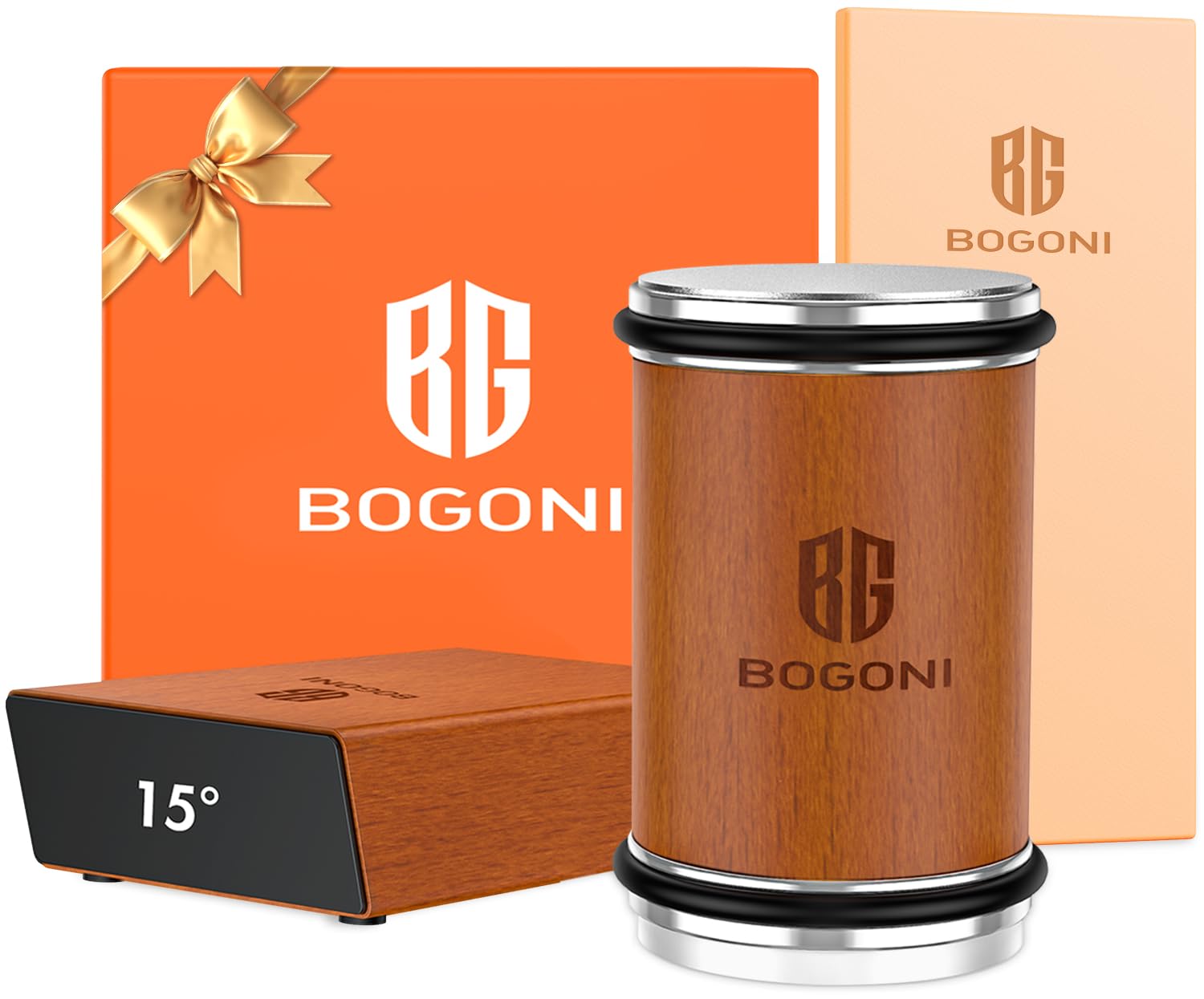
| Bogoni Rolling Sharpener Classic KitBest Value | Beginners who want a no-skill roller | Manual rolling | 15° & 20° magnetic | 400-grit diamond + 3000-grit ceramic | Amazon |
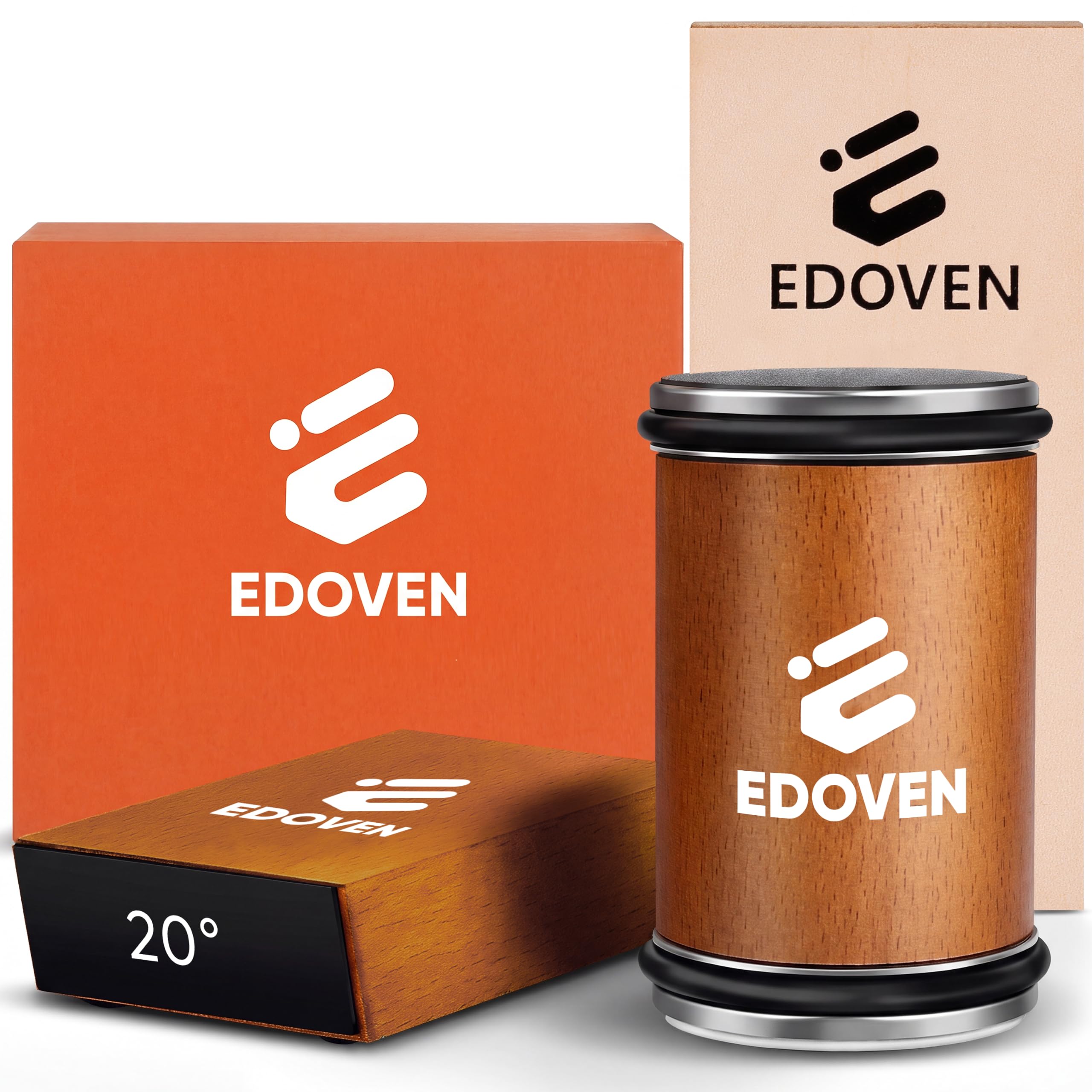
| EDOVEN Rolling Sharpener KitBest Kit | Home cooks who want a finished edge | Manual rolling | 15° & 20° magnetic | 400-grit diamond + 6000-grit ceramic + strop | Amazon |
| Sharp Pebble 5 Precision Adjust | Mixed knife drawers needing many angles | Manual pull-through | 12°, 15°, 18°, 21°, 24° | Coarse / medium / fine grit | Amazon |
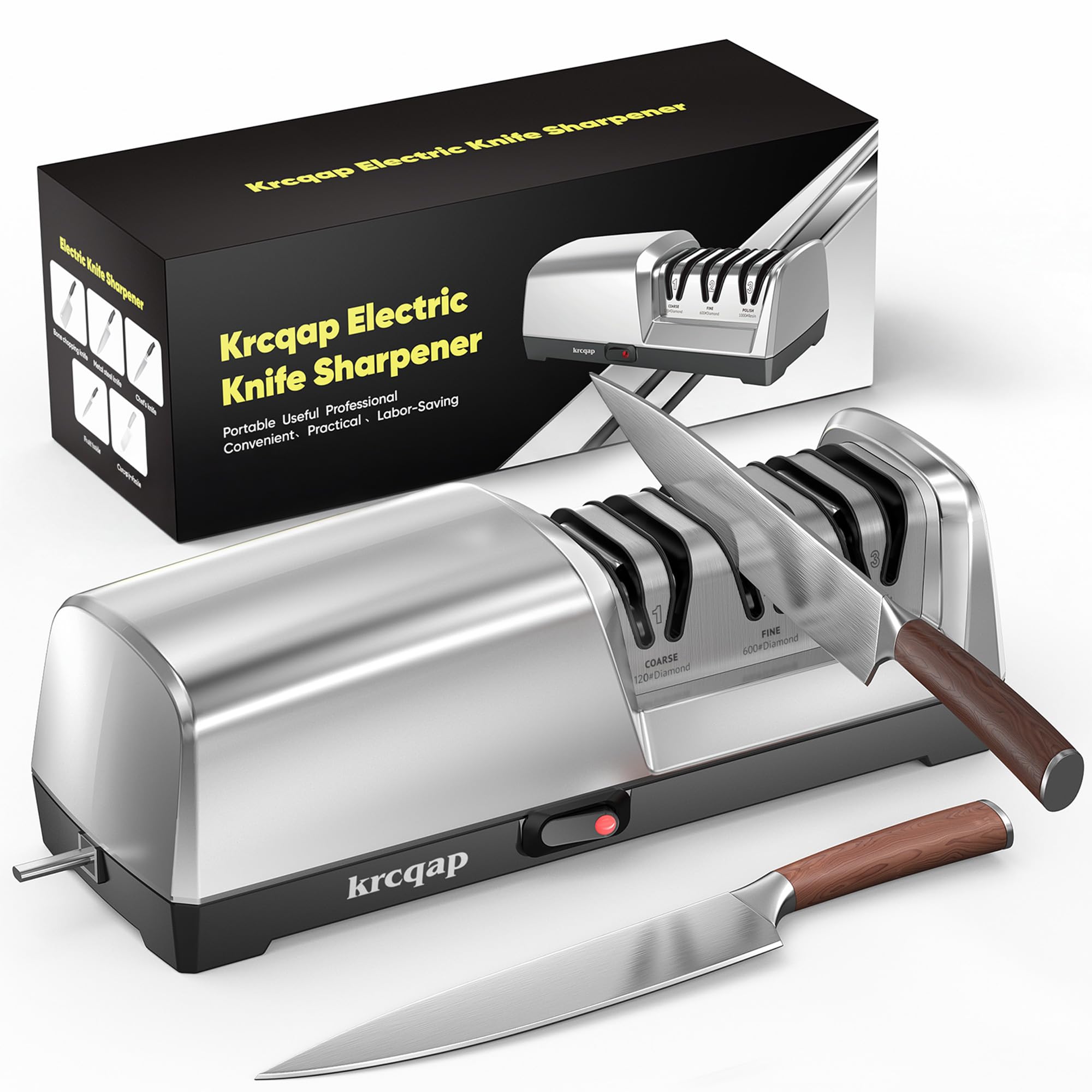
| Krcqap Electric 3-Stage | Everyday quick touch-ups | Electric, 3-stage | 15° guided | Coarse / medium / fine + non-slip base | Amazon |
| HORL 3 Cruise | Precision without the learning curve | Manual rolling | 15° & 20° | Diamond + stainless steel honing disc | Amazon |
| Chef’sChoice 15XV Metal Housing | Heavy daily use and pro kitchens | Electric, 3-stage | 15° (Trizor XV) | 100% diamond abrasives, metal housing | Amazon |
In‑Depth Reviews
1. Chef’sChoice 15XV EdgeSelect Professional Electric Knife Sharpener
Our pick — over 4.5★ from 14,000+ verified ratings; the strongest balance of quality and price.
The countertop machine that turns a dull block into a 15-degree razor in about a minute.
This is the pick for the cook who has a whole drawer of tired knives and no patience for a whetstone. The Chef’sChoice 15XV is a 3-stage electric that uses 100-percent diamond abrasives to reshape a blade and a flexible stropping stage to finish it. It converts a traditional 20-degree factory edge into the brand’s sharper Trizor XV 15-degree edge. The first full sharpen takes about one minute; a touch-up on a knife that already holds its edge runs about 10 seconds.
Speed is where it pulls ahead of every manual option here. A dull 15-year-old chef’s knife reprofiled with 20-plus pulls through stage one, two pulls through stage two, and five pulls through stage three, then glided through a bell pepper. For a knife block that has gone years without care, that is a rapid turnaround — no oil, no water, no soaking stones. The flexible spring guides adjust the angle automatically, so you are not compensating by hand the way you would on a freehand stone.
The honest catch is the learning curve on the first knife. Told plainly, beginners who rushed the process made a blade duller on the very first attempt before they settled into a rhythm — so practice on a cheap knife and read the manual first. The unit also does one job only: knives. It will not touch scissors, and two of the reviews mention packaging that showed up repackaged rather than in an original box. At 10 inches long by 4.25 wide and 4.25 high, it needs a real corner of counter or cupboard.
What Works
- Restores a 15-degree Trizor XV edge from a 20-degree factory edge.
- About 1 minute for a full sharpen, roughly 10 seconds to resharpen.
- Dual action on straight and serrated blades thanks to the stropping stage.
- Flexible spring guides control the angle so you do not have to.
The Honest Limits
- First attempt on an expensive knife can dull it without practice.
- Sharpens knives only — no scissors, no tools.
- At roughly 4.2 pounds it is the heaviest pick here and needs counter space.
Buy it if: you own a full set of kitchen knives and want them slicing again in a minute per blade.
Think twice if: you only own one or two knives and would rather not spend time learning a machine’s feel.
2. Bogoni Rolling Knife Sharpener with Diamond & Ceramic Disc, Classic Kit
A compact roller that gets knives shaving-sharp in minutes and fits in a drawer afterward.
For anyone who owns two or three good knives and wants a simple counter tool, this kit earns its place. The rolling design pairs a 400-grit diamond disc for reshaping with a 3000-grit ceramic disc for polishing. A magnetic holder with six built-in N52 neodymium magnets — N52 being the strongest common grade of neodymium magnet — clamps the blade at a fixed angle so you cannot tilt it mid-stroke. Quality and ease of use are the two things buyers talk about most with this one, and the rolling motion is the reason: you simply roll the cylinder along the blade and the geometry holds itself.
Two preset magnetic guides cover 15 degrees for fine, delicate edges and 20 degrees for everyday durability, so you can switch based on the blade in hand. The body is natural wood with a smooth roller, and the kit includes a leather strop for the finishing pass. For edge control without a whetstone class, it is the roller buyers recommend to friends. Sharpening my kitchen knives to perfection, as one buyer put it — as sharp or sharper than new.
The recurring gripe is the magnet itself — a few users found the guide slipped slightly on wider blades and wanted a stronger hold. It also runs slower and demands more care around the blade than an electric machine does; the roller moves over the edge, not the other way round, so patience matters. The unit measures 4.6 inches long by 5.9 wide by 3.3 high and weighs 0.5 kg, so it stores small.
The short version: a no-skill roller with two real angle settings, a strop, and a footprint that tucks into a drawer — the value pick for a small kitchen.
One thing to expect: it asks more time and care than an electric sharpener, especially on smaller paring or pocket knives.
Reach for this if: you want consistent 15-degree edges and store your tools in tight space.
Look elsewhere if: you sharpen a large knife block weekly and would rather let a motor do the work.
3. EDOVEN Rolling Knife Sharpener Kit with Leather Strop & Magnetic 15° & 20° Angle Guide
Rolls the blade clean and then finishes it — a two-disc roller with a real leather strop in the box.
Most manual sharpeners stop at “sharp.” This kit goes one step further. After the 400-grit diamond disc reshapes the edge, a 6000-grit ceramic disc polishes it, and the included leather strop handles the final pass that removes the leftover burr. That last step is the difference between an edge that cuts and one that glides. The magnetic 15-degree and 20-degree guides hold the blade at the exact angle automatically, with Grade N48 neodymium magnets doing the clamping.
The practical draw is consistency. Place the blade against the guide, roll the cylinder along the edge, and the system keeps the same contact geometry from the first pass to the last, so you are not estimating. A dull chef’s knife came back to slicing tomatoes in under five minutes, and the honest friction report is that it is sparing on steel rather than aggressive. Build is high-grade natural wood with a non-slip feel and it stores nearly flat.
The one trade-off worth knowing: it is not fast. The roller method takes its time compared to a pull-through or an electric machine, so if you are sharpening a whole block in one sitting, expect to work for it. The kit is also built for standard kitchen knives, and the angle guide is more comfortable on larger blades than on small paring knives. With the strop and both discs in one box, though, it covers reshape, polish, and finish without buying anything extra.
Where It Shines
- 400-grit diamond reshapes, 6000-grit ceramic polishes, and a leather strop finishes.
- Magnetic 15° & 20° guide removes the guesswork and the wobble.
- Everything for the full process comes in one box.
What To Weigh
- Manual rolling is slower than an electric sharpener.
- Best suited to larger kitchen blades rather than small paring knives.
The right call for: a cook who wants a properly finished edge and does not mind a few extra minutes of rolling.
Less of a fit for: someone sharpening small pocket folders where the guide feels awkward.
4. Sharp Pebble 5 Precision Adjust Knife Sharpener, 3-Stage

Five angles in a handheld frame — set 15 degrees for your chef’s knife, then switch for everything else.
If your drawer holds a mix of kitchen knives, a pocket folder, and a fishing blade, a single fixed angle is a compromise. This Sharp Pebble adjusts across 12, 15, 18, 21, and 24 degrees, and you pick the angle with a dial wheel that lines up with a printed guide. That means the 15-degree setting is right there for a fine bevel, while the wider angles handle tougher edges. It is a pull-through design — you set the blade in the slot, pull through a few times, and you are done. The body is ABS plastic (a hard, impact-resistant plastic) over a rubber gripping surface, and the whole unit weighs about 1.5 ounces, so it packs easily for travel and storage.
Speed is the headline. A knife comes back shaving-sharp in under 30 seconds, and the coarse, medium, and fine grooves let you repair, then refine, then polish in one sitting. The user instructions print right on the unit and a downloadable copy is included, so you do not need to hunt for a manual. It handles kitchen work without fuss and the rubberized base stops it sliding mid-pull.
Now the trade-offs. Pull-through sharpeners are more aggressive than a rolling guide, and the adjustment wheel can feel tight in use — that is a real note from buyers rather than a deal-breaker. It is also for straight-edge blades only: serrated knives and scissors are out. And a manual pull-through will not match a good whetstone for absolute edge quality, which is worth knowing if you already own stones.
Why it earns a spot: five angle options in a one-hand, sub-30-second tool is hard to argue with for a mixed knife drawer.
The catch: it will not touch serrated edges or scissors, and the wheel takes a little muscle to turn.
Best for: someone with assorted blades who wants 15 degrees available without owning a separate sharpener for each angle.
Skip if: your kit includes serrated bread knives or kitchen shears you want sharpened too.
5. Krcqap Electric Knife Sharpener for Kitchen Knives, 3-Stage
A compact electric that keeps the counter quiet while it brings dull kitchen knives back in minutes.
For the everyday cook who wants sharp knives without hand work, this Krcqap is a practical entry into electric sharpening. It runs a 3-stage diamond grinding system across coarse, medium, and fine stages, with a built-in 15-degree angle guide that holds the bevel for you and helps prevent over-grinding a blade. Full kitchen use is the target: chef knives, utility knives, paring knives. You feed the blade through, the slots do the work, and the setup is simple enough that a beginner picks it up on the first knife.
Two things recur across owner impressions. The stability of the non-slip base keeps the unit from drifting across the counter mid-pass, and the results come back consistent — a chef’s knife that sliced tomatoes cleanly after a coarse-then-fine run. It is also compact for storage and stays a reasonable volume while running, which matters if you sharpen while dinner is on. An experienced cook with a bench-style sharpener and a steel in the drawer still gave this unit a solid nod for hard-to-sharpen fillet knives.
The honest limit: it is not built for daily heavy sharpening. A few buyers found it best for occasional dulling rather than a knife-block marathon, so if you sharpen several knives every week you may want the more powerful electric in this list. It also handles kitchen knives only — this is not a tool-sharpening station.
The value read: a small, stable, low-effort electric that brings dull kitchen knives back fast for everyday home cooking.
Worth knowing: it suits occasional sharpening, not a professional kitchen’s daily volume.
Ideal if: you want push-button sharpening in a small footprint and sharpen a knife or two at a time.
Not ideal if: you run a busy kitchen and sharpen a stack of knives every day.
6. HORL 3 Cruise Rolling Knife Sharpener, Diamond & Steel Disc

The precision roller for people who are not good with traditional sharpeners — and it just works.
HORL built this for the cook who wants a razor edge without learning freehand technique. A permanently fixed diamond disc (a disc coated in diamond particles that grinds the metal) does the sharpening, and a stainless steel honing disc follows it to remove the burr (the rough lip left on the edge) and polish the edge. The magnetic angle support uses a Grip Pad the maker rates at up to 70 percent more grip than the HORL2 version, so even small pocket knives stay clamped. The body uses ocean-bound recycled plastic, and it is made in Germany.
The two angles split the work cleanly: 15 degrees for fine Japanese, carbon, and Damascus blades, and 20 degrees for European chef’s knives, outdoor, and pocket knives. Six knives went to an accurate 15-degree edge in about 15 minutes, and the magnetic holder keeps the blade flat without scratching it. For someone who was previously paying to have knives sharpened, five minutes per knife is the difference between outsourcing the job and doing it at home.
Here is where honest buyers split. Sharpness, quality, and ease of use are what people love; value is the mixed note, and a fair number of owners want a finer grit option than the diamond disc provides — a few finished knives came back only shave-sharp without an extra strop (a leather strip used to polish the edge). Larger butcher knives also need the roller run over a wood board to reach the full edge. If you want an obsessive, multi-grit progression, this stops short of it; if you want consistent 15-degree edges with no skill gap, it delivers.
What Wins People Over
- Fixed diamond disc plus a stainless steel honing disc that clears the burr.
- Magnetic angle support holds even small pocket knives at an accurate angle without scratching.
- 15° and 20° settings cover fine Japanese blades and sturdy European ones.
What To Consider
- Value is the mixed point — it costs more than most manual rollers.
- No finer-grit disc, so some edges need an extra strop to reach razor.
- Very long blades need a wood board under the roller to finish the edge.
Settle on this if: you want a simple to use, repeated 15-degree edge and dislike the whetstone learning curve.
Keep shopping if: you want a deep grit progression and treat sharpening as a hobby.
7. Chef’sChoice 15XV Professional Electric Knife Sharpener, Metal Housing

The same 15-degree Trizor edge as the top pick, wrapped in a heavier metal shell built for daily duty.
This is the armored version of the Chef’sChoice formula. The brushed metal upper housing is made for daily professional use, and the internals are the familiar 3-stage EdgeSelect system: stages one and two use 100-percent diamond abrasives (a hard abrasive that grinds metal) to sharpen and hone, and stage three uses a flexible abrasive to polish and help prolong the life of serrated edges. It converts a standard 20-degree factory edge into the 15-degree Trizor XV, and resharpening a maintained knife runs about 10 seconds.
The heavier build changes the experience in two ways. It runs louder — the maker lists noise between 65 and 75 decibels, which is about the volume of a normal conversation pushed up to a vacuum cleaner. It also runs cooler, because the metal case helps dissipate the heat grinding generates, which protects the blade’s temper during a long session. A four-year-old kitchen knife came back in five minutes; a blunt butcher knife needed around half an hour of patient work. Both straight-edge and serrated blades are covered.
The practical caution is over-grinding. Owners who pressed too hard removed more steel than needed, and nicks stay in a blade unless the edge is fully reworked — so light, even passes are the technique. There is also a labeling quirk to expect: the serial may read “Model 15” rather than “15XV,” which the brand has confirmed is the same unit. At 12 inches long by 6.25 wide by 6 high and 5 pounds, it needs more counter room than anything else here and it is the loudest pick in the list.
The case for it: if you sharpen often, the metal housing and the same fast 3-stage diamond system make this the durable long-haul electric.
Where it stumbles: noise and size — it is the heaviest and loudest pick, and it takes a learning curve to avoid pressing too hard.
Suits you if: you sharpen frequently and want a machine built to handle that volume with a cooler, sturdier body.
Suits you less if: counter space and quiet matter more than heavy-duty build.
Understanding the Specs
Sharpening Angle
The angle is the bevel the blade is ground to, measured between the edge and the flat of the knife. A narrower 15-degree edge bites into food with less resistance, so it slices cleanly, but it is thinner and needs more frequent touch-ups. A wider 20-degree edge is more durable and stands up to heavier chopping. Many 15-degree sharpeners here offer both, so you can choose a fine edge for delicate blades or a sturdy edge for daily work.
Grit And Abrasive Type
Grit measures how coarse the abrasive is. A low number like 400 grit is coarse and removes metal fast to repair a dull or chipped edge. A high number like 3000 or 6000 grit is fine and polishes the edge smooth. Diamond abrasives cut harder steels and hold their bite longer than conventional stones. A leather strop is a finishing step that aligns the edge and removes the burr left after grinding.
FAQ
Is a 15-degree edge better than a 20-degree edge?
Can a 15-degree sharpener convert my 20-degree factory knives?
Will a 15-degree sharpener work on serrated knives?
How many passes does it take to sharpen a dull knife?
Is a manual rolling sharpener or an electric sharpener better?
How do I keep the sharpening angle consistent by hand?
What is the difference between diamond and ceramic discs?
Do these sharpeners sharpen Damascus or high-carbon steel?
Will an electric sharpener grind away too much of my knife?
How often should I sharpen my kitchen knives?
Final Thoughts: The Verdict
For most kitchens, the 15-degree knife sharpener to start with is the Chef’sChoice 15XV EdgeSelect — it converts a 20-degree factory edge to a 15-degree Trizor edge and restores a tired knife in about a minute, which is why it holds the top spot at 4.6 stars across a massive owner base. If you would rather roll by hand and keep it in a drawer, the Bogoni Rolling Sharpener delivers 15- and 20-degree magnetic guides with a strop in a compact kit. And for the cook who wants simple to use precision without the wheel-turning, the HORL 3 Cruise clamps even small blades at an accurate angle and finishes with a steel honing disc.
If your knives are dull right now and you sharpen a block often, the electric picks save about a minute per blade — stop putting it off.
How We Picked
We do not accept paid placement. Every pick is matched to a real buyer and a real use-case; we do not hands-on test units.
Sources & Methodology
Specifications: manufacturer listings and product documentation. Review insights: verified customer reviews, as of September 2026. Pricing: not shown on this page (it changes often); check the current price via the retailer link.
As an Amazon Associate, KitchPrep earns from qualifying purchases. This does not affect which products we feature.
Related Guides
