
Specs are compiled from manufacturer listings and verified buyer reviews and can change over time — please confirm the key details on the product page before buying.
A portable unit rolls between rooms and needs no permanent bracket, a window unit cools harder for the money, and only some of these run on an inverter compressor (a variable-speed motor that slows down instead of clicking on and off). Pick the wrong shape and no BTU number will save your summer.
I’m Mohammad Maruf — the founder and writer behind KitchPrep. This guide is built by comparing the manufacturers’ published specifications and the patterns across verified customer reviews, so you get each pick’s real strengths and trade-offs instead of marketing spin.
One heads-up before the picks: this list allows flexible matching for the 14,000 BTU cooling tier, so units sold in the roughly 13,500 to 14,500 BTU band are included alongside exact 14,000 BTU models, and a few listings quote a lower SACC number (the newer, stricter DOE rating) for the same machine. Here is what actually separates the best 14000 BTU air conditioner options.
Our Picks at a Glance
How To Choose The Best 14000 BTU Air Conditioner
The first decision is not the brand. It is the shape. A portable air conditioner stands on the floor and exhausts through a hose kit in your window. A window air conditioner sits in the window frame itself. That single choice decides how loud the unit runs, how cold your room gets, and how much of your wall or floor space it eats.
Portable or window? Start with your window.
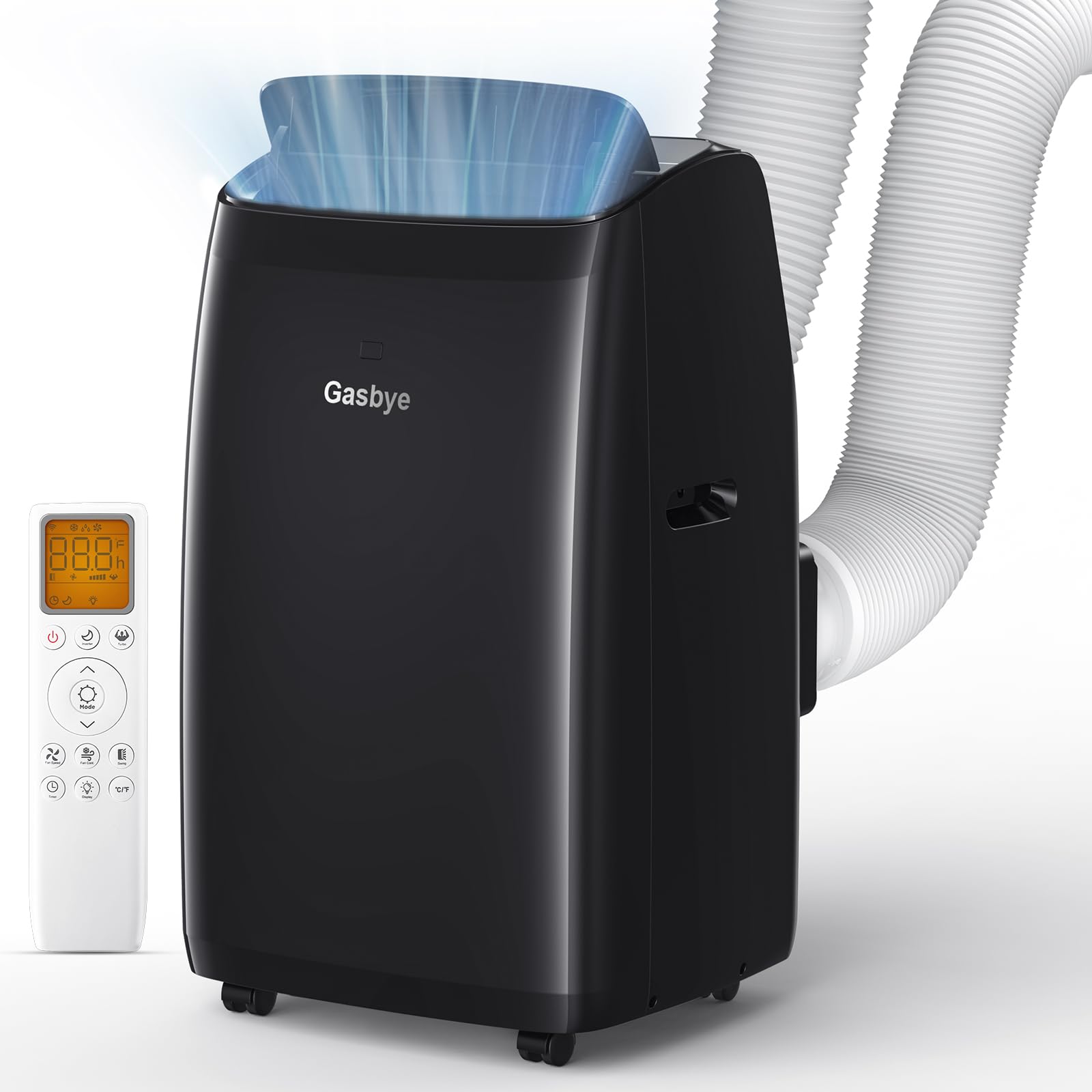
Portables fit sliding and casement windows that a window unit cannot. They also move room to room on casters and need no permanent install. The trade-off is that a portable cools less efficiently and occupies floor space — the Gasbye unit in this list is a true full-size 14,000 BTU portable at 15.5″ D × 17.7″ W × 29.3″ H, so measure your corner before you commit.
Window units, by contrast, only work in double-hung or single-hung frames. The LG window model here needs a window opening 27″ to 39″ wide by 16″ tall. In return you get stronger cooling from the same BTU rating and no hose to insulate.
Read the SACC number, not just the headline BTU.
Many portables advertise 14,000 BTU ASHRAE but deliver 10,000 or 10,500 BTU SACC — the SACC figure is the tighter, more realistic rating for a portable in a hot room. The Gasbye lists 10,500 BTU SACC and 14,000 BTU ASHRAE. The ZAFRO lists 10,000 BTU SACC. Expect the SACC number to govern what the unit can actually do on a 100°F day.
Quick Comparison
| Model | Best For | Form Factor | Rated Coverage | Rated Noise | Amazon |
|---|---|---|---|---|---|
| Gasbye Dual Hose Portable★ Best Overall | Whole-room quiet cooling | Portable, dual hose | Up to 500 Sq.Ft. | 45 dB | Amazon |
| Air Future Smart PortableBudget Champion | Big open spaces on a budget | Portable, single hose | Up to 750 sq. ft. | 45 dB | Amazon |
| KAMLAM Portable ACDehumidifier First | Dehumidifying damp basements | Portable, single hose | Up to 700 sq. ft. | 52 dB | Amazon |
| GrowthWing Smart WiFi Portable | Phone and voice control | Portable, single hose | Up to 700 sq. ft. | 42 dB | Amazon |
| Frigidaire Smart Window AC | Whole-apartment window cooling | Window | Up to 700 sq. ft. | — | Amazon |
| ZAFRO Smart Inverter Portable | Dual-hose inverter value | Portable, dual hose | Up to 700 sq. ft. | 42 dB | Amazon |
| DELLA Smart Window AC | Alexa-controlled window install | Window | Up to 700 sq. ft. | 54 dB | Amazon |
| Midea Smart Inverter Window AC | Quiet efficiency in a window | Window | Up to 700 sq. ft. | 41 dBA | Amazon |
| DREO Portable 516S | Bedroom sleep comfort | Portable, single hose | — | 45 dB | Amazon |
| LG LW1522FVSM Window AC | Large rooms, app control | Window | Up to 700 Sq.Ft. | 44 dB | Amazon |
| Whynter ARC-1230WN | Portable cooling with auto drain | Portable, dual hose | Up to 600 sq. ft. | — | Amazon |
In‑Depth Reviews
1. Gasbye Dual Hose Portable Air Conditioner, 14,000 BTU
Our pick — over 4.5★ from 450+ verified ratings; the strongest balance of quality and price.
The dual-hose inverter that made one owner call it the coldest air of ten units owned
If you want one unit to quietly hold a 500-square-foot room at temperature through a full summer, this is the one to beat. It runs a full DC inverter compressor (a variable-speed motor that throttles down rather than slamming on and off), and Gasbye rates it at 13.6 CEER — a real energy-efficiency score verified by the DOE. The company also states plainly that it does not inflate the BTU rating, which is why the cabinet is a true full-size 15.5″ D × 17.7″ W × 29.3″ H instead of a squeezed “mini” shell.
The dual-hose design is the reason it cools like a bigger unit than it is. Two hoses — one pulling outside air in, one pushing hot air out — keep your room from going negative-pressure, so hot air does not get dragged back through door gaps. Owners who moved up from a single-hose model describe the difference immediately, and buyers report the unit pulling a 1,000 sq ft space down to 68°F when it was 103°F outside. The inverter also drops the compressor to half load within two minutes and settles around 45dB, so it stops shouting at you once the room is cool.
Runtime and energy use are where the inverter pays off. Turbo mode pulls roughly 800 to 1,300 watts for fast cooldown, then drops to about 500 to 800 watts once the room holds, and owners mention it idling near 530 watts. It has run continuously for stretches of three days in owner reports and draws an estimated 442 kilowatt hours per year. The catch worth knowing: the hoses are 5.9″ in diameter and 59″ long, and Gasbye advises against extension hoses because they cut cooling performance — if your window sits high, you raise the unit on a stand instead.
What owners keep coming back to
- Dual-hose pressure balance cools faster and more evenly than a single hose
- 13.6 CEER inverter runs around 45dB and holds temperature instead of cycling hard
- Three-year coverage with brand-new replacements and fast support responses
- A second drainage outlet sits higher on the back, so manual draining is easier when humidity spikes
Where it asks something of you
- Humidity above 85% RH in an unsealed room can outrun auto-evaporation and need draining
- A true full-size cabinet needs real floor space and open clearance around it
- Short cords and hoses limit where the window kit can reach
Best fit for: a hot bedroom or living room where you want one quiet machine holding the temperature all night with a single efficient compressor.
Think twice if: your only window sits high and far from the floor — the 59″ hoses cannot be extended without hurting cooling.
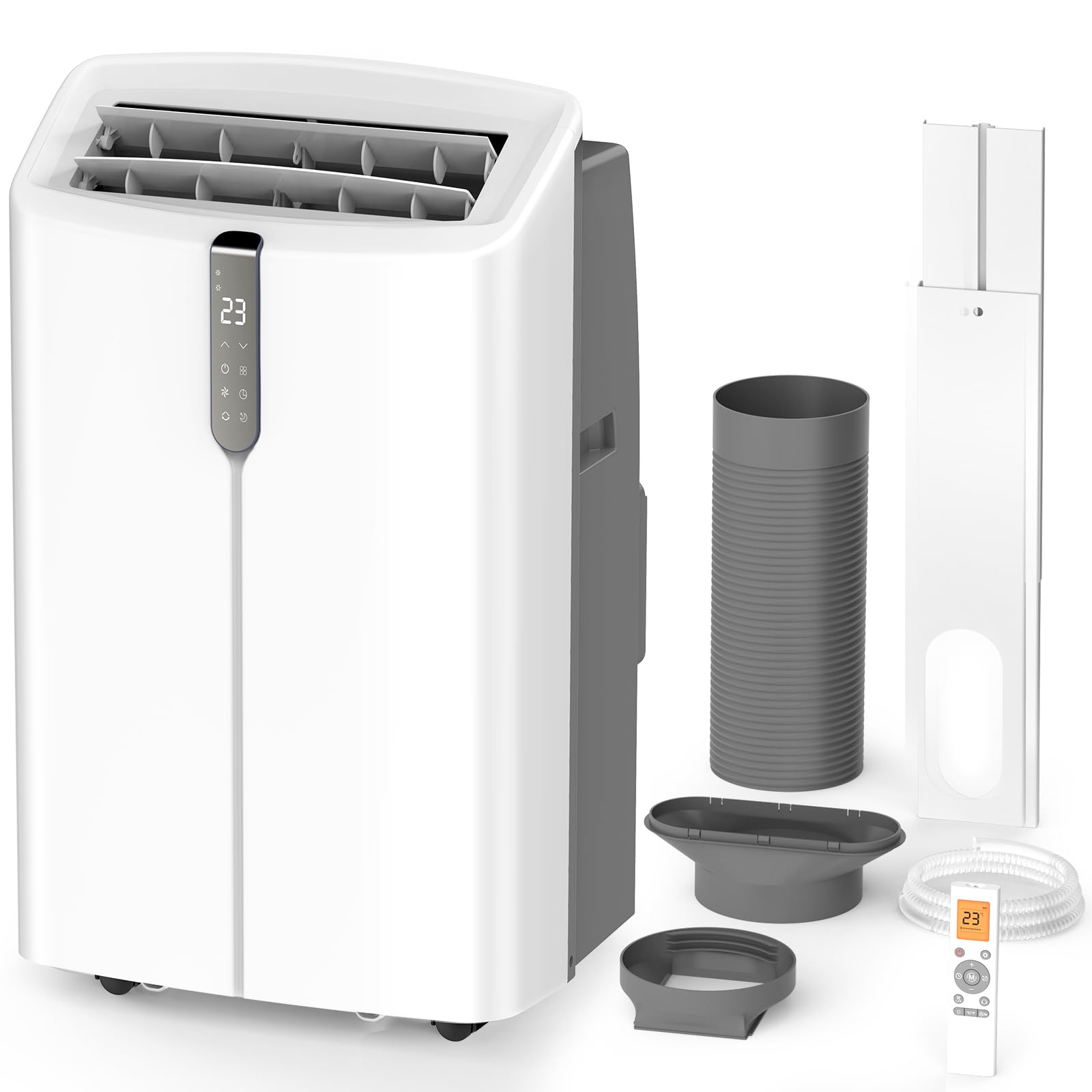
2. Air Future 14000 BTU Smart Portable Air Conditioner
Reaches 68°F overnight in a top-floor room that held heat all day
This is the model to look at when you want real cooling coverage without stepping into premium territory. It is rated 14,000 BTU ASHRAE and 10,000 BTU SACC, runs on 115V/60Hz power with ETL certification, and uses R32 refrigerant — a newer coolant the listing describes as having almost zero ozone depletion potential (the measure of how much a gas harms the ozone layer). Owners freeing up a 300-square-foot top-floor room report it dropping to temperature in about an hour.
The self-evaporation setup is a genuine convenience. Condensate pulled out of the air is recycled to cool the condenser coils, then sent out the exhaust hose, so you are not emptying a tank every day. Tool-free assembly helps too: an adjustable window seal plate and telescopic hose fit most vertical and horizontal sliding windows, and the whole cabinet rolls on four 360-degree casters with recessed side handles for lifting over thresholds.
Where it earns its keep is coverage for the money — few units here promise 750 square feet at this tier, and the cooling performance is what owner feedback centers on. Sleep mode is rated at 45dB, and the auto swing louver spreads air instead of blasting one spot. The honest caveat is noise consistency: some owners describe it as surprisingly quiet while others find it loud, so placement matters more here than on a dual-hose inverter. Water drainage is the other thing to watch — in humid weather the self-evaporation can fall short and you may be draining a bucket. One longer owner report also notes the 60s-to-90s temperature range holds for summer cooling rather than year-round use.
The value math: a 750-square-foot cooling claim, R32 refrigerant, a 24-hour timer, and touchscreen-plus-remote control land here for less than most of the field.
Set expectations: this runs a rotary compressor rather than an inverter, so it will cycle on and off instead of gliding, and noise reports split both ways.
Reach for it if you need broad coverage across one big open room and want smart scheduling without paying premium rates.
Look elsewhere if a whisper-stable compressor matters more to you than the coverage figure.
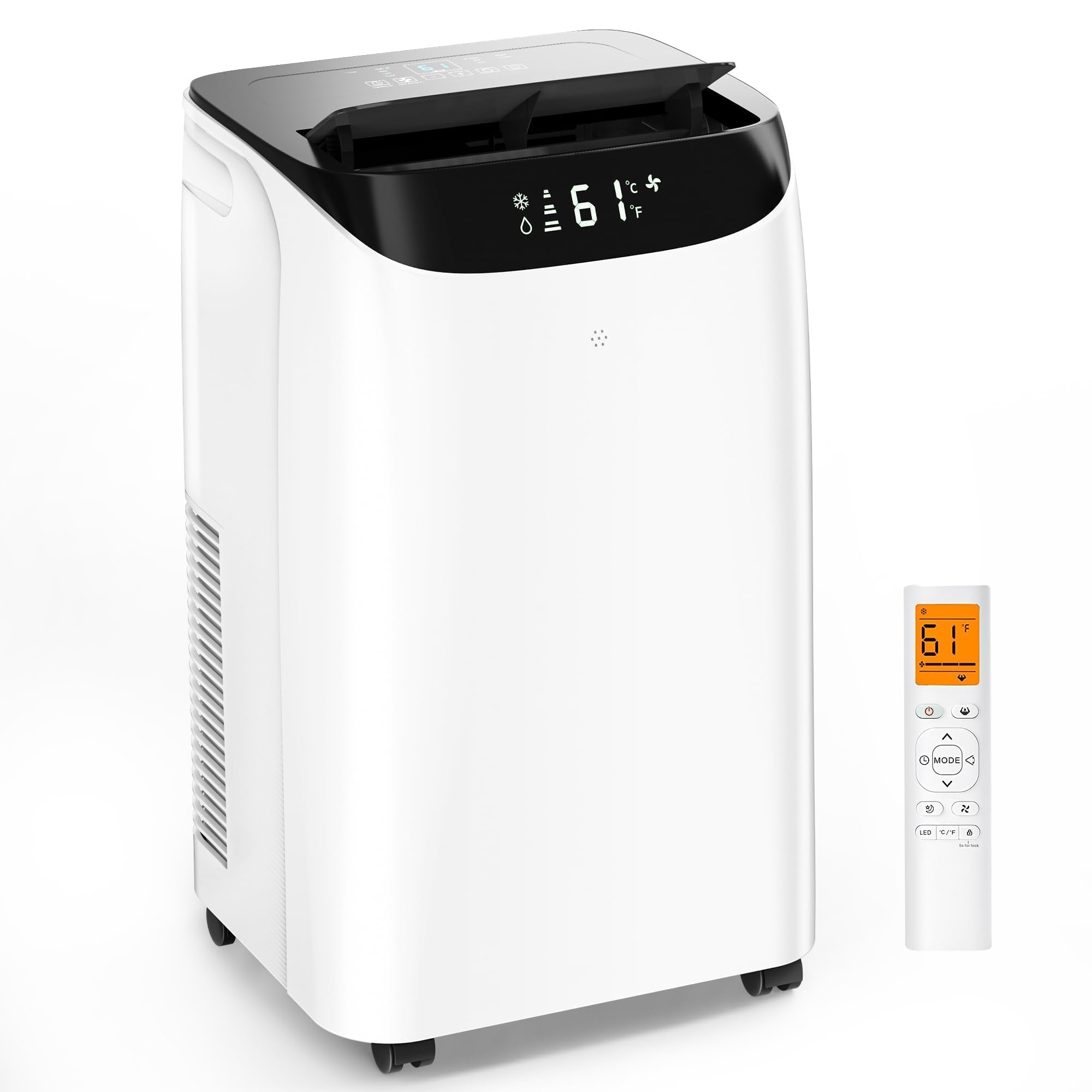
3. KAMLAM 14000 BTU Portable Air Conditioner
The damp-basement specialist — 95 pints of moisture pulled out per day
If your problem is a muggy basement, laundry room, or a garage that sweats, this unit’s headline number is the one that matters: a 95 pints-per-day dehumidification capacity. That is a lot of moisture, and it means this machine earns its place in rooms where cooling and dampness are the same job. It runs 14,000 BTU ASHRAE / 10,000 BTU SACC, pushes 400 m³/h of airflow through a wide 75-degree outlet, and covers rooms up to 700 square feet across living rooms, bedrooms, kitchens, garages, basements, and offices.
The mode set is genuinely flexible. Four modes cover Cooling, Fan, Dehumidifying, and Auto, and in cooling mode you can dial anywhere from 61°F to 86°F. A front LED display and a remote with up to 23 feet of range mean you adjust temperature and fan speed from the sofa. The 0.5-to-24-hour timer lets you preset automatic on and off, which is the practical way to cut electricity costs on a non-inverter machine like this one.
Here is the trade-off, and it is worth reading carefully. This unit has no inverter, so instead of gliding it clicks on and off, and it runs about 52dB in normal cooling and 48dB in Sleep Mode. It also summarizes honestly that in humid spots like basements or laundry rooms, drainage can be needed every 8 hours, at which point shutdown protection kicks in as a reminder — you unplug the rear drain plug, attach a garden hose, and restart. Owners rate the cooling as strong and the build as solid, with several noting it runs quietly and blows very cold air. Setup is about as simple as it gets: panels on the window, hose to the unit, plug in, and the kit needs no extra tools. A few buyers mention assembly took closer to an hour.
Where it shines: the highest dehumidification figure on this list at 95 pints per day, paired with 400 m³/h airflow and cooling down to 61°F.
Its honest edge to your patience: no inverter means louder cycling at 52dB and more frequent draining in wet rooms than a self-evaporating inverter model.
Suits: anyone fighting humidity as much as heat — think basements, garages, and laundry rooms.
Not the pick for: a quiet bedroom where a cycling compressor and a possible drain every 8 hours would break the peace.
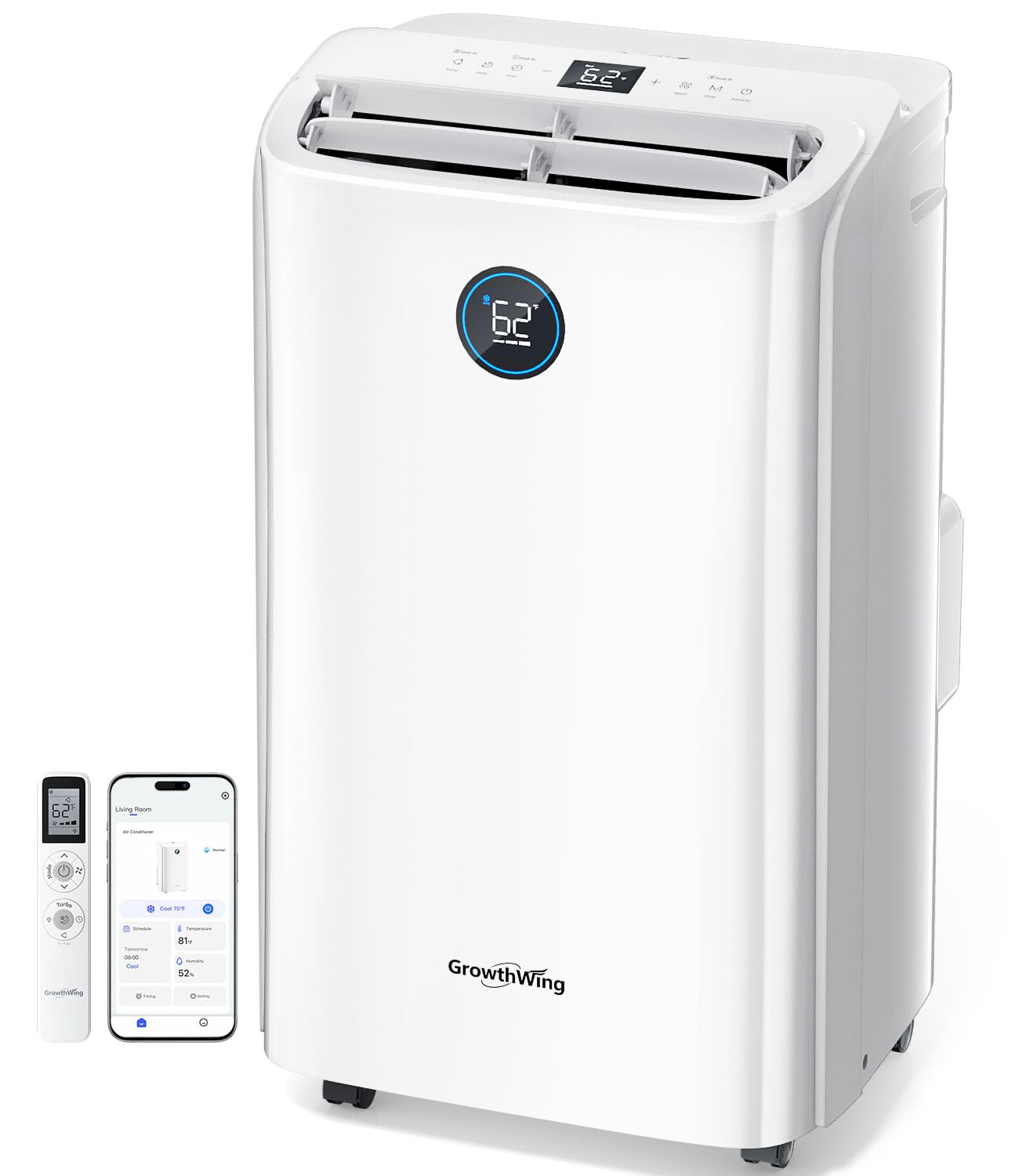
4. GrowthWing 14,000 BTU Smart WiFi Portable Air Conditioner
Talk to it, schedule it, dim it — the portable built around app control
Start with the feature you will actually use daily: this unit takes app, voice, and remote commands. You adjust temperature, fan speed, modes, and schedules from your phone before you get home, or by voice through your smart speaker. Setup is short — download the app, turn the unit on, hold the Mode button until the indicator flashes, add the device, and pick your home network.
Noise and drainage are the two specs people check next, and this one handles both. Sleep mode quiets down to 42dB — one of the lowest ratings in this list, alongside the Midea window unit’s 41 dBA — and the display dims itself at night instead of lighting up the room. The self-evaporating system is rated for up to 72 hours of drainage-free cooling in most environments, and for extended dehumidifier use you connect the included drain hose. Cooling is listed at 14,000 BTU with a wide 77-degree air outlet and eco-friendly R32 refrigerant.
Installation is genuinely tool-free: the window kit panels adjust to fit most horizontal and vertical sliding windows from 20.39″ to 67″, and you just connect the exhaust hose. Owner feedback centers on cooling performance, followed closely by how easy the setup is and how quiet it runs at night — the feature that turns off all the unit’s lights comes up often. Where you should calibrate: this is a smaller review base than the giants on this list, and one owner finds the 700-square-foot claim generous, with real-world results closer to a 20′ x 24′ room. It cools that space well, but treat the coverage number as a best case.
Control without getting up: phone, voice, and remote all adjust temperature, modes, fan speed, and schedules, with a 42dB sleep rating.
Trim the coverage claim: 700 square feet is the maximum, not the norm — a vaulted or sunny room will want less expectation.
Great for: someone who wants to pre-cool from the car and never hunt for a remote in the dark.
skip it if: you need guaranteed coverage of a genuinely huge open space rather than one comfortable room.
5. Frigidaire 14,000 BTU Smart Window Air Conditioner

The window unit that keeps a two-bedroom apartment even through a 90°F stretch
A window air conditioner cools harder per BTU than any portable, and this Frigidaire shows why the form factor still wins for whole-apartment duty. It is rated 14,000 BTU and up to 700 square feet, with a rotary-scroll compressor and Wi-Fi built in. Through the Frigidaire app you turn it on or off remotely, change temperatures, switch modes, set custom schedules, and adjust fan speed — all from your phone.
The performance reports read like a unit with headroom to spare. Owners describe it keeping temperatures even in 90+ degree weather and cooling an 800-square-foot open kitchen and living area quickly. Several note it outperformed an older 8,000 BTU unit enough to stay icy on eco low even around 100°F outside. There is a filter light reminder and a dust pre-filter, and owners mention the filter needs cleaning faster if you run it all day — a small routine, not a chore. The app handles temperature control and lets you set individual tasks.
The catch is sound. Most owners call it quiet enough to barely hear, but one describes it as extremely loud in an open kitchen and living room. That is the nature of window units — they are mounted in the wall, not tucked in a corner, so the compressor sits in your room’s frame. This one also carries real weight, and owners flag that installing a heavy window unit takes two people. If noise sensitivity runs high in your household, weigh a dual-inverter portable instead.
Where it pays off: whole-apartment coverage with app scheduling and a filter light that reminds you to clean the pre-filter.
Mind the room: a window unit puts the compressor right in your space, and a small number of owners find the sound intrusive.
Pick this one if you have a standard double-hung window and want maximum cooling reach plus remote control.
pass on it if your window is casement or sliding, since a window unit will not fit.
6. ZAFRO Smart Inverter Portable Air Conditioner, 14000 BTU
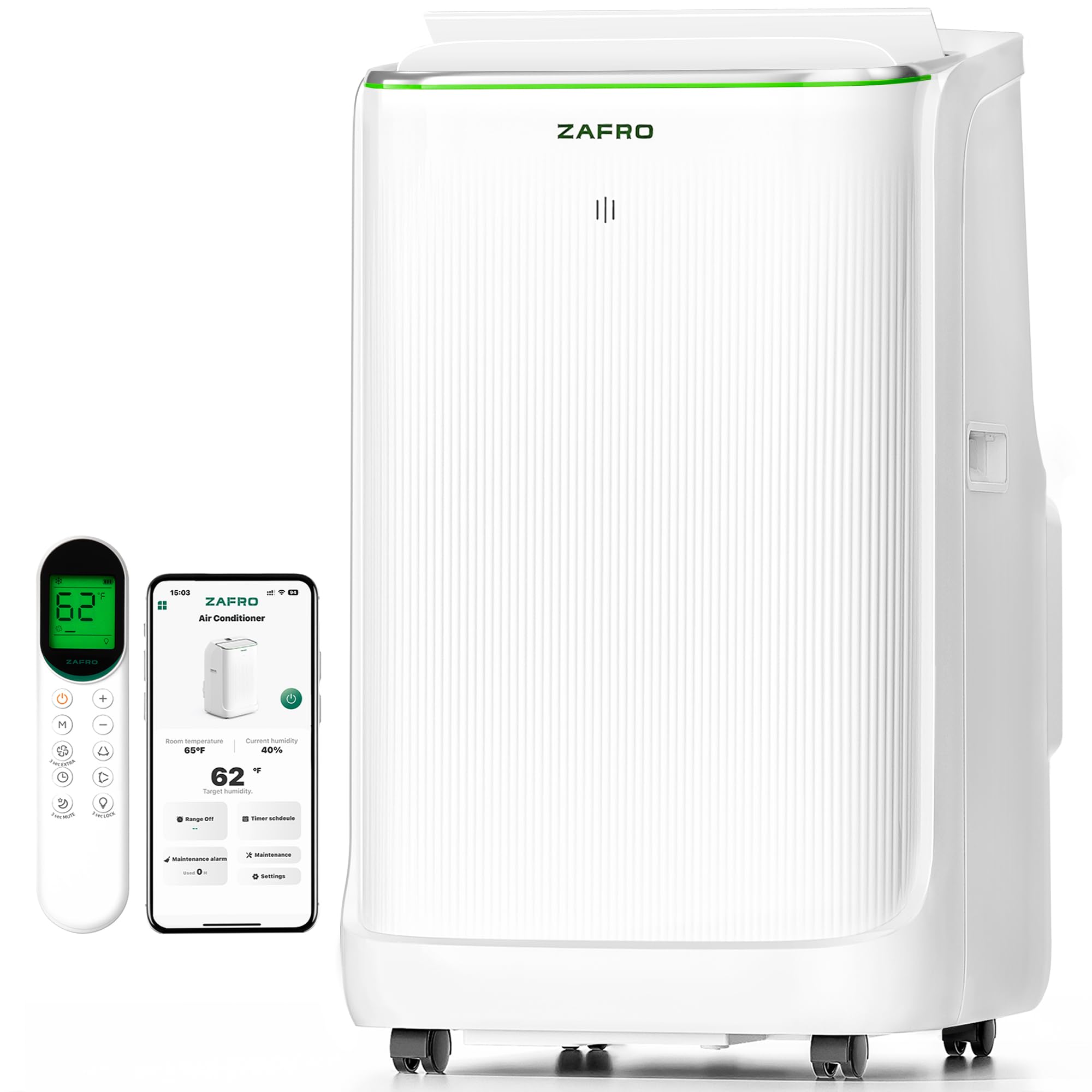
Inverter cool at 42dB with an Extra mode that pins the temperature at 61°F
Most buyers weighing a portable want three things: it cools fast, it runs quietly, and it does not need constant babysitting. This ZAFRO delivers all three at a mid-range price, with an inverter compressor and a dual-hose system that pushes 390 cubic meters of air per hour. Its inverter scores a CEER of 12.8 — a real efficiency rating, and one above the standard 7.83 baseline it cites. There is also an Extra mode that locks the temperature at 61°F and runs at full power for instant relief on brutal days.
The self-evaporating system answers the drainage question directly. Moisture from the evaporator is slung into the condenser and evaporated, so in humidity under 90% the unit runs drainage-free for 72 hours. Above 90% humidity, a drain hose is included. Sleep mode drops to as low as 42 decibels — quieter than normal conversation — and six modes cover Cool, Dry, Fan, Sleep, Extra, and Eco, with four-way oscillation spreading air across the room. App, remote, and touch controls all work, and a 24-hour timer lets you pre-cool before you arrive.
What owners put real weight on is how quickly this thing gets cold — the cooling performance is what most report, with a 650-square-foot basement and office in hot, humid New York handled comfortably and no draining needed across weeks of 12-hour days. The dual hose is repeatedly praised as more effective than an older single-hose unit, and the 400-square-foot room it was tested in cooled in minutes. One report measured it taking an 81-square-foot room to temperature in about 30 seconds. The honest notes: the exhaust hose gets hot, so insulation wrap helps, and one buyer found the exhaust hose disconnects easily — duct tape is the cheap fix.
The efficient combo: inverter compressor at CEER 12.8 with a dual-hose system and a 42dB sleep rating for mid-range money.
Manage the hose: the exhaust hose runs hot and can pop loose, so add insulation and check the connection.
Best for: a buyer who wants inverter quiet and dual-hose efficiency without paying the top-tier rate.
Know going in: six modes and an app are only useful if you actually set the schedule — don’t buy it for features you will ignore.
7. DELLA 14,000 BTU Smart Window Air Conditioner
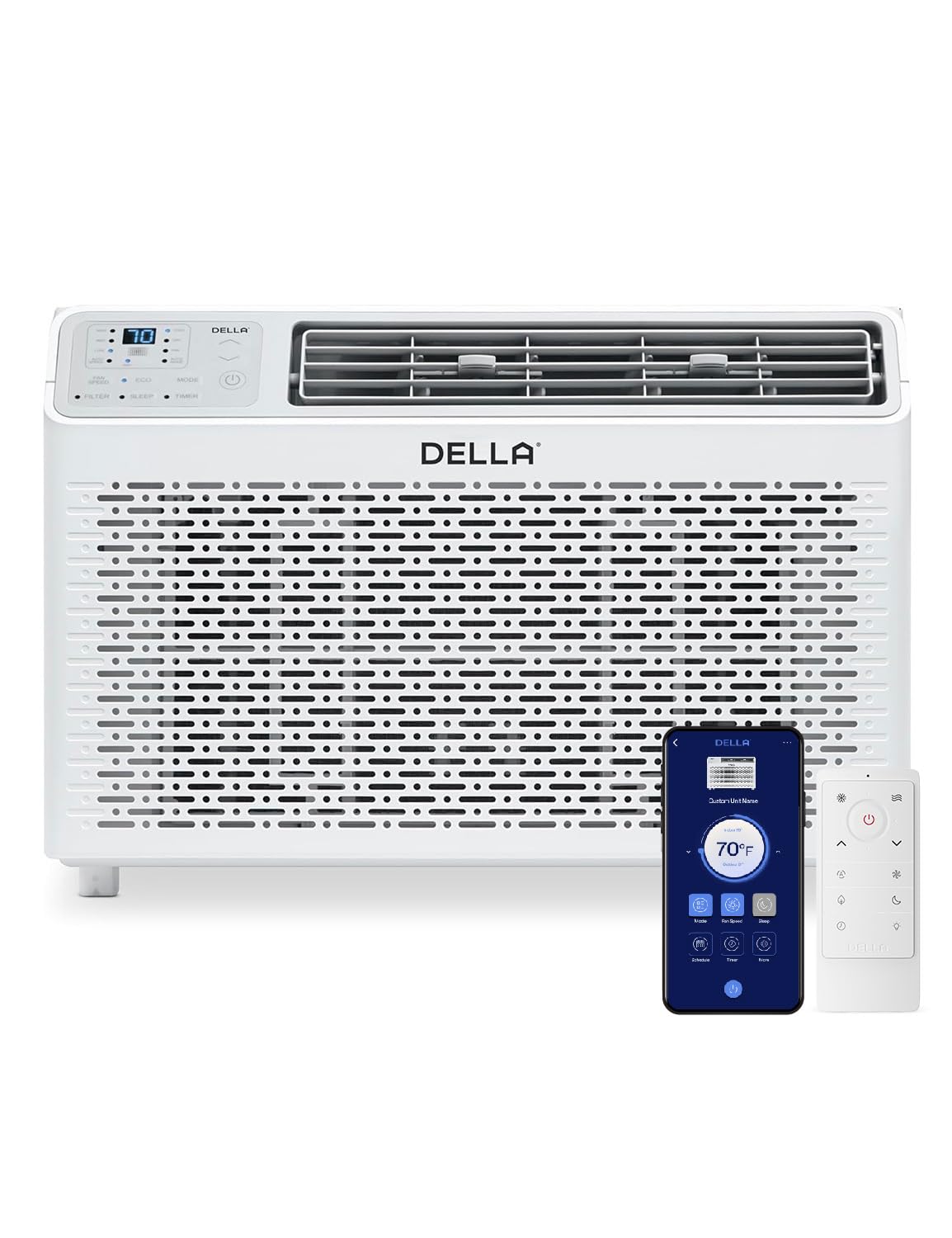
A window unit that cools a house down and answers to your voice
This is the value window pick for a large room, and its smart features go beyond the usual app. The redesigned Della+ app controls the unit from anywhere, and GEO location means it can act on where you are. Alexa voice control is built in, and there is also a remote and an LED control panel. It is rated 14,000 BTU with a CEER of 10.7, cooling rooms up to 700 square feet, and it carries 4 modes (Auto, Cool, Fan, Dry), 3 fan speeds, and a 24-hour timer with a temperature range from 61°F to 88°F.
Installation is straightforward for the right window. It fits openings from 26 to 36 inches wide with a minimum height of 16 inches, and the unit measures 19.76″W x 21.5″D x 15.16″H at 69.4 lbs. All the mounting accessories come in the box, and there is no need to modify the existing window frame. It runs as low as 54dB, has a reusable filter, and includes a dehumidifier and fan on top of cooling. The compact footprint makes it easy to slot into a standard frame.
Real-world reports on cooling are strong: owners describe it holding a bedroom comfortable when it is 110°F outside, and one Florida user replaced a central AC drawing huge summer costs with window units and saw the electric bill drop significantly. The honest trade-offs show up on the noise and longevity sides. Some owners say it is quiet with no rattling, while others find it noisy. A small number report durability issues, and one unit arrived dented and later failed with a digital fault. Set the app up with some smart-home familiarity — the printed instructions are weak.
Smart and simple: Alexa voice control, GEO-location app triggers, and a 19.76″W footprint that fits standard frames without modification.
The split on sound: owner experience on noise runs both directions, and a handful of durability complaints exist — handle installation with care.
Ideal for: a large living room where you want voice control and don’t mind a window install.
Less ideal if: you need proven long-term durability — the data here is mixed, so an extended warranty is worth considering.
8. Midea 14,000 BTU Smart Inverter 115V Window Air Conditioner

Window cooling that drops to 41 dBA — quieter than the DELLA by a clear margin
If you want the efficiency of an inverter in a window frame, this is the pick. It uses variable-speed inverter technology (the same slow-it-down-not-off approach as the best portables here) and is energy star certified, with Midea listing more than 40% energy savings versus the Energy Conservation Standard. It is rated 14,000 BTU for rooms up to 700 square feet, with 4 modes (Auto, Cool, Dry, Fan), 3 speed settings, a 24-hour timer, and an ECO energy saver mode. Control runs through the SmartHome app, Alexa, Google Assistant, the panel, or the remote.
The noise spec is where it separates itself from the window crowd. It operates as low as 41 dBA — versus the DELLA’s 54dB floor — so it stays out of the way during a Zoom call or a TV show, and owners describe it creating just enough white noise to sleep. The 115V requirement is real, though: this is a large 14,000 BTU unit on a standard circuit, and one owner notes it needs its own 110V circuit and calls it the maximum size that 110V will carry. Worth checking your breaker before you buy.
Cooling reports are strong and specific. Owners describe it holding a desert bedroom at 60°F despite east and west windows, and cooling a whole downstairs using only ceiling fans. It is also lighter than most 14,000 BTU units, which makes a one-person install realistic. The honest split is on sound once more: some owners call it quiet enough to sleep next to, while others find it loud, and the inverter is described as quieter than older window ACs but not the quietest inverter available. The app is also described as occasionally slow to respond to commands.
Efficiency in a window: variable-speed inverter, energy star certified, 41 dBA floor, and light enough for a solo install.
Check your breaker: it needs its own 110V circuit, and app responsiveness is hit-or-miss.
Your match if you want window-unit cooling strength with inverter efficiency and a genuinely low noise floor.
Rethink it if your outlet shares a circuit or your electrical panel is already loaded.
9. DREO Portable Air Conditioner 516S, 14000 BTU
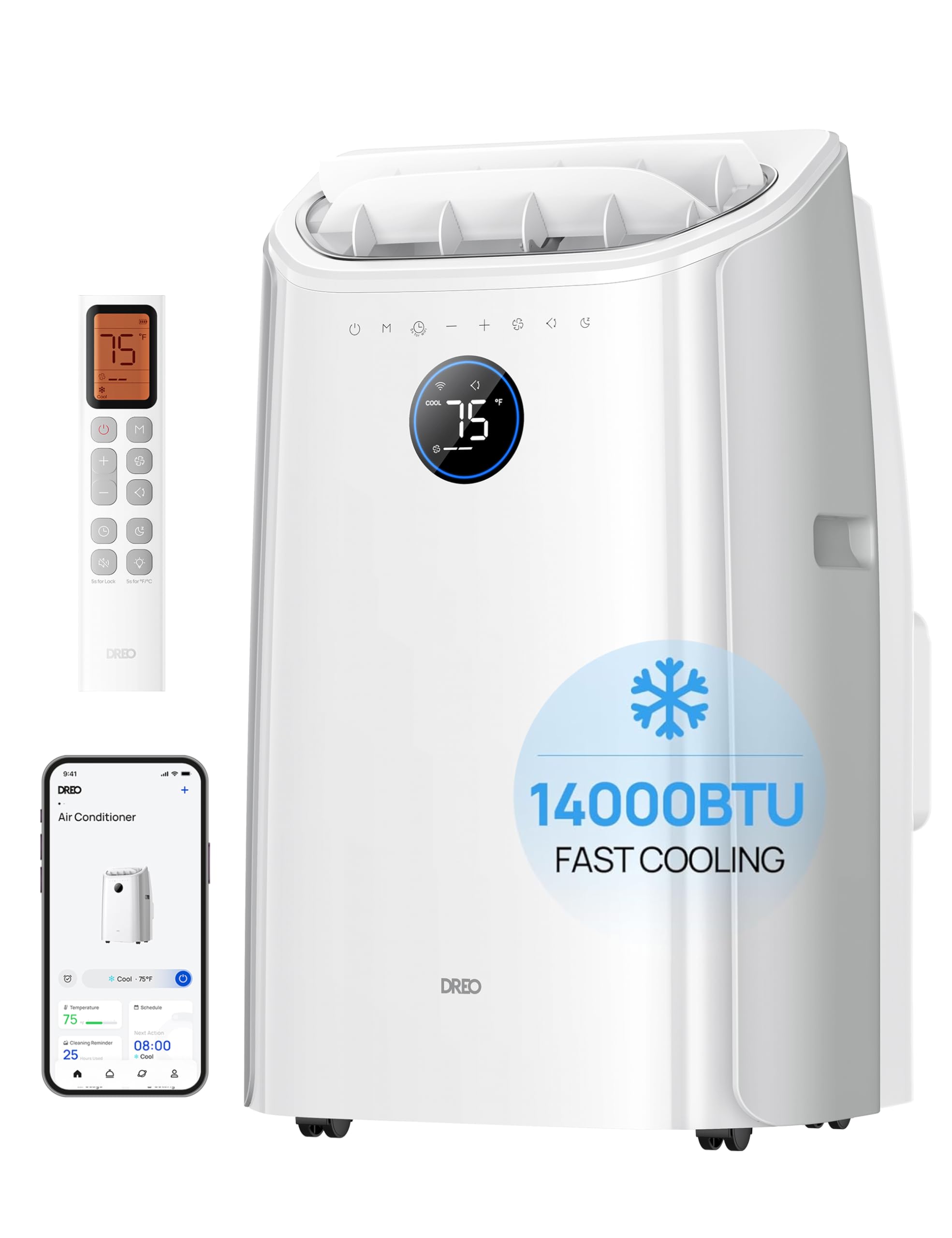
Built for the bedroom — noise isolation, drainage-free cooling, and voice control
If the whole point is sleeping through a hot night, this unit is engineered around that single goal. It is rated 14,000 BTU ASHRAE (10,000 BTU SACC), covers rooms with a temperature range from 61°F to 86°F, and uses DREO’s patented noise isolation system to bring compressor and turbulence noise down to just 45dB. That is marketed as ideal for a bedroom or a workspace, and it is the feature this unit is built around.
The drainage system is the other headline. A patented setup of algorithms, sensors, and a pump evaporates excess water automatically, eliminating the need for drainage in environments under 90% humidity. Controls are genuinely smart too: Siri, Amazon Alexa, and Google Home voice control, plus a DREO app where you monitor temperature and humidity and set a custom sleep curve. It is a true 3-in-1 with Cool, Fan, and Dry modes, each with three functions inside, and it rolls on wheels for moving between rooms.
Owner experience backs the comfort angle — performance leads, followed by cooling performance and noise, and reports describe it cooling a room fast and holding a comfortable temperature. It handles larger rooms without struggling in high heat, and the design is compact and modern. Durability is the mixed part of the picture. One report flags a serious odor issue after months of light use, and one measured test found real noise closer to the low-50s decibels at common listening distances rather than 45dB, with the thermostat reading a few degrees off until a firmware fix. Weigh those carefully against the strong majority of positive reports.
The sleep build: patented noise isolation at 45dB, drainage-free cooling under 90% humidity, and voice control through three assistants.
Calibrate the claims: independent measurement puts real-world noise above the rating at close range, and durability reports are mixed.
Strong fit for: a bedroom where drainage-free operation and sleep-curve control matter more than the last decibel.
Value check: it costs more than the ZAFRO for similar inverter-free cooling, so buy it for the comfort engineering, not the spec sheet.
10. LG 14000 BTU Window Air Conditioner LW1522FVSM

Dual inverter efficiency and 700 square feet of coverage with app control from anywhere
This is the window unit for a genuinely large room where efficiency and quiet matter. LG’s dual inverter technology runs up to 35% more energy savings than the ENERGY STAR certification requirement, per the company’s rating, and it uses eco-friendly R32 refrigerant. It is rated 14,000 BTU, covers up to 700 square feet, and pairs a BLDC motor with a dual inverter compressor to hold sound as low as 44dB in sleep mode.
Control is a real strength here. LG ThinQ lets you run the unit from your phone, and it works with Google Assistant and Amazon Alexa for voice commands. There is a washable filter with a filter light reminder, and the listing suggests cleaning it every 30 days. Installation runs through LG’s EZ Mount kit, with a slide-in-and-out chassis that fits a double-hung window sized 27″ to 39″ wide by 16″ tall. The slide-out chassis is the feature that matters most on install day — you handle the frame and the heavy core separately.
Owners confirm the cooling performance and the quiet operation repeatedly, and one describes cooling roughly 1,400 square feet with a second larger unit and watching the electric bill drop compared with an older model. The honest caveats are on design and durability. One owner found the install hardware awkward, with misaligned screw holes and no support bracket for heavier window sills. Another reports that the design holds water in the drain pan by design — the fan splashes it across the coils to boost efficiency — and that this shortens life, so they drilled drain holes to let it escape. A broken clip being sourced under warranty also came with a slow response.
Where the money goes: a dual inverter compressor rated for up to 35% energy savings, 44dB sleep operation, and full ThinQ app plus voice control.
Read the install notes: hardware complaints exist, and one owner found the drain pan design keeps water sitting where they would rather it drain.
Choose this if you have a wide double-hung window and want large-room cooling with the lowest electric use a window unit can manage.
Consider alternatives if your window sill is unusually narrow or unsupported, since installation hardware is the common grievance.
11. Whynter Portable Air Conditioner Inverter 14000 BTU ARC-1230WN
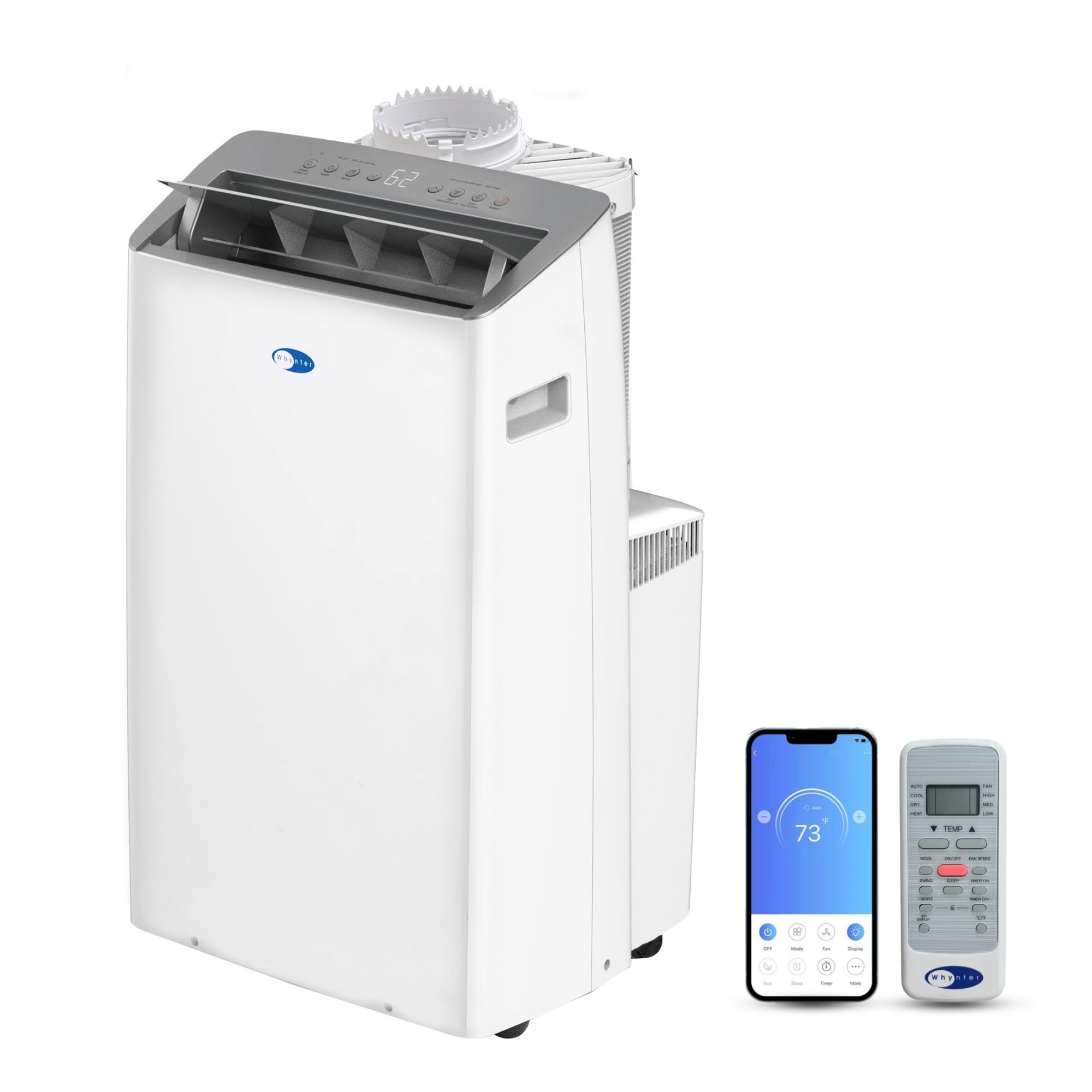
The dual-hose inverter that drains itself — up to 87 pints of condensate a day
Two things make this the portable to weigh against the Gasbye at the top tier: it is a dual-hose inverter, and it handles drainage for you. Whynter rates the dual-hose design for 20% more cooling and 40% more efficient use, per its own figures, and the patented auto drain function automatically exhausts up to 87 pints per day of condensate. It is rated 14000 BTU and covers areas up to 600 square feet, with a full inverter compressor, three operational modes (cool, dehumidify, fan with 3 speeds), and thermostatic control from 60°F to 86°F.
The hardware is thoughtfully done. The indoor unit measures 19.5″W x 16.75″D x 32.5″H, and it ships with a dual exhaust and intake “hose-in-hose” design that extends up to 47 inches — the nested layout is meant to prevent heat leakage. A window installation kit runs up to 82 inches, and there is a washable air filter. Smart control runs through the NetHome Plus app over WiFi, and it is compatible with Alexa and Google Home for voice commands. It draws a maximum of 1293W / 11.9A on a 115V / 60Hz / 1 phase supply.
Crucially, this unit’s cooling performance stands out. Customers note the dual hose cooling a 650-square-foot apartment on its own — replacing two window units — with no mold smell after a year, and they describe it as whisper quiet with immediate cold air, even in Florida triple-digit heat. Owners also report the auto drain means no tank draining in typical summer humidity, which depends on your climate. The genuine caveat is a specific one: this unit can leak rainwater through the window hose during heavy rain, requiring you to remove or adjust the hose, and it needs the right window setup for intake and exhaust. It also costs the most in this list.
low-maintenance cooling: dual-hose inverter design with a patented auto drain good for up to 87 pints per day and coverage to 600 square feet.
Plan for weather: rain can seep through the window hose during storms, and it demands a suitable window for both intake and exhaust.
Made for: a renter or homeowner who wants dual-hose cooling with almost no drainage attention in summer.
Weigh the cost if: your window cannot accommodate the hose-in-hose kit, since the install is the limiting factor here.
Understanding the Specs
BTU: ASHRAE vs SACC
BTU (British thermal units) measures how much heat the unit removes. The tricky part is that two ratings exist. ASHRAE is the older, more generous number you see in big print, while SACC is the newer DOE figure that reflects how a portable actually performs once its own heat output is counted. That is why one unit lists 14,000 BTU ASHRAE and 10,000 BTU SACC — same machine, two honest numbers. When you compare portables to window units, the window unit’s number is usually the closer real-world match.
Inverter vs Fixed-Speed
A fixed-speed compressor only runs two ways: full blast or off. An inverter compressor varies its speed to hold the temperature steady, which means fewer on-off cycles, less noise, and lower electricity use. That is why the lowest-noise units here all use inverter compressors and sit near 42 to 45dB, while the fixed-speed models cycle louder. Inverter models also hold a set temperature more tightly instead of swinging several degrees.
FAQ
Will a 14000 BTU air conditioner cool a 700 square foot room?
What does the SACC number mean on a portable air conditioner?
Is a dual hose portable air conditioner better than a single hose?
How much electricity does a 14000 BTU air conditioner use?
Do I need to drain a 14000 BTU portable air conditioner?
Will a portable air conditioner work with a sliding or casement window?
How loud is a 14000 BTU air conditioner in decibels?
How long does a 14000 BTU air conditioner last?
Should I buy a window unit or a portable for a 14,000 BTU room?
Do I need a dedicated circuit for a 14000 BTU air conditioner?
Does a 14000 BTU smart air conditioner work with Alexa and Google?
Final Thoughts: The Verdict
For most rooms, the 14000 btu air conditioner winner is the Gasbye Dual Hose Portable because its dual-hose inverter holds temperature quietly, runs a verified 13.6 CEER, and comes with three-year coverage that replaces units with brand-new hardware. The buyer consensus there is strong and the reliability story is the most reassuring on this list. If you want the strongest cooling per square foot and have a double-hung window, grab the Midea Smart Inverter Window AC and its 41 dBA floor, or the LG LW1522FVSM if you want dual inverter efficiency with ThinQ app control. And for budget-friendly coverage across one big room, the Air Future Smart Portable delivers 750 square feet on R32 refrigerant for the least money here.
How We Picked
We do not accept paid placement. Every pick is matched to a real buyer and a real use-case; we do not hands-on test units.
Sources & Methodology
Specifications: manufacturer listings and product documentation. Review insights: verified customer reviews, as of September 2026. Pricing: not shown on this page (it changes often); check the current price via the retailer link.
As an Amazon Associate, KitchPrep earns from qualifying purchases. This does not affect which products we feature.
Related Guides
