
Specs are compiled from manufacturer listings and verified buyer reviews and can change over time — please confirm the key details on the product page before buying.
If you’re cutting concrete for a patio or driveway, a 14-inch electric saw is what turns a weekend job into a one-day task. The real question is which motor can push a heavy diamond blade through rebar without tripping your breaker or stalling mid-cut.
I’m Mohammad Maruf — the founder and writer behind KitchPrep. This guide is built by comparing the manufacturers’ published specifications and the patterns across verified customer reviews, so you get each pick’s real strengths and trade-offs instead of marketing spin.
Here’s how to pick the right 14 in electric concrete saw for your project, from breaker needs to blade quality, so you buy once and cut for years.
Our Picks at a Glance

How To Choose The Best 14 in Electric Concrete Saw
Every 14-inch electric concrete saw spins a large blade, but the differences in motor power, cut depth, and water features change how you use it. Your job is to match the tool’s limits to the thickness of the concrete you’re cutting.
Cut depth: the number that matters most
Most 14-inch saws cut between 4.5 and 5.1 inches deep in a single pass. If you’re cutting a 4-inch sidewalk, a 4.5-inch depth works. If you’re scoring a foundation or a thicker slab, you need the reach of a 5-inch or 5-1/8-inch cut. Measure your material first.
Motor power and your breaker
These saws draw serious current. A 15-amp motor generally runs on a standard 20-amp household circuit, while a 20-amp motor needs a dedicated 20-amp outlet — it will not work on a 15-amp one. Check your garage or jobsite outlet before you buy, or you’ll be resetting breakers all day.
Water feed, dust, and the blade itself
A water line keeps dust down and extends blade life, but the included “stock” blade is often the weak link. Many owners swap in a premium diamond blade for real work. If you’ll cut indoors, look for a water or vacuum system to control the slurry.
Quick Comparison
| Model | Best For | Motor Power | Cut Depth | Speed (RPM) | Amazon |
|---|---|---|---|---|---|
| Makita 4114X★ Best Overall | General masonry & rebar | 15.0 Amp | 4.5-4.75″ max | 3,800 | Amazon |
| Evolution R14DCTDeep Cut | Heavy-duty deep cuts | 20 Amp | 5-1/8″ | — | Amazon |
| JACKCHEN JCS-HPE3000 | Value + sidewalk cuts | 3000W (110V) | 4.8″ | 4,200 | Amazon |
| XtremepowerUS 2600W | DIY projects on a budget | 2600W (15A) | — | — | Amazon |
| Steel Force KPC 3551 | Homeowner masonry jobs | 15 Amp (2600W) | — | 4,300 | Amazon |
| Makita XWL01Z | Remote, power-free sites | 36V (18V X2) | — | 3,800 | Amazon |
| Husqvarna K4000 | Pro indoor cutting | — | 5″ | — | Amazon |
In-Depth Reviews
1. Makita 4114X
Our pick — over 4★ from 100+ verified ratings; the strongest balance of quality and price.
The corded workhorse that owners call the best electric saw they’ve tried — reliable, powerful, and ideal for interior cured concrete.
At 23.8 pounds with a 15.0 AMP motor spinning 3,800 RPM, the Makita 4114X is built to chew through cured concrete and rebar without stalling. Its SJS technology (a mechanical clutch that lets the drive shaft slip if the wheel jams) protects the motor and gears when you hit something hard, which is exactly when cheaper saws burn out.
The tool base removes for cutting closer to walls, and the guide wheels on the guard help you travel smoothly along a line. Buyers report cutting 8-inch slabs with rebar and 30-foot trenches in 4-5 inch concrete, but note it “cuts 4.5-4.75″ max, not 5”, so measure your slab before committing.
One honest limit: this saw is happiest on a dedicated circuit. It runs fine on a 15A breaker but can trip a 20A one if you rush the cut. Use a vacuum with a bag and skip the water for indoor jobs, and it’s a tidy, dust-controlled package.
Why owners stick with it
- Built-in vacuum port keeps indoor dust manageable
- SJS clutch protects the motor from jams
- Removable base cuts flush to walls
What to check first
- Max cut is 4.75″, not the full 5″
- Blade install is tricky on first try
- Blade touches the ground when set down
The trusted pick: For a serious masonry tool that holds up on interior cured concrete and rebar, this is the one to beat — third-purchase loyal for a reason.
Reach for it if: You need a dependable corded saw for frequent jobs; skip it if you must cut deeper than 4.75 inches in one pass.
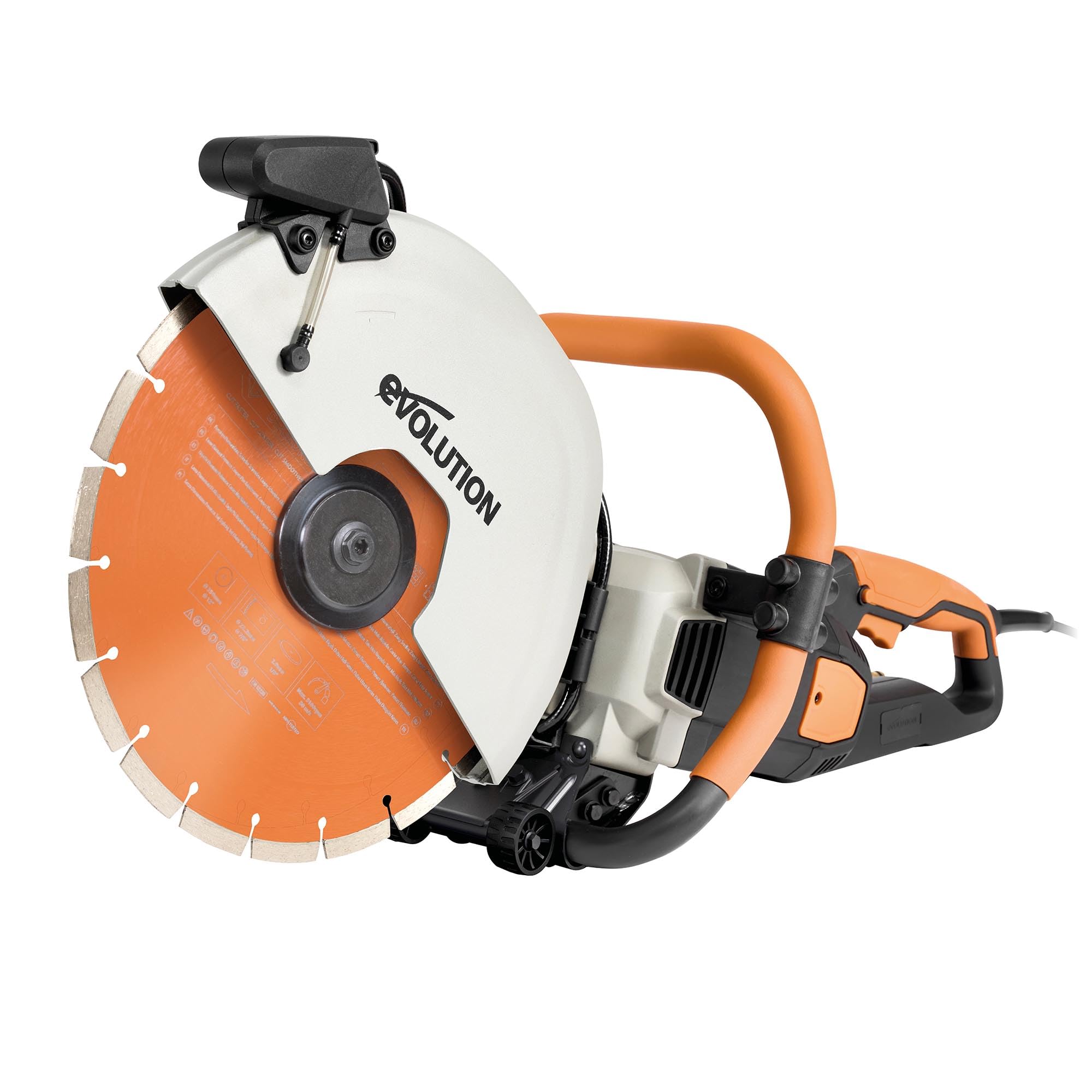
2. Evolution R14DCT
A 20-amp powerhouse that cuts 5-1/8 inches deep with auto water suppression — the clear pick for thick slabs.
The Evolution R14DCT is the rare electric saw that handles heavy-duty concrete without gas fumes, thanks to a high-torque 20A motor. Its deep 5-1/8-inch cut with a 14-inch diamond blade — one with “35% more diamond” per the maker — means fewer passes on thick material.
The standout is the Auto ON/OFF Dust Suppression System: it waters the blade when you’re cutting and stops when idle, which owners say controls the mud and keeps the cut line visible. The 5-position rotating blade guard and wheeled skid plate make horizontal and vertical cuts more precise, and a 3-year warranty backs it up.
Owners mention cutting ~70 wall caps plus a 12-foot sidewalk with smooth starts and good brakes, and the supplied blade held up under heavy freehand horizontal cuts. The catch: it requires a 20A outlet and won’t run on a 15A one, so check your power source before you plan a job around it.
Pro-grade value: Gas-like power, no fuel or oil, and a blade that lasts — owners called the performance “exceeded expectations” and the build quality strong.
One requirement: A dedicated 20A outlet is non-negotiable; plan your extension cord and circuit accordingly.
3. JACKCHEN JCS-HPE3000

A 3000W motor with a 4.8-inch cut depth that owners say outperforms far pricier saws on the same jobsite.
The JACKCHEN JCS-HPE3000’s 3000W motor spins at 4200 RPM and cuts 4.8 inches deep, with a steel wrap-around front handle that reduces vibration by 40% for control on long cuts.
Customers note it “outperforms two k+ Bosch saws” while cutting 125 feet of 18-inch-wide ditches in 70-year-old concrete with no breaker trips on a 20A circuit. One owner cut a 4-inch sidewalk and 2-inch asphalt driveway in about an hour. The bundled accessory kit — wrenches, a proportioning pot, and a priming funnel — shows unusual attention to setup.
The honest trade-off is the stock blade. Several owners trashed it quickly and swapped in a Core Cut blade, which transformed the saw. If you budget for a better blade, this mid-range saw delivers premium results.
Efficiency winner: Faster cutting and better value than renting for a weekend — one owner spent only ~ more than a rental and kept the tool.
Swap the blade: Plan on replacing the stock blade for the saw to reach its full potential.
4. XtremepowerUS 2600W

A lightweight corded cutter with a double-protection switch — a genuine DIY workhorse if you respect its limits.
The XtremepowerUS 2600W is marketed on its power-to-weight ratio and low vibration, and the 30-pound build backs that up. Its double-protection switch prevents accidental starts, and the water line feeds the blade to cut dust while boosting blade life — so it’s a safer, cleaner way to cut granite, porcelain, or concrete.
Owners call it “one of my BEST DIY tool purchases,” noting it cuts well with light pressure and excellent wheels that track straight. One owner said it cuts “just as good as my walk behind wet saw” without the gas fumes. The verdict is consistent: it’s a DIY tool, not a pro-grade daily driver.
The trade-offs are real but manageable: run it on a 20A circuit to avoid tripping (a 30A breaker is even better), and skip the included stock blade for a quality Bosch 14-inch one. The base plate and vacuum port are weak points, so rely on the wheels and your own line control.
What wins DIY buyers over
- Excellent wheels that make straight cuts easier
- Double-protection switch adds safety
- Light 30 lb build with low vibration
Where it cuts corners
- Needs a 20A circuit or it browns out
- Base plate and vacuum port are weak
- Included blade should be upgraded
The weekend pick: For a homeowner with a patio or block wall project, this is a solid, affordable introduction to electric cutting.
Look elsewhere if: You’re running a crew daily — this is built for occasional substantial jobs, not continuous commercial use.
5. Steel Force KPC 3551

A 4,300 RPM wet/dry cutter with water adapters included — genuinely useful for light home masonry, with clear limits.
The Steel Force KPC 3551 spins a 14-inch blade at 4,300 RPM and includes 1/2-inch and 3/4-inch water hose adapters plus a guide roller, so it’s ready for dust-suppressed cuts from the start. A 15 Amp motor handles granite, porcelain, and concrete, and the included 14-inch general-purpose diamond blade gets you started.
Owners who matched it to the job were happy: it cut a door sill cleanly, and one reported the maker’s support team sent a free flush-cut adapter on request. For light blocks and wall work, it’s “good enough for home use” per a reviewer, with no exhaust fumes to deal with.
This is the honest budget trade-off: it’s not a commercial tool. One owner reported the motor seized after ~100 cuts (3ft x 1in deep, ~5hrs) despite gentle use, and others note a slow ramp to speed and a startup shake. If you’re cutting regularly and deeply, spend more; if it’s a few weekend slabs, this fits the bill.
The home-owner appeal
- Water line + dust port reduce mess and noise
- Both 1/2″ and 3/4″ hose adapters included
- Delivered with a 14″ diamond blade
Know the limits
- Not built for daily commercial use
- Slow to reach full speed
- One owner reported the motor seized after ~100 cuts
The budget fit: For a homeowner cutting the occasional sill, block, or wall, this is a serviceable entry point.
Think twice if: You need reliability for frequent or deep cuts — the recurring gripe is durability under sustained use.
6. Makita XWL01Z

A 36V brushless cutter that frees you from cords and gas — perfect for sites with no power at all.
The Makita XWL01Z runs on two 18V LXT batteries (sold separately) to deliver 36V of cordless power at 3,800 RPM. Its BL brushless motor runs cooler and more efficiently for longer life, and the electric brake lets you adjust between cuts faster.
This saw suits remote sites where power is scarce. One owner with “a cultured stone job that didn’t have any power” reported it cut well on about 4-5 amp-hour batteries per day, calling it “way better than hearing a generator run all day.” Others use it for lightweight metal studs and framing, so it doubles as a cutoff tool.
The trade-off is runtime and torque. A disappointed owner got only “3 cuts through 4x3x1/4 angle” before two 5Ah batteries died, and the saw isn’t built for heavy-gauge metal. For masonry, a thin kerf diamond blade makes a big difference, so plan your blade choice and battery budget accordingly.
Freedom to work anywhere: No extension cords, no gas fumes, and a 3-year limited warranty — ideal for job sites without power.
Battery reality: Expect 4-5 amp-hour batteries per day on masonry; bring spares if you’re cutting all day.
7. Husqvarna K4000

A pro-grade 5-inch cut with a constant-flow water valve — the indoor alternative to gas that plumbers and warehouse crews trust.
The Husqvarna K4000 is purpose-built for tradespeople who can’t run gas engines indoors. It cuts 5 inches deep with a 14-inch blade, and its constant-flow water valve regulates water volume automatically — enough to bind the dust without flooding your workspace. An ergonomic rear handle with the power cord inlet underneath keeps it comfortable for long sessions.
Pros back it up: a plumber cut roughly 100 feet of 5-inch reinforced concrete indoors with it, and a warehouse owner picked it “inside a warehouse where gas is not acceptable.” The pop-up carbon brushes (the wear parts that deliver power to the motor) extend service intervals, and the one-piece inspection lid makes maintenance simple.
The recurring wisdom is to upgrade the stock blade. Owners who swapped to a quality Stihl blade found it “works great, no issues,” while the included one left some unimpressed. It also wants a 20A breaker (not 15A), and the water intake coupler can be delicate — but for serious indoor cutting, this is the professional’s pick.
Why pros choose it
- 5″ cut depth handles reinforced concrete
- Constant-flow water valve controls dust
- Overload sensor stops the saw before jams
Set expectations
- Needs a 20A breaker to run properly
- Stock blade underwhelms — budget for an upgrade
- Water intake coupler demands careful handling
The pro’s tool: For indoor reinforced concrete where gas is banned, this is the saw the trades reach for.
Only if: You cut regularly and can feed it a quality blade — casual users will overspend on capability they won’t use.
Understanding the Specs
Motor Power (Amps vs. Watts)
Think of this as the engine size. A 15-amp motor (roughly 2600W) is the common baseline for 14-inch saws and runs on most 20-amp household circuits. A 20-amp motor, like in the Evolution, delivers more torque for deep cuts but needs its own 20-amp outlet — it won’t run on a standard 15-amp one. More power means less stalling in dense concrete, but also more breaker trips if your circuit can’t keep up.
Cut Depth
Cutting depth is the maximum thickness the saw can slice in one pass. Most 14-inch saws manage 4.5 to 4.8 inches, while premium models reach 5 to 5-1/8 inches. Measure your thickest material first — a 4-inch sidewalk works on a 4.5-inch saw, but a foundation or heavy slab needs the extra reach of a 5-inch cut, or you’ll flip the blade for a second pass.
FAQ
Will a 14-inch electric concrete saw run on a standard household outlet?
What is the deepest cut a 14-inch blade can make?
Is a corded concrete saw better than a battery-powered one?
Do I need water to cut concrete with these saws?
Why does my saw trip the circuit breaker during a cut?
Is the included diamond blade any good?
Can I cut rebar with a 14-inch concrete saw?
Is renting a concrete saw cheaper than buying one?
Final Thoughts: The Verdict
Across the board, the 14 in electric concrete saw winner is the Makita 4114X because it pairs a proven 15-amp motor with the clutch protection and dust control that owners rely on for interior cured concrete and rebar. If you need a deep 5-1/8-inch cut and have a 20A outlet, grab the Evolution R14DCT. And for a weekend sidewalk job at a smarter price, the JACKCHEN JCS-HPE3000 is the one to reach for.
How We Picked
We do not accept paid placement. Every pick is matched to a real buyer and a real use-case; we do not hands-on test units.
Sources & Methodology
Specifications: manufacturer listings and product documentation. Review insights: verified customer reviews, as of August 2026. Pricing: not shown on this page (it changes often); check the current price via the retailer link.
As an Amazon Associate, KitchPrep earns from qualifying purchases. This does not affect which products we feature.
Related Guides
