
Specs are compiled from manufacturer listings and verified buyer reviews and can change over time — please confirm the key details on the product page before buying.
A 14-inch band saw resaws thick boards, cuts tight curves, and slices veneer in a home shop. The catch is that not every saw with a 14-inch wheel actually delivers the muscle to push a wide blade through seasoned hardwood — and the wrong pick leaves you fighting drift, burning edges, and stalling mid-cut. This guide compares motor power, resaw height, and table size across 11 saws.
I’m Mohammad Maruf — the founder and writer behind KitchPrep. This guide is built by comparing the manufacturers’ published specifications and the patterns across verified customer reviews, so you get each pick’s real strengths and trade-offs instead of marketing spin.
You will learn which specs matter when shopping for the best 14 in band saw: resaw capacity, blade length, and motor amperage. The best 14 in band saw balances motor power against resaw height.
Our Picks at a Glance


How To Choose The Best 14 in Band Saw
Most first-time buyers assume the 14-inch number refers to how much wood the saw can cut. It does not. That number is the wheel diameter, and it mostly tells you the blade length and the footprint. What actually decides whether a saw handles your projects is the resaw capacity — how tall a board you can stand upright and slice in one pass.
Resaw capacity is the number that decides projects
Resaw capacity is the height between the table and the upper blade guide, so it sets the tallest board you can slice lengthwise into thinner boards. A saw with 6 inches of resaw lets you break down common 2-inch stock comfortably. A saw with 13 inches lets you turn a thick slab into bookmatched panels or your own veneer. If you plan to make your own thin stock, buy resaw height before you buy anything else.
Match motor power and blade width to your hardest wood
A band saw motor is measured in horsepower (HP), and more power means the blade keeps moving through dense hardwood instead of slowing down. Wider blades resist twisting under that load, which is why resaw work wants a wide blade and curve work wants a narrow one. Blade width ranges in the specs tell you how much of each cut the saw can take on. A saw that only accepts a narrow blade will wander on tall resaw cuts, no matter how strong the motor is.
Do not overlook the table, fence, and dust port
The table size tells you how much support you get under long boards, and cast iron holds its flatness better than a stamped top. The fence is what guides straight rips and resaws, so a fence you can adjust for blade drift matters. Dust collection port size tells you whether your shop vacuum or collector will hook up without an adapter. These three details decide how pleasant the saw is to live with daily.
Quick Comparison
| Model | Best For | Motor | Resaw / Cut Height | Blade Length | Amazon |
|---|---|---|---|---|---|
| JET JWBS-14SFX★ Best Overall | Deep resaw in one pass | 1.75 HP | 13″ | 116″ | Amazon |
| WEN BA1487Budget Resaw | Budget resaw with stand | 9.5 A | 8.85″ | 100-3/4″ | Amazon |
| WEN BA1411Dual-Voltage | Dual-voltage shop starter | 1 HP / 11 A | 6″ | 93.5″ | Amazon |
| JET JWBS-14CS | Long-life hobbyist workhorse | 1 HP / 10 A | 6″ | 93.5″ | Amazon |
| QD-KYOHO QBS-14″ | Fast dual-speed cutting | 2 HP / 14 A | 13″ | 111″ | Amazon |
| Laguna MBAND1412-175 | Low-vibration precision | 1-3/4 HP | 12″ | 115″ | Amazon |
| Shop Fox W1849 | Two-height resaw fence | 2 HP / 15 A | 14″ | 120″ | Amazon |
| Powermatic PWBS-14CS | Chip blower and detension lever | 1-1/2 HP | — | 93.5″ | Amazon |
| Laguna MBAND14BX220-250 | High-power 220V resaw | 2.5 HP | 12″ | — | Amazon |
| Grizzly G0555XH | Cast iron frame resaw | 1.75 HP | 12″ | — | Amazon |
In‑Depth Reviews
1. JET 14″ Woodworking Band Saw, 1.75 HP, 13″ Deep-Cut Resaw Capacity
Our pick — 4.5★ from 150+ verified ratings; the strongest balance of quality and price.
The saw that swallows a 13-inch slab in a single pass instead of two
If you are tired of flipping thick stock to finish a resaw, this is the machine that ends it. The JET JWBS-14SFX carries a 1.75 HP capacitor-run motor (a motor built to hold speed under continuous load), and that power feeds a 116-inch blade loop so you can slice material up to 13 inches tall in one go. That is 75% more motor power than the WEN BA1411 on this list, which tops out at 1 HP. In practice you stand a thick slab on end, feed it through, and get bookmatched panels or your own veneer without a second machine.
The 360 sq. in. ground cast-iron table tilts 0–45° right on a diecast-and-steel trunnion, so bevel cuts stay supported across a wide surface. Ground cast iron means the top is machined flat, which keeps stock moving smoothly instead of catching on a wavy surface. A 13-1/2-inch throat capacity sets how far in from the edge you can cut curves. Blades run from 1/8 inch wide for tight scroll work up to 3/4 inch wide for fast resawing, with independently adjustable ball-bearing blade guides holding the blade steady above and below the table.
What wins people over is the build itself — the quality of the cast frame and wheels is the single thing owners bring up most. Buyers report it cuts through seasoned oak like pine, and the very same saw leaves that stock with a surface ready for glue-up. Assembly is the one spot where experiences split: some set it up quickly, while others spend a couple of hours getting the blade guides dialed in, and a few mention the blade is sold separately so your first cut waits on a trip for a 116-inch blade. Every unit is backed by an exclusive 5-year warranty for home shops.
Where It Earns Its Place
- 13-inch resaw capacity in one pass, so thick slabs split without a second machine
- 1.75 HP motor that holds speed through seasoned oak
- 360 sq. in. ground cast-iron table tilting 0–45° right
- 116-inch blade loop runs 1/8″ to 3/4″ wide for both scroll and resaw work
What To Plan Around
- Saw blade is sold separately, so budget for one at purchase
- Setup time varies — some find it quick, others spend hours on guide alignment
- At 75.5″L x 27″W x 37″H assembled, it needs real floor space
Reach for this if: you make your own veneer or break down thick slabs on a regular basis and want the resaw height to do it in one pass.
Think twice if: you are not ready to buy a blade separately or you have no room for a full floor-standing machine.
2. WEN (BA1487) Band Saw with Stand, Two-Speed, Black, 14-Inch
The value pick that resaws a 12-inch log without asking twice
Trying to spend less without giving up real resaw height? This is the one to look at first. The WEN BA1487 runs a 9.5-amp motor that cuts up to 8.85 inches deep and 13-3/8 inches wide, which is 47% more cut depth than the WEN BA1411 at 6 inches. Owners put that depth to work on whole logs: one buyer reports it resaws 12-inch logs and cuts hardwood easily. Blade length here is 100-3/4 inches, and it accepts blades from 1/8 to 1 inch wide — that full inch is the widest range in this guide, and wide blades are exactly what keeps a tall resaw from wandering.
The 21-1/2 x 15-3/4-inch work table bevels up to 45 degrees, so angled cuts still get a broad surface underneath. Two speeds of 1480 or 3280 FPM let you dial down for dense hardwood and speed up on softer stock. Included with the saw: a blade tension gauge, a circle cutting guide for round work, a flexible work light, a 3-in-1 dust port, a fence, a 1/2-inch blade, and a miter gauge. The circle-cutting jig in particular is the kind of extra that usually costs more on a separate saw.
Blade quality is what buyers single out as the standout — the supplied blade and the saw’s appetite for aftermarket replacements is the most-discussed topic, with power and value right behind. The honest catch: the fence arrives a bit loose, so a few owners swap in an aftermarket replacement, and the miter gauge does not glide freely in its slot for everyone. Verified buyers do note it is not as precise as machines costing several times more, which is a fair read for a non-professional shop. At 138.9 pounds it moves with effort, so pick its spot before you assemble it.
The resaw-for-less case: 8.85 inches of cut depth and a 13-3/8-inch throat get you through real log work at a fraction of the flagship machines, and the toggle between 1480 and 3280 FPM keeps both hardwood and softwood cutting clean.
The trade you accept: the stock fence wants upgrading and the miter gauge can feel sticky, so plan on a small parts budget alongside the saw itself.
Best fit for: a workshop that wants genuine resaw depth and log capacity without climbing into flagship money.
Look elsewhere if: you need fence-level precision straight out of the crate.
3. WEN Industrial Band Saw, 14-Inch, 1 HP Dual-Voltage 120V/240V, Two-Speed (BA1411)
Rewire it once and it runs on either household or shop current
Not every shop is wired for 240 volts, and this saw does not make you choose. The WEN BA1411 runs an 11-amp, 1 HP motor on either 120V or 240V, so you can start on a standard household outlet and switch to 240V later without buying a new machine. It cuts up to 6 inches deep and 13.5 inches wide, and it runs two speeds of 1700 or 3000 FPM — the faster setting of the two sits above the WEN BA1487’s 3280 FPM peak only at the low end, since the BA1411 tops out at 3000 FPM while the BA1487 reaches 3280 FPM. Pick the BA1411 when the wall wiring matters more than maximum cutting height.
The 14-by-14-inch cast iron table bevels up to 15 degrees left and 45 degrees right, and a cast iron frame cuts vibration while the machine is under load. Cast iron there means the body is heavy and stiff, which keeps the blade tracking steady instead of chattering. Ball bearing blade guides and thrust bearings sit above and below the table, and a quick-release blade tension mechanism speeds up blade swaps between scroll work and ripping.
The story buyers tell is one of easy assembly and a solid, sturdy machine — one describes cutting 3×3 black walnut cabriole legs with the included 3/8-inch blade and getting good results with no issues. The recurring gripe is the factory blade: it wears fast under moderate use, and a few units arrive with a blade that is simply unusable from the start, so most owners factor in a quality replacement blade early. For a first proper machine in a home shop, the sense buyers share is that it is tough to top at this level. A heavy-duty steel stand, a 4-inch dust port, a T-fence, and an adjustable sliding miter gauge round out the package.
Who it suits: the woodworker whose shop only has 120V today but wants the option to rewire for 240V down the road.
Skip if: you expect a long-lived blade in the box — plan for a replacement from day one.
4. JET 14-Inch Woodworking Band Saw, 1 HP, 115/230V 1Ph (JWBS-14CS)

A proven design that has outlasted two decades of shop changes
Some machines earn their keep by staying put and never needing attention, and this JET is that kind of saw. It carries a 10-amp, 1 HP motor and 6 inches of resaw capacity, with a 13.5-inch throat for cuts that run deep into a board’s width. Upper and lower cast iron frames add rigidity, and six-spoke precision computer-balanced wheels are balanced to cancel vibration at the source. Balanced wheels matter because vibration at the wheel is what makes a blade wander on a long cut.
Blade tracking and guide setup are the two chores most saws make you dread, and this one reduces both. A single knob handles tracking adjustment, and a micro-adjustable lower blade guide trims setup time by letting you dial the guide in without pulling the table. The blade guide post uses rack-and-pinion adjustment, which moves the guide up and down smoothly instead of jerking it. Upper and lower ball bearing guides cut friction so blades last longer.
Quality is the trait owners return to again and again, followed closely by how easy the saw goes together. Long-term ownership is where this saw separates itself: buyers describe more than two decades of clean operation with nothing replaced but blades and tires. The stock blade is a soft spot — it dulls quickly on hard maple, so most owners pick up a fresh blade early. Assembly runs into two shipping boxes and the cast iron top is heavy enough to want a second set of hands, but once it is up, the 1 HP motor is described as plenty powerful for bandsaw boxes and 4×4 cuts.
Why it lasts: balanced wheels, rack-and-pinion guide adjustment, and cast iron at both frame points mean fewer things to fight as the years stack up.
Pick this one if: you want a saw that rewards you for not tinkering — set it once and cut for decades.
Not for you if: you plan tall resawing above 6 inches without adding a riser kit.
5. QD-KYOHO Band Saw, 14 Inch, 1445 & 2950 FPM Dual-Speed, 2 HP, 120V 14-Amp Motor
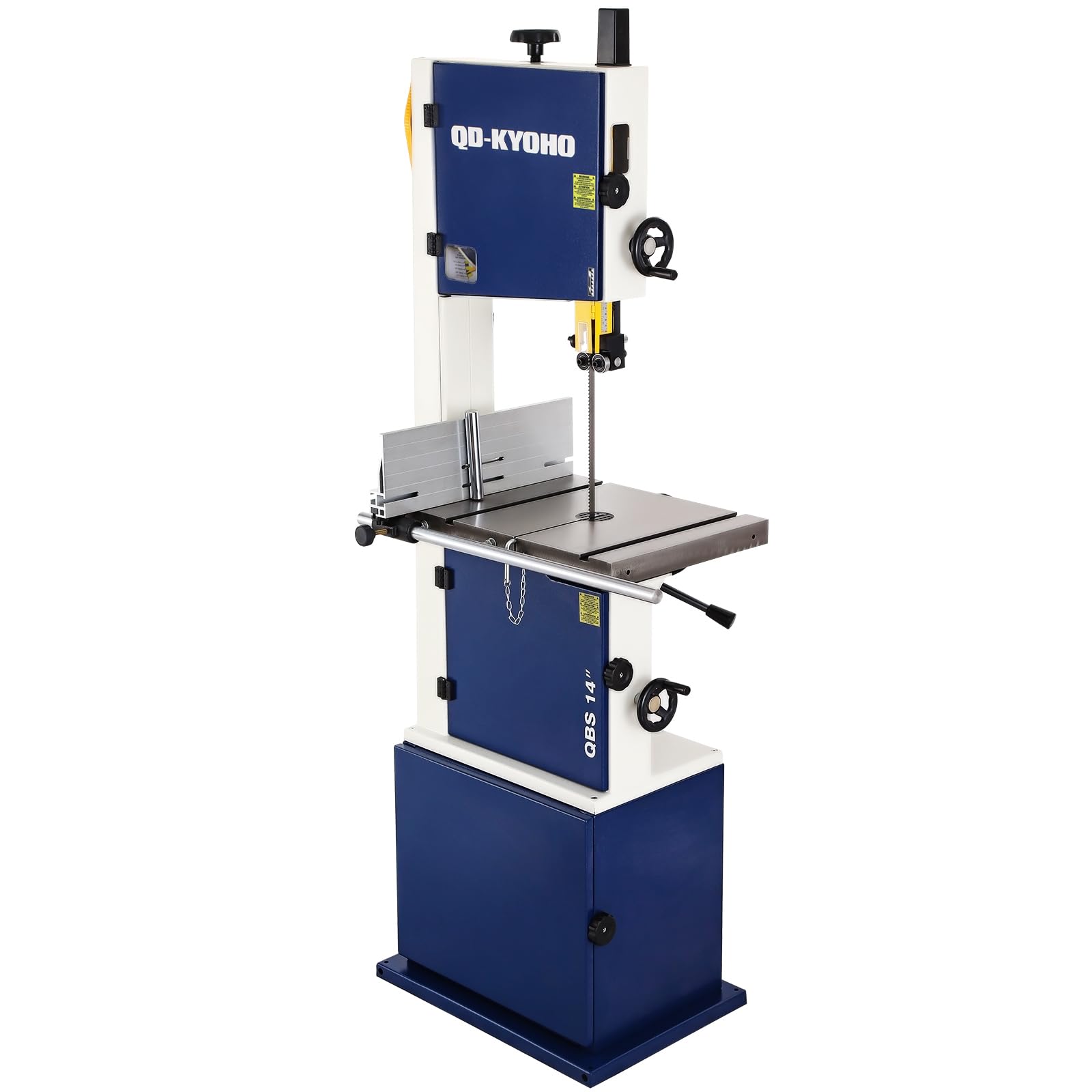
Two horsepower and a speed switch that matches the wood in front of you
Hardwoods and softwoods want different blade speeds, and this saw lets you flip between them. The QD-KYOHO runs 1445 FPM for hardwoods and 2950 FPM for a smoother cut on softwoods, driven by a 2 HP, 14-amp motor. It cuts wood up to 13 inches tall with a 13-5/8-inch maximum throat width, and it carries a 111-inch blade. At 2 HP it is the most powerful 120V machine in this roundup, matching the Shop Fox W1849 on horsepower while running on standard household current rather than 220V.
Angle work gets a wide platform here: the cast iron table measures 21-1/2 x 15-3/4 inches and tilts 45 degrees right and 5 degrees left on a cast iron trunnion. The frame is welded steel plate with dynamically balanced cast aluminum wheels, and the upper and lower guide structure adjusts both vertically and horizontally to keep the blade locked where you set it. A quick-setting tension control means blade swaps take seconds, and overload protection shuts the motor down before a hard bind turns into damage.
Owners describe a saw that sets up fast and cuts accurately, with the built-in instructions getting consistent credit. Durability is the open question buyers raise honestly — that reputation has not had years to build yet, and one owner frames it plainly as something only time will tell. What is not in question is the value and the customer service response, which owners rate highly. One practical note: the rip fence’s unanchored end can shift right when you clamp it down, so check it against your blade before a critical rip.
The speed-and-power mix: a 2 HP motor and a 1445/2950 FPM switch give you a fast setting for softwood and a controlled one for hardwood without touching the blade.
One field note: the rip fence’s free end can slide when clamped, so verify it before a finish rip.
Suits you if: you cut across a mix of hard and soft species and want the motor to lead on horsepower at 120V.
skip it if: you need a decade-long track record before you commit.
6. Laguna Tools MBAND1412-175 14 x 12 Bandsaw, Black/Grey
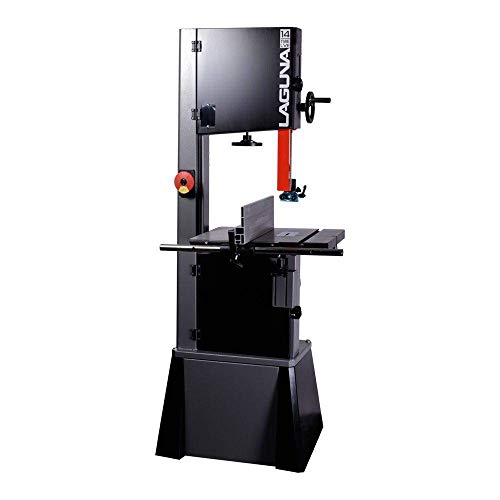
Built heavy so the blade never shakes loose mid-cut
When a blade drifts, you lose the line — and this saw is engineered to stop that before it starts. It runs a 14/7 amp TEFC motor (totally enclosed, so dust cannot get into the windings) at 1-3/4 HP on 115V or 230V, with 12 inches of resaw and a 115-inch blade. Cast iron wheels and a heavy duty 8 x 13-inch cast trunnion give it the mass that keeps vibration out of the cut. Owners run oak and plywood through it and characterize the cutting as accurate and steady.
Laguna’s own blade guides sit above and below the table, and a tension window plus a tension indicator let you confirm the blade is loaded correctly before you start. A rack-and-pinion upper guide raises and lowers smoothly, and a quick-release tension lever takes the load off the blade when the saw sits idle. The 21-1/2 x 16-inch table tilts 45 degrees right and 7 degrees left with a 90-degree positive stop, so returning to square is a simple drop into position rather than a guess.
Performance is the trait owners talk about above all else, followed by how completely the machine does its job. What shows up on the honest side of the ledger: the fence angle can be off a couple of degrees and may need shims to square, and the lower blade guide is awkward to reach under the table. The light attachment draws complaints too — one owner calls it useless because it throws a shadow right across the cut, so skip that add-on and light the work area your own way. Blade changes take a little patience for first-timers. None of this stops the saw cutting; it just means a small setup session up front.
Built for: the woodworker who cuts hard, dense stock and wants vibration kept out of the cut above all else.
Consider alternatives if: you want a fence that arrives perfectly square or you dislike reaching under the table to tune the lower guide.
7. Shop Fox W1849 Resaw Bandsaw, 14″, White, Silver

The tallest cut height and the longest blade in this whole lineup
If you split very thick stock, this is the pick with the most headroom: its maximum cutting height is 14 inches, the tallest figure in this guide, and it runs a 2 HP motor on 110V/220V that draws 15A at 110V and 7.5A at 220V. The 120-inch blade is likewise the longest loop among these saws. Feeding that big frame is a 21-3/4 x 16-1/8-inch table and a deluxe two-height resaw fence that lets you set the fence tall for deep cuts and low for thinner stock without swapping parts.
Owners describe it as smooth, quiet, and stable in use, and the 2 HP motor does everything a resaw should without complaint. It is a woodworking-only machine built for hardwood, softwood, and manufactured board in a home or small production shop. Assembly is the step that demands a partner — the table is heavy enough that two people should mount it. A couple of owners mention bolt holes that benefit from a light retapping and fence holes that need opening up, so keep a tap and a file nearby for the build day.
Two practical notes worth knowing before you buy. First, the included blade dulls fast, so buy quality blades up front and the saw rewards you with accurate, sturdy cutting. Second, the electrical reality surprises people: it ships prewired for 110V, and one owner found the saw actually draws 19.75 amps and strongly recommends wiring it for 220V to cut the amp draw. Backed by a 2-year warranty, it is a real resaw machine with a build day that is half the story.
What It Brings To The Bench
- 14-inch maximum cutting height — the tallest here
- 2 HP motor on 110V/220V with a 120-inch blade loop
- Deluxe two-height resaw fence for deep and thin cuts alike
- Described as smooth, quiet, and stable under load
What The Build Day Demands
- Two people needed to mount the heavy table
- Bolt and fence holes can need light retapping or opening
- Factory blade dulls quickly; plan on better blades
- Runs better on 220V — a 110V circuit may not keep up
The right pick when: maximum cutting height and one of the longest blades in the category top your list, and you have a helper for assembly.
Better to pass if: you want a saw that comes out of the crate with no fettling at all.
8. Powermatic 14-Inch Woodworking Bandsaw, 1-1/2 HP, 115/230V 1Ph (PWBS-14CS)

Blade-changing features that save you time on every single swap
This saw is built around the chores that slow a shop down. A Carter quick-tension lever speeds blade changes, and a detension setting relaxes the blade while the saw sits idle to extend its life. A chip blower keeps the cut line visible by pushing sawdust off your mark as you work. The 1-1/2 HP motor runs on 115/230V, and the saw carries a 93.5-inch blade with an exclusivity-designed quick-release precision T-square style rip fence that includes a 4-inch resaw attachment for taller cuts.
The guide system is the precision story here: durable micro-adjustable dual bearing blade guides sit above and below the table for close blade control with less friction, and tensioning gauge settings are marked in blade-width increments so you match the gauge to the blade you loaded. Precision-balanced nine-spoke cast iron wheels cut vibration and smooth the blade’s travel, and a 60-watt adjustable lamp casts a direct light on the blade and workpiece while you cut. A 6-inch riser block comes in the box if you later want more resaw height.
The honest read is that this is a machine that rewards a careful setup. Owners describe the tables as machined to near perfection and praise the fit and finish against other brands, and several note a powerful, quiet motor with strong dust collection. But the setup itself is real work: assembly takes two people for parts of it, the instruction booklet leaves gaps, and the extension table is complex to align. This is a fit question for a buyer who enjoys dialing in a machine, and a caution for one who wants to cut the same afternoon it arrives.
Where the time goes: the quick-tension lever, detension setting, and chip blower all target the frustrating minutes around a cut — blade changes, idle storage, and keeping your line visible.
What it asks back: patient assembly and a willingness to work through thin documentation before the saw sings.
The right tool for: a woodworker who values blade-change speed and shop dust control and does not mind a full-day setup.
Think carefully if: you want a saw that works straight from the pallet without a tuning session.
9. Laguna Tools 220v 2.5hp Bandsaw with 13″ Resaw and 38″ Table Height, Model MBAND14BX220-250

The most horsepower in this lineup, wired for a dedicated shop circuit
When nothing but the strongest motor will do, this is the pick. The Laguna 14BX220 runs a 2.5 HP motor on 220V — the highest horsepower figure in this roundup, above the 2 HP of the QD-KYOHO and the Shop Fox. It carries 12 inches of resaw and a 21-1/2 x 16-inch table at a 38-inch working height, with a 7-degree table tilt to the left. Owners put that power to work on hard stock: one buyer reports slicing 1/8-inch veneer off 10 inches of walnut, and another resaws 8-foot, 3/4-inch plywood without strain.
Setup runs quick for a machine this size — one owner reported tension and tracking dialed in within three to four minutes using 1/4-inch and 3/4-inch blades. Ceramic bearings hold the blade steady, though the lower bearings take some patience to adjust. Dual dust ports pair well with a collector rated around 650 CFM (cubic feet per minute, a measure of how much air the collector moves), and owners describe the saw as quiet for its class. A mobility kit and a 220V light kit are both worth considering if the saw will move or sit in a dim corner.
Know the catch before you commit: this saw does not ship with a blade, so a replacement is a required purchase on day one rather than a nice-to-have. That single omission is the most common note in the reviews. A few owners also run into factory setup issues — a table insert that arrives warped, a fence that is not square from the start, and dust brush bolts that are awkward to reach — and one owner reported trouble keeping blades seated and overheating. Quality and cutting performance are what most buyers praise despite those notes, so this is a machine that rewards a thorough setup session.
What The Power Gets You
- 2.5 HP on 220V — the most horsepower in this lineup
- 12-inch resaw and a 21-1/2 x 16-inch table
- Fast tension and tracking setup reported in minutes
- Dual dust ports that pair with a 650 CFM collector
What To Expect On Arrival
- No blade included — you must buy one before the first cut
- Some units arrive with a warped table insert or an unsquare fence
- Lower ceramic bearings are fiddly to adjust
Buy this if: your shop has 220V and you want the most motor this category offers for hard, dense stock.
Better to pick the 110V version if: you have no 220V outlet or you want a blade in the box.
10. Grizzly Industrial G0555XH 14″ 1-3/4 HP Extreme Series Resaw Bandsaw

A cast iron body that stays put, sold as a dedicated resaw machine
This is a saw built for one job and labeled that way. The Grizzly G0555XH pairs a 1.75 HP motor with 12 inches of resawing capacity, set in a cast iron frame and a heavy duty stand that keeps the machine planted under load. It is prewired for 120V but capable of 110V/220V. Extruded aluminum resaw fence and a miter gauge come included. The 24-tooth blade spec and brushless design round out a package aimed squarely at breaking down hardwood into thinner boards.
Owners who resaw for a living tend to talk about the blade as the real variable. The factory blade left one buyer unimpressed, and switching to aftermarket wood-slicer blades transformed the cut — slicing a maple 2×6 in half in no time with an excellent edge. Those same buyers describe the machine itself as a professional-quality tool that works as advertised, well built and sturdy without much adjustment needed out of the crate. If you resaw regularly, budget for a set of quality blades, because that is where the performance difference shows.
The setup itself is light — owners note there is not much to adjust before use. One thing to watch for is shipping: this is a heavy machine on a pallet, and at least one arrived with a destroyed crate, a creased motor housing, and sheared mounting screws, with the return process dragging on for weeks. That kind of freight damage is rare, but it is worth inspecting the crate before you sign. When it arrives sound and you load a good blade, it is a straightforward resaw machine that does exactly what a resaw band saw should.
Built for breaking down stock: 1.75 HP, 12-inch resaw, and a cast iron frame and stand mean dense hardwoods come apart predictably.
Two things to plan for: upgrade the blade for real resaw performance, and inspect the crate on arrival where the machine is heavy enough to be damaged in transit.
Made for: the woodworker who resaws hardwoods regularly and wants a cast frame that never shifts under load.
Hold off if: you want a machine with a built-in flexibility for other cutting styles, or you are not ready to source quality blades.
Understanding the Specs
Resaw Capacity
Resaw capacity is the tallest board you can stand upright and slice in one pass, and it is the single spec that decides which projects a saw can take on. It reads as a height between the table and the upper blade guide, and the saws here range from 6 inches up to 14 inches. If you want to break down thick slabs or make your own veneer, more resaw height means youcan cut without flipping the board. If you only work with common 2-inch stock, a smaller figure still gets the job done.
Motor Power in HP and Amps
Motor power is what keeps the blade moving when it hits dense hardwood instead of bogging down. It is measured two ways: horsepower (HP), which describes the motor’s output, and amps, which describes how much current it draws. A saw with 1-1/2 to 2 HP handles hardwood comfortably. A 14-amp motor on 120V draws more current than a 9.5-amp one, so a bigger motor may want a dedicated circuit — check your breaker before you buy.
Blade Length and Width Range
Blade length is the loop size the saw is built to run — a 93.5-inch blade will not fit a saw made for a 116-inch loop, and vice versa. It matters mostly at purchase time and when you reorder. Blade width range is the more useful daily spec: a saw that accepts 1/8 to 1 inch wide blades covers both tight scroll cuts and heavy resaw work. Narrow blades turn sharp curves; wide blades resist twisting under load.
Table Size and Tilt
The table is the flat surface your stock rides on, and its size determines how much support you get under long boards. A larger cast iron table holds flatness better and steadies heavy work. Table tilt is the angle you can lean the table to make bevel cuts, usually rightward toward 45 degrees with a smaller leftward range on some models. A positive 90-degree stop lets you snap back to square without measuring.
FAQ
Do I really need 220V for a 14-inch band saw?
What size blade fits a 14-inch band saw?
How much resaw height do I need for veneer and bookmatched panels?
Will a 14-inch band saw cut hardwood like oak and maple?
Does a 14-inch band saw come with a blade in the box?
What should I look for in a band saw fence?
How long does a band saw blade last?
Is a two-speed band saw better than a single-speed one?
How heavy is a 14-inch band saw to move and set up?
Does a band saw need a dust collector?
Are all 14-inch band saws the same size?
Final Thoughts: The Verdict
Resaw capacity decides which boards you can break down on your own bench. For most woodworkers, the JET 14″ Woodworking Band Saw, 1.75 HP, 13″ Deep-Cut Resaw Capacity is the pick: 13 inches of resaw and a 1.75 HP motor cut seasoned oak in a single pass, and it holds a strong reputation for build quality. If you want a dedicated resaw machine with the tallest cut height here, grab the Shop Fox W1849 Resaw Bandsaw, 14″. And for a budget shop that still wants real log capacity, the WEN BA1487 resaws 12-inch logs at a fraction of the cost.
How We Picked
We do not accept paid placement. Every pick is matched to a real buyer and a real use-case; we do not hands-on test units.
Sources & Methodology
Specifications: manufacturer listings and product documentation. Review insights: verified customer reviews, as of September 2026. Pricing: not shown on this page (it changes often); check the current price via the retailer link.
As an Amazon Associate, KitchPrep earns from qualifying purchases. This does not affect which products we feature.
Related Guides
