
Specs are compiled from manufacturer listings and verified buyer reviews and can change over time — please confirm the key details on the product page before buying.
If you are wiring a boat, a trailer, a shed circuit, or a set of in-wall speakers, the one thing that decides whether your job holds up is the actual gauge and metal inside the jacket. Fourteen gauge wire is the everyday workhorse for low-voltage runs and light household branch circuits — thick enough to carry real current, thin enough to bend around a corner. The catch is that “14 gauge” on a listing can mean tinned marine copper, copper-clad aluminum, or stiff solid house wire, and those three behave nothing alike. This guide sorts them by what you are actually installing.
I’m Mohammad Maruf — the founder and writer behind KitchPrep. This guide is built by comparing the manufacturers’ published specifications and the patterns across verified customer reviews, so you get each pick’s real strengths and trade-offs instead of marketing spin.
The list below splits the two jobs apart: flexible stranded wire for cars, boats, and speakers, and solid cable for permanent indoor circuits. By the end you will know which spool matches your project, which metal to insist on, and where a budget 14 gauge wire is genuinely good enough. Read on for the picks that fit your job.
Our Picks at a Glance

How To Choose The Best 14 Gauge Wire
Three specs decide the right spool before you open a listing: the conductor metal, the strand construction, and the jacket rating.
Stranded Versus Solid: Pick By Where The Wire Lives
Solid wire is one stiff copper core, which makes it easy to push through a wall cavity and hold a shape. Stranded wire is many thin copper threads bundled together, so it bends around tight corners and shrugs off engine vibration. Behind drywall, where the run never moves, solid copper pushes through stud bays and holds its shape. Under a hood, on a trailer tongue, or inside a speaker cabinet, stranded wire bends around corners and absorbs vibration.
Tinned Copper, Bare Copper, And Copper-Clad Aluminum
Tinned copper means each strand is dipped in a thin tin coating that slows corrosion in damp or salt-heavy air — the reason marine and boat wiring uses it. Bare copper conducts well but will oxidize over time in moisture. Copper-clad aluminum (CCA) is an aluminum core with a copper skin: lighter and cheaper, and fine for many indoor and 12V jobs, but it is not the same conductor as pure copper and should not be treated as a swap-in for it.
Jacket Ratings Decide Where You Are Allowed To Run It
An NM-B jacket is the standard white cable for indoor branch circuits behind walls and in attics. A CL2 rating is what lets speaker wire legally sit inside a wall or ceiling. A temperature and voltage figure tells you how hot the insulation tolerates and how much electrical pressure it is built to hold. Pick the jacket rating for the space: NM-B for indoor branch circuits, CL2 for speaker wire inside a wall.
Quick Comparison
| Model | Best For | Conductor | Length | Voltage Rating | Amazon |
|---|---|---|---|---|---|
| Ancor 104810 Tinned Copper Wire, 14 AWG (2mm2), Red – 100ft★ Best Overall | Boat and van wiring in wet air | Tinned copper | 100 ft | 600 volts | Amazon |
| GEARit 14 Gauge Primary Wire CCA, 100 ft Each Black & Red (200 ft Total)Best Value Pair | Budget car audio and trailer runs | Copper clad aluminum | 200 ft total | 12 volts | Amazon |
| 14 AWG Silicone Wire 40ft Spool, 20ft Black/20ft Red, 200°C 600VBest for Tight Bends | Bench projects and tight bends | 400-strand tinned copper | 40 ft total | 600 volts | Amazon |
| Energeaster Solid Indoor 14/2 W/G NMB Cable 25ft | Short indoor outlet and switch runs | Solid bare copper | 25 ft | 600 volts | Amazon |
| NAOEVO 14 Gauge Wire 2 Conductor, 30FT | Marine, LED, and speaker runs | 41-strand tinned copper | 30 ft | 600 volts | Amazon |
| 50 Feet 14/2 Type NM-B Copper, White | Longer basement and wall circuits | Solid copper | 50 ft | 600 volts | Amazon |
| 14 Gauge Wire Combo 6 Pack (600ft Total) | Colour-coded multi-circuit projects | Copper clad aluminum | 600 ft total | 12 volts | Amazon |
| GEARit 14 Gauge in-Wall Speaker Wire 200FT, CL2 Rated | Whole-home and ceiling audio | Copper clad aluminum | 200 ft | CL2 rated jacket | Amazon |
In‑Depth Reviews
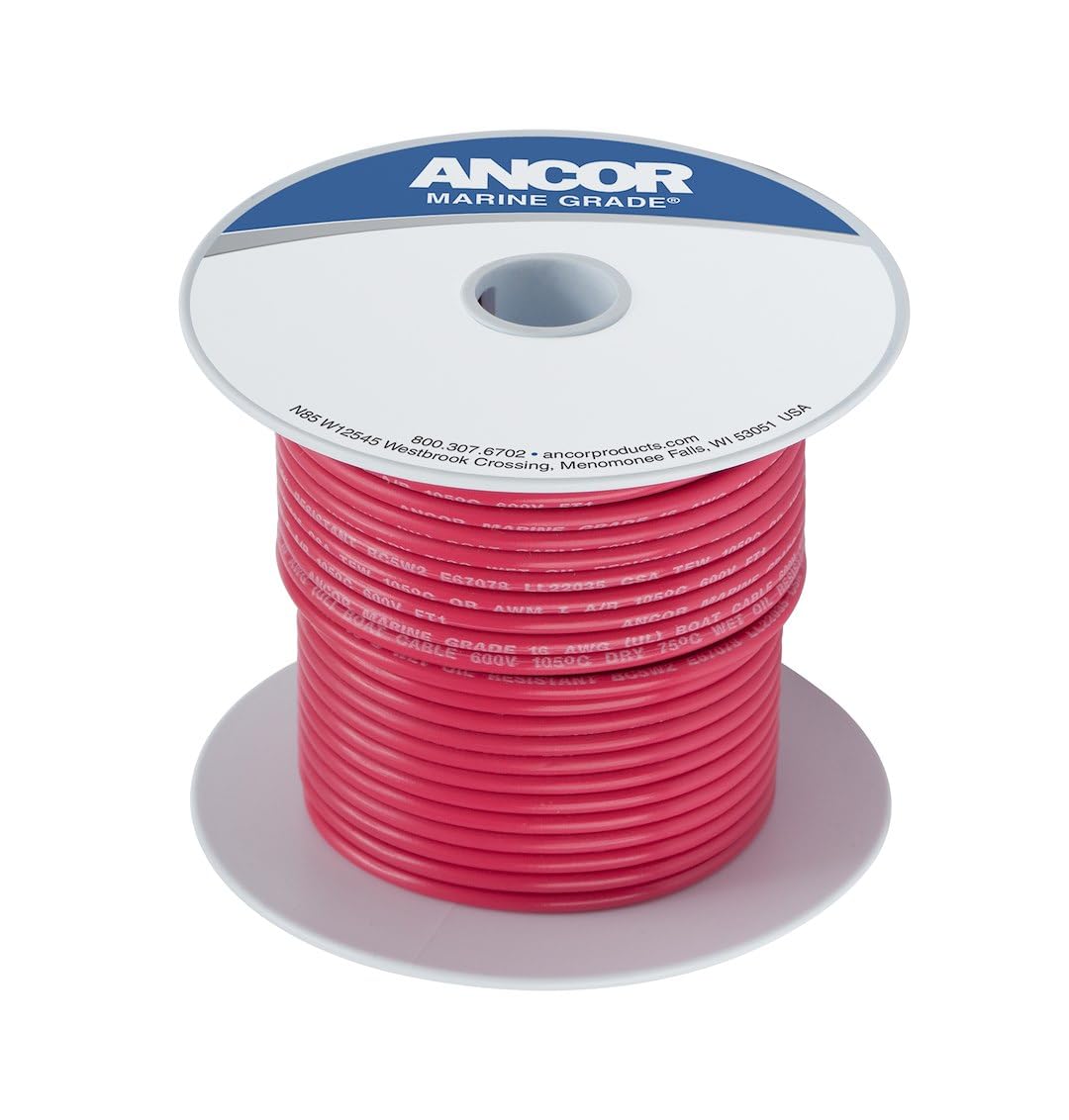
1. Ancor 104810 Tinned Copper Wire, 14 AWG (2mm2), Red – 100ft
Our pick — over 4.5★ from 400+ verified ratings; the strongest balance of quality and price.
Tin-coated copper strands built for salt air, engine heat, and a hundred feet of it.
For anything that lives outdoors or near water — a boat, a van build, a dock light — this is the spool the job deserves. Every individual copper strand is tinned, meaning each one is coated in a thin layer of tin before the bundle is twisted. That coating is what keeps corrosion from creeping in when the wire sits in damp air or splashes, and it is why marine-grade cable is priced where it is. You get 100 feet of single red conductor, one wire per order.
The build here is genuinely different from the budget CCA spools further down this list. This is solid tinned copper rather than an aluminum core, and it is wired and rated at 600 volts against the 12-volt ceiling on the GEARit primary wire — the two are not interchangeable for power work. Ancor builds it with ultra-flexible Type 3 stranding, which simply means the strands are arranged to bend and bounce back rather than crack when a boat or vehicle vibrates. The vinyl jacket is rated 600 volts, 105°C dry and 75°C wet, and stays pliable down to -40°F/C. It also resists salt water, battery acid, oil, gasoline, heat, abrasion, and UV light, and the maker states it exceeds UL 1426, US Coast Guard charter boat, and ABYC standards.
What wins owners over is the quality of the metal itself — tinned, flexible, and easy to work. It is the go-to for low-voltage auto and boat work, with vans and boats being the two places it shows up most; as owners put it: “The best for low voltage auto or boat work. I used in a van build out.” The recurring theme across the review pages is that it is worth the premium over generic spools, and the occasional discount makes it an easy call. The catch is availability and color: this listing is red only, at a single 100-foot length, so a full black-and-red pair means buying two rolls.
What Earns Its Place Up Top
- Every strand is tinned copper, which is the corrosion-fighting construction you want in damp or salty air
- Ultra-flexible Type 3 stranding is built to resist fatigue from vibration — the reason it suits vehicles and boats
- 600-volt rating, 105°C dry and 75°C wet insulation, and flexible down to -40°F/C
- Resists salt water, battery acid, oil, gasoline, heat, abrasion, and UV radiation, per the manufacturer
The Honest Trade-Offs
- Red only — a black-and-red pair means buying two separate rolls
- It is the most expensive way to buy 14 gauge on this list per foot, because the metal genuinely costs more
- One wire per roll, so multi-circuit jobs need more than one spool
Buy it for: saltwater, engine bays, and any run that gets wet or shaken.
Look past it if: you are pulling a dry indoor circuit and just need the cheapest safe copper.
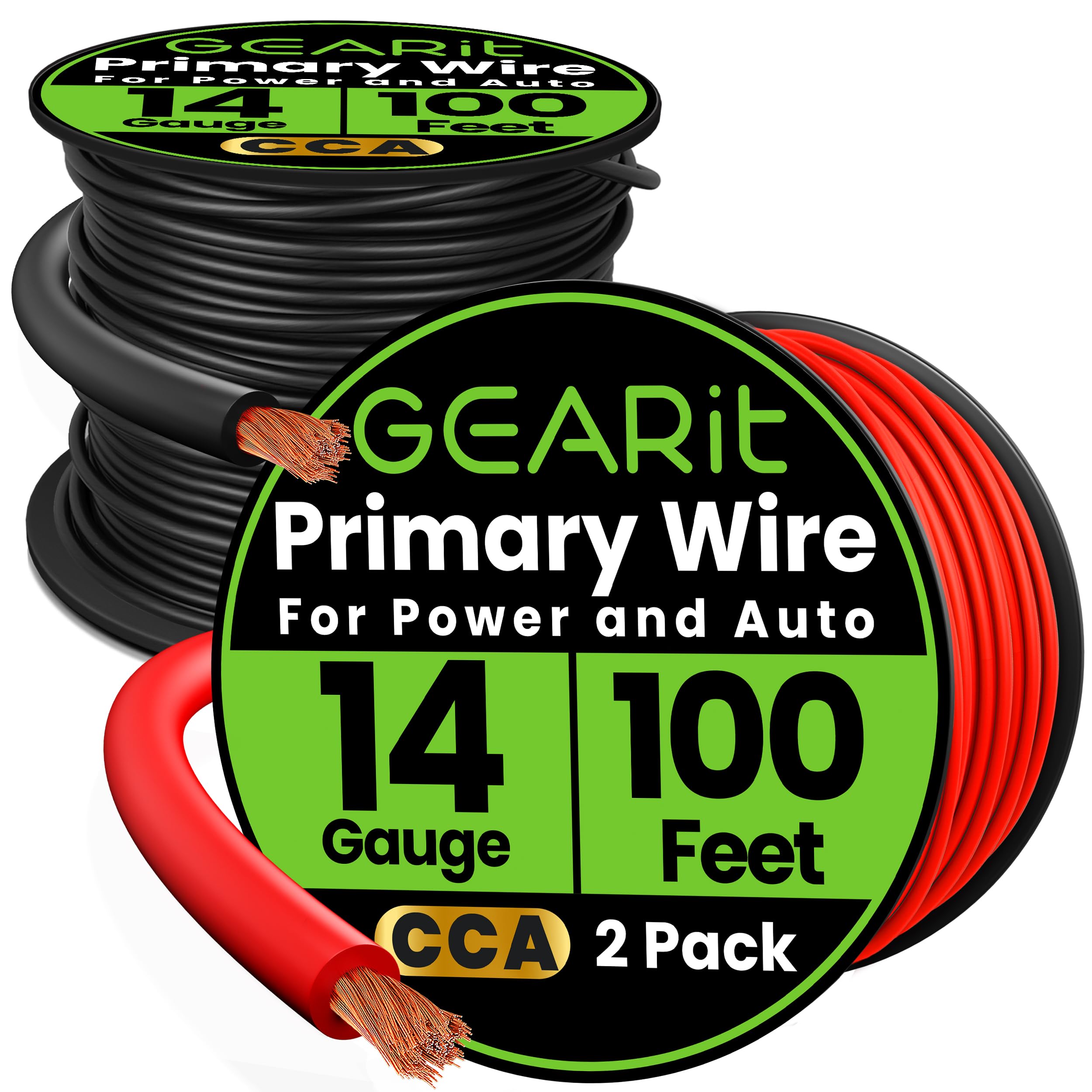
2. GEARit 14 Gauge Primary Wire CCA, 100 ft Each Black & Red (200 ft Total)
Two full rolls, one black and one red, at the lowest price per foot here.
If you are wiring a trailer harness, a speaker run, or a ground lead and you want both colors in one box, this pair is the pragmatic starting point. You get 100 feet of black and 100 feet of red in a single order, 200 feet total, at the lighter end of the 14 gauge field by construction — this roll weighs 2.6 pounds, versus the 2 pounds of the single 100-foot Ancor spool, which is the kind of weight difference a copper-clad aluminum (CCA) core produces. CCA means the strands are an aluminum core wrapped in a copper skin: lighter and more flexible than solid copper, and cheaper to boot.
The flexible stranded build bends easily through dashboards, panels, trunks, and amp racks, and the bright red and black insulation makes it simple to keep power, ground, and signal runs separate so you never cross polarity. It is rated for 12-volt work, which is the automotive and low-voltage ceiling, and the listing is explicit that it is aimed at car audio, trailer, marine, and low-voltage wiring rather than household branch circuits. One owner put it to work well beyond its stated purpose, swapping a robotic mower’s boundary wire: the flexible, temperature-tolerant insulation kept moisture and heat from triggering “wire missing” errors, and a spare roll covered the rest of the perimeter.
What buyers highlight most is the overall quality and the sheer footage for the money, which is what you would expect from a two-roll bundle. A practical note worth heeding: one owner found the roll narrower than the product photo suggested, and since this is CCA rather than solid copper, it is not the conductor to reach for if your project demands pure copper conductivity.
Value read: 200 feet of flexible two-color wire makes this the least expensive way here to stock both polarities at once, and the CCA core is exactly what keeps the weight and cost down.
Reach for this: trailer wiring, car audio, and low-voltage projects where you need a spare roll of black and red on hand.
Think twice: if your run needs pure copper conductivity, step up to a tinned copper spool like the Ancor above.
3. 14 AWG Silicone Wire 40ft Spool, 20ft Black/20ft Red, 200°C 600V
Four hundred fine tinned strands inside a soft silicone skin that bends like a shoelace.
Bench work, RC models, 3D printers, gauge wiring, and anywhere the run has to snake through a tight curve — this spool earns its spot because of one number. That number is 400: the conductor is made of 400 strands of 0.08 mm tinned copper, which is why the wire feels like thread and carries current with very low impedance. The silicone jacket is softer and more heat-tolerant than PVC, and it is rated 600 volts with a temperature range from -140°F to +392°F. You get 40 feet total, split into 20 feet of black and 20 feet of red on one hard spool.
That 600-volt rating is where this beats the budget CCA options here — the GEARit primary wire tops out at 12 volts, while this silicone spool is built for 600. The trade-off of all that flexibility is physical: the jacket is supple enough that a few owners note it is not as pliable or durable as their regular brand, though it is also around half the cost, and the copper fibers themselves are described as fine, sturdy, and flexible. The multi-use list is long, spanning model planes, cars, ships, batteries, lamps, household appliances, meters, instruments, and motor lead wire.
Here is the trap that catches first-time buyers, and owners are blunt about it: the red and black wires are two separate conductors wound onto the same spool, not a joined pair. The listing says so plainly, but it is easy to skim past and then wonder why your two-conductor run is not connected. If you need a single bonded cable, this is not it — wrap the two runs together yourself or shop elsewhere.
Why Bench Builders Pick It
- 400 strands of 0.08 mm tinned copper give it ultra-soft flexibility and super low impedance
- Silicone jacket handles -140°F to +392°F and is rated 600 volts
- 20 ft black plus 20 ft red on one dispenser spool for easy payout
Read Before You Buy
- Red and black are separate wires on a shared spool, not one connected two-conductor cable
- The silicone skin is softer than heavier-duty jackets, so it is not the toughest option for abrasion
Suits: solder-heavy projects, RC and 3D-printer wiring, and any run that needs a soft bend and 600-volt headroom.
Not for: anyone who wants a pre-bonded red-and-black pair straight off the roll.
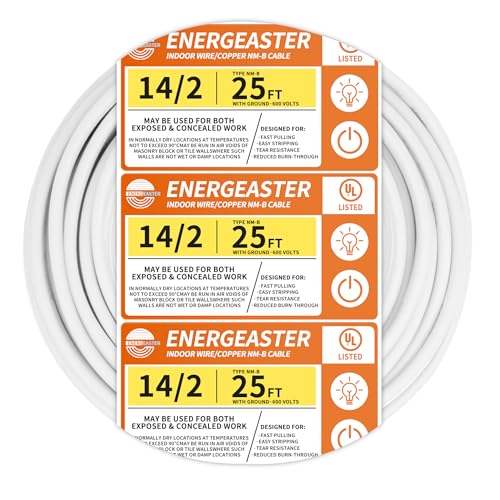
4. Energeaster Solid Indoor 14/2 W/G NMB Cable 25ft, Electrical Wire, White
Stiff solid copper for indoor branch circuits, sold in a short 25-foot coil.
This is a different animal from the flexible stranded spools above — it is Type NM-B, the non-metallic sheathed building cable you run behind drywall for outlets and switches. The construction is two solid 14 gauge conductors, one black and one white, laid parallel, plus a bare copper ground wire wrapped in fire-retardant paper and run between them. Because it is solid rather than stranded, it holds a shape, which makes pushing it up and down wall cavities and through stud bays far less fiddly than wrestling a limp stranded run.
The jacket is rated 600 volts, and the copper is the conductor here rather than the copper-clad aluminum you get on the CCA spools. This listing is UL Listed, and it is intended for indoor branch circuits inside wall cavities and attics. The copper is solid 14 gauge all the way through, including the ground. It also comes as a 25-foot coil rather than a large reel, which is the right amount for adding a receptacle or a switch leg without leaving a mostly-unused roll in the garage.
Owners consistently describe it as comparable to big-box-store wire at a friendlier price, and the jacket strips and slices cleanly — one owner split it with a box knife and had no trouble running it. The one recurring gripe is length: the coil has a habit of feeling shorter than the 25 feet on the label, so measure your run before you commit. It also ships in a plastic bag rather than a box, which owners say does not affect how it works.
Where it wins: for a small indoor branch circuit — an added outlet, a switch leg — the rigid solid core and clean-stripping jacket make it an easy afternoon job.
The honest catch: that same short-feeling 25-foot coil means you should measure twice, because one roll will not stretch to a long circuit run.
Best fit: a single indoor outlet or switch run inside a wall cavity or attic.
skip it if: your circuit is long or you need flexibility — a stranded spool is the wrong tool, and a longer reel of NM-B is the right one.
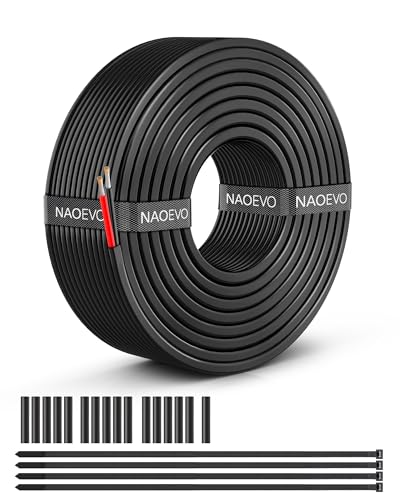
5. NAOEVO 14 Gauge Wire 2 Conductor, 14 Gauge Automotive Wire 12V Cable, 30FT
A bonded two-conductor run that is waterproof to IP68 and ready for truck, boat, or light.
When you want a single neat cable instead of two loose wires, this 30-foot two-conductor run is the fix. Each of the two circuits holds 41 strands of 0.24 mm tinned copper, and the whole thing is wrapped in an outer jacket measuring a nominal 3.5 mm. Tinned copper means the strands resist corrosion, and the oxygen-free copper construction is built for lower resistance and higher conductivity. It is rated 600 volts and carries an IP68 waterproof rating — the code for dust-tight and protected against continuous immersion — so it holds up on a boat, a trailer frame, or a truck bed.
It is flame-retardant to VW-1, and the working temperature range runs from -22°F up to 221°F, so it does not mind an engine bay or a sun-baked roof. The kit even includes 16 packs of heat-shrinkable tubes and 4 packs of cable ties to protect the connections from abrasion and moisture. The conductors are color-coded red and black and easy to tell apart, and owners call out how well it runs through roof rails, frame channels, and tight passages.
Versatility is the whole pitch here, and it delivers — the same cable handles low-voltage runs, speaker wire, LED power, landscape lighting, automotive, marine, and lamp wiring. What owners praise most is the value and how well it simply works, with a following among boat owners and DIYers alike. It is flexible enough to bend around components and strip cleanly, and the flat-ish profile threads through cramped spaces better than a round bundle.
What Makes It The Flexible All-Rounder
- IP68 waterproof rating plus a VW-1 flame-retardant PVC jacket for tough outdoor spots
- 41 tinned copper strands per circuit for lower resistance and higher conductivity
- Ships with 16 heat-shrink tubes and 4 cable ties to seal and secure connections
- 600-volt rated and works from 5V and 12V up to 600V
Worth Weighing First
- 30 feet may come up short on a long full-vehicle or whole-yard run
- Its flexibility is excellent in corners but is not the stiffness you want for pulling through a long straight conduit
Pick it when: you need one tidy, waterproof two-conductor cable for a marine, LED, or truck project.
Measure first if: your run is longer than 30 feet — you may want two, or a larger reel.
6. 50 Feet 14/2 Type NM-B Copper. #14 AWG, 2 Conductors with Ground. Insulated Jacket White
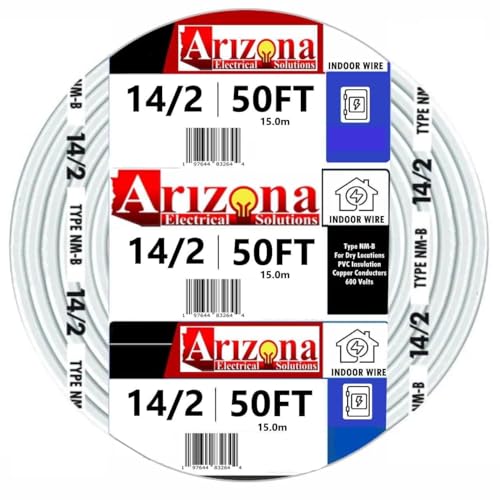
Twice the coil of the 25-foot indoor cable, so a full basement leg fits on one roll.
This is the same Type NM-B indoor branch cable as the Energeaster above, only in a 50-foot coil rather than 25 — which matters when your run has to travel across a basement before it reaches the first outlet. It is 14/2 with ground: two solid conductors plus a bare copper ground, sheathed in an insulated white jacket rated 600 volts. The listing notes it is built to UL Standard 719 and UL 83 for conductor construction, plus ASTM B-3, ASTM B-8, Federal Specification A-A-59544, and National Electrical Code NFPA 70, and that it is REACH and RoHS compliant. Solid copper throughout, not CCA.
Because it is solid 14 gauge, it is stiff enough to push through stud bays and hold a straight path, which is exactly what you want when running lights across a ceiling or adding outlets to a garage wall. Buyers report it performs well on long stretches and stacks up evenly against name-brand cable, and the build quality of both the wire and the insulation reads as equivalent. The material is polyvinyl chloride jacketing over copper conductors, and the single roll is a full 50 feet.
What buyers appreciate most is the value — there is enough on the roll to finish the job with leftovers for the next one, and it holds up as the same quality as the recognizable brands. It is not a solution for a full-house rewire, since 50 feet is a single leg’s worth, and at a solid 14 gauge it is not the cable to bend into tight low-voltage corners.
The practical edge: doubling the coil to 50 feet is what turns this from a single-outlet patch into a real basement or garage circuit run.
Keep in mind: it is rigid solid NM-B, so treat it as permanent indoor wiring rather than something you flex into an automotive or marine corner.
Choose this: for basement, garage, and attic circuits where one continuous 50-foot leg completes the job.
Not the one for: low-voltage, vibrating, or wet environments — those want the stranded spools instead.
7. 14 Gauge Wire Combo 6 Pack (600ft Total) 100ft Per Roll, 12V Low Voltage Automotive and Electrical Cable

Six separate colors, 100 feet each, so every circuit gets its own shade.
For a multi-circuit project where you want to tell every run apart at a glance, six rolls beat one. This pack gives you black, blue, green, red, white, and yellow, 100 feet of each, 600 feet total. It is single-conductor stranded wire with a copper-clad aluminum (CCA) core and a PVC jacket rated 158°F and 6 to 80 volts, built for car audio, home theater, automotive, and 12-volt home projects. With six colors on the bench, keeping circuits separated is simple.
The CCA core is the honest headline here, and the listing does not hide it — a copper-clad aluminum conductor is lighter and more flexible than copper wire, which is the whole reason six rolls of this can be had for so little. For 12-volt work like marker lights, audio, and accessory wiring, that flexibility and light weight are real advantages. The company’s own note — that this is not American 14 AWG wire — is worth reading before you buy, because it signals the aluminum-core difference up front rather than after the fact.
Owners confirm it is easy to work with and flexible, and they like having the full color spread for keeping circuits apart; some report returning for a second order. The recurring caution is that CCA corrodes more readily than solid copper in exposed conditions, and the wire is not solid copper — fine for a low-voltage application, less ideal for a wet or high-demand one. If your job needs pure copper conductivity or long-term corrosion resistance, shop a tinned copper spool instead.
Why Six Rolls Win
- Six colors — black, blue, green, red, white, yellow — make multi-circuit wiring easy to trace
- 600 feet total at 100 feet per roll, enough to cover a whole project with spares
- Flexible stranded CCA is light and bendy, rated 158°F and 6 to 80 volts
Where It Falls Short
- Copper-clad aluminum, not solid copper — the maker notes it is not American 14 AWG wire
- CCA has less corrosion resistance than copper, so it is best kept to dry, low-voltage jobs
Buy it for: a multi-color 12-volt project — trailer harnesses, car audio, or a home theater wiring job across several runs.
Pass on it if: you need a pure-copper conductor or a run exposed to moisture for years.
8. GEARit 14 Gauge in-Wall Speaker Wire 200FT, CL2 Rated 14/2 CCA Wire, White

Two hundred feet of CL2 in-wall speaker cable with printed foot markers on the jacket.
Whole-home audio, ceiling speakers, a surround setup, or a small church or classroom system — this is the cable that is actually rated to hide inside the wall. The jacket carries a CL2 rating, which is the classification that makes speaker wire legal to run behind drywall and above ceilings, and it is flame-retardant so it resists fraying as it is pulled through studs and corners. You get 200 feet of 14/2 cable with two color-coded conductors and a white jacket. It is copper-clad aluminum (CCA), an aluminum core with a copper skin that is lighter and more budget-friendly than pure copper — a reasonable fit for indoor audio runs.
The detail that makes a long install far less painful is printed right on the cable: sequential foot markers along the jacket let you measure each run before you cut, so you do not end up guessing at how much reaches the far surround speaker. The red and black conductors make it easy to keep polarity straight when you land the connections on the amp or receiver. It weighs 5.7 pounds on the spool, and the flexible PVC jacket threads through walls, ceilings, corners, and other tight spaces without fighting back.
The manufacturer lists it for home theater, whole-home audio, surround sound, classrooms, and office audio. Owners mention that running it through walls is straightforward, that it strips cleanly with a scoring-and-pull technique, and that the polarity markings are clear; it is a particular favorite for rear-surround and height-channel speakers where long in-wall runs are the norm. Because it is CCA, not solid copper, it is meant for supported indoor audio use rather than power circuits or high-demand runs.
Installer-friendly read: foot markers plus a CL2-rated, soft PVC jacket are exactly what turn a whole-home speaker install from a weekend of guessing into a clean afternoon.
One thing to know: the CCA core is lighter and cheaper than copper, so keep it to indoor audio rather than powering anything that demands pure copper.
Best for: anyone running in-wall or in-ceiling speakers and needing enough cable to wire a whole home or theater.
Look elsewhere if: your run carries power rather than audio, or you specifically want a solid or tinned copper conductor.
Understanding the Specs
AWG Gauge And What 14 Actually Means
AWG stands for American Wire Gauge, a numbering system where a smaller number means a thicker conductor. That means 14 gauge is thicker than 16 or 18 gauge and thinner than 10 or 12 gauge. Thicker wire carries more current with less voltage drop over distance, so 14 gauge sits comfortably in the low-voltage and light-branch-circuit range. If your run is long, the thicker metal is doing the work of keeping the voltage steady at the far end.
Strand Count, Metal Type, And Jacket Ratings
Strand count tells you how flexible and vibration-tolerant a wire is — 400 fine strands of 0.08 mm copper bend far more easily than a single solid core of the same gauge. The metal matters just as much: tinned copper resists corrosion in moisture, bare copper conducts plainly, and copper-clad aluminum (CCA) is an aluminum core with a copper skin that is lighter and cheaper but not pure copper. Jacket ratings like NM-B and CL2 decide where the wire is legally allowed to sit — NM-B for indoor branch circuits, CL2 for speaker runs inside a wall.
FAQ
What is 14 gauge wire actually used for?
Is 14 gauge wire thick enough for a house outlet?
What is the difference between tinned copper and copper clad aluminum?
Can I use 14 gauge speaker wire in a wall?
How much current can 14 AWG wire carry?
Does 14 gauge wire work for a car audio amp?
What is the difference between solid and stranded 14 gauge wire?
What does the 600V and temperature rating on the jacket mean?
Is copper clad aluminum wire safe for outdoor use?
How do I strip 14 gauge wire without nicking the copper?
Final Thoughts: The Verdict
For most people the 14 gauge wire winner is the Ancor 104810 Tinned Copper Wire, because every strand is tinned for corrosion fighting, it is rated 600 volts, and it stays flexible down to -40°F/C — the combination that makes it hold up on a boat, in a van, or anywhere that gets wet or shaken. If you want the best value for a low-voltage automotive or trailer job, the GEARit primary wire pair hands you 200 feet of black and red and asks very little for it. And for hiding cable inside the walls of a home theater, the GEARit CL2 in-wall speaker wire is the one to reach for, thanks to its ratings-correct jacket and printed foot markers.
How We Picked
We do not accept paid placement. Every pick is matched to a real buyer and a real use-case; we do not hands-on test units.
Sources & Methodology
Specifications: manufacturer listings and product documentation. Review insights: verified customer reviews, as of September 2026. Pricing: not shown on this page (it changes often); check the current price via the retailer link.
As an Amazon Associate, KitchPrep earns from qualifying purchases. This does not affect which products we feature.
Related Guides
