
Specs are compiled from manufacturer listings and verified buyer reviews and can change over time — please confirm the key details on the product page before buying.
Before you buy any 14 gauge cable, ask yourself one honest question: what are you actually wiring? A boat, a car stereo, a wall outlet, or a full-yard speaker setup each demand a different conductor—and a wrong guess means a re-do, a fire risk, or a wire that corrodes within a season. This guide sorts through the real trade-offs between tinned copper, copper-clad aluminum, silicone, and solid NM-B cable, so you can buy the exact spool that finishes your job right the first time.
I’m Mohammad Maruf — the founder and writer behind KitchPrep. This guide is built by comparing the manufacturers’ published specifications and the patterns across verified customer reviews, so you get each pick’s real strengths and trade-offs instead of marketing spin.
The best 14 gauge cable for your project balances cost against corrosion resistance, flexibility, and the voltage you’re pushing. The conductor metal and insulation rating determine whether your installation lasts five years or twenty.
Our Picks at a Glance

How To Choose The Best 14 Gauge Cable
Every 14-gauge cable looks similar from the shelf, but the conductor metal and the insulation change everything about where it belongs. Anchoring your choice in two questions—where the wire runs, and what voltage it carries—separates the perfect fit from a frustrating mistake.
Match the conductor metal to the environment
Bare copper conducts beautifully but corrodes when moisture, salt, or battery acid reaches it. Tinned copper wraps each strand in a protective tin layer that resists that corrosion, which is why marine-grade wire uses it. Copper-clad aluminum (CCA) uses an aluminum core with a thin copper jacket; it’s lighter and easier on the budget, but it’s not a like-for-like replacement for pure copper in every job, and its corrosion resistance is weaker in wet use.
Check the stranding for flexibility and fatigue
Solid 14-gauge has one stiff conductor, ideal for fixed runs inside walls. Stranded wire uses many thin wires twisted together; more strands means more flexibility and better resistance to metal fatigue from vibration. That’s why a 400-strand silicone wire bends around corners like rope, while a single-strand NM-B cable stays rigid enough to pull straight through studs.
Confirm the voltage rating and insulation type
Automotive and low-voltage projects rarely exceed 12 or 24 volts, so most primary wire is rated around 600 volts—plenty of headroom for a car or trailer. In-wall residential runs, though, require a specific cable type (like NM-B) with a fire-retardant jacket that meets local building code. The insulation material also sets temperature limits: PVC is durable and cheap, while silicone survives from -60°C to +200°C, a huge range for engine bays or heat-prone gear.
Quick Comparison
| Model | Best For | Conductor | Voltage Rating | Total Length | Amazon |
|---|---|---|---|---|---|
| Ancor 104810 Tinned Copper★ Best Overall | Marine & corrosion-prone wiring | Tinned Copper | 600 volts | 100 ft | Amazon |
| GEARit 14 Gauge CCA PairBest Value | Automotive & trailer wiring | Copper Clad Aluminum | 12 volts | 200 ft | Amazon |
| Mygatti 14 Gauge 6-PackColor-Coded Pick | Multi-color hook-up projects | Copper Clad Aluminum | 12/24 volts | 150 ft | Amazon |
| Haerkn 14 AWG Silicone | Heat-resistant flexible wiring | Tinned Copper | 600 volts, 20 A | 50 ft | Amazon |
| NAOEVO 14/2 CCA 100ft | Speaker & low-voltage runs | Copper Clad Aluminum | 12 volts | 200 ft | Amazon |
| Energeaster NM-B 14/2 | In-wall residential branch circuits | Solid Copper | 600 volts | 25 ft | Amazon |
| NAOEVO 14 Gauge Tinned 50ft | Tinned-copper automotive projects | Tinned Copper | 600 volts | 50 ft | Amazon |
| BABOOM 14 Gauge Combo 6-Pack | Big multi-color auto reels | Copper Clad Aluminum | 6 to 80 volts | 600 ft | Amazon |
| NavePoint CL2 500ft | Whole-home in-wall audio | Copper Clad Aluminum | CL2 rated | 500 ft | Amazon |
In-Depth Reviews
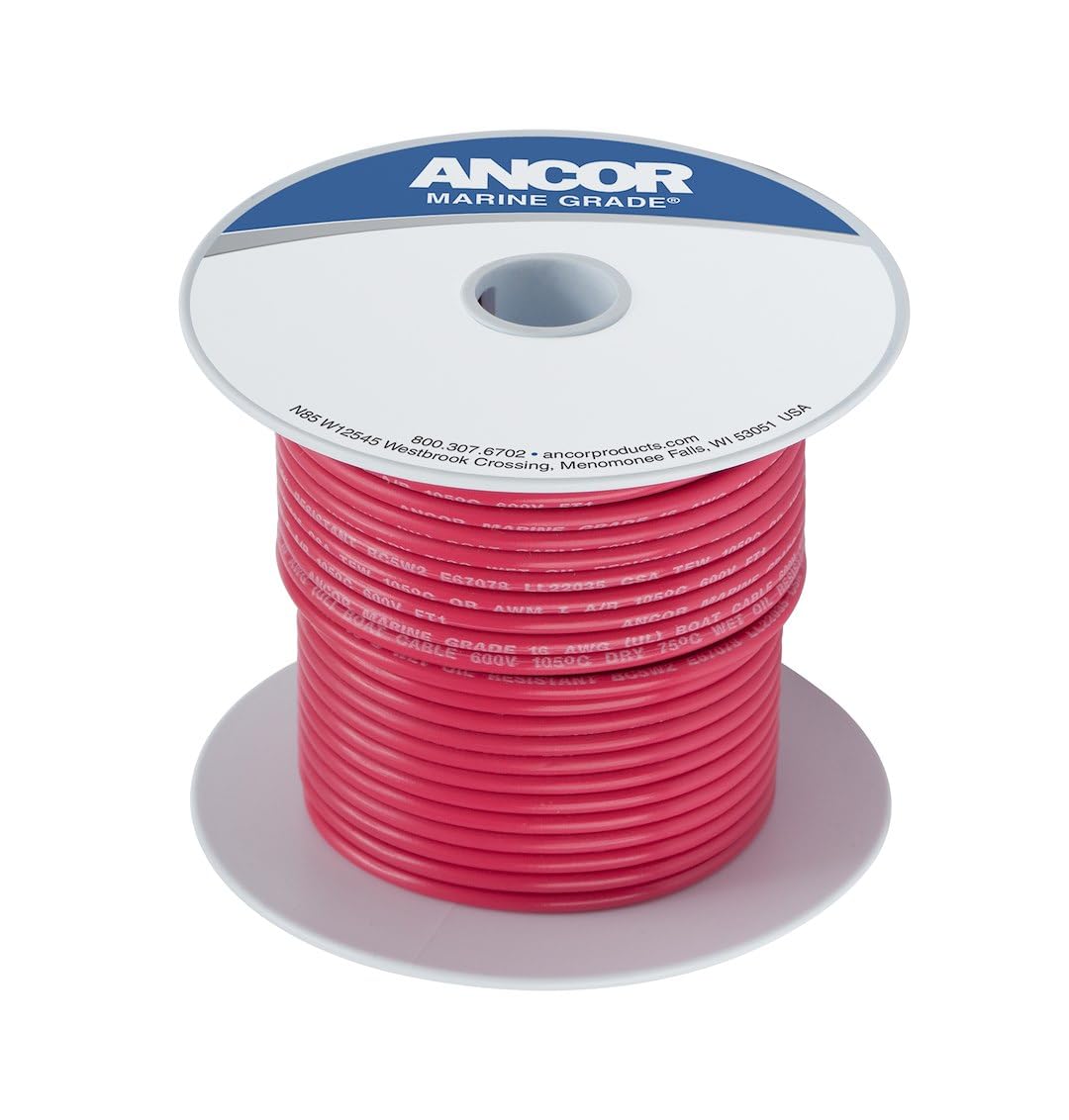
1. Ancor 104810 Tinned Copper Wire, 14 AWG, Red – 100ft
Our pick — over 4.5★ from 400+ verified ratings; the strongest balance of quality and price.
This tinned-copper wire sets the benchmark for corrosion resistance in marine and high-moisture environments.
This cable survives the harshest marine environments because each copper strand is tinned—a protective coating that blocks salt spray and moisture, which quietly destroy bare copper. That same protection makes it a standout for van builds and any low-voltage auto work. The premium vinyl insulation is rated at 600 volts and 105°C dry, and it stays flexible even at -40°F/C, so a cold-weather install doesn’t turn into a wrestling match.
What wins people over is the build quality—the single most-cited praise in the owner feedback, with value for money trailing as a close second. Buyers report it as “some of the best in the game,” with tinned copper called “a premium choice for long lasting wire.” It’s made in the USA and exceeds UL 1426, US Coast Guard Charter boat (CFR title 46), and ABYC standards, which is the shorthand serious installers trust when they can’t afford a re-do.
The honest trade-off is the price point—this is a premium pick compared to budget CCA spools, so it’s overkill if you’re just wiring a trailer that lives in a dry garage. But for anything touching water, battery acid, or vibration, the corrosion protection and fatigue resistance justify the cost.
Built for the worst conditions
- Tinned strands resist corrosion from salt water and battery acid
- Ultra-flexible Type 3 stranding shrugs off vibration fatigue
- Meets ABYC, UL 1426, and US Coast Guard standards
Know your budget
- Costs more than copper-clad aluminum spools
- Single red roll, so you’ll buy a second for polarity
Reach for this if: your wire will face salt, spray, or constant vibration—a boat, a van build, or a marine accessory circuit.
Think twice if: you’re on a strict budget for a dry, indoor automotive project where bare copper or CCA is acceptable.
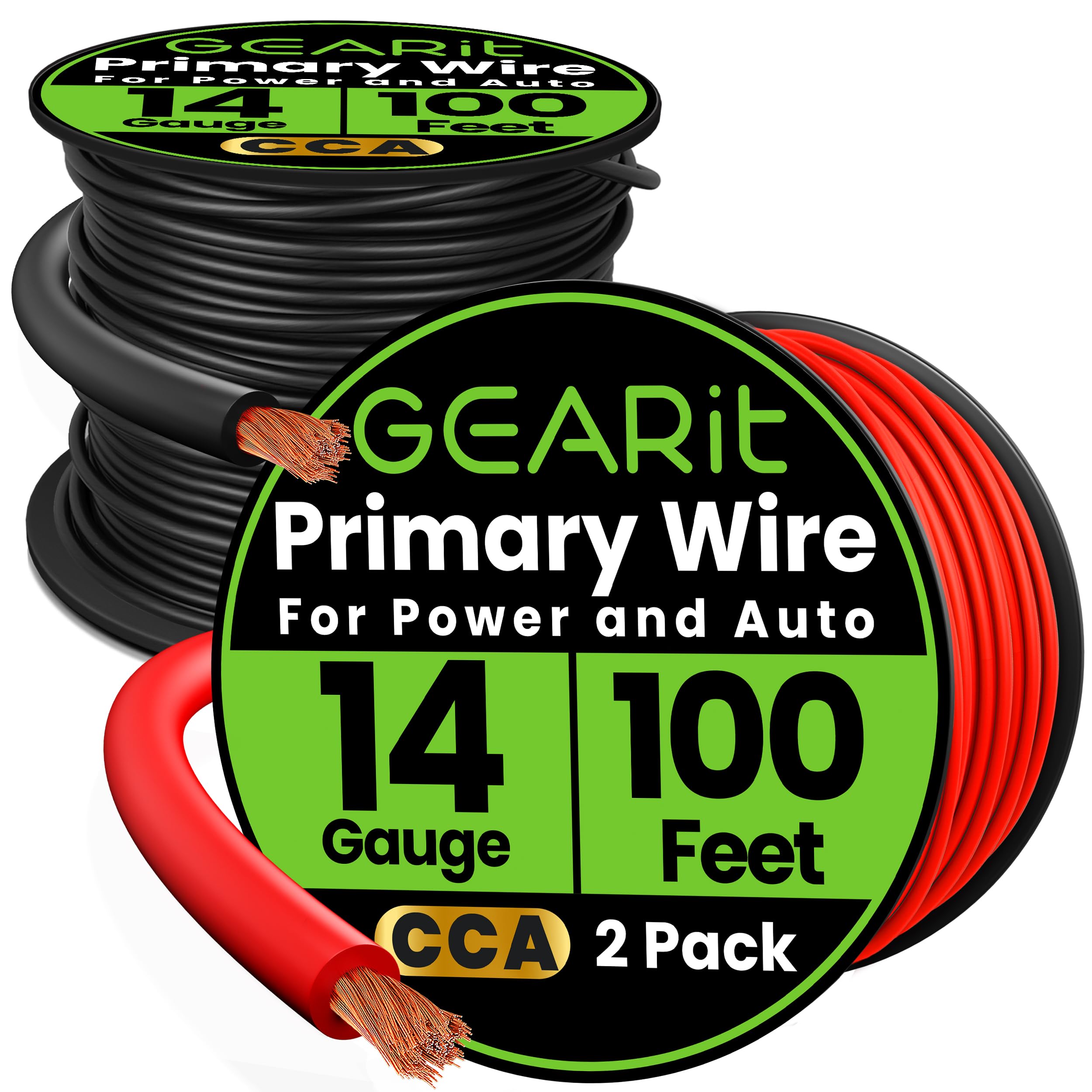
2. GEARit 14 Gauge Primary Wire CCA, 100ft Black & Red Pair
This 200-foot two-spool CCA set offers budget-friendly flexibility for dashboards and trailer frames.
At 12 volts and roughly 2.6 pounds for the pair, this CCA (copper-clad aluminum) wire is built for the daily grind of automotive, trailer, and car-audio work—not for corrosive marine use. The smart buy here is the packaging: 100 feet each of black and red lets you keep polarity straight without ordering two separate rolls. Owners mention it worked great for full trailer rewires and as a cost-effective stand-in for pricey branded boundary wire on robotic mowers, where longer runs stayed flexible and insulated through extreme temperatures.
The flexible stranded CCA construction with a durable PVC jacket bends easily through dashboards, panels, trunks, and tight amp racks—the stuff that makes a stereo install go from frustrating to smooth. It’s the functionality that buyers praise most, with quality and value for money as the top-cited strengths, and the recurring criticism is narrow: a handful note some portions of the roll have more strands than others, which is a QC quibble rather than a functional failure for most low-voltage jobs.
A few owners found the roll looked narrower than the photo and couldn’t verify the full 100-foot length, so measure if you need an exact run. For the price, though, it’s hard to argue with a two-spool setup that covers a whole yard or a full trailer harness.
Value verdict: the most versatile budget pick here—two full 100-foot spools of color-coded 14 AWG for less than most single rolls of pure copper, with flexibility that makes it a joy to route.
The honest catch: CCA is not corrosion-proof, and a few rolls arrive with uneven strand counts, so inspect before a critical install.
3. Mygatti 14 Gauge Wire 6-Pack, Black/Red/Grey/Blue/Green/Brown, 25ft Each
Six 25-foot color-coded CCA rolls keep complex harnesses organized and traceable.
This 150-foot multi-pack solves the problem every DIY installer hits: keeping six different circuits straight in your head. With black, red, grey, blue, green, and brown at 25 feet each, you can reserve a color per function—one for power, one for ground, one for a remote trigger—and never second-guess a connection later. The CCA cable is lighter and more flexible than pure copper, which owners confirm makes it easy to route through tight spots, and the thick insulation is a point of praise for anyone who’s been burned by thin-jacket wire that nicks during install.
Quality is the top-cited strength, with value for money running second, and the real-world uses range from wiring a VTEC setup into a Civic to running fog lights that “work good so far.” The 12V/24V DC rating covers most automotive and hobby work, and the stranded 14-gauge construction is forgiving when you bend it around corners. It’s rated for car audio, electrical equipment, model cars and ships, lamps, speaker audio, and security alarm control, which makes it a true generalist’s kit.
The main limitation is length per roll—25 feet disappears fast on a full car install—so this is best as a starter kit or for smaller projects rather than a whole-vehicle rewire.
Organization win: six colors at 25 feet each give you a complete color-coding system for a fraction of the cost of six individual spools, and the thick PVC jacket is durable enough for daily handling.
Length reality: 25-foot rolls run short for a full car harness—budget two packs or step up to 100-foot reels if you’re wiring a whole vehicle.
4. Haerkn 14 AWG Silicone Electrical Wire, 2 Cores, 25ft Spool

This silicone-jacketed wire bends like rope and withstands extreme engine-bay heat.
The spec that defines this wire is the insulation: silicone rated from -60°C to +200°C, a temperature range that leaves PVC far behind. That makes it the go-to for engine bays, heat lamps, and any spot where a melting jacket would be a fire hazard. Inside, there are 400 strands of 0.08 mm tinned copper—an extreme stranding count that delivers super-low impedance and a flexibility that feels more like fabric than wire. It’s rated for 600 volts and carries up to 20 amps, so it handles moderate-current electronic projects with plenty of headroom.
The tinned copper conductor is the same corrosion-resistant choice that marine installers pay extra for, and owners confirm the wire holds up in humid, salty environments and survives soldering, crimping, and cutting without issue. One build report sums it up: it was used to wire a van three years ago and is still working perfectly. Quality is the top-cited strength, with functionality and flexibility close behind, and the 2-core design—black and red bonded together—makes polarity obvious at a glance.
The trade-off is that silicone is soft, so the insulation can tear more easily than PVC if you’re rough with it—durability gets the mixed reviews here. It’s also more expensive per foot than CCA, but for heat resistance and long-term reliability, owners call it “pricey but worth it.”
Where this excels
- -60°C to +200°C range survives engine-bay heat
- 400-strand tinned copper bends and flexes like rope
- Low impedance suits moderate-current electronics
The soft spot
- Silicone jacket tears more easily than PVC
- Costs more per foot than CCA spools
Grab this for: heat-exposed runs, electronic projects, and any build where extreme flexibility saves you hours of routing grief.
Look elsewhere if: you need maximum abrasion resistance or you’re on a strict per-foot budget.
5. NAOEVO 14 Gauge Wire 2 Conductors, CCA Red Black, 100FT

This dual-spool 200-footer handles both garden lights and surround-sound speakers with reliable performance.
The headline here is sheer quantity—100 feet each of red and black, giving you 200 total feet of 14/2 for one purchase. That’s enough to run speaker wire across a room, feed a row of garden lights, or add two extra channels to a 7.2 surround system without splicing. Owners backing it for low-wattage surround channels found the strands “pretty decent, pliable, twisted together well,” and the numbered 2-color jacket makes polarity differentiation easy, reducing the risk of wiring a device backwards.
The CCA (copper-clad aluminum) construction is the honest compromise: it merges copper’s conductivity with aluminum’s lighter weight, so it’s easier to route than pure copper and more cost-effective. The premium PVC insulation operates from -20°C to 70°C, with anti-aging, moisture-proof, and anti-corrosion properties that suit automotive, home or car speakers, LED, marine, 12V/24V DC circuits, and solar panels. Quality leads the owner feedback, with functionality and value for money as the follow-ups, and there are “no reported issues” in the customer consensus.
The catch is that CCA is not a direct substitute for pure copper in every high-current audio scenario—some purists want oxygen-free copper for long speaker runs. For garden lights and general low-voltage work, though, it’s reliable and easy to peel and cut to any length.
Quantity play: 200 total feet of color-coded 14/2 for a single price makes this the volume pick for multi-zone speaker or lighting projects.
Sonic caveat: serious audiophiles chasing maximum conductivity on long runs may prefer pure tinned copper over CCA.
6. Energeaster Solid Indoor 14/2 W/G NMB Cable, 25ft, White
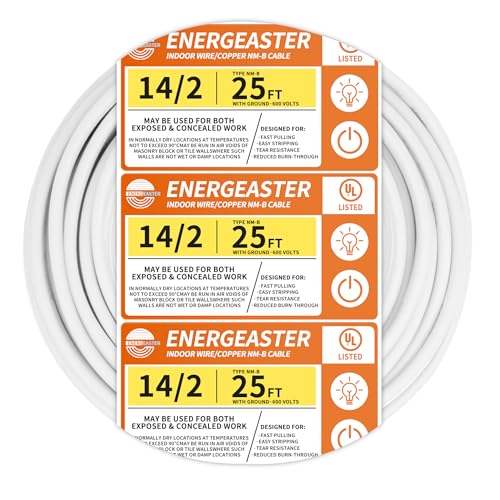
This solid 14/2 NM-B cable is purpose-built for in-wall switches and outlets, not automotive use.
This is a completely different tool from the stranded automotive spools above; it’s Type NM-B (non-metallic 90°C) copper building wire, the stuff residential electricians run inside wall cavities and attics as a branch circuit for switches and outlets. The conductors are solid 14-gauge copper—black, white, and a bare ground wire—wrapped in a white fire-retardant jacket rated at 600 volts. Owners say it performs just as well as big-box store wire but at a better price, and the rigid solid-core construction makes running it up and down walls a breeze.
Quality dominates the feedback—it’s the most-cited positive by a wide margin—with value for money second, and ease of use third. The jacket slices cleanly with a box knife, and the fire-retardant paper wrap keeps the conductors organized as you pull. It’s the right pick when you’re adding receptacles or running a new branch circuit and you need a cable that meets code, not just a wire that conducts.
Two honest quirks: the jacket is much harder to strip cleanly than automotive wire, which is a common complaint, and some owners feel 25 feet runs a little short of expectations—a minority even say it measures under the advertised length, so measure twice if your run is tight. It’s also a 25-foot coil, so multi-outlet jobs need two.
Code-ready performance
- Meeting NM-B 90°C spec for in-wall branch circuits
- Solid copper handles fixed residential runs
- Value beats the big-box hardware stores
Install realities
- Jacket is notoriously tough to strip
- Length reads short to some buyers
Choose this when: you’re wiring a receptacle or outlet into a wall and need legitimate NM-B cable, not automotive wire.
Not for: any low-voltage 12V project—this is purpose-built for 120V residential branch circuits only.
7. NAOEVO 14 Gauge Wire 2 Conductor, Tinned Copper, 50FT
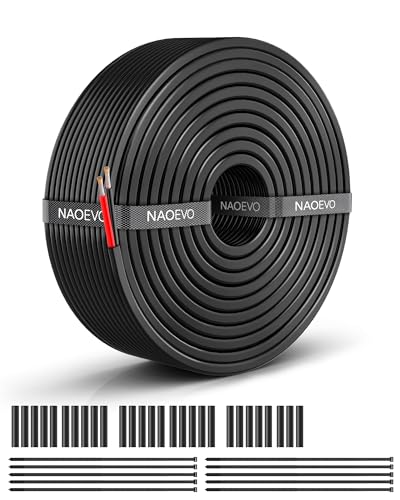
This 50-foot tinned-copper wire delivers marine-grade corrosion resistance for automotive and LED projects.
The defining spec is the conductor: 41 strands of 0.24 mm oxygen-free tinned copper inside each circuit, giving lower resistance and higher conductivity than CCA. The tinning is the same corrosion shield found on premium marine wire, which is why customers note professional results on boats and automotive builds alike—wet environments that would eat a bare-copper or CCA wire over time. The jacket is rated at 600 volts with an IP68 waterproof level and a working temperature range up to -22°F to 221°F, plus a VW-1 flame-retardant grade for extra safety.
Quality leads the owner feedback overwhelmingly, with value for money second, and buyers describe the wire as “flexible, durable, and easy to work with,” with clear red/black markings that survive routing. The kit goes beyond the wire itself—it ships with 28 packs of heat-shrinkable tubes and 10 packs of cable ties, so you have the protection accessories to finish the job properly. The 3.5 mm outer diameter keeps it thin enough to route through tight spaces and roof rails.
The trade-off is length—50 feet disappears quickly on a full vehicle build, so this suits smaller projects or finishing touches where you want premium material. It’s also priced above CCA, but owners call the quality “exceeds price” and say they’d repurchase.
Premium material, real proof: tinned 41-strand copper plus IP68 waterproofing and included heat-shrink tubing make this the pick where corrosion resistance and a clean finish matter more than raw length.
Plan around: 50 feet goes fast—order two for a full automotive accessory install.
8. BABOOM 14 Gauge Wire Combo 6 Pack, 600ft Total, CCA

Six 100-foot reels of color-coded CCA that keep a full classic-car rewire organized start to finish.
At 600 total feet across six 100-foot rolls—black, blue, green, red, white, and yellow—this is the volume play for anyone rewiring a whole vehicle or a home theater with serious channel counts. Owners describe it as “your go to for wire,” with repeat buyers saying “these wires are the only ones I’ll use.” The stranded CCA construction is flexible and easy to work with, rated for 6 to 80 volts at 158°F, which covers car audio, home theater, and any 12-volt project. The six-color selection makes it simple to keep circuits separated during a big install.
Wire quality leads the feedback, with value for money second and repeatable praise for the ease of use and color options. The honest catch, though, is spelled out right in the listing: “THIS IS NOT AMERICAN 14 AWG WIRE,” and it’s copper-clad aluminum, not solid copper. Owners who missed that note before buying flag it, and durability gets negative feedback because CCA corrodes more quickly than pure copper in some environments. It also shows a staggering 1,340 items count on the listing, which is a data quirk—the real takeaway is a single 6-pack of reels.
For a classic-car rewire where you’ll color-code every circuit, the volume and flexibility win. Just know before you buy that CCA isn’t a drop-in for pure copper in every corrosion-prone spot.
Volume champion: six 100-foot rolls give you 600 feet of organized, color-coded 14 AWG at a price per foot that’s tough to beat for big projects.
Read the fine print: it’s CCA, not solid copper, so avoid it for wet marine use or critical corrosion-prone circuits.
9. NavePoint 500ft In-Wall Audio Speaker Cable, CL2 14/2 AWG, White

A 500-foot pull box of CL2-rated speaker cable built for wiring entire media rooms in one pass.
This is the professional installer’s answer to whole-home audio: 500 feet of flat, white 14/2 speaker cable with two conductors made from 80 strands of 0.16 mm wire each. The CL2 rating is the key spec—it certifies the jacket for in-wall installation per building code, which is exactly what you need when running audio through walls, attics, or a media room. Reviewers point out clear sound with no distortion even at high volume, and a 70V gym system with JBL speakers delivered clean audio on a long run.
Quality is the dominant praise—the most-cited positive by far—with ease of use second, and shoppers say the cable stays flexible even in cold climates and the tough jacket survives being pulled through pipes. Two owners mention the flat design routes neatly and the pull box is convenient, though one box arrived with a factory packaging tangle and another notes the box can feed poorly and catch if you pull too fast. It’s CCA, so a few buyers flag the material as a negative, but at this scale the value is hard to match.
If you’re running a single pair of speakers across one room, 500 feet is overkill—but if you’re wiring a full media room or a multi-zone house, this is the one-pass solution. The recurring advice from owners is to inspect the box before you start pulling to avoid tangles.
Installer-grade scale
- CL2-rated jacket meets in-wall code requirements
- 80-strand conductors stay clear at high volume
- 500 feet covers a whole media room in one pull
Pull box quirks
- Box can catch or tangle if you pull too fast
- CCA construction, not pure copper
Buy this for: a whole-home audio run where code-compliant CL2 cable and massive length beat per-foot cost.
Skip if: you need one short speaker run—you’ll be paying for 500 feet you won’t use.
Understanding the Specs
Conductor Metal: Tinned Copper vs. CCA
The conductor metal is the single biggest durability decision. Tinned copper wraps each strand in tin to block corrosion from salt, moisture, and battery acid—that’s why marine-grade wire uses it. Copper-clad aluminum (CCA) puts a thin copper layer over an aluminum core; it’s lighter, cheaper, and fine for dry low-voltage work, but it corrodes faster in wet environments and isn’t a true substitute for pure copper in every high-current job.
Stranding Count and Flexibility
The number of thin strands twisted together controls how flexible the wire is and how well it survives vibration. Solid wire has one stiff conductor, perfect for fixed runs in walls. Stranded wire with counts like 41 or 80 strands bends more easily, while ultra-flexible silicone wire can pack 400 strands for maximum bendability. More strands generally mean better resistance to metal fatigue from constant movement.
Voltage and Insulation Ratings
The voltage rating tells you the maximum the insulation can safely handle—most automotive primary wire is rated at 600 volts even though cars run at 12V, giving huge headroom. Temperature ratings matter too: PVC jackets typically handle a moderate range, while silicone insulation survives from -60°C to +200°C. For in-wall residential runs, look specifically for a code-approved cable type like NM-B or CL2, not just any wire.
Length and Spool Configuration
Buying the right total length is about planning your full run. Single-color spools give you maximum length of one conductor but require a second purchase for polarity. Paired spools—black and red together—keep two-conductor projects organized. Multi-color packs let you assign a color per circuit, which is gold for complex installs where you’ll need to trace wires later.
FAQ
What’s the difference between tinned copper and copper-clad aluminum 14 gauge wire?
Can I use 14 gauge automotive primary wire for in-wall residential wiring?
How much current can 14 gauge wire safely carry?
Is a higher strand count always better for 14 gauge wire?
What does the voltage rating like 600 volts mean for a 12V car project?
Why does the Ancor wire cost more than CCA spools of the same gauge?
How do I choose between solid and stranded 14 gauge wire?
Is 25 feet of 14 gauge wire enough for a car stereo or trailer project?
Final Thoughts: The Verdict
For a truly corrosive-proof, set-and-forget install, the winner is the Ancor tinned copper—its tin-coated strands and marine-grade pedigree are the crowd favorite for a reason, and nothing here matches its corrosion resistance. If you want maximum flexibility and heat tolerance for a tight engine-bay or electronics project, the Haerkn silicone is the one to reach for. And for a budget automotive or trailer rewire where 200 feet of color-coded wire beats a single premium roll, the GEARit CCA pair is your value play. If your project is residential, skip all of those and grab the Energeaster NM-B for code-compliant in-wall branch circuits.
How We Picked
We do not accept paid placement. Every pick is matched to a real buyer and a real use-case; we do not hands-on test units.
Sources & Methodology
Specifications: manufacturer listings and product documentation. Review insights: verified customer reviews, as of September 2026. Pricing: not shown on this page (it changes often); check the current price via the retailer link.
As an Amazon Associate, KitchPrep earns from qualifying purchases. This does not affect which products we feature.
Related Guides
