
Specs are compiled from manufacturer listings and verified buyer reviews and can change over time — please confirm the key details on the product page before buying.
If your 14 inch duct run keeps collapsing, kinking at the elbow, or leaking hot air into an attic, the hose is usually the problem, not the fan. This guide shows you what separates a 14 inch flexible duct that lasts from one that shreds on install day. One honest note first: this list uses flexible matching for the 14 inch diameter requirement, so some listings may offer 14 inch as a selectable option rather than the exact number you typed. Where the exact 14 inch size isn’t listed, the closest same-type size performs the same job, and each review flags the real measured diameter.
I’m Mohammad Maruf — the founder and writer behind KitchPrep. This guide is built by comparing the manufacturers’ published specifications and the patterns across verified customer reviews, so you get each pick’s real strengths and trade-offs instead of marketing spin.
You will see PVC and aluminum builds side by side, plus the insulation ratings that quietly decide whether your HVAC system wastes energy. Below, the 14 flexible duct picks are sorted by what actually survives a real install.
Our Picks at a Glance


How To Choose The Best 14 Flexible Duct
The hardest part of buying a 14 inch flexible duct is not picking a brand — it is matching the hose to the job in front of you. A hose for a basement exhaust fan and a hose for an attic HVAC run have almost nothing in common once you look past the diameter.
Measure your actual fitting, not the label
The single most common frustration in this category is a hose that says 14 inches but will not slide over a 14 inch steel collar. Duct walls have thickness, and the inner core diameter is what actually has to clear your fitting. If you are connecting to rigid metal duct, leave yourself room by choosing a hose known for a loose slip-on fit. If you are clamping to a blower lip, a snugger hose is an advantage because the adjustable rope can cinch it down.
PVC weave versus aluminum foil
A PVC duct is a woven polyester sleeve coated in vinyl, held open by a carbon wire spring. It resists abrasion and handles rough jobs like welding fume extraction or moving sawdust. An aluminum duct is thin foil, often laminated in layers, and it is lighter and cheaper but tears more easily if you drag it across a sharp vent seam. Choose PVC for durability and repeated handling; choose aluminum for a low-cost, light, flexible run on a fixed HVAC connection.
Insulation and temperature ratings decide the rest
If your duct passes through a hot attic or an unconditioned garage, bare foil loses the conditioned air you just paid to cool. That is where insulation ratings come in — a higher R-value means a thicker fiberglass blanket wrapped around the inner tube. Temperature range matters too: check the stated low and high limits against your application before you commit, whether that is a dryer, a portable AC, or a hot exhaust stream.
Quick Comparison
| Model | Best For | Material | Length | Temp Range | Amazon |
|---|---|---|---|---|---|
| 14in PVC Flexible Duct Hose, 16FT Fan Ducting★ Best Overall | Welding fume and workshop exhaust | PVC | 16 feet | -22° to 212°F | Amazon |
| 14 Inch Flexible Ducting Hose 12 Feet Black AluminumBest Value | Tight-space furnace return runs | Aluminum, 4-layer | 12 feet | -22° to 302°F | Amazon |
| Flexible 14 Inch 16ft Aluminum DuctingTop Performer | Long AC vent runs with clamps | Aluminum, 4-layer | 16 feet | — | Amazon |
| 14IN 25FT Ducting Hose PVC Flexible Duct Hosing | Hanging exhaust with D-rings | PVC | 25 feet | -22° to 212°F | Amazon |
| 16ft Ducting Hose 14in PVC Flexible Duct Hosing | Contractor-grade vent tube | Vinyl, polyester, carbon wire | 16 feet | -22° to 212°F | Amazon |
| Simple Deluxe 14 Inch 25 Feet Ducting | Dryer venting and hydroponic tents | Aluminum, 4-layer | 25 feet | 0° to 185°F | Amazon |
| GAF Master Flow 14″ X 25′ Insulated Flexible Duct | Attic HVAC runs needing R6 | Metalized jacket, R6 | 25 feet | — | Amazon |
| 14″ Inch Flexible Aluminum Ducting Hose Insulated R-6.0 | Long insulated HVAC trunk lines | Aluminum, R-6.0 | 25 feet | — | Amazon |
In‑Depth Reviews
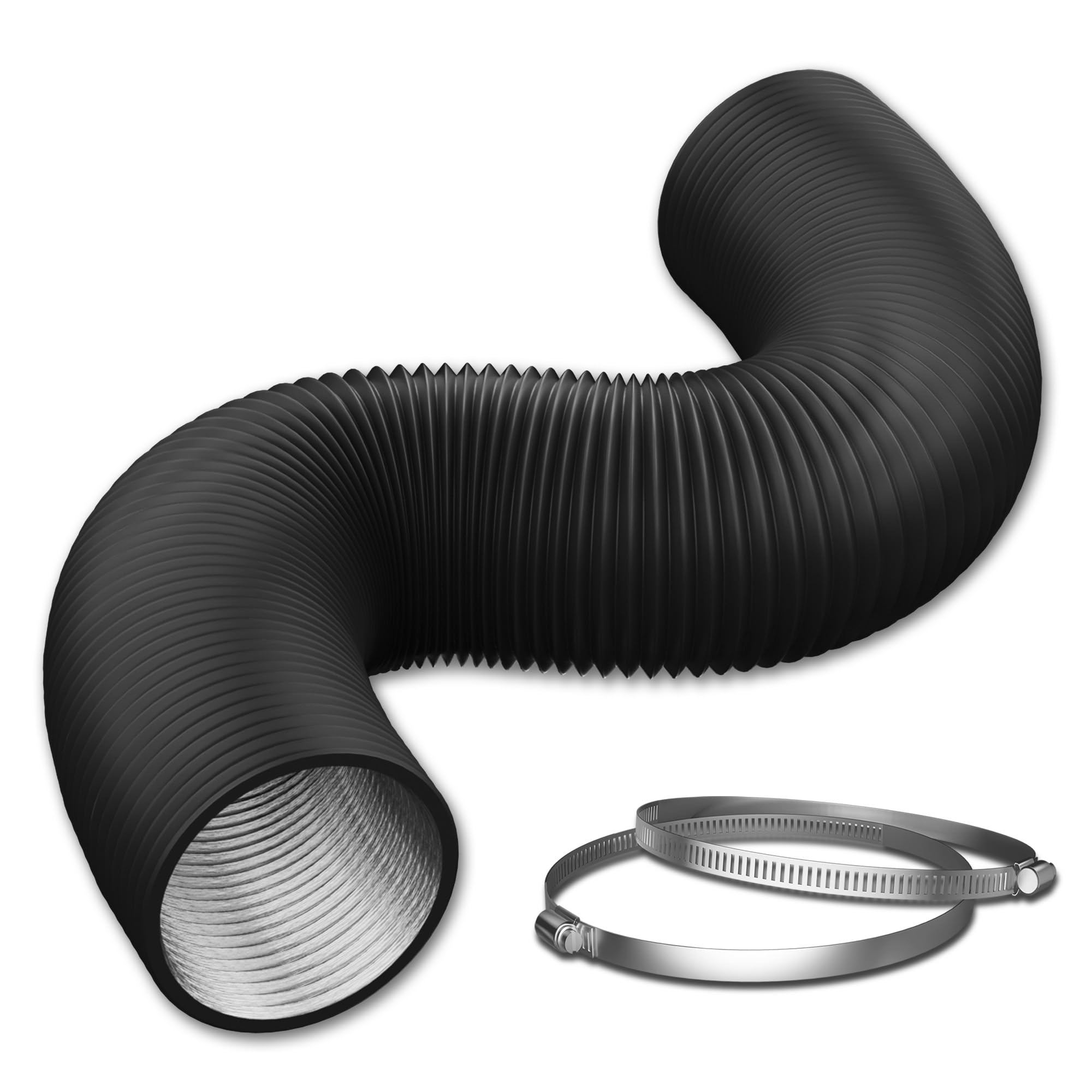
1. 14in PVC Flexible Duct Hose, 16FT Fan Ducting
Our pick — over 4.5★ from 100+ verified ratings; the strongest balance of quality and price.
A woven PVC hose built to survive a workshop floor, not a tidy closet shelf.
If your duct lives near sparks, grinding dust, or a moving intake you reposition by hand, this is the one to start with. The build is a woven vinyl polyester sleeve over a carbon wire spring, with a smooth inside wall so air moves without catching on ridges. That structure is why it handles abrasive jobs — and why it earns the top spot here as the crowd favorite at 4.7 stars across 100+ ratings, the strongest combination of score and volume in this lineup.
What wins people over is how overbuilt the thing feels in hand. The wall carries a wear strip for abrasion resistance, and the stated working range runs from -22° to 212°F (-30 to 100°C), which covers hot exhaust streams and cold garage mornings alike. Buyers report it held up well in a high-heat environment and connected easily with standard HVAC fittings, with no tearing or fraying after heavy use. Fume hood builders rigging welding and plasma cutting tables describe it as very heavy duty, with real attachment points at the ends to lock onto a frame.
Hanging it overhead is genuinely easy: a D-ring lets you hang it freely on walls or pillars, 3 load hooks keep it stable, and support clips along the sides let you run it along a ceiling. The adjustable expanded horn with thick PP rope (polypropylene rope, a strong synthetic cord) lets you cinch the mouth down to whatever the passage diameter actually is. One honest catch, and it is the same one that follows every 14 inch hose here: owners mention the end will not slide over 16 inch round duct adapters without cutting the ring on the one end. Plan for a trim, not a perfect slip-on.
What earns its keep
- Wear-strip reinforced PVC wall rated from -22° to 212°F (-30 to 100°C)
- D-ring plus 3 load hooks for stable ceiling or pillar hanging
- Adjustable PP rope horn seals against mismatched fitting sizes
- Handles abrasion-heavy work like welding and plasma fume extraction
The part to plan around
- Will not slip over a 16 inch round adapter without trimming the end ring
- Heavier and bulkier to store than a bare aluminum foil hose
Reach for this if: you are pulling fumes, dust, or smoke through a duct you will move, hang, and handle repeatedly.
Look elsewhere if: you need a featherweight foil run buried in a ceiling once and never touched again.
2. 14 Inch Flexible Ducting Hose 12 Feet Black Aluminum Ducting
A 12-foot black foil hose sized for the cramped furnace return run nobody wants to crawl into.
Twelve feet is the length that actually fits most furnace return retrofits, and that shorter span is the entire reason this hose belongs near the top. The wall stacks four layers — aluminum foil, PET, aluminum foil, then an outer black PVC skin — so it resists the pinholes and rips that finish off single-layer foil. Its stated tolerance runs from -22° to 302°F (-30 to 150°C), the widest high-end range in this group, which matters if your exhaust stream runs hotter than a standard dryer.
The thing everyone raves about is how easily it bends where you need it. It collapses down to save space compared with bulky insulated duct, which is exactly what a cramped basement or joist cavity demands. A furnace cold-air return install that would normally fight you can be a solo job here. Just note the honest catch that shows up in this listing’s own buyer feedback: the size can go wrong. Customers note receiving a 12 inch duct when the listing said 14 inch, and separately, that it will not fit over crimped 8 inch ducting at all. Measure your collar before you clamp.
Compare it directly with the FICBXRA hose above and the trade-off sharpens: this one runs 12 feet to that model’s 16, so the FICBXRA leads on reach while this fitting leads on a cooler-running install under 185 degrees. If you already have clamps and a short run, this is the smart money.
Where it earns its place: a four-layer, 302°F-rated foil wall in a 12-foot length that fits tight retrofits where longer duct simply will not route. For a furnace return or a compact vent job, that shorter span is a feature, not a limitation.
Best for: a short interior run where a longer hose would buckle and bunch.
Confirm first: your collar measures true to the stated diameter before clamping, since mislabeled sizes do turn up.
3. Flexible 14 Inch 16ft Aluminum Ducting
Sixteen feet of cut-to-fit four-layer foil with rustproof stainless clamps included.
Get the length right the first time and this is a straightforward buy: 16 feet of 14 inch diameter duct you can slice to whatever you need with a wire cutter and a paper knife. The four-layer wall — aluminum foil, PET, aluminum foil, outer black PVC — is built to keep the run free of rips and pin holes, and the included stainless steel clamps are rustproof and rated heavy duty. That combination makes the connection point, usually the weak spot on a cheap foil hose, the least of your worries.
Functionality is what this hose is known for. It bends to any angle, slides onto a duct fan, vent exhaust, carbon filter, or light reflector, and tightens with a screw so the joint holds. The most-appreciated trait here is simply that it works, and the construction backs that up. One recurring note: the diameter can run tighter than the number suggests. Reviewers point out the fit onto a steel 14 inch duct is genuinely difficult — eventually on, but slow and fiddly. Sliding this over a rigid collar with a helper is realistic; expecting a one-hand push is not.
Set against the HYITCL hose above, this one gives you roughly four more feet of working length and a cooler-safe 185-degree ceiling, while the HYITCL stretches higher on heat at 302°F. Pick by if you need reach or heat headroom.
Built for fixed connections: a 16-foot cuttable roll with stainless clamps, ideal where you want one continuous run and control over the finished length.
The snug-fit reality: budget extra install minutes on rigid steel collars — this hose prefers a blower lip and a tightening screw to a bare push-on fit.
Choose this when: you are running AC, a carbon filter, or a reflector line and want clamps included rather than sourced separately.
Pass if: your only connection is a tight rigid collar and you have no patience for a wrestling match.
4. 14IN 25FT Ducting Hose PVC Flexible Duct Hosing
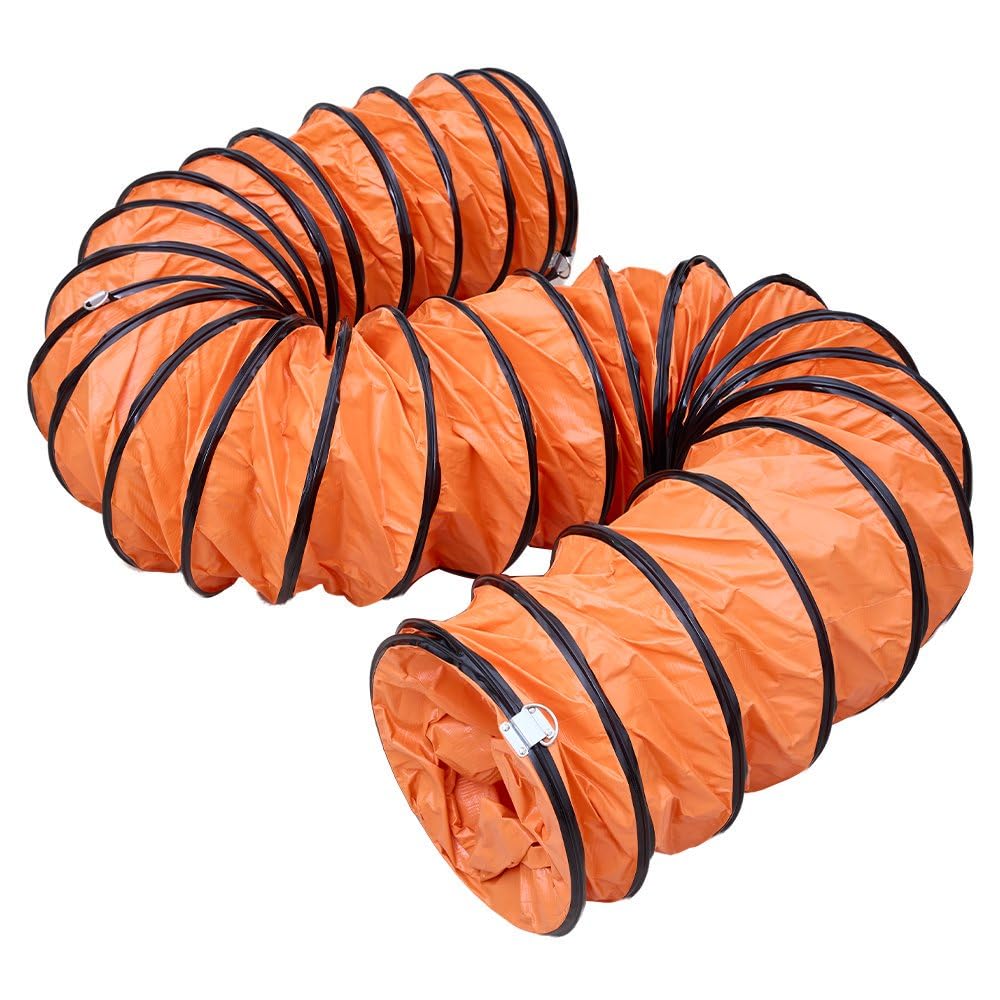
An orange PVC hose with D-rings that hang across a ceiling without rope pinching the wall shut.
The D-rings are the reason to look here. Thick adjustable ropes cinch the duct mouth to fit a range of passage sizes, and the D-shaped rings let you hang the run freely along a wall or ceiling beam. The knot here is that hanging a flexible duct with rope or straps wrapped around it can pinch it closed — the built-in rings sidestep that problem entirely. Material runs the same professional route as the FDTDUCT 16-foot hose: wear-resistant industrial adhesive tape over a thickened high-carbon wire spring, holding from -22° to 212°F (-30 to 100°C).
What the rigging setup open up is temporary-versus-permanent flexibility. There is a cinch connector for quick connections you will break down, and metal holding connectors for runs you want to keep. The orange color is a real benefit in a dim basement or a cluttered shop because you can see the run at a glance, and the vinyl wall resists tears when you drag it across a floor. The recurring gripe is the new-PVC scent — strong out of the bag, gone within hours once air starts moving through it.
Where this one earns its keep is length, and it is worth naming plainly: at 25 feet this hose carries roughly nine more feet than the 16-foot FICBXRA, enough to route a long workshop exhaust without splicing two shorter ducts together with a collar.
Why the rigging wins
- D-rings plus adjustable ropes hang the run without pinching it shut
- 25 feet of PVC weave, the longest span in this lineup
- Rated -22° to 212°F (-30 to 100°C) for hot and cold spaces
- Orange jacket stays visible in dark basements and busy shops
Worth knowing
- A strong new-PVC smell at first, though it fades within hours of airflow
- Bulky to store when you are not using the full 25 feet
The one to grab: when the duct has to hang and you want to reposition it without unrigging the whole run.
Think twice if: you need a bare foil hose you can fold flat into a drawer between jobs.
5. 16ft Ducting Hose 14in PVC Flexible Duct Hosing

A 16-foot vinyl-weave PVC hose that one working contractor called impressive for the money.
Trade-rated is the right framing for this one. The 16-foot, 14 inch body is a hard-wearing vinyl-woven polyester sleeve over a carbon wire spring with a smooth inside wall, rated from -22° to 212°F (-30 to 100°C). The detail that separates it from the pack is that it connects multiple ducts without a connecting collar — the adjustable rope at the mouth bridges straight to the fan lip. If you are chaining lengths or moving between fittings, that saves you a part and a step.
What people tend to say when they have used it on a real job is that the quality punches above what they expected. Shoppers say it is durable and does the job, and that a contractor found the quality impressive for the price. The reinforced tape and thickened wire spring stiffen the wall against collapsing under its own length, which is the failure that ends most cheap PVC hoses in a shop environment.
Compared with the Misriga 25-footer above, this one loses on reach but holds its own on the fitting side, since the collar-free connection is genuinely convenient when you are not running a permanent rig. For factory vents, basement fans, and farm exhaust, both land at the same temperature ceiling, so the choice really depends on length versus connection convenience.
The installer’s argument: a 16-foot PVC hose that joins to a blower lip without a separate collar, so one person can set up a vent run solo.
Suits: anyone who moves a duct between fittings often and wants fewer parts to lose.
Skip if: you need the extra reach of a 25-foot run for a single long permanent line.
6. Simple Deluxe 14 Inch 25 Feet Ducting
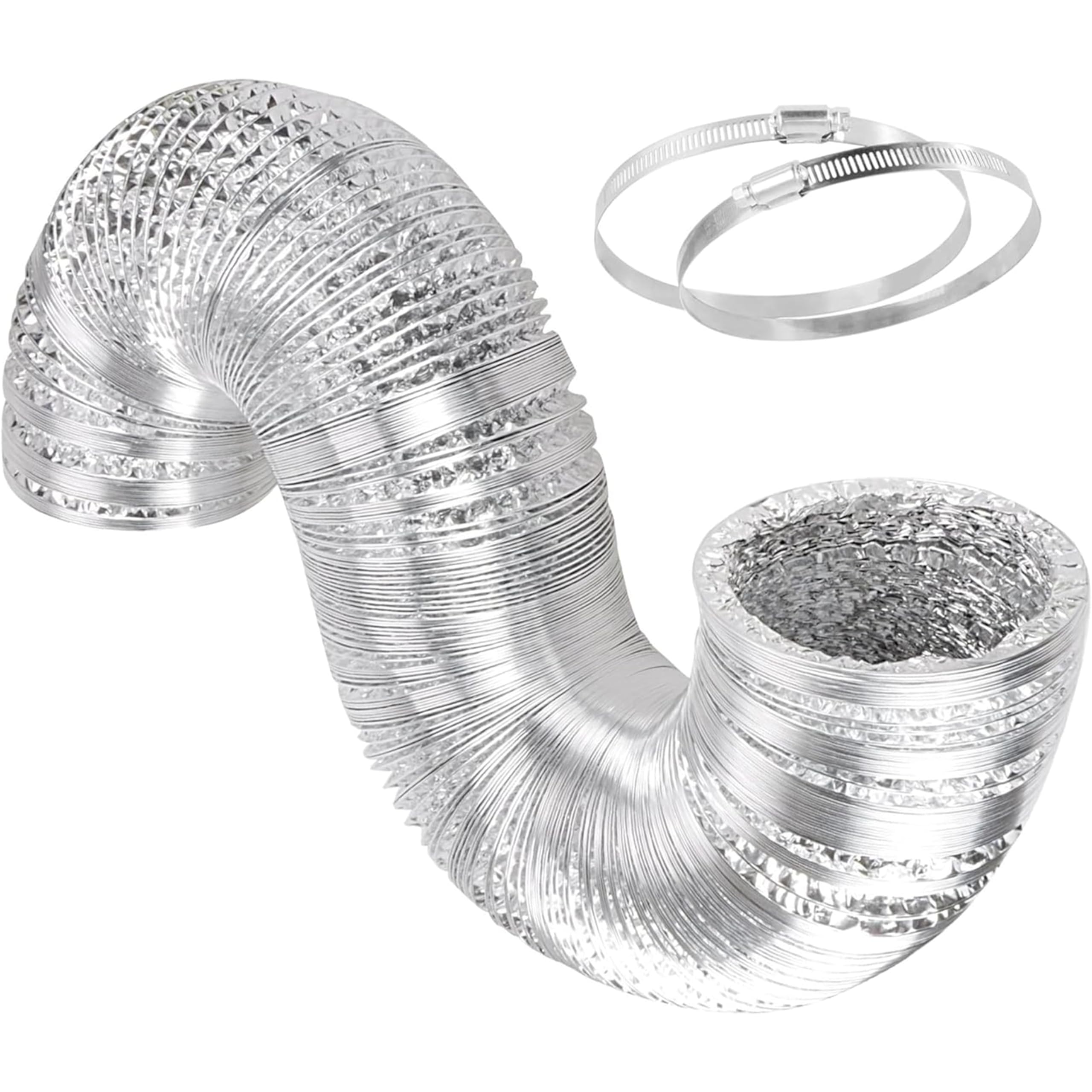
Twenty-five feet of four-layer silver foil for long, cool-air runs that just need to work.
Long runs are where this hose makes sense. Twenty-five feet of 14 inch duct in a four-layer build — flame-retardant aluminum foil inside and out over the multi-layer core — lets you reach across a basement, a loft, or a grow tent setup without splicing. It is rated for 0 to 185°F, so it is a fit for dryer venting and air circulation rather than a hot exhaust stream. Two clamps in the matching opening size come in the box, so the connection is a one-purchase job.
The flexibility is what keeps up with real routing: it bends around corners, collapses compactly, and holds its shape once you set it. What owners highlight is the thickness of the foil, which lands noticeably more substantial than a flimsy single-layer hose, and the included clamps save a trip to the hardware store. The recurring note runs the other way on durability — thin spots can tear at the connection if you are not careful sliding it on, so use vent tape and secure a few inches in from the end where the hose meets the collar.
Here is the direct contrast worth making: against the shorter aluminum FICBXRA above, this Simple Deluxe adds nine more feet and two included clamps, at the cost of a lower heat ceiling — 185°F versus the FICBXRA’s 302°F. If your air is comfortably cool, the extra reach and included clamps win.
Where it fits
- 25 feet of four-layer foil for long basement, loft, and tent runs
- Two matching clamps included in the box
- Collapses compactly and holds shape for neat routing
- Foils off tearing better than a single-layer hose at this length
Handle with care
- 185°F ceiling rules out hot exhaust, dryer venting only
- Thin spots can tear at the clamp if you pull too hard on install
- Mislabeled sizes have shown up, so check the stamp on arrival
Good match for: a long, cool-air duct run where you want clamps ready in the box and a full 25 feet of reach.
Not for: anything pushing past 185°F, where a higher-rated hose belongs instead.
7. GAF Master Flow 14″ X 25′ Insulated Flexible Duct with R6 Insulation

The attic run that keeps your conditioned air conditioned on the way through.
This is what you buy when the duct has to cross a hot attic, not a cool basement. The Master Flow hose carries R6 insulation, which the manufacturer states delivers 33% more insulation than standard R4.2 products — the difference between a run that bleeds conditioned air and one that arrives at the vent mostly intact. It is covered in a heavy-duty silver jacket for durability, meets the UL181 standard, and is ETL listed, so it clears the safety bar for permanent HVAC installation.
Coverage computes to roughly 350 square feet across a 14 inch by 25 foot run at R6 per inch of insulation (R6 is a measure of how well the insulation resists heat flow), and the weight — 23.3 pounds — tells you how much fiberglass blanket you are actually hauling up a ladder. Working with it is the trade-off: the fiberglass insulation tears and stretches easily, and the outer jacket can separate from the inner tubing if you get rough with it. The tip that makes the install smoother is to pre-cut and prefabricate your sections before you climb into the attic, so you are not wrestling the whole roll in a tight space.
Against the bare foil Simple Deluxe above, the whole point of this hose is the R6 blanket — the Simple Deluxe has none, and this one’s manufacturer rates it above standard R4.2. So if your duct crosses conditioned-to-unconditioned boundary, this is the more efficient install by design.
The insulated case: R6 insulation, a heavy-duty silver jacket, and ETL listing under UL181 — a real step up for a permanent attic or garage run that must not lose its cool.
The handling reality: fiberglass around the core is delicate. Pre-cut sections and cover the clamp with the outer sleeve, and it works cleanly.
Built for: a fixed HVAC run through an attic, crawlspace, or garage where insulation value changes your energy bill.
Overkill if: your hose stays inside conditioned space and never crosses a temperature boundary.
8. 14″ Inch Flexible Aluminum Ducting Hose Insulated R-6.0

The top-tier duct for a long, insulated trunk line you install once and forget.
If the run is permanent and the stakes are high, this is the ceiling of the group. The construction layers aluminum on the outside and inside for insulation value, then wraps a thick fiberglass blanket around an air-tight inner core rated at an R-value of 8.7 — the highest insulation figure in this lineup. That air-tight core also means no fiberglass erosion into the air stream, which matters if you care about what comes out of your vents, and the reinforced metallized polyester jacket is built to resist tearing and punctures.
Where this hose separates from the Master Flow above is the combination of insulation value and kink resistance: it is designed to hold bends and sharp turns without collapsing, and it stays air-tight across a 25-foot run at 14 inches. At 12.2 kilograms, it is the heavy build you would expect from a thick insulated hose, so plan your support points. Owners note it is easy to work with on long overhead runs, fits well for mobile home ductwork, and holds up as a sturdier option than smaller insulated hoses.
The honest cap on it is cost: this is the premium end of the range, and the extra insulation only pays you back if the duct crosses unconditioned space. Compared with the Master Flow’s R6, this hose steps up to an R-value of 8.7, so the gap is real — just make sure the job justifies it before you spend up.
Why it commands the top tier
- Air-tight inner core rated at an R-value of 8.7, the highest here
- No fiberglass erosion into the air stream
- Reinforced metallized polyester jacket resists tearing and punctures
- Holds bends and sharp turns without kinking over 25 feet
The trade-offs
- Heavy build demands proper support along a long ceiling run
- Premium insulation value only pays off if the duct crosses unconditioned space
Made for: a long, permanent, insulated HVAC trunk line where the highest R-value in the group is worth paying for.
Not the one to pick: for a short interior vent run or a temporary shop exhaust, where its insulation never gets to work.
Understanding the Specs
Diameter and fit
A 14 inch flexible duct measures the inner bore, but the wall thickness eats into the clearance where the hose meets a rigid collar. That gap is why the same diameter can slide easily onto a blower lip but fight you on a steel adapter. If you are connecting to rigid metal, expect to trim one end or add vent tape; if you are clamping to a fan mouth with an adjustable rope, a snugmer hose is easier to seal.
Layer count and material
Aluminum foil ducts stack multiple layers — foil, PET, foil, then an outer PVC skin — to resist the pinholes and tears that finish off single-layer hoses. PVC woven hoses use a polyester sleeve over a carbon wire spring and favor abrasion resistance, which is why they hold up in welding shops and dusty basements. Both work; the material choice follows the job.
Temperature range
Every hose here states a working range, and the low and high limits tell you where it belongs. PVC hoses typically cover -22° to 212°F (-30 to 100°C), while aluminum foil models stretch higher. Match the range to your stream: dryer venting sits cooler than a hot exhaust application, and picking a hose with headroom above your actual temperature keeps the wall from degrading.
R-value and insulation
R-value measures how well an insulated duct slows heat transfer through its wall — a higher number means a thicker fiberglass blanket. Bare foil has essentially none, so any run crossing a hot attic or cold garage loses conditioned air without it. Insulated hoses here range from R6 up to an R-value of 8.7; only pay for the higher rating if your duct actually crosses unconditioned space.
FAQ
Will a 14 inch flexible duct actually fit my 14 inch duct fan?
What wall temperature range do I need for dryer venting compared to welding exhaust?
Whats the difference between PVC and aluminum flexible duct?
Do I need R6 insulated duct or is bare foil good enough?
How do I stop a flexible duct from kinking or collapsing at a bend?
Can I cut a flexible duct shorter without ruining it?
How many clamps should I have for a 14 inch duct connection?
Why does my new PVC duct smell when I first use it?
Is insulated duct heavier to install on a ceiling run?
What does the UL181 listing mean on an insulated duct?
Final Thoughts: The Verdict
For most workshop and exhaust jobs, the 14 flexible duct winner is the 14in PVC Flexible Duct Hose, 16FT Fan Ducting because its wear-strip PVC wall tops the group on durability and it hangs cleanly with a D-ring, three load hooks, and an adjustable rope. If you want the longest reach for hanging a run, grab the 14IN 25FT Ducting Hose PVC Flexible Duct Hosing. And for insulation on a boundary-crossing attic run, the 14″ Inch Flexible Aluminum Ducting Hose Insulated R-6.0 is the one to reach for. With a 4.7 rating across more than a hundred buyers holding strong after heavy use, the top pick is the safest place to put your money.
How We Picked
We do not accept paid placement. Every pick is matched to a real buyer and a real use-case; we do not hands-on test units.
Sources & Methodology
Specifications: manufacturer listings and product documentation. Review insights: verified customer reviews, as of September 2026. Pricing: not shown on this page (it changes often); check the current price via the retailer link.
As an Amazon Associate, KitchPrep earns from qualifying purchases. This does not affect which products we feature.
Related Guides
