
Specs are compiled from manufacturer listings and verified buyer reviews and can change over time — please confirm the key details on the product page before buying.
Before you buy 14 gauge wire, answer one question: will the run go inside a wall, inside a car door, or under your lawn? The gauge is settled — 14 AWG (American Wire Gauge, a standard thickness measurement) is the 15-amp workhorse of household circuits and the flexible favorite for 12-volt automotive runs. What changes everything is the type of cable: solid copper NM-B (a non-metallic sheathed cable for permanent indoor wiring) for walls, stranded copper for speakers and landscape lights, and copper-clad aluminum (CCA, a thin copper skin over an aluminum core) for budget 12-volt projects where weight matters more than maximum conductivity.
I’m Mohammad Maruf — the founder and writer behind KitchPrep. This guide is built by comparing the manufacturers’ published specifications and the patterns across verified customer reviews, so you get each pick’s real strengths and trade-offs instead of marketing spin.
A shed outlet needs solid NM-B, a boat needs tinned marine cable, and landscape lights need a direct-burial jacket. This breakdown of the 14 awg wire options covers what each spool actually does well.
Our Picks at a Glance

How To Choose The Best 14 AWG Wire
Start by asking where the cable physically lives. A wall cavity, a boat bilge, and a garden bed each punish wire in a different way, and 14 AWG is only ever half the answer. The rest is jacket, conductor material, and conductor count.
Copper or CCA
Pure bare copper carries current with the least resistance, so it is the right call for permanent household wiring and any run you cannot easily reach again. Copper-clad aluminum puts a thin copper skin over an aluminum core. It is lighter, more flexible, and friendlier to the wallet, but it is not the same conductor — one owner of a CCA spool pointed out, “it’s copper-clad aluminum, not solid copper wire.” Pick CCA for short 12-volt runs; spend on copper for long ones.
Solid or stranded
Solid conductor means one thick metal core per wire. It holds its shape, pushes through wall cavities, and terminates cleanly under a screw on an outlet. Stranded means many thin wires twisted together, so the cable bends repeatedly without cracking. If the wire needs to survive constant flexing — inside a car door, around an amp rack, under a moving trailer — you want stranded.
Jacket type tells you the job
White NM-B sheathing (non-metallic, meaning a plastic outer jacket instead of metal conduit) belongs in dry indoor spaces. A marine jacket of tinned copper is built to shrug off salt and moisture. A direct-burial outdoor jacket is rated to sit in the dirt without conduit. Buying the wrong jacket for the environment is the most expensive mistake in this category.
Quick Comparison
| Model | Best For | Conductors | Length | Conductor Build | Amazon |
|---|---|---|---|---|---|
| InstallGear 14 Gauge Speaker Wire★ Best Overall | Car audio and speakers | 2 | 100 ft | Multi-strand CCA | Amazon |
| GEARit 14 Gauge Primary Wire PairBest for Long Runs | 12V power and ground runs | 2 | 200 ft total | Single-strand CCA | Amazon |
| Arizona Electrical Solutions 14/2 NM-BBest for House Wiring | Indoor outlet and switch runs | 3 | 25 ft | Solid copper | Amazon |
| NAOEVO 14 Gauge 2 Conductor Wire | Marine and automotive 12V | 2 | 30 ft | 41-strand tinned copper | Amazon |
| Energeaster 14/2 NMB Cable | Recessed and indoor branch circuits | 3 | 25 ft | Solid copper | Amazon |
| NOVINO 14 Gauge Marine Wire | Boat and harsh outdoor wiring | 2 | 100 ft total | Tinned stranded copper | Amazon |
| Lightkiwi 14/2 Landscape Wire | Direct-burial lighting | 2 | 100 ft | 41-strand bare copper | Amazon |
| BABOOM 14 Gauge Wire Combo 6 Pack | Multi-color 12V color-coding | 6 | 600 ft total | Single-strand CCA | Amazon |
In‑Depth Reviews
1. InstallGear 14 Gauge Speaker Wire 100 ft Cable, 14 AWG
Our pick — over 4.5★ from 29,000+ verified ratings; the strongest balance of quality and price.
100 feet of two-conductor speaker wire on one spool, enough for a full car audio install.
The InstallGear 14 Gauge is the crowd favorite of this whole roundup — 4.8 stars across 29,000-plus ratings — and the number that earns that spot is simple: 100 feet of two-conductor speaker wire on one spool. That is the length that disappears into a full car audio install with enough left over for a bench speaker project. Where the Arizona NM-B gives you 25 feet and a single room’s worth of cable, this roll keeps going.
What wins people over is the jacket. It is a soft-touch PVC sleeve, and the flexibility is what the install crowd talks about most — 462 buyers name it, and 588 call out how easy it is to work with. It bends around amp racks and door frames without fighting back, and the frosted blue and black conductors make polarity obvious at a glance. Get the positive and negative reversed and you can damage your audio gear, so that color split is doing real work.
The honest caveat is durability. The stranded CCA core (copper-clad aluminum, meaning a copper coating over an aluminum core) is not the same as solid copper, and the years of tabs on this product show a small split between owners who call it tough and those who say it breaks. That is the trade-off for the price and flexibility — great for cabin runs, less ideal for something you want to leave buried for a decade.
What earns the top spot
- 100 ft on a single spool — long runs without a second roll
- Soft-touch PVC jacket stays flexible for routing and low memory
- Two-color conductors make polarity unmistakable
The honest trade-off
- CCA strand, not solid copper — heavier flex stress can split it
Buy it if: You want one long, flexible, clearly marked speaker spool for cars, trucks, and home audio.
Look elsewhere if: You need permanent in-wall or underground power wire — that calls for solid copper.
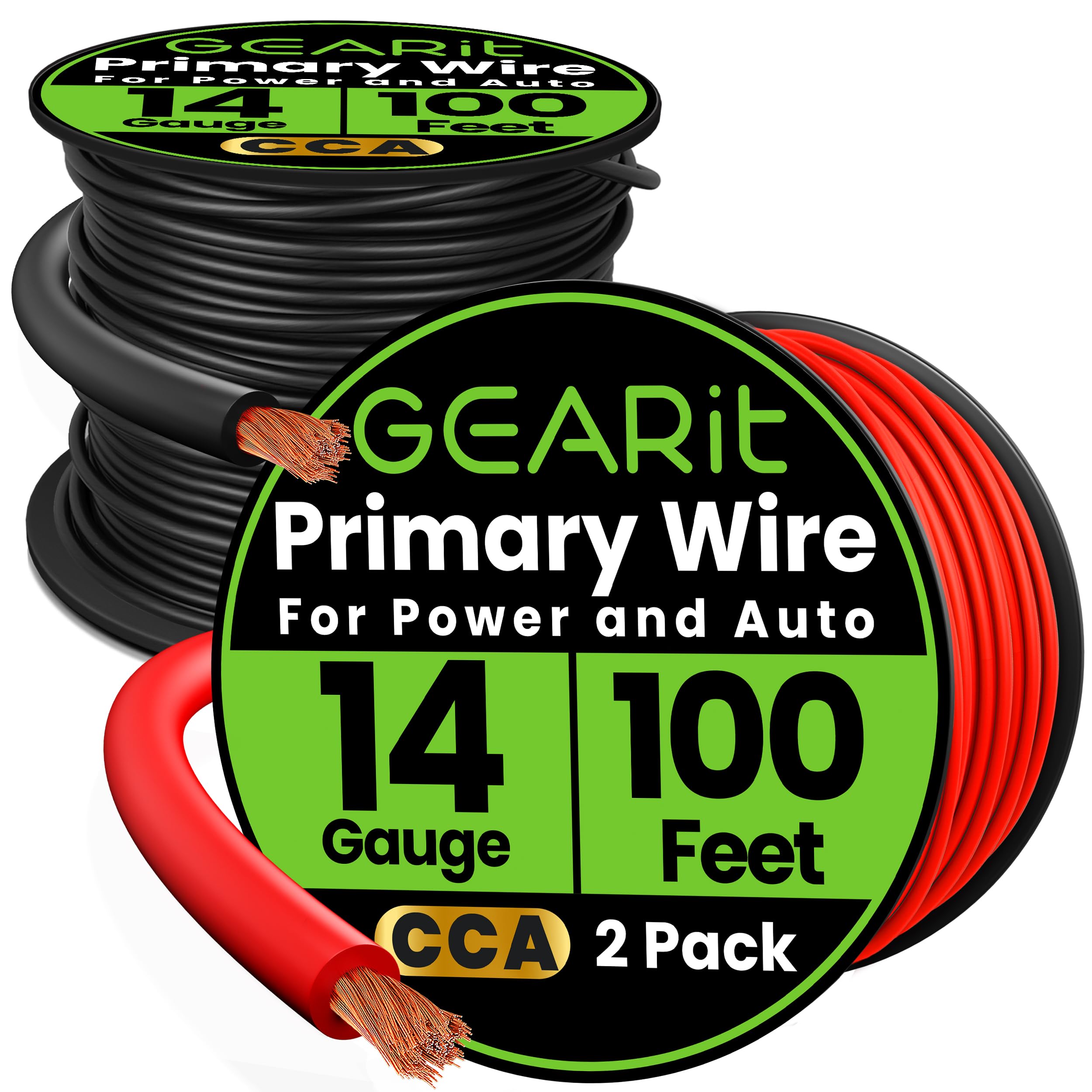
2. GEARit 14 Gauge Primary Wire CCA, 14 AWG Copper Clad Aluminum Power & Ground Battery Cable, 100 ft Each Black & Red Pair (200 ft Total)
100 feet of black and 100 feet of red, for pulling power and ground to the same spot.
If your project is long — think a trailer harness, a robotic mower boundary, or a whole amp circuit — the number that matters here is 200 feet. That is 100 feet of black and 100 feet of red in the box, and it beats the InstallGear above on total length while beating the Arizona roll several times over. For automotive, marine, and low-voltage work where you are pulling power and ground to the same place, having matching black and red on hand is the difference between a tidy install and a labelled mess.
The jacket is a durable PVC with a stranded CCA core, so it bends easily through dashboards, trunks, and amp racks. You lose a little conductivity compared to bare copper, but you gain flexibility and a much lower cost per foot. The blue and red color coding, paired with two spools, also means you can keep power, ground, and signal runs separated without a shop trip mid-job.
One thing to know before you order: the roll looks narrower in person than the listing photo suggests, and buyers have taken that photo on faith — “Assumes 100ft per roll (unverified)” as one put it. It is still rated as the wire to reach for on trailer and mower jobs, but budget for the smaller-looking spool if visual size matters to your expectations.
Fit-for-purpose: This is a 12-volt primary wire, so it is the right pick for cars, trailers, and mowers, and the wrong pick for fine in-wall household runs.
One small surprise: The physical roll is slimmer than the marketing image implies, which is worth knowing if you are planning storage around it.
Pick this if: You need matched black-and-red 12V wire by the hundred feet and value flexibility over maximum copper conductivity.
Check the specs if: Your job needs solid copper for a permanent building circuit — this is CCA and belongs in low-voltage work.
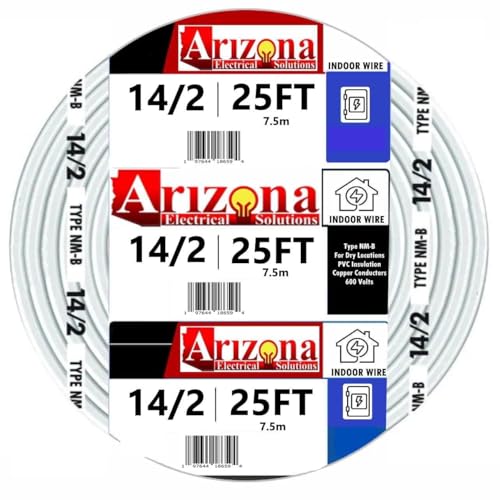
3. Arizona Electrical Solutions 25 Ft 14/2 NM-B Copper Wire, 14 AWG 2 Conductor with Ground, 600V White Non-Metallic Sheathed Cable
Solid copper 14/2 NM-B in a white sheath, the standard cable for indoor outlet and switch runs.
When the job is a real outlet or switch inside a wall, this is the cable to use — not the flexible stranded stuff at the top of the list. It is 14/2 NM-B, meaning two insulated 14 AWG conductors plus a bare copper ground, in the standard white non-metallic sheath. That bare ground is the third path to earth, and the 600-volt rating plus a 15-amp ceiling match what a standard residential branch circuit looks like. This is the wire that passes inspection for a light or an outlet because it was built for exactly that.
The middle conductor count is the standout: with two insulated conductors and a bare ground, that is 50% more conductors than a two-conductor speaker or primary wire gives you. Solid copper also means it will not corrode the way a CCA skin can, and it holds firm under a screw terminal. The flat sheath feeds through studs and joists reasonably well for a short 25-foot run, and it strips cleanly at boxes and panels.
The obvious limit is length. Twenty-five feet does one outlet, one switch, or one short circuit extension, and no more — you are not wiring a whole house off this roll. The upside is that you skip the cabinet-at-the-hardware-store routine: multiple buyers mention that they ordered it because it was easier than waiting for a locked wire aisle to be opened.
Where it wins
- Solid copper conductors with a proper bare ground
- 600-volt rating, 15A circuit match
- White NM-B sheath is the inspector-friendly standard
Where it stops
- Only 25 feet — one room’s worth of project, no remodels
Reach for this if: You are adding or replacing a residential outlet, switch, or short circuit and want solid copper NM-B.
skip it if: You are pulling wire across a whole floor — you will need several rolls.
4. NAOEVO 14 Gauge Wire 2 Conductor, 14 Gauge Automotive Wire 12V Cable, 30FT
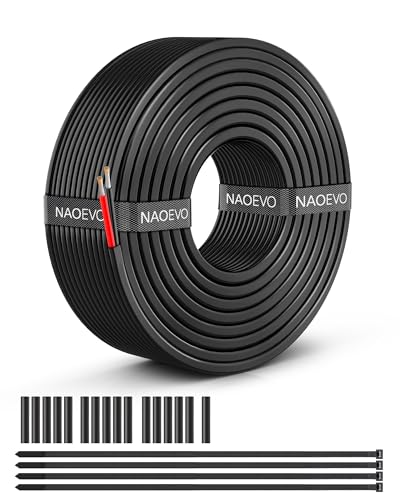
41 strands of tinned copper per conductor, rated IP68 for under-hood and wet outdoor runs.
Most cheap wire is bare copper-clad aluminum, and bare copper corrodes when it meets moisture. This NAOEVO spool takes the opposite route: 41 strands of tinned copper inside each of its two conductors, with tinned meaning a thin tin coating over each strand that fights corrosion. The count is the number to hold onto — 41 strands is a fine-gauge, very flexible bundle, and that tinning is why it is rated IP68 (the top grade in the IP waterproofing scale, meaning it is sealed against dust and protected against long immersion).
The rest of the spec sheet reads like it means business. Each conductor is 3.5 mm outside diameter, rated to 600V, and the working temperature range runs from a claimed -22°F up to 221°F. It ships with 16 heat-shrink tubes and 4 cable ties, which is the kind of inclusion that saves a separate order mid-install. The flat, pliable profile also slides through odd spaces that round cable fights, and the conductors are clearly marked red and black so you will not cross polarity.
This is not the pick if you want hundreds of feet for cheap — 30 feet is a workshop-sized run, and it costs more per foot than the CCA rolls above. What you get in return is corrosion resistance and a durable, pliable PVC insulation that makes it a natural fit for under-hood and low-voltage outdoor jobs.
what separates it: Tinned copper plus an IP68 jacket is a combination the cheaper CCA rolls simply do not attempt.
The trade: 30 feet is a short run, and you pay a premium per foot for the tinned build.
Best suited to: Marine, RV, and exposed automotive wiring where corrosion is the enemy.
Not the one for: High-volume 12V harness work where you need hundreds of budget feet.
5. Energeaster Solid Indoor 14/2 W/G NMB Cable 25ft, Electrical Wire, White

Solid copper 14/2 NM-B at a budget price, though the outer sheath is hard to strip.
Here is the parallel pick to the Arizona cable: solid 14/2 NM-B, 25 feet, 600 volts, and one bare ground runner. If you are comparing the two, they are almost twins — the difference is price. This Energeaster spool is the budget choice in this match-up, and for a short outlet or light run it is functionally the same job.
What is different is inside the jacket. The ground wire here is wrapped in fire-retardant paper and laid parallel to the two insulated conductors, black and white, with the white outer jacket standard for 14 gauge. It is also rated for the air voids inside masonry block or tile walls, as long as those cavities stay dry. Where bare copper is exposed at a box, that paper wrap is an extra layer to think about during terminations.
The single recurring gripe is stripping. A fresh utility knife and a careful score line make it manageable, but if you are doing a long box-filled run, the screwdriver-and-nail method is not the move here. Everything else — cutting, installing, bending into stud bays — is standard solid copper behavior.
Why it is the value pick
- Solid copper 14/2 NM-B at a budget price point
- Fire-retardant paper wrap on the ground conductor
- 600V rated and dry-location indoor applications
The one to plan for
- The outer sheathing can be genuinely hard to strip — score carefully
The budget call: Anyone wiring a shed outlet or replacing an indoor switch run who wants to save versus the big-box rolls.
Go premium if: You value a sheath that strips as easily as it cuts — the bulk reels tend to spoil you here.
6. 14 Gauge Marine Wire 14 AWG Marine Grade Wire, 14 Gauge 50FT Red & 50FT Black
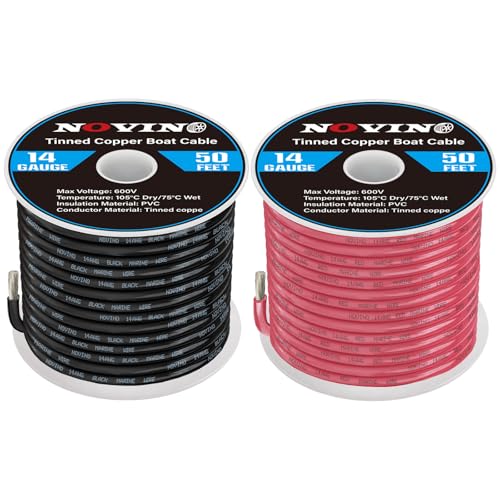
50 feet of red and 50 feet of black tinned copper, rated to UL 1426, SAE, and ABYC marine standards.
For a boat, “wire is wire” is the wrong assumption, and this spool is the reason. It is tinned stranded copper from end to end, so every strand inside carries a rust-resistant coating against the salt and moisture a bare copper spool would fight. The insulation is rated 105 degrees C dry and 75 degrees C wet, and the whole build is described as meeting UL 1426, SAE, and ABYC marine standards — the codes boat builders actually reference for abrasion, heat-shock, and open-flame resistance.
What you get for your money is 50 feet of red plus 50 feet of black, split into two clearly-sheaved rolls for polarity clarity. The intended jobs read like a marine electrician’s list: bilge pumps, navigation and underwater lighting, solar inverter leads, shore power, and trailer harnesses. On a boat, the failure mode you are trying to avoid is a bare-copper run corroding to a dead circuit mid-season, and the tinning here is the direct answer to that.
Two things are worth naming. First, 14 AWG marine wire is not a monster gauge — this is fine for signal, lighting, and low-draw circuits, but not for a heavy starter or high-amperage winch feed. Second, the price per foot sits above the cheap CCA options, which is the honest cost of tinned copper. The people who buy this generally are not shopping on price — they are shopping on the assumption that the boat is going to stay in the water.
Best-at: Tinned copper in a salt-rated jacket is the strongest corrosion story in this roundup.
Worth knowing: 14 AWG suits low-draw marine and trailer circuits, not high-amperage feeds.
The smart buy: Boat, RV, and camper owners who want wire that plans to survive the water.
Wrong pick if: You need the absolute cheapest feet for a dry, low-stakes 12V job.
7. Lightkiwi 14/2 Landscape Wire 100ft Pure Copper Direct Burial ETL Listed
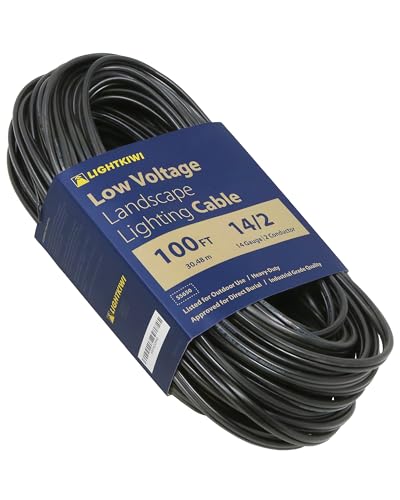
100% bare copper in a direct-burial jacket, ETL listed for landscape lighting runs.
Here the pitch is simple: 100% bare copper, 14 AWG, 100 feet, and a jacket rated for direct burial — meaning you can put it straight in the dirt without running conduit. This is a 41-strand stranded construction, so it is flexible enough to snake around trees, beds, and deck posts, and stranded bare copper does not corrode the way a copper-clad aluminum core can. For a landscape wiring project, the jacket is the whole story: it resists sunlight, moisture, dirt, and weather, so it also handles above-ground runs to a spotlight or a porch fixture.
What the buyer crowd talks about most is the conductivity and the value — plenty of owners note that this copper plays in the same league as the big-box landscape cable, only cheaper per foot and without a store run. Reviews also flag the practical uses: LED spotlights, path lights, in-ground well lights, hardscape runs, and top-lit trees. The ETL listing (an independent North American electrical-safety certification) is extra reassurance if you are the type to check for a safety mark before burying anything in your yard.
Two caveats. First, 14/2 landscape wire is a low-voltage product (typically a 12-volt system), so it is not the cable for a 120-volt deck circuit or a hardwired outlet. Second, a small number of reviews note the copper runs stiff — rigidity shows up as a mild complaint. That stiffness is often read as “thick” and reliable, but if you are doing a tight, twisty run, it will feel less eager than a softer jacket.
Why landscape owners buy it
- 100% bare copper conductors — not a CCA-skin shortcut
- Direct-burial rated jacket survives dirt, sun, and wet seasons
- ETL listed for safety reassurance
Consider before you order
- Stiff stranded copper can fight tight turns in the trench
The right pick for: Backyard LED lighting, path lights, and any run you want to bury and forget.
Not this one for: Any 120-volt household circuit — that needs indoor NM-B, not low-voltage cable.
8. 14 Gauge Wire Combo 6 Pack (600ft Total) 100ft Per Roll, 12V Low Voltage Automotive and Electrical Cable, Copper Clad Aluminum (CCA)

Six colors, six hundred feet, one job site that never wants to stop.
The headline number here is 600 feet — six rolls of 100 feet each, in black, blue, green, red, white, and yellow. For anyone tracing a tangle of circuits through a project, that color spread is a functional tool: keep each circuit or leg on its own color and the wiring diagram becomes self-explanatory. The jacket is PVC, the conductors are stranded copper-clad aluminum, and each roll is rated for 6 to 80 volts inside a working range up to 158 degrees F. That covers most automotive and home 12-volt projects.
Buyers report the wire quality and value are the reasons to consider a six-pack — the natural applications here are rewiring a classic car, adding accessory circuits, and home-theatre or automotive runs. The flexibility is real: stranded CCA is lighter and easier to route than solid copper, so tight harnesses and dashboards go faster. It also saves a bundle versus buying six comparable single-roll spools separately.
The one warning is right in the listing title. This is listed as CCA and not American 14 AWG wire, so it is not the standard for a code-governed building circuit. The trade is honest: you get lots of feet and lots of colors for a modest price, but you sacrifice the copper purity and corrosion resistance of the marine or landscape cable. Buyers of this box know what they are getting into, and it is the right call for hobbyist work where the cable is easy to replace later.
What it’s built for: High-volume, multi-circuit 12V hobbyist wiring where color-coding saves you a headache.
The honest catch: CCA is not solid copper, and the product page says so plainly — skip it for permanent building circuits.
Worth it for: Automotive restorers and home-theatre builders who want cheap feet and a full color set.
Not it if: You need pure copper for a buried or marine run that has to survive corrosion.
Understanding the Specs
Gauge and Amp Rating
Gauge is a reverse scale: 14 AWG sits above 12 AWG in number but below it in thickness, and the relationship flips because the number measures how many draw-throughs it took to make the metal. Fourteen gauge handles a standard 15-amp household branch circuit and is the most common gauge for indoor outlets and switches. Thicker wire (lower gauge) carries more current over longer runs with less voltage drop. If your run stretches past the length the manufacturer lists for 14 AWG, or the amp draw is above 15 A, step up to a heavier gauge.
Conductor Build and Jacket Type
Solid conductors are one heavy core per wire; stranded conductors bundle many thin wires and flex with the cable. CCA (copper-clad aluminum) has a copper skin over an aluminum core, which is lighter and cheaper but lower in conductivity than pure copper. Jacket ratings tell you where the cable can live: NM-B (non-metallic) is indoor dry-location; directional-burial jackets go into the ground without conduit; marine-rated jackets resist salt and moisture. Match the jacket to the environment, then match the conductor to your budget.
FAQ
Can I use 14 AWG wire for a 20-amp circuit?
What is the difference between CCA and copper 14 AWG wire?
How far can I run 14 AWG wire before voltage drop matters?
Is 14 AWG speaker wire better than 16 AWG?
Can I bury 14 AWG wire underground?
Do I need tinned copper wire for a boat?
Is 14 AWG wire the right pick for automotive 12-volt work?
Can I run 14 AWG wire through walls?
How many conductors does 14/2 wire have?
What temperature range can 14 AWG wire handle?
Final Thoughts: The Verdict
For most people searching the 14 awg wire shelves, the answer is the InstallGear 14 Gauge Speaker Wire — a full 100-foot spool, 4.8 stars across tens of thousands of ratings, and the flexibility and polarity markings that make a real car-audio or home-theatre install go smoothly. If your project is a permanent outlet in a wall, grab the Arizona Electrical Solutions 14/2 NM-B for its solid copper and 25-foot inspector-friendly run. And for landscape lighting, the buried-rated Lightkiwi 14/2 Landscape Wire is the roll to reach for. One nudge from the data: the InstallGear spool already carries hundreds more reviews than any other pick here at the same 4.8-star level, so it is the easiest wire in this group to feel good about ordering first.
How We Picked
We do not accept paid placement. Every pick is matched to a real buyer and a real use-case; we do not hands-on test units.
Sources & Methodology
Specifications: manufacturer listings and product documentation. Review insights: verified customer reviews, as of September 2026. Pricing: not shown on this page (it changes often); check the current price via the retailer link.
As an Amazon Associate, KitchPrep earns from qualifying purchases. This does not affect which products we feature.
Related Guides
