
Specs are compiled from manufacturer listings and verified buyer reviews and can change over time — please confirm the key details on the product page before buying.
A NEMA 14-50 adapter converts a 50-amp outlet to fit your RV, welder, or tools. Whether you’re parking an RV at a campground pedestal, plugging a welder into a garage outlet, or trying to run household tools off a generator, the right adapter prevents breaker trips and keeps power flowing smoothly.. Matching plug shape, amperage, and wire gauge to your equipment prevents overheating and power starvation.
I’m Mohammad Maruf — the founder and writer behind KitchPrep. This guide is built by comparing the manufacturers’ published specifications and the patterns across verified customer reviews, so you get each pick’s real strengths and trade-offs instead of marketing spin.
When you need to safely power an RV, welder, or EV charger from a single source, choosing the right 14-50 adapter is the difference between reliable performance and constant breaker trips in the garage or on the road.
Our Picks at a Glance

How To Choose The Best 14-50 Adapter
Every 14-50 adapter changes the plug shape to match your device’s receptacle. Wrong plug shape or wire gauge risks fire or breaker trips. Before you buy, check three things on your own equipment.
Match the plug geometry first
The NEMA 14-50P is a 4-prong, 50-amp plug rated for 125/250 volts. If your source is an RV pedestal or a modern EV charger outlet, that’s the shape you’ll see. But if your generator only puts out a 30-amp twist-lock connection, you need an adapter with a different male end, like the L14-30P, to step down to your 50-amp RV cord. Buyers report success running a “50 amp camper off the generator” using such a bridge, so know what your power source looks like before you order.
Check the wire gauge for the load
You avoid overheating and tripping breakers when you pick a thicker cord. A 10 AWG (American Wire Gauge, a standard measure of wire thickness) cord handles most RV and household gear, but welder-specific adapters step up to 8 AWG or even 6 AWG to manage the steady pull of a welding machine without heat buildup. If you run a big tool or charger, do not choose the thinnest cord just to save a few dollars—it can overheat under load.
Know what you’re plugging in
Some 14-50 adapters split one 50-amp outlet into multiple 120-volt household receptacles. That’s perfect for running portable AC units or power tools at a campsite. Others convert to a NEMA 6-50R for welders, which is a completely different 3-prong 250-volt shape. Choose the adapter that ends in the receptacle your device actually needs.
Quick Comparison
| Model | Best For | Connector Type | Wire Gauge | Item Length | Amazon |
|---|---|---|---|---|---|
| CircleCord 30A to 50A★ Best Overall | Generator to RV | L14-30P to 14-50R | 10 AWG | 12 inches | Amazon |
| S7 50A to 110VTop Performer | EV outlet to tools | 14-50P to 4X 5-20R | 10 AWG | 20 inches | Amazon |
| M1A2 50A to 110VWorkhorse Pick | Heavy household loads | 14-50P to 4X 5-20R | 10 AWG | 18 inches | Amazon |
| Rophor 50A to 20A | RV campsite power | 14-50P to 4X 5-20R | 10 AWG | 1.5 feet | Amazon |
| Cleyean Welder Adapter | Welder hookup | 14-50P to 6-50R | 8 AWG | 18 inches | Amazon |
| Suplevel Welder Adapter | High-output welders | 14-50P to 6-50R | 6 AWG | 12 inches | Amazon |
| M1A2 Heavy-Duty Welder | Shop-grade durability | 14-50P to 6-50R | 6 AWG | 12 inches | Amazon |
| MECMO Distribution | Multi-outlet distribution | 14-50P to 4X 5-20R | — | 18 inches | Amazon |
| CircleCord Surge Protector | Campground protection | TT-30P to 14-50R | 10 AWG | 12 inches | Amazon |
In‑Depth Reviews
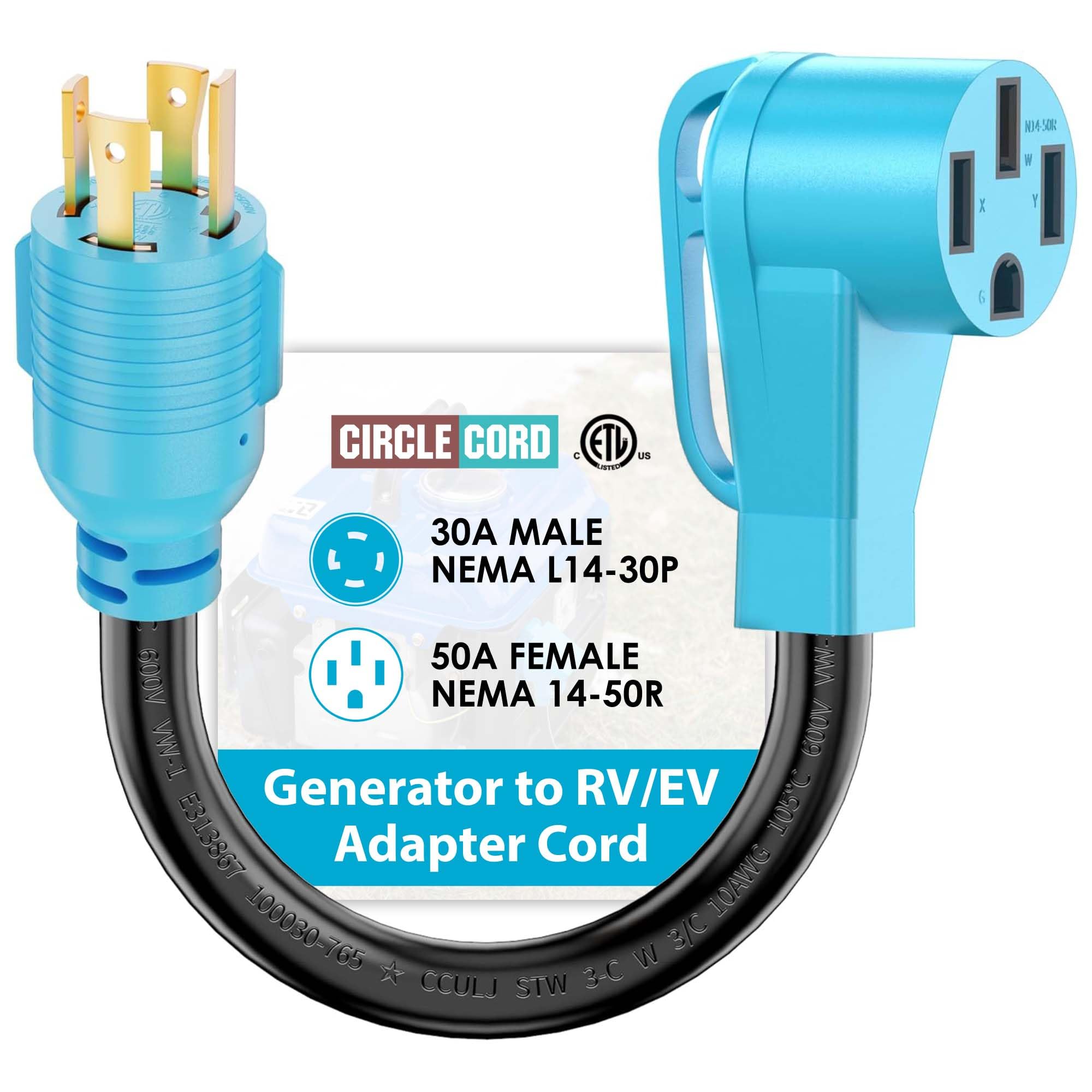
1. CircleCord 4 Prong 30 Amp to 50 Amp Generator to RV/EV Adapter Cord
Our pick — over 4.5★ from 500+ verified ratings; the strongest balance of quality and price.
The dependable bridge that feeds a 50-amp RV from a portable 30-amp generator without drama.
If you camp with a generator that only offers a 30-amp twist-lock outlet, this CircleCord is the piece that makes your 50-amp rig light up. It pairs a 30 Amp L14-30P locking male plug with a 50 Amp 14-50R female receptacle, so the hookup is secure on both ends. Owners mention exactly what you hope for: “Perfect was able to run 50 amp camper off the generator.”
The build quality is what earns the top spot here. It uses 10-gauge copper wiring wrapped in a heavy-duty, flame-retardant, UV-resistant STW jacket rated to UL 62 standards, with the molded plug meeting UL 817. That means it’s built for indoor and outdoor use and shrugs off sun and weather. The ergonomic grip handle on the female end makes unplugging from a tight RV inlet far less of a knuckle-scraper, and the blue jacket stands out instantly in a tote full of black cords. It weighs 1.2 pounds and runs 12 inches, so it stays close to the connection instead of dangling.
What wins people over is consistent quality—far more owners praise the construction than any other single trait. It’s a simple, well-executed conversion with no electronics to fail. The only real note is that a 30-amp source limits you to 30 amps of draw, so you can’t run every 50-amp appliance at once; it’s about convenience, not adding capacity.
What earns the praise
- Molded 30A L14-30P to 14-50R conversion fits generators and RVs cleanly.
- 10 AWG copper with flame-retardant, UV-resistant jacket handles outdoor life.
- Ergonomic grip handle and bright blue color make hookups easy.
Worth knowing
- A 30-amp feed caps total power—large simultaneous 50A loads aren’t possible.
Reach for this if: you own a 50-amp RV and rely on a 30-amp generator when boondocking.
Look elsewhere if: you need to split a 14-50 outlet into multiple household plugs rather than feed one RV.
2. S7 50 Amp to 110 Adapter, 240V to 120V Adapter, 4 Prong NEMA 14-50P Male to 4X 5-20R Household Outlet Female 1.8FT
Turns one 50-amp garage outlet into four 120-volt workhorse plugs for tools and chargers.
If you have a 50-amp outlet in your garage for an EV charger but mostly need standard 120V power, this S7 adapter is the practical open up. It converts a NEMA 14-50P receptacle into four 5-15/20R outlets, giving you a mini power distribution center. That 20-inch length makes it noticeably easier to reach than the shorter 12-inch adapters on this list, which is handy when your outlet sits high on the wall.
The key spec here is the wiring: four 10 AWG pure copper cores rated for 105 °C, which keeps voltage drop minimal under heavy loads. It’s wrapped in a bright orange 600V STW jacket that resists abrasion, oil, moisture, and UV, so it’s happy on a job site or in a damp garage. Customers note a common story: a pressure washer kept tripping the GFCI outlet, but “no more tripped breakers” once they ran it through this adapter on the 40-amp EV outlet.
Functionality is the trait owners praise most, followed closely by build quality, and many call it a fair value. The one area that draws mixed feedback is power distribution—a rare report of one leg outputting only 50 to 60 volts shows why you should test each outlet with a meter if you’re running sensitive gear. A few also note the little outlet covers can be stubborn, though that’s a minor nuisance, not a safety issue.
The strong points
- 10 AWG copper cores rated for 105 °C handle continuous heavy draw.
- Four grounded outlets give real flexibility from one 14-50 source.
- Rugged orange STW jacket shrugs off outdoor and garage abuse.
The trade-offs
- Rare reports of uneven voltage across one leg—test outlets first for sensitive tools.
- Dust covers can be finicky to keep seated.
Best for: homeowners with a 50-amp EV or welder outlet who want to run pressure washers, saws, and other 120V gear without tripping breakers.
skip it if: you only ever need one outlet—a simpler single-port adapter would be cheaper and smaller.
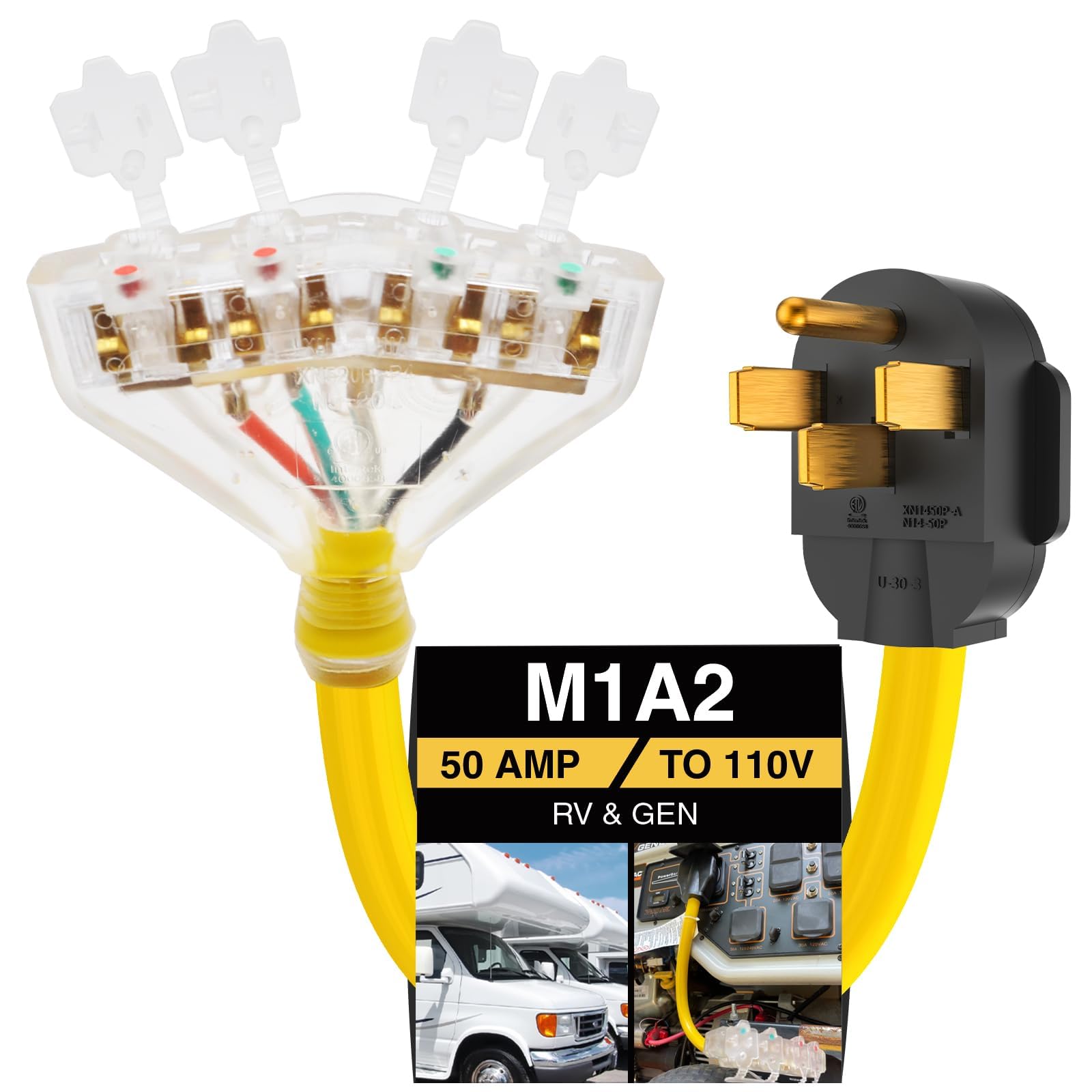
3. 50 Amp to 110 Adapter NEMA 14-50P to 4X 5-20R Household with Dust Caps
A UL-listed splitter that proved itself running two window AC units for hours straight.
This M1A2 adapter is the answer when you need serious 120-volt power from a 50-amp source. It takes a 4-prong NEMA 14-50P plug and splits it into four 5-20R T-blade household outlets, carrying a 10-gauge build rated for 125V with a max of 3750 watts. Being UL Listed means an independent lab verified the construction, which is a meaningful checkpoint for a device that carries live current.
The real-world proof is in the reviews. Reviewers point out running two portable AC units in a garage—a 10000 BTU and a 14000 BTU—for over 10 hours without a hiccup. Another owner notes the plug “has held up great” after a few years of use, and RV dwellers call it a must-have for converting an unused electric car port into useful outlets. Functionality is the most-praised aspect, with quality close behind and durability getting strong mentions too.
It’s an 18-inch cord, which gives a little more reach than some foot-long rivals. The molded plug and 5-15/20R receptacles come with dust protection caps, and an ergonomic handle helps you grip when unplugging from a tight RV inlet. The 12-month money-back and 24-month quality warranty adds a layer of confidence for a cord that lives outdoors.
Built for endurance: all-copper 10-gauge wire in a flame-resistant jacket plus a UL listing backs up the “runs ACs for 10+ hours” stories.
Choose it if: you need dependable multi-outlet power for big portable appliances or RV living.
Think twice if: you’re feeding only small electronics—the 10-gauge build is heavier than that job requires.
4. Rophor 50 amp to 110 Adapter RV 50 Amp to 20A Adapter Cord, 4 Prong NEMA 14-50P Male to 4X 5-20R Household Outlet Female with Dust Protection Caps, 1.5 FT

The campsite favorite that lets you plug extension cords straight into the pedestal, not the RV.
RV travelers love this adapter for a specific reason: it lets you tap power directly at the pedestal and run multiple extension cords without pulling through your RV’s own electrical system. That means you can power outdoor lights, a griddle, or tools without tripping the breaker inside the coach. The Rophor uses a NEMA 14-50P male plug feeding four 5-20R T-blade household outlets over 1.5 feet of cord.
This adapter stops the campground breaker from tripping every time you plug in. Shoppers say that before this cord, they kept tripping the power box breaker—one reviewer notes, “once we got this we have not had any issues.” It handles up to a 30 Amp overload, rated at 125V with a maximum of 3750 watts. Owners most often praise its build quality, with value for money and versatility mentioned next.
The build leans on 10 AWG all-copper wires with a 600-volt thermoplastic STW jacket that resists abrasion, oil, and moisture. Clear end receptacles with dust caps keep the contacts clean when parked. Rophor backs it with a 5-year maintenance promise, which is a strong vote of confidence at this price point.
Reliability read: quality is the top-mentioned trait, and the breaker-trip stories that disappear after install are the strongest real-world signal.
Grab it if: you camp often and want clean, trip-free power for multiple cords at the pedestal.
Pass if: you need a longer reach—1.5 feet keeps you close to the outlet box.
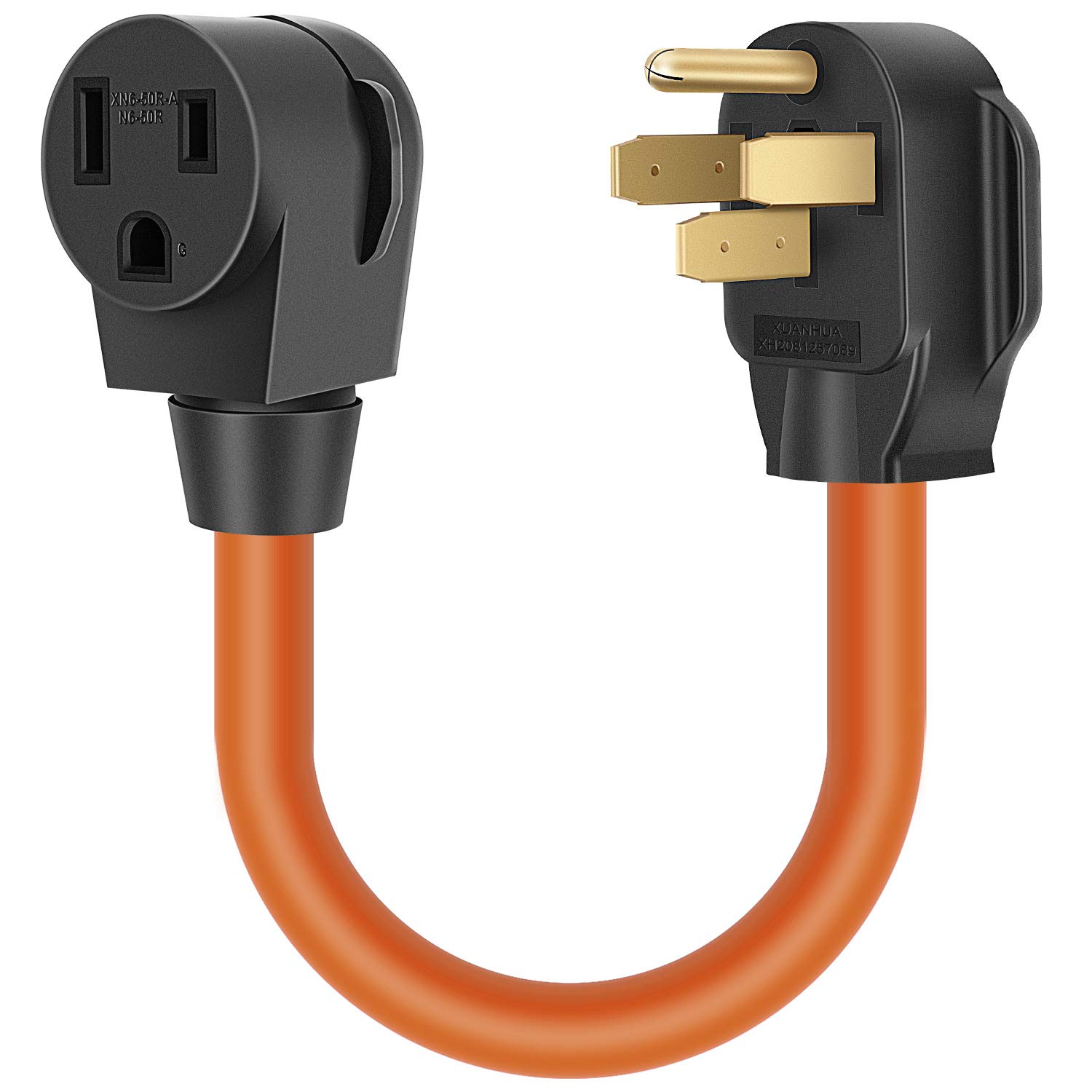
5. Nema 14-50P to 6-50R Welder Adapter Cord, Welder Plug Outlet Adapter Power Cord Heavy Duty STW 8AWG, 50Amp, 250V, 1.5FT
Solves the classic mismatch: a 14-50 RV outlet trying to power a 6-50 welder plug.
When your welder’s plug doesn’t match the power outlet on your wall or generator, this Cleyean adapter is the fix. It connects a NEMA 14-50P male plug to a NEMA 6-50R female socket, both rated at 50 Amp and 250V with a max of 12500 watts. That 1.5-foot length keeps the adapter tidy at the connection point without a heavy cord flopping around.
The standout spec here is the 8 AWG wire gauge—thicker than the 10 AWG found on general RV splitters, which matters when a welder draws sustained current. The heavy-duty 8 AWG/3 cord uses a 600V STW standard jacket that’s fire-retardant, wrapped around 100% copper wire. Both ends are right-angle molded connectors, which helps keep the cord profile low against the wall or generator face.
Buyers report using it regularly with Lincoln wire-feed MIG and TIG welders with no issues, and durability gets frequent praise. One note: some buyers wish the prong orientation were flipped, which can matter if your outlet is mounted in a particular direction. It’s a minor ergonomic quirk, not a functional problem.
Why it works
- 8 AWG copper handles the continuous draw of MIG and TIG welders.
- Right-angle molded ends keep the profile low and strain off the plug.
- Rated 50A/250V up to 12500 watts—plenty of headroom.
The small stuff
- Prong orientation may not suit every outlet mounting direction.
Buy it for: a straightforward, no-frills hookup between a 14-50 source and any 6-50 welder.
Move up if: you run a high-amperage machine all day—a 6 AWG cord adds more thermal margin.
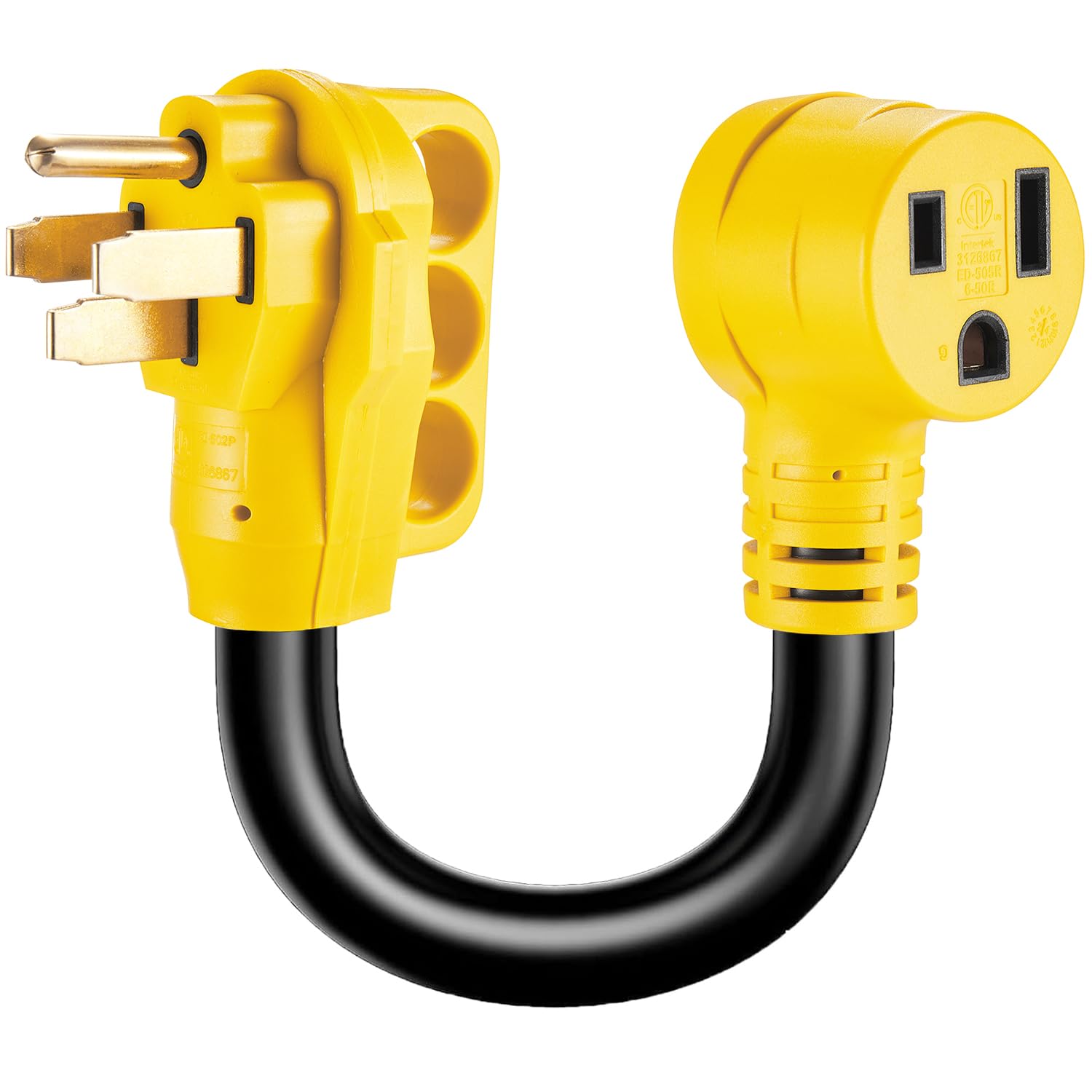
6. 50 Amp Welder Adapter Cord NEMA 14-50P to 6-50R, STW 6 AWG/3C
The 6 AWG upgrade that solves the overheating problem thinner welder cords can cause.
This Suplevel adapter exists to fix a specific frustration: welder cords made with 8 or 10 AWG wire that get worryingly hot under load. Stepping up to 6 AWG/3C means more copper to carry the 50 Amp, 250V current with a max of 12500 watts, so it runs cooler even during extended welding sessions. The 12-inch length keeps it compact while the ergonomic handle makes disconnect easy.
Both ends are oriented in opposite directions, so you can connect directly without twisting the cord during hookup. The molded connectors are made from 100% pure copper wire with a heavy-duty, flame-retardant, UV-resistant polyethylene sleeve. It’s ETL Listed, which confirms third-party safety testing, and wired for a 4-prong NEMA 14-50P male to 3-prong 6-50R female connection.
Quality is the most-praised trait, with buyers noting it works well for both welders and plasma cutters and handles a busy weld shop where gear isn’t treated gently. One owner loves the “3-hole grip” that makes disconnecting easy. Fit does get mixed feedback—a few report the neutral blade can be tight—so be ready for a snug first connection if your outlet is newer.
The upgrade payoff
- 6 AWG wire runs cool where thinner 8/10 AWG cords overheat.
- ETL Listed with flame-retardant, UV-resistant sleeve for shop abuse.
- Opposite-facing ends mean no cord twisting during hookup.
Fit notes
- A few owners find the neutral blade connection tight on first use.
Pick this if: you weld frequently or push a plasma cutter hard and want zero heat worries.
Save your money if: you only weld occasionally—a quality 8 AWG cord will do the job.
7. Heavy-Duty Welder Adapter Cord, NEMA 14-50P Male to 6-50R Female, 50 Amps, STW 6 AWG, 250V RV 12500 Watt 12Inch
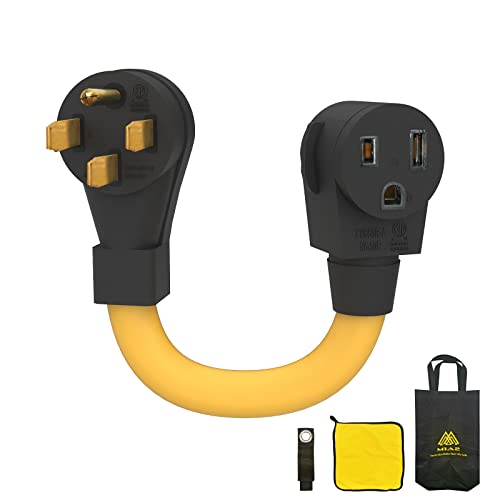
A noticeably massive 6 AWG cord that feels like it could outlast the welder itself.
This M1A2 adapter makes a first impression you won’t forget. Owners describe the wire bundle and insulation as roughly an inch in diameter—”it is huge”—which tells you exactly how much copper is packed in. That 6 AWG build is rated for 250V with a max of 12500 watts, giving welders and even EV charging serious headroom without excess heat.
It’s a 4-prong NEMA 14-50P plug to a 3-prong 6-50R receptacle, UL certified with copper wire in a flame-resistant PVC sleeve. A thoughtful touch: it ships with a carry bag, a soft towel for cleaning cables, and a strap. Because that much copper is genuinely heavy, the maker adds a velcro carrying handle, which owners appreciate when moving between jobs.
Functionality is the most-praised trait, with quality, durability, and build quality all drawing strong mentions. Buyers feed 240V MIG welders, TIG welders, and plasma cutters from a typical RV 50A outlet, and one notes it “stays in place even when the welder isn’t being used” thanks to its short, compact length. The ergonomic handle gets mixed feedback—some units clearly have it, and a few owners note its absence—so check the listing photos if that detail matters to you.
Built like a tool: the inch-thick 6 AWG bundle, velcro carry handle, and included storage bag make this feel like pro-shop equipment, not an accessory.
Take it if: you want maximum durability for a busy shop or frequent generator-to-welder hookups.
Leave it if: you want the lightest option—6 AWG copper is heavy by nature.
8. MECMO 50 Amp to 20 Amp 110V RV Distribution Adapter, NEMA 14-50P to 4 X 5-20R/15R RV 4-Prong to Multiple Household Outlet w/ 20amp Circuit Breaker, RV Generator Distribution Cord – 1.5ft
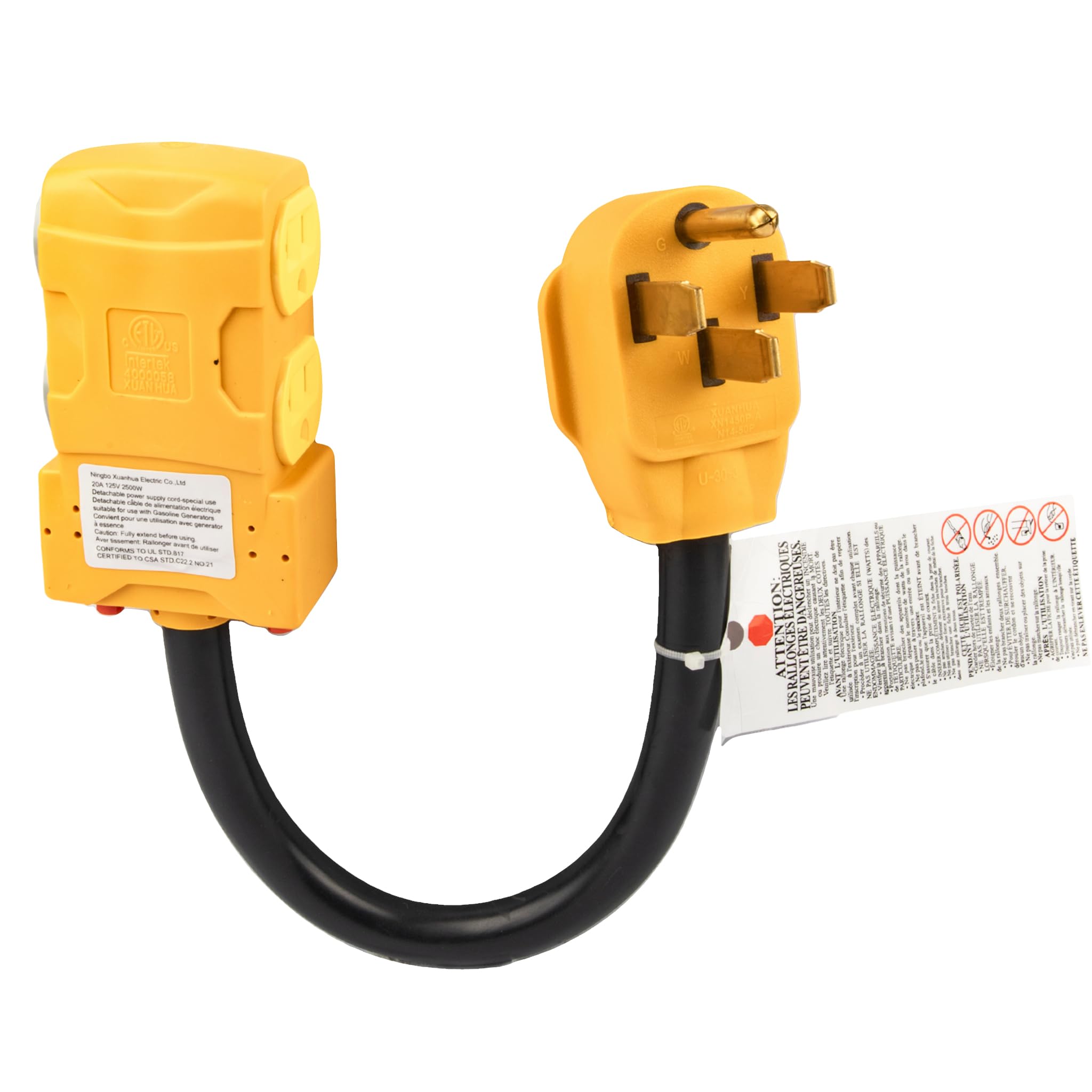
The only splitter here with built-in 20-amp breakers to protect each side of your load.
Most 14-50 splitters just pass power through. This MECMO adds genuine protection: two 20 Amp circuit breakers, one on each side, so a fault on one bank of outlets cuts power there instead of tripping your main panel. Each side is rated 20A/250V/5000W, for a combined 10000 watts across all four outlets. That extra layer of safety is why it stands apart from simpler adapters.
The distribution logic matters in practice. Buyers describe running a table saw and dust collector, or a planer and jointer, by connecting one tool to each side without overloading a single circuit. Others use it at campsites to run a griddle, coffee maker, and phones simultaneously from an RV pedestal—”a lifesaver” for heavy power tools that used to trip the garage breaker.
Functionality is by far the most-praised aspect here, with durability and compatibility both drawing heavy mentions. One owner noted it survived a 5-day camping trip without issue. The 1.5-foot cord keeps it compact, and the pure copper wire build gives it the ruggedness to live outdoors at a campsite or job site.
The safety edge
- Two built-in 20A breakers isolate faults before they reach your panel.
- 10000-watt combined capacity handles serious simultaneous loads.
- Proven in campsite and workshop use with heavy tools and appliances.
Keep in mind
- You must balance loads across the two sides to use full capacity.
Best for: workshop owners and campers running multiple heavy tools or appliances who want breaker-level protection.
pass on it if: you just need one extra outlet—the breaker system is overkill for light loads.
9. CircleCord 30A to 50A RV Surge Protector Adapter Cord with Circuit Breaker
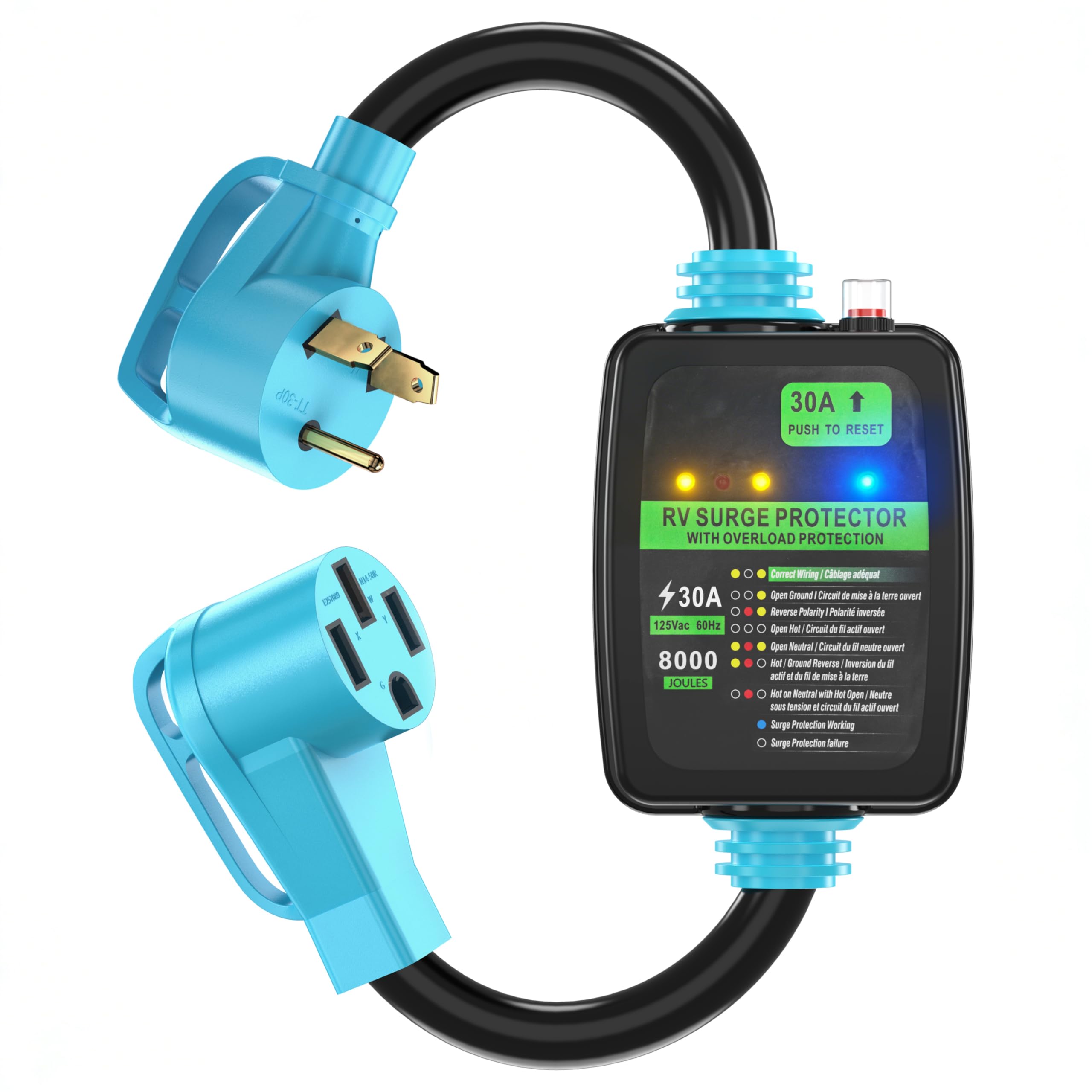
The campground guardian that shields your RV’s electronics from power spikes before they bite.
This CircleCord does more than convert power—it protects. Packing 8000 Joules of surge protection, it absorbs damaging power spikes before they reach your RV’s sensitive electronics. That’s a meaningful upgrade over a plain adapter when you’re plugging into unfamiliar campground pedestals where wiring quality is a gamble. Its blue color makes it easy to spot in a tote full of cords.
The protection stack is comprehensive. A 15A circuit breaker automatically cuts power and resets with a button, while an integrated circuit analyzer checks the power source wiring for faults before connecting your RV. An LED indicator keeps you informed of connection status. It converts a 30 Amp TT-30P campground plug to feed your 50 Amp NEMA 14-50R RV inlet, built with heavy-duty 10 gauge STW pure copper wire and UV-resistant casing.
Functionality and quality both draw the most praise, tied at the top, with durability and value close behind. Owners like the handles that help separate the cord from the outlet, and note it stays solid even after extended outdoor exposure. One honest technical note: because a 30-amp source feeds a single 120V hot leg to both 14-50 hots, this won’t power 240V devices like EV chargers—it’s for running standard 120V RV systems from a 30-amp pedestal.
Protection first
- 8000-joule surge rating shields RV electronics from spikes.
- 15A breaker plus circuit analyzer checks wiring before you connect.
- LED indicator and ergonomic handles make monitoring and hookup easy.
Know the limits
- Single 120V feed means no 240V devices or EV charging through this adapter.
Choose it if: you camp at varying parks and want surge protection plus fault checking before your RV is exposed.
Look elsewhere if: you need to power a 240V appliance or EV charger from a 30-amp source—this won’t do it.
Understanding the Specs
Wire gauge (AWG)
This number tells you how thick the copper conductors are inside the cord. A lower gauge number means thicker wire that can carry more current without heating up. For a 14-50 adapter, you’ll typically see 10 AWG for general RV and household splits, 8 AWG for standard welders, and 6 AWG for high-draw machines that run for long stretches. If you’re pushing a welder or charger hard, thicker wire is the difference between a warm cord and a hot one.
Plug and receptacle shapes
NEMA codes describe the physical shape of the connection. The 14-50P is the 4-prong, 50-amp plug you find on EV chargers and RV pedestals. A 5-20R is a standard household outlet, while a 6-50R is the 3-prong 250-volt receptacle used by many welders. An L14-30P is a locking 30-amp twist-lock plug common on generators. Matching these shapes is the entire job of an adapter—get the code right and the plug fits; get it wrong and nothing connects.
FAQ
Will a 14-50 adapter let me charge my EV faster?
Can I run a welder through a 14-50 to household outlet adapter?
What is the difference between 8 AWG and 6 AWG welder cords?
Will a 30-amp to 50-amp adapter give my RV more power?
Can I use a 14-50 splitter to power a 240V appliance?
Is a surge protector adapter worth the extra cost?
Why does my adapter feel hot after running a load?
What does the 3750-watt rating on a splitter mean?
Final Thoughts: The Verdict
For most RV owners, the 14-50 adapter to buy is the CircleCord 30A to 50A because it solves the most common hookup problem—a 30-amp generator feeding a 50-amp RV—with a sturdy 10-gauge cord. If you have a 50-amp garage outlet and want to run household tools, the S7 4-outlet splitter turns that outlet into a workshop hub. For welders, the Suplevel 6 AWG adapter is the pick when you want no heat worries under heavy load, and the CircleCord surge protector is the campground favorite, offering 8000 joules of surge protection.
How We Picked
We do not accept paid placement. Every pick is matched to a real buyer and a real use-case; we do not hands-on test units.
Sources & Methodology
Specifications: manufacturer listings and product documentation. Review insights: verified customer reviews, as of September 2026. Pricing: not shown on this page (it changes often); check the current price via the retailer link.
As an Amazon Associate, KitchPrep earns from qualifying purchases. This does not affect which products we feature.
Related Guides
