
Specs are compiled from manufacturer listings and verified buyer reviews and can change over time — please confirm the key details on the product page before buying.
A whole-home generator search usually stalls at one big question: what happens when the gas stations are down too? A 13000 Watt Tri-Fuel Generator answers that by running on gasoline, propane, or natural gas from your house line, so you are never locked into a single fuel supply during a long outage.
I’m Mohammad Maruf — the founder and writer behind KitchPrep. This guide is built by comparing the manufacturers’ published specifications and the patterns across verified customer reviews, so you get each pick’s real strengths and trade-offs instead of marketing spin.
These 13 picks were matched flexibly to the search range of 13,000–15,000 watts, so a few models run higher or slightly lower on certain fuels, and every one of them is tri-fuel capable with a propane and natural gas option alongside gasoline. find the 13000 watt tri-fuel generator that actually fits your home’s power needs and fuel setup here.
Our Picks at a Glance
How To Choose The Best 13000 Watt Tri-Fuel Generator
Choosing a backup generator this size means matching the machine’s real output to the loads you will actually run during an outage, then picking a fuel strategy that works when you need it most. The biggest trap is shopping on the “peak watt” number alone, since peak watts are only a few seconds of surge power.
Match the running watts to your real loads, not the peak number
Every generator advertises two numbers: the surge watts used for a few seconds when a motor starts, and the running watts it sustains continuously. Your central AC, well pump, and fridge all draw extra current at startup, so the running watts on natural gas—usually the weakest fuel—are the number that decides whether your whole house stays on.
Understand how much power each fuel actually delivers
Gasoline delivers the highest output, propane sits slightly below it, and natural gas delivers the least power of the three because of its lower energy content per volume. A generator that produces 13,000 surge watts on gasoline may drop to around 10,000 on natural gas, which still runs fridges and lights but might not start a large central AC.
Check whether your natural gas line can feed the machine
Natural gas models need a line with enough flow—measured in BTU per hour—to support the engine at full load, and many owners install a dedicated 3/4-inch or 1-inch line with a quick-connect fitting. If your home’s gas meter or pipe size is too small, the generator will sputter or underperform on natural gas, leaving you to rely on propane or gasoline instead.
Decide between standard and inverter output
A standard alternator is cheaper and fine for resistive loads like heaters and water heaters, but an inverter generator cleans up the power into a stable sine wave that runs sensitive electronics like laptops and TVs safely. Inverter models also run quieter and throttle the engine down to match the load, so they burn less fuel when you are only running a few lights.
Quick Comparison
| Model | Best For | Engine Size | Max Running Watts (Gas) | Weight | Amazon |
|---|---|---|---|---|---|
| DuroMax XP13000HXT | Whole-home NG backup | 500cc | — | 240 lbs | Amazon |
| WEN TF-1450X | Central AC + garage power | 500cc | 11,500 | — | Amazon |
| DuroStar DS13000MXT | 72-hour emergency runs | 500cc | — | — | Amazon |
| Westinghouse WGen10500DFc | Reliability + remote start | 500cc | 10,500 | 230 lbs | Amazon |
| DuroMax XP15000HXT | All-electric homes | 670cc | — | — | Amazon |
| Champion 201161 | Texas-size storm duty | 717cc V-Twin | 12,000 | 331 lbs | Amazon |
| WEN TF1300iX Inverter | Quiet clean power | 550cc | 10,500 | 246.9 lbs | Amazon |
| Westinghouse WGen14500TFc | Larger homes + jobsites | 713cc V-Twin | 14,500 | 348.3 lbs | Amazon |
| GENMAX GM13500iETC Inverter | Auto-start whole-home | 550cc | 11,500 | 273.7 lbs | Amazon |
In-Depth Reviews
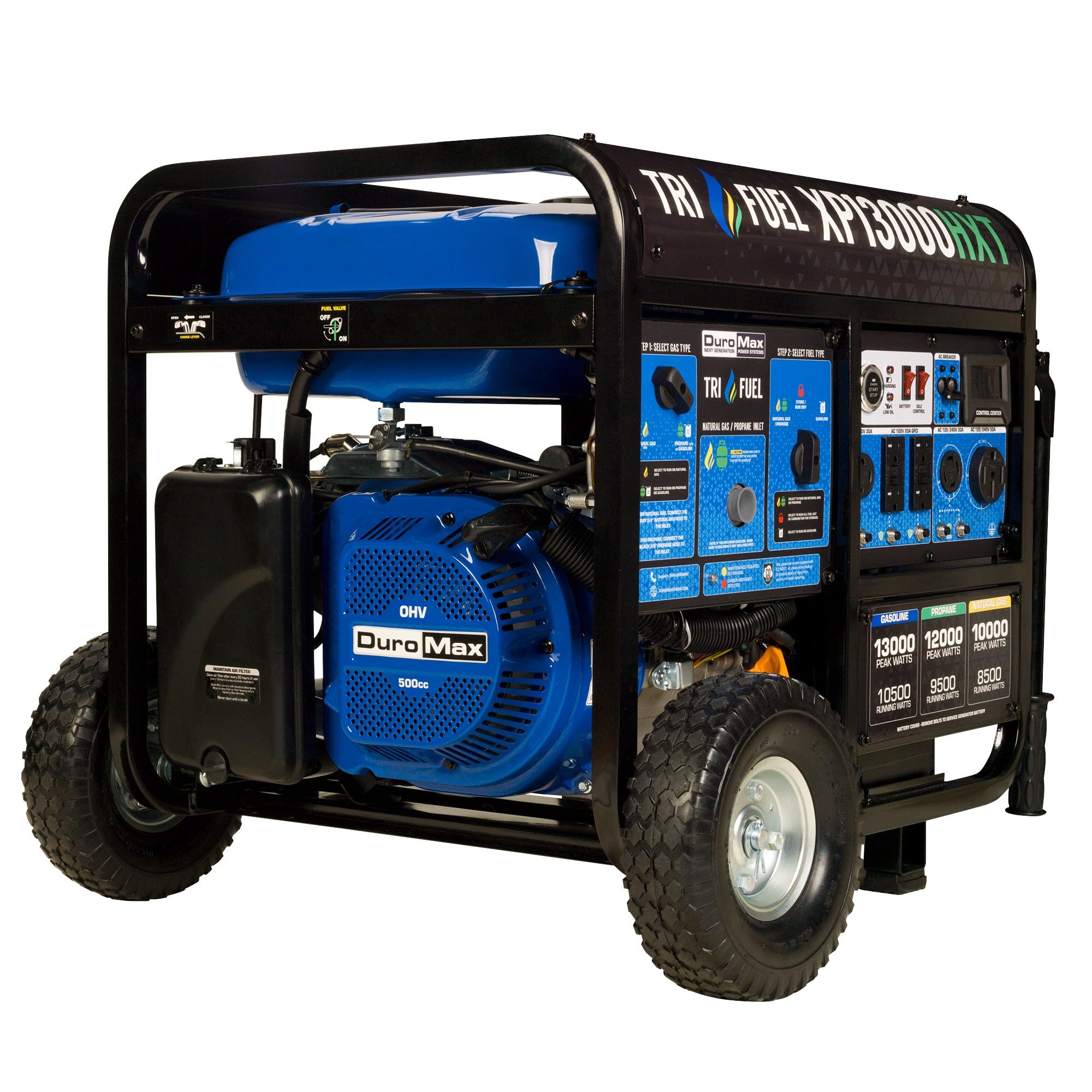
1. DuroMax XP13000HXT
The home-backup standard that powers whole houses and earns the top spot on this list.
This is the pick most owners describe as running their entire home from a natural gas line — one detailed account covers a downstairs AC, internet, computer, TV, refrigerators, and lights all at once. The key enabler is the transfer-switch-ready 50 amp outlet, which lets a licensed electrician connect it straight to your panel so you are not snaking extension cords through every room.
The 500cc 4-stroke engine starts via push button or the included remote fob, and the front-facing interface switches fuel in seconds. The box includes a 15-foot natural gas hose and a propane regulator, so you only need to supply your own gasoline. One careful review notes the natural gas setup needs a 225K BTU/hr line (3/4-inch recommended) and that the included NG hose reducer is very tight to seat, while another owner’s battery died after three months and was replaced by customer service within days.
Buyers report that after an interlock install the machine “ran AC, 2 fridges, lights/computers at ~60% load,” which gives you real headroom above your daily needs. The recurring notes across reviews are consistent: expect to add oil and a trickle charger yourself, give it 4–5 start attempts on first use, and plan for a monthly 10–15 minute test run to keep the battery healthy.
Why owners pick it
- Remote and push-button electric start from the included fob
- Runs on gasoline, propane, or natural gas with quick fuel switching
- 50A outlet works with a transfer switch for whole-home power
The honest limits
- No oil included — you must add your own before the first start
- Heavy at 240 pounds, so the wheel kit is essential
- NG hose reducer is very tight to seat during setup
Reach for it when: you want a transfer-switch-ready whole-home backup on natural gas with remote start convenience.
Think twice if: you are not comfortable adding oil, sourcing a 3/4-inch NG line, and running a monthly test cycle yourself.
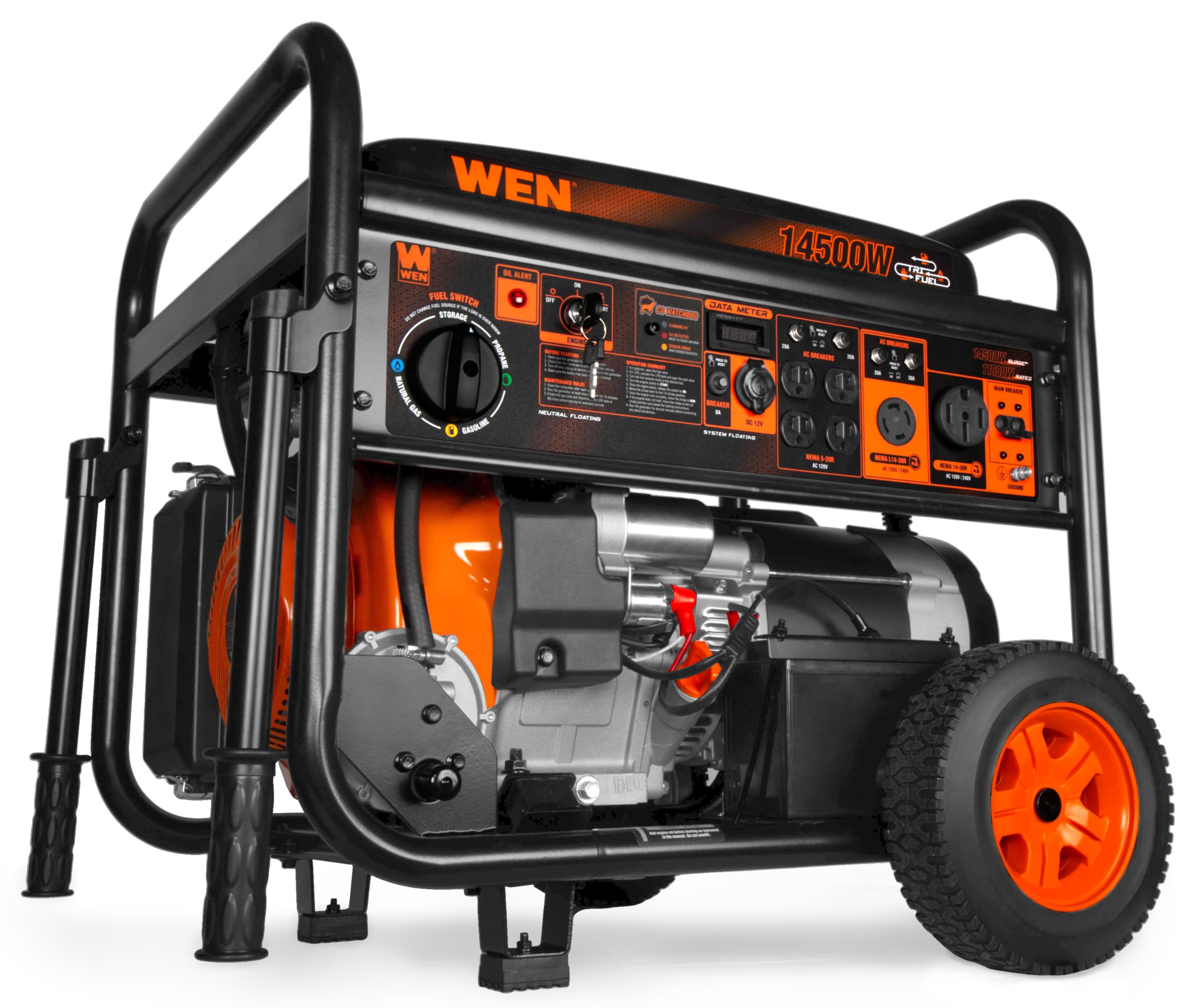
2. WEN TF-1450X
More power than the class-leading DuroMax at a friendlier price, with surprisingly strong owner results so far.
This is the rare machine that pushes past the 13,000-watt target: 14,500 surge watts and 11,500 running watts on gasoline, dropping to 10,300 running watts on propane and 8,750 running watts on natural gas. A turn of the fuel dial switches between all three, and the electric start fires the 500cc 4-stroke OHV engine with a key turn.
The 8.2-gallon tank delivers up to 12 hours of half-load runtime, and the included kit is generous — a bottle of oil, a 6-foot LPG hose, an NG quick-connect adapter, and a spark plug wrench all arrive in the box. Owners mention it “runs my whole house including central air and my garage all at once,” a level of coverage that explains why early owners are so enthusiastic.
The trade-off is that this model is new, with far fewer owner experiences logged than the DuroMax above, though it holds a higher 4.7-star score so far. One thoughtful 4-star review notes the “only 50 amps” as a limitation for truly massive all-electric homes, and another advises completing the 8-hour oil break-in before trusting it under full load.
Where it leads
- 11,500 running watts on gasoline covers central AC plus a garage
- Ships with oil, LPG hose, and NG adapter ready to run
- Transfer-switch-ready L14-30R and 14-50R outlets included
Where it’s early
- Too new to have a long-term reliability track record
- Some owners found it needed starting fluid on the very first pull
- Only one 50A outlet limits truly huge simultaneous loads
Choose it if: you want maximum watts per dollar and a full accessory kit for a whole-home setup.
Hold off if: you prefer a model with years of owner-proven reliability behind it over a brand-new release.
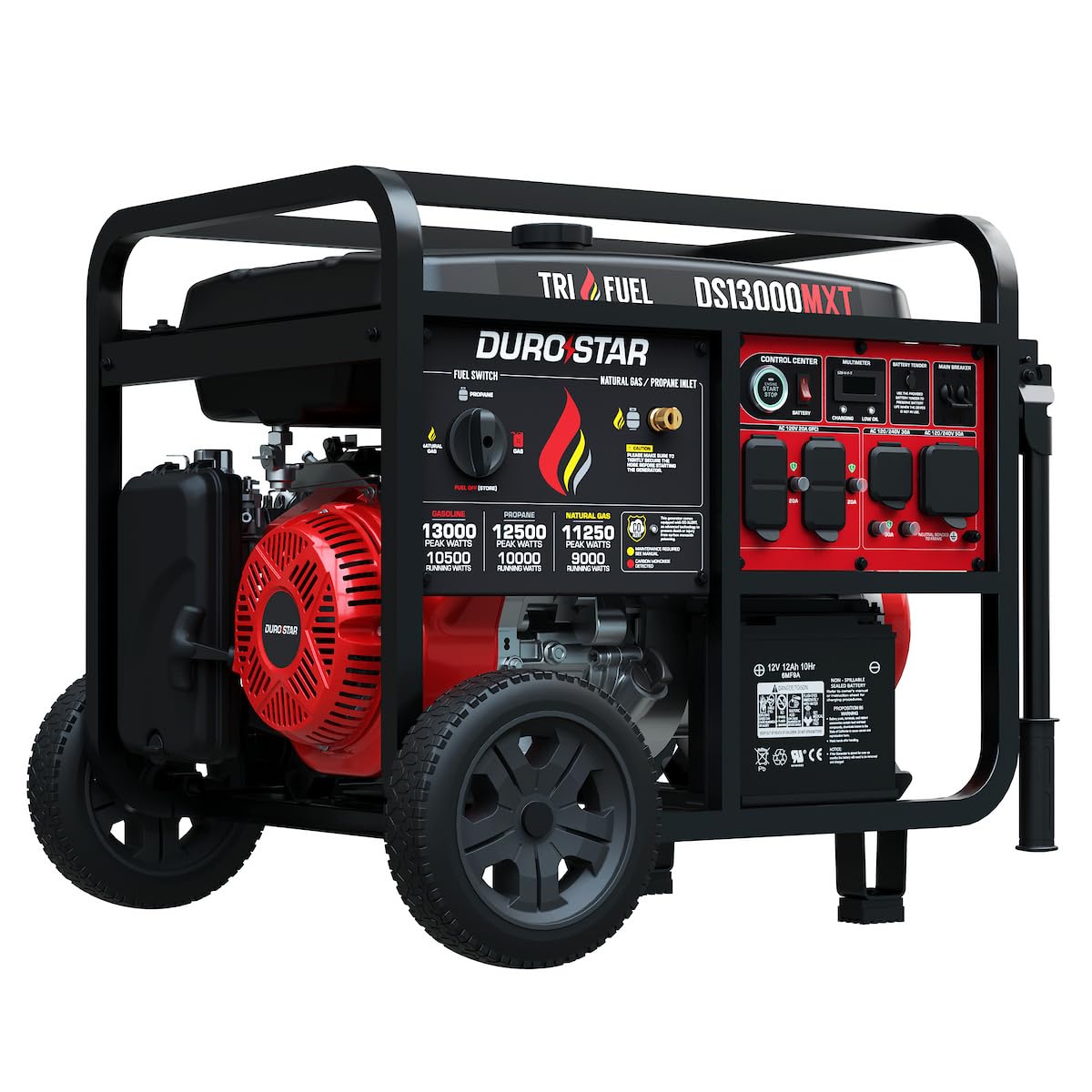
3. DuroStar DS13000MXT
The long-haul machine with a proven 72-hour emergency run under its belt from real owners.
Performance is the thing everyone raves about here, and no owner story sells it better than the 72-hour gas-powered run that kept an AC, fridge, freezer, microwave, pumps, lights, and phones going — with refills every 12 hours and no overheating. That kind of endurance test is exactly what you want from a whole-home backup, and it explains why food-truck owners also report it runs their setup easily.
The 500cc 4-stroke OHV engine pairs a push-button start with a fuel selection knob for gasoline, propane, or natural gas. The box includes both a 15-foot natural gas hose and a propane regulator, plus a remote control, wheel kit, and tool set. One thorough owner review ran it on propane for two weeks at 8–10 hours a day without a single issue.
The honest catch is a design quirk that a handful of owners flagged: the oil drain tube sits near the tire, and one mover caught the wheel on the line, pulled the plug, and caused an oil leak. It is a real risk worth checking before you roll it over rough ground, but it is not a reason to skip a generator this proven at the actual job of keeping a house running through a multi-day outage.
Why it wins trust
- Owner-proven 72-hour continuous run on a single gas strategy
- Push-button start plus fuel selection knob on the panel
- Includes NG hose, propane regulator, and remote control
Know before you go
- Oil drain tube position near the wheel risks a pulled plug
- Semi-loud 500cc engine — fine outside, not indoors
- No oil included in the box
The one for: owners who want a generator already proven to carry a full house for three straight days.
Not the one for: anyone who regularly moves the unit over uneven ground without checking the drain line first.
4. Westinghouse WGen10500DFc
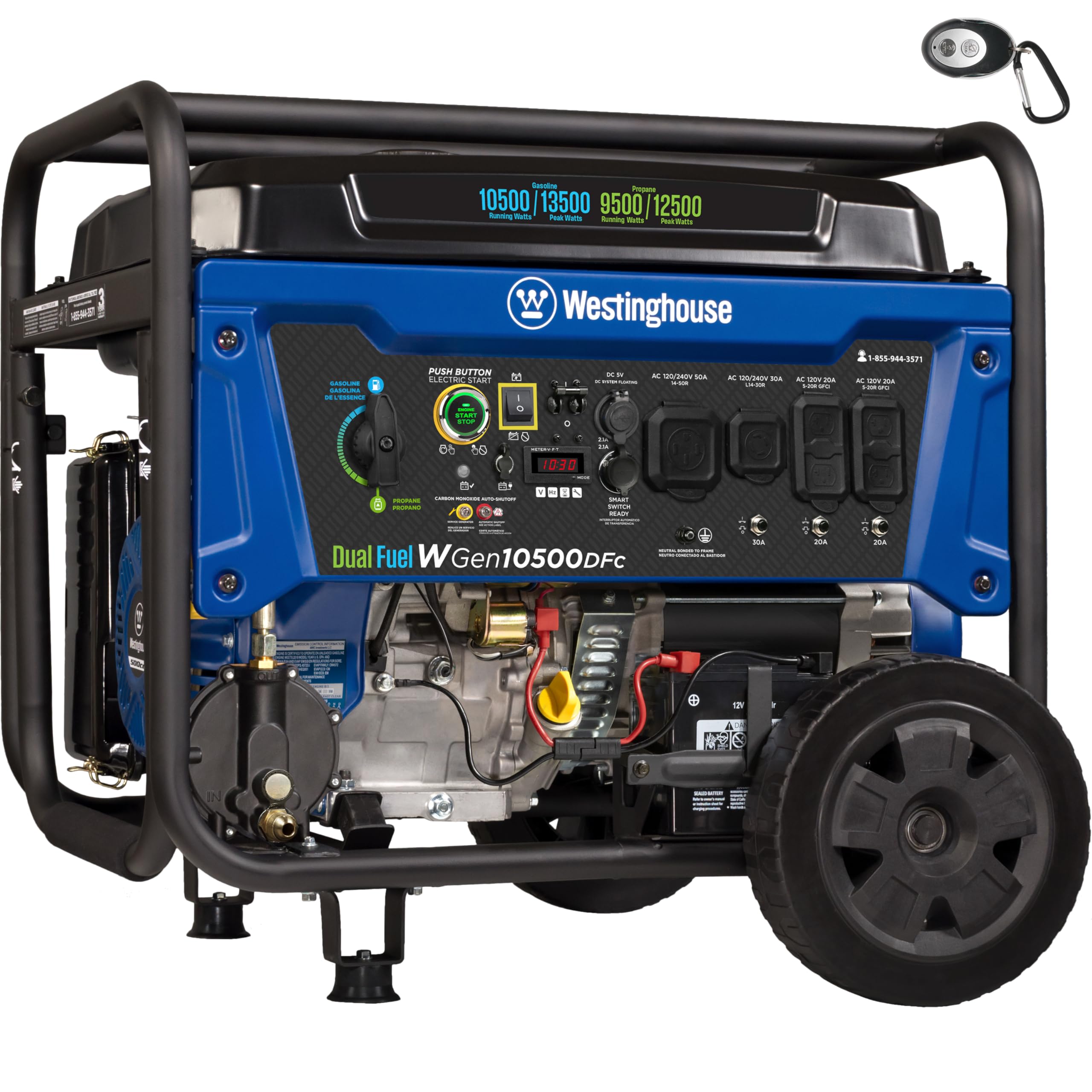
Build quality is what wins people over — owners call it a heavy-duty powerhouse that starts instantly.
Even though this is technically a dual-fuel model, a pattern in the reviews shows buyers often receiving a free tri-fuel upgrade, which is why it earns a place on this list. Running on gasoline it puts out 13,500 peak watts and 10,500 running watts, and on propane those figures drop to 12,500 peak and 9,500 running — but real owners describe it powering an entire home including multiple AC units.
The 500cc 4-stroke OHV engine has a cast iron sleeve, and the remote start key fob ships with oil, a funnel, a tool kit, and a 12V battery charger. The 9.5-gallon fuel tank with a gauge delivers up to 19 hours of run time, which means you are not refueling in the middle of the night during a storm. Setup is genuinely minimal, and the factory functionally tests each unit before it ships.
Where it leads is owner confidence — the satisfaction runs deep enough that many call it a bargain at its price tier. The trade-off is that if you specifically need natural gas, you are relying on the goodwill of a free upgrade rather than a spec sheet guarantee, so confirm what fuel options your particular unit ships with before you commit your home to it.
The praise it earns
- Remote start via included key fob from the box
- 19-hour runtime on the 9.5-gallon tank
- Low-oil and CO automatic shutdowns built in
The fine print
- Dual-fuel by spec; natural gas depends on the free upgrade
- At 230 pounds, you will want the wheels deployed
- Functionally tested at the factory, so a faint oil or fuel odor is normal
For you if: a supremely well-built gas-and-propane machine with an easy remote start is the priority.
Look elsewhere if: you absolutely require guaranteed natural-gas capability written into the specifications.
5. Westinghouse WGen11500DFc
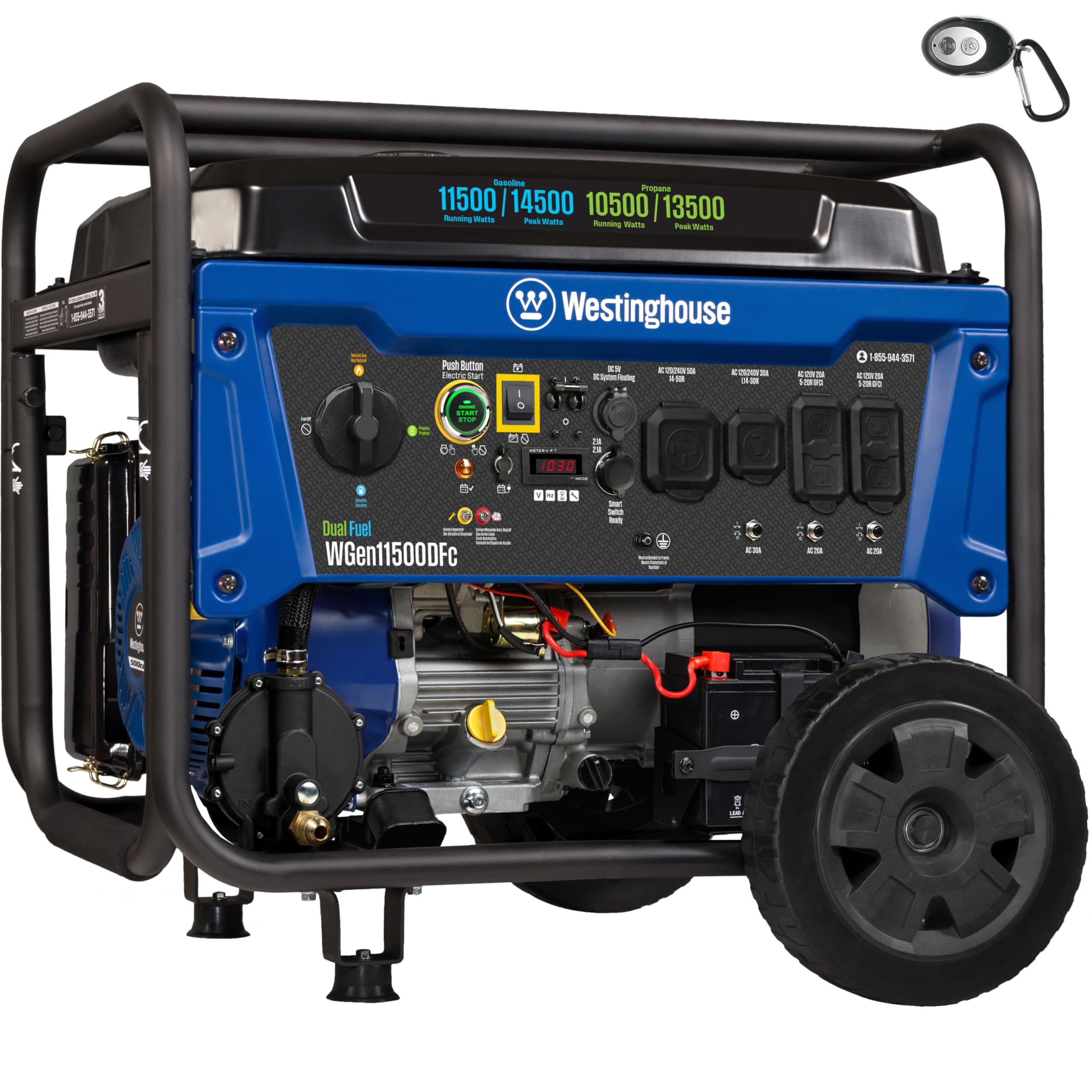
The jobsite workhorse that one owner ran daily for five months straight without a complaint.
This bigger Westinghouse pushes out 14,500 peak watts and 11,500 running watts on gasoline, with 13,500 pea a full basement reports it handles everything without problems, and another runs a food trailer on propane and gasoline. The 670cc 4-stroke engine is the largest in the DuroMax lineup here, and the advanced computer interface with a large LED display shows gas gauge, load gauge, voltage, frequency, and time in real time.
The panel is fully loaded with 4 GFCI 120V 20A outlets, a 120V 30A twist lock, a 120/240V 30A twist lock, and a 120/240V 50A heavy-duty outlet. The 100% copper windings conduct heat better than aluminum, which extends the life of the generator under sustained load. Push-button and remote start both come standard, along with the 15-foot natural gas hose and propane regulator in the box.
The honest tension in the reviews is reliability: while many call it excellent and say it works like a charm, a rare but serious warning emerges — one unit stopped starting after 60 hours of use and spent three months at a certified shop without a diagnosis. It is the kind of outlier that could happen with any machine, but it tempers what is otherwise a powerhouse recommendation for all-electric homes that need maximum surge capacity.
The raw capability
- 15,000 surge watts runs all-electric homes comfortably
- LED display shows load, voltage, and frequency live
- Heavy-duty 50A outlet plus four GFCI 20A receptacles
Weigh this
- An occasional unit has failed early with a hard-to-diagnose issue
- Largest and heaviest DuroMax here at 36 inches long
Choose it when: you run an all-electric home and need the surge capacity to start everything at once.
Pause if: the thought of an intermittent reliability record makes you prefer a more proven engine platform.
6. Champion 201161

The hurricane-season hero that powered entire Houston homes through the deadly heat of Beryl.
When a generator carries a house through Hurricane Beryl’s aftermath on natural gas for days — including central air with a soft start — that is the real-world endorsement buyers trust most. The 717cc Milwaukee Series V-Twin engine delivers 15,000 starting watts and 12,000 running watts, with up to 9 hours of runtime on a full gas tank at a noise level of 78 dBA from 23 feet (roughly the volume of a loud conversation at that distance).
The CO Shield system auto-shuts the unit down if carbon monoxide builds up, and the Intelligauge keeps track of voltage, hertz, and run-time hours so you can monitor output and plan maintenance. Natural gas and propane hoses are both included, so it runs on any of the three fuels right from the start. Owners have logged over 100 hours across tornado season powering a 4,400-square-foot house with two ACs running on soft starts, with zero issues.
The setup demands respect: a 5-hour break-in period with an oil change afterward is required before full-load use, and the second spark plug is very hard to access when it comes time for maintenance. One owner notes the manual is inadequate for that task. But the reliability consensus is strong enough that buyers describe it as a life-saver worth every penny during back-to-back hurricane seasons.
Storm credentials
- Proven through 100+ hours across tornado and hurricane seasons
- Natural gas and propane hoses included in the box
- Intelligauge tracks voltage, hertz, and run time
Setup realities
- Requires a 5-hour break-in and oil change before full load
- Second spark plug is very hard to reach for service
- Heavy at 331 pounds with a large footprint
The serious choice for: storm-prone regions where a generator must start and run for days without fail.
Not ideal if: you want minimal break-in procedure and easy access to every maintenance part.
7. WEN TF1300iX Inverter
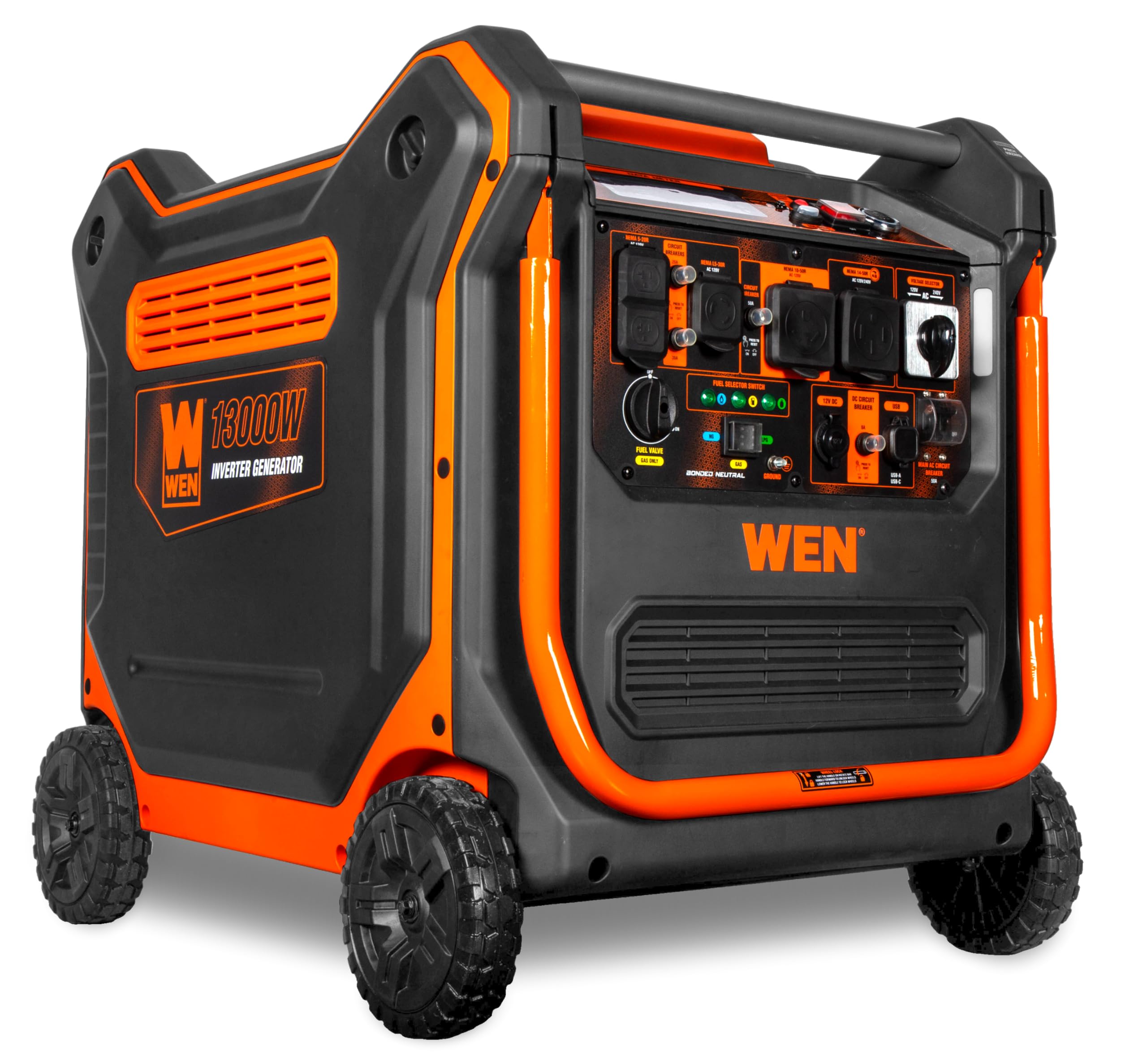
The quiet generator that runs a class-A motorhome on 50 amps while staying conversation-quiet.
This is the inverter pick for buyers who want whole-home power without the deafening roar of an open-frame unit. On gasoline it produces 13,000 surge watts and 10,500 running watts — a true 13,000-watt machine — with propane dropping to 11,250 surge and 9,000 running, and natural gas at 10,000 surge and 8,000 running. One owner ran a class-A motorhome on 240V 50-amp with two AC units running simultaneously in eco mode with no problems.
The bonded-neutral setup is 120V/240V, making it transfer-switch ready, and the quiet 550cc engine runs at a tolerable sound level that owners consistently note. The 7.1-gallon tank provides up to 7.7 hours of half-load runtime, and the outlet spread is impressive: two 120V 5-20R outlets, a 14-50R outlet ready for EV charging, an L5-30R transfer-switch-ready outlet, a 10-50R outlet, a 12V DC outlet, and two USB ports. The WEN Watchdog CO sensor auto-shuts it down if carbon monoxide accumulates.
The technical caveat that trips up some buyers: you cannot use the 240V and 120V receptacles simultaneously — a voltage selector disables one set when the other is active. This is a real limitation for mixed loads, so think about your outlet needs before buying. On the plus side, owners who run it on natural gas report it easily powers their AC, freezers, lights, and a work-from-home computer setup.
The quiet power
- Inverter technology keeps it quiet with clean power for electronics
- EV-ready 14-50R outlet for Level 2 charging
- Ran a motorhome with two ACs on 50 amps in eco mode
The selector catch
- Cannot run 240V and 120V receptacles at the same time
- Short runtime of 7.7 hours means more refueling stops
- Shipping took over a month for one early buyer
A great match for: RV owners and home users who need clean power and quiet operation over raw output.
Reconsider if: you must power both 240V appliances and 120V circuits simultaneously from one machine.
8. Westinghouse WGen14500TFc
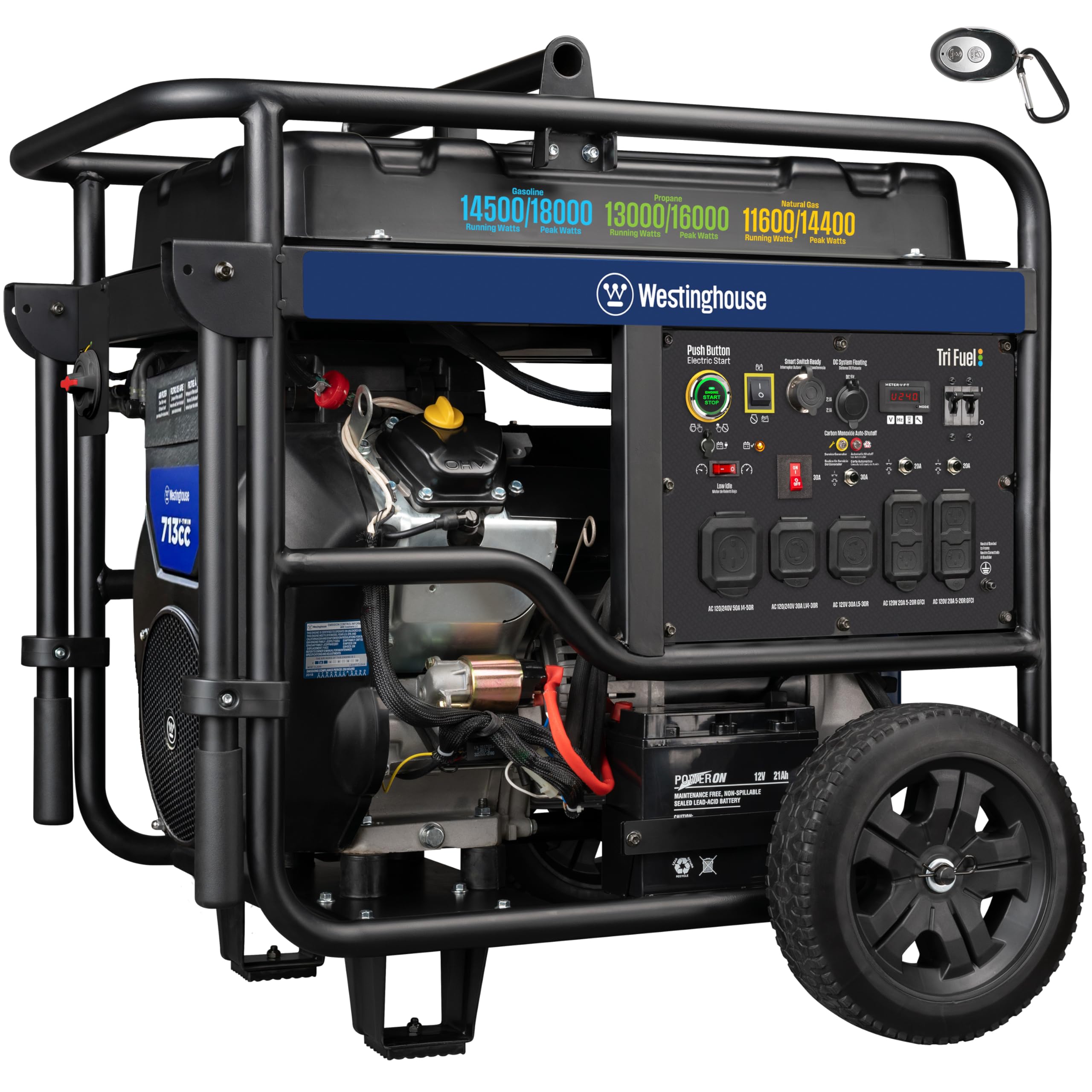
Serious tri-fuel power that handles a large home’s AC load without breaking a sweat.
With 18,000 peak watts and 14,500 running watts on gasoline, this Westinghouse is the larger step up for bigger homes, and it still runs natural gas at 14,400 peak and 11,600 running watts — enough that owners call it a beast that powers the whole house. The 713cc V-Twin OHV engine with a cast iron sleeve is built for sustained heavy use, and the 10.5-gallon tank stretches up to 16 hours at 25% load.
At less than 5% THD, the output is safe for sensitive electronics, and the low idle mode helps cut noise to as low as 74 dBA. The VFT data center shows voltage, frequency, and lifetime hours, while the outlet selection covers a 14-50R 50A, an L14-30R 30A, an L5-30R 30A, two GFCI duplex outlets, and two USB ports. It ships with oil, a funnel, and a setup guide so you are ready to go quickly.
Quality is what wins people over most, with owners praising the clear, self-explanatory manual and easy assembly. The mixed note is starting performance: most report it fires fine and handles AC load easily with only a brief power dip on natural gas, but a rare defective unit arrived with stripped lifting-hook threads and a non-working remote start — and that owner found Westinghouse support slow to send the correct replacement part. It is an outlier, but worth knowing before you rely on one in an emergency.
The heavy-hitter appeal
- 14,500 running watts on gas, 11,600 on natural gas
- Low THD at under 5% protects your electronics
- VFT data center tracks voltage, frequency, and hours
The risk to know
- A rare unit arrived with defective parts and slow support
- Heavy at 348.3 pounds — plan your placement carefully
Your pick if: you have a larger home with serious AC demands and want low-THD power for your electronics.
Think twice if: you cannot accept the small chance of a support headache on a defective unit.
9. GENMAX GM13500iETC Inverter
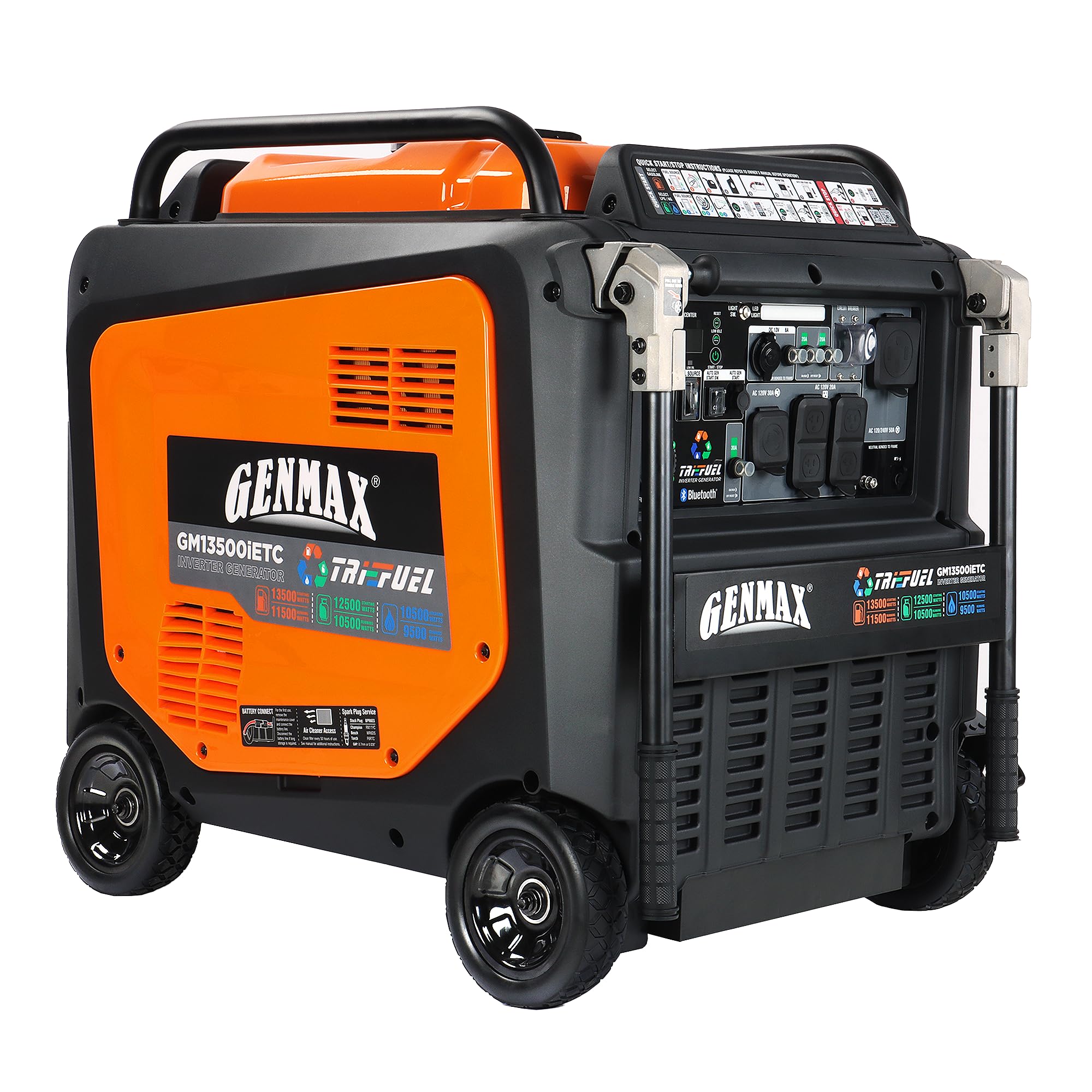
The 62 dBA inverter with auto-start that kicks in by itself when the grid goes dark.
This is the most feature-dense pick on the list: a 13,500 peak watt inverter that runs 11,500 running watts on gasoline, 10,500 on propane, and 9,500 on natural gasgas. What makes it genuinely different is the 2-wire ATS auto-start — no other large portable generator on the market currently offers this, as one owner put it — so it can pair with an automatic transfer switch and fire up on its own during an outage, no human needed.
The 550cc 4-stroke OHV engine delivers ≤3% THD pure sine wave power, which is clean enough for laptops, phones, and even medical equipment. Eco-mode auto-adjusts engine speed to match your load, cutting noise to just 62 dB(A) at 25% load — about the volume of a normal conversation — and stretching runtime up to 11.2 hours on the 6.9-gallon tank. The built-in soft LED light illuminates the control panel so you are not fumbling in the dark during a nighttime outage.
Start options number five in total: push-button electric, remote key fob, Bluetooth app control, recoil backup, and that ATS 2-wire auto-start. Reviewers point out the Bluetooth app and remote fob both work well, and that a 4-ton AC with a soft start barely affects it under load. The digital monitor displays real-time wattage, voltage, runtime, and critical alerts like overload or low oil, and the whole unit is CARB certified for all 50 states.
The trade-off is weight and price — at 273.7 pounds it is not a casual mover, and it sits at a premium tier. One owner notes it is heavy but not too heavy to move between locations, and the foldable handle and sturdy wheels help. Another appreciates that its footprint matches a smaller 12,500-watt model while delivering more power — a genuine space saver for the output.
The smart features
- ATS 2-wire auto-start for unattended whole-home backup
- 62 dB(A) at 25% load — conversation-quiet operation
- Bluetooth app control plus remote fob plus recoil backup
- ≤3% THD pure sine wave for sensitive electronics
The honest costs
- Heavy at 273.7 pounds despite the folding handle
- Premium price tier for the feature set
- Only 30 minutes of run time logged by the earliest reviewer
The smart-home choice for: buyers who want a generator that starts itself during an outage and can be monitored from a phone.
skip it if: you do not need auto-start and prefer to spend less on raw watts instead of smart features.
Understanding the Specs
Surge vs. Running Watts
Every generator quotes two numbers. Surge (or peak) watts is the brief burst of power a motor needs for the first second or two when it starts — think of the moment your AC compressor kicks on. Running (or rated) watts is what the unit sustains continuously. You need your biggest motor’s surge draw to fit under the surge rating, and everything running at once to fit under the running rating. On natural gas, both numbers drop, so check the gas-specific running watts if that is your primary fuel.
Tri-Fuel Fuel Strategy
Tri-fuel means gasoline, propane, and natural gas are all viable. Gasoline gives the highest output but goes stale in storage and can be scarce after a storm. Propane stores indefinitely in tanks but delivers less energy per volume. Natural gas flows from your home’s line with no refilling ever, but demands a line with sufficient BTU flow — often 3/4-inch or larger — and delivers the lowest wattage of the three. Match your fuel choice to your actual outage scenario.
CO Shutdown Systems
Carbon monoxide sensors automatically shut the generator down if dangerous fumes build up. They are a genuine life-safety feature — CO is odorless and deadly — but they can occasionally trip early in tight spaces and limit output. Always run a generator outdoors, far from windows and doors, and give the sensor room to sample fresh air. If you must run it near a structure, position it with the exhaust pointing away and add airflow around the unit.
Transfer Switch Readiness
A generator with a 50A outlet can connect to your home’s electrical panel through a transfer switch or interlock kit — a device that safely isolates your house from the grid while the generator runs. Without it, you are limited to extension cords. The 14-50R and L14-30R outlets you see on these models are the standard connection points. This setup requires a licensed electrician in most areas to ensure it is wired safely and legally.
FAQ
What is the difference between running watts and starting watts on a 13,000-watt generator?
Can a 13,000-watt tri-fuel generator run central air conditioning?
Will a 13,000-watt generator run my whole house?
What size natural gas line do I need for a tri-fuel generator?
Do these generators come with the natural gas hose and propane regulator?
Is natural gas or propane better for emergency home backup?
Do I need a transfer switch or can I use extension cords?
How long can a 13,000-watt generator run continuously?
Do I need to change the oil after a break-in period?
Are inverter generators worth the extra cost over standard models?
Can I run an EV charger from a tri-fuel generator?
Are these generators CARB compliant for California?
Final Thoughts: The Verdict
For most buyers, the 13000 watt tri-fuel generator winner is the DuroMax XP13000HXT because it pairs proven whole-home natural gas capability with push-button and remote start, backed by the strongest owner track record in this class. If you want cleaner inverter power for your electronics and are willing to pay more, the GENMAX GM13500iETC is the standout with its ATS auto-start and Bluetooth control. And if raw output is what your home demands, the Westinghouse WGen14500TFc delivers a full 14,500 running watts on gas. Whatever you choose, match the running watts — not the surge number — to your real loads, confirm your natural gas line can feed it, and have a licensed electrician install the transfer switch. That combination turns any of these machines from an expensive toy into the reason your family stays comfortable through the next storm.
How We Picked
We do not accept paid placement. Every pick is matched to a real buyer and a real use-case; we do not hands-on test units.
Sources & Methodology
Specifications: manufacturer listings and product documentation. Review insights: verified customer reviews, as of September 2026. Pricing: not shown on this page (it changes often); check the current price via the retailer link.
As an Amazon Associate, KitchPrep earns from qualifying purchases. This does not affect which products we feature.
Related Guides
