
Specs are compiled from manufacturer listings and verified buyer reviews and can change over time — please confirm the key details on the product page before buying.
A 13 x 19 printer is a different beast from your office all-in-one. This is the format where you can finally print your work large enough to frame, proof a design at true size, or hand a client a portfolio piece that feels like a real print, not a handout. The hard part isn’t finding a printer that accepts the paper — it’s finding one that lays down color you can trust, handles thick media without jamming, and doesn’t bankrupt you on ink after the first month. This guide cuts through the spec sheets to the models that actually deliver on the big-paper promise.
I’m Mohammad Maruf — the founder and writer behind KitchPrep. This guide is built by comparing the manufacturers’ published specifications and the patterns across verified customer reviews, so you get each pick’s real strengths and trade-offs instead of marketing spin.
Below are the wide-format workhorses worth your money, from studio-grade color engines to budget-friendly entry points, so you can find the right 13 x 19 photo printer for your exact workflow.
Our Picks at a Glance


How To Choose The Best 13 X 19 Photo Printer
Choosing a wide-format printer means living with it for years, so you need to match it to your real work. Are you a fine-art photographer who needs prints that last decades, a scrapbooker feeding cardstock, or a crafter doing sublimation transfers (a process where heat transfers dye from paper onto fabric or other materials)? Your answer determines everything from the ink chemistry to the paper path.
Match the Ink System to Your Output
Dye-based inks (like the 6-color and 8-color systems from Canon) deliver vivid, glossy-friendly color that’s great for display prints. Pigment inks (like Epson’s UltraChrome line) resist fading for decades and sit on top of the paper, which is why they’re the choice for fine-art and archival work. If your prints will hang in a gallery or sell to clients, lean pigment; if you’re printing family photos and portfolios that will live behind glass, dye is more than enough and usually cheaper to feed.
Check Paper Handling Before You Fall in Love
A printer that prints 13 x 19 is useless if it won’t feed the thick, textured media you actually want to use. Look for a dedicated front or rear feeder for heavy paper, since standard trays often choke on 140lb cardstock or watercolor paper. If you plan to print borderless, confirm that’s supported — it’s a common feature but the manual-feed behavior varies wildly between models.
Budget for the Real Cost: Ink
The printer body is the cheap part; the cartridges are the lifetime commitment. High-capacity tank systems slash per-print costs dramatically, while cartridge-based photo printers can burn through a set of inks in a single afternoon of 13 x 19 printing. Read the fine print on how much ink comes in the box — some models ship with “starter” cartridges that are barely half full, forcing an immediate reorder.
Don’t Ignore the Connectivity Reality
Wireless printing sounds great until you’re fighting a driver conflict at 11pm. Many photo printers still behave best over a plain USB cable for the initial setup, and Wi-Fi reliability is a recurring theme across owner feedback. If you print from a phone or tablet, confirm the printer supports AirPrint or a solid companion app before you buy.
Quick Comparison
| Model | Best For | Ink System | Max Print Speed | Paper Handling | Amazon |
|---|---|---|---|---|---|
| Epson Artisan 1430★ Best Overall | Value-driven 13×19 printing | 6-color Claria dye | 2.8 ppm B&W / 2.8 ppm color | CD/DVD, up to 13×19 borderless | Amazon |
| Canon IP8720Fastest Performer | Fast, detailed photos on a budget | 6-color with gray | 14.5 ppm B&W / 10.4 ppm color | Up to 13×19, heavy media up to 140lb | Amazon |
| Epson XP-970Most Versatile | All-in-one print, scan, copy | 6-color Claria Photo HD | 8.5 ppm B&W / 8 ppm color | Auto duplex, 13×19 borderless | Amazon |
| Canon PRO-200S | Semi-pro vibrant color prints | 8-color dye-based | 2 ppm B&W / 2 ppm color | 3.5″ to 13×19 borderless, 32 lbs | Amazon |
| Epson SureColor P700 | Professional color gamut and permanence | 10-color UltraChrome PRO10 pigment | 1 ppm B&W / 1 ppm color | Rolls & sheets up to 1.5 mm thick | Amazon |
In‑Depth Reviews
1. Epson Artisan 1430 Wireless Color Wide-Format Inkjet Printer (C11CB53201)
Our pick — over 4★ from 850+ verified ratings; the strongest balance of quality and price.
The budget champion that treats 13×19 prints like a daily habit, not a special occasion.
Print quality is what wins people over here, and the numbers back it up — this is the most-praised feature in the owner feedback by a wide margin. The 6-color Claria ink system (Cyan, Magenta, Yellow, Light Cyan, Light Magenta, plus Black) delivers borderless, hi-def photos up to 13 x 19 inches that owners describe as true to the original colors, especially on glossy paper. Setup is a genuine bright spot too: buyers report getting it running from three PCs wirelessly in about 30 minutes, which is rare for a wide-format machine.
You trade speed for reliability here. At 2.8 pages per minute for both black and color, you won’t be tapping your foot — a full-page 13×19 art print is a slow, deliberate process, and a few owners mention one large print taking 15 to 45 minutes. Ink is the other recurring cost: the six cartridges are pricey, but customers note that cheap remanufactured replacements work fine, which changes the math dramatically.
Owners love what this machine does with unusual media — bristol, bond, grid paper, and even acetate all feed through, though heavier matte paper comes out looking softer than glossy. The large footprint (about 24 x 13 inches) needs real desk space. This is the pick for the budget-conscious enthusiast who wants gallery-sized prints without gallery-sized prices, and who can live with a slower pace.
What wins owners over
- Print quality is the standout — vivid, screen-accurate color on glossy media
- Wireless setup from multiple devices in roughly 30 minutes
- Handles bristol, bond, grid paper, and acetate
- Prints directly on CDs and DVDs
What to weigh before buying
- Slow at 2.8 ppm — large prints take patience
- Large footprint needs dedicated desk space
- Black-and-white output is weaker than color
- No duplex printing
Reach for it if: you want true 13×19 prints on a budget and don’t mind a slower, more deliberate workflow.
Look elsewhere if: speed is critical or you print mostly black-and-white fine art, where its grayscale falls short.
2. Canon IP8720 Wireless Printer, AirPrint and Cloud Compatible, Black
The speed demon that tears through 13×19 prints at more than five times the pace of its budget rival.
This Canon doesn’t just print big — it prints fast. At 14.5 pages per minute in black and 10.4 pages per minute in color, it leaves the Epson Artisan 1430 in the dust, a 5.2x gap on black-and-white and a 3.7x gap on color that you feel immediately when proofing a stack of images. The 6-color ink system includes a dedicated gray ink, and the 9600 x 2400 maximum color dots per inch (the printer’s resolution) produces detail so fine that prosumer reviewers point out it’s noticeably sharper than a standard office model.
Long-term owners are emphatic about the build quality — one professional print designer reports 5000+ sheets printed since 2018 with around 5 jams total, and “excellent print quality” shows up consistently across the most common positive feedback. It also handles serious media, taking paper up to 140lb weight plus vinyl and other materials, which makes it a genuine workhorse for mixed projects. The noise level sits around 43.5 dB(A), quiet enough for a home studio.
The recurring gripe is wireless connectivity — it’s the most-discussed negative aspect, with some owners spending hours trying to get Wi-Fi working before falling back on a USB cable. Ink cost is the other reservation: high ink usage during cleaning cycles when you don’t print frequently, and the XL cartridges run pricey. This is the pick for the high-volume user who prints regularly, values speed, and is comfortable with a wired setup if the Wi-Fi misbehaves.
Why it earns its place
- Blazing speed: 14.5 ppm B&W, 10.4 ppm color
- Rugged build — a heavy-use owner logged 5000+ sheets since 2018
- Handles heavy media up to 140lb plus vinyl
- Sharp 9600 x 2400 dpi output with dedicated gray ink
Where it tests you
- Wi-Fi setup is the #1 complaint — many fall back to USB
- Ink usage climbs if you let it sit idle
- Requires technical expertise for best color output
Your best bet if: you print often, in volume, and want a machine that keeps pace with a busy desktop.
Think twice if: you need plug-and-play wireless from the start — this one rewards patience.
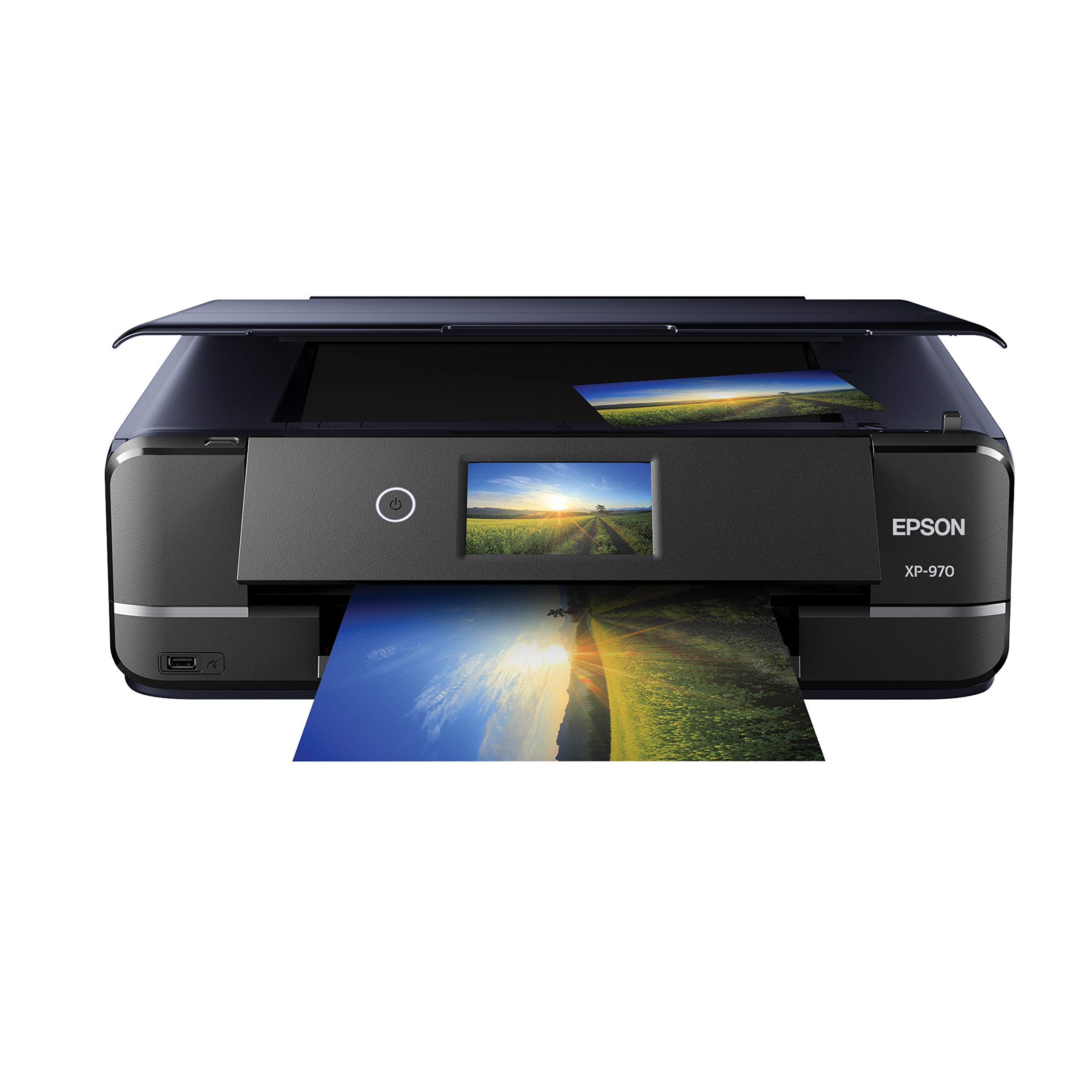
3. Epson Expression Photo XP-970 Wireless All-in-One Wide-Format Printer
The do-everything studio mate that scans, copies, and prints 13×19 photos with professional polish.
This is the wide-format printer for people who want one machine, not three. It’s an all-in-one that prints, copies, and scans — and the scan quality gets real praise, with owners reporting it captures extreme detail even from 60+ year old photos. The 6-color Claria Photo HD ink system produces prints that owners say match professional studio portraits, and the auto-duplex feature is a rare convenience at this size. At 8.5 pages per minute black and 8 pages per minute color, it’s a middle ground — faster than the budget Epson, slower than the Canon IP8720.
The standout feature is the fold-over scan lid, which holds thick originals like books in place while scanning. Owners consistently describe the print quality as matching professional studios, with one noting that photos taken via smartphone look great. USB setup runs about 45 minutes, and the printer is described as both fast and quiet in operation — the first print of a new task is slower, but subsequent prints flow.
The trade-offs are real. The XL ink cartridges are hard to find in stores, so owners recommend ordering direct from Epson. Card stock quality gets mixed feedback, with some reporting feed issues, and one owner hit frustrating problems with angled 4×6 label feeding. This is the pick for the home studio or scrapbooker who needs scanning and copying alongside big photo prints, and who values a single tidy footprint over raw speed.
The multi-tool appeal
- Print, copy, and scan in one — with impressive scan detail
- Auto duplex saves paper on double-sided jobs
- Quiet, fast operation once warmed up
- Fold-over lid holds books and thick originals
The compromises
- Card stock feeding is finicky per owner feedback
- XL ink is hard to find at retail
- Interface and tray controls take some getting used to
Choose this if: you want print, scan, and copy in one wide-format machine without sacrificing photo quality.
skip it if: you print mostly on cardstock or need high-volume speed.
4. Canon PIXMA PRO-200S Professional 13″ Wireless Inkjet Photo Printer

The 8-color studio machine that turns semi-pro workflows into gallery-grade prints.
Quality is the headline here, and it’s the most-cited positive in the owner feedback. The 8-color dye-based ink system produces vibrant, high-quality prints that one owner says “far surpasses” their old Canon 8720 — this is a step up for photographers and artists who’ve outgrown a consumer model. Borderless printing runs from 3.5″ x 3.5″ all the way up to 13″ x 19″, and the speed is respectable when it counts: a bordered A3+ print takes just 90 seconds, or a bordered 8″ x 10″ in 53 seconds.
The 3.0″ color LCD monitor makes it easy to check ink levels and printer status without guessing. Owners who push it hard — printing on Red River paper, for example — report beautiful, vibrant results with nearly true color. It’s also notably quiet in operation, which matters in a shared studio space. At 32 pounds and 28.7 inches deep, this is a substantial machine that needs permanent real estate.
The setup experience is where opinions split. Some owners find it easy, while others hit glitchy phone-install issues and Wi-Fi interference from other Canon printers in the house. The cartridge-based system means higher per-print ink cost, and speed at maximum quality slows noticeably — one owner notes roughly 30 prints drains half a black cartridge. This is the pick for the serious hobbyist or semi-pro who wants true 8-color fidelity and can navigate a slightly demanding install.
What makes it pro-grade
- 8-color dye system for vibrant, accurate color
- Fast bordered prints: A3+ in 90 seconds, 8×10 in 53 seconds
- Quiet operation suited to a studio
- Easy LCD monitoring of ink and status
What holds it back
- Setup can be glitchy, especially phone install and Wi-Fi
- Heavy at 32 lbs with a 28.7″ depth
- Cartridge ink costs add up at high volume
Pick this for: photographers and artists upgrading from a consumer printer who need true 8-color output.
Be wary if: you demand flawless plug-and-play setup or print at very high volume on a tight ink budget.
5. Canon PIXMA Pro9000 Mark II Inkjet Photo Printer (3295B002)

The cartridge-free craft machine that makes sublimation transfers at a fraction of the per-print cost.
This is a different breed entirely — a converted Epson EcoTank ET-15000 that runs on high-capacity ink tanks instead of cartridges, bundled with a full set of sublimation ink for heat-transfer crafting. The tank system is the whole point: no cartridges to replace, just refill. The bundle includes Black 127mL, Magenta 85mL, Cyan 85mL, and Yellow 85mL of sublimation ink, and the auto-fill nozzle fits the inlet perfectly with no syringe, no squeezing, no leakage. Owners using it for sublimation are emphatic: “color quality is great,” “prints large sizes,” and it’s very quiet.
It’s also a true all-in-one with a built-in scanner and copier featuring an ADF (automatic document feeder). Wide-format printing runs up to 13″ x 19″, and borderless printing reaches 11″ x 17″. The 250-sheet front tray and 2.7″ color touchscreen make it feel like a modern office machine, while the finer ink droplet size means you worry less about clogging. At 17 pages per minute black and 9 pages per minute color, it’s the fastest printer in this lineup for document work.
The catch is the warranty logic, which some owners found the hard way: the warranty is void as soon as you put the sublimation ink in — even though that ink is included in the bundle. One owner reports the paper feed is prone to issues, and shipping the printer for repair. If you’re buying for sublimation, go in knowing the 1-year limited warranty may not cover you once you start printing. This is the pick for the crafter or small-business owner doing sublimation transfers at volume who accepts the warranty caveat as part of the deal.
The craft-friendly wins
- Cartridge-free tank system slashes per-print ink costs
- Bundle includes full sublimation ink set (Black 127mL, CMY 85mL each)
- Fast: 17 ppm B&W, 9 ppm color
- Built-in scanner with ADF and 250-sheet tray
Know before you buy
- Warranty voids once sublimation ink is installed
- Paper feed can be finicky per owner reports
- Repair shipping costs around
Buy it for: sublimation crafting and heat transfers where ink cost per print is your #1 concern.
Think twice if: you need warranty protection while using the included sublimation ink.
6. Epson SureColor P700 13-Inch Printer, Black
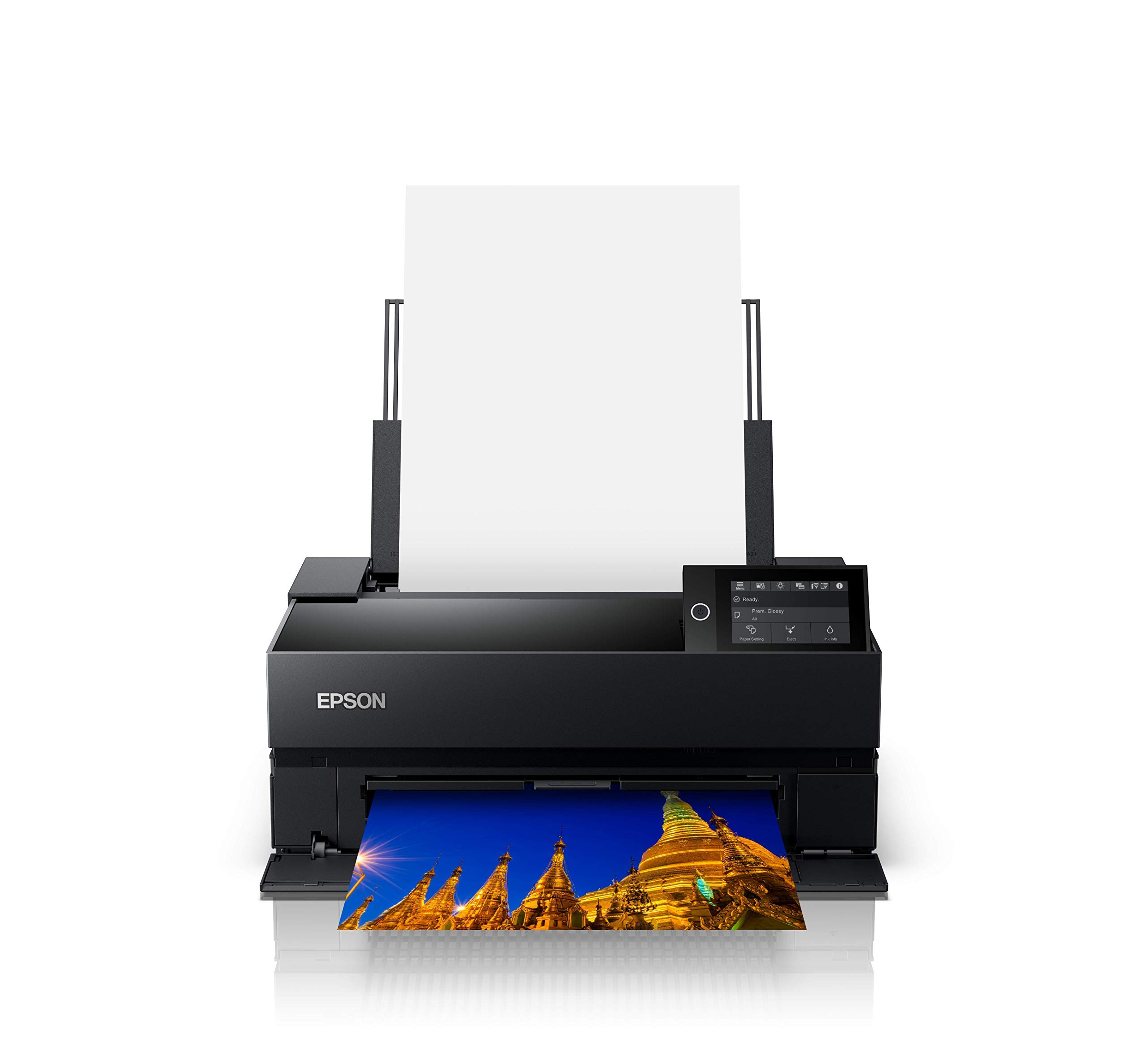
The pro-grade color engine with a violet ink that expands your printable gamut beyond consumer limits.
Print quality is the dominant theme in owner feedback, and the technology backs it up. The all-new UltraChrome PRO10 ink system includes Violet, which produces a wider color gamut for vibrant, rich tones that consumer printers can’t touch. The 10-channel MicroPiezo AMC printhead delivers consistent speed and accuracy, and the dedicated nozzles for both Photo Black and Matte Black mean no switching delay between glossy and fine-art work. Owners with a Nikon Z8 report “outstanding print quality” that justifies the pro price tag.
The 4.3″ customizable touchscreen, wireless connectivity, and interior LED light make operation genuinely pleasant. The Carbon Black Driver Technology increases black density on glossy papers, and the compact design is 23 percent smaller than Epson’s previous generation. Media handling is pro-grade: rolls and sheet media up to 1.5 mm thick, covering Epson Professional, Signature Worthy, and Legacy papers plus third-party options. Owners praise the fade-resistant ink quality in both matte and glossy blacks, and the violet channel specifically.
The ink economics are the elephant in the room. Multiple customers note the included cartridges arrive nearly empty — used up during priming — and you’ll need replacement cartridges almost immediately, at roughly each. One owner estimates about for the initial 10-cartridge set, and the ink consumption during setup can hit 80% of the included ink. The paper handling also demands attention: thick fine-art paper often needs hand-feeding, with owners reporting frequent “out of paper” and “paper jam” errors on thick media. This is the pick for the professional or serious enthusiast who demands the widest gamut and best black density, and who budgets for the real ink cost.
Why pros choose it
- Violet ink expands the color gamut significantly
- Dedicated Photo Black and Matte Black nozzles — no switching
- Handles rolls and sheets up to 1.5 mm thick
- Fade-resistant output, compact 23% smaller design
The honest cost
- Included inks nearly depleted during setup — expect ~ for replacements
- Thick paper often needs hand-feeding, with jam errors
- Individual cartridges run about each
Invest in this if: you’re a professional or serious enthusiast who demands the widest color gamut and best black density available at 13 inches.
Pass it by if: you want low running costs or print thick fine-art paper at high volume without hand-feeding.
Understanding the Specs
6-Color vs 8-Color vs 10-Color Ink
The number of ink colors determines how smooth your gradients and how wide your color gamut will be. A 6-color system (like the Epson Artisan 1430 or XP-970) adds light cyan and light magenta to the standard four, which smooths out skin tones and skies. An 8-color system (like the Canon PRO-200S or Pro9000 Mark II) adds even finer tones — the Pro9000 even includes red and green for punchier primaries, while the PRO-100 adds three grays for dedicated black-and-white. The 10-color pigment systems (Epson P700, Canon PRO-10) reach the widest gamut and best archival permanence, at a higher ink cost. More colors generally means better color accuracy, but also more cartridges to replace and more to spend.
Pages Per Minute and Real-World Speed
Pages per minute (ppm) for a photo printer is a rough guide, not a promise. A fast document printer like the Canon IP8720 hits 14.5 ppm in black, which makes short work of text pages. But a photo printer like the Epson Artisan 1430 at 2.8 ppm is a different experience — a full 13×19 photo at maximum quality can take 15 to 45 minutes, and that’s normal for the format. Photo printing at high quality is inherently slower because the printhead makes many more passes to lay down smooth gradients. If you print a stack of photos regularly, prioritize a higher ppm; if you print one or two large pieces at a time, speed matters far less than color accuracy.
Dye vs Pigment Ink Chemistry
This single choice defines what your prints are for. Dye-based inks soak into the paper and produce vivid, glossy-friendly color that looks stunning right out of the printer — they’re the choice of the Canon PRO-200S, PRO-100, and most consumer photo printers. Pigment inks sit on top of the paper in tiny particles, which makes them far more resistant to fading and smudging over decades — that’s why the Epson P700 and Canon PRO-10 are built for archival and fine-art work. The trade-off: pigment inks cost more, and some printers use more of them during setup and cleaning cycles.
Paper Handling and Borderless Printing
A 13×19 printer is only as good as its paper path. Look for a dedicated front or rear feeder for heavy-weight media — the Canon Pro9000 Mark II’s front feeder is a standout for watercolor paper, while the Epson P700 handles rolls and sheets up to 1.5 mm thick. Borderless printing means your image extends to the very edge of the paper with no white margin, which is essential for display prints. Most models in this guide support borderless up to 13×19, but check the manual-feed behavior, since thicker media often needs single-sheet loading through a specific slot rather than the main tray.
FAQ
What is the real cost of printing a 13×19 photo?
Will a 13×19 printer also print standard letter size?
Do I need a special paper for 13×19 prints?
Is borderless printing worth it for large photos?
What is the difference between dye and pigment ink for photos?
Can I print from myphone or tablet with these printers?
How much desk space does a 13×19 printer need?
Are third-party or remanufactured inks safe to use?
What causes photo printer head clogs and how do I fix them?
Which 13×19 printer is best for black-and-white photos?
Is a 13×19 printer worth it for a beginner photographer?
Final Thoughts: The Verdict
For the majority of shoppers, the 13 x 19 photo printer winner is the Epson Artisan 1430 because it delivers genuine wide-format printing at a price that doesn’t punish your wallet, with the print quality being the single most-praised feature. If you want blazing speed for high-volume work, grab the Canon IP8720, which flies through pages at 14.5 ppm. And for the professional who demands the widest color gamut and archival permanence, the Epson SureColor P700 is the one to reach for, so long as you’ve budgeted for its premium ink — the crowd favorite in this list holds a 4.3-star score across 800+ owners who overwhelmingly praise its output, a stronger consensus than any high-end rival can claim.
How We Picked
We do not accept paid placement. Every pick is matched to a real buyer and a real use-case; we do not hands-on test units.
Sources & Methodology
Specifications: manufacturer listings and product documentation. Review insights: verified customer reviews, as of September 2026. Pricing: not shown on this page (it changes often); check the current price via the retailer link.
As an Amazon Associate, KitchPrep earns from qualifying purchases. This does not affect which products we feature.
Related Guides
