
Specs are compiled from manufacturer listings and verified buyer reviews and can change over time — please confirm the key details on the product page before buying.
If your solar panels and your battery are not talking to each other properly, you lose power you already paid for. That is the whole job of a charge controller: it sits between the panel and the battery, manages the current so your battery fills up safely and does not get overcharged or drained flat. Get it wrong and you fry a battery; get it right and you rarely think about it again. This guide covers nine real 12V Solar Charge Controller options, from budget-friendly PWM units to premium MPPT models, and explains plainly which one fits your setup and who should skip each.
I’m Mohammad Maruf — the founder and writer behind KitchPrep. This guide is built by comparing the manufacturers’ published specifications and the patterns across verified customer reviews, so you get each pick’s real strengths and trade-offs instead of marketing spin.
You will see why a controller rated for 30A behaves nothing like one rated for 10A, and how PWM and MPPT change what your panels can do. By the end you can pick a winning 12V Solar Charge Controller for your RV, boat, or shed panels without guesswork.
Our Picks at a Glance


How To Choose The Best 12V Solar Charge Controller
Before you buy anything, you need two numbers from your own setup: the total wattage of your solar panels, and the voltage your battery bank runs at. Everything else — PWM versus MPPT, amperage rating, display, waterproofing — flows from those two facts. Get them right and the rest of the shopping is easy.
PWM Or MPPT — Which One Do You Actually Need?
A PWM controller (pulse width modulation) drops your panel’s voltage down to match the battery, so it is simple, tough, and budget-friendly. An MPPT controller (maximum power point tracking) constantly searches for the balance where your panels make the most power, so it pulls more usable watts from the same panels. MPPT pays off most when your panels run at a higher voltage than your battery, which happens when you wire panels in series.
Match The Amperage To Your Panels
A 30A controller handles more panel current than a 10A one, so the amp rating caps how much solar you can push through. Size the controller above your expected peak so you never clip your harvest on a bright day. Going too small throttles your array; going too large is just unused headroom you paid extra for.
Battery Type And Low-Temp Protection
Flooded, AGM, gel, and lithium batteries each want different charge voltages, so confirm the controller supports your chemistry before buying. If you run LiFePO4 in cold weather, a low-temperature cut-off stops charging below freezing — a feature that protects the battery from cold-weather damage. Check that your chosen chemistry is either auto-detected or selectable.
Display, App Control, And Mounting
An LCD screen lets you watch battery voltage, charge current, and generated energy at a glance, while app control lets you monitor from a few feet away without crouching over the unit. For boats and exposed RV mounts, an IP67 waterproof rating keeps the unit running through spray and condensation. Check the physical footprint too — a flush-mount controller tucks into a wall panel, while a larger unit needs more clearance behind it.
Quick Comparison
| Model | Best For | Type | Max Current | Battery System | Amazon |
|---|---|---|---|---|---|
| Renogy Adventurer 30A PWM★ Best Overall | Fast flush-mount RV upgrades | PWM | 30A | 12V / 24V | Amazon |
| Bateria Power SunRock 10 MPPTBest for Small Systems | Motorcycle and small-panel upkeep | MPPT | 10A | 12V | Amazon |
| Renogy Voyager 20A PWMBest Waterproof Pick | Wet, exposed marine installs | PWM | 20A | 12V / 24V | Amazon |
| POWLAND 60A MPPT | Big arrays that need high current | MPPT | 60A | 12V / 24V / 36V / 48V | Amazon |
| EPEVER Tracer3210AN G3 30A | Monitoring-heavy cabin systems | MPPT | 30A | 12V / 24V | Amazon |
| Victron Energy BlueSolar 100/30 | Maximum reliability, no fuss | MPPT | 30A | 12V / 24V | Amazon |
| BougeRV Sunflow 30A MPPT | Cold-climate LiFePO4 protection | MPPT | 30A | 12V / 24V | Amazon |
| LiTime 12V/24V 30A MPPT | Built-in Bluetooth monitoring | MPPT | 30A | 12V / 24V | Amazon |
| EPEVER 40A MPPT Tracer BN | High-voltage multi-panel arrays | MPPT | 40A | 12V / 24V | Amazon |
In‑Depth Reviews
1. Renogy 30A 12V/24V PWM Solar Charge Controller with LCD Display Flush Mount
Our pick — over 4★ from 900+ verified ratings; the strongest balance of quality and price.
The crowd favorite that slots straight into an RV wall panel and starts charging in minutes.
The Renogy Adventurer 30A is the pick most people should start with, and its 4.4 stars across 900+ ratings back that up. The 30A rating means it moves a serious amount of current, and the 6.56″L x 4.5″W x 1.9″H body is built to sit flush inside your wall rather than hang loose on a shelf. A surface kit is included, so you can mount it cleanly and route your wires without a custom panel. The backlit LCD shows live status, and you can pull charging data onto your phone through the DC Home app if the panel is Renogy BT-1 compatible.
You get a fast hookup and a controller that is simple to live with day to day. It auto-detects whether you have a 12V or 24V battery bank, so you do not have to flip a switch. It works with lithium, AGM, gel, and flooded batteries. Its 4-stage charging (bulk, boost, float, equalization) extends battery life, and it can revive an over-discharged lithium battery. Standard negative-ground compatibility removes the reverse-polarity worry, which is among the most common ways a DIY install fails on the first try. It also runs from -4°F to 140°F, so a cold RV bay or a hot engine compartment does not knock it out.
What owners keep praising
- Flush-mount design drops into a wall cutout with a surface kit included.
- Auto-detects 12V/24V and handles lithium, AGM, gel, and flooded banks.
- 4-stage charging extends battery life and revives over-discharged lithium.
- Negative-ground wiring takes the fear out of a first DIY install.
Worth knowing before you buy
- On some installs, sloppy rear wire connections have interrupted the charge output.
- This is PWM, so it delivers less usable power from the same panels than an MPPT model.
- App monitoring only works if you add the Renogy BT-1 module.
Best for: Anyone upgrading an RV, van, or camper wall who wants a fast flush-mount install and broad battery support.
Skip if: You run panels at a higher voltage than the battery bank and want the extra harvest MPPT gives you.
2. Bateria Power SunRock 10 10Amp 12 Volt MPPT Solar Charge Controller
Tiny MPPT brain for keeping a motorcycle, boat, or shed battery topped up on a single small panel.
This controller runs at 10A, a 3.0x smaller amperage rating than the Renogy’s 30A, so it suits a small single panel rather than a large array. Its 3.7″L x 2.42″W x 1.06″H footprint also saves space — 77% less volume than that larger unit — and it weighs 145 g, so it slips into a glovebox or a small marine locker without a second thought. What you get for the smaller size is MPPT charging, which keeps pulling useful power from a modest panel where a cheaper PWM unit would surrender some of it.
This controller is built for a 12V battery only, and it works with AGM, gel, deep-cycle, sealed, lead-acid, flooded, and LiFePO4 banks. Bateria Power claims up to 100% tracking efficiency and up to 20% faster charging than other options — maker’s figures, not independently verified. Wiring is plug-and-play via SAE connectors, and two 130mm SAE extension cables are included for a quick hookup. The PV input needs to be higher than the battery voltage — a minimum of 15V and no more than 30V — and the connection order matters: battery first, panel second. It also carries overcharge, over-temperature, over-voltage, over-current, short-circuit, discharge, and reverse-polarity protection.
The honest catch is the display. The LCD and LED indicators show what the panel is doing, but the display is hard to read, and the meter has been noted to run 100-400mV off. It also stops charging at 14.4V rather than 14.6V for LiFePO4, with no adjustable settings. The controller is built for outdoor use, though the maker itself advises not soaking it in water. Buyers report a version of this unit keeping a motorcycle battery maintained off-grid through a 35W panel for roughly a year, and starting a high-compression 1700cc engine after six months — a good sign for the trickle-charge crowd.
Where it earns its spot: Compact MPPT at a small-system price, waterproof enough for outdoor use, and SAE connectors make connecting a two-minute job.
Reach for this if: You are maintaining a motorcycle, boat, or shed battery on a 35W-to-150W panel and want MPPT efficiency in the palm of your hand.
Look elsewhere if: You plan a 30A+ array — this controller’s 10A ceiling will cut the harvest short.
3. Renogy Voyager 20A PWM Solar Charge Controller IP67
Built for the elements — spray, rain, and condensation do not shut this 20A PWM unit down.
If your controller lives on a boat, a tender, or any exposed mount, the Voyager’s IP67 rating is the whole point. IP67 means the unit stays fully operational when hit with water spray, rain, or condensation, which covers almost everything short of full immersion. It accepts 55V of PV input and auto-senses 12V or 24V systems, and it supports AGM, gel, and flooded batteries with a lithium activation feature. Physically it measures 6.08″L x 3.83″W x 1.4″H and comes with a removable mount that sits nicely beside the battery for a short wire run.
What people consistently like is the build and the price-to-performance balance — Removable mount by battery, plug-in wires. This one actually works in the weather, and the backlit LCD keeps you informed with charging current, generated energy, temperature, battery voltage, and error codes. The multiple protections cover reverse polarity, overcharge, short-circuit, reverse current, overload, and over-discharge, so a hastily wired install is far less likely to end in a dead battery. Real-world it has kept a 12V fence charger with a lead-acid battery running off a 20W panel, floating at 13.8V and resuming charge at sunrise.
The complaint worth knowing is on accuracy. Battery voltage readings have been seen running.2 to.4V off, and the error can worsen when the temperature sensor is attached. The backup buttons can be sluggish, and some units report a blank screen after a while. Owners mention a 24V sailboat install that auto-detected the voltage and started charging immediately, with an easy-to-read display and a minor note that flush mounting leaves little wire clearance behind — roughly an inch of wire visible below the unit. Treat those notes as sizing and setup quirks rather than reasons to rule the Voyager out.
Why it stands out on a wet mount: The IP67 waterproofing, the 55V PV input ceiling, and the lithium activation feature put it ahead of the ambient-only controllers in this list.
The right call if: Your controller is exposed to weather — a boat, a camper trailer, or a fence-charger box — and you want it to keep working through the worst of it.
Head inside instead if: You need voltage readings accurate to the tenth of a volt, since this unit’s display accuracy is one of its weak points.
4. POWLAND 60A MPPT Solar Charge Controller 12V/24V/36V/48V Auto

Feeds a serious array — 60 amps of charging current for setups that outgrow the small stuff.
When your panel array is big enough that a 20A or 30A unit would bottle-neck it, the POWLAND 60A is the pick here to step up to. The headline figure is the 60A charging rate, the highest amperage in this list, and the 4-level charging algorithm (batch, boost, float, equalizing) is designed to charge fast and safely. POWLAND rates it at ≥99% PV utilization and ≥98.1% max efficiency, so it pulls nearly all the available power from the array. It auto-detects 12V, 24V, 36V, or 48V systems, and it supports flooded, AGM, gel, and lithium-ion batteries.
A built-in fan handles cooling and kicks in at higher charging or solar amperage, and it can handle roughly 50A of solar charging without shutting down. The LCD screen and four buttons let you watch system data and operating status, and the manual is accurate and clear. Real-world feedback on larger installs confirms the high-current claim — one owner moved from a PWM controller to this unit and saw it take ~50A of solar charging without a hiccup, and another bought a second one after the first ran for years.
The trade-off is noise and size. The same fan that lets it run cool is described as too loud, so plan on locating it away from living space. Its 7.9″L x 7.9″W x 3.16″H body and 3.8-pound heft demand real mounting room. Some units arrive with connection screws that are nearly impossible to remove — heat from a soldering iron may be needed — so budget a little patience for the first setup. Functionality is the mixed-leaning part of the picture, and the value still comes through for buyers running a large array.
What it gets right
- 60A charging current — the highest in this lineup — for arrays that need real throughput.
- Auto-detects 12V, 24V, 36V, or 48V systems and supports four battery chemistries.
- Cooling fan handles roughly 50A of continuous solar charging without shutdown.
Where it gives something back
- The cooling fan runs loud at high amperage — site it away from living quarters.
- Connection screws have arrived seized hard enough to need soldering-iron heat.
- Bulky 7.9-inch square footprint and 3.8 pounds of weight need a sturdy mount.
The high-current specialist: Pick this when your panel array is big enough to justify 60A of charge throughput and you have somewhere out of earshot to mount it.
Not for you if: Your system tops out under 30A — you will pay for capability you never tap.
5. EPEVER 30A MPPT Solar Charge Controller Tracer3210AN G3
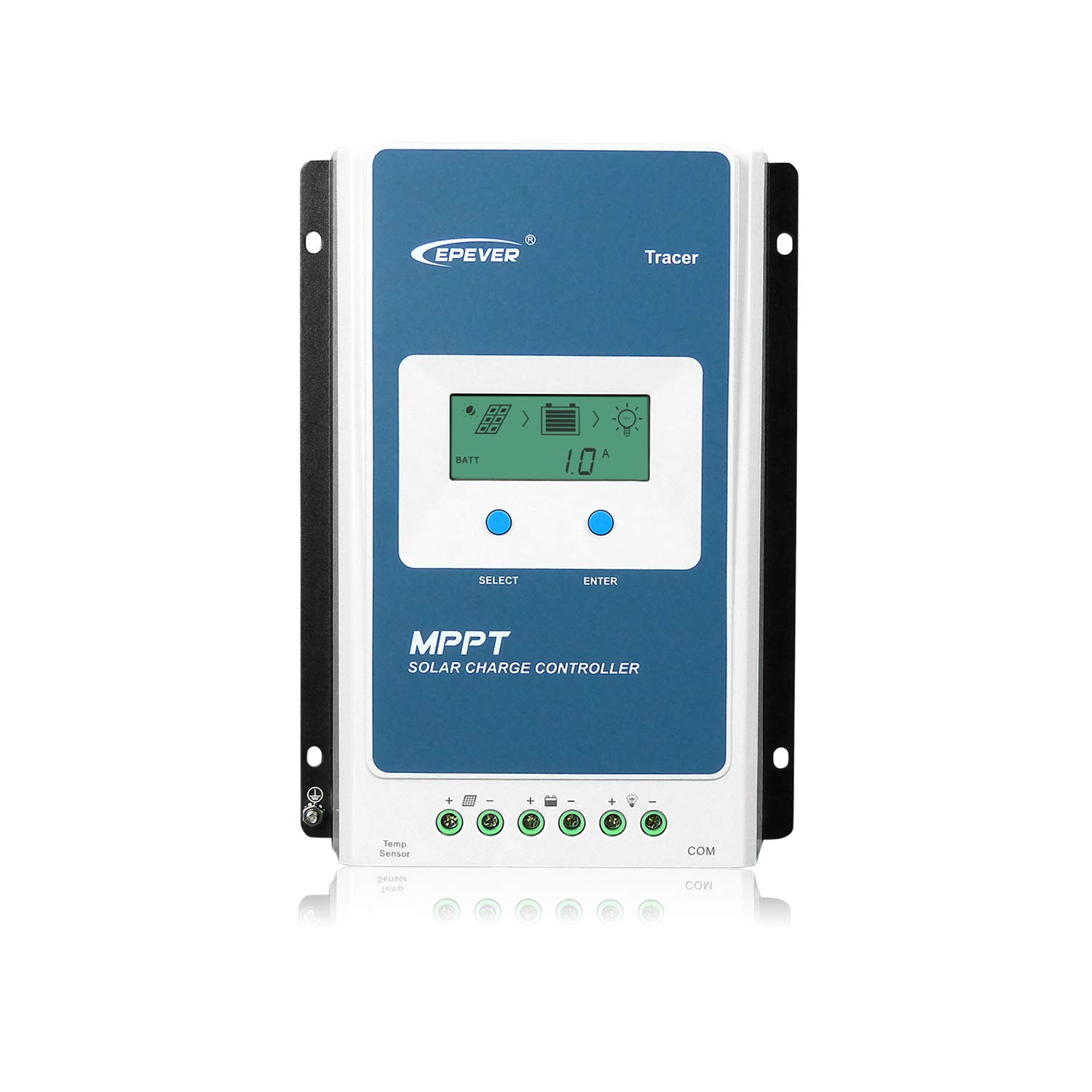
A quiet over-achiever that pulls 99.5% tracking efficiency from small off-grid arrays.
The Tracer3210AN G3 is the choice for the tinkerer who wants to monitor and tune the system, not just plug it in and forget it. EPEVER lists tracking efficiency above 99.5% and peak conversion efficiency at 98%, so it extracts nearly all the usable power from a small array. It auto-identifies 12V/24V batteries, handles up to 390W of PV at 12V or 780W at 24V, and accepts a max PV voltage of 100V. The 92-ounce, plastic-cased unit is designed for common negative-ground systems.
Where it really pulls ahead for the right buyer is the RS485 Modbus communication port, which opens up a range of monitoring accessories: MT52, RTS, PC cable (USB-RS485), Bluetooth, and Wi-Fi adapters are all available. Four load control modes — manual, light ON/OFF, light On + Timer, and test mode — let you automate a light or a load. The G3 version is the latest iteration of a model line that has been in production since 2008, with reduced noise and improved stability compared to earlier versions. So if you are the type who likes to see the numbers, this is where the controller earns its keep.
The trade-off is that EPEVER keeps some things behind paid additions. The MT50 remote meter is not compatible with this newer model, and a LiFePO4 setup isn’t preset — you’ll need “User” mode, a laptop, and a manufacturer-specific remote setup to dial in the voltages. Screen visibility is also described as challenging at some angles. Battery type isn’t shown by default, and the buttons can feel unresponsive. If those rough edges sound like a deal breaker, consider the Victron below, which takes a more polished approach — but for those who want the communication options, the EPEVER is worth the extra setup effort.
The case for the tinkerer: Tracking efficiency of more than 99.5%, a peak conversion efficiency of 98%, and a full RS485 accessory ecosystem set it apart from the plug-and-forget crowd.
Choose this for: A garage, cabin, or workshop system where you want to watch the data and maybe automate a light or a load.
Pass it by if: You want to install once with zero extra setup — the remote meter incompatibility and lithium programming will test your patience.
6. Victron Energy BlueSolar MPPT Solar Charge Controller 100V 30A

The buy-it-once controller: fewer repairs, more usable power, and the least drama in the lineup.
Victron has earned a near-cult following among off-gridders for one reason: reliability. The BlueSolar MPPT 100/30 is the model that comes closest to being the last controller you’ll ever need to install, and its 4.1-star rating across 350+ ratings reflects a crowd that has owned a lot of controllers and prefers this one. The headline spec is 100V of max PV input and 30A of charging current on a 12V/24V system. The MPPT tracking is lightning-fast and paired with intelligent charge algorithms, so you get close to max power even when your panels are partially shaded — a big deal if you live around trees or mount panels that see cloud shadows during the day.
The physical package is a compact 7.32″L x 2.75″W x 5.12″H unit that weighs about 3 pounds and runs cool thanks to the cast-metal housing. The real draw is that it simply works: customers note setting this up and then forgetting about it for years, in contrast with cheaper controllers that have failed or been replaced. Some owners swap out failed competitors and settle here permanently. Where it shines, though, is shade tolerance — if your panel is partially covered, the Victron is engineered to keep harvesting, and that means less wasted sun on an imperfect mount.
Two honest caveats. First, this is the BlueSolar line, not the SmartSolar line — which means no built-in Bluetooth. The name is misleading, and a separate dongle is required to use the VictronConnect app. Second, value is subjective: you are paying for reliability and support, not for extra features. That is a fair trade-off for anyone who values less maintenance, but it can be a surprise if you assumed wireless monitoring from the start.
The Victron Energy BlueSolar MPPT 100/30 pairs a 100V PV input ceiling with 30A of charging current and the shade-tolerant tracking that off-gridders prize for panels tucked near trees.
The reliability premium: Reviewers point out fewer failures and less replacement churn than with cheaper MPPT controllers, so the confidence is the real feature.
The Bluetooth snag: The “Blue” in the name does not mean wireless — a separate dongle is required for the app, which is a surprise worth knowing before you buy.
The one to buy if: You want a controller you can install and trust for years in a shaded or imperfect array, and you do not mind adding a Bluetooth dongle later.
Look to the BougeRV if: Built-in app control and Bluetooth matter more to you than the Victron’s track record.
7. BougeRV MPPT Solar Charge Controller 30A with Low-Temp Cut-Off & APP Control
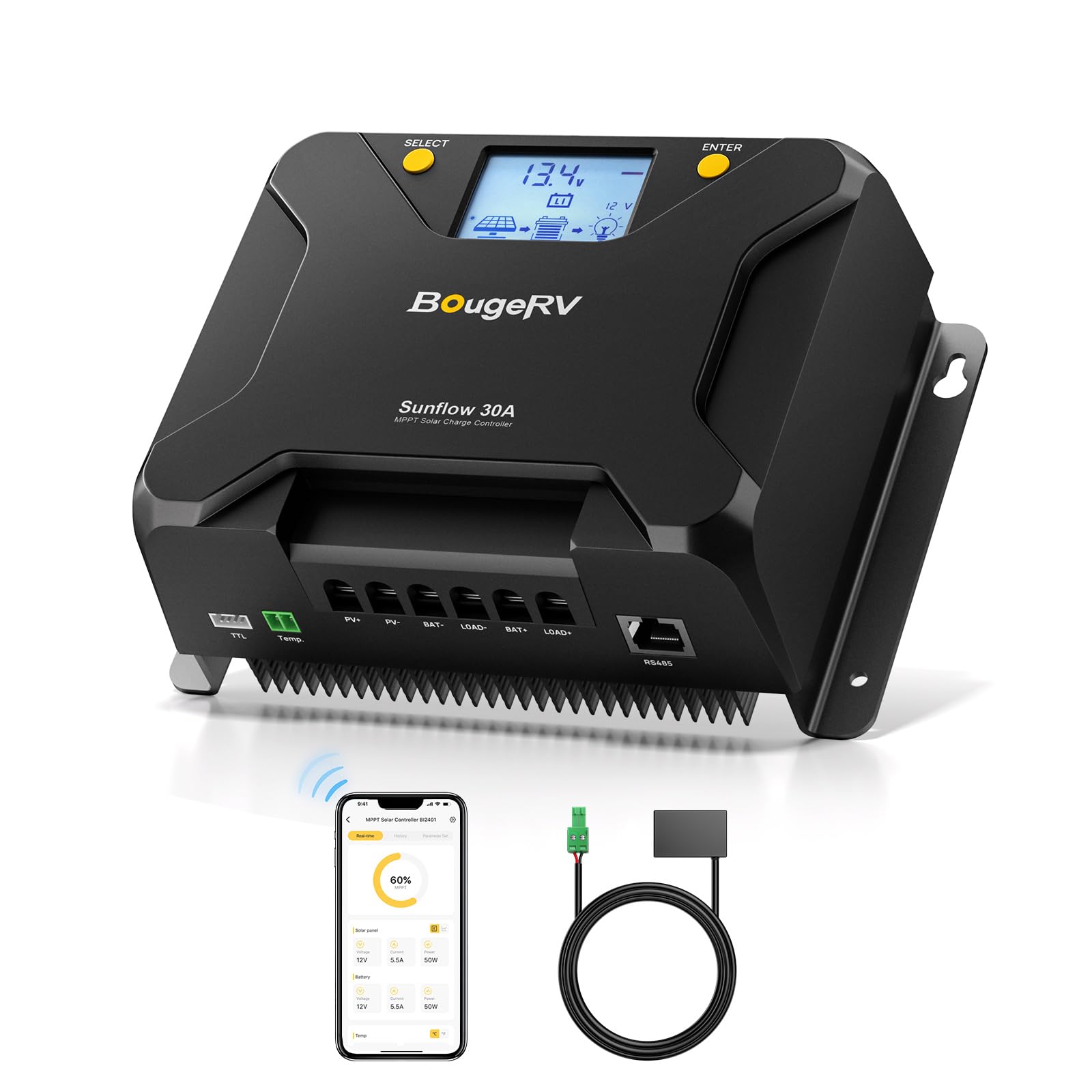
Charges hard in summer, cuts off when the temperature drops — the LiFePO4-friendly 30A MPPT.
If your panels run through winter in a cold garage or garage-temperature RV bay, the BougeRV Sunflow 30A is the pick to look at. The headline feature is a low-temperature cut-off that stops charging below 32°F to protect LiFePO4 batteries from cold-weather charging damage — a real protection, not just a marketing label. It will also restart or wake a dormant 12V or 24V LiFePO4 battery that has been turned off by a short circuit or over-discharge. BougeRV rates it at 99.5% tracking efficiency and up to 99% peak conversion efficiency, so it squeezes the most from the panels.
The build is solid, with a quality aluminum heat sink to dissipate heat faster and minimize power lost under full load. The charge current adjusts from 0A to 30A, the PV input maxes out at 450W for a 12V system or 900W for a 24V system, and the max PV input voltage is 95V. The wire spec is 15-8AWG and the rated load current is 20A. The controller is CE and RoHS certified and uses a dual MOS circuit to block reverse current. Multiple protections cover over-temperature, open-circuit, short-circuit, overload, polarity reverse, and current flow-back, and it comes with 18-month tech support.
Two things to know. The app — BougeRV — works well for most people and shows panel, battery, and load status, but it runs on Bluetooth and can be finicky to connect on the first few tries. Some users find the two-button on-device interface less helpful than the app, so plan to download it before you set the unit. That said, the low-temp cut-off is a real differentiator for anyone who runs LiFePO4 in a cold climate and wants to protect the bank without extra wiring.
The cold-weather advantage: Below 32°F, the low-temp cut-off stops charging to protect LiFePO4 — the kind of feature that saves a battery’s life in a winter cabin.
The app-first reality: The BougeRV app is how most users dial in the settings, and Bluetooth pairing can take a few tries before it catches.
Best fit for: Cold-climate off-grid setups running LiFePO4 that need winter protection and a controller that will wake a dormant battery.
Maybe not if: You dislike app-based setup and prefer a controller you can fully configure from the front panel without touching a phone.
8. LiTime 12V/24V 30A MPPT Solar Charge Controller with Bluetooth & LCD
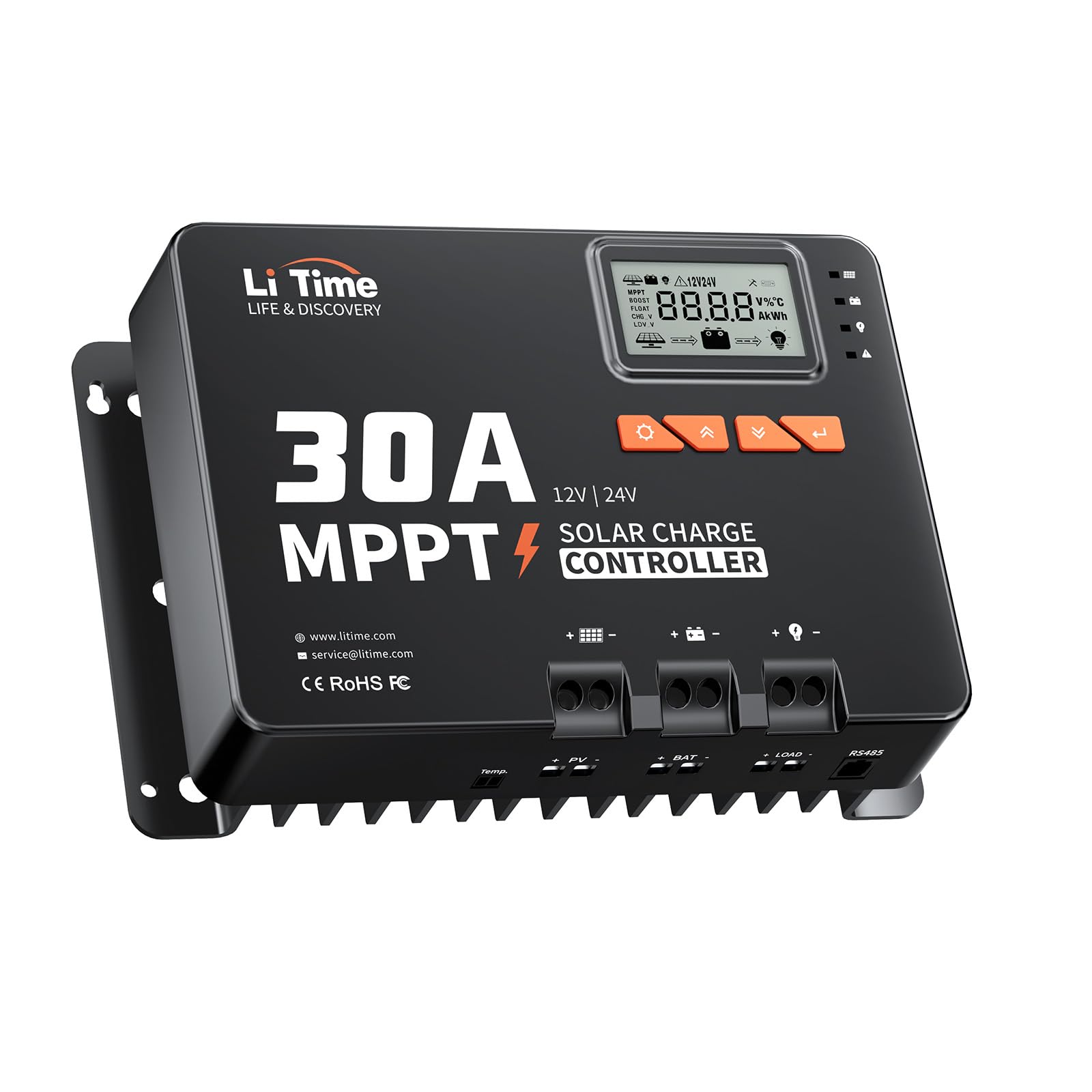
Bluetooth monitoring comes already installed — no dongle, no add-on, no extra cost.
The LiTime 30A MPPT is the one for buyers who want the app already there when the box opens. The built-in Bluetooth module means you do not have to buy a separate dongle, and the app lets you remote-control and read usage information straight from your phone. Its 99%-plus tracking follows the array’s maximum power point, with peak conversion efficiency at 98%. It runs on 12V or 24V systems, handles up to 450W of PV at 12V or 900W at 24V, and supports LiFePO4 as well as Sealed, Gel, and Lead-acid batteries with a parameter adjustment.
The 9.65″L x 3.25″W x 7.09″H controller is built in die-cast aluminum for better heat dissipation, with an LCD screen, four operation buttons, and LED indicators covering the solar array, battery, loads, and controller state. Copper wire connectors are included in the box, along with heat-shrink tubes and screws, so parts do not need hunting down on install day. Multiple protections guard against reverse connection, overpower, overvoltage, short-circuit, and over-temperature, and this model is also covered by AIG Product Liability Insurance.
The weak spot sits squarely with the app. Bluetooth connectivity is the recurring gripe — users have had trouble pairing, dealt with “Chinglish” errors in the app, and found that a too-new Android OS may not support the download at all. That is a real friction point if remote monitoring is why you’re buying. There is also a manuals conflict: the LTCP and remote temp sensor question is answered differently between the paper and online versions, with the resolution being that LiFePO4 low-temp protection is handled by the battery management system — so leave the remote sensor disconnected.
Where the value lands
- Built-in Bluetooth module — no extra dongle to buy, unlike the Victron above.
- 99%-plus tracking efficiency and 98% peak conversion efficiency from die-cast aluminum hardware.
- Copper connectors, heat-shrink tubes, and screws all included in the package.
Room to improve
- Bluetooth pairing is inconsistent for some owners, with occasional drops mid-session.
- App store compatibility can lag on very new Android versions.
- Paper and online manuals disagree on the low-temp sensor question — check the online version.
Best for: Anyone upgrading from a lead-acid setup to LiFePO4 who wants Bluetooth monitoring already built in, not bolted on.
skip it if: You need bulletproof wireless reliability — the app’s pairing quirks are the one place this controller lets you down.
9. EPEVER 40A MPPT Solar Charge Controller 12V/24V Auto, Max PV 150V (Tracer BN Series)

Handles long panel strings at up to 150V while the die-cast aluminum body runs cool.
The Tracer BN 40A sits at the top of this lineup for buyers running series-wired panels. Its 150V max PV open circuit voltage is the number that matters here — it lets you run long panel strings without dropping down to lower-voltage configurations, which cuts your wire losses over distance. EPEVER lists tracking efficiency at no less than 99.5% and maximum conversion efficiency at 98%, matching the EPEVER 30A above. It auto-identifies 12V or 24V systems and supports Sealed, Gel, Flooded, and User charging profiles.
Where the 40A beats the 30A pick above is raw output capability and the exact set of accessories. It comes packaged with the 4215BN controller, MT50 remote meter, RTS temperature sensor, and RS485 interface all in the box — meaning everything needed for monitoring and temperature reference is included without extra purchases. The die-cast aluminum design gives it excellent heat dissipation characteristics, and the RS485 interface means the same cellphone app (eBox required), PC software, and MT50 monitoring options that make the line popular are all available. For a household system or an industrial field installation, that communication flexibility is what separates it from the plug-and-forget crowd.
The honest catch is weight and mounting. At 3.75 kg with an 11.9″L x 7.19″W x 2.5″H body, this is one of the heaviest controllers in the list, so you need a solid mounting surface and good clearance. It’s also the most expensive pick here by a wide margin — you’re paying for the 40A rating, the included MT50 meter, the temperature sensor, and the 150V ceiling all at once. That makes sense if you’re running a big, high-voltage array; it makes less sense if your system is small and would sit comfortably on a 30A or PWM unit instead.
The EPEVER 40A Tracer BN pairs a 150V max PV open circuit voltage with 99.5%-plus tracking efficiency, making it the pick for high-voltage panel strings that outsize a 30A unit.
The high-voltage advantage: The 150V PV ceiling and the included MT50 remote meter, RTS sensor, and RS485 interface are what separate this pick from the 30A EPEVER above.
The weight reality: At 3.75 kg and 11.9 inches long, it needs a sturdy mount — plan for the space before you buy.
Reach for this if: You run long series panel strings, want to monitor from a phone or PC, and value the accessories being bundled in already.
Consider the BougeRV instead if: Your array is modest — the size, weight, and included extras here only pay off on larger high-voltage setups.
Understanding the Specs
Amperage Rating
The amperage rating — 10A, 20A, 30A, 40A, or 60A — caps how much current can flow through the controller to your battery. A 30A unit can push roughly three times the current of a 10A one, which is why the Renogy 30A pairs with RV-scale arrays while the Bateria Power 10A suits a single small panel. Size your controller above your expected peak so you never clip your harvest on a bright day. Under-sizing throttles your array; over-sizing is unused headroom.
MPPT Vs PWM
PWM (pulse width modulation) simply lets panel voltage drop to battery voltage, so it is simple and budget-friendly — good when your panel voltage is already close to your battery voltage. MPPT (maximum power point tracking) actively searches for the point where your panels produce the most power, so it pulls more usable watts from the same array. MPPT pays off most when your panel voltage runs higher than your battery voltage, such as with series-wired panels.
Max PV Input Voltage
The max PV input voltage is the highest panel open-circuit voltage the controller can safely accept. The Bateria Power 10A caps at 30V, the BougeRV at 95V, the Victron and EPEVER 30A at 100V, and the EPEVER 40A Tracer BN at 150V. A higher ceiling lets you run longer series strings and thinner, cheaper wire over distance. Exceed it, though, and you risk damaging the controller.
Low-Temp Cut-Off And Battery Chemistry
Lead-acid, AGM, gel, flooded, and lithium batteries each want different charge voltages, so a controller must match your chemistry. For LiFePO4 in cold weather, a low-temperature cut-off stops charging below freezing to protect the battery — a feature the BougeRV Sunflow carries. Confirm your chemistry is either auto-detected or manually selectable before you buy.
FAQ
What size charge controller do I need for my solar panel array?
Is MPPT better than PWM for a 12V solar setup?
Will a 12V charge controller work with a lithium battery?
What does low-temperature cut-off do on a charge controller?
Do I need a waterproof solar charge controller for a boat?
How long do solar charge controllers typically last?
Can I connect a solar charge controller without a battery?
Why is my controller showing 7 amps in but no charge output?
What wire gauge should I use with a 30A solar charge controller?
Final Thoughts: The Verdict
For most people wiring up a 12V system, the 12v solar charge controller winner is the Renogy Adventurer 30A because it auto-detects 12V or 24V, handles lithium, AGM, gel, and flooded banks, and drops into a wall cutout in minutes — the fewest ways to get it wrong on day one. If you run a cold-climate LiFePO4 setup and want winter protection built in, grab the BougeRV Sunflow 30A, whose low-temp cut-off stops charging below freezing. And for a long series-wired panel array that needs a high-voltage ceiling plus bundled monitoring, the EPEVER 40A Tracer BN is the one to reach for. Whichever you pick, size the amperage above your panel’s peak and mount it where air can move around it — those two choices do more for a controller’s working life than any feature on the box.
How We Picked
We do not accept paid placement. Every pick is matched to a real buyer and a real use-case; we do not hands-on test units.
Sources & Methodology
Specifications: manufacturer listings and product documentation. Review insights: verified customer reviews, as of September 2026. Pricing: not shown on this page (it changes often); check the current price via the retailer link.
As an Amazon Associate, KitchPrep earns from qualifying purchases. This does not affect which products we feature.
Related Guides
