
Specs are compiled from manufacturer listings and verified buyer reviews and can change over time — please confirm the key details on the product page before buying.
If you are shopping for a 12V pure sine wave inverter, the number you should trust least is the one printed biggest on the box. Wattage ratings are frequently optimistic, but whether your microwave, fridge, or CPAP machine actually runs — and keeps running — depends on three things: a stable sine wave, a battery bank big enough to feed the load, and DC cables thick enough to carry the current without heating up. This guide walks through six proven options, what each one genuinely does well, and the honest trade-offs you will live with after installation.
I’m Mohammad Maruf — the founder and writer behind KitchPrep. This guide is built by comparing the manufacturers’ published specifications and the patterns across verified customer reviews, so you get each pick’s real strengths and trade-offs instead of marketing spin.
Whether you are wiring a camper, backing up a fridge, or building an off-grid solar setup, the six picks below span 1000W to 3000W continuous. The right 12v pure sine wave inverter for most people is the one whose continuous rating, cable gauge, and protection features match the appliances you own.
Our Picks at a Glance

How To Choose The Best 12V Pure Sine Wave Inverter
An inverter takes the 12-volt direct current (DC) stored in your battery and turns it into 120-volt alternating current (AC), the same type of power that comes out of a wall outlet. A pure sine wave inverter produces that AC as a smooth, rounded wave — the same shape your household grid produces — which is why motors run cooler and electronics do not hum or flicker. A modified sine wave unit chops the wave into a blocky staircase shape, and that is what causes buzzing in audio gear and rough running in inductive loads.
Match continuous watts to your real load, not the surge number
Every inverter lists a continuous rating and a surge rating. Continuous watts is what the unit can deliver all day; surge is the brief spike a motor or compressor pulls for a second or two at startup. A microwave that draws around 1200 watts steady may pull far more for a split second when the magnetron kicks in. Buy for the highest continuous load you plan to run at once, and check the surge figure so a fridge compressor or AC unit can start without tripping the unit into protection.
Your battery bank and DC cables decide success
This is where most installs go wrong. Pulling 2000 watts at 12 volts demands a very large direct current from the battery, and that current flows through your DC cables. Thin cables over a long run heat up, drop voltage, and can shut the inverter down — or worse. The included cables are often adequate only for short runs at moderate loads. If you are mounting the inverter far from the battery, expect to upgrade to a heavier gauge such as 2 AWG, 1/0 AWG, or 2/0 AWG, and to add an appropriately sized inline fuse on the positive cable.
Look for the protections and monitor that matter
Good units guard against over-voltage, under-voltage, overload, over-temperature, short circuit, and reverse polarity. A wired remote with a display lets you switch the inverter on and off and watch battery voltage from inside your vehicle or living space. If you plan to hardwire the output into a breaker panel, look for a hardwire terminal or an outlet rated for the load. And if you plan to connect the inverter to a building circuit, ground it correctly per the manufacturer’s instructions and your local code.
Quick Comparison
| Model | Best For | Continuous Power | Weight | Outlets & Ports | Amazon |
|---|---|---|---|---|---|
| GIANDEL 2200W Pure Sine Wave Inverter★ Best Overall | Whole-system RV and off-grid builds | 2200W | 10.5 lb | 2 AC outlets + 1×2.4A USB + 20A hardwire blocks | Amazon |
| LANDERPOW 1000W Car Power InverterBest Value | Trucks, commutes, and light appliance duty | 1000W (2000W surge) | 3.6 lb | 3 AC outlets + USB & USB-C | Amazon |
| VOLTWORKS 2000W Pure Sine Wave Inverter | RV appliances and hardwired circuits | 2000W | 9.9 lb | 2 AC outlets + 40A terminal blocks + 2 USB ports | Amazon |
| BELTTT 2000W Pure Sine Wave Inverter | Mid-size off-grid and truck use | 2000W (4000W surge) | 7.7 lb | Dual AC socket + 20A outlet + USB + hardwire port | Amazon |
| GIANDEL 1500W Pure Sine Wave Inverter | Campers and smaller appliance loads | 1500W (3100W max) | — | GFCI outlets + USB-C 36W + 20A GFCI | Amazon |
| BELTTT 3000W Pure Sine Wave Inverter | Heavy loads like AC and simultaneous appliances | 3000W (6000W peak) | 9.9 lb | Dual AC socket + 20A outlet + USB + hardwire port | Amazon |
In-Depth Reviews
1. GIANDEL Pure Sine Wave Power Inverter 2200Watt ETL UL458 Listed DC 12V to 120 Vac
Our pick — over 4.5★ from 450+ verified ratings; the strongest balance of quality and price.
The heavyweight that runs a microwave and a soft-start AC while towing a fridge on the move.
When you are running an off-grid solar system, a camper, or a whole backup circuit, this GIANDEL delivers 2200 watts of continuous pure sine wave power from a 12-volt battery into 120 volts AC. That sine wave is a low-distortion 3% total harmonic distortion reading, which in plain terms means the AC shape is close enough to your household grid that sensitive electronics run without humming or flickering. It is ETL listed and built to the UL458 standard, a safety certification that applies to this class of power conversion equipment. The 2200W figure beats the 2000W units in this list on continuous rating, and it is designed for appliances drawing up to that ceiling.
What really separates this unit from the lighter picks is its willingness to feed heavy, hardwired loads. It ships with 20-amp hardwire terminal blocks, so you can tie it into a breaker panel or dedicated wiring rather than relying only on the two AC outlets. GIANDEL recommends a 200 Ah battery bank or larger to run the loads this inverter is built for, and it comes with a pair of 2-foot pure copper cables in 35 mm² — thicker than 2 AWG — to carry that current. A 15-foot wired remote turns the unit on and off from inside your rig, and the LED display shows input voltage, output power, and protection status. At 10.5 pounds it is a substantial piece of gear; the lighter LANDERPOW 1000W runs 3.6 pounds, but it also tops out at 1000 watts, so the two exist for very different jobs.
The real-world picture from long-term owners is steady. RV solar builds report running a microwave, a soft-start air conditioner, and a fridge on AC while towing, all on one 2200-watt unit. People powering a house through a manual transfer switch during outages describe keeping a fridge, microwave, gas furnace, router, and LED lighting going for hours. Quiet operation comes up again and again — the cooling fan stays off at idle and only spins up under genuine load. On efficiency, a shop-vac test pulled about 1300 watts from a 12.4-volt battery and stayed cool to the touch. GIANDEL backs it with a 36-month warranty and an aluminum alloy housing, and it carries 4.6 stars across 400+ ratings.
What earns it the top spot
- 2200W continuous output with 3% THD for clean, grid-like power
- 20-amp hardwire terminal blocks let you wire it into a panel
- 15-foot wired remote plus LED readout for voltage and load
- 35 mm² pure copper cables (thicker than 2 AWG) included
- ETL listed to UL458, with a 36-month warranty
Where it asks something of you
- Heavy at 10.5 pounds — plan a solid mounting spot
- GIANDEL recommends a 200 Ah or larger battery bank to pull 2200W
- The 18-inch supplied leads are the first thing heavy users replace with 2 AWG welding cable
Built for: RV and off-grid systems where you want to hardwire big loads and monitor everything from a remote.
Think twice if: you only need to run a laptop and a phone charger — this is far more inverter than that job requires.
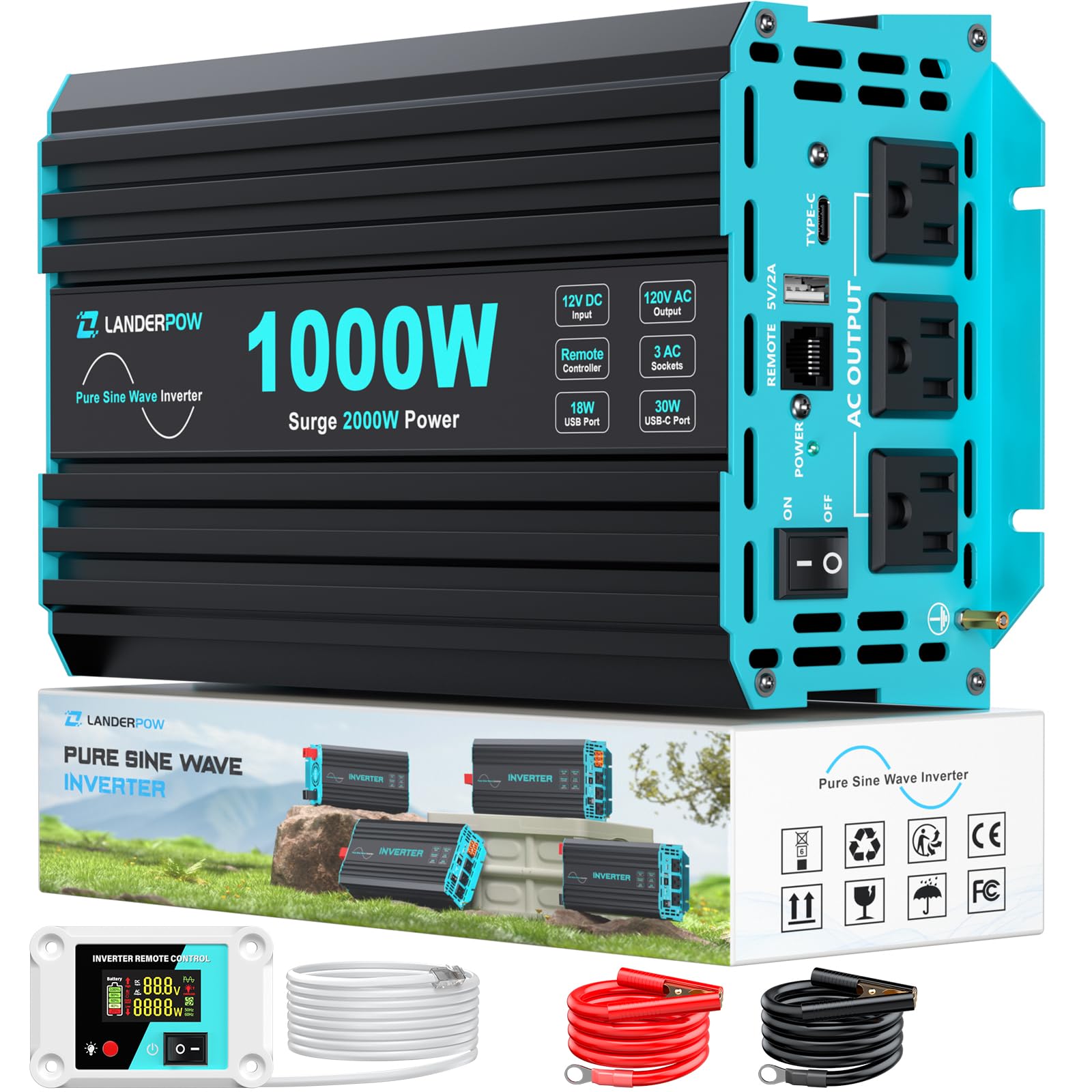
2. 1000 Watt Car Power Inverter, Pure Sine Wave, 12V DC to 120V AC
The light, compact pick that still starts a kettle and holds a stable wave for ham radio gear.
If you want a pure sine wave inverter that lives in a truck cab or a weekend camper without eating up space, this LANDERPOW is the easy answer. It delivers 1000 watts of continuous clean power with a 2000-watt surge, and it is rated at greater than 91% efficiency, meaning most of the energy it pulls from your battery actually reaches your appliances rather than escaping as heat. The output is the same grid-quality pure sine wave shape you would get from a wall outlet, so inductive and capacitive loads — home theater gear, audio equipment, motors — run without the hum a modified sine wave unit would introduce. It weighs 3.6 pounds to the GIANDEL 2200W’s 10.5 pounds, and it measures 10.35 by 5.75 by 3.15 inches against that unit’s 16 by 9.4 by 3.9 inches.
The features punch above the size. You get three AC outlets plus a 5V/3.1A USB port and a 30W USB-C PD port for fast device charging — enough to run a laptop, top off phones, and keep a small appliance going at the same time. A 15-foot wired remote with a smart LED screen tracks battery level, output, and fault codes, so you can watch the numbers from the driver’s seat instead of crawling back to the unit. The included cables are 7 AWG at 2 feet, and LANDERPOW adds a 1-year low-maintenance replacement plus 2-year extended support on top.
Buyers running this unit hard report that the included wiring is where the compromises live. A 4-gauge set overheated at 1300 watts, and stepping up to 0-gauge fixed it — note if you plan to push near the top of the range. Ham radio users praise the stable sine wave under heavy loads and the way it stays cool, and a 10,000 BTU air conditioner reportedly starts without trouble. The remote panel earns consistent love for letting you shut the inverter down without leaving the cab. It holds 4.4 stars across 600+ ratings, and the name of the game here is convenience and clean output at a lighter weight — not brute capacity.
The size question: At 3.6 pounds and roughly two-thirds the footprint of the GIANDEL 2200W, this is the one to mount under a seat or in a tight truck compartment where a 10.5-pound unit simply will not fit.
Know your ceiling: 1000 watts continuous is plenty for laptops, routers, CPAPs, small kettles, and many microwaves — but it will not carry a soft-start RV air conditioner the way the higher-rated units here can.
Grab this one for: cab-mounted power in trucks and vans, plus fast USB-C charging and a remote that reads your battery from the front seat.
Step up if: your appliance list runs past 1000 watts continuous — the jump to a 2000W or higher unit is worth it.
3. VOLTWORKS 2000 Watt Pure Sine Wave Inverter 12V DC to 110V 120V AC
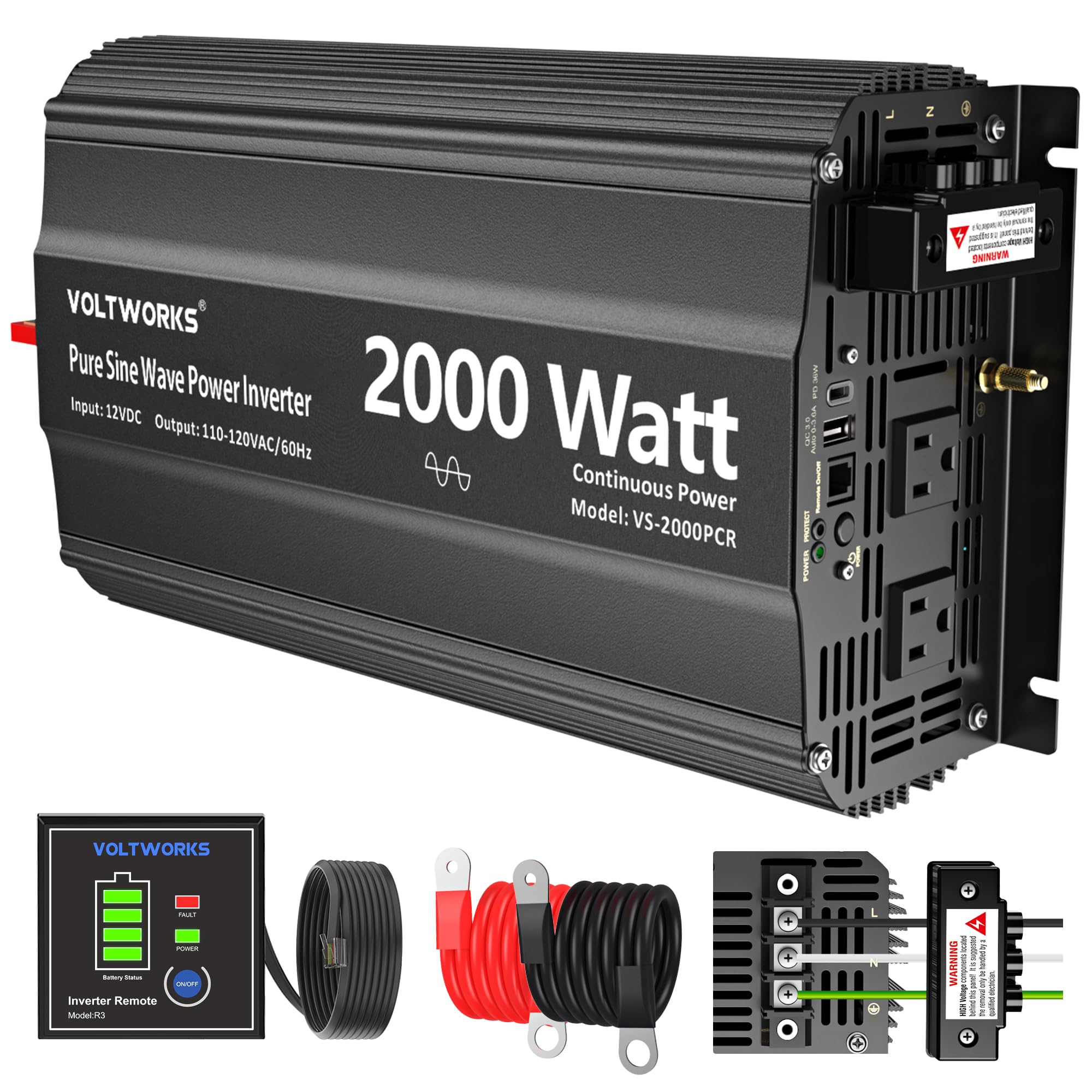
A motorhome-friendly 2000 watts that hardwires straight into your 110V circuit.
This VOLTWORKS is the pick for the DIY motorhome build. It converts 12 volts DC to 110–120 volts AC at a full 2000 watts continuous, with up to 90% conversion efficiency, and it gives you two AC outlets, 40-amp AC terminal blocks, and two fast-charging USB ports on the face of the unit. Those terminal blocks are the key detail if you plan to hardwire the inverter into an existing 110V circuit rather than plug appliances in one at a time. The upgraded USB side adds a 3.6A USB-A port and a PD36W USB-C port, which together handle laptops and phones quickly, and a 15-foot remote turns the whole thing on and off from across the rig.
The thermal design is thoughtful. The cooling fan does not run when you power the unit up — it only kicks in once internal temperature hits 104°F, which keeps idle noise at zero and saves battery draw during quiet hours. The all-metal housing handles the bumps and drops of life on the road, and protection covers short circuit, input over- and under-voltage, output short circuit, overload, over-current, and over-temperature. Remember that the biggest draw on a unit like this is not the appliances but the battery. Owners running this on a 300 Ah lithium bank report the unit holding 900 watts at 120 volts without trouble, and one RV owner hardwired it into a Class C circuit with dual batteries and 100-watt solar and ran a 1100-watt coffee maker without issue. Idle draw on this class of unit sits around 0.7 amps, so it pays to switch it off when you are not using it.
The one honest caveat is the remote connector. It uses an RJ10 4P4C serial-style jack, which is fine once mounted but awkward to extend or relocate compared with a simple two-wire remote. A few owners note the LCD only shows battery voltage rather than a real load meter. The unit carries 4.4 stars across 600+ ratings, and VOLTWORKS has a track record of replacing defective units directly, which softens the sting if you happen to draw a lemon.
Why it wins RV installs
- 2000W continuous into two AC outlets, 40A terminal blocks, and dual USB ports
- Fan stays silent until internal temps reach 104°F
- 15-foot remote for one-touch on and off from across the vehicle
- All-metal housing built to take road vibration and knocks
Points worth knowing before you buy
- Remote uses an RJ10 serial-style jack — hard to extend or relocate
- LCD shows battery voltage, not a true load wattage meter
- Idle draw around 0.7A means switching it off between uses saves battery
Best matched to: a hardwired motorhome or van circuit where you want the outlets and terminal blocks in one box.
Consider a different pick if: you want a live load-wattage readout — the more advanced displays on the BELTTT units do that better.
4. BELTTT 2000W Pure Sine Wave Inverter 12V DC to 120V AC, 4000W Surge
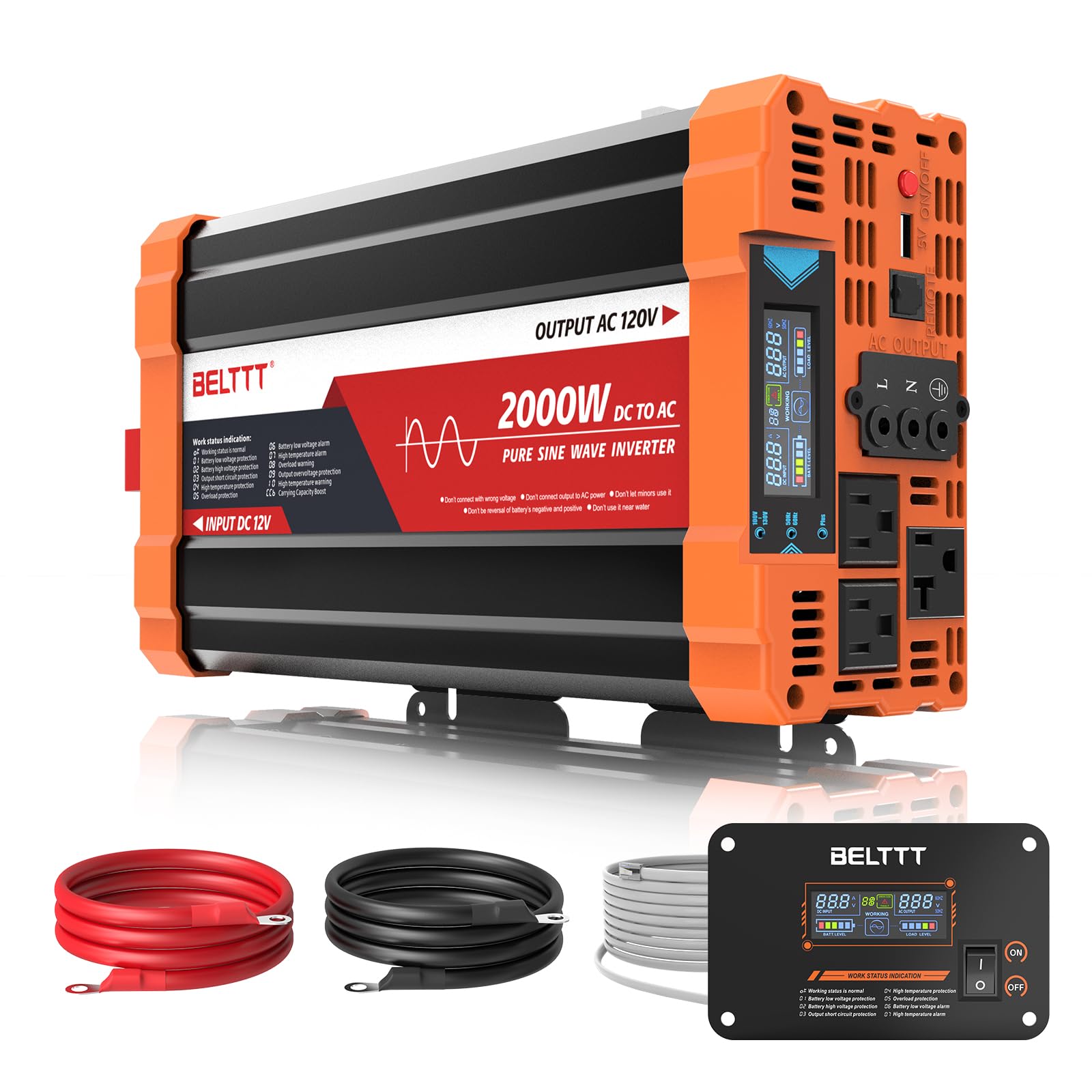
A real-time LCD panel that shows you exactly what your system is doing — surge rating included.
This BELTTT sits at 2000 watts continuous with a generous 4000-watt peak surge for motor starts, and it does it at just 7.7 pounds — lighter than either the VOLTWORKS 2000W at 9.9 pounds or the GIANDEL 2200W at 10.5 pounds. what separates it is the intelligent graphical LCD display, a bright real-time screen that shows input and output voltage, battery and load status, and fault codes so you can troubleshoot on the spot. It also carries both UL and ETL listings, which matters if you want a unit that has been independently tested to the safety standards for this product class.
The output itself is what you expect from a true pure sine wave inverter: a waveform that matches the AC that comes out of your wall, which is what lets inductive and capacitive loads — TVs, home theaters, motors — run without stress. Conversion efficiency holds above 93% during normal operation with low no-load losses, so battery drain stays modest when nothing is plugged in. You get dual AC sockets, a 20-amp outlet, a 5V/2.1A USB port, a hardwire port for panel integration, and a remote controller on a 23-foot cable — longer than the 15-foot remotes on most of the other picks here.
Where owners get excited is the internals. The unit uses soldered metal tabs rather than bolted lugs at the high-current points, which keeps resistance — and heat — down where it matters. In testing, one buyer ran a 10,000 BTU air conditioner for an hour on a 300 Ah LiFePO4 bank with the fans only 24°F above ambient temperature. The display shows clear on-panel fault codes, and a truck owner reports running a mini-fridge, a 700W microwave, a TV, and an occasional coffee maker day after day. The honest caveat: some units shipped with thinner 6 AWG cables than the 2 AWG the listing advertises, so check the box on arrival and plan on upgrading if you are running much beyond short distances. With 4.5 stars across 600+ ratings, it is a people-pleaser for good reason.
The monitor factor: The real-time LCD showing voltage, load, and fault conditions in one place is the single biggest reason this unit outperforms pricier rivals.
Watch the cabling: The inverter itself is solid — just confirm your included cables match the advertised gauge, and upgrade to 2/0 AWG or heavier for long runs at high current.
Made for you if: you want live system data on a bright screen and a hardwire option in a package lighter than the other 2000W-class units here.
Look elsewhere if: you demand a fully predictable cable spec from the start — check your shipment carefully or budget for cable upgrades.
5. GIANDEL 1500 Watt Pure Sine Wave Power Inverter, 12V DC to 120V AC, 3100W Max
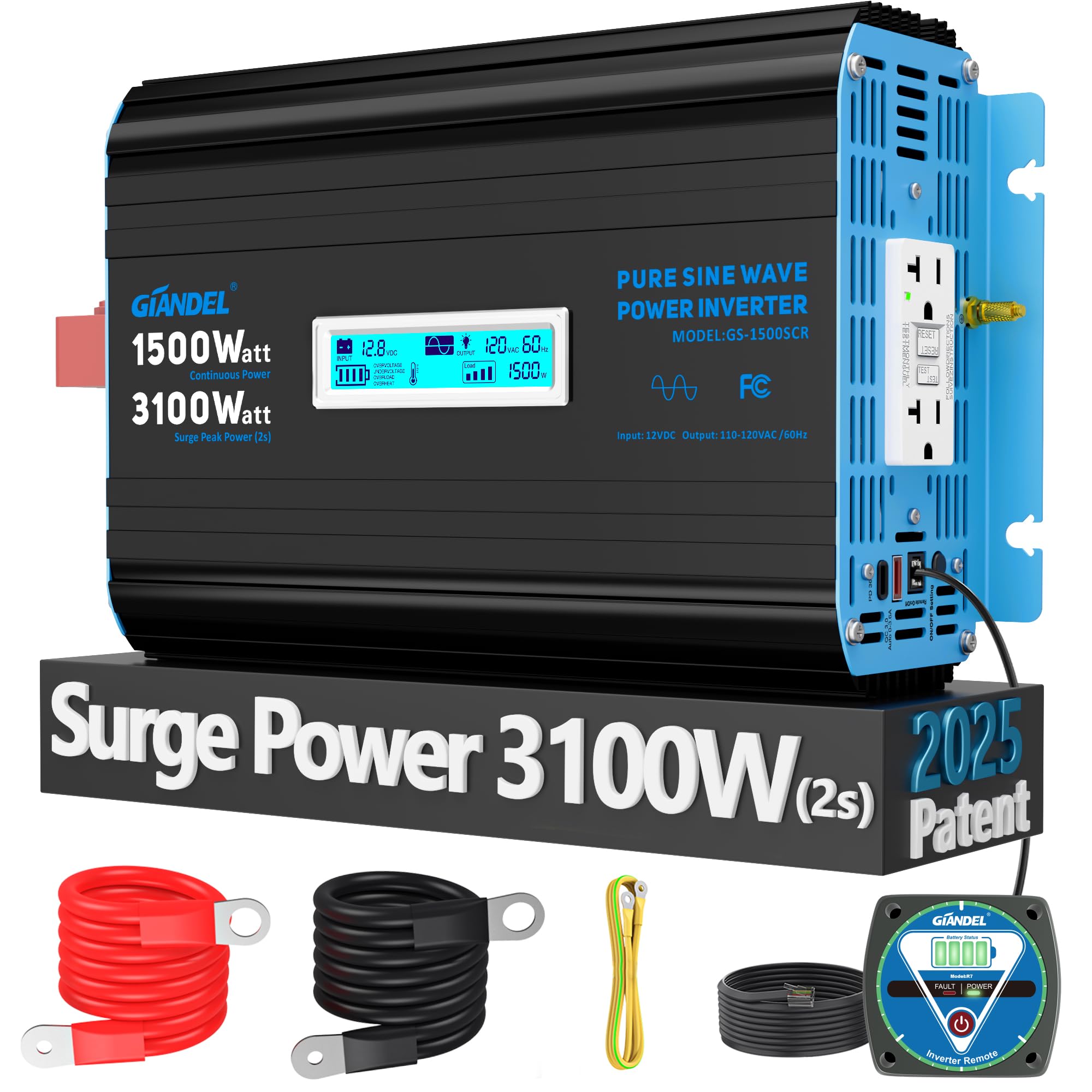
Built-in GFCI outlets and a 2-second 3100W surge for appliances that need a running start.
If safety features are high on your list, this GIANDEL is the one to look at first. Its 20-amp outlets are GFCI rated — ground fault circuit interrupter protection, the same guard against shocks you have in a modern home — and the UL458 standard applies to the outlets. The unit puts out 1500 watts continuous as a pure sine wave, converts 12V DC to 110–120V AC, and delivers a 3100-watt surge for 2 seconds, which is the window a compressor or motor needs to get moving. The heavy-duty onboard LCD reports input voltage, output voltage, load watts, frequency, and protection codes, and you can set a working timer from 1 to 100 hours before the unit shuts itself off.
The smart battery handling is genuinely useful. You can select the battery type with a long press of the power button — lithium, LiFePO4, lead acid, AGM, or gel are all supported — and the low-voltage protection threshold is resettable between 9.5V and 11V, meaning you can dial in the exact cutoff that matches your battery chemistry. PCB, transformer, and fuses are UL approved, and a 15-foot wired on/off remote brings the power switch to wherever you sit. The unit is a bit smaller in footprint than the 2200W and 2000W picks in this list, which makes it easier to fit into a tight bay.
The one thing to understand before you commit: 1500 watts continuous is a lower ceiling than the 2000W-plus class here, and pushing it hardest can trigger a thermal cutout. A Tesla-charging owner found the unit overheated and tripped a breaker once ambient temperatures crossed 90°F, and returned to GIANDEL after trying two other brands. Used at its rating for microwave, freezer, and furnace duty, though, it does the job — gas furnaces, laptop chargers, and small appliances run clean and quietly at the lower end of the range. It holds 4.4 stars across 700+ ratings, and that GFCI protection is a feature you will not find on many competing units at this level.
Safety-forward strengths
- UL458-rated 20A GFCI outlets for shock protection
- 3100W surge for 2 seconds handles hard-start appliances
- Selectable battery type plus resettable low-voltage cutoff from 9.5V to 11V
- 1-to-100-hour working timer with auto-shutoff
- USB-C 36W port for fast device charging
Where it asks you to be careful
- 1500W continuous is lower than the 2000W-plus units in this list
- Fan and heatsink can let the unit overheat near its top end in hot weather
- Better suited to lighter appliance loads than the larger GIANDEL 2200W
Choose it for: campers, RVs, and backup power where GFCI protection and selectable battery chemistry matter most.
skip it if: your plans honestly run past 1500 watts continuous — the bigger units on this page handle that load with more headroom.
6. BELTTT 3000W Pure Sine Wave Inverter 12V DC to 120V AC, 6000W Peak

The big-output pick that runs an air conditioner plus appliances from a single 12V bank.
When your load list includes 12,000 BTU mini-splits, RV air conditioners, and simultaneous cooking appliances, the 3000-watt BELTTT is the unit that stops playing small. It delivers 3000 watts of continuous power from 12-volt DC to 120-volt AC with a 6000-watt peak surge for motor starts, and conversion efficiency stays above 93% during normal running with low no-load losses. The output is pure sine wave, matching the AC from your utility grid and suitable for the inductive and capacitive loads that make lesser inverters buzz — TVs, home theaters, and anything with a motor inside. The intelligent LCD panel reports input and output voltage, battery and load status, and operating conditions, and BELTTT ships it with beefy 1/0 AWG battery cables, 9x 45A fuses, and a 23-foot remote cable — thicker cable than the 2 AWG on most competing units at this rating, which is what lets a 3000W unit actually reach its number without overheating.
The 3000W class is about real-world headroom, and owners use it that way. One driver runs a microwave, coffee maker, laptop, chargers, and phone every day in a semi truck without trouble. Another replaced a seven-year-old 2KW inverter and runs a 1200-watt microwave, an Instant Pot, a crock pot, and a blow dryer — all on one bank. A third keeps a 10,000 BTU AC and an RV fridge running, and reports the unit powers a 12,000 BTU mini split as well. Fans run continuously above 1000 watts and are a bit louder than the lighter units, which is a fair trade for the output.
The honest catch with a 3000W inverter is that the surrounding system has to keep up. Running a microwave through a 300-amp breaker caused the unit to trip within 30 seconds — not a fault, just the built-in protection sensing the surge — and removing the redundant breaker fixed it. If you want to run everything at once rather than one appliance at a time, size the inverter well above your loads, exactly as this one does. Watch the tight outlet spacing: the three AC sockets sit close, so pick a heavy-duty power strip if you plan to plug in multiple large adapters. It carries 4.5 stars across 400+ ratings and is among the most appreciated picks in this class.
Where the 3000 watt rating pays off: Simultaneous loads that trip smaller inverters — a microwave and an air conditioner running together — are exactly the scenario this unit is engineered for.
Don’t forget the wiring: A 3000W pull is genuinely heavy DC current, and the included 1/0 AWG cables deserve the matching heavy fuse and short run they are designed for.
Right for: high-demand rigs running air conditioning plus kitchen and electronics on a single 12V bank where the lights need to stay on.
Overkill for: a light RV with a couple of small appliances — the smaller GIANDEL and VOLTWORKS units deliver that at lower cost.
Understanding the Specs
Pure sine wave vs. modified sine wave
A pure sine wave inverter produces AC with a smooth rounded shape that closely matches what your household grid delivers. That shape is why inductive loads (motors, compressors) and capacitive loads (power supplies, audio gear) run cleanly without humming, flickering, or drawing extra heat. A modified sine wave inverter produces a blocky staircase wave, which is cheaper to build but causes those buzzing and heating issues. If you plan to run sensitive electronics, a microwave, or anything with a motor, the pure sine wave output in every pick on this list is the spec that matters most.
Watt rating: continuous vs. surge
Continuous watts is what your inverter can deliver all day long from its 12V DC input, and it is the number to size against your appliances. Surge (sometimes called peak) watts is the brief spike a motor or compressor pulls for a second or two at startup — that is why the units here list figures like 2000W surge or 6000W peak alongside their continuous ratings. Buy for the highest continuous load you plan to run at the same time, and confirm the surge figure can cover the startup spike of any compressor or AC unit you plan to start.
DC cable gauge and run length
Pulling hundreds of amps from a 12-volt battery means the DC cables do real work. Thicker gauge wire (lower AWG number, like 2 AWG or 1/0 AWG) carries more current with less voltage drop and less heat. Short supplied cables are often adequate for short runs at moderate loads, but going long distance or pushing toward the top of the unit’s rating almost always means upgrading to heavier cable and adding an inline fuse. Many owners in the reviews here replaced the shipped cables with 2 AWG or 2/0 AWG before pushing their units hard, and that single change typically resolves both overheating and voltage sag.
Protection features to check
Every good inverter guards against over-voltage, under-voltage, overload, over-temperature, short circuit, and reverse polarity. In practice those protections do different jobs: under-voltage guard prevents you from running your battery flat, overload shuts the unit down before it burns out on too big a load, and reverse polarity protects the inverter when you accidentally touch the cables to the wrong battery terminals. GFCI outlets, which some picks here include, add ground-fault protection like a modern home outlet. A wired remote and LCD display combine with these features to warn you before things go wrong.
FAQ
What size inverter do I need for a 12V battery system?
Is a pure sine wave inverter worth it over a modified sine wave?
Will a 12V pure sine wave inverter run an air conditioner?
Do I need to upgrade the DC cables that ship with my inverter?
How much battery do I actually need behind the inverter?
Can I hardwire a 12V inverter into my RV breaker panel?
Do 12V inverters drain my battery when nothing is plugged in?
What is GFCI protection on an inverter and do I need it?
Why does my inverter shut off under a load it should handle?
Can I run a microwave off a 1000W pure sine wave inverter?
Final Thoughts: The Verdict
For a serious 12V install — 2200W continuous, 20A hardwire terminals, 3% THD, a 15-foot remote, and a 36-month warranty — the GIANDEL 2200W Pure Sine Wave Inverter is the one to take home. It carries the highest rating in this lineup at 4.6 stars across 400+ ratings, offers 2200W continuous, and brings a 36-month warranty and ETL UL458 listing for the safety-minded buyer. If you want a lighter, cheaper package that still runs clean pure sine wave power — the LANDERPOW 1000W is the mobility play. And if your rig runs air conditioning plus appliances at once, the BELTTT 3000W is the one to grab.
How We Picked
We do not accept paid placement. Every pick is matched to a real buyer and a real use-case; we do not hands-on test units.
Sources & Methodology
Specifications: manufacturer listings and product documentation. Review insights: verified customer reviews, as of September 2026. Pricing: not shown on this page (it changes often); check the current price via the retailer link.
As an Amazon Associate, KitchPrep earns from qualifying purchases. This does not affect which products we feature.
Related Guides
