
Specs are compiled from manufacturer listings and verified buyer reviews and can change over time — please confirm the key details on the product page before buying.
If a laptop charger plugged into a cheap car outlet has ever died mid-project, the outlet was the problem, not your car. Most 12V power inverters fall into two camps: plug-in bricks capped around 150W, or hardwired boxes that need cables run to your battery. The right pick depends on your continuous wattage needs and whether you will hardwire to the battery. This guide breaks down nine inverters across both types so you can match the unit to your devices.
I’m Mohammad Maruf — the founder and writer behind KitchPrep. This guide is built by comparing the manufacturers’ published specifications and the patterns across verified customer reviews, so you get each pick’s real strengths and trade-offs instead of marketing spin.
Whether you drive a truck, sleep in a van, or just want a dependable outlet in the passenger seat, the right 12v power inverter turns your vehicle into a working power source instead of a phone charger with extra steps. The nine picks below run from a 150W cup-holder brick to a 2000W pure sine workhorse.
Our Picks at a Glance

How To Choose The Best 12V Power Inverter
The single most common mistake buyers make with a 12V power inverter is buying by peak wattage instead of continuous wattage. A unit advertised as 1000W might only hold that number for a few seconds during startup surge. Continuous watts are what it can actually deliver hour after hour. Always size your inverter by the continuous number, then check that the peak number comfortably covers whatever your appliance draws the moment you switch it on.
Waveform: the spec that decides whether your device survives
Pure sine wave inverters produce the same smooth alternating current your wall outlet gives you, so sensitive electronics run cleanly without buzzing or overheating. Modified sine wave inverters use a stepped, approximate waveform that is cheaper to build but can cause motors to run hot and some devices to refuse to power on at all. If you are running anything with a motor, a compressor, or a sensitive circuit board, pure sine wave is the safer bet.
Connection type: plug-in versus hardwired
A cigarette-lighter plug is the easiest option because you simply push it into the socket you already have. The catch is that those sockets are typically rated for lower current, so many manufacturers cap plug-in use well below the inverter’s full rating. Alligator clips that connect directly to the battery posts let you draw the full rated power, which is why larger inverters include them and recommend them for anything drawing serious wattage.
Safety protections you should never skip
At minimum, look for overload, overheat, and short-circuit protection so the unit shuts itself down before it damages your devices or your car’s wiring. Voltage display screens help you watch battery health in real time, which matters if you are running off a deep-cycle or lithium bank where draining too far can shorten battery life.
Quick Comparison
| Model | Best For | Continuous Power | Waveform | Outlets & Ports | Amazon |
|---|---|---|---|---|---|
| 150W Car Power Inverter (ZEEHOO)★ Best Overall | Cup-holder charging on the go | 150W | Pure Sine Wave | 2 AC, 18W USB-A, dual 30W PD | Amazon |
| YSOLX 1000W Power InverterTop Performer | RV and truck camping power | 1000W | Modified Sine Wave | 3 AC, 2 USB-A, 30W USB-C | Amazon |
| OLTEANP 1000W Power InverterSmart Display Pick | LCD readout and simple installs | 1000W | Modified Sine Wave | 2 AC, 36W USB-C, 5V/3A USB-A | Amazon |
| BESTEK 400W Pure Sine Wave | CPAP and sensitive electronics | 400W | Pure Sine Wave | 2 AC, PD30W USB-C, QC18W USB-A | Amazon |
| Tripp Lite PV375 | Light-to-medium duty reliability | 375W | Pure Sine Wave | 2 AC outlets | Amazon |
| JARXIOKE 1100W Pure Sine Wave | Off-grid cabin and remote control | 1100W | Pure Sine Wave | 2 AC, dual USB, Type-C | Amazon |
| BELTTT 1500W Pure Sine Wave | Heavy workshop and compressor loads | 1500W | Pure Sine Wave | 2 AC, 5V 2.1A USB | Amazon |
| GIANDEL 2000W Inverter | Budget hardwired RV setup | 2000W | Modified Sine Wave | 2 AC, 2.4A USB | Amazon |
| VOLTWORKS 2000W Pure Sine Wave | Full-time off-grid and RV living | 2000W | Pure Sine Wave | 2 AC, 40A terminals, 3.6A USB-A, PD36W USB-C | Amazon |
In‑Depth Reviews
1. 150W Car Power Inverter, 12V DC to 110V AC Car Plug Adapter Outlet Converter
Our pick — over 4.5★ from 450+ verified ratings; the strongest balance of quality and price.
It drops into your cup holder and quietly turns your car into a four-device charging station.
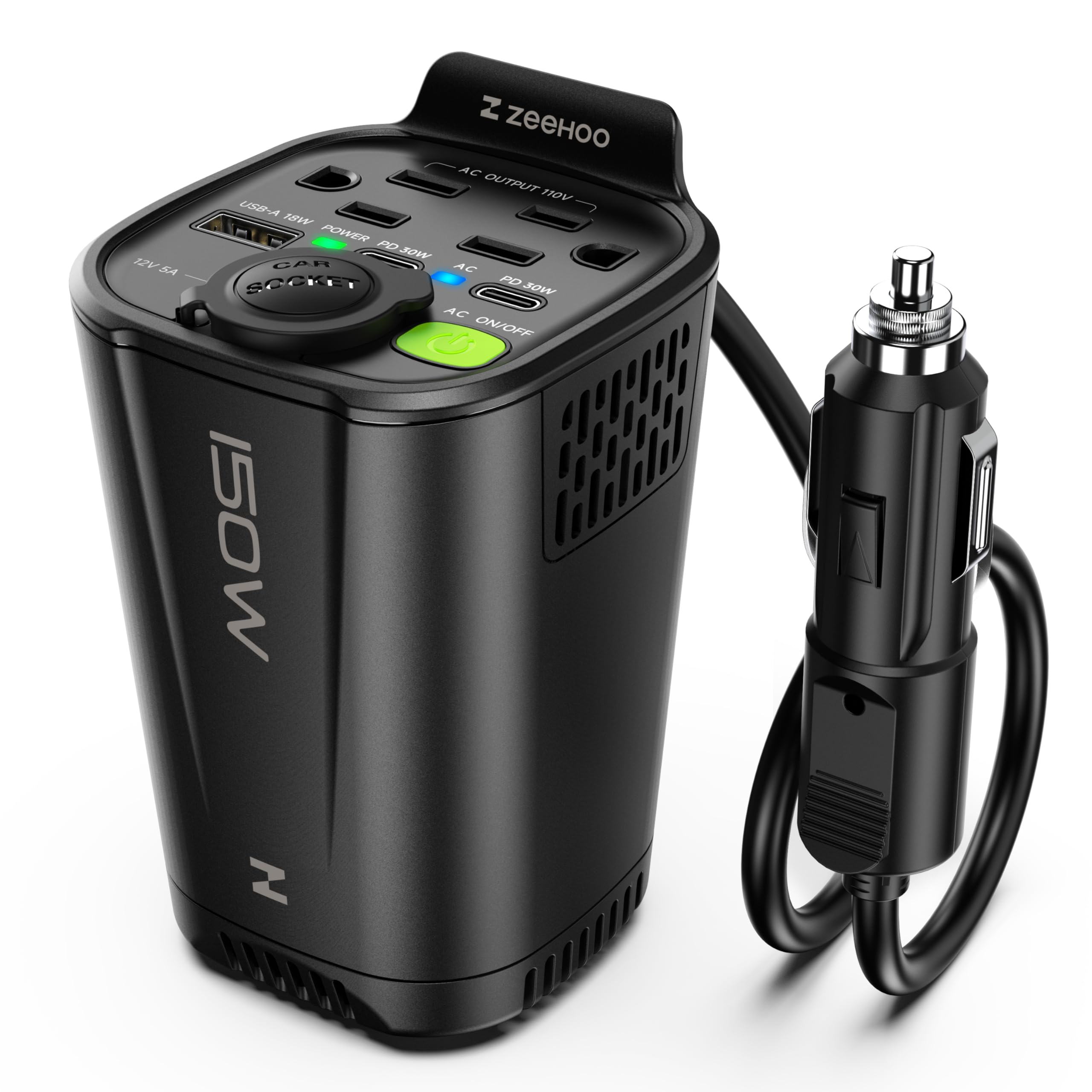
This ZEEHOO unit is rated at 150W continuous and converts 12V DC from your car into standard 110V AC household power. The headline for most buyers is the port selection: two AC outlets, one 18W USB-A charging port, and dual 30W PD car chargers built into a single palm-sized block. That combination lets you run a laptop on AC while fast-charging two phones over USB-C at the same time, without swapping cables every few minutes.
The pure sine wave output is the reason this tiny brick holds up where cheaper plug-in units struggle. Your wall outlet delivers smooth sine wave power, and pure sine approximates that closely enough that laptops, drone chargers, and dash cams run without the electrical noise that can cause a device to refuse to power on. The listed frequency is 60 hertz, matching standard North American household current, and the input is a straight 12 volts.
The form factor is what seals it. At 2.75″L x 2.75″W x 4.13″H, it slots neatly into a standard cup holder, which means no loose box rattling around your console. That same footprint is why it will not run a coffee maker or a space heater — 150W is a laptop-and-gadgets number, and the dual 30W PD ports are the real value at this size. Owners use it for everything from charging a Moto Edge dead-to-full in 45 minutes to running dash cams and fast-charging drone batteries, and the recurring note in reviews is how quiet the fan stays compared with the buzzing bricks people replace.
What earns its keep
- Pure sine wave output at a compact size rarely seen in this budget tier
- Two AC outlets plus dual 30W PD and an 18W USB-A port for four devices at once
- Cup-holder footprint keeps it stable and out of the way while driving
- Auto-shutoff when idle helps prevent overheating during long trips
Where it stops short
- 150W ceiling rules out anything with a heating element or motor
- The attached power cable runs short, so an extender may be needed depending on your socket location
- Reviews note the plastic surround can block bulkier AC adapters from seating fully
Grab this one if: your power needs live in the laptop, phone, tablet, and camera-charger lane and you want a clean sine wave without hardwiring anything.
Move up a tier if: you need to run appliances that pull more than 150 watts, because this one will simply shut down rather than strain.
2. YSOLX 1000W Power Inverter 12V to 110V/120V for RV Camping
A mid-tier workhorse that steps up from plug-in bricks to a real 1000W with three AC outlets and a 30W USB-C port.
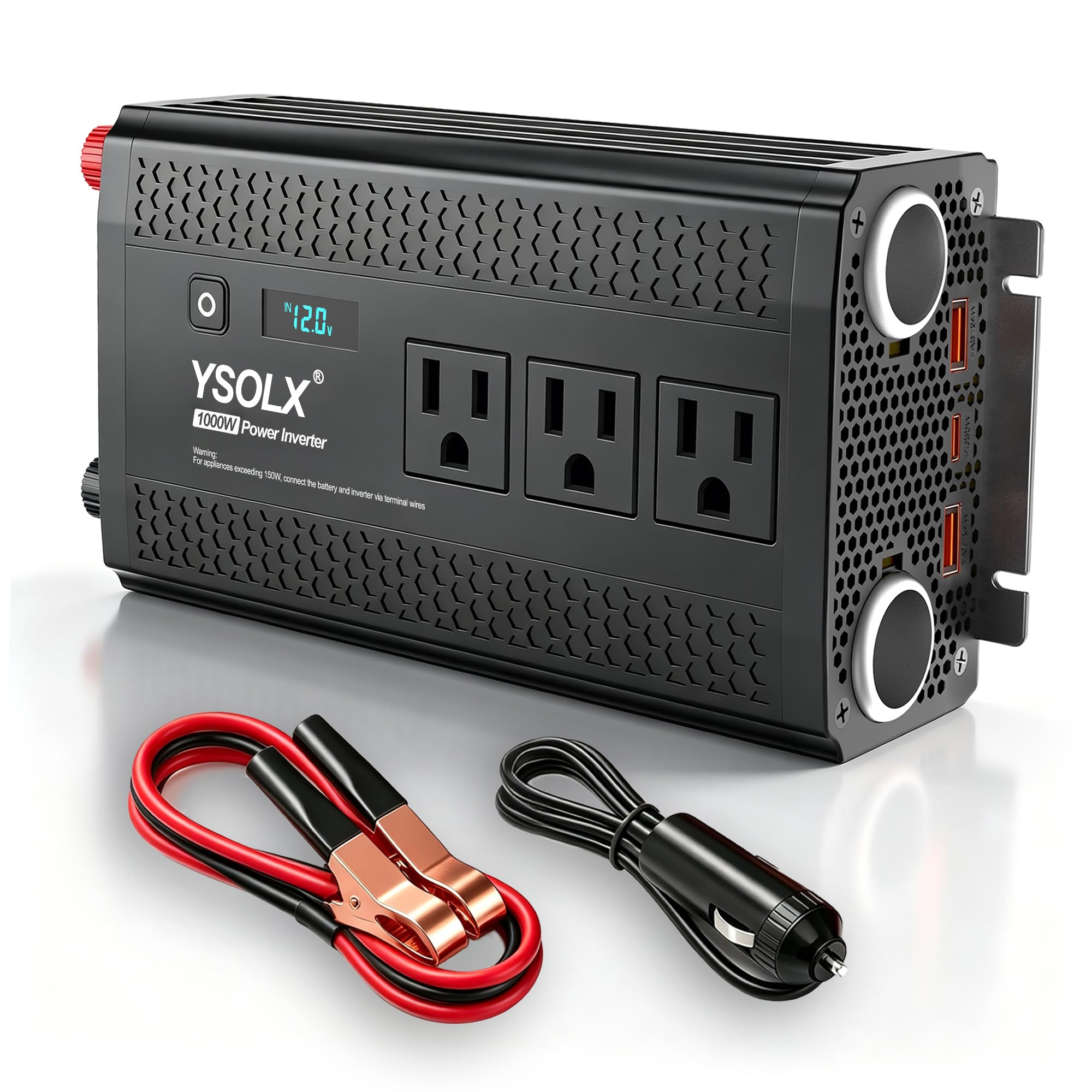
The jump from the 150W pick above is the whole story here: you are moving from 150W to 1000W continuous, which is roughly a 6.7x gain in headroom. That is the difference between charging a laptop and actually running one, plus a fan, plus a phone at the same time. The YSOLX also brings a 2000W peak surge rating, which matters when a device like a compressor or a fridge kicks on and briefly pulls far more than its running wattage.
On the outlet front, you get three AC sockets, two USB-A ports, and a 30W USB-C PD port, plus dual 12V cigarette-lighter sockets. The real-world payoff in reviews is genuine multi-device use: owners describe filling all three AC outlets with a laptop and a cordless tool battery charger simultaneously, and running fans and phones for extended stretches. The LED screen shows live battery voltage so you can watch your battery level without a separate meter.
Where this unit asks for your attention is modified sine wave output. That stepped waveform is fine for chargers, lamps, and laptops, but appliances with motors or sensitive circuitry can behave unpredictably on it. Reviews bear this out — the unit is praised for quiet operation compared with noisier rivals, and one owner even described it as “super quiet and dependable,” but the same pages include a unit that quit after fewer than ten uses powering a single fan. That is the honest trade-off at this tier.
The pitch that lands
- 1000W continuous and 2000W peak covers laptops, fans, phones, and small appliances
- Three AC outlets plus dual USB-A and a 30W USB-C PD port meant for simultaneous charging
- LED display for live battery voltage monitoring
- Silent cooling fan starts at 42°C and auto-shuts at 38°C to keep noise and heat down
The catch to weigh
- Modified sine wave is a poor match for motor-driven or highly sensitive appliances
- Reliability draws mixed feedback, with a subset of owners reporting early failures
- Some desktop computers fail to boot on this waveform even when the wattage is sufficient
Reach for this if: you want meaningful wattage, multiple outlets, and voltage visibility at a mid-range value without stepping up to premium hardwired territory.
Look elsewhere if: any of your core devices use a motor or sensitive circuit, because pure sine wave is the smarter route for those loads.
3. 1000W Power Inverter 12V DC to 110V/120V AC Car Converter for Vehicles
The one to pick when you want to see your battery voltage in real numbers instead of guessing from a blinking light.
That is the OLTEANP’s defining move — a built-in LCD screen that shows input voltage, output voltage, and battery status in real time, plus fault codes like OL for overload and OH for overheat. When you are running off a vehicle battery or a deep-cycle bank, being able to read those numbers live is a genuine advantage over a single power LED.
On the power side, it is rated at 1000W continuous with a 2000W peak surge, converting 12V DC to stable 110V/120V AC. The port layout is two AC outlets, a 36W USB-C fast charging port, and a 5V/3A USB-A output, and the smart ports adjust output automatically to match what you plug in. Its footprint of 7.87″L x 4″W x 2.28″H and weight of 1.2 kg keep it reasonably compact for a full 1000W unit, which is why it fits neatly in truck consoles and van cubbies.
Reviews point to the same theme: quality and the display are what owners bring up most. Real-world notes include running a laptop, phone, and small tools simultaneously, and one owner mentioned handling a 600W load with no trouble. The honest limit to plan around is waveform — it is modified sine wave, so it is fine for most small electronics but the manufacturer explicitly says to avoid refrigerators, microwaves, air conditioners, laser printers, and sensitive medical devices. Pair it with the right loads and it holds up well.
What the display buys you: real-time input and output voltage plus fault codes means you can spot a struggling battery or overload condition before either one damages your devices, which is a meaningful step up from a bare indicator light.
One caveat worth flagging: modified sine wave output makes this a poor match for motor-driven appliances, and the manufacturer itself recommends keeping sensitive medical devices off this unit.
the balance: truck owners and van lifers who want voltage visibility and multi-device charging without stepping up to premium hardwired pricing.
Know before you buy: if a refrigerator, microwave, or AC unit is on your list, modified sine wave is the wrong column — this one is for laptops, chargers, and phones.
4. BESTEK Pure Sine Wave Power Inverter, 400W DC 12V to 110V AC Car Converter

Clean, grid-quality power for the devices that refuse to run on anything less than a true sine wave.
The BESTEK’s case rests almost entirely on one spec: pure sine wave at 400W continuous with 800W peak surge. That smooth waveform is the same shape your wall outlet delivers, which is why this unit is built to power CPAP machines, nebulizers, breast pumps, and air pumps — the kind of devices that either balk at a modified waveform or run hot and noisy on one. It will also handle everyday gear like laptops, iPads, cameras, and projectors without issue.
Charging is fast on both USB types. The USB-C port delivers PD30W, and the USB-A port is QC18W with Quick Charge 3.0, which the manufacturer says can take most Android devices from 0% to 80% in 30 minutes. Between the two AC outlets and the two USB ports, you can run up to four devices at once.
Notably, the input range is 11-17V, which means it is designed to work from the 16V cigarette lighter socket in Tesla vehicles — a compatibility point almost no other inverter in this list calls out. Reviews back the reputation: owners describe stable, accurate output compared with fussier units, and the smart cooling fan adjusts its speed to load so it stays quiet. One owner confirmed running it daily in a Tesla Model Y to power a 200W laptop charger, and the recurring praise centers on performance and clean output. Just remember that the full 400W cannot be reached through a lighter socket on every vehicle — hardwiring directly to the battery is the honest way to get there.
what separates it
- Pure sine wave output suitable for sensitive devices like CPAP machines and nebulizers
- 11-17V input range works from a 16V Tesla lighter socket, which is rare at this tier
- PD30W USB-C and QC18W USB-A fast charging with automatic device detection
- Smart temperature-controlled silent fan adjusts speed to load
- 30-day return and 18-month replacement coverage
Where to temper expectations
- 400W is a modest ceiling for appliances that heat or compress
- Full output typically requires hardwiring to the battery rather than using the lighter plug
- Reports of the connector loosening in some vehicles mean checking the socket fit matters
Choose this for: sensitive electronics, medical-style devices, and everyday travel gear where waveform quality outweighs raw wattage.
Pass if: you are trying to run a coffee maker or a fridge, because 400W will not go the distance on anything that heats or compresses.
5. Tripp Lite 375W Car Cigarette Lighter Plug Power Inverter with 2 Outlets (PV375)
A rugged metal brick that has been quietly powering laptops and chargers from car sockets for years.
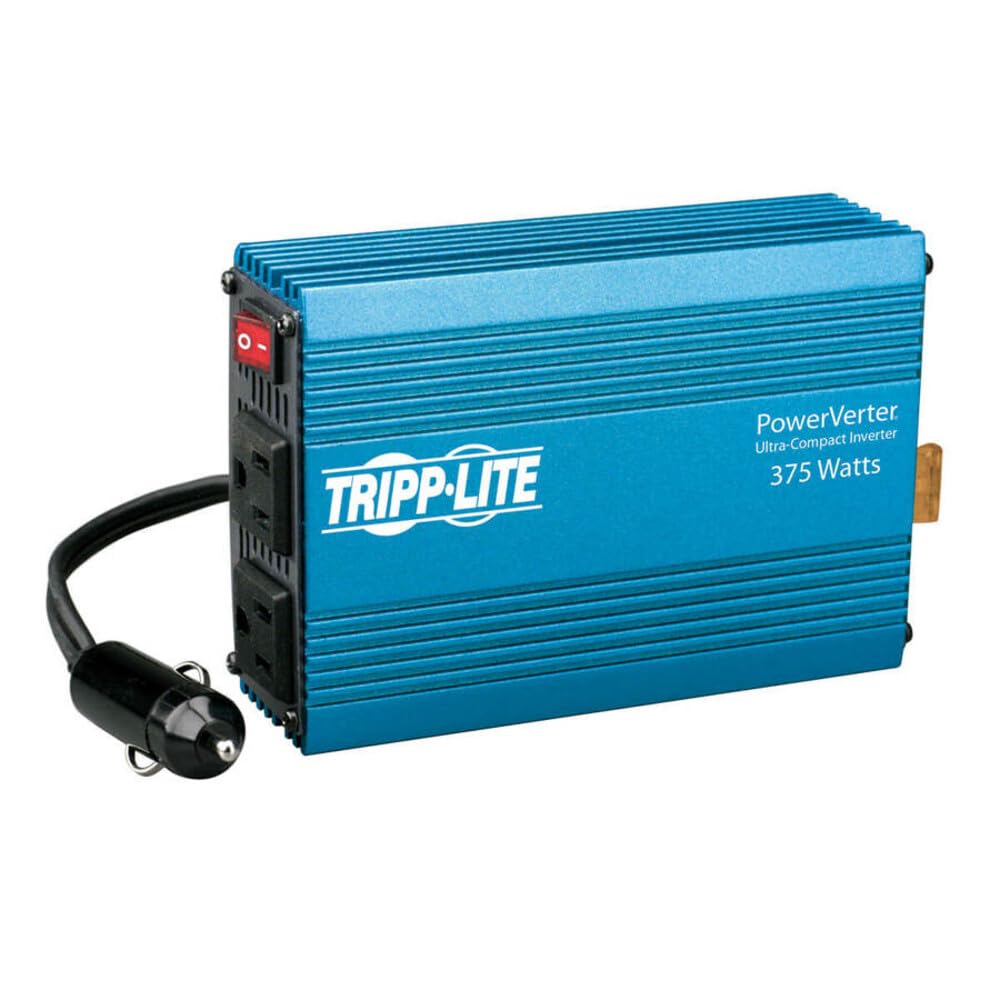
Tripp Lite’s PV375 delivers 375W continuous with up to 600W instantaneous power, wrapped in an all-metal housing that weighs 2.1 pounds. That heft is the point — this is one of the few plug-in inverters in this range built with enough metal that it holds up to years of being tossed in a glovebox. It runs a cigarette-lighter plug straight into two AC outlets, so there is no cabling to route, no clips to attach.
Owners describe this unit as the kind of inverter that keeps going long after cheaper options fail. Reviews include a driver powering a laptop through 10-hour shifts without a hiccup, and another running a printer and two li-ion chargers at once. The recurring praise centers on its cooling — it never gets hot to the touch in real use, and the auto shutoff on overload means the unit protects your devices and itself rather than cooking quietly.
The honest drawback here is the lighter socket itself, not the inverter. That connector is typically limited in how much current it can carry, so real-world output is closer to 180-240W than 375W regardless of what the unit is rated for. The permanently attached lighter cord cannot be swapped for clips, which is the reason for that ceiling. The fan also runs constantly and is audibly noticeable, so if silence matters this one will not be your pick. Used within its realistic window, though, it is about as dependable as plug-in inverters get.
Why owners keep coming back: the metal housing and cooling design are the reasons this one survives years of car storage and daily laptop duty, and auto-shutoff prevents the slow bake that ruins cheaper plastic units.
Realistic output window: the permanently attached lighter cord caps practical output well below the 375W rating on paper, so plan your loads around the 180-240W range for consistent results.
For the long-haul buyer: anyone who wants a dependable plug-in inverter for laptops, printers, and phones over many years of vehicle use.
Skip the upgrade: hardwired, higher-wattage units are the right move if you need to approach or exceed the lighter socket’s current limits.
6. 1100 Watt Pure Sine Wave Power Inverter 12V DC to 110V 120V with Remote Control
Trim, pure sine power with a remote that reaches across the whole back of your rig.
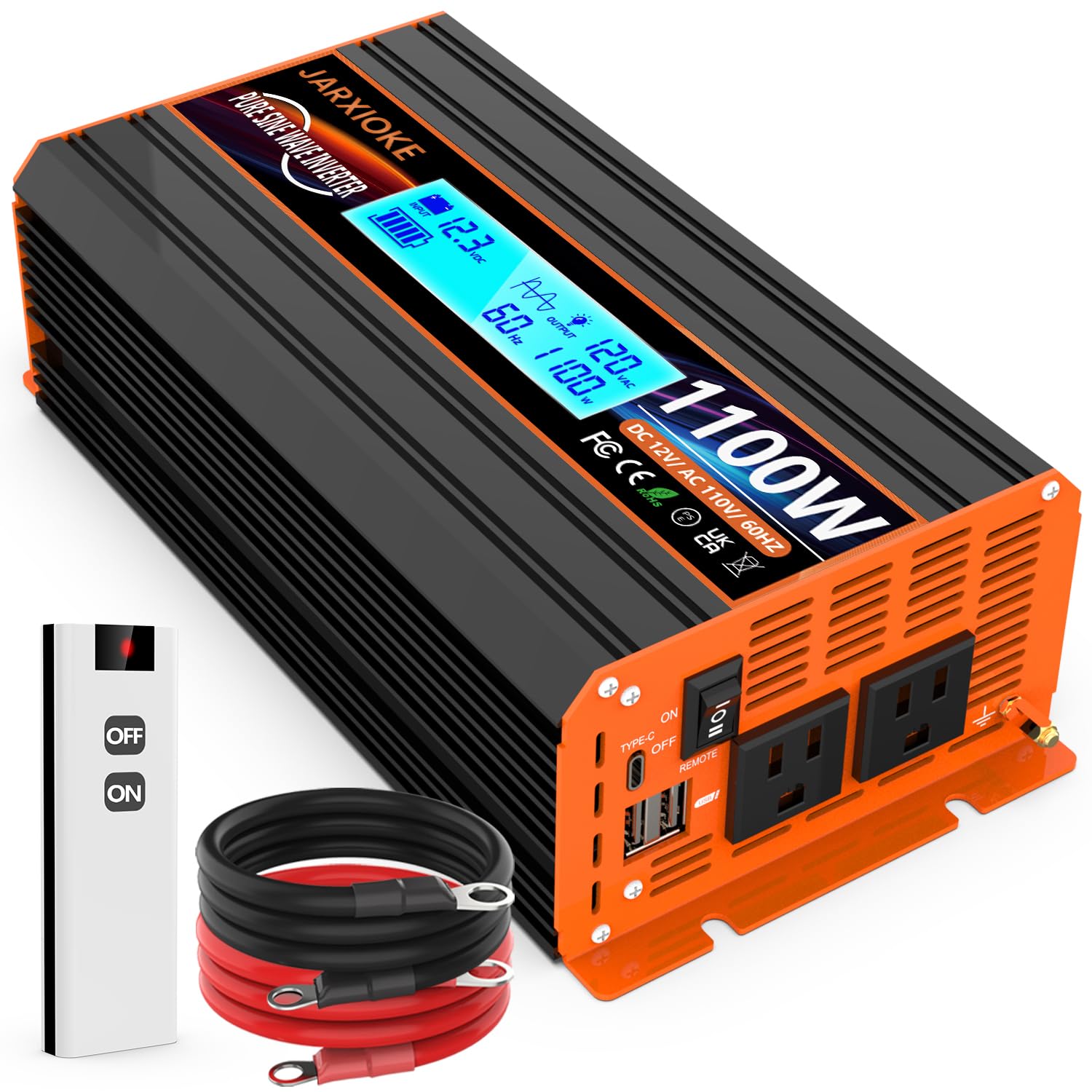
The JARXIOKE 1100W hits a balance between the compact mid-tier units and the heavy hardwired boxes at the top. It delivers 1100W continuous and 2200W peak pure sine wave output, with a conversion efficiency above 90% and low no-load loss. The pure sine waveform means sensitive loads — audio gear, sensitive electronics, anything with fine circuitry — see power almost identical to what they would get from your utility company.
The feature that sets this one apart in the two-sentence version: wireless remote control that works within 100 meters. If you have hardwired the inverter deep in an RV cabinet, that remote lets you switch it on and off from inside the cabin without crawling to it. The Graphical display and audible alarm keep you aware of battery state and fault conditions, and the aluminum housing is designed to handle bumps and drops without issue.
The safety list is thorough: over voltage, low voltage, overload, short circuit, overheat, and reverse polarity protection, plus automatic restart and ground leakage protection. Reviews back the day-to-day experience — owners describe running garage freezers off DIY solar setups for 18 months through 105°F heat, handling table saws during a barndominium build, and running 1700W loads off a 250Ah LiFePO4 bank without complaint. The recurring honest note is fan noise in hot conditions, and one extreme case involved a separate 3000W 24V unit showing signal irregularities under heavy load. For most buyers the fan noise is the only real friction point — and the price-to-performance stack makes it easy to forgive.
What you are paying for
- 1100W continuous and 2200W peak pure sine wave for sensitive loads
- Wireless remote works within 100 meters — control it from the cabin
- Above-90% conversion efficiency keeps battery draw lower
- Comprehensive protections including reverse polarity and ground leakage
- 24-month warranty on the unit
What to plan around
- Fan noise ramps up in hot conditions, which owners mention as the main gripe
- Wireless remote requires an A23 battery, sold separately
- Uses fuses rather than resettable breakers for the AC outlets
Built for: RV and off-grid setups where you want pure sine wave power and the convenience of switching it on from across the cabin.
Not for: anyone running 24V systems or planning to push past about 1700W sustained, because those demands sit outside this unit’s 12V, 1100W territory.
7. BELTTT 1500W Pure Sine Wave Inverter 12V to 110V Converter, 3000W Surge

Pure sine wave 1500W with sturdy cables and a smart readout for the shop or the road.
The BELTTT 1500W delivers 1500W continuous and 3000W peak surge of pure sine wave power, with conversion efficiency above 90% during normal operation. That is a serious step up from the mid-tier units above, and the shape of the waveform stays true to grid power, so inductive and capacitive loads — motors, compressors, transformers — run without the misfiring behavior that modified sine wave can cause.
Unlike most of the smaller units in this list, the BELTTT comes with real cabling: 3AWG, 3-foot battery cables plus four 45A fuses and an installation thimble and spanner. That tells you the manufacturer expects this unit to be hardwired directly to a battery bank, which is exactly how you access its full 1500W. The smart LCD simultaneously shows input and output voltages, battery status, and load level, and the output voltage can be adjusted slightly to match your specific setup.
Owners put it through real work: one ran it for eight hours straight at 1.45kW powering a space heater off an 1120Ah lithium bank without failure, and another used the included cables to charge six Milwaukee batteries on a rapid charger while driving. Startup loads for fridges, freezers, and small AC units are handled smoothly. The honest limit to know about: heavy resistive loads like a 900W microwave with a big surge demand can bog it down, and the connecting lugs are on the lighter side, so wire bending calls for care. Used within its realistic envelope, this is a genuinely capable mid-premium unit.
The strongest cards
- 1500W continuous and 3000W peak surge pure sine wave
- Ships with 3AWG 3-foot cables and four 45A fuses for direct battery hookup
- Smart LCD displays input/output voltage, battery state, and load level
- Adjustable output voltage lets you fine-tune for your equipment
- Aluminum and sturdy plastic housing rated for long-term use
What to know first
- Resistive loads like a microwave with a big surge demand can bog it down
- Connection lugs are on the lighter side — be careful when bending battery cables
- At 5.3 pounds and 12.22″L x 6.28″W x 3.53″H, it needs real mounting space
The right fit for: workshops, vans, and RV builds that want true 1500W sine wave output with cables and fuses included in the box.
Consider twice if: you are powering big resistive appliances like microwaves with surge-heavy startup, because those can still push it past what it will deliver.
8. GIANDEL 2000Watt Power Inverter 12V DC to 110V 120V AC ETL Listed UL458 STD

A verified, ETL-listed 2000W unit built for hardwired RV and solar rigs on a real budget.
GIANDEL’s 2000W delivers 2000W continuous and 4000W peak, backed by ETL listing to UL 458 standard and product liability coverage through AIG. That combination of real wattage and a proper listing is what separates this from the no-name boxes floating around at the same wattage. It includes two pairs of 5AWG 2-foot cables, a 15-foot wired remote with LED display, and four shock-proof pads — you get the full hardwired install kit in the box.
The build holds up to real loads. Sandwiched between the mid-tier units above and the premium options below, this handles the workloads in between: one owner ran a Dewalt 7.25″ circular saw off a deep-cycle marine battery as if it were plugged into a wall outlet, and a truck driver used it for a microwave and grill from behind the seat. The 15-foot wired remote means you can switch it on and off without crawling to it. Modified sine wave output and dual AC outlets plus a 2.4A USB port round out the layout.
The honest expectations here matter more than on most picks. It is modified sine wave, so the manufacturer itself says it does not power induction ovens. Real-world loads frequently come in below the rated 2000W — buyers report it flipping off on overload at higher draws, and the manual recommends a 400AH battery for the full 2000W continuous, which is a substantial battery investment you should factor in before purchase. Used within its realistic envelope, though, it is a solid workhorse for the money.
Why the listing matters: ETL/UL 458 certification is not marketing padding — it means the unit passed third-party safety testing, which is what you want when the inverter is going to sit near your battery bank long-term.
Sizing reality check: the 400AH battery recommendation in the manual is the number to respect here — under-battery this unit and you will hit overload shutdown before you hit 2000W of useful output.
The budget RV answer: hardwired setups where UL listing, real wattage, and a wired remote matter and the budget is tight.
Look past it if: your loads need pure sine wave, or you do not have the battery bank to feed a true 2000W demand.
9. 2000 Watt Pure Sine Wave Inverter 12V DC to 110V 120V AC Power Inverter
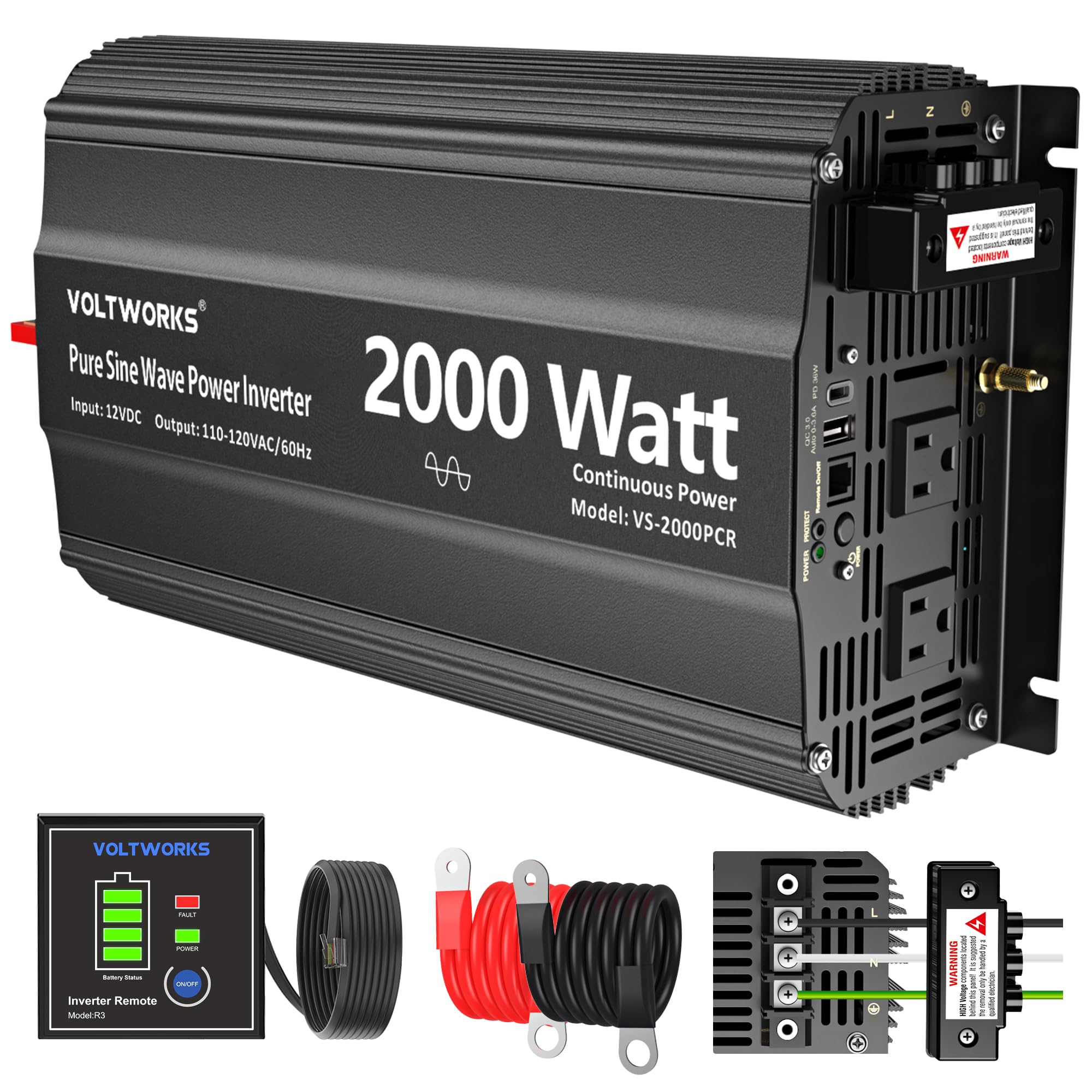
The full 2000W pure sine wave setup for anyone living off-grid and running real appliances daily.
The VOLTWORKS 2000W is the largest pure sine wave unit on this list, delivering 100% 2000W continuous output with conversion efficiency up to 90%. It brings two AC outlets, 40A AC terminal blocks for hardwiring, and two fast charging USB ports — a 3.6A USB-A and a PD36W USB-C. The frequency is 60 hertz and the input is 12V DC, and the whole unit weighs 9.9 pounds in a 15″L x 8″W x 3.9″H aluminum housing.
The smart cooling fan on this one only spins up once internal temperature reaches 104°F, so it stays effectively silent through light loads. That fits the off-grid picture: owners mention the fan rarely activates at all in normal use, and describe the unit handling microwaves, coffee makers, TVs, and CPAP machines without complaint. The 15-foot remote is an RJ10 4P4C connector that you can extend with DIY cable if the standard length is not enough. Bonded neutral and a ground connection are part of the design — the manufacturer’s emphasis on tying this to Earth or frame ground is worth respecting.
The honest picture from real use: this is a unit that shines when properly sized. The listed idle draw is around 0.7A, which works out to roughly 24Ah per day, so switching it off when not in use is the smart habit. Reviews show a year of trouble-free service from most owners, with a small subset seeing early failures, and at least one case where a first unit shut down at 1500-1600W and was replaced under warranty with a properly performing unit. That is a fair picture of a genuinely high-wattage device.
The case for this one
- 2000W continuous pure sine wave with 90% conversion efficiency
- 3.6A USB-A and PD36W USB-C fast charging ports
- 40A AC terminal blocks for clean hardwired installs
- Silent cooling fan only activates once internal temperature reaches 104°F
- 15-foot RJ10 remote you can DIY-extend to any length you need
The fine print
- At 9.9 pounds, it needs solid mounting support and real space
- Idle draw of roughly 0.7A daily adds up — switch it off between uses
- The battery meter shows on/off and state-of-charge but is not tuned for LiFePO4 batteries
Best for: off-grid cabins, RVs, and van conversions running high-wattage appliances daily and willing to hardwire for the full output.
Think twice if: your loads stay under 1000W, because a smaller unit will save you weight, space, and idle draw without compromising your setup.
Understanding the Specs
Continuous vs Peak Watts
Continuous watts are what your inverter can deliver hour after hour without overheating, so that is the number you size your loads against. Peak watts — also called surge watts — are the short burst of extra power available the moment a device switches on, which is useful for anything with a motor or compressor that pulls hard for a second. A unit rated at 1000W continuous and 2000W peak can comfortably run 800W of steady load while covering the startup spike of a fan or small compressor.
Pure Sine Wave vs Modified Sine Wave
Pure sine wave inverters produce a smooth alternating current that closely matches the power coming out of your household outlet, so sensitive electronics, motors, and audio gear behave normally. Modified sine wave inverters use a stepped approximation that is cheaper to build but can cause motors to run warm, newer devices to refuse to power on, and fine electronics to buzz or malfunction. If you are running anything more delicate than a phone charger or a laptop brick, pure sine wave gives you far fewer surprises.
The Cigarette Lighter Socket Ceiling
A 12V cigarette lighter socket is only rated for so much current, which is why manufacturers often cap practical output far below the unit’s full rating when you are plugged into one. To reach a full 1000W or higher, you typically need to connect the included alligator clips or battery cables straight to the battery posts. That connection also matters for distance — longer cable runs drop more voltage, so mounting the inverter closer to the battery gets you closer to its rated output.
Protection Systems Worth Having
Overload protection shuts the unit down before your devices or wiring get damaged when you ask for too much power. Overheat protection relies on a cooling fan and temperature cutoff so the inverter can handle long stretches of use without cooking itself. Short-circuit, reverse polarity, and under/overvoltage protection round out the safety picture, and a display that shows live battery voltage lets you watch your source before you drain it too far.
FAQ
What size 12V power inverter do I need for a laptop and phone charger?
Can I run a refrigerator on a 12V power inverter?
What is the difference between pure sine wave and modified sine wave inverters?
Will a 12V power inverter drain my car battery?
Do I need to hardwire an inverter or can I use the cigarette lighter plug?
Can I use a 12V power inverter while the car engine is running?
What appliances can a modified sine wave inverter safely run?
How much battery capacity do I need to run a 2000W inverter?
Will a 12V power inverter work with a Tesla or other EV cigarette socket?
How long do 12V power inverters typically last?
Can I leave a 12V power inverter plugged in all the time?
Final Thoughts: The Verdict
For most buyers, the 12v power inverter winner is the 150W Car Power Inverter (ZEEHOO) because it delivers pure sine wave output at a size that disappears into a cup holder, with two AC outlets and dual 30W PD plus an 18W USB-A port that keep laptops, phones, and dash cams running smoothly. It holds 4.6 stars across 400+ ratings, the highest score in this lineup. The YSOLX and JARXIOKE have more reviews, but neither matches its score, and no other pick here offers clean sine wave power without hardwiring. If you need to run appliances and want true 1500W pure sine wave with cables included, grab the BELTTT 1500W Pure Sine Wave. And for off-grid living with 2000W of continuous pure sine power, the VOLTWORKS 2000W Pure Sine Wave is the one to reach for.
How We Picked
We do not accept paid placement. Every pick is matched to a real buyer and a real use-case; we do not hands-on test units.
Sources & Methodology
Specifications: manufacturer listings and product documentation. Review insights: verified customer reviews, as of September 2026. Pricing: not shown on this page (it changes often); check the current price via the retailer link.
As an Amazon Associate, KitchPrep earns from qualifying purchases. This does not affect which products we feature.
Related Guides
