
Specs are compiled from manufacturer listings and verified buyer reviews and can change over time — please confirm the key details on the product page before buying.
If your panels are making power and your batteries still crawl to full, the charger between them is usually the problem — not the sun. A 12V MPPT solar charge controller squeezes far more usable current out of the same panels than the older PWM type, which is why upgrading is the single biggest jump most off-grid, RV, and marine systems ever see. This guide covers nine genuinely verified MPPT units, sorted by what they actually do well, so you can pick the one that matches your panel count, your battery chemistry, and how much you want to fiddle with settings.
I’m Mohammad Maruf — the founder and writer behind KitchPrep. This guide is built by comparing the manufacturers’ published specifications and the patterns across verified customer reviews, so you get each pick’s real strengths and trade-offs instead of marketing spin.
You will see where each unit wins and where it frustrates, from tiny 30-amp models to a hardworking 60-amp workhorse. Read on for the practical breakdown of the 12v mppt solar charge controller.
Our Picks at a Glance


How To Choose The Best 12V MPPT Solar Charge Controller
Choosing an MPPT controller looks simple until you realize a higher amp rating does not automatically mean more charging. What actually decides your results is how well the unit tracks your panels’ best power point, how much panel voltage it can safely swallow, and whether it speaks to the battery type you already own.
Match the amp rating to your panel array, not the sticker
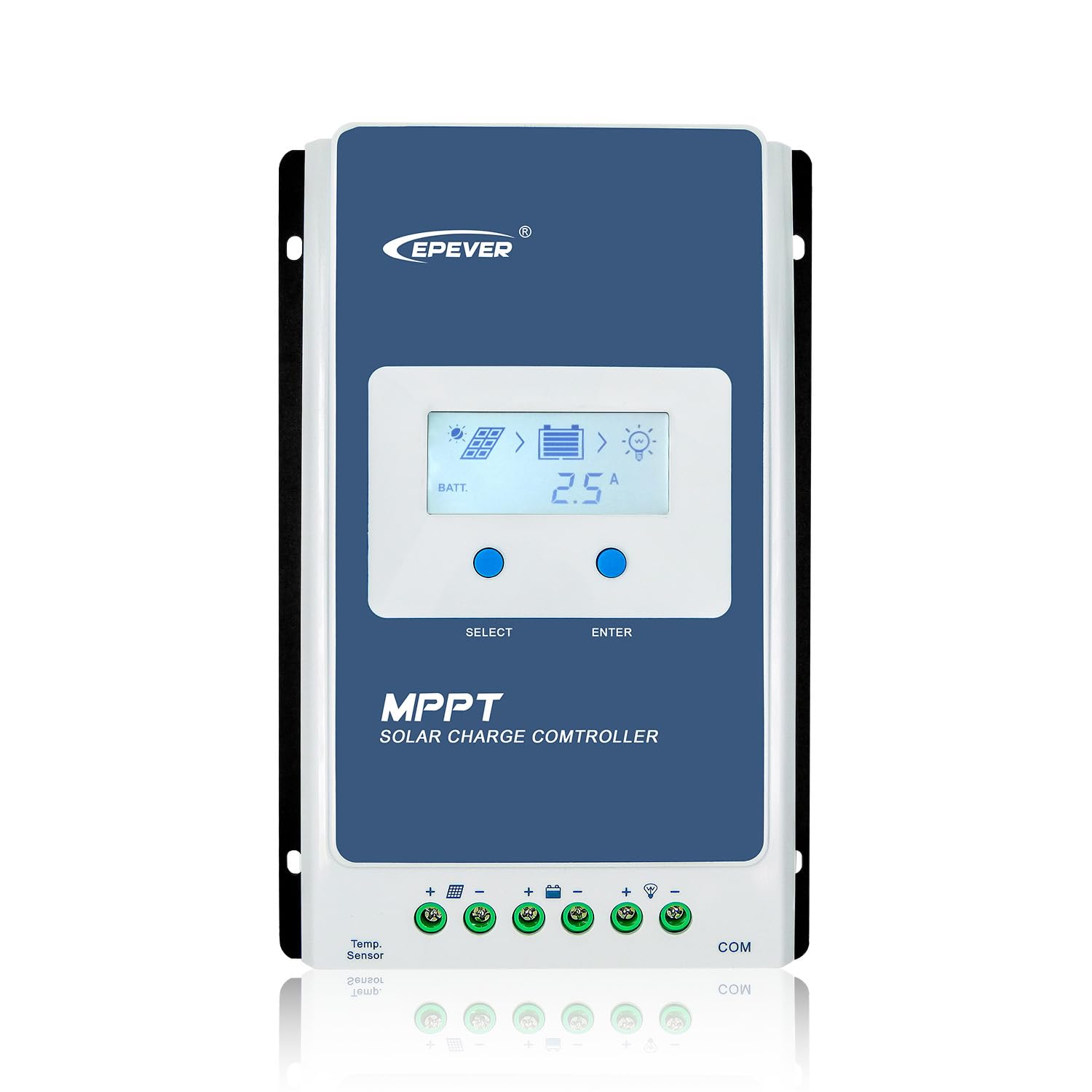
Match the amp rating to your panels or you waste sunlight. The amp number is the ceiling on charging current. A 30-amp unit like the EPEVER Tracer3210AN-G3 accepts up to 390W of panel on a 12V battery or 780W on a 24V bank. The bigger 60-amp PowMr units suggest 720W at 12V and up to 2800W at 48V. Buy too small and the controller caps out and wastes sunlight. Buy too big and you spend more than you needed for the same output.
Check maximum PV input voltage before you wire anything
Exceed the solar-side voltage ceiling and you can damage the controller. The Renogy Rover 30A tops out with a Voc (open-circuit voltage, the voltage a panel shows with nothing drawing from it) of 100V or less. Buyers report it simply stops charging above that. Plan your series wiring so the combined cold-weather voltage stays under the limit.
Decide if you need built-in Bluetooth or can add it later
Remote monitoring splits these controllers cleanly into two camps. The Victron, Power Queen, and LiTime units include the radio inside, so your phone talks to them right away. The Renogy models need a BT-2 module bought separately, which is worth knowing before the box arrives.
Quick Comparison
| Model | Best For | Max PV Input | Rated Charge Current | Built-In Bluetooth | Amazon |
|---|---|---|---|---|---|
| Victron SmartSolar 150V 45A Tr★ Best Overall | Serious off-grid builds | 150V, up to 2800W panel array | 45A | Yes — VictronConnect app | Amazon |
| EPEVER Tracer3210AN-G3 30ATop Performer | Budget-conscious camper and cabin builds | 100V, 390W at 12V / 780W at 24V | 30A | No — adapter sold separately | Amazon |
| Renogy Rover 20ABest for Small Rigs | Small 12V/24V starter setups | 100V, 20A charging | 20A | No — BT-2 module sold separately | Amazon |
| Renogy Rover 30A | Mid-size RV and marine banks | Voc ≤100V, 400W at 12V / 800W at 24V | 30A | No — BT-2 module sold separately | Amazon |
| Power Queen 30A MPPT | LiFePO4-first setups | — | 30A | Yes | Amazon |
| LiTime 30A MPPT Bluetooth | Hands-off lithium systems | 450W at 12V / 900W at 24V | 30A | Yes | Amazon |
| PowMr 60A MPPT (B08LZDZ6GP) | Large auto-detecting multi-voltage systems | Up to 160VDC / 2800W at 48V | 60A | No | Amazon |
| PowMr 60A MPPT Parallel (B0CXXSTGHK) | Scalable parallel banks | Up to 150V / 2800W at 48V | 60A | No | Amazon |
| POWLAND 60A MPPT | Budget 60-amp solar household systems | 150V max input | 60A | No | Amazon |
In‑Depth Reviews
1. Victron SmartSolar Charge Controller (150V 45A Tr)
Our pick — over 4.5★ from 100+ verified ratings; the strongest balance of quality and price.
The 150-volt, 45-amp heavyweight that revives batteries other chargers have already given up on.
Here is the number that sells this controller: 150 volts of solar input at 45 amps of charging, in a case that weighs 3.04 ounces. The voltage ceiling matters because it lets you run panels in long series strings — which means thinner, cheaper copper wire over a long run from roof to battery bank — while still harvesting serious current. Several owners mention that 700W of panels wired in series yields nearly 45A of output, which is the controller doing exactly what its rating promises.
This controller can bring back a battery other chargers give up on. Victron says this unit will recharge a severely depleted battery and can operate with battery voltage as low as 0 Volts, as long as the cells are not permanently damaged. One buyer’s second 150/45 replaced a different brand that could not even recognize the battery. The Victron immediately brought it back and charged it to normal. Owners also report it reviving seven-year-old flooded batteries and charging lithium banks cleanly. If you are nursing an old bank back to health, that behavior is the whole reason to pay for this one.
Setup and monitoring are where it pulls ahead of the field. Everything runs through the VictronConnect app over built-in Bluetooth, and the app holds presets and custom charge settings you can change without touching the unit. The load output is configurable too — you set the voltage at which it disconnects a load, which stops a runaway drain from flattening your batteries overnight. Customers note the heatsink runs cool, and the accepted approach for many owners is to avoid excessive overpaneling and let it work without a fan.
Why it earns the top spot
- 150V input and 45A output handle big, series-wired panel arrays
- Built-in Bluetooth with the VictronConnect app for presets and live tracking
- Configurable load output prevents batteries from draining flat
- Reviewers point out it reviving depleted and long-neglected battery banks
Where it asks more of you
- The Bluetooth radio is known to be weak — it works, but range is short
- Terminals are tight for oversized stranded wire, so plan your gauge carefully
- Configuring happens on your phone, not on the charger itself
The one to buy: a long-life system where reliability, configurability, and battery recovery justify paying more than the field.
Pause if: you need long-range wireless monitoring or you plan to stuff heavy gauge wire into the terminals.
2. EPEVER MPPT Solar Charge Controller 30A 12V 24V Auto Max PV 100V
The 30-amp trail favorite that wakes up at the crack of dawn and keeps charging all day.
Thirty amps and a 100-volt ceiling do not sound dramatic, but the numbers behind this EPEVER are. Tracking efficiency is rated above 99.5% and maximum DC/DC conversion efficiency at 98%, and it takes 390W of panel on a 12V battery or 780W on a 24V bank. In real terms, that means a small camper or garden-lighting array gets squeezed harder than a cheap unit can manage. An owner running 100 watts on a camper roof reports the unit starts producing power with the very first sun of the morning, keeping two deep-cycle batteries topped up for everything onboard.
The Tracer3210AN-G3 works with almost any battery you already own. It supports Gel, AGM, Flooded, Sealed, and LiFePO4 (4s/12V; 8s/24V), plus a user-defined lithium mode. It includes battery temperature compensation and real-time energy statistics. The RS485 interface speaks Modbus (a standard industrial data language), so it can talk to monitoring add-ons like MT50/MT52, WiFi, BLE, or PC software if you want to automate. Owners running a 450Ah lead-acid bank with a 320W panel report it charging up to 21A in full sun. It also handles a 250A bank with a 370W monocrystalline panel that is fully charged by 11am in Brazilian summer.
Two honest notes. The user manual is thin on explaining every setting and screen, so beginners may find themselves hunting for what each menu option does. And value opinions are genuinely split — some owners call it worth the premium for the tracking behavior, others say the cost pushed them toward cheaper competitors. If you want straightforward good charging and are happy to learn the menus, this is a strong 30-amp pick. If you want a phone-first interface, the Power Queen or LiTime below deliver that from the start.
What the tracking buys you: an owner upgrading from a cheap PWM controller saw the EPEVER recover real output they had been losing with 24V panels in series. A 450Ah bank charging at 21A in full sun is the kind of result that comes from genuine MPPT behavior, not marketing labels.
Where it splits opinions: the manual is not beginner-friendly, and some owners consider it pricey against cheaper 30-amp rivals — a fair gap only if the tracking advantage matters to your array.
Reach for this if: you want a dependable 30-amp controller with excellent tracking and don’t mind learning a slightly cryptic menu.
Look elsewhere if: you want built-in Bluetooth without buying an add-on or prefer a phone-driven interface.
3. Renogy Rover 20A MPPT 12V/24V Auto-Detect LCD
A compact 20-amp unit built for shaded roofs, cloudy afternoons, and tight panel budgets.
Partial shade is the enemy of small solar systems, and this controller tackles it directly. Dual-peak MPPT tracking is rated at 99.9% multi-peak efficiency, and the conversion efficiency is claimed at 98% — 20% higher than PWM controllers, according to the maker. For an RV or off-grid cabin where trees flicker across the panels all day, that partial-shade handling is the feature that actually matters most. It also runs 12V and 24V systems automatically and works with gel, sealed, flooded, and lithium batteries.
Owners who keep coming back are the clearest signal. One buyer’s second Renogy MPPT controller came after a first unit ran for three years with no problems, and ease of use and reliability are what they name in the same breath. Setup is straightforward — the backlit LCD walks you through bulk, absorption, and float stages, and the unit stores 365 days of performance logs plus integrates with Modbus for anyone planning remote monitoring later.
The catch is real but fits the design: Bluetooth is not built in. You need the BT-2 module (sold separately) to use the Renogy DC Home app. And 20 amps of charging current has a ceiling — if your panels or battery bank grow beyond a smaller setup, you will want to step up to the 30A Renogy below. There is also a 100V input limit, which several owners point out means the unit stops charging if your solar exceeds it, so size your strings accordingly.
A good starting point: the Rover 20A covers batteries from gel to lithium, handles shade competently, and keeps the LCD simple enough to read at a glance. For a first RV or cabin setup where you want reliability without a big spend, this is the one to start with.
Know the ceiling: 20 amps and 100 volts cap the growth path, and Bluetooth is an extra purchase — plan around both if you expect to expand.
Ideal owner: a camper, van, or cabin starter system with a handful of panels and a mid-size battery.
Outgrown quickly if: your panel string exceeds 100V or you want integrated phone monitoring without buying an add-on module.
4. PowMr 60A MPPT Solar Charge Controller (Parallel, 12/24/48V)
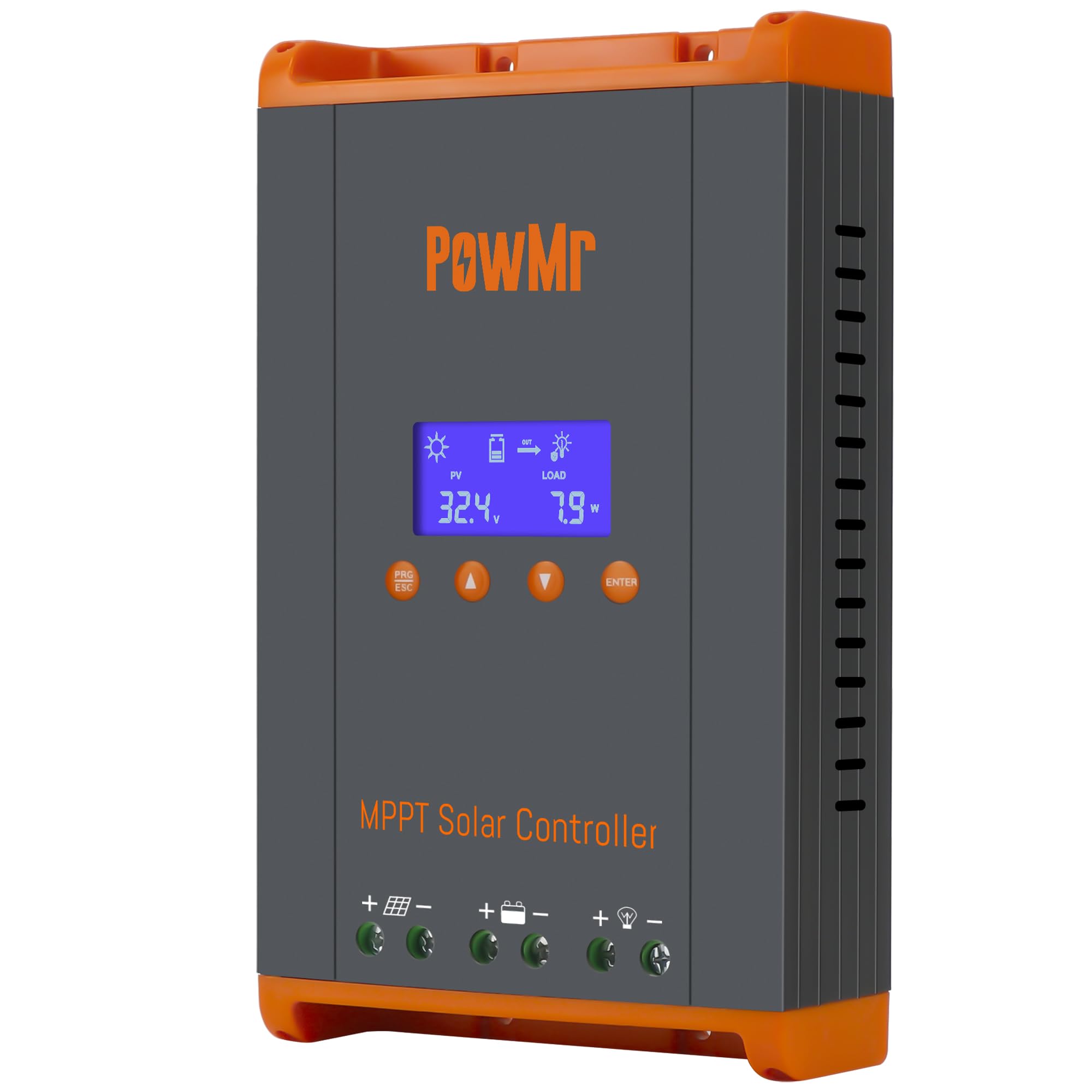
Rated to run up to twelve of itself side by side when one 60-amp unit is not enough.
This PowMr scales with your system instead of being replaced. Sixty amps of charging is a lot of current for a single controller. The manufacturer says as many as twelve 60A units can be connected in parallel to grow a large system’s total capacity. For someone building a serious off-grid bank in stages, that kind of headroom means the controller can scale with you. The unit auto-detects 12/24/36/48V and supports lead-acid and lithium with preset sealed, gel, flooded, and LFP profiles. It also offers user-programmable absorption voltage, float voltage, low-voltage cutoff, and load timer.
Cooling is handled with dual method: die-cast aluminum heat dissipation plus a silent bladeless fan that activates above 45°C and turns off below 40°C. That fan-free design is quieter and suits RVs, boats, and yachts where equipment noise is a real annoyance. Panel capacity scales by system voltage — suggested 720W on 12V, 1440W on 24V, 2100W on 36V, and 2800W on 48V — with matching input voltage windows that give you room to wire panels in series.
Track record is where buyers split. Owners who keep reordering say it is a genuine value — several report running multiple units for years without trouble, with one buyer is on their fourth unit. Others have had harder experiences: a small share report voltage spikes knocking 24V inverters offline, and in one long-term report a fan stopped on a unit that had run for a long stretch. The honest read is that this controller can perform well when sized and wired with care, and the flatter software features are its strength; treatment matters more with this model than with the Victron above.
Why some owners keep reordering: the parallel scaling, LFP presets, bladeless fan cooling, and per-system panel charts give it a lot of flexibility for the tier, and the model has earned repeat purchases from long-term users.
What to keep an eye on: a small share of shoppers say voltage spikes and one fan failure over long periods — spring for surge protection on your inverter and check connections periodically.
Strong fit for: a growing off-grid bank where you want to add capacity over time by linking units rather than replacing them.
Think twice if: you want fully hands-off reliability without doing periodic wiring and connection checks.
5. POWLAND 60A MPPT Solar Charge Controller 12/24/36/48V Auto

60 amps at an entry-level price, with a small print worth reading carefully.
Sixty amps of charging current paired with four-level battery charging — batch, boost, float, and equalize — is the core proposition here. The MPPT algorithm is rated for PV utilization of at least 99% and maximum efficiency of at least 98.1%, and the unit auto-detects 12V, 24V, 36V, or 48V systems up to a 150V input ceiling. Compatible chemistries cover flooded, AGM, GEL, and lithium-ion. For a solar household system or an RV build that wants big current without paying the premium for a Victron, this is the price-to-output play.
There are concrete positives from owners. The unit handles around 50A of solar charging without shutting down, the cooling fan kicks in as charging current climbs, and one buyer reports a first unit still running after two years. It is a clear step up from a PWM controller — one owner running it against an old PWM says it was a significant improvement. Manual quality is also good enough that one buyer returned two other units over poor manuals before settling here.
The important honest note is that the panel capacity claim is aggressively high; one buyer reports the overload protection shuts the unit down above roughly 600W, which is well below the “wide range” numbers in the listing. Functionality is the aspect owners discuss most often, and it lands mixed — many work well, but a few report it stops working after a short while. If your array is small enough to stay comfortably under the real ceiling and you want the 60-amp capability at an entry-level price, scale accordingly. If your panel array is already large, this one may not be the right 60-amp.
Where it earns its keep: the pricing, four-stage charging, and 150V input make it a genuinely useful upgrade path from PWM for small-to-moderate arrays.
The recurring frustration: the printed panel capacity runs well ahead of what the unit actually protects to, so treat the wattage ceiling conservatively and stay under the real limit.
Worth considering if: you want 60-amp capability without paying premium prices and your array fits well below the practical limit.
Better upgraded past if: your panel count already sits near or above 600W, where this unit’s own protection may handcuff you.
6. Power Queen 12/24V 30A MPPT Solar Charge Controller, Built-in Bluetooth
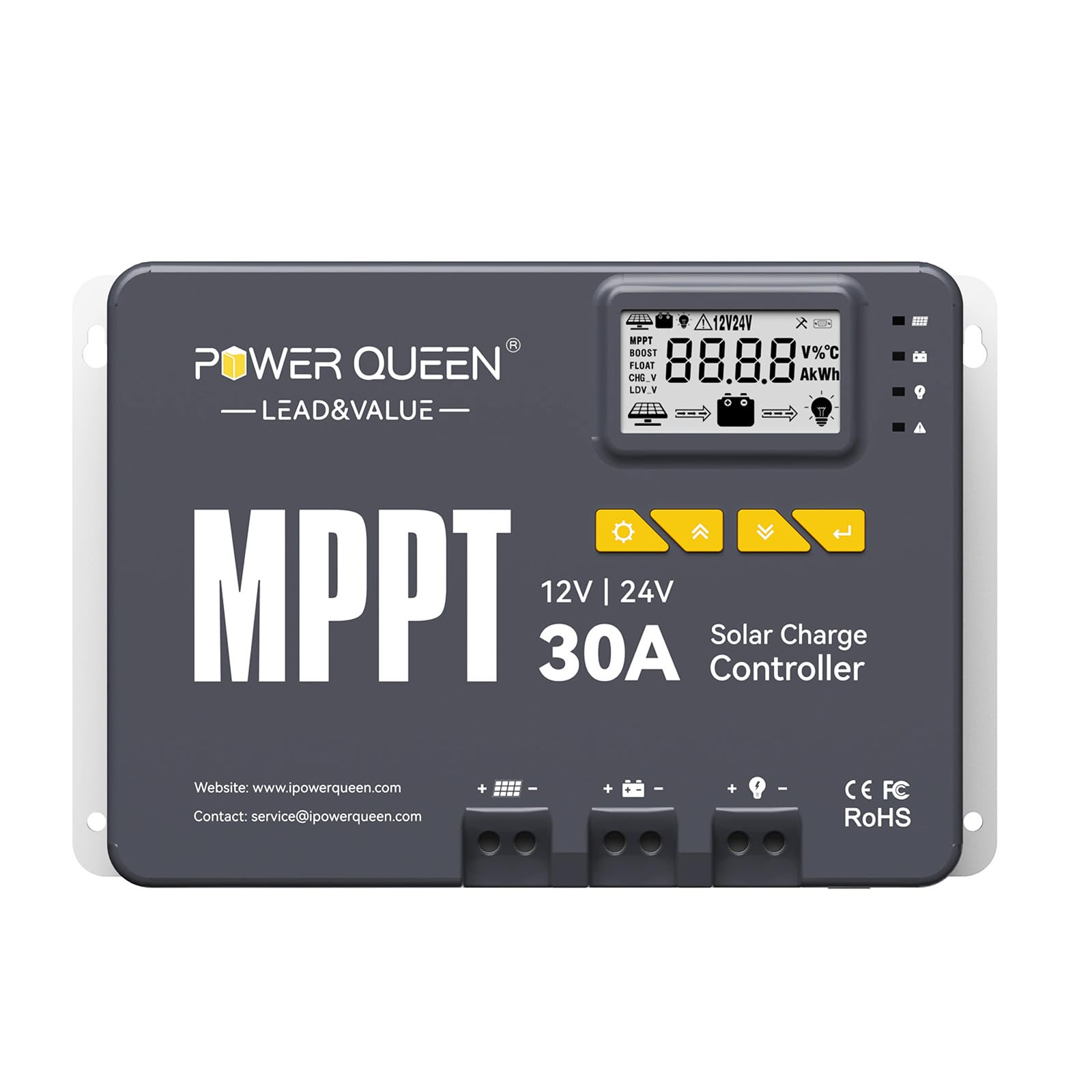
The 30-amp controller that lets your phone do the walking, no module required.
Built-in Bluetooth is the reason to look here. There is no add-on module to buy and no extra cable to route — your phone talks to the controller directly for real-time status and adjustments, which makes checking your system from inside the RV or cabin simple. Tracking efficiency is rated up to 99% and peak conversion at up to 98%, and the die-cast aluminum body helps shed heat to reduce power loss. On top of that it bundles protections against reverse polarity, overpower, overvoltage, short-circuit, and over-temperature, plus a proper LiFePO4 charging mode with sealed and gel lead-acid support when you adjust the parameters.
Owners running this against a large LiFePO4 bank report meaningful real-world outcomes. One setup runs 8x100Ah LiFePO4 at 24V with 8x100W panels and a 10,000Wh backup, and the owner reports only 9% loss. Another powers a 100Ah LiFePO4 battery, a 7-cubic-foot freezer through a 600W inverter, a 12V 55-quart fridge, and 300W of solar — running flawlessly over a two-week stretch. The display plus LED status lights for solar, battery, load, and controller give you a fast visual read without touching the app.
Two honest caveats. The provided connectors have been a weak point for some owners — one buyer cut them off and used bare wire for a perfect result. And while the app works, at least one owner reports it fails to stay connected even at closer range and sometimes shows wrong or missing data. The load feature and the display work well regardless; remote monitoring is the part with occasional friction.
Why it suits LiFePO4 owners: the built-in Bluetooth and dedicated LFP charging mode mean you get monitoring and a matched profile without buying anything extra, backed by a die-cast aluminum case that handles the heat from continuous charging.
The honest friction point: supplied connectors have let some owners down and the app is not the most stable — swapping to bare wire and treating Bluetooth as a nice-to-have, not a mission-critical tool, keeps expectations realistic.
Best matched to: LiFePO4 users who want integrated Bluetooth monitoring without buying add-ons.
Stay clear if: you need rock-solid app connectivity at distance, or you would rather not touch the wiring after unboxing.
7. Renogy Rover 30A MPPT 12V/24V Auto DC Input LCD

The most-reviewed Renogy in the lineup — 30 amps of proven dual-peak tracking for mid-size banks.
Thirty amps, 400W of panel at 12V or 800W at 24V, and a Voc ceiling of 100V — those three numbers define what this Renogy can do. Dual-peak MPPT is rated at 99.9% multi-peak tracking efficiency and 98% conversion efficiency, so it keeps pulling power even when trees flicker across the array. It runs 12V and 24V systems automatically, supports gel, sealed, flooded, and lithium, and includes a lithium reactivation mode for deeply discharged banks. The 4-stage charging — bulk, absorption, float, and equalization — is what keeps lead-acid banks living longer, and the smart temperature compensation adjusts charging between -40°F and 149°F.
Owners genuinely like the results. One reviewer noted this 30A alongside an existing 20A Rover to run parallel for a total of 50A into a 400Ah bank with a 2k inverter. Another noticed the MPPT upgrade let them wire panels in series in a tree-heavy location, so batteries charge earlier and excess full-sun voltage converts to usable amps. A third explains it simply: real MPPT pulls power even in overcast, the LCD shows voltage, amps, and battery percentage at a glance, and the metal case with heatsink handles the load. That matches what the tracking efficiency claim is really promising — more usable current, not just a label.
The friction points are real but specific. Bluetooth requires the BT-2 module (sold separately), so the phone monitoring is not free. The cooling fan is loud enough that owners notice it, and the paper manual is rough — the cable attachment instructions in particular are unclear, and the PDF guide is not always included. On the earlier 20A Rover above, that same 100V planning limit applies here too, and once or twice a unit has failed with an error code from the start, though the overwhelming majority of buyers are happy.
The consensus take: solid real MPPT behavior, easy setup, and a clear display — the things repeat Renogy buyers name every time.
What you pay extra for: the BT-2 module for app monitoring, and you live with a loud fan and a rough paper manual.
Perfect for: mid-size RV, marine, and off-grid banks that want a proven 30-amp controller with measured, real-world results.
Not the one if: your plan requires built-in Bluetooth, a quiet fan, or a polished manual.
8. LiTime 12V/24V 30A MPPT Solar Charge Controller Bluetooth, LCD Display
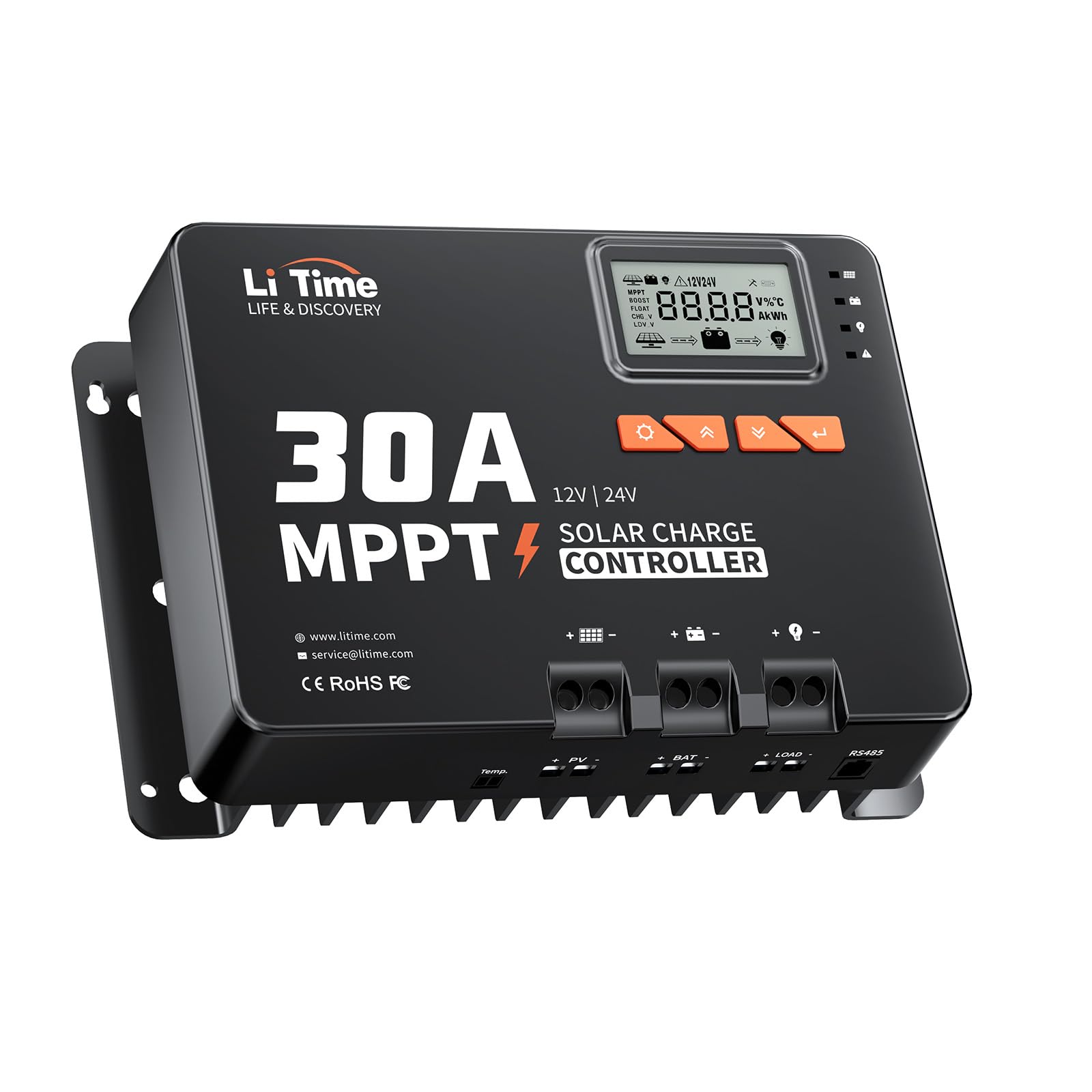
Thirty amps, a factory LiFePO4 mode, and Bluetooth that comes in the box instead of the cart.
You get direct on-unit control without pulling out your phone. Panel capacity sits at 450W for a 12V battery and 900W for a 24V bank. Tracking efficiency is rated at no less than 99% and peak conversion at 98%. The 30 amps of charge current with four buttons and an LCD screen gives you direct on-unit control. LED indicators for solar array, battery, load, and controller mean you can read the system state at a glance. The die-cast aluminum case takes the heat from sustained charging. Built-in protections cover reverse connection, overpower, overvoltage, short-circuit, and over-temperature.
For a straightforward lithium upgrade, this one has an easy on-ramp. One owner upgraded a 40-year-old off-grid system from lead-acid to LiFePO4 with this controller, and reports the switch made the system hands-off, compared to the constant monitoring lead-acid required. The included Bluetooth module and the free Android app made the configuration painless. Another buyer running a 100-watt solar panel and a LiTime LiFePO4 battery notes the 30-amp charger runs without generating RF interference on their ham radio gear. A third, more unusual result: this controller came with a LiFePO4 charging mode that made the lithium setup simple, and it charges LiTime lithium batteries well.
Two fit notes worth knowing ahead of time. The 450W/900W panel ceiling is a real cap — one owner undersized it and could not charge a 314Ah battery in a single day, so size the lithium bank and array together. And the app experience is uneven; the newest Android versions do not connect cleanly, and a fallback version drops the Bluetooth link every few minutes. On-unit buttons handle everything the app does, but remote access is the weaker half of the feature set. One more thing worth noting: the discharge Ah readings the app shows are not fully accurate, because not all loads pass through the controller.
A clean lithium move: the factory LiFePO4 mode, in-box Bluetooth, and die-cast aluminum cooling make the transition from lead-acid easy for anyone with moderate panel wattage.
Size it before you buy it: the 450W at 12V and 900W at 24V panel ceilings are not placeholders — many an oversized bank has outrun this controller in a single day.
Built for: LiFePO4 or mixed banks that want in-box Bluetooth monitoring and a dedicated lithium charging mode.
Not for: lithium banks well above the panel ceiling, or setups that depend on a stable Android app over remote access.
9. PowMr MPPT 60A Solar Charge Controller 12/24/36/48V Auto
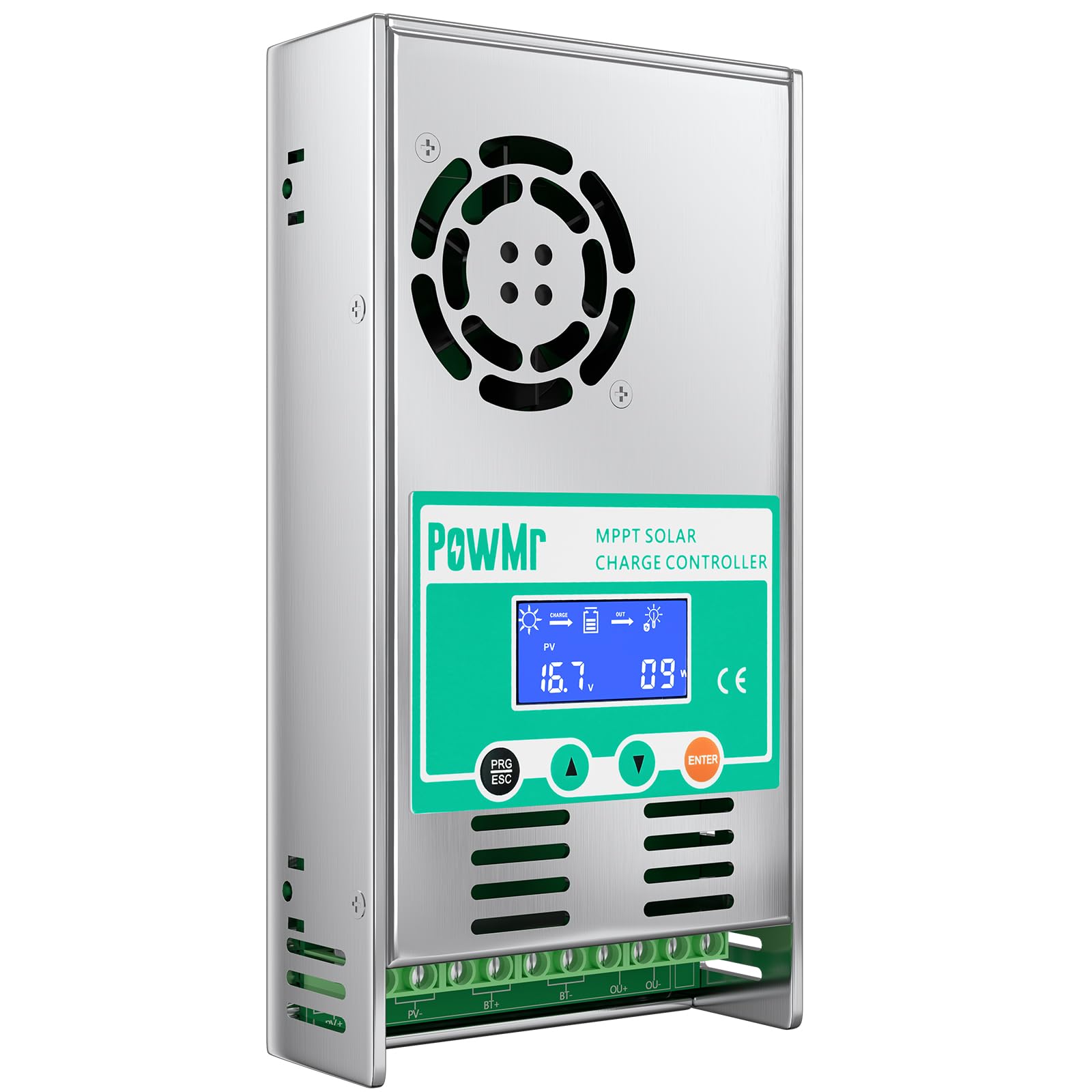
A 60-amp auto-sensing controller that reads your battery voltage and gets on with the job.
Auto-detection across 12V, 24V, 36V, and 48V systems is the headline here, and the panel windows are worth studying carefully. Suggested peak solar is 720W on 12V with up to 80VDC input, 1440W on 24V with up to 105VDC, and 2100W on 36V or 2800W on 48V with up to 160VDC input. Tracking efficiency is rated above 98.1%, meaning it should out-charge a standard PWM controller by a clear margin on the same array. The aluminum alloy housing handles heat dissipation and a temperature-controlled fan activates above 104°F to keep the unit cool during heavy charging.
Repeated buyers give the clearest picture of how this model handles life. One owner is on their second unit running in parallel with the first, describing it as long-lasting and effective; another has bought these for years, with one still running after five. That kind of repeat purchase rate — one buyer is on their fourth unit — is the strongest signal that the controller has a track record serious users trust. The three-stage charging (MPPT, absorption, float) and user-definable parameters make it flexible for a wide battery catalog including sealed, gel, flooded, and LiFePO4.
Its honest limitation is on the terminals. One long-term owner notes the cable lugs do not accept very thick wire gauge. If your installation uses heavy-gauge conductors, that constraint deserves attention before you buy. And while it holds up well for most buyers, one owner reports units that developed voltage spikes over time on a 24V system and could not be reset. It is the recurring trade-off in this tier: strong real-world reliability for most, with a small share where something goes wrong.
Where it delivers: auto-detection, temperature-controlled cooling, and a user base that keeps buying more — the combination makes this the default multi-voltage 60-amp for buyers who want value without unknown brands.
The one real constraint: terminals do not accept very fat wire gauges, so factor your wiring size in before you commit.
Right pick for: buyers running a 12V to 48V system who want auto-detection, strong tracking efficiency, and a track record with repeat purchasers.
Reconsider if: your design calls for heavy-gauge conductors the terminals may not accept, or you want remote monitoring built in.
Understanding the Specs
Tracking Efficiency and Conversion Efficiency
Tracking efficiency and conversion efficiency measure two different things. Tracking efficiency measures how well the controller finds the balance where your panels produce the most power under the current sun and temperature. Conversion efficiency is how much of that harvested power makes it to your battery after the voltage adjustment. Controllers in this group rate tracking as high as above 99.5% (EPEVER) and conversion as high as 98% (several Renogy, LiTime, and PowMr models). The Renogy dual-peak units list 99.9% tracking. A high tracking figure with a middling conversion figure still beats a PWM controller’s rough cut. That is why true MPPT is worth the upgrade if your goal is squeezing more usable current from the same panels.
Maximum PV Input Voltage and Panel Capacity
Every controller here has a solar-side voltage ceiling — the 150V Victron and the 160VDC PowMr allow long series strings, while the Renogy Rover 30A and EPEVER cap at 100V. Exceeding that ceiling is how controllers die. The panel wattage charts scale with system voltage: the EPEVER accepts 390W at 12V and 780W at 24V, the LiTime 450W at 12V and 900W at 24V, and the PowMr models up to 2800W at 48V. Check both numbers before wiring: your string’s cold-weather open-circuit voltage and your array’s total wattage must sit under the controller’s ceiling with room to spare.
Battery Chemistry and Charge Profiles
Lithium support varies more than lead-acid support. Every controller here supports LiFePO4, but the amount of adjustment varies. The Power Queen and LiTime units ship with a dedicated LFP charging mode from the start. The PowMr and Renogy models support lithium profiles that sometimes need manual parameter tweaking. The makers note that lithium batteries show different resting voltages than their lead-acid equivalents, so the charge settings may need adjusting. Lead-acid coverage is universal: sealed, gel, flooded, and AGM are all supported across this list, usually with preset profiles that need no setup.
Cooling, Terminals, and Installation Reality
60-amp controllers work hard and get hot, so cooling design matters. The PowMr parallel unit uses a bladeless fan that activates above 45°C; the PowMr auto-detecting 60A uses a fan that kicks in above 104°F. The Victron claims a cool heatsink with no fan needed for most setups. Terminals are the other real-life constraint: one owner of the 150/45 Victron says oversized stranded wire is hard to land, and an owner of the PowMr auto-detecting 60A says the terminals do not accept very thick gauge. Always plan your wiring size against the terminal spec before you commit.
FAQ
What is the difference between MPPT and PWM solar charge controllers?
Will a 12V MPPT charge controller work with a 24V battery bank?
How much solar panel wattage can a 30A MPPT controller handle?
Why does my MPPT controller stop charging above a certain panel voltage?
Do I need an MPPT, or will a cheaper PWM controller do for 12V systems?
Can I add Bluetooth to a Renogy Rover if I want app monitoring?
What size MPPT controller do I need for a 48V battery bank?
How long should a 12V MPPT solar charge controller last?
Do MPPT controllers work with a mix of panel brands and sizes?
Is a temperature-controlled fan a problem in a solar charge controller?
Final Thoughts: The Verdict
For most off-grid, RV, and marine systems the winner here is the Victron SmartSolar 150V 45A Tr. It pairs a 150-volt input and 45-amp output with built-in Bluetooth monitoring, configurable load protection, and a reputation for reviving depleted battery banks that cheaper units give up on. If you want a lower-cost 30-amp performer with strong tracking and a wide battery list, the EPEVER Tracer3210AN-G3 is the one to grab. Its record with campers and off-grid lighting setups speaks for itself. For a small camper or cabin starter where the budget matters most, the Renogy Rover 20A is the sensible first pick. It is easy to install, supports four battery chemistries, and has a shade-handling algorithm that gets more out of a modest panel array. Whichever you choose, resist the temptation to over-size your panel array to the printed wattage numbers. Every controller in this list has a real ceiling on input voltage, and staying under it is what keeps the unit working season after season.
How We Picked
We do not accept paid placement. Every pick is matched to a real buyer and a real use-case; we do not hands-on test units.
Sources & Methodology
Specifications: manufacturer listings and product documentation. Review insights: verified customer reviews, as of September 2026. Pricing: not shown on this page (it changes often); check the current price via the retailer link.
As an Amazon Associate, KitchPrep earns from qualifying purchases. This does not affect which products we feature.
Related Guides
