
Specs are compiled from manufacturer listings and verified buyer reviews and can change over time — please confirm the key details on the product page before buying.
A 12V battery backup power supply keeps your router and modem running through blackouts, so your internet stays up when the grid goes down. A 12V battery backup power supply fixes exactly that by giving your router and modem their own private power source that kicks in automatically. This guide breaks down the models that keep your internet alive for hours, not minutes.
I’m Mohammad Maruf — the founder and writer behind KitchPrep. This guide is built by comparing the manufacturers’ published specifications and the patterns across verified customer reviews, so you get each pick’s real strengths and trade-offs instead of marketing spin.
Your internet setup deserves to survive blackouts, and finding the right 12v battery backup power supply means matching capacity, output ports, and charge time to your exact gear—so you stay connected when the grid doesn’t.
Our Picks at a Glance
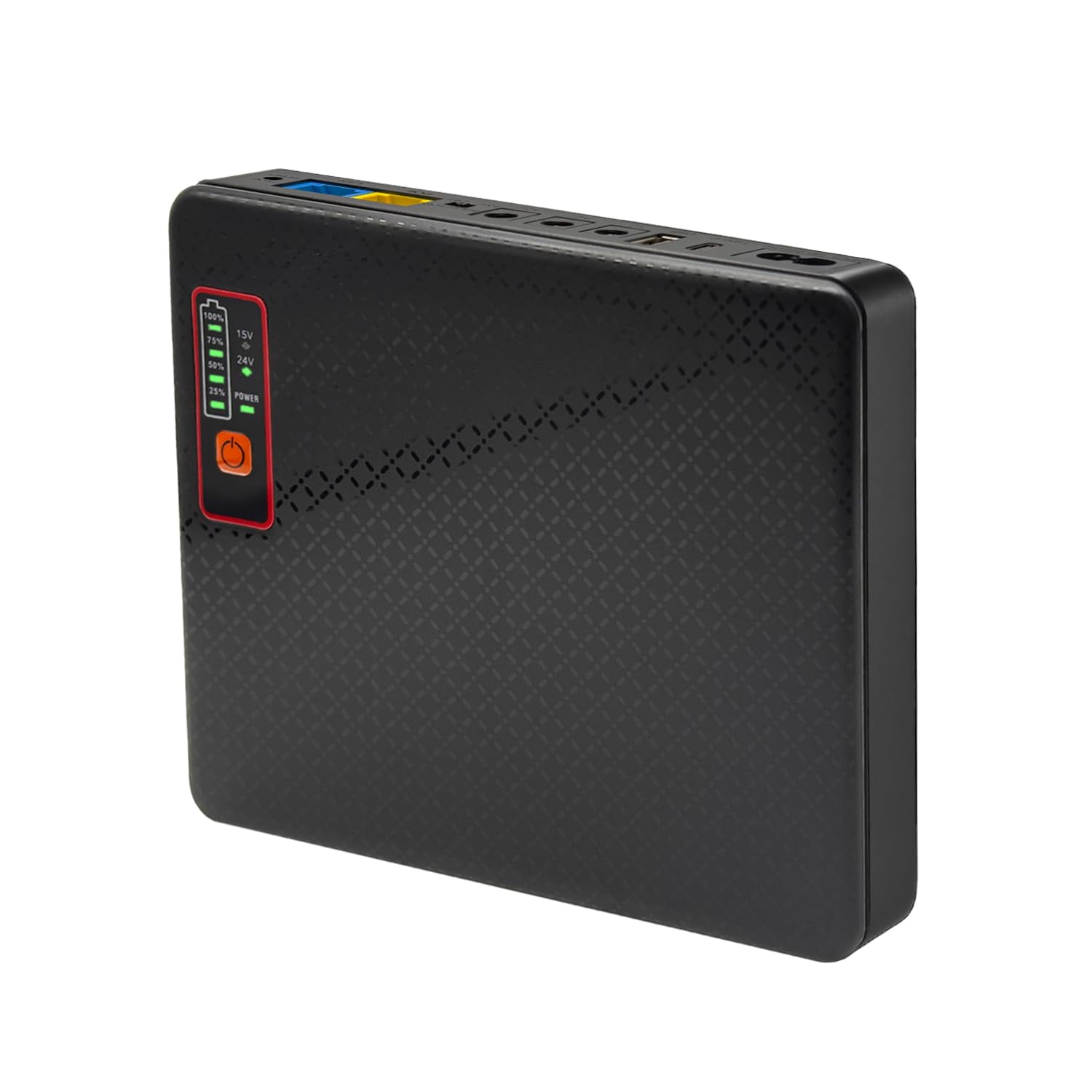

How To Choose The Best 12V Battery Backup Power Supply
Choosing the wrong unit can leave your router dead anyway, so match the voltage and capacity to your gear before buying. Here’s what actually matters.
Match the Voltage and Ports to Your Gear
Check the label on your router’s original power adapter. Most need 12V or 9V DC, and the connector is usually a 5.5mm x 2.1mm barrel plug. If your camera system runs on PoE, you need a unit with a PoE port—not every backup has one. Confirm the port size before you order or you’ll be buying extra adapter cables.
Capacity is Your Outage Clock
Higher mAh and watt-hour ratings translate directly to longer backup runtime. A 20800mAh (62Wh) unit runs a typical router far longer than a 10400mAh (38Wh) one—roughly double. But that extra runtime comes at the cost of weight, so match capacity to how long outages actually last in your area.
Don’t Ignore the Recharge Time
Recharge time determines how quickly the unit is ready for the next outage. Some models draw a full charge in about 2 hours, while others need 11 hours or more. If you face frequent, long blackouts, a fast-charging unit keeps you ready sooner.
Quick Comparison
| Model | Best For | Capacity | Charge Time | Max Output | Amazon |
|---|---|---|---|---|---|
| DC UPS 20800mAh★ Best Overall | Whole-home router & camera backup | 20800mAh (62Wh) | 11 hours | 18W | Amazon |
| Shanqiu Mini UPSFast Recharge | Metal-cased, fast-recharge value | 10000mAh (37Wh) | 2 hours | 60W | Amazon |
| Yuuki Power 10400mAhCCTV Ready | PoE cameras + router combos | 10400mAh (38Wh) | — | 24W | Amazon |
| PECRON D77 | Long outages, days of runtime | 76.96Wh | — | 76.96W | Amazon |
| TalentCell 27000mAh | 8-9 hour marathon sessions | 27000mAh (97.2Wh) | — | 98W | Amazon |
| Wbacon 20000mAh | Multi-device power users | 20000mAh (75Wh) | — | 65W | Amazon |
| Yuuki Power 18000mAh | Modem & firewall setups | 18000mAh (56Wh) | 20 hours | 24W | Amazon |
| SKE DC20000 Plus | Quiet, with AVR stability | 20000mAh | — | — | Amazon |
In‑Depth Reviews
1. DC UPS 20800mAh (62Wh) Battery Backup
Our pick — 4.5★ from 50+ verified ratings; the strongest balance of quality and price.
The marathon runner that keeps a 12-watt router alive through long blackouts with room to spare.
This pick balances the largest everyday capacity with versatile output options. The 20800mAh (62Wh) lithium battery delivers hours of backup, and buyers report a 12-watt TP-Link router staying up through a full one-hour outage without blinking. You get 18W of total output, which splits cleanly across 5V⎓2A, 9V⎓1A, and 12V⎓1.5A DC ports, plus PoE ports for security cameras and USB-A plus USB-C for phone charging.
Its automatic protection suite guards against overcharge, overdischarge, and short circuits. The unit guards against overcharge, overdischarge, and short circuits, so you can leave it plugged in 24/7 without cooking the battery. The LED indicator shows remaining charge at a glance, and the 600g (1.3lb) body slips neatly beside your modem. Owners mention it sails through five-hour outages thanks to intentional rationing—good enough to keep internet running through scheduled power cuts.
The trade-off is the recharge time. A full fill takes 11 hours, so after a long outage you’re waiting a while before it’s fully ready again. That’s the price of the doubled capacity, and it’s a fair one.
What Owners Applaud
- Doubled capacity over the smaller Yuuki — 20800mAh vs 10400mAh (2x)
- 18W output handles router, modem, and cameras together
- Compact 1.3lb design that hides behind networking gear
The Fair Warning
- 11-hour recharge leaves you waiting after long outages
- Plastic shell, not the metal of pricier rivals
Reach for this if: you want the best blend of large capacity, multiple outputs, and real-world proven reliability for a typical home network.
Think twice if: your outages come in rapid succession and you need a unit that refills in under a few hours.
2. Mini UPS Battery Backup for Router, Modem, Security Camera
The aluminum-armored backup that refills in two hours flat—perfect for frequent outages.
If your power blips often, this is the unit that bounces back fastest. The built-in 10000mAh (37Wh) battery charges in just 2 hours, a full 5.5x quicker than the 11-hour DC UPS above. That speed means it’s ready for the next outage before you’ve even finished resetting your clocks.
You get a tough aluminum-alloy shell and enough ports to keep your whole network alive. It delivers up to 60W total across 5V USB 2A, 5V DC 2A, 9V DC 2A, and 12V DC 2A outputs—so you can power a router, a hub, and a phone at once. Customers note it running a TP-Link Deco M4 plus an IKEA hub for about 4 hours on battery. It also works as a standard USB power bank, and fibre modem users confirm the 12V output lands at a clean ~12.1V with correct polarity, so your modem gets stable power.
The honest catch: battery life is the most-discussed trade-off, with several owners reporting the pack doesn’t last more than 6 months. It’s reliable while it works, but treat it as a consumable rather than a decade device.
Instant switchover: the auto-switch to battery is smooth, so your network never restarts mid-call—home workers specifically praise this, meaning you stay connected during a power cut.
Keep in mind: the included plug adapters don’t include reverse-polarity options, and the 37Wh capacity suits a router plus one or two small devices, not a full rack.
Best for: households that face short, frequent outages and want a metal-cased unit that’s always recharged and ready.
Not for: anyone needing days-long backup—the modest 37Wh battery drains fast with heavy loads.
3. Mini UPS for Wifi Router, USB 5V⎓3.6A DC UPS 12V⎓2A Battery Backup 9V⎓2A
The 24-watt multi-tool that powers routers and PoE security cameras from one slim box.
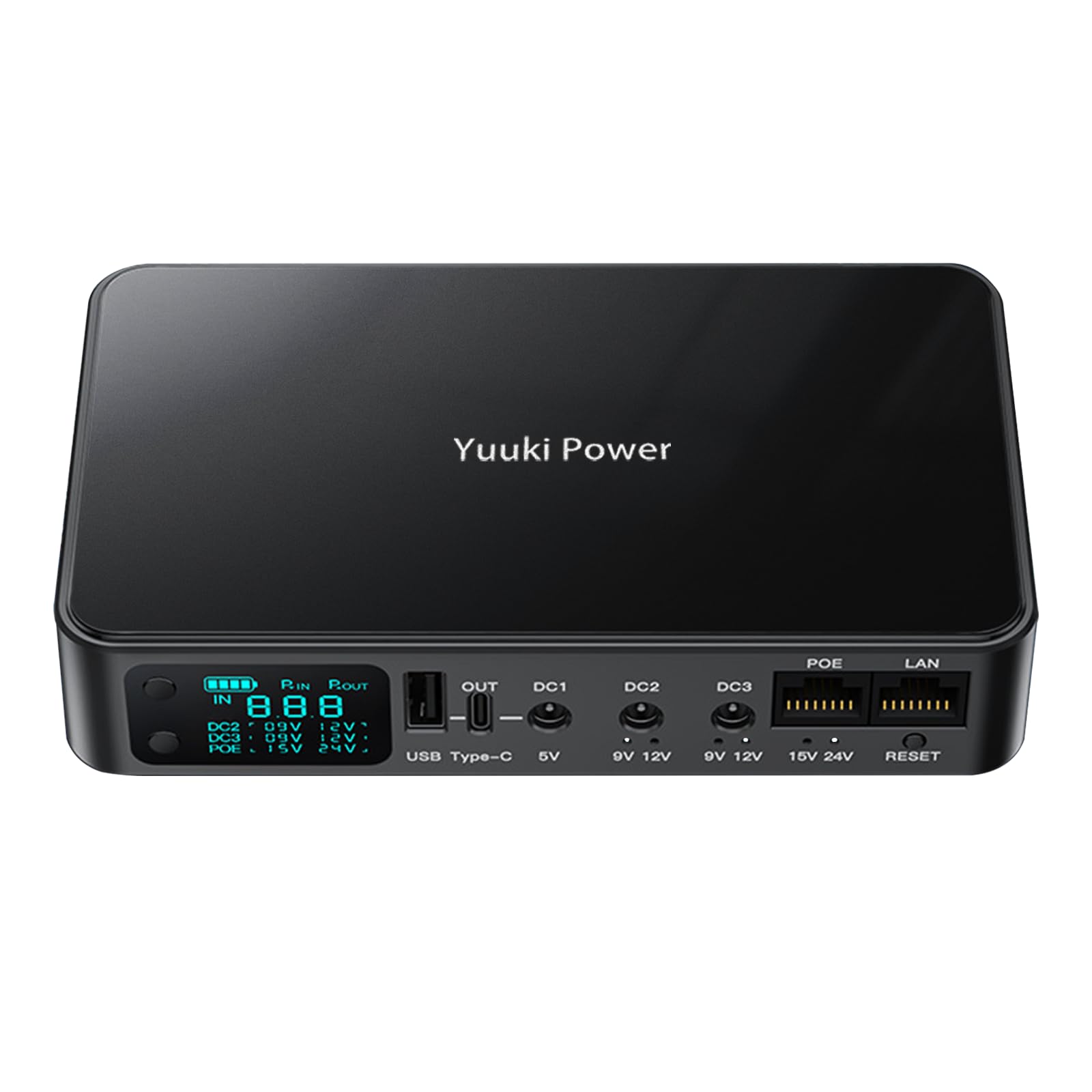
This unit earns its spot by offering the most flexible output menu at this size. The 10400mAh (38Wh) battery feeds a 24W total output across 5V3.6A, 9V2A, and 12V2A DC ports—and it’s a 33% higher max output than the 18W DC UPS above. Crucially, it adds PoE outputs at 15V1.3A or 24V0.8A, so your CCTV cameras stay recording through an outage, not just your Wi-Fi.
Owners praise its reliability, confirming it keeps a modem and router running for hours during outages. The clear LCD screen shows real-time status, and the 426g (0.9lb) weight makes it the lightest full-featured pick here—41% lighter than the 600g DC UPS. Battery replacement is designed to be simple, and it ships with plenty of DC barrel adapters plus a 12V3A US charger.
The recurring gripe is compatibility with certain routers. There’s a documented case where an Amazon Eero 6+ didn’t play nice, so check your router’s voltage demands before committing.
Versatility win: the USB-C port doubles as a power bank for a car modem or phone, and the 24W ceiling handles far more than a bare router.
Compatibility caveat: a few specific router models have failed to connect—verify your gear first.
Choose this if: you run PoE cameras and a router together and want one compact, light unit to back them all up.
skip it if: you’re on an Eero mesh system and want zero risk of a mismatch.
4. PECRON D77 DC UPS Battery Backup
A 76.96Wh powerhouse that outlasts whole workdays—one buyer says it lasts days, not hours.
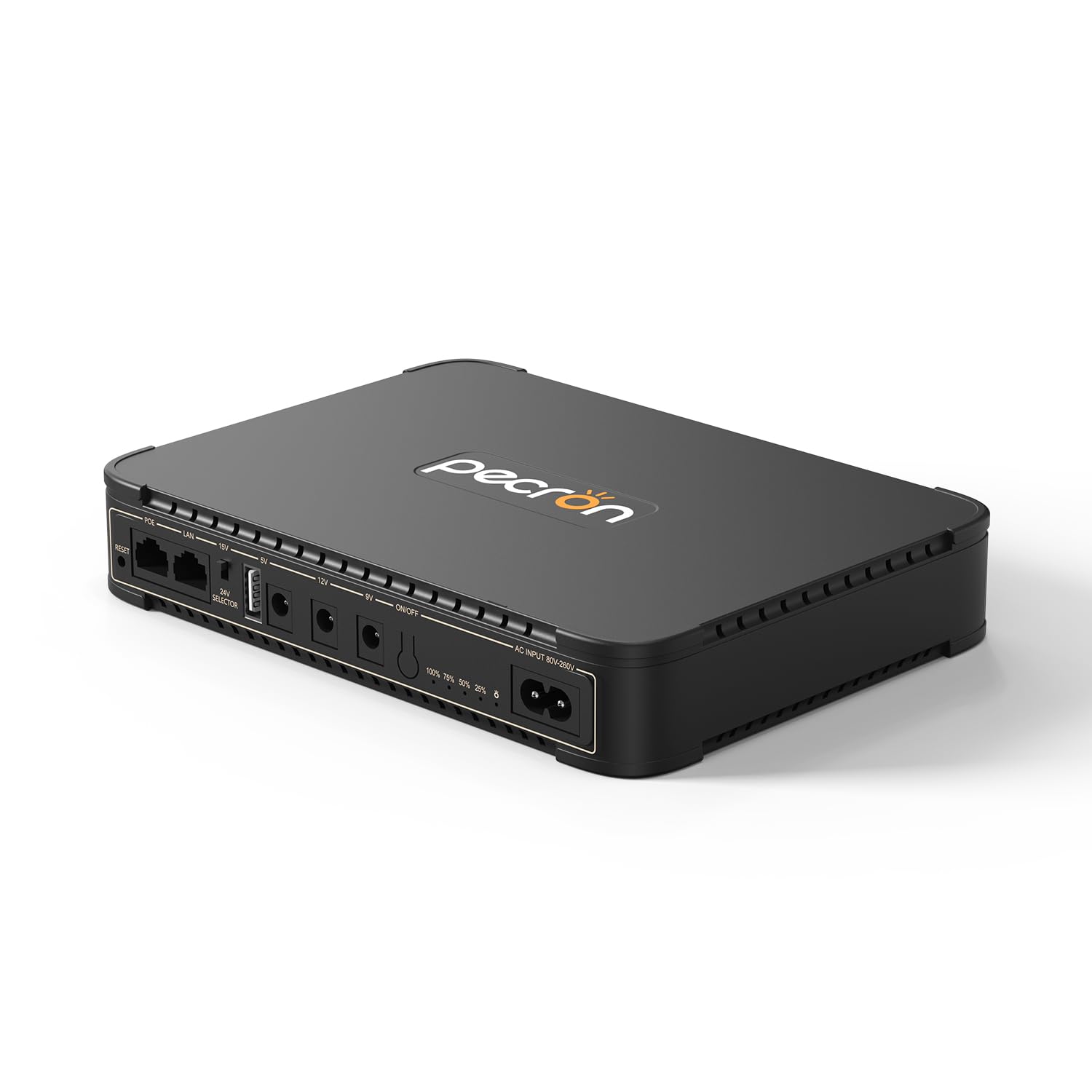
This is the unit you grab when outages stretch beyond an afternoon. The 76.96Wh battery is the second-largest here, and reviewers point out it’s genuinely overkill for a single AT&T ONT—charging a 5000mAh phone barely dents the battery. It supports 76.96W max output with a wide 80-260V AC input, so it handles voltage swings most cheap bricks can’t.
The output layout is deceptively simple: one 5V/2.6A USB-A port, three DC5521 outputs (5V, 9V, 12V), and a PoE port. Shoppers say the voltages are accurate—5V, 9.1V, 12.2V measured—and the six-fold protection system covers over-charge, deep-discharge, over-current, short-circuit, voltage instability, and thermal issues.
The fair warning: the 12V output tops out at 2A, so a power-hungry Wi-Fi 7 triband router won’t get enough juice. And at 700g (1.5lb), it’s not the lightest to toss in a bag.
What Wins People Over
- 76.96Wh capacity runs a router for days, per owners
- Wide 80-260V AC input handles unstable grids
- Accurate output voltages verified by buyers
The Reality Check
- 2A limit at 12V can’t feed modern Wi-Fi 7 routers
- Short 5ft cable included—buy a longer one
Grab this for: long regional outages or as a mobile power source that lives in your car and powers laptops, tablets, and phones in the field.
Pass if: you’ve already upgraded to a power-hungry Wi-Fi 7 router that needs more than 2A at 12V.
5. TalentCell Mini UPS 27000mAh (97.2Wh)

The 8-to-9-hour champion that owners say keeps them working through entire workdays without blinking.
This unit has the most extensive owner track record for marathon runtime. The 27000mAh (97.2Wh) lithium ion pack—built from 12 individual cells—powers a router, ONT, and mini-PC for hours, and buyers report it lasting 8 to 9 hours on a single charge through a power cut. The pass-through charging means zero interruption when the grid drops, so you keep working without missing a beat.
Output-wise, it’s the most generous here: four DC 12V ports (range 9-12.6V), one DC 9V port, two USB 5V ports, plus an 18W USB-C PD output. The 98W max output is the highest in this lineup, and protection covers short-circuit, over-current, and over-charge/discharge. Owners specifically call it the most stable UPS they’ve owned, ideal for single router or camera backup.
The honest caveat: the battery cells are not field-replaceable, and one teardown after warranty revealed bad solder and dead cells. Most owners adore it; a rare few hit a dud.
What everyone loves: pass-through charging with no dropouts, plus enough capacity that “I never worry about not having internet during a power cut.”
The trade-off: no battery-level or power-loss indicator, and the non-removable cells mean replacement is a full-unit affair.
Ideal for: remote workers who need their connection to survive an entire working day without a hiccup.
Consider elsewhere if: you want visible battery-percentage feedback or user-swappable cells.
6. Wbacon 14 PCS Mini UPS 20000mAh
The eight-port Swiss Army backup that powers Eero Pro 6E routers and whole mini network racks.
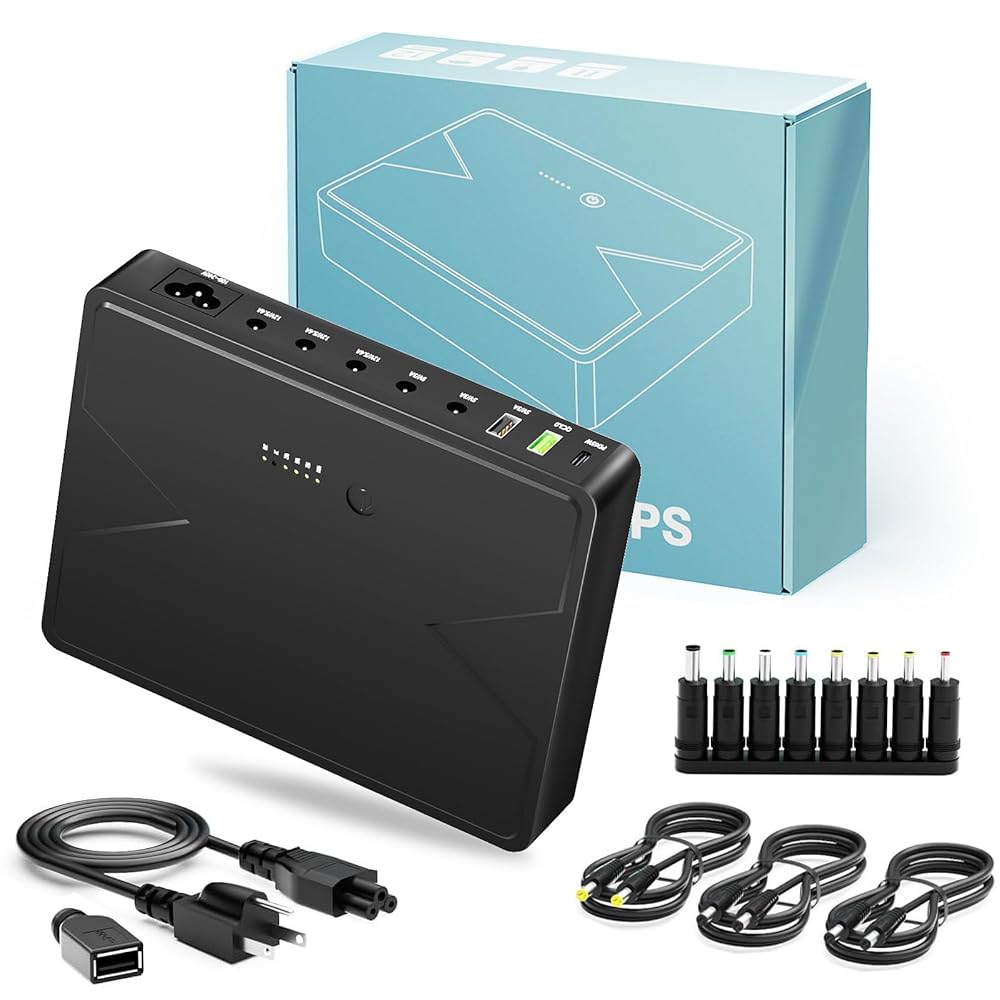
If you have more than just a router to protect, this is the unit built for you. The 20000mAh (75Wh) battery feeds an 8-output layout: five DC ports (5V/3A, 9V/3A, or 12V/5.4A), a USB 5V/2A port, a USB QC3.0 port, and a Type-C port hitting 65W PD. Owners mention it cleanly powering an Eero Pro 6E via USB-C 9V 3A while a Netgear switch runs off 5V simultaneously.
The aluminum-alloy casing houses intelligent control that senses low voltage and switches modes automatically, with 6 LED battery indicators keeping you informed. The 65W max output outpaces most rivals here, making it the bridge between a simple router backup and a real mobile power station. At 0.46 kg, it’s light enough to carry on the go despite the 9 included connectors and 3 DC cables.
The recurring gripe: the included barrel connectors don’t always fit the 12V outputs—several owners note only one connector fits, so budget for extra DC cords. And AT&T fiber router customers note it won’t work without the specific power adapter.
Standout strength: the 65W USB-C PD output charges laptops and tablets, which no other router UPS here can match.
Watch out: connector fit is hit-or-miss, and it’s not compatible with AT&T fiber router-modems without their adapter.
Perfect for: power users running Eero mesh systems plus switches who also want to top up a laptop during an outage.
Look elsewhere if: you’re on AT&T fiber or want guaranteed barrel-connector fit from the start.
7. Battery Backup for Router CCTV 18000mAh (56Wh)
The extra-capacity twin of the 10400mAh Yuuki—72% more battery for the same 24W output.
This is the same design family as pick 3 but with a bigger heart. The 18000mAh (56Wh) pack delivers roughly 72% more capacity than the 10400mAh model while keeping the identical 24W max output and the same DC menu: 5V3.6A, 9V2A, 12V2A, plus PoE at 15V1.3A or 24V0.8A for CCTV. Reviewers point out it running a modem and router for about 5 hours while those devices together draw around 15 watts.
The LCD screen shows real-time status, and the 512g (1.1lb) weight stays manageable. Buyers praise it for saving several receptacle ports and replacing a power strip entirely—one owner powers a cable modem, firewall, and an external PoE access point with ports left over. Battery replacement is designed to be straightforward, and it ships with plenty of DC barrel adapters.
The significant trade-off is recharge time: it takes roughly 20 hours to fully refill. And durability is mixed—a rare unit stopped working after 6 months, so this one rewards gentle treatment.
What owners value: the 5-hour runtime on a 15-watt modem-router combo makes it a genuine all-evening backup.
Fair warning: the 20-hour recharge means you can’t rush it back to readiness, and barrel cables run short.
Pick this if: you want the Yuuki feature set—PoE, LCD, multi-voltage—with noticeably more capacity for a modest step up in weight.
Avoid if: you face back-to-back outages and can’t wait 20 hours for a refill.
8. SKE DC20000 Plus Altair Mini DC UPS

The silent sentinel with AVR that owners say powers a Wi-Fi router for 8-plus hours, no noise at all.
For a backup you’ll forget is even there, this is the one. The 20000mAh pack runs a router for 8+ hours per owners, and the standout praise is that it makes no noise whatsoever while in use. The built-in Automatic Voltage Regulation (AVR) keeps output stable even when input power fluctuates, which owners call essential quality for consistent router operation.
The layout covers 5V, 9V, and 12V DC devices plus USB and Type-C charging, so it backs up routers, cameras, tablets, and phones alike. The slim, rack-style 0.65 kg design fits neatly near network cabinets or media setups, and the LED battery indicator shows remaining capacity at a glance. Owners describe it as solidly built and heavy with a quality feel, arriving almost fully charged.
The honest mixed note: power duration varies by load, and a rare unit failed after 5 months with no support response. Most owners have units from this brand several years old, but the occasional dud exists.
The consensus: quality is the top praise, with noise level close behind—this is the quietest, most solid-feeling unit reviewed.
The mixed reality: some shoppers say 9-hour runtimes while a few hit a failed unit at 5 months; support response is inconsistent.
Choose this for: a silent, quality-feeling backup that keeps Wi-Fi alive through workdays and long evenings.
Think twice if: you want a proven decade-long track record—the occasional early failure is a real, if rare, outcome.
Understanding the Specs
Capacity: mAh and Watt-Hours
mAh (milliamp-hours) and Wh (watt-hours) both measure how much energy the battery holds. Wh is the more honest number because it accounts for voltage—so 20800mAh at 12V is vastly different from 20800mAh at 5V. In practice, a 62Wh unit runs a typical 12-watt router for roughly five hours, while a 97.2Wh unit stretches toward nine. Match capacity to the length of outages you actually face.
Output Ports and Voltage
Your router’s adapter label tells you the voltage it needs—usually 12V, 9V, or 5V. The connector is almost always a 5.5mm x 2.1mm barrel plug, though some units use USB-C or PoE for cameras. A unit with three or four DC outputs plus USB lets you back up a router, modem, and camera simultaneously. If your security system runs on PoE, you must buy a unit with a PoE port.
Charge Time
This is the hidden spec that bites after the first outage. A 2-hour charge time means your backup is ready again fast. An 11-hour or 20-hour charge time means you’re waiting most of a day after a long blackout. If you face rolling outages, prioritize a fast-charging unit—the Shanqiu at 2 hours beats the Yuuki models at 11 to 20 hours by a wide margin.
Max Output Power
This is the ceiling for everything you connect at once, measured in watts. A 24W unit handles a router plus a modest camera. A 65W unit with USB-C PD can also charge a laptop. The rule: add up the watt draw of every device you’ll connect and keep it under the unit’s max output—exceeding it drains the battery fast and can trip protections.
FAQ
Will a 12V battery backup work with my specific router?
How long will a 20000mAh battery backup actually run my router?
Can I use a 12V battery backup to power my security cameras?
What does pass-through charging mean for my router?
Is a 12V battery backup better than a full AC UPS?
How do I know if my devices will exceed the max output?
Why does recharge time vary so much between models?
Can a 12V battery backup double as a power bank for my phone?
How long does a 12V battery backup last before needing replacement?
What happens if I connect a device with the wrong polarity?
Final Thoughts: The Verdict
For most buyers, the 12v battery backup power supply winner is the DC UPS 20800mAh because it pairs the largest everyday capacity with genuine multi-device versatility at a fair weight. If you want the fastest recharge between outages, grab the Shanqiu Mini UPS with its 2-hour fill time. And for marathon sessions that stretch past a workday, the TalentCell 27000mAh is the proven crowd favorite that owners say keeps them connected for 8 to 9 hours straight.
How We Picked
We do not accept paid placement. Every pick is matched to a real buyer and a real use-case; we do not hands-on test units.
Sources & Methodology
Specifications: manufacturer listings and product documentation. Review insights: verified customer reviews, as of August 2026. Pricing: not shown on this page (it changes often); check the current price via the retailer link.
As an Amazon Associate, KitchPrep earns from qualifying purchases. This does not affect which products we feature.
Related Guides
