
Specs are compiled from manufacturer listings and verified buyer reviews and can change over time — please confirm the key details on the product page before buying.
If you want one answer before you read anything else: the Anker SOLIX C2000 Gen 2 is the safest place to put your money, and the DARAN NEO300L is the one to grab if you mostly need to keep a laptop, a router, and a small fridge alive through a storm. Everything below explains why, and where each of the other seven wins.
I’m Mohammad Maruf — the founder and writer behind KitchPrep. This guide is built by comparing the manufacturers’ published specifications and the patterns across verified customer reviews, so you get each pick’s real strengths and trade-offs instead of marketing spin.
A 120V battery bank is simply a big battery with a household-style AC outlet on it, so you can plug in normal appliances without a generator running outside. The picks below cover every size from a backpack unit to a whole-home backup, and each one runs on standard North American household voltage. Here is what actually separates a 120v battery bank you will still be using in three years from one you will regret.
Our Picks at a Glance
How To Choose The Best 120V Battery Bank
The three numbers that decide whether a unit suits you are watt-hours, continuous watts, and surge watts. Get those right and everything else is convenience. Get them wrong and you own a very heavy paperweight.
Start with watt-hours, not watts
Watt-hours (Wh) are the size of the tank, while watts are how fast you can pour. A 288Wh unit and a 4,096Wh unit can both run a 120V fridge, but the bigger tank runs it for far longer. Add up what you want to keep alive and for how many hours, then match the tank to that job.
Match continuous watts to your biggest single appliance
Continuous watts is the ceiling for everything plugged in at once. A unit rated 350W will not run a 1,500W space heater no matter how big its battery is. Always size the wattage to the hungriest appliance you plan to run, not the average of them.
Do not ignore surge watts
Motors pull a heavy jolt for a second or two at startup, which is why a fridge compressor can trip a unit that looks big enough on paper. That jolt is the surge rating, and it is usually listed alongside the continuous figure. If your plan involves a fridge, a pump, or a power tool, check the surge number first.
Check the chemistry and the charge time
LiFePO4 (a lithium chemistry that holds its capacity across far more charge cycles than older lithium-ion) is now standard on good units. Then look at how long a full recharge takes, because a unit that needs a whole night on the wall is useless in a rolling blackout.
Quick Comparison
| Model | Best For | Capacity | Continuous / Surge Output | Weight | Amazon |
|---|---|---|---|---|---|
| Anker SOLIX C2000 Gen 2★ Best Overall | Home backup and RV fridges | 4,096Wh | 2,400W / 4,000W | 34.2 kg | Amazon |
| DJI Power 1000 V2Top Performer | Campers, RV owners, creators | 1024Wh | 2600W stable output / — | — | Amazon |
| Jackery Solar Generator 1000 v2Best with Solar | Off-grid living with solar included | 1,070Wh | 1,500W / 3,000W | 23.8 pounds | Amazon |
| BLUETTI Elite 200 V2 | Long-term home backup | 2073.6Wh | 2600W / 3900W lifting | 53.4 pounds | Amazon |
| Jackery HomePower 3000 | Whole-home essentials and RV hookups | 3072Wh | 3600W / 7200W | 59.5 pounds | Amazon |
| EF ECOFLOW DELTA Pro | Expandable whole-home power | 3600Wh | 3600W / up to 4500W with X-Boost | 99 pounds | Amazon |
| GRECELL 1000W Solar Generator | Camping and small emergency backup | 999Wh | 1000W / 2000W | 17.86 pounds | Amazon |
| EBL Portable Power Station 500W | Budget starter backup | 519.48Wh | 500W / 1000W | 18 pounds | Amazon |
| DARAN NEO300L | Backpack portability and small devices | 288Wh | 350W / 600W | 8.2 pounds | Amazon |
In‑Depth Reviews
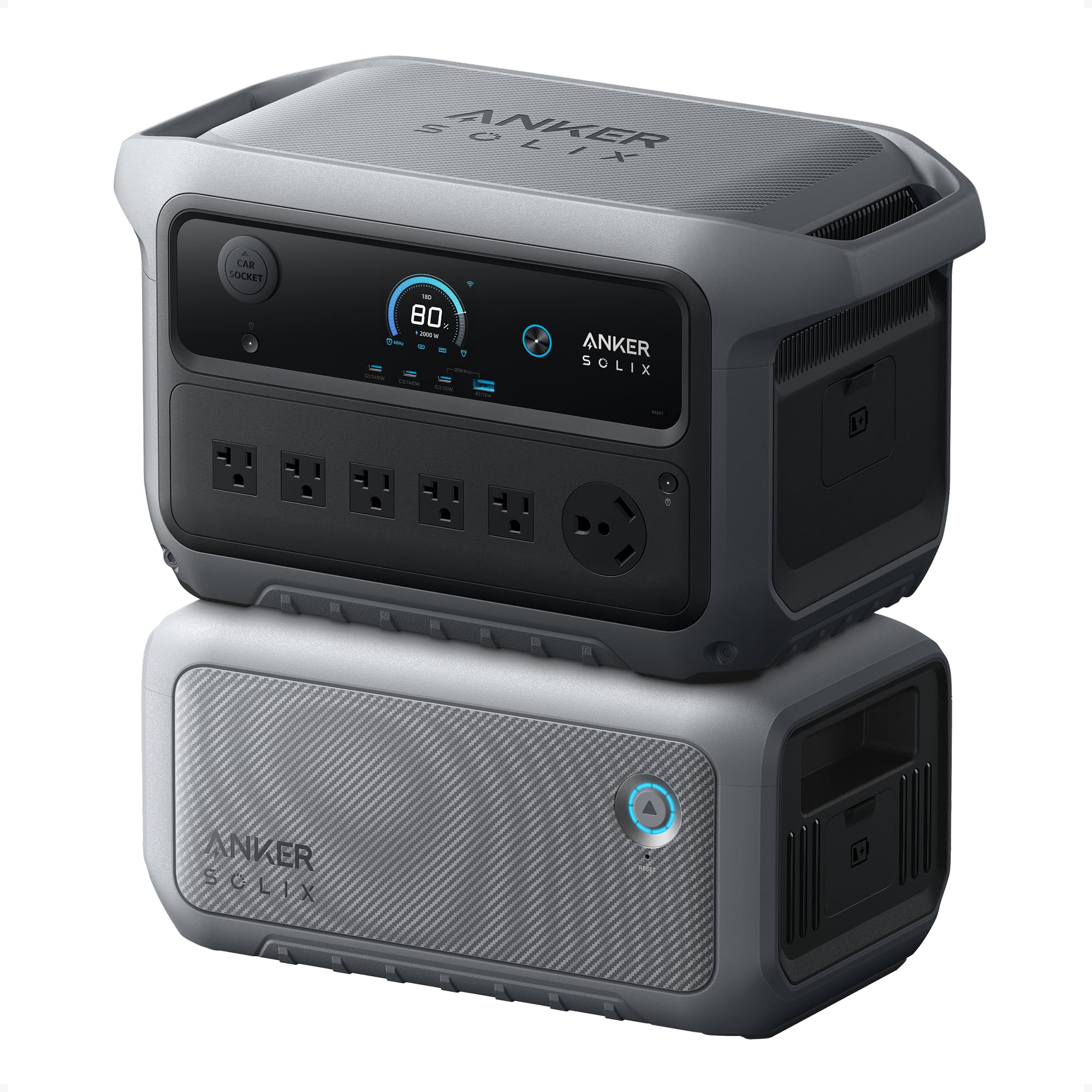
1. Anker SOLIX C2000 Gen2 Portable Power Station, Expansion Battery, 4096Wh
Our pick — over 4.5★ from 650+ verified ratings; the strongest balance of quality and price.
A full home backup that recharges while you eat lunch and never once asks for gasoline.
For anyone who has watched a storm warning crawl across the screen and started counting how many hours the freezer will hold, this is the unit to design around. Anker pairs a 4,096Wh LiFePO4 battery (a lithium chemistry built to survive thousands of charge cycles) with a 2,400W continuous output and a 4,000W peak, so the compressor surge on a full-size fridge or most window and RV air conditioners is comfortably inside the headroom. Against the DARAN NEO300L below, that is 4,096Wh versus 288Wh and 2,400W versus 350W — a different class of machine entirely, and it should be, because the jobs are different.
The 9W standby draw is unusually low for a 4,096Wh unit. Anker quotes a 9W standby draw, which is the trickle the unit sips while sitting idle, and that small number is what lets the same battery run a dual-door fridge for up to 32 hours — and up to 64 hours once you bolt on the included BP2000 expansion battery. Recharging is the other headline: 80% in 45 minutes and 100% in 58 minutes on an AC outlet. Solar owners get monocrystalline panels quoted at up to 23% conversion efficiency, with four adjustable tilt positions at 30°, 40°, 50°, and 80° to chase the sun, plus an IP67 waterproof rating (fully dust-tight and able to shrug off rain) on the panels themselves.
At 34.2 kg it is a two-hand lift, and small air conditioners will not run for long stretches. At 34.2 kg this is not a one-hand carry, and owners routinely move it on a wheeled case instead. Buyers report a real-world pattern worth knowing: “Used weekly for remote karaoke/outdoor events: drops to ~70% after 4hrs; powers RV fridge/fans/pumps for 3-day weekend leaving 27%; weighs 45lbs with two handles; charges fast (27% to full in 1hr10min on dedicated 15A outlet).” The other recurring note is that the app’s runtime estimates are rough guides rather than precise forecasts, so plan by measured hours, not the predicted ones. Small air conditioners will not run for long stretches either.
What earns it the top slot
- 4,096Wh of LiFePO4 storage with a 2,400W continuous, 4,000W peak output — enough surge for a fridge compressor or most RV air conditioners.
- Refills from empty to 100% in 58 minutes on AC, so a rolling outage never catches it flat.
- 9W standby draw keeps a dual-door fridge alive up to 32 hours, or up to 64 hours with the bundled expansion battery.
- Indoor-safe: no fumes, no exhaust, and near-silent running, which matters if the unit lives in a kitchen or bedroom.
Where it asks something of you
- 34.2 kg is a two-hand lift every time — most owners end up buying a wheeled case.
- App and display estimates for remaining runtime are rough, not precise.
- Long stretches of small AC use will drain it faster than the fridge numbers suggest.
Built for: households that want a fume-free replacement for a small gas generator, and RV owners running a fridge, fans, and pumps for a weekend.
Look elsewhere if: you need something you can carry upstairs one-handed, or you only ever charge phones and a laptop.
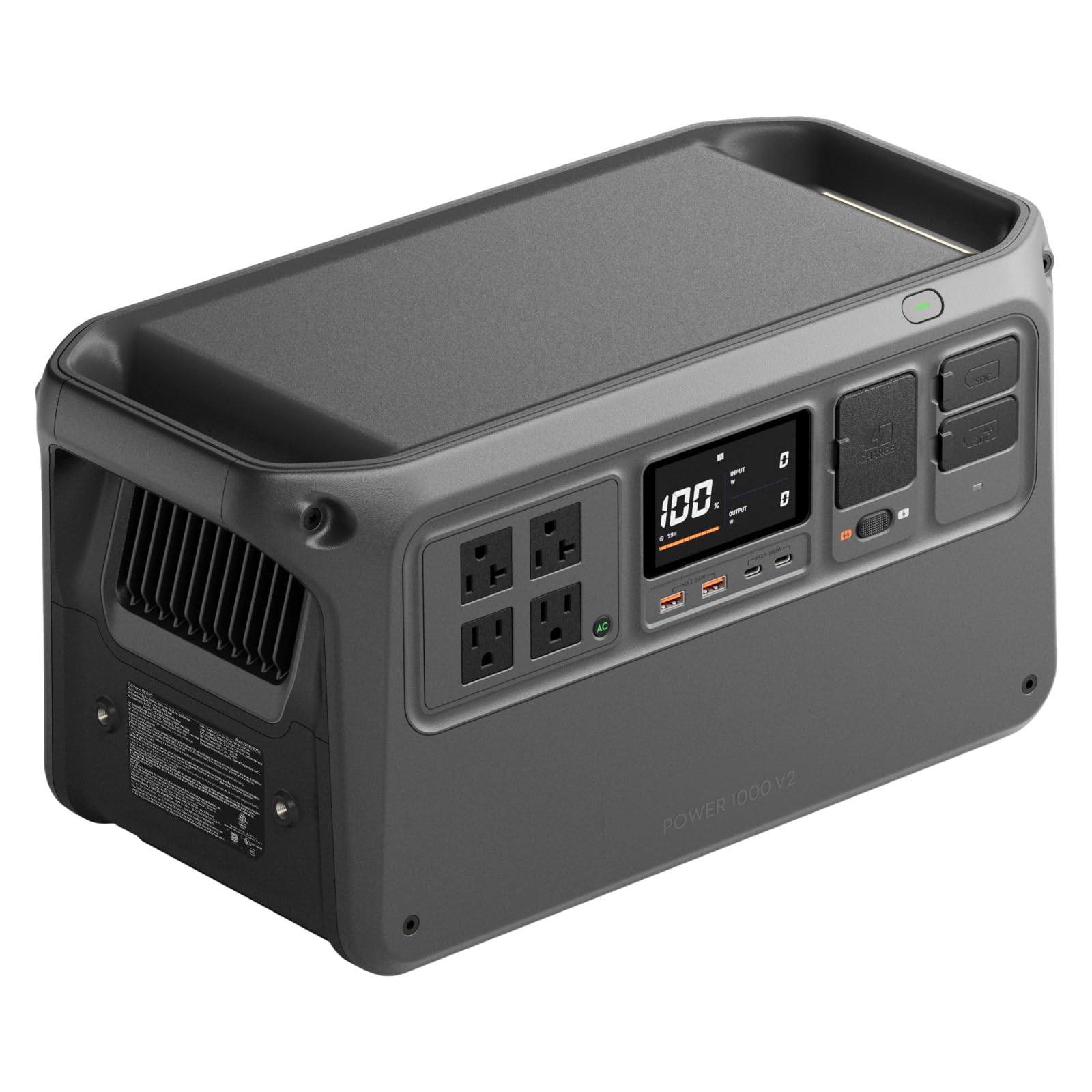
2. DJI Power 1000 V2 Portable Power Station, 1024Wh LFP Battery
Refills to 80% before your coffee finishes brewing, and runs quiet enough to sleep beside.
If the thing you dread most is waiting hours for a dead bank to come back to life, this is the pick. DJI quotes 80% charge in 37 minutes and a 2600W stable output, which is a lot of grunt for a unit this size — it will drive kettles, cookers, projectors, saws, and drills, and DJI claims it powers 99% of appliances. The 1024Wh LFP battery (lithium iron phosphate, the same long-cycle chemistry the big units use) sits behind an intelligent battery management system, a sub-nano coating, and a flame-retardant housing. DJI also rates the battery at a 10-year lifespan.
Sleep quality is where this one quietly beats bulkier rivals. It runs as low as 26 dB, which is roughly the sound of a quiet room, so a camper van or RV at 2 a.m. stays peaceful even while devices charge. For creators there are dual 140W USB-C ports for 280W total output — DJI puts that at 40% more power than typical dual 100W setups — and the UPS switchover is quoted at 10ms, twice as fast as the Power 1000, so a desktop, router, or camera rig rides through a brief outage without rebooting. A 5-year warranty backs it up.
Two things to weigh honestly. First, DJI does not build the MPPT charge controller (the circuitry that squeezes the most power out of a solar panel) or the car charging module into this unit, so going solar or charging from a vehicle needs a separate compatible adapter. Second, owners have flagged that those DJI accessories can be hard to find in stock, which pushes some people toward third-party adapters instead. Owners mention the rest of the experience is solid: one long-run user describes “Used in mobile DJ rig with Opus Quad, Yamaha HS5 monitor, audio interface, 2 USB fans, iPhone. Ran 6-hr pool party set using only 25% battery.”
Fast lane, no fumes: The rapid 37-minute top-up and 26 dB running noise are what separate it from the pack — this is a unit you charge mid-day and forget about overnight.
Mind the accessory path: Budget for the separate MPPT and car adapters if you plant to run solar, and check availability before you commit to the DJI ecosystem.
Reach for it when: you want the fastest recharge in the lineup plus the quietest night-time operation, and you are powering RV gear, drone batteries, or a mobile workstation.
Think twice if: your plan hinges on adding solar immediately, since the required adapter is not included and can be scarce.
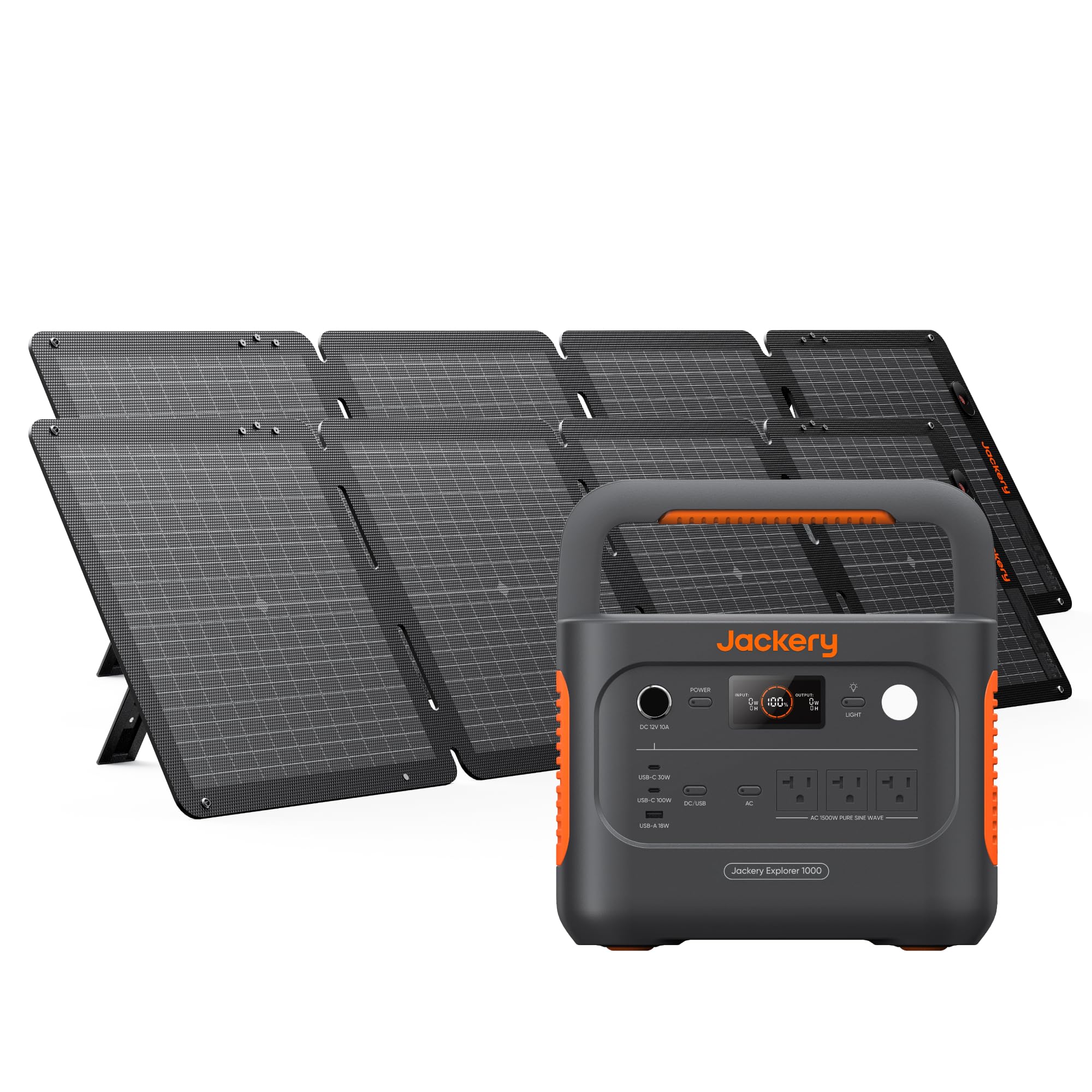
3. Jackery Solar Generator 1000 v2 with 2x100W Solar Panel, 1070Wh Portable Power Station
The one that arrives with its own solar panels, so your first sunny afternoon already tops it up.
Buying panels separately is where most people stall out, and this bundle skips that step entirely — the box includes two 100W solar panels alongside the 1,070Wh station. The 1,500W AC output with a 3,000W surge peak is enough for most home essentials including AC units, fridges, and electric pots, and there are three pure sine wave AC ports plus two USB-C and one USB-A port and a DC car port. Foldable, lightweight panels mean the whole kit packs into a car trunk for a road trip or an off-grid cabin weekend.
Charging is the marquee claim: 0% to 100% in one hour on the wall, with the option to drop to a gentler 1.7-hour fast charge to go easier on the battery. Jackery builds the unit on ChargeShield 2.0 with UL certification, and rates the LiFePO4 pack for 4,000 cycles while still holding 70% of original capacity — a claim of four times the lifespan of the earlier Explorer 1000. There is also 100W PD USB-C in and out, so you can refill it from a compatible source without a separate power brick, and a 30 dB quiet overnight mode plus app control for scheduling and energy-saving tweaks.
What owners keep circling back to is honesty — the station does what it says and the solar panels stretch it further than the math suggests. As the review pages sum it up: “This is well worth the money. We have lost power 3 times since I purchased this unit and it has worked like a champ each time. Charges fast and runs for a long time.” The recurring gripe is expectation, not hardware: people underestimate how much power their big appliances need, and the honest framing is that it is a 1,070Wh station, not a whole-house system. Weighing 23.8 pounds with a handle, it is a genuine one-person carry.
Why it works as a bundle
- Ships with two 100W solar panels — no separate purchase, no compatibility gamble.
- 1,500W continuous with a 3,000W surge runs fridges, electric pots, and most home essentials.
- 1-hour wall recharge, plus a 1.7-hour fast mode if you want to baby the battery.
- LiFePO4 cells rated for 4,000 cycles and 70% capacity retention, with 100W PD USB-C in and out.
Set expectations here
- 1,070Wh is a modest tank if you plan to run high-draw appliances for hours.
- Solar output depends on direct, unobstructed sunlight, so a shaded campsite changes the math.
- The panels and station ship separately, so your first charge may arrive a day or two apart.
Suits you if: you are building an off-grid routine and want one box with the panels already chosen for you.
skip it if: your main plan is running a big appliance all evening, since the 1,070Wh capacity is the limiting factor, not the output.
4. BLUETTI Elite 200 V2 Portable Power Station 2073.6Wh 2600W

Built around a 17-year battery claim, and it drinks just 10W while sitting idle.
Most people shopping in the two-kilowatt-hour range are thinking about the long haul, and BLUETTI has aimed this unit squarely at that. The Elite 200 V2 carries a 2073.6Wh battery rated for over 6,000 cycles and a 17-year lifespan of everyday use, backed by a claim of being the industry’s first CNAS-certified true automotive-grade LiFePO4 pack. Output is 2600W continuous with 3900W of power lifting for motor-start spikes, enough for fridges, hair dryers, and coffee makers, and it can drive up to nine devices at once.
The 10W standby draw is what stretches runtime here. Standby consumption is trimmed to 10W, which BLUETTI frames as three times lower than similar stations, and the extra headroom shows up as runtime rather than on paper — a 120V 60W diesel heater running ten hours a day will go 3.3 days, which BLUETTI puts at 13% longer than similar products. It stays quiet too, running 16–30 dB in Silent Mode, which BLUETTI describes as 45% quieter than typical 30–50 dB power stations. Three charge modes let you pick the trade-off yourself: Turbo hits 0–80% in an hour, Standard fills in 1.6 hours, and Silent takes 3 hours at 800W for the gentlest cycle on the battery.
Customers note the performance lives up to the spec sheet — this was the pick that drew the most enthusiasm in the category for sheer capability. One owner ran an electric skillet and a TCL TV through an outage, and another put it to work on an induction cooktop, air fryer, pressure cooker, and dishwasher in sequence. The honest caveats: at 53.4 pounds it is a real two-hand lift, and there is one genuine annoyance — there is no user-settable state-of-charge limit for solar charging, which would help protect the battery over the very long term you are buying into. One owner also hit a charging quirk that likely needed a full charge-and-discharge cycle to recalibrate the battery management system.
Where it pulls ahead: 2073.6Wh with 6,000-plus cycles and a 17-year claim puts this among the longest-lived picks here, and the 10W standby draw quietly buys you extra runtime hour after hour.
The recurring gripe: no settable charge ceiling for solar, which the careful owner will miss on a battery you plan to keep for a decade.
Best for: a permanent home-backup station you set up once and expect to still own long after the warranty card is filed away.
Know before buying: 53.4 pounds rules out regular carrying, and there is no wheels option.
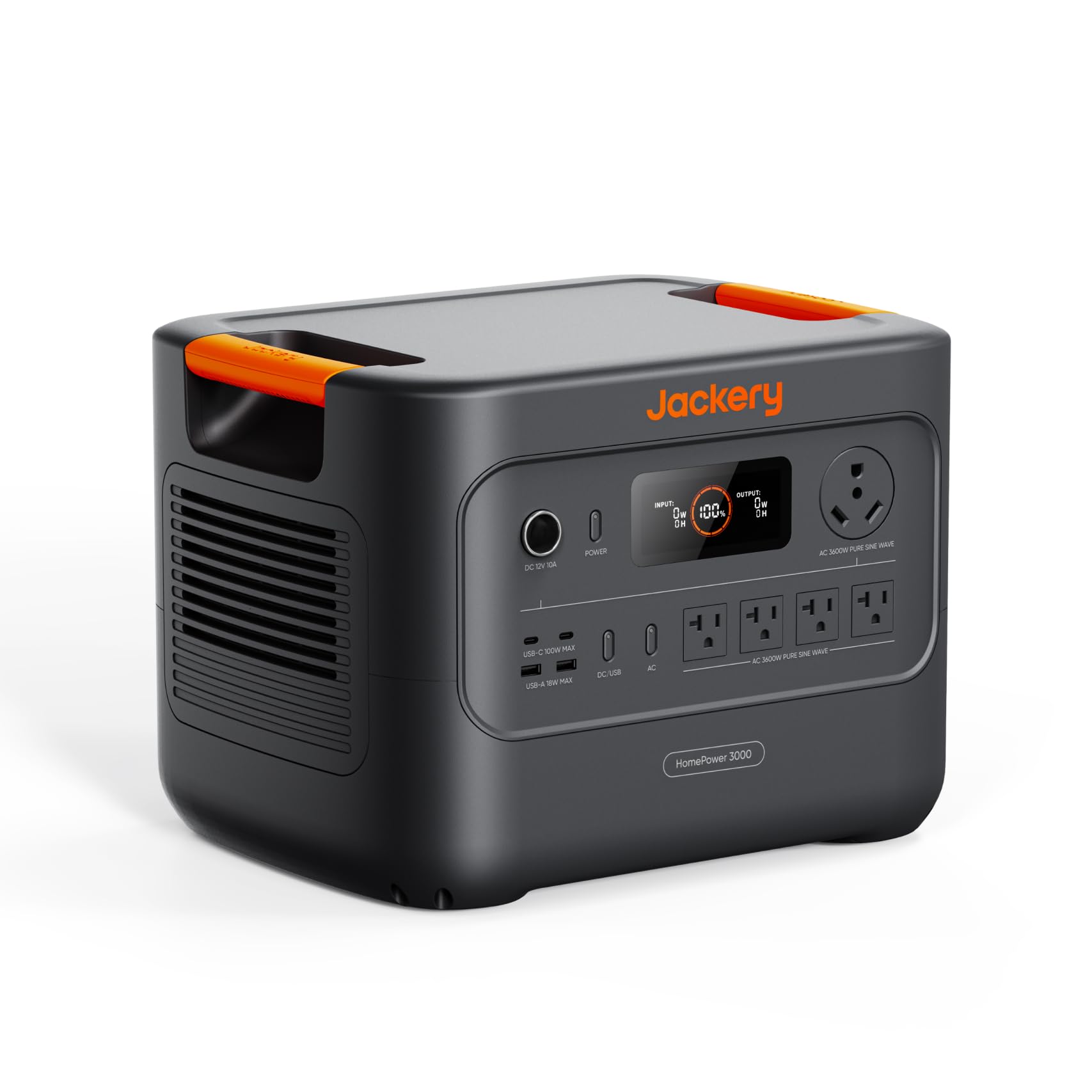
5. Jackery HomePower 3000 Portable Power Station, 3072Wh, 3600W AC Output
The one with a built-in 30A RV port, so your camper plugs straight in with no adapter.
If your definition of backup power includes a travel trailer, this is the unit that skips the dongle drawer. The 3072Wh LFP battery feeds a 3600W output with a 7200W surge, enough for a household of essentials for up to fifteen hours, and a fridge for one to two days. The built-in TT-30 RV port takes a camper cord directly — no outside wiring, no adapter. Jackery also ticks the compactness box using CTB technology, and claims to be the world’s first 3kWh portable station with it, boosting space efficiency by 14% while running 47% smaller and 43% lighter than comparable-capacity models.
Alongside the RV port you get dual 100W PD USB-C ports for fast-charging phones, tablets, and drones, plus AC, USB-A, and DC connections. The UL-certified UPS switches in ≤20ms, which is quick enough to ride through a brief outage on things like security cameras, a medical refrigerator, a Zoom call, or a pet feeder. On the charging side, hybrid AC and DC refills the battery in 1.7 hours, or 2.2 hours on AC alone, and it accepts a 12V car charger and even a gas generator if you want redundancy. The LiFePO4 pack is rated for 4,000 cycles while keeping 70% capacity.
Reviewers point out running a 30-foot travel trailer off it for three-plus days of dry camping. One writes that the 30A outlet “allows direct camper plug-in without adapters” and that they ran a 30-foot travel trailer off it for three-plus days of dry camping, using propane for the heavy heating and the station for TV, microwave, and Starlink. Two honest limitations stand out. First, it is 59.5 pounds and the handles reward using both. Second, the cooling fan is audible under load, with one owner measuring it near 60 dB during everyday tasks, so it is not a great fit as a silent always-on office UPS. Values on the cold end also run short — at least one owner found it cut out far below freezing when driving a diesel block heater.
Reasons owners keep it
- Built-in TT-30 RV port — plug a camper cord straight in with no adapters.
- 3600W continuous with a 7200W surge carries nearly a whole household or trailer.
- ≤20ms UPS switchover keeps cameras, routers, and pet feeders running through brief outages.
- 1.7-hour hybrid AC and DC recharge, plus solar, car, and even gas-generator inputs.
Where it asks for patience
- 59.5 pounds is a genuine two-hand move every time.
- Fan noise under load makes it a poor always-on UPS for a quiet office.
- Cold-weather performance has disappointed at least one winter-time user.
This is the one if: you camp in a trailer, want the RV cord to plug straight in, and value a big 7200W surge headroom for motors and appliances.
Not the choice if: you need a whisper-quiet unit sitting under a desk all day, or you will be carrying it up stairs.
6. EF ECOFLOW Portable Power Station 3600Wh DELTA Pro, 120V 3600W AC Output
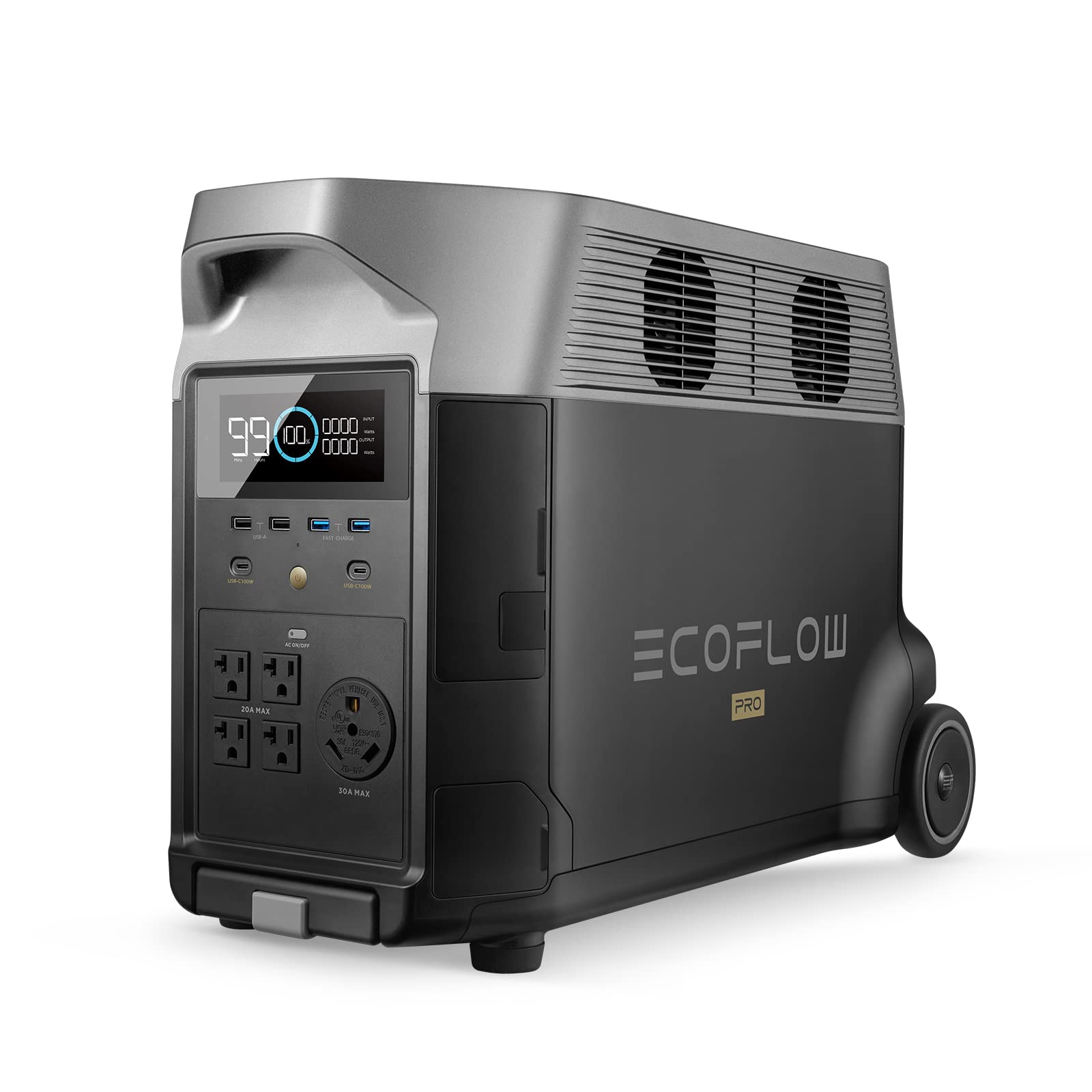
Starts at 3.6kWh and can grow to 25kWh — a system that scales with you.
The DELTA Pro is the pick for anyone who wants to start moderate and add capacity later without replacing the whole thing. from the start it holds a 3600Wh LFP battery, but add DELTA Pro Extra Batteries or Smart Generators and it expands from 3.6kWh all the way to 25kWh. Output starts at 3600W AC, jumps to 4500W with X-Boost technology, and two units can pair for a 7200W total — EcoFlow claims that powers 99.99% of heavy-duty devices. With 15 output methods including five AC outlets, dual 100W USB-C, four USB-A (two fast-charge), DC outlets, a car output, and an Anderson port, you can run a small tool collection off one box.
Recharge speed is where it punches above its class. X-Stream charging fills the battery in 1.8 hours on 240V outlets, or 2.7 hours on 1800W wall outlets, and solar tops it up in 2.8 hours from four 400W panels at up to 23% efficiency. There are five ways to charge, including EV station, solar, wall, smart generator, and car outlet. App control via Wi-Fi or Bluetooth covers charge level, temperature, charge and discharge times, and custom settings for everything from energy-saving to output limits. One thing to keep in mind: solar input is capped at 15A, which is fine for most single-string arrays but does limit expansions.
Shoppers say running a heat press at vendor markets with zero voltage drops. One ran a heat press at vendor markets with zero voltage drops, praising its “3600W output, five 120V AC outlets, fast startup, quiet, impressive battery life, solid build.” Another used it to hold a fridge and some lights through an outage and still had 30% left by morning. Two things to plan around: at 99 pounds it wants a permanent spot or a cart, and second, always shut breakers off before wiring into 110V household outlets so you protect both linemen and the unit. The expansion ecosystem is the reason to buy — just budget for the accessories.
Why expandable matters: 3600Wh now, 25kWh later means this one grows with your needs instead of being replaced — genuinely rare at this price tier.
Plan the accessories: Solar input caps at 15A, and going past that requires more hardware, so sketch the full system before you buy.
Pick this for: anyone running a side business, off-grid setup, or tool-heavy shop who wants to start at 3.6kWh and expand to 25kWh over time.
Consider lighter if: you just need interim backup for laptops and a fridge — 99 pounds is overkill for that job.
7. GRECELL 1000W Solar Generator 999Wh Portable Power Station
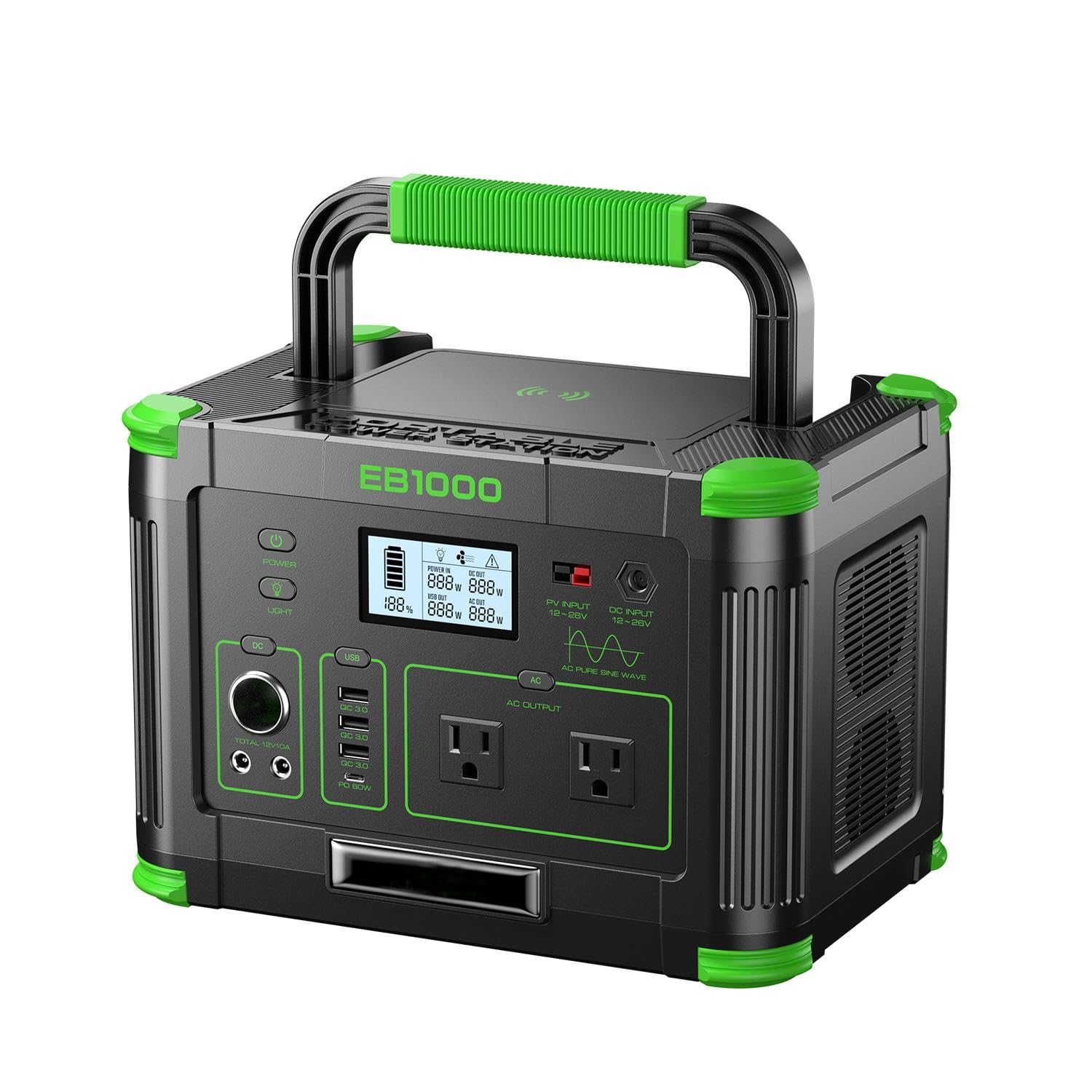
Nearly a kilowatt-hour you can carry single-handed, with a flashlight for the walk back.
At 999Wh and 17.86 pounds, it is light enough to carry one-handed yet big enough to run ten devices at once. The 999Wh battery sits behind a 1000W pure sine wave output with a 2000W surge, feeding ten devices at once through two AC sockets, three USB QC ports, a USB-C PD port, two DC 12V ports, a 12V cigarette lighter port, and a wireless charging pad. There is also a built-in LCD display, an LED light, and a flashlight with SOS mode. At 17.86 pounds with an ergonomic handle, one-handed carrying is realistic — four reinforced rubber bumpers stand the unit up against rough ground and knocks.
Charging is flexible in both directions. You can top it up from an AC outlet, a solar panel, or a car outlet, and the built-in MPPT controller squeezes extra juice out of variable solar input rather than losing it to shading and clouds. The included kit covers a 7909 solar charging cable, an AC charging cable, and a car charging cable. The battery management system stops charging automatically at full, protects against short circuits and surge damage, and keeps the internal dual cooling fans quiet enough to run in a kitchen. Owners consistently rate the build quality of the case highly, and it fits specific camp hardware neatly — one writes simply, “It fits my EBL 1000-watt camp battery perfectly with room to spare for the 110 charger and the extra cords!!!”
The trade-off to know about is the honest gap between solar expectations and solar reality. Solar charging on this size of unit tends to trickle rather than gush — a full recharge from a single panel takes planning, and using the wall outlet is generally the realistic route. Owners also note the solar controller is best for off-grid adventures where a slow top-up is fine. For camping, a small emergency, powering a projector for a movie night, or running a CPAP through a short outage, it does the job cleanly — just do not expect it to keep a fridge going all weekend.
What buyers praise most: the case and build quality, with the storage capacity and portability coming in right behind — the ten-port design is a genuine convenience pick for a small station.
The trade-off: solar charging is slow relative to what people picture, so plan on wall charging for the serious top-ups.
Buy it if: you need a light, well-portable station for camping, short outages, and small-device backup, and a wall outlet is usually within reach.
pass on it if: solar-only living is the plan — the recharge curve will not keep up.
8. EBL Portable Power Station 500W (Peak 1000W), Camping Solar 519.48Wh
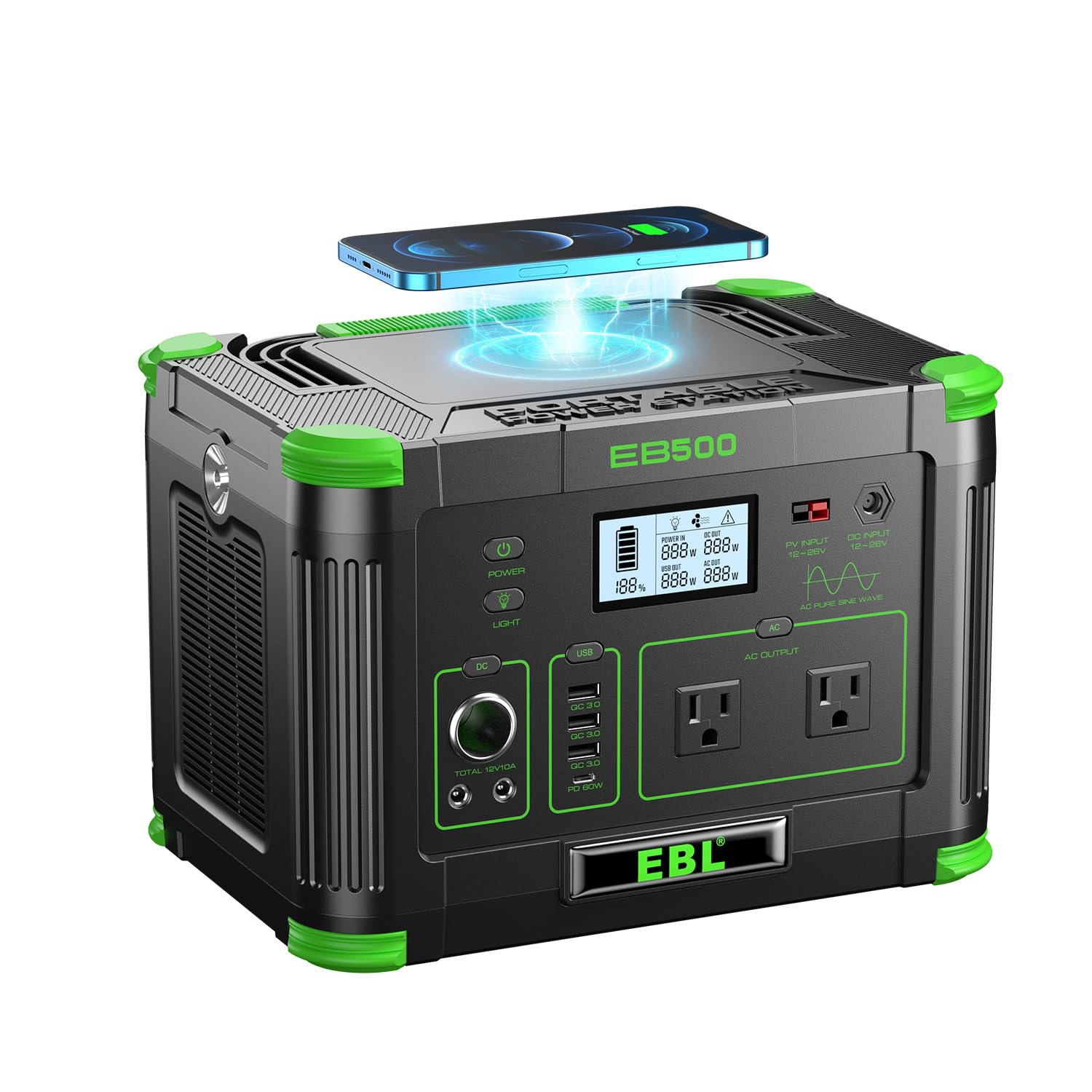
A pure sine wave starter station with ten ways to plug in and a wireless charging pad on top.
For a first 120V battery bank, the way to shop is by what it will happily run, and this one sets its line clearly at 500W. Inside is a 519.48Wh battery feeding two pure sine wave AC outlets at 120V and 500W, backed up by three USB-A Quick Charge 3.0 ports at 18W each, a 60W USB-C PD port, two DC ports, a 12V car port, and a wireless charging pad. Quick Charge and PD combined promise up to 2.5x faster phone and laptop charging than standard ports. The pure sine wave inverter is the detail note for anyone running a CPAP machine, a laptop, or a sensitive TV — it delivers a smooth household-style current rather than the rough output of the cheapest inverters.
Recharging happens three ways: 6–9 hours from a compatible 100W-plus solar panel, 7–8 hours via a 12V car outlet, or 6–7 hours on the wall overnight. A battery management system watches temperature, voltage, current, and short circuits, and EBL advises turning the AC output off when unused since it drains the battery even with no load. Owners repeatedly single out the value proposition and the port count — this is a station that fits neatly between the tiny backpack units and the serious whole-home machines. One owner described why they bought two after a two-day outage that involved medical equipment at home.
The 519.48Wh battery is best suited to lower-draw gear like a mini fridge, lights, or a router. This is a roughly half-kilowatt-hour station, and buyers report the AC outlets are best for lower-draw gear — a mini fridge, lights, a router, a phone. Two practical notes: first, do not use it to power anything above 500W, and second, the unit wants a top-up charge at least every three months if it lives in storage. A few owners have reported units that arrived and failed quickly — that is the rare story, not the norm, but it is why buying from a seller with easy returns matters at this tier.
Standout on value: with a top positive pull of quality and value-for-money aspects that owners mention heavily, this is the budget pick that feels sturdier than its category.
Honest limit: 500W continuous is a ceiling, not a suggestion — plugging in an appliance above it will trip or strain the unit.
Best for: campers and first-time emergency buyers who want a pure sine wave station with plenty of ports and a wireless charging pad, without overshooting their need.
Not for: targeting a fridge, space heater, or power tool — the 500W ceiling closes that door.
9. DARAN Portable Power Station, 288Wh LiFePO4 Battery, 350W (600W Peak)
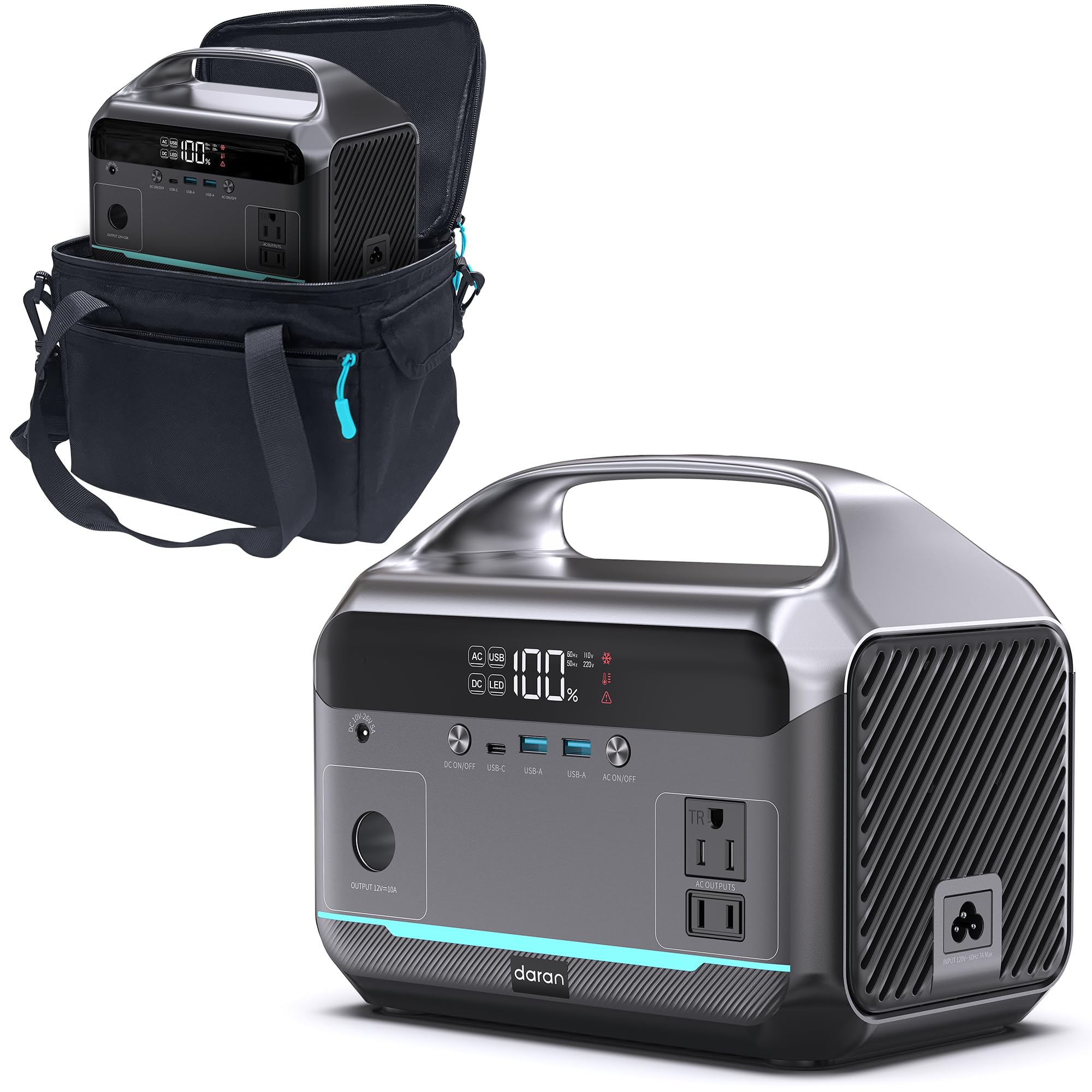
The carry-anywhere one, small enough to disappear into a backpack and reliable enough for off-grid internet.
Not every 120V battery bank has to sit in a garage, and this is the proof. The DARAN weighs 8.2 pounds and sizes up at 10.0 x 6.6 x 8.2 inches, so it disappears into a hiking pack, a glovebox, or a home emergency kit without being bulky. Its 288Wh LiFePO4 battery and 0.85 conversion rate support a 30W CPAP machine for up to 8.16 hours or a 100W stew pot for about 2.44 hours, with 350W of rated power and a 600W surge — enough for phones, tablets, a mini fridge, a projector, and a decent run on a lot of small gear.
Seven ports handle the load: two 350W AC outlets, one 60W PD USB-C, two 18W USB-A, and one DC I/O, so phones, a laptop, and a small appliance can all run at once. Recharging fits the schedule too — wall outlet, 12V car port while driving, or an optional solar panel — with a quoted 2.1-hour fast charge. The LiFePO4 pack is paired with an advanced battery management system covering overcharge, over-discharge, short circuit, temperature, and cell balancing, and there is an LCD showing real-time power plus a rear LED with steady, strobe, and SOS modes.
Owners mention running a Starlink Mini off the AC outlet with stable power and about two hours of runtime. Customers note powering it from the AC outlet with “stable, no reboots, ~2hrs” of runtime, and the solar charge controller holds up even in overcast conditions. The honest limitation: the USB-C PD tops out at 85W and 19V, which falls short of the 100W-plus that Starlink wants over USB-C in speed tests, so the AC outlet is the route to take. As a companion to bigger stations, it is excellent for keeping phones, modems, and small camping loads topped off — not a replacement for a whole-home rig.
What makes it a keeper
- 8.2 pounds makes it genuinely backpack-friendly — rare at this capacity.
- LiFePO4 cells with a multi-protection battery management system for stable, quiet running.
- Seven ports, including 60W USB-C and dual 350W AC outlets, cover phones, laptops, and small appliances.
- Stays cool, recharges while driving, and its solar controller works even under cloud cover.
What to plan around
- USB-C PD is capped at 85W and 19V — not enough for demanding gear like Starlink over USB-C.
- 350W rated power rules out bigger appliances without tripping the unit.
- Solar and car charging cables are sold separately, so add them at checkout.
Ideal for: backpackers, car campers, and small-device backup where every ounce counts, and anyone topping up a Starlink Mini off-grid.
Skip if: your job list includes a fridge, a kettle, or an induction burner — the 350W ceiling is a hard stop.
Understanding the Specs
Watt-Hours (Wh): the size of the tank
Watt-hours tell you how much energy the battery holds, which becomes runtime. The math is rough but useful: a 1,000Wh unit running a 500W appliance lasts about two hours before the battery runs down. That is why a 288Wh backpack station and a 4,096Wh whole-home box behave so differently — same 120V outlet, wildly different staying power.
Continuous Watts vs. Surge Watts
Continuous watts is the steady ceiling the inverter can hold, and surge watts is the brief spike it can survive. Motors like a fridge compressor or a power tool pull a big jolt for a second or two on startup, which is why the surge figure matters more than it first appears. A unit rated 1,500W continuous with a 3,000W surge can start devices that a 1,500W-only unit cannot.
LiFePO4 vs. Older Lithium-Ion
LiFePO4 is a lithium chemistry that keeps its capacity across far more charge cycles than older lithium-ion packs. That is why some stations here quote 4,000 or 6,000-plus cycles while still retaining 70% or 80% capacity — the difference between a battery you replace in a few years and one you plan around for a decade.
Pure Sine Wave Output
A pure sine wave inverter produces a smooth, household-style current that sensitive electronics expect. Cheap modified-sine inverters can make devices buzz, misbehave, or run hot. If you plan to run a CPAP, a laptop, a router, or a modern TV, insist on pure sine wave — it is standard on the mid-range and premium picks above.
UPS Switchover Time
Some stations can sit between the wall and an appliance and take over when the power drops. The switchover time is measured in milliseconds — the faster it is, the less likely a computer or router even notices the outage. This is the feature that turns a battery bank into silent insurance for a home office.
Solar and AC Recharge Speed
A battery bank is only as useful as how fast it refills. Premium units here claim 0–80% in under an hour on AC, while budget models take six to nine hours on the wall and longer on solar. Match the recharge speed to your outage pattern — a slow-recharging unit is fine for a planned camping trip and frustrating in a rolling blackout.
FAQ
Can a 120V battery bank run my refrigerator during an outage?
What is the difference between continuous watts and surge watts?
How long does a LiFePO4 battery bank actually last?
Can I charge a 120V battery bank with solar panels?
Is pure sine wave output important, or is modified sine wave fine?
Can I use a 120V battery bank as a UPS for my computer or router?
How much capacity do I need for a weekend camping trip?
Will these units run a CPAP machine overnight?
Do 120V battery banks produce fumes or noise like a gas generator?
Can I expand the capacity of a 120V battery bank later?
Final Thoughts: The Verdict
For most homes, the 120v battery bank worth building around is the Anker SOLIX C2000 Gen 2, because its 4,096Wh LiFePO4 battery, 2,400W continuous and 4,000W peak output, and 58-minute full recharge cover a fridge, an RV, or a whole room of essentials without fumes or fuel. If your priority is a unit light enough to carry single-handed, grab the DARAN NEO300L at 8.2 pounds. And for whole-home coverage you can expand over time, the EF ECOFLOW DELTA Pro is the one to reach for, since it scales from 3.6kWh all the way to 25kWh.
The one nudge worth making: the two picks with the strongest owner followings in this lineup are the Anker SOLIX C2000 Gen 2 and the BLUETTI Elite 200 V2, and both have earned that pull through genuinely long-lived LiFePO4 batteries and honest output ratings. Whichever way you go, buy on watt-hours and continuous watts first, portability second, and the extras last. That is the combination that keeps the lights on when the grid does not.
How We Picked
We do not accept paid placement. Every pick is matched to a real buyer and a real use-case; we do not hands-on test units.
Sources & Methodology
Specifications: manufacturer listings and product documentation. Review insights: verified customer reviews, as of September 2026. Pricing: not shown on this page (it changes often); check the current price via the retailer link.
As an Amazon Associate, KitchPrep earns from qualifying purchases. This does not affect which products we feature.
Related Guides
