
Specs are compiled from manufacturer listings and verified buyer reviews and can change over time — please confirm the key details on the product page before buying.
If you want steady, silent warmth in a room the central system leaves chilly, a 120V baseboard heater is the fix. Unlike fan-forced space heaters that blow air in one direction, these units use natural convection—cool air sinks in at the bottom, warms, and rises—so the whole room warms evenly with no noise. The catch is that most are hardwired into your wall and need a separate thermostat, so you are really buying a heating system, not a plug-in appliance.
I’m Mohammad Maruf — the founder and writer behind KitchPrep. This guide is built by comparing the manufacturers’ published specifications and the patterns across verified customer reviews, so you get each pick’s real strengths and trade-offs instead of marketing spin.
Note that this list uses flexible matching for voltage, so a few picks are the nearest same-type size and wattage to an exact 120V search. Here is how to choose the right 120v baseboard heater for your room size, your wiring, and your tolerance for installation work.
Our Picks at a Glance


How To Choose The Best 120V Baseboard Heater
Before you buy a baseboard heater, you need to match its wattage to your room’s square footage, check that your circuit can handle the amperage, and choose between hardwiring it into the wall or plugging it into an outlet. Getting these three decisions right matters more than the brand you pick, because a heater that is too small leaves you cold and one that is too large wastes energy.
Match the wattage to the room, not the length
Wattage is the number that actually determines heat output, and it directly controls how many square feet the unit can warm. A 500-watt unit covers roughly 100–150 square feet, while a 1500-watt model steps up to cover a larger area. Baseboard heaters are “supplemental” heat sources, so if you are trying to warm a big open space that the central system ignores, lean toward the higher wattage number rather than the longer cabinet.
Hardwired or plug-in: know the installation reality
Most fixed baseboard heaters connect permanently to a dedicated 120-volt circuit, so there is no cord and no outlet. That means cutting into your wall, running wiring, and usually hiring a qualified electrician. If that sounds like too much, a plug-in portable model with a grounded cord and built-in thermostat gives you the same convection warmth without any wall work, but you will see the cord and cover less area.
Quick Comparison
| Model | Best For | Wattage | Heating Coverage | Amperage | Amazon |
|---|---|---|---|---|---|
| Cadet F Series 36 in.★ Best Overall | Supplemental zone heating | 750 W | 187.5 sq ft | 6.25 A | Amazon |
| BEYOND HEAT 1500WBest Value | Plug-in quiet rooms | 1500 W | Small to medium | — | Amazon |
| KING 6K1215-BW | Large room power | 1500 W | 350 sq ft room tested | 12.5 A | Amazon |
| King KP1210 | Simple supplemental heat | 1000 W | Supplemental rooms | 8.3 A | Amazon |
*The 4K1210 listing states its heating coverage as 1000; in real-world use buyers report it effectively warms 10×14 basement rooms. Coverage figures come from each manufacturer’s own listing and vary by room insulation.
In‑Depth Reviews
1. Cadet F Series 36 in. Electric Baseboard Heater
Our pick — over 4★ from 550+ verified ratings; the strongest balance of quality and price.
The crowd favorite that nails the balance of quiet power and easy install for a chilly bedroom.
This 36-inch Cadet is the pick most owners land on when they want real warmth without the whir of a fan. It pushes 750 watts and 2560 BTU of convection heat—enough to cover 187.5 square feet—and it works on a standard 120-volt circuit, so it fits the wiring most homes already have. The steel body stays dependable season after season, which is why reliability is the thing everyone raves about in the reviews.
It is a hardwired unit, so there is no cord and no outlet—you connect it permanently to a dedicated circuit. Owners mention the installation is straightforward: “These heaters were easy to install and they work well, they only draw two amps.” People also praise the quality and value for a wall-mounted zone heater. Compare that to the KING 2K1205 at 500 watts, and this Cadet delivers 88% more heating coverage—187.5 square feet versus 100–150—for a modest bump in price.
Before you buy, know that the thermostat is sold separately. You will need to pair this with a wall-mounted line-voltage thermostat (a thermostat that controls the full 120-volt power going to the heater) or a built-in end kit, and most owners recommend professional installation since it connects directly to your circuit. For safety, a full-length automatic overheat cut-out switches the unit off if it ever gets too hot, though a small number of customers note the heating element can burn through in the same spot after heavy use—so watch it closely during the first season.
What wins people over
- Silent convection warmth with no moving parts to fail
- Easy to install, per multiple verified buyer reports
- Compact 36-inch design tucks under windows
- Built-in overheat cut-out for safety
Know before you buy
- Thermostat not included—separate purchase required
- Hardwired installation, so an electrician is recommended
- A few reviewers point out element burnout in the same spot
Reach for it if: you want a proven, quiet hardwired heater for a small-to-medium room and you are fine adding a wall thermostat.
Think twice if: you want a plug-and-play unit with no wiring—this one needs a dedicated circuit connection.
2. BEYOND HEAT Electric Baseboard Space Heater 1500W
A plug-in 1500W unit with a digital display that finally lets you dial in the exact degrees.
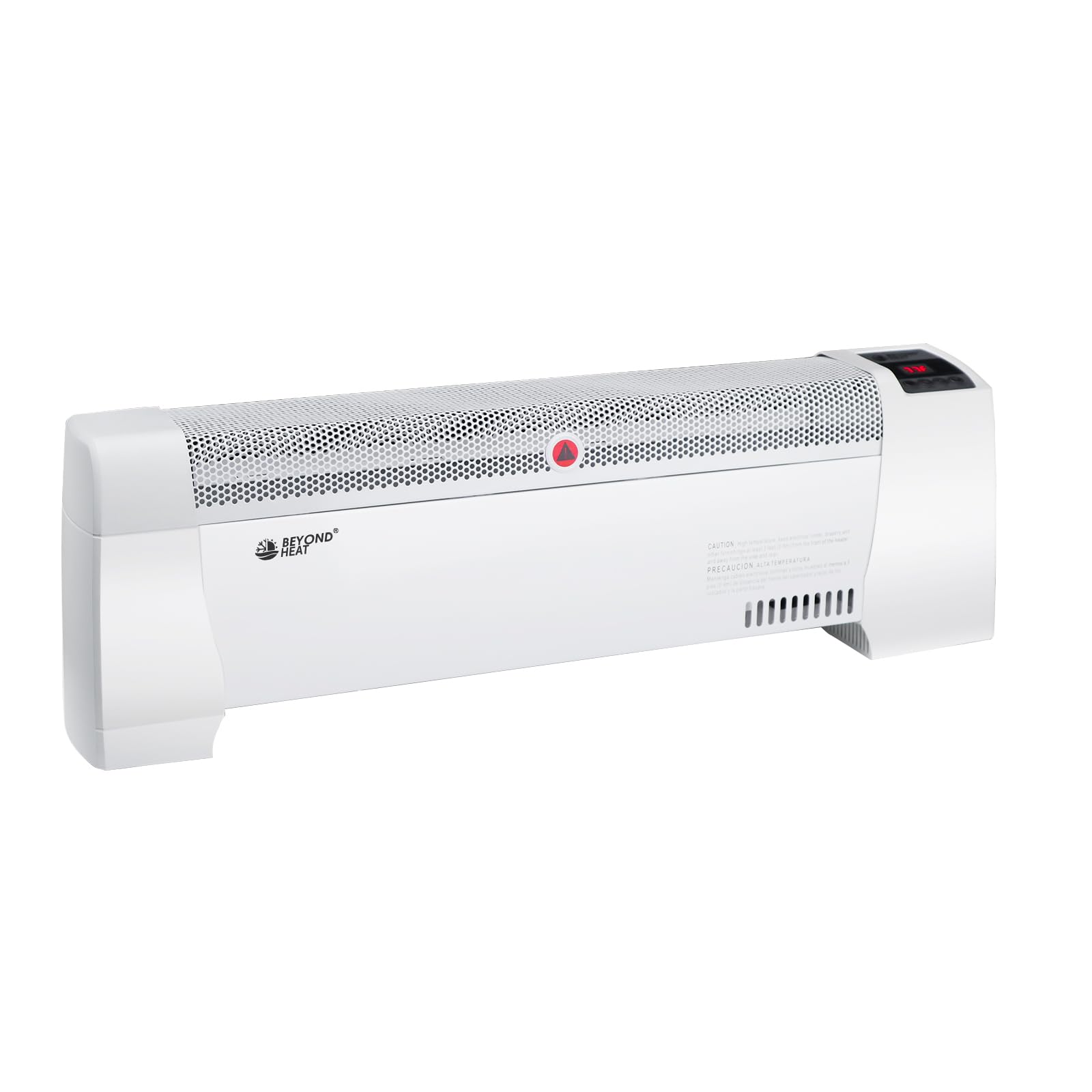
Most baseboard heaters make you buy the thermostat separately—this BEYOND HEAT skips that hassle with a digital thermostat and display built right in. It delivers 1500 watts of convection heat across two settings, and the whole package is portable at 29.25 x 5.25 x 9.25 inches, so you can move it from a bedroom to an office without touching a screwdriver. Owners describe the heat output as the standout trait, with one reporting it “keeps living room warm at steady 68 degrees. It’s silent no noise.”
That is the appeal in one line: it is genuinely quiet. The convection design has no fan blowing in one direction—it just warms the room. It also brings real safety hardware for a portable, including a tip-over switch, an overheat protection system, and dent-proof end panels with a stay-cool body. The temperature range runs from a 40 °F minimum up to 90 °F, which is wider than most fixed baseboard heaters offer.
The trade-off is precision. While it holds a steady temperature when set, a few shoppers say dramatic swings in smaller rooms—set at 62 degrees, the space can feel hot even though the display still reads 62. The amperage is not published in the listing, so if you are wiring this into a circuit, check the draw first. For a plug-in portable, this is the easiest path to silent heat with a thermostat you do not have to buy separately.
Silent and simple: the only 1500W pick here with a built-in digital thermostat and display, plus tip-over and overheat protection.
The honest catch: temperature control can swing wide in very small rooms, and the amperage spec is not listed for circuit planning.
3. KING 2K1205-BW K Series Baseboard Heater
The stubby 27-inch KING built for tight spots like a 7×7 basement bathroom.
If your space is genuinely small, this 27-inch KING is sized right. It runs at just 5 not want to cut into your walls. It plugs into any standard 120-volt wall outlet using the included 6-foot grounded cord, with no electrician and no dedicated circuit required. At 1500 watts it puts out 5,120 BTU of convection heat—enough to cover up to 600 square feet—and it has a large dial thermostat with an off setting built right in, so there is no separate wall thermostat to buy.
Owners heat a Midwest office with the door closed, warm a basement “really fills it up with the heat coming from it,” and low-maintenance until spring in a den addition. The 49-inch body has built-in handles and weighs 10.1 pounds, so it genuinely moves from room to room. Safety hardware includes a tip-over switch that cuts power if it is knocked over and a high-temperature shutoff, plus it is made in the USA with a 2-year warranty.
Where this pick divides opinion is longevity. The reviews show a clear split: some units run reliably for years, while others “only lasted for a few weeks then stopped working completely” according to one frustrated owner. Another reported failure after two years and seven months. The exposed coil also collects dust, which owners flag as a fire risk, and the surface gets hot—so this is not a child-safe appliance. For plug-in convenience with real 1500W output, just keep an eye on it in the first season.
Zero-install warmth: the rare 1500W baseboard heater that needs no hardwiring, with a built-in dial thermostat and 600 sq ft coverage.
The gamble: reliability is the most mixed aspect—some units fail in weeks, and the hot exposed coil demands careful placement.
4. KING 6K1215-BW K Series Baseboard Heater
The 6-foot KING that warms a 350-square-foot room and keeps it cozy all winter.
When a room runs cold no matter what the central system does, this 6-foot KING is the heavy hitter. At 1500 watts and 12.5 amps on a 120-volt circuit, it delivers serious convection output—one owner had an electrician install it for a 350-sqft room and reports “it does the job,” while another says it keeps a roughly 10 x 12 downstairs room “very warm.” The 60-inch cabinet spreads heat along the full wall, and at 14.8 pounds it has real presence.
Functionality and installation are the two things owners praise most here. It is easy to install, comes with clear instructions, and works with a separate wall thermostat. The aluminum ribbon fin element, crushproof construction, and dent-resistant die-form cover give it the same rugged build as the smaller KING models, scaled up. Owners who had a professional wire it on a proper circuit report years of trouble-free warmth.
Quality is genuinely mixed in the owner feedback, and you should know why. The loudest complaint is that some units fail after a season or two—one owner’s unit worked three months, then died the next November. Others note in the same breath that units installed correctly by an electrician “work great.” Heat output also reads mixed, with one owner claiming it only warms 1.5 feet in front of it, which points to placement issues rather than the heater itself. Buy this for a large room, install it right, and it delivers.
Why it leads on power
- 1500W output heats 350 sq ft rooms effectively
- 6-foot length spreads warmth along the wall
- Highly functional and easy for electricians to install
- Dent-resistant cover with crushproof element
What owners flag
- Quality is mixed—some units fail after a season
- Thermostat not included
- Proper circuit installation is essential
Reach for this if: you have a genuinely large cold room and will have an electrician handle the dedicated circuit.
Look elsewhere if: you want plug-in simplicity or a shorter, less powerful unit for a small space.
5. King KP1210 1000-Watt 4-Foot Portable Baseboard Heater
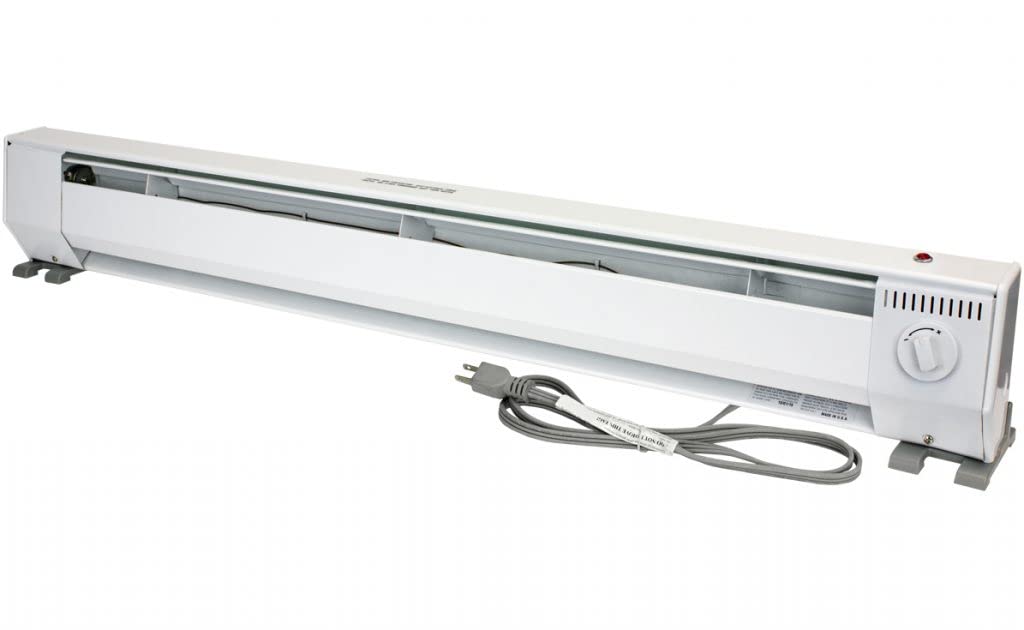
A simple, sturdy 1000W plug-in that quietly handles daycare rooms and cold bedrooms.
Sometimes you just want a heater that plugs in, warms the room, and stays out of the way—and that is exactly what this 4-foot KING does. It runs at 1000 watts and 8.3 amps on a standard 120-volt outlet, with convection heat and a built-in thermostat, all in an all-aluminum design that comes in at 11.5 pounds. Owners have kept a daycare “nice and warm going to winter months” and use it as reliable supplemental heat for a cold bedroom.
It is genuinely quiet—the convection design has no fan—and the built-in thermostat clicks on and off automatically to hold your set temperature. Owners describe it as sturdy, simple, and well-built, with front panels that come off easily. The all-aluminum body is the same construction KING uses in its hardwired units, just fitted with a cord so you do not need an electrician. The max temperature setting reaches 194 °F, which is plenty for keeping pipes warm in a garage or breezeway—one owner kept a 14×19 breezeway at 60°F in negative temperatures.
The honest feedback splits on heat output: at 1000W this is slow to warm a large room and owners say it is “weak for large rooms.” Quality and value both read mixed in the reviews, with the most common complaint being poor packaging—multiple owners received damaged units with bent thermostats or broken legs. There are no low/med/high settings or a temperature readout, just a simple thermostat dial. For a small-to-medium supplemental space where you value quiet and simplicity, this is a solid budget pick; just inspect the box on arrival.
What it does well
- Quiet, fan-free convection warmth
- Plug-in design with no wiring needed
- Built-in thermostat with auto on/off
- Sturdy all-aluminum body at 11.5 pounds
Set expectations
- 1000W warms slowly and weakly in large rooms
- Quality and value reviews are mixed
- Poor packaging leads to some damaged arrivals
Best for: a small bedroom, office, or daycare space needing quiet supplemental warmth with zero installation work.
Not for: large open rooms, where the 1000W output will leave you waiting for warmth.
Understanding the Specs
Wattage and BTU
Wattage is the raw measure of how much electrical power the heater converts into heat, and it is the single best predictor of how large a room the unit can warm. A 750-watt heater like the Cadet F Series covers roughly 187.5 square feet, while a 1500-watt unit steps up to cover larger spaces. BTU (British Thermal Units) is another way to state the same heat output—2560 BTU on the Cadet, 5,120 BTU on the portable Cadet—and manufactures list one or both. Bigger wattage means bigger rooms, but also a bigger load on your electrical circuit.
Amperage draw and circuit planning
Amperage tells you how much electrical current the heater pulls from your circuit when it runs, and it decides whether you can plug it into an existing outlet or need a new dedicated circuit. A low-draw unit like the KING 2K1205 runs at just 4.2 amps, which fits easily into most household circuits. A 1500W unit can draw 12.5 amps—near the limit of a standard 15-amp circuit—so hardwired models usually need their own dedicated breaker. If you are unsure, a licensed electrician is the safe call.
FAQ
Will a 120V baseboard heater work on my standard household circuit?
Do baseboard heaters come with a thermostat included?
How many square feet will a 1500W baseboard heater warm?
What is the difference between a hardwired and a plug-in baseboard heater?
Why does my baseboard heater need a separate thermostat?
Is a 500W baseboard heater enough for a small bathroom?
Why does my portable baseboard heater smell or smoke on first use?
Can I plug a 1500W baseboard heater into a power strip or extension cord?
What does an overheat safety cutout do on a baseboard heater?
Is a 120V heater as powerful as a 240V baseboard heater?
Final Thoughts: The Verdict
The winner for most homes is the Cadet F Series 36 in. because it pairs the most-praised reliability in this lineup with 750W of quiet convection heat covering 187.5 square feet on a standard 120V circuit. If you want to skip the electrician entirely, the BEYOND HEAT 1500W delivers plug-in warmth with a built-in digital thermostat. And for the best balance of price and power in a fixed unit, the KING 3K1207 gives you 750W that owners say can warm an entire small house.
How We Picked
We do not accept paid placement. Every pick is matched to a real buyer and a real use-case; we do not hands-on test units.
Sources & Methodology
Specifications: manufacturer listings and product documentation. Review insights: verified customer reviews, as of September 2026. Pricing: not shown on this page (it changes often); check the current price via the retailer link.
As an Amazon Associate, KitchPrep earns from qualifying purchases. This does not affect which products we feature.
Related Guides
