
Specs are compiled from manufacturer listings and verified buyer reviews and can change over time — please confirm the key details on the product page before buying.
If you want one window unit that cools a large room in July and takes the chill off in November, the deciding factor is not BTU — it is the voltage and the heat-pump cutoff point. Most 12,000 BTU window air conditioners with heat run on 208/230V, which means an electrician and a dedicated circuit before you can even plug in. A few run on standard 115V house current. And almost every heat mode quits once the outside air drops near 41°F, so if you live somewhere that actually freezes, that detail matters more than any spec on the box.
I’m Mohammad Maruf — the founder and writer behind KitchPrep. This guide is built by comparing the manufacturers’ published specifications and the patterns across verified customer reviews, so you get each pick’s real strengths and trade-offs instead of marketing spin.
The picks below are split by what you can actually plug in, how low the heat keeps working, and how loud the compressor is when it kicks on. Every unit here is a genuine 12,000 BTU cooling machine with a real heating function, so the only question left is which one fits your wall outlet and your winter. Here is how to sort the 12000 btu window air conditioner with heat options before you buy.
Our Picks at a Glance

How To Choose The Best 12000 BTU Window Air Conditioner with Heat
Three things separate a window AC with heat that you love from one you regret: the outlet it needs, the temperature its heater gives up at, and the room size it is actually rated for.
Check your outlet before anything else
A 115V unit plugs into a normal three-prong household outlet. A 208/230V unit needs a dedicated high-voltage circuit, which is a different plug shape entirely. Buyers who skip this step end up with a box they cannot power, so confirm the receptacle type in the room before ordering.
One buyer summed up the frustration plainly: “There was no picture of the type outlet we needed and it would not work in our house. Be sure and research.”
Know where supplemental heat stops
Supplemental heat is not the same as primary heat. These units are designed to take the edge off, not replace a furnace. Midea states its heat pump will not operate if the outside temperature drops below 41°F. Keystone rates its supplemental heating mode for outdoor temperatures between 23 and 76 degrees. Solo read the labels or you will be disappointed in January.
Match the square footage honestly
A 12,000 BTU unit is generally rated for rooms up to 550 square feet, and that number assumes a normal ceiling and decent insulation. A kitchen that runs hot, a room with west-facing glass, or a space with poor insulation may need more capacity than the rating suggests.
Weigh noise against the inverter
An inverter compressor varies its speed instead of switching fully on and off, which usually means steadier temperatures and a lower noise floor. Midea lists noise as low as 45 dBA, while ROVSUN lists 59 dB at its quietest. That gap is the difference between forgetting the unit is running and hearing every compressor cycle.
Quick Comparison
| Model | Best For | Voltage | Heating Capacity | Room Size | Amazon |
|---|---|---|---|---|---|
| Midea 12,000 BTU with Heat★ Best Overall | Best overall balance | 115V | Supplemental heat | Up to 550 sq ft | Amazon |
| Soleus Air 12,000 BTU Saddle MountBest for Window Views | Window view and quiet | 115V | 10,000 BTU | Year-round | Amazon |
| TCL 12000 BTU Q-Series InverterSmartest Control | Whole-home smart control | 115V | Heat pump | Up to 550 sq ft | Amazon |
| Frigidaire 12,000 BTU with Supplemental Heat | Quiet bedrooms | 240V | Supplemental heat | Up to 550 sq ft | Amazon |
| Whirlpool 12,000 BTU Window AC | Small studios | — | 11,000/9,000 BTU supplemental | Up to 550 sq ft | Amazon |
| ROVSUN 12000 BTU 4-in-1 | Easy install, tight windows | 208/230V | Heat mode | Up to 550 sq ft | Amazon |
| GARRISON Through-The-Window Heat/Cool | Landlords and rentals | — | Heat mode | Up to 550 sq ft | Amazon |
| Keystone 12,000 BTU with 11,000 BTU Heating | Tight spaces on a budget | 230V | 11,000 BTU | Up to 550 sq ft | Amazon |
In‑Depth Reviews
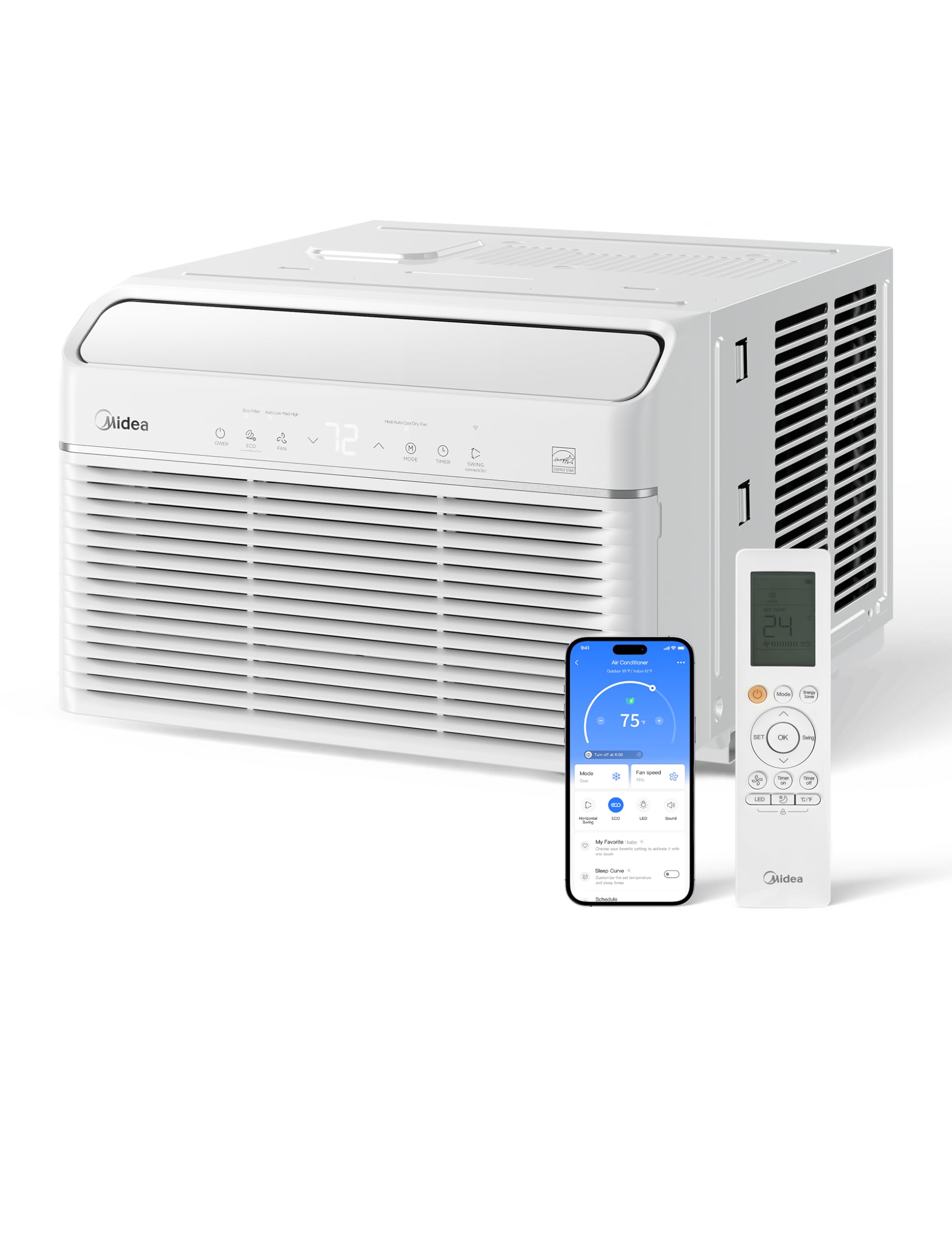
1. Midea 12,000 BTU Window Air Conditioner with Heat, 550 Sq Ft
Our pick — over 4★ from 300+ verified ratings; the strongest balance of quality and price.
Runs on ordinary house current, cools a 550-square-foot room, and stays quiet enough to take a call beside it.
This is the one to buy if you want the most complete package without rewiring anything. It runs on 115V, so it plugs into a standard three-prong outlet — no electrician, no dedicated 230V circuit. That alone beats the ROVSUN 4-in-1 and the Keystone for most apartments, since both need 208/230V service.
You get steady, quiet cooling from the inverter compressor (a motor that ramps speed up and down instead of slamming on and off). It holds the room at a steady temperature and keeps noise as low as 45 dBA — about the sound of a quiet refrigerator. One buyer reports the unit pulling a 350-square-foot space below target in under 15 minutes while the inverter kept the temperature flat and the power draw down. You also get dehumidifier mode, defrost control, and a washable front filter, and you can control everything from the panel, the remote, the Midea SmartHome app, or Alexa and Google Assistant.
Before you buy, know the heater’s limit: Midea states the heat pump will not operate once the outside temperature falls below 41°F, so it warms shoulder seasons rather than deep winter. Multiple owners have hit that wall on cold snaps, and one called the heater “useless” below that threshold. The included install kit fits double-hung windows with openings 24 to 38.5 inches wide and a vertical clearance of 14.5 inches, and the unit itself measures 19.41 inches wide by 22.17 inches deep by 13.9 inches high — check those against your sill before it ships.
What buyers keep coming back to
- Cools fast — one owner clocked a 350 sq ft room dropping below target in under 15 minutes
- 45 dBA operation, quiet enough that a nearby conversation or video call is not disturbed
- 115V plug means no electrician and no high-voltage circuit
- Control from the panel, remote, app, or Alexa and Google Assistant voice commands
Where the shine wears thin
- Heat pump shuts off below 41°F outside, so it is not winter-grade heating
- Heavy enough that two people make installation far easier than one
- Needs a window opening of 24 to 38.5 inches wide and 14.5 inches of vertical clearance
Buy this if: you want strong cooling, real app and voice control, and a plug that works in a standard outlet.
Look elsewhere if: you need heat that keeps running once the temperature drops into the thirties.
2. Soleus Air 12,000 BTU Window Air Conditioner with 10,000 BTU Heater
The saddle design hangs over the wall instead of filling the window, so your view survives the summer.
Most window units block half your glass and sit in the sill as a permanent obstacle. This one straddles the wall, which the maker says makes it practically impossible to fall out and leaves the window itself usable. The design also pushes the noisy compressor outdoors on the far side of the wall, so the indoor half runs at just 38 dB — quieter than any traditional window unit in this group.
The heat side is where this one separates itself from the Midea. It uses a true heat pump rated at 10,000 BTU, and buyers report usable warmth with outdoor temperatures in the thirties, with some describing good heat down to 40°F and less efficiency down to 30°F. One long-term owner chose this specifically over Midea because the Midea shuts off at 41°F, and reports it delivering modest heat even with outside temperatures in the thirties, along with a working defrost cycle.
The caution here is reliability, and it is not a small sample. A meaningful share of owners mention units that failed within the first days or weeks — one stopped heating after three days, another quit cooling after roughly 20 hours of runtime. Others have run the unit for months without trouble. This 115V model is Wi-Fi enabled through the app, comes with an activated carbon filter, and accommodates walls up to 12.5 inches thick.
What stands out: 38 dB indoor noise plus a 10,000 BTU heat pump that keeps working into the thirties is a combination nothing else here matches.
The real risk: the failure stories are frequent enough to matter, so buy from a seller with a straightforward return path and keep the box.
Reach for this if: you want to keep your window, hate compressor noise, and need heat that survives real winter weather.
Pass on it if: you would rather not gamble on long-term reliability, or your wall is thicker than 12.5 inches.
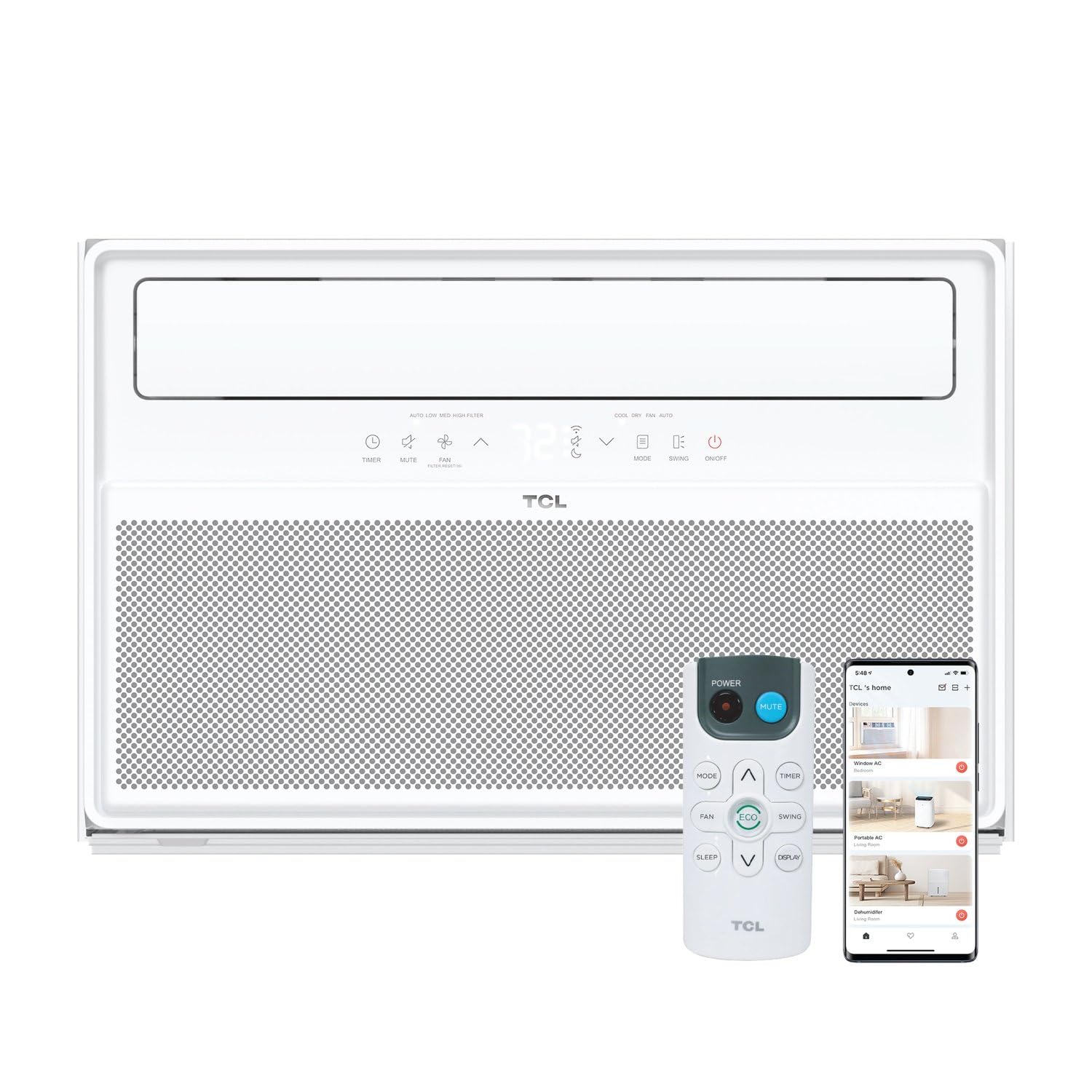
3. TCL 12000 BTU Q-Series Smart Inverter Window AC with Heat Pump
A heat pump that keeps warming well below freezing and plugs into a normal 115V outlet.
If winter heating is your main worry, this is the pick. TCL claims up to 67% heating and 32% cooling energy savings, and the 115V plug fits a standard three-prong outlet — no 208/230V circuit like the ROVSUN and Keystone need. The window opening needs to be 29.5 to 41 inches wide and 18.5 inches high.
Unlike the Midea, whose heat pump shuts down at 41°F, this one keeps producing heat far lower. Cooling earns praise too, with owners calling the dehumidification mode the standout feature and describing it as cooling a downstairs bedroom completely and efficiently.
The trade-off is the setup experience. Owners describe the manual as genuinely poor — front panel removal steps are missing, the mounting instructions skip the drainage tilt, and the sash bracket needed trimming and a bit of window cutting in one install. Wi-Fi has been unreliable for a few, with one buyer reporting that one of two units would not connect at all. The thermostat also runs a touch inaccurate, so manual temperature adjustment is often necessary.
Why it wins on heating: a true heat pump rated for very cold outdoor temperatures is rare in a 115V window unit, and it is the single biggest reason to choose this over anything else here.
The rough edges: budget an afternoon for installation and expect to fine-tune the temperature yourself rather than trusting the auto setting.
Worth it if: you want serious winter heat without a 230V circuit, and you can tolerate a fiddly first install.
Think twice if: you want set-and-forget control or your window is narrower than 29.5 inches.
4. Frigidaire 12,000 BTU Window Air Conditioner with Supplemental Heat
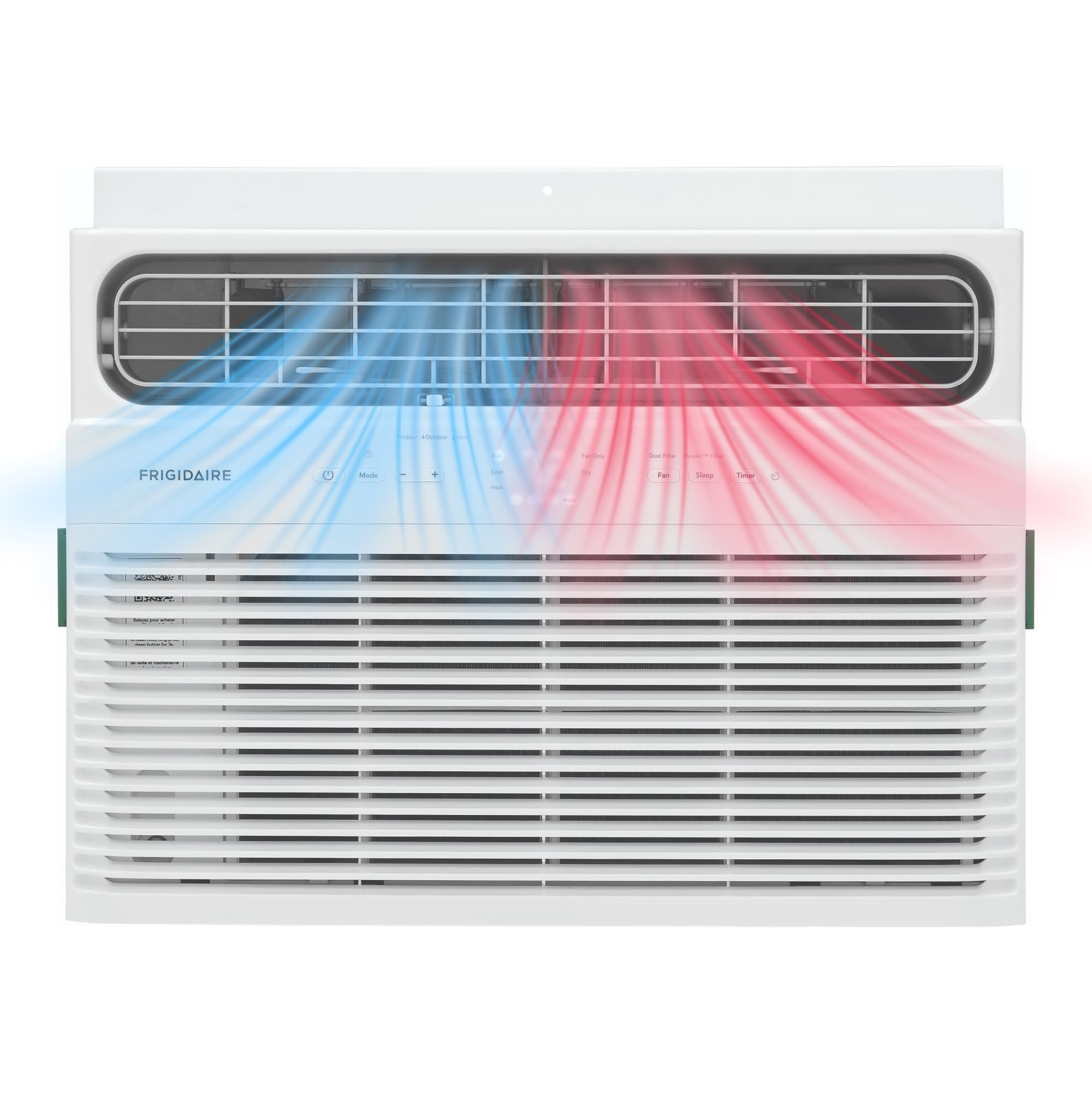
Built for bedrooms — 54 dBA operation, six-way directional louvers, and a filter alert that tells you when to clean up.
If noise is the thing that wakes you up, start here. This unit runs at 54 dBA, which lands between the Midea’s 45 dBA and the ROVSUN’s 59 dB — quiet enough that owners describe sleeping next to it without trouble. Six-way directional airflow lets you aim the air rather than blasting it straight across the room, and three fan speeds plus Eco Mode and Sleep Mode give you something to tune.
The feature set is built for convenience. A 24-hour on/off timer matches your schedule, and Auto Restart brings the unit back to its previous settings automatically once power returns after an outage. Clean Filter alerts keep the washable dust filter from clogging, which owners say matters when the unit runs all summer. Controls come through the included remote, and the unit is rated for spaces up to 550 square feet.
Two caveats come straight from the spec sheet and reviews. Customers note this 12,000 BTU model needs a 240VAC outlet rather than a standard 110V one, so check your receptacle type first. And several buyers found that no compatible window sleeve exists for this unit from Frigidaire or third parties due to its unusual size — relevant only if you plan to install it in an existing sleeve. If you are mounting into a bare window frame, it is not a factor.
The draw: quiet 54 dBA operation plus six-way airflow and Auto Restart makes this the easiest unit here to live with nightly.
Before you buy: confirm you have a 240VAC outlet, because it will not run on ordinary 110V house current.
Best matched to: a bedroom or living room where quiet matters and a 240V outlet already exists.
Not the one if: you need a plain 115V plug or you are dropping it into an existing sleeve.
5. Whirlpool 12,000 BTU Window Air Conditioner, up to 550 Sq Ft
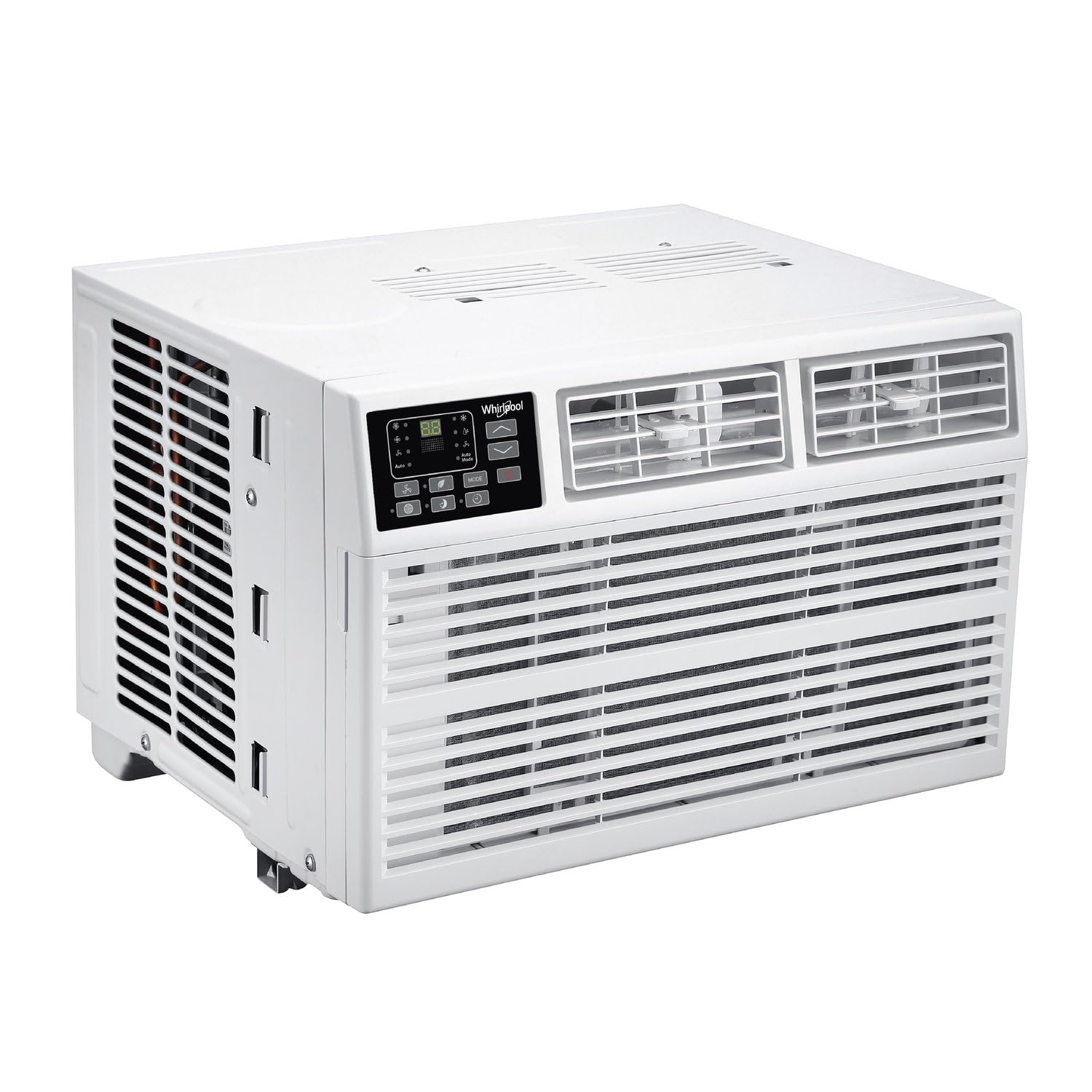
Small-space heating is the whole point here — one owner kept a studio warm through a stretch of teen temperatures.
This is the buy for a studio, a converted attic, or a spare room where the heat matters as much as the cooling. The unit is rated 12,000/11,600 BTU for cooling and 11,000/9,000 BTU for supplemental heat, and the 8-way directional louvers let you push warm air toward the far corner instead of straight ahead. One owner reported the heat mode keeping a 312-square-foot studio apartment comfortable through a run of consecutive days in the teens — a real-world result that far outpaces the shoulder-season heating on the Midea.
The controls are straightforward: electronic panel with digital display, three cooling speeds, Eco Mode, Sleep Mode, and a 24-hour on/off timer, all commandable from the included remote. The mounting kit installs in windows with a minimum height of 19.5 inches, and the filter is washable and separately removable. It is also clear from the listing that this is supplemental heat, not a primary heat source in the coldest months — worth holding onto that phrase.
The main complaint from buyers involves listed dimensions not matching the actual product. One report describes the width being off by roughly four inches horizontally and one inch vertically, with the actual width measuring 19.75 inches rather than 24. If you are cutting or building anything around this unit, measure your own window and the unit itself rather than trusting the listing images.
The case for it: 11,000/9,000 BTU of supplemental heat in a 115V-style window unit is rare, and buyers confirm it holds a small studio through real cold spells.
Add to the list: confirm actual dimensions before installation, because listing measurements have been reported as inaccurate.
Pick this for: a small studio or studio-adjacent space where heat carries you through winter and cooling carries you through summer.
skip it if: you need an exact-dimension fit into an existing sleeve or frame — measure first.
6. ROVSUN 12000 BTU Air Conditioner Window Unit with Heat, 4-in-1

Four functions in one chassis — cool, heat, dehumidify, and fan — with the side panels included to make install quick.
This is the pick for someone who wants installation to be over quickly. ROVSUN includes side panels and mounting parts in the box along with a detailed instruction manual, and buyers consistently single out the install as the smoothest part of ownership. The unit then runs as four machines: air conditioner, heater, dehumidifier, and fan, with a 24-hour timer, ECO mode, automatic mode, and adjustable fan speeds toggled from the LED display or the remote.
Cooling and heating are both rated for spaces up to 550 square feet, and the operating temperature range is 61°F to 88°F on the indoor side. This model requires 208/230V, so it needs a high-voltage circuit rather than a standard outlet — the same limitation the ROVSUN shares with the Keystone above. The slide-out filter makes cleaning easy, and the compressor uses copper core components.
The honest trade-offs here are noise and long-term durability. At 59 dB, this is louder than the Midea and the Frigidaire on the noise floor, and multiple owners describe a loud compressor kick-in that interrupts a quiet room. A smaller number of buyers have had units that failed to cool at all. For most buyers, though, the easy install and four-in-one value outweigh the noise.
What wins people over: ROVSUN’s included side panels and mounting hardware make this the least painful install in the group — a genuine value for a first-time window AC buyer.
Plan for: 208/230V service and a compressor that announces itself every time it kicks in, which matters in a shared bedroom.
Fits best: a buyer with a 230V outlet available who wants everything in one box, including the mounting hardware.
Not for you if: you need standard 115V plug-in simplicity or truly quiet operation near a bed.
7. GARRISON R-410A Through-The-Window Heat/Cool Air Conditioner, 12000 BTU

A basic, no-frills heat-and-cool unit built for a tenant’s window rather than a showroom floor.
For a landlord, a rental unit, or a garage office that just needs reliable heat and cold, this is the pragmatic pick. It cools and heats up to 550 square feet, runs five modes — Fan, Cool, Heat, Dehumidifier, and Auto — and uses a Follow Me function on the remote that reads the room temperature where you are sitting and adjusts the unit to match. A galvanized cabinet and a self-evaporative system mean fewer condensate surprises, and the remote plus a 24-hour timer handle basic programming.
The remote can be set to Sleep mode to trim noise overnight, which helps in the bedrooms where this unit usually lands. It is a split-system-style installation in a through-the-window form factor, so the window mounting requires a bracket the unit does not include — an owner installed a support underneath until a proper bracket arrived. If you are installing this for a tenant, budget for the bracket on day one.
The unit has no inverter, so the compressor cycles fully on and off rather than ramping, which means bigger temperature swings and a louder start-stop rhythm than the Midea or the TCL. That is normal for this price tier, but worth knowing if you sleep lightly. There is also a caveat from one buyer whose compressor failed within a year and who got no help from the manufacturer — sized against the rest of the reviews, most reviewers point out the unit working as intended.
Why it earns its spot: five modes including heat and dehumidify, a Follow Me remote, and a self-evaporative system give real-world utility at a rental-grade price.
Budget for: a window mounting bracket, since it is not included, and expect a compressor that cycles rather than ramps.
If simplicity is the goal: this handles heat, cool, and dehumidify for a rental or secondary room with minimal fuss.
Move on if: you want inverter-quiet operation or a complete install kit in the box.
8. Keystone 12,000 BTU Window Air Conditioner with 11,000 BTU Supplemental Heating
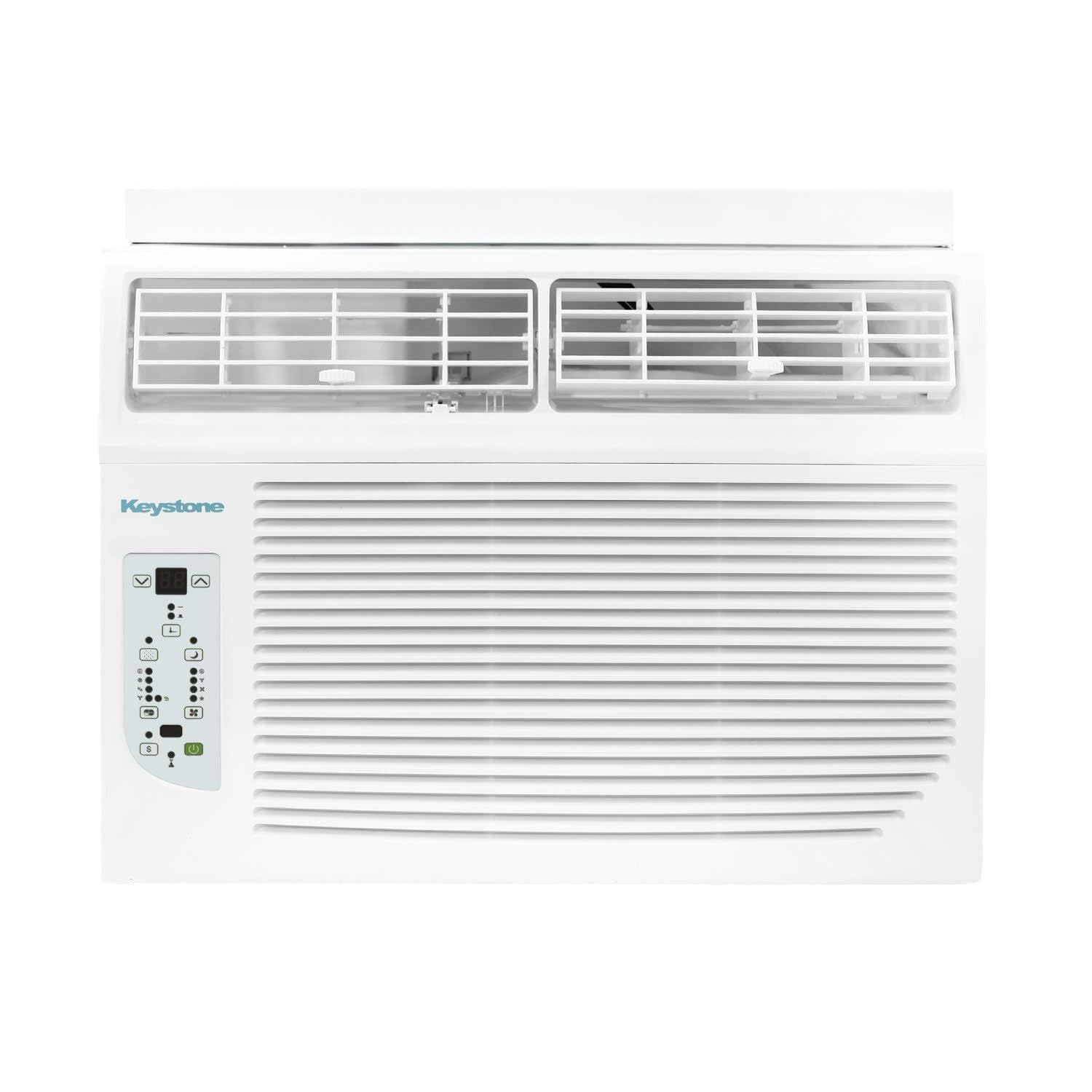
A 230V four-function unit with an I Sense remote that keeps checking the room temperature every three minutes.
If you already have a 230V outlet available, this is the value option. It runs a full 12,000 BTU cooling capacity and 11,000 BTU of supplemental heating, plus dehumidification and fan circulation, all controlled through a remote with the I Sense feature — the remote takes the room’s temperature at your seat, shows it on an LCD screen, and signals the unit every three minutes to keep the reading accurate. Four-way swing and a filter light reminder round out the daily conveniences.
The 230V power requirement is the same hurdle as the ROVSUN, and it is the exact spec that makes this cheaper than a 115V unit. If you do not have the circuit, add the cost of wiring into the equation before you buy. Waste no time checking your receptacle — this is not a plug-into-anywhere machine.
Keystone rates heating on this unit for outdoor temperatures between 23 and 76 degrees, and the manufacturer is explicit that it is supplemental and not a primary heat source. Buyer experiences split here: several shoppers say it cooling a room quickly and love having both functions in one box, while a handful of others found the heating weaker than expected in larger rooms and reported units that arrived damaged or failed to cool at all. That split is typical at this price — match the unit to your room size and keep the return window in mind.
What works well: the I Sense remote’s three-minute temperature refresh and the 230V efficiency make this a solid value for anyone with the circuit already installed.
Know before you order: 230V service, supplemental-only heating, and a mixed record on reliability — buy with the return window in mind.
The right fit: a 230V-ready room where cost matters and supplemental heat plus cooling from one unit is the goal.
Better to avoid if: you need primary heating or you only have a standard 115V outlet available.
Understanding the Specs
BTU rating and room size
BTU stands for British Thermal Unit — the amount of heat the unit can remove from a room in an hour. A 12,000 BTU window air conditioner is generally sized for spaces up to 550 square feet, and buyer reviews back that up in mild-to-moderate conditions. If your room is larger, hotter, or poorly insulated, expect to work harder at the same setting.
Voltage and outlet type
This is the spec that stops most first-time buyers cold. A 115V unit plugs into a standard three-prong household outlet and offers the simplest install. A 208/230V unit needs a dedicated high-voltage circuit and a matching receptacle — often an electrician’s job. Confirm your outlet style before ordering, since the plug shapes are not interchangeable and adapters are not an option.
Heat pump versus supplemental heat
A heat pump moves heat from the outdoor air into the room, so it keeps working at lower outdoor temperatures than a resistance heater. Supplemental heat from a heating coil gives up quickly. Midea’s heat pump will not operate below 41°F outside; TCL’s heat pump is rated down to about -5°F; Keystone’s supplemental heat is rated for 23°F to 76°F outdoors.
Noise in decibels and inverter compressors
An inverter compressor varies its speed instead of cycling fully on and off, which keeps temperatures steady and reduces how often you hear a hard start. Midea lists noise as low as 45 dBA, Soleus Air lists 38 dB, Frigidaire lists 54 dBA, and ROVSUN lists 59 dB. For reference, a quiet library runs around 40 dB and normal conversation is around 60 dB — so 38 dB is genuinely soft, and 59 dB is the sound of a loud room.
FAQ
Will a 12000 BTU window air conditioner with heat fit my window?
Do I need a special outlet for 208/230V window AC units?
How cold can it get outside before the heat mode stops working?
Is supplemental heat strong enough to replace a furnace?
How loud is a window air conditioner with heat?
What does CEER mean on a window air conditioner?
How much square footage can a 12,000 BTU window AC with heat cool?
Do these window AC units come with a mounting kit?
Can I control a window air conditioner with heat from my phone?
How often does the filter need cleaning on a heat and cool window unit?
Final Thoughts: The Verdict
The winner for most people is the Midea 12,000 BTU Window Air Conditioner with Heat. It runs on 115V, cools a 550-square-foot room down fast thanks to its inverter compressor, and stays as quiet as 45 dBA while covering you through shoulder-season chills. The Frigidaire 12,000 BTU is the one for bedrooms if a 240V outlet already exists, since its 54 dBA operation plus six-way airflow is the calmest way to sleep cool. If winter heat is the real priority, the TCL 12000 BTU Q-Series Inverter is the decisive pick, because its heat pump keeps producing warmth long after the Midea and the Soleus Air give up.
How We Picked
We do not accept paid placement. Every pick is matched to a real buyer and a real use-case; we do not hands-on test units.
Sources & Methodology
Specifications: manufacturer listings and product documentation. Review insights: verified customer reviews, as of September 2026. Pricing: not shown on this page (it changes often); check the current price via the retailer link.
As an Amazon Associate, KitchPrep earns from qualifying purchases. This does not affect which products we feature.
Related Guides
