
Specs are compiled from manufacturer listings and verified buyer reviews and can change over time — please confirm the key details on the product page before buying.
If you want one chilly room warm without hiring an electrician for a new 240-volt line, a 120-volt baseboard heater is your simplest route. These units run on the ordinary wall circuits you already have. The trick is matching wattage to room size, and the nine models below sort that out for you.
I’m Mohammad Maruf — the founder and writer behind KitchPrep. This guide is built by comparing the manufacturers’ published specifications and the patterns across verified customer reviews, so you get each pick’s real strengths and trade-offs instead of marketing spin.
Every pick here runs on standard household current, from the 4.2-amp compact units up to the 1500-watt plug-in models that heat a whole living space. Below you will find the quietest, the best value, and the one built for a three-seasons room — all part of a complete look at the 120 volt baseboard heater.
Our Picks at a Glance

How To Choose The Best 120 Volt Baseboard Heater
Three things decide whether a baseboard heater keeps you warm or wastes your money — wattage, whether it hardwires or plugs in, and where the thermostat lives. Get those right and you will not think about the heater again until spring.
Match Wattage To Your Room Before Anything Else
A baseboard heater’s wattage tells you how much warmth it can push into a space. The Cadet 48-inch runs 1000 watts and the Fahrenheat portable runs 1500 watts, while the compact KING 27-inch puts out just 500 watts. Small rooms and bathrooms need less; a drafty bedroom or a sunroom hits the ceiling quickly. Buy for the room you actually have, not the biggest number on the shelf.
Plug-In Versus Hardwired Changes Everything
You get a permanent, built-in look with hardwired heaters like the Cadet 48-inch, but they connect permanently to a circuit and need a professional — no cord, no outlet, and you buy the wall thermostat separately. Plug-in models such as the shinic and the Cadet Portable carry a 6-foot grounded cord and a built-in dial, so you can move heat from room to room. Pick based on if you want a permanent fixture or a flexible one.
The Thermostat Is The Most Forgotten Cost
Most hardwired baseboards ship without a thermostat, and that trips a lot of first-time buyers. A line-voltage wall thermostat or a built-in end kit is a separate purchase you must plan for. Plug-in models sidestep this entirely because the dial or digital panel is built onto the unit.
Quick Comparison
| Model | Best For | Wattage | Amperage | Install Type | Amazon |
|---|---|---|---|---|---|
| Cadet 48 Inch 1000W | Bedrooms and offices | 1000 watts | 8.33 A | Hardwired | Amazon |
| shinic 1500W/750W | Plug-and-play warming | 1500 watts | 12.5 A | Plug-in | Amazon |
| Cadet F Series 36 in. | Small-room hardwired zones | 750 watts | 6.25 A | Hardwired | Amazon |
| KING 3′ 750W | Whole small houses | 750 watts | 12.5 A | Hardwired | Amazon |
| KING 4′ 1000W | Basement rooms | 1000 watts | 8.3 A | Hardwired | Amazon |
| Fahrenheat FBE15002 | Three-seasons rooms | 1500 watts | 12.5 A | Plug-in | Amazon |
In‑Depth Reviews
1. Cadet 48 Inch Electric Baseboard Heater – 1000W, 120V, White, 3415 BTU
The wall-hugging Cadet that warms a bedroom without ever making a sound
For a bedroom, home office, or sunroom that your central system never quite reaches, this slim 48-inch Cadet is the safest all-round bet in this whole group. It puts out 1000 watts and 3415 BTU of convection heat — meaning it warms the air that drifts up off its fins, with no fan to push dust or noise around the room. Pulls 8.33 amps on a standard 120-volt circuit, so it fits an ordinary household setup rather than demanding a special line.
The design chops are why people keep re-buying it. At 48 inches wide, 6.75 inches high, and 9.5 pounds, its all-steel cabinet sits low enough to tuck under a window ledge where cold air pools. The full-length automatic cut-out shuts the unit down the moment it runs hotter than it should, which is your quiet backstop against a heater that never gets left unattended without a safety net.
Heating output is what this pick wins on — it is the single most talked-about strength of the model, and it is deserved. Buyers report warming roughly 160-square-foot bedrooms to noticeable comfort within five minutes, with fanless convection that stays silent while it runs. One widely-shared caveat: the thermostat is sold separately, so budget for a line-voltage wall unit or an end-mounted kit before you install, and hardwiring is best left to a qualified electrician.
What owners keep praising
- 1000 watts and 3415 BTU warm a mid-size bedroom fast, with front-discharge convection that circulates without a fan
- Fanless, so it runs silent — the top comfort note across the whole model line
- All-steel cabinet and full-length overheat cutout for everyday confidence
- Value holds up: owners say it does not noticeably move the utility bill
What to plan around
- Thermostat is not included — you must buy a separate line-voltage wall or end unit
- Hardwired only; no cord, so a dedicated circuit and a pro install are on you
- A small number of long-term reports flag durability concerns after heavy seasonal use
Best for: Anyone who wants a permanent, silent heat source tucked under a window in a bedroom or office, and is fine buying the thermostat separately and paying an electrician once.
Skip if: You want heat you can carry to another room — this one bolts to the wall for good.
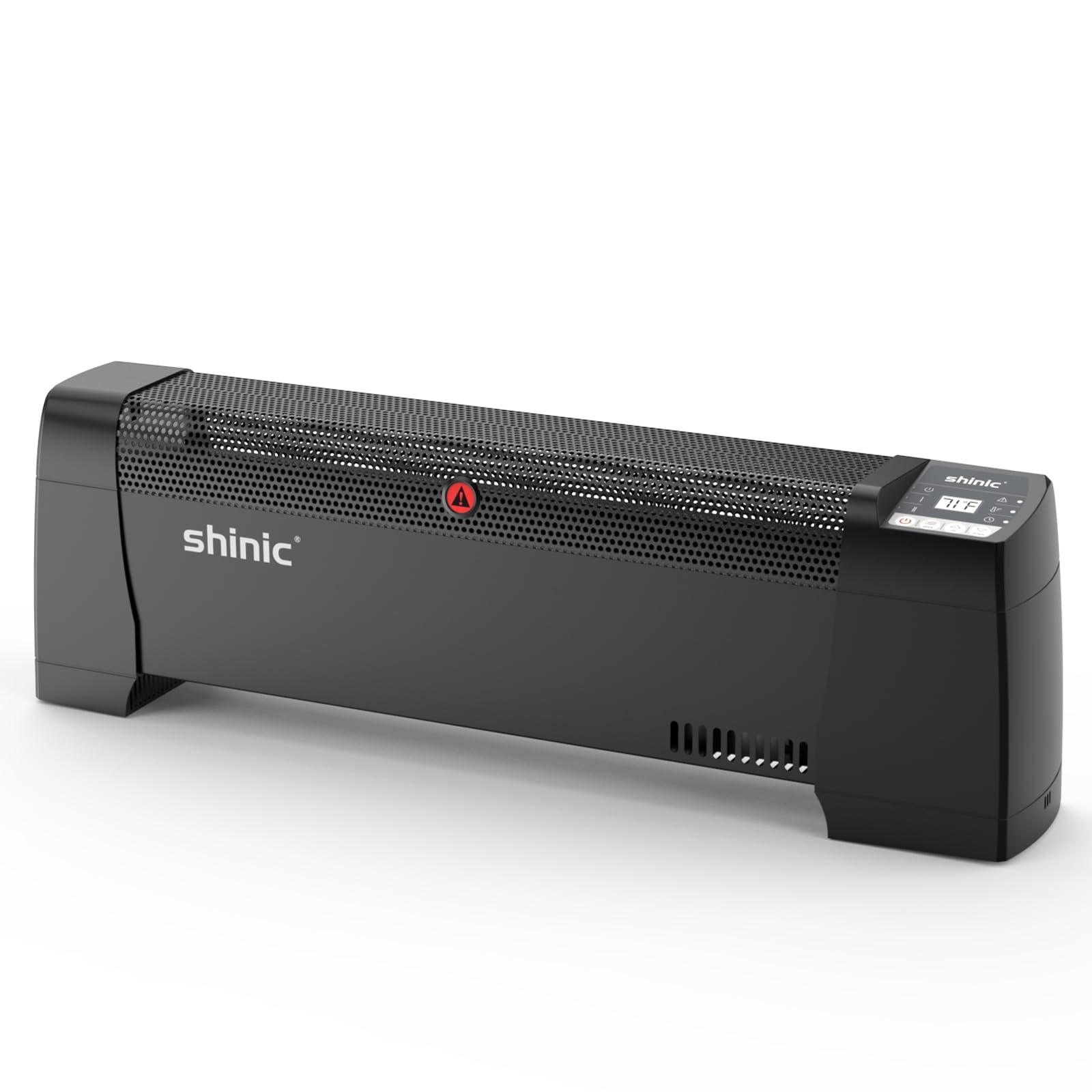
2. shinic Electric Baseboard Heater 120V with Digital Thermostat, Timer, Convection Space Heater for Indoor Use, Bedroom, Office, Overheat & Tip-Over Protection, Silent Operation, 1500W/750W, Black
The only pick here that lets you dial in a temperature and walk away
If you would rather not buy a thermostat or call an electrician at all, the shinic is the quickest path to warm. It is a 1500-watt plug-in convection heater you set down on the floor and plug into any standard 120-volt outlet, with a built-in digital panel and a timer that shuts it off on its own. Switch it to 750 watts when you only need to hold a cozy temperature around you, and up to 1500 watts when you want the room warmed in a hurry.
Everything lives on the unit, so you skip the separate thermostat and the dedicated circuit that the hardwired picks in this list — including the Cadet 48-inch above — require. It runs at a claimed 30 decibels — quieter than normal conversation — so it won’t drown out your TV. Safety is layered on well too: it shuts off automatically if it tips over or overheats, and there is a child lock plus dent-proof end panels for homes with kids or pets around.
Its weakness is control feel: setting a precise temperature or flipping between Fahrenheit and Celsius takes a stretch of repeated button presses. The thermostat holds a set point like 71°F tightly enough that some owners hear it click on and off. Keep it out from under a desk or bedside where the cycling would distract you, and unplug it when it is not in season.
Where the money goes: you are paying for the digital thermostat, the timer, and the dual-wattage flexibility — features the hardwired Cadet and KING models simply do not carry.
Set your expectations: it is best suited to a small bedroom or office, and one owner bluntly wished it were more powerful for its size. Think of it as targeted local warmth, not whole-house heat.
Reach for this if: you want a thermostat, a timer, and safety shutoff all built in, and you would rather plug in than rewire.
Look elsewhere if: you need serious output for a large or open room.
3. Cadet F Series 36 in. Electric Baseboard Heater (Model: 3F750-1W, Part: 05532), 120 Volt, 750 Watt, White
The 36-inch Cadet built to warm one tight room without hogging the wall
The F Series is Cadet’s shorter sibling — 36 inches wide and about 6.75 inches tall, putting out 750 watts and 2560 BTU on a 120-volt circuit. That is roughly three-quarters the output of the 48-inch Cadet above, which is why it is best aimed at bathrooms, hallways, and small offices rather than a drafty master bedroom. It draws just 6.25 amps, the lowest of the two Cadet hardwired units, so it is a lighter load on your breaker.
Build quality is the headline strength here. It shares the same front-discharge convection design as its bigger brother — cool air in low, warm air out and up, no fan, no dust storm — and the all-steel cabinet includes a full-length overheat cutout that shuts the whole unit down if it gets too hot. Owners who install it themselves consistently mention how quick and clean the wiring goes; if you are handy, this is a comfortable weekend job.
The recurring considerations are honest and worth planning around. The thermostat is not included and Cadet does not bundle one, so factor that in. Cadet rates it for 187.5 square feet, but one owner found it too little alone for a 14-by-14 kitchen and added a second heater. Ventilate the room well for the first few hours to clear the burn-off smell.
Why it earns its place: 6.25 amps is the lightest draw of any hardwired model in this roundup, so it’s less likely to trip a breaker. Reviews back up the easy-install reputation, and its 6.25-amp draw is the lightest of any hardwired model here.
One number to hold onto: 187.5 square feet of rated coverage, so measure the room before you commit.
Ideal for: a small hardwired zone — a bathroom, entryway, or compact office — where you want a lower-amp load on the circuit.
Think twice if: you are heating anything past a small room, since this one is the shortest-reaching of the two Cadet hardwired options.
4. KING 2K1205-BW K Series Baseboard Heater, 27″ / 500W / 120V, Bright White
 Check Price on Amazon
A three-foot KING that owners say warms a whole tiny house
Where the KING 27-inch is deliberately small, the 3-foot KING is the workhorse for people who want one unit to cover a compact living space. It runs 750 watts at 120 volts with the same natural-convection, aluminum ribbon-fin element and full-length safety cutout as its smaller sibling, but spreads it across 36 inches instead of 27. Owners describe it as economically warming an entire small house, with heat that reaches the whole space rather than one corner.
Durability is designed in with a crushproof element and a dent-resistant die-formed cover, and the unit runs silent whether it is heating or cooling back down. It pulls 12.5 amps, so it belongs on a dedicated branch like every other unit in this class. A neat detail: it can be fitted with a double-pole thermostat instead of a single-pole one to get a true full off, which matters if you want the heater completely de-energized between seasons.
Two things to know before you order. First, this is not a plug-in heater — it hardwires to a circuit, a surprise that catches buyers who expect a cord. Second, it comes without a thermostat, so you will add a wall or inline unit yourself. Plan for both and the install is straightforward.
Strong points to weigh
- 750 watts over 36 inches warms a full small house or large room
- Runs silent on and off — no fan and no cooling noise
- Crushproof element and dent-resistant cover for a long service life
- Accepts a double-pole thermostat for a true off position
Reality checks
- Hardwired, not plug-in — no cord, no outlet
- Thermostat is not included
- 12.5 amps means it needs its own circuit
Pick this when: one 120-volt wall unit has to heat a small home, cabin, or large room economically and you are set up for a hardwired circuit.
Better to pass if: you were hoping for something you can plug in and move.
5. KING 4K1210-BW K Series Baseboard Heater, 4′ / 1000W / 120V, Bright White
The 4-foot KING tuned for cold basement rooms and constant duty
If your cold room is underground, this is the KING to look at. At 4 feet wide and 1000 watts, it is the largest of the KING K Series here, pulling 8.3 amps — the same output class as the Cadet 48-inch, so expect comparable warmth. Where it pulls ahead is its element design: the heating element is shielded so dust and debris cannot fall onto it, a detail that matters in a basement or workshop where dust settles.
Owners lean on it for exactly that job. Owners mention it heats a 10-by-14-foot basement bedroom well and runs quiet, working cleanly alongside a common wall thermostat. The install is described as simple, though the supplied wiring guidance is less clear than it could be — more than one owner had to sort out the white-and-black wire diagram themselves before it clicked. It also smokes and smells for the first 30 to 45 minutes, then settles into silent, odor-free operation.
The honest trade-off is durability over the very long haul. A handful of customers note shorter service lives after years of seasonal garage and bathroom duty, and one early unit failed with an overheating incident. For most buyers running it as intended on a thermostat and flipping the breaker off between seasons, it holds up well; it is the heavy, let-it-run-for-years crowd who should expect to replace it eventually.
Built for: a basement bedroom, workshop, or cold below-grade space where the shielded element and 1000 watts of output are the deciding factors.
Consider another pick if: you want a heater you never think about replacing — this one prefers being run on a thermostat and turned off between seasons.
6. Cadet Portable Electric Baseboard Heater 1500W 120V Plug In, Thermostat

A 46-inch portable that owners park in three-seasons rooms and forget about
For a sunroom, a three-seasons room with floor-to-ceiling glass, or any space the furnace cannot reach, the Fahrenheat is the pick that keeps coming back. It is the widest portable here at 46 inches and throws 1500 watts and 5120 BTU of fanless convection heat across 250 square feet, pulled from any standard 120-volt outlet. Two of them, one at each end of a room, reportedly take a 12-by-25-foot space from cold to fully warm in a couple of hours.
What sold owners on this model again and again is how unobtrusive it is. With natural convection moving the air and no fan or moving parts, it warms the room evenly, quietly, and — as owners put it — stays “cool to touch.” That combination keeps dust and allergens from being blown around, which is welcome in a bedroom or a room where someone is sensitive to airborne particles. The overheat protection and the linear high-temperature cutout both add safety if the intake ever gets blocked.
Two practical notes. It has no thermostat and no on-off switch, so you will need a plug-in thermostat to control it — a common workaround owners figure out fast. And because it runs about 12 amps on high, an electrician’s rule of thumb applies: on a 15-amp circuit it should run alone, and you should never push past roughly 80% of the circuit load.
The right call for: a cold sunroom or three-seasons space where quiet, even, allergy-friendly heat matters more than a built-in thermostat.
Pass on it if: you want a self-contained heater with its own control — you will need to add a plug-in thermostat here.
Understanding the Specs
Watts, Amps, and Your Breaker
Wattage is the raw heating power a unit delivers, and amps tell you how hard it works your circuit. A 500-watt model like the KING 27-inch draws a light 4.2 amps, while the 1500-watt plug-ins here draw 12.5 amps. Breakers are sized for a steady load, so a 12.5-amp draw wants its own circuit — plug the big units straight into a wall outlet and never share with another appliance.
Convection Versus Radiant Heat
Convection heat is what most baseboards in this group use: air warms against the fins and drifts upward, filling the room slowly and evenly with no fan, so it is silent and does not stir up dust. Radiant heat, by contrast, warms objects and people directly rather than the air. For a bedroom or a room where quiet matters, convection is the type to look for.
FAQ
Will a 120 volt baseboard heater work on a standard household outlet?
What size room can a 1500 watt 120 volt heater heat?
Can I plug a 1500 watt baseboard heater into an extension cord?
Do 120 volt baseboard heaters come with a thermostat?
How many amps does a 1000 watt heater draw at 120 volts?
Is a baseboard heater safe to leave on overnight?
Should I choose a hardwired heater or a portable one?
How much coverage does a 500 watt baseboard heater give?
Do these heaters make noise?
What smells should I expect from a new heater?
Final Thoughts: The Verdict
For most bedrooms, offices, and sunrooms that the central system leaves chilly, the 120 volt baseboard heater to beat is the Cadet 48 Inch 1000W — 3415 BTU of silent, fanless convection and a proven reputation that keeps owners coming back for more. If you would rather skip the electrician entirely, plug in the shinic 1500W/750W and let its built-in digital thermostat and timer do the work. And for a cold three-seasons room, the Fahrenheat FBE15002 is the one owners keep reaching for, with its wide 46-inch frame and cool-to-touch cabinet. Measure your room, pick the wattage that matches it, and buy once.
How We Picked
We do not accept paid placement. Every pick is matched to a real buyer and a real use-case; we do not hands-on test units.
Sources & Methodology
Specifications: manufacturer listings and product documentation. Review insights: verified customer reviews, as of September 2026. Pricing: not shown on this page (it changes often); check the current price via the retailer link.
As an Amazon Associate, KitchPrep earns from qualifying purchases. This does not affect which products we feature.
Related Guides
