
Specs are compiled from manufacturer listings and verified buyer reviews and can change over time — please confirm the key details on the product page before buying.
If you want power after sunset, the honest answer is simple: buy a 12 volt wind turbine for its low cut-in speed, not for the big number on the box. A turbine that starts turning in a light breeze will charge your battery bank far more consistently than one that promises huge watts it rarely reaches. Every pick below outputs 12V DC and pairs with a charge controller, so you can wire it straight into a battery setup alongside solar.
I’m Mohammad Maruf — the founder and writer behind KitchPrep. This guide is built by comparing the manufacturers’ published specifications and the patterns across verified customer reviews, so you get each pick’s real strengths and trade-offs instead of marketing spin.
Real-world output almost always lands under the label for small turbines, so the picks here are ranked by build quality and honest start-up speed first. Below you’ll find seven compact units compared on blades, start-up wind speed and weight, plus what actually happens when you bolt one to a mast — a practical shortlist of the best 12 volt wind turbine setups for cabins, boats and off-grid battery banks.
Our Picks at a Glance
How To Choose The Best 12 Volt Wind Turbine
The number printed largest on the box is the one you should trust least. Rated wattage on small turbines is measured in ideal lab wind, and almost nothing in a backyard, marina or rooftop ever matches that. What actually determines whether your batteries stay topped up is the cut-in wind speed — the point where the rotor starts spinning fast enough to push current — combined with how high you can safely mount the unit.
Start with cut-in wind speed
A turbine rated at 2.5 m/s start-up will begin generating in a breeze that barely moves leaves, which matters because most locations spend far more hours in light wind than in strong wind. A unit rated at 4.5 mph cut-in is a reasonable middle ground for exposed sites. If your site is sheltered by trees or buildings, no rated wattage will save you — height and clearance come first.
Match the controller to the turbine
A charge controller is the box between the turbine and your battery that stops overcharging and protects against over-speed. An MPPT controller (maximum power point tracking, which constantly adjusts the voltage to squeeze the most current out of the rotor) will outperform a basic unit in real conditions. Check that the controller’s amp rating comfortably exceeds what the turbine can deliver at 12V, and that it’s adjustable — several owners of budget kits report the stock controller limits output more than the turbine itself does.
Plan the mast before you order
The mount is where most installs stall. A tall, rigid steel mast, proper guy wires and a solid base cost real money and effort, and several of the turbines below list towers, wiring or batteries as not included. Decide on your mounting height, clearance from obstructions and grounding plan before the box arrives, because a turbine bolted to a short wobbly pole will underperform regardless of its specifications.
Quick Comparison
| Model | Best For | Rated Power | Start-Up Wind | Blades | Amazon |
|---|---|---|---|---|---|
| Automaxx Windmill 600W★ Best Overall | Boat & cabin battery banks | 600W | 4.5 mph | 3 | Amazon |
| 12V 1200W Wind Turbine Generator KitBudget Champion | Budget solar supplement | 1200W | 2.5 m/s (5.6 mph) | 5 | Amazon |
| VEVOR 500W Wind Turbine Generator | Cabins, sheds, boats | 500W | 2.5 m/s | 5 | Amazon |
| Pikasola 400W 12V Kit | Marine and off-grid kits | 410W | 2.5 m/s | 5 | Amazon |
| VEVOR 800W Wind Turbine Generator | Larger home & farm setups | 800W | 2.5 m/s | 3 | Amazon |
| Pikasola 200W Vertical Axis Turbine | Tight spaces, low-noise sites | 200W | — | 5 | Amazon |
| HEVIRGO 4500W Vertical Axis Turbine | Experimenters & hobby builds | 4500W | — | 5 | Amazon |
In‑Depth Reviews
1. Automaxx Windmill 600W (12V/24V) Wind Turbine Generator Kit
Our pick — over 4★ from 20+ verified ratings; the strongest balance of quality and price.
Starts charging in a 4.5 mph breeze — the lowest cut-in speed of the seven picks here.
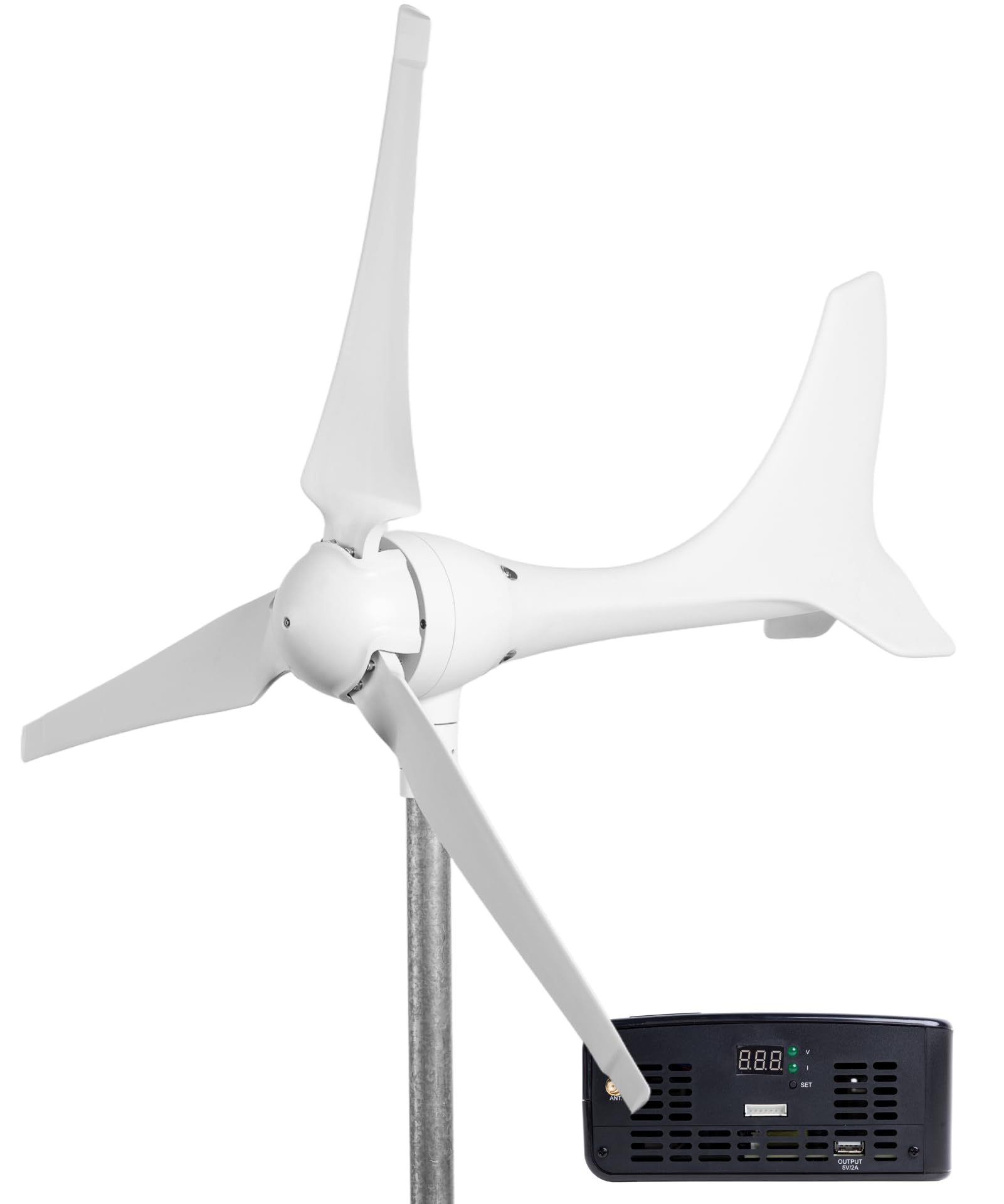
The Automaxx earns the top spot on one number: a 4.5 mph cut-in speed, the lowest figure among the picks here. That means the rotor begins pushing current into your battery while other turbines are still sitting still, which is exactly what you want on a boat or a garage bank that needs topping up overnight. It ships with its own MPPT controller (maximum power point tracking, the circuit that constantly re-tunes voltage for peak output) plus a digital amp, volt and watt display, so you can watch what you’re actually harvesting rather than guessing. At 12V it’s rated to deliver up to 50 amps, and it drops to 25 amps when wired for a 24V bank.
Where it beats the cheaper 1200W kit beside it is footprint and finish. At 26 pounds and measuring 9.8 by 19.3 by 30 inches, it’s the smallest physical unit in this group — and next to the 1200W kit’s 25 by 21.3 by 45 inch frame, that gap is huge in practice. Marine-grade, water-resistant materials resist salt and UV, which is why so many buyers mount it on boat sterns. Wiring is straightforward once you know the trick: connect blue to white, and the seller will walk you through it if the manual leaves you stuck.
Here’s the honest part — reliability draws genuinely mixed reports. Several owners describe battery banks staying full through winter for weekend tool use, even outperforming their solar panels. Others wrestle with the MPPT reading slightly below battery voltage and seeing negligible current in moderate 10-15 mph winds, where one buyer measured only around 60W against the 600W rating. That’s the nature of small wind: label wattage assumes perfect conditions. What’s consistent is ease of assembly, and over half the reviews land at five stars, so most buyers get what they came for.
Why owners stick with it
- 4.5 mph cut-in means charging starts in light air
- Self-contained MPPT controller with amp, volt and watt readout
- Only 26 pounds and the most compact body here
- MPPT overcharge cutoff at 28.8-30V plus overspeed braking at 1250 rpm
Where it asks patience
- Output in moderate wind often lands below the 600W label
- A single-pole mast can feel unstable — guy wire plates on four sides help
- Manual braking and controller troubleshooting take some learning
Best home for it: a boat, cabin or garage battery bank where overnight charging in calm air is the whole point.
Look elsewhere if: you need whole-house output — this is a battery-top-up unit, not a generator replacement.
2. 12V 1200W Wind Turbine Generator Kit, 5-Blade, 2.5M/s Low Start-Up
Rated 1200W — the highest badge here, and the one buyers report misses it by the widest margin.
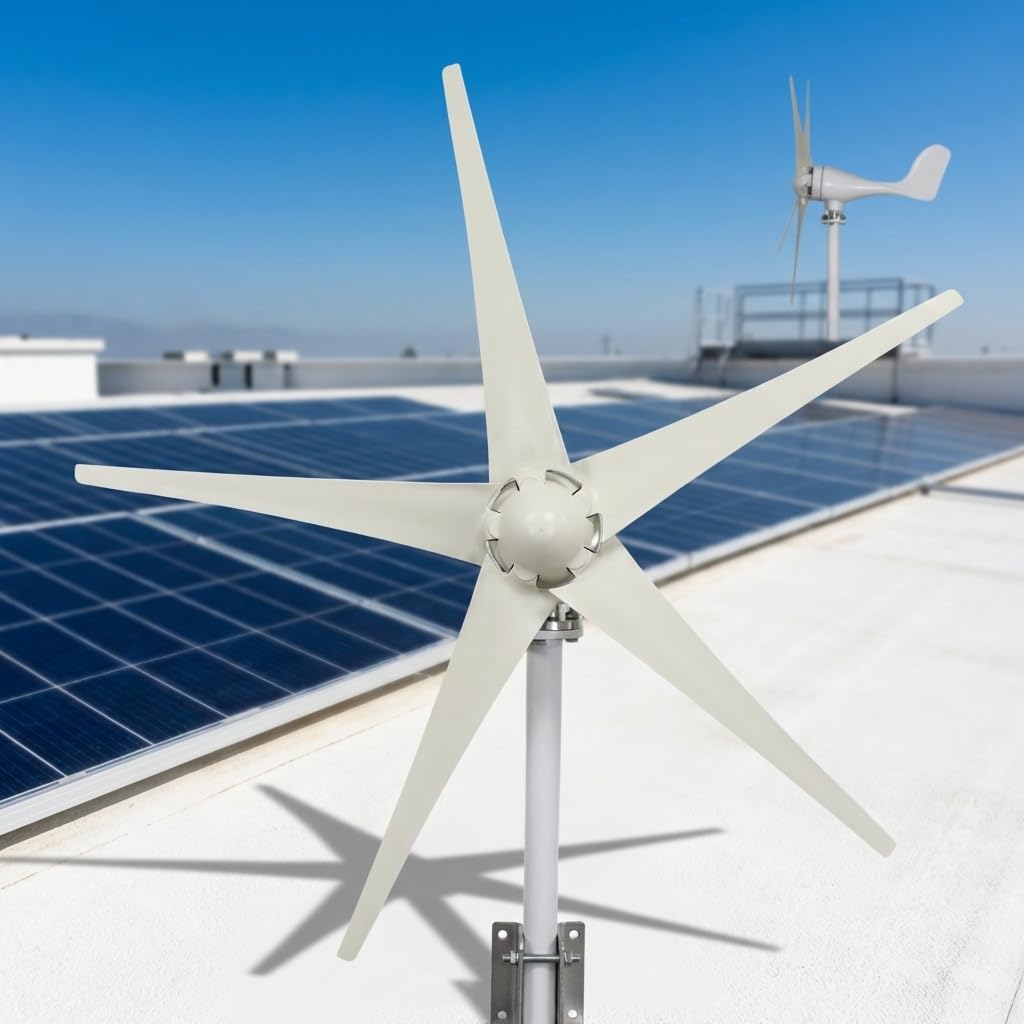
If wattage per dollar is your yardstick, this is the headline act: 1200W rated, a 1.2 m (47.2 in) five-blade rotor, and automatic yaw that swings the head to follow shifting wind. Start-up is listed at 2.5 m/s (5.6 mph), so it’s designed to move in light air. Physically it’s the largest unit in the group at 25 by 21.3 by 45 inches, which dwarfs the Automaxx’s 9.8 by 19.3 by 30 inch body — roughly a 2.6x difference in the space it occupies on a mast.
The build mixes plastic and metal and is listed as weather-resistant, but there’s no hurricane or survival-wind rating, so treat it as a fair-weather machine. Setup hardware is included as a tool set plus manual, yet the tower, wiring and battery are not. Expect to need an 80 mm (3.2 in) plus mast and a 12V, 200-400Ah battery bank, with the tower listed at 4.5-10 m (15-33 ft). It’s aimed at RV sites, cabins, farms, workshops and marine locations.
Owners bullish on this kit describe it as a great addition to a solar system — easy to put together, a nice surprise to see battery level climbing at night. The reality check is sharp, though: owners mention everything from stripped blade bolts and hub holes left as cast, to a manual that states a 300W max next to a 1200W badge. One buyer’s experience is stark: “This turbine in 40 mph wind and it’s spinning fast has only produced 2 watts out of 1200 that was advertised.” Others see a more believable 600-800W depending on location. Plastic blades are also the wear point — a Texas buyer expected them to last a year or two.
The value case: unbeatable on paper for a first wind project where the budget rules everything.
But know this: the rated 1200W is an ideal-wind figure — plan around real-world output several times lower.
3. VEVOR 500W Wind Turbine Generator, 12V, 5-Blade with MPPT Controller

Runs at a listed 55dB and weighs 15.3 lbs — the lightest full kit in this roundup.
For a unit meant to live on a shed or a boat, silence and weight carry more practical weight than a big badge. The VEVOR 500W runs at a listed 55dB — quiet enough to live next to — and at 15.3 pounds it’s light enough to lift onto a mast without a second person. The five blades are reinforced fiberglass nylon with a 47-inch rotor diameter, rated to shrug off temperatures from -40°C to 80°C. A three-phase permanent magnet generator and MPPT microprocessor handle the electrical side, adjusting current and voltage to match your circuit.
It’s set up for real wind too: a 2.5 m/s start-up, 12 m/s rated speed and a 3-25 m/s operating range, with an adjustable tail to point into the breeze and dual bearings to cut vibration. Everything about the body — die-cast aluminum housing, waterproof and corrosion-resistant finish — says it’s built for outdoor duty, and the kit covers shops, farms, RVs, boats and homes.
What owners notice first is how straightforward it goes up: the packaging is complete, materials feel sturdy, and a Wisconsin buyer notes it shrugged off brutal winter winds and heavy snow on a custom mount, feeding a shed’s 12V battery bank. The honest trade-off is twofold. First, output is mixed — one owner doubts the 500W claim based on the small gauge wiring and suspects far less, while others say it does the job. Second, this needs a tall, strong steel mast to turn well, and poles are not cheap and not included. Budget for the mount as seriously as the turbine.
The quiet-build win: 55dB plus a 15.3-lb body and a complete, well-packed kit is a strong combination for a shed or boat install.
Weigh the mast cost: its best performance depends on a tall steel pole you supply and fund yourself.
Reach for this if: you’re mounting on a shed, small boat or cabin wall and want the lightest, quietest five-blade kit on the list.
Consider the Automaxx instead if: you’d rather get a lower cut-in speed and a complete MPPT display in the box.
4. Pikasola Wind Turbine Generator Kit 400W 12V with 5 Blade and Charge Controller

The most-reviewed kit here, and the one with the most owner reports of output far below its 410W rating.
What draws people to the Pikasola 400W is the hardware story: 23.8 inch nylon carbon fiber blades that resist water and corrosion while staying light, a three-phase permanent magnet motor with high-performance NdFeB magnets, and a rotating aluminum alloy body with an automatic yaw system to catch the best wind angle. Start-up is listed at 2.5 m/s, and the whole kit packs down compact — at 26.5 by 11.8 by 18.3 inches, this is the smallest footprint on the list by a wide margin.
Assembly is clearly where it shines. Putting it together is repeatedly described as easy, the construction feels sturdy, and a sailboat owner who welded a base to an iron pipe and ran 8-foot pipe through the deck with four guy wires uses it to maintain a two-battery bank feeding a 3000W inverter — keeping the charge up once winds hit 10 mph or more, and cycling the inverter off below that. An Alaskan buyer, who rates the install at about five hours with the flange welded on, is happy enough to plan a second unit.
The catch is output, and it’s the most-documented issue on the page. Customers note minimal generation even with sustained winds over 24 mph at 15 feet of height, and one owner calls it a lawn ornament after seeing a max of around 23W in the highest winds even after swapping in a Renogy MPPT controller. A few units arrive with cut wires or missing hardware, and the maker’s response — full refunds, responsive support — is genuinely good. Blade balance is also a known quirk that guide wires help settle.
What makes it attractive
- Compact body at 26.5 by 11.8 by 18.3 inches
- Nylon carbon fiber blades, waterproof and corrosion resistant
- Easy assembly with a yaw system that reads wind direction automatically
- Responsive seller who honored refunds when output fell short
What to accept
- Real output is often far below the 410W rating
- Blades can arrive poorly balanced and need guide wires
- Occasional units ship with cut wiring or missing parts
Suits you if: you want the easiest assembly and can accept output as a battery top-up rather than a big contributor.
Not for you if: you need dependable wattage and would rather spend toward a higher-rated unit with fewer output complaints.
5. VEVOR 800W Wind Turbine Generator, 12V, 3-Blade with MPPT Controller

A 59-inch rotor — 12 inches wider than the 500W VEVOR’s — sweeps more wind than the smaller kits here.
Step up from the 500W VEVOR and the 800W version trades blade count for rotor size: three blades instead of five, but a 59-inch rotor diameter against the 500W’s 47 inches. Those reinforced fiberglass nylon blades take the same -40°C to 80°C range, and the body is die-cast aluminum with a waterproof, corrosion-resistant finish. A three-phase permanent magnet generator paired with an MPPT microprocessor handles the output, and a 2.5 m/s start-up with a 3-25 m/s operating range puts it in the same wind class as its sibling. The one difference that matters is noise: 58dB versus the 500W’s 55dB.
A 3-blade rotor is usually heavier and runs a touch louder than a 5-blade, and buyers confirm both edges. One notes this model is heavier than the 500W 5-blade version but quieter in a different way — a soft “woosh. woosh.” instead of a high-pitched buzz — and it charges a 12V bank faster. A camper mounts it on a vehicle for trips with a solar panel and never touches it, running heating pads and phones day and night. It’s the pricier of the two VEVOR kits and comes without the tower pole, so factor in a mast cost before you commit.
The recurring gripe isn’t the turbine, it’s the controller: reviewers point out the stock charge controller braking too early in moderate winds and limiting output, and one saw it fail entirely after about a month. Many replace it with an adjustable MPPT unit to open up the head’s real potential. A smaller caution — the manual’s mounting recommendation of 10 meters of clearance above nearby objects with a large tower, concrete base and multiple guy wires makes it a poor fit for anything but a fixed property or a good-sized yacht. A few units arrive missing the controller or previously opened.
Best matched to: a fixed home, farm or large-boat install where you can fit a big rotor and a proper tower.
Think twice if: you’re on a small RV or boat deck — the mounting demands and rotor size are more than mobile setups can carry.
6. Pikasola 200W Max 220W 12V 5-Blade Vertical Axis Wind Turbine

A vertical shaft takes wind from any direction, so there’s no yaw system or tail to aim.
A vertical axis turbine works differently from every horizontal unit above: the blades turn on a vertical shaft, so the rotor accepts wind from any direction and needs no yaw system at all. The blades sit fixed inside a flange, which is why the maker bills it as safe with no risk of a blade flying off. At 11.27 kg it’s a manageable lift, and because it can mount on a screw pile foundation rather than a concrete pad, the install is quicker and the foundation is fully recyclable at end of life. It produces three-phase permanent magnet AC at a 200W output with a 220W max, and pairs with a hybrid solar-wind setup.
Where a horizontal turbine needs a tall mast and constant alignment, this one’s shape suits tight urban plots, monitoring cabinets and hybrid street-light rigs — anywhere you can’t get a big rotor up high. Users report it works day and night as a float-charge supplement, with one owner running it across eight golf cart batteries at 12V through an inverter and praising the customer service as top-notch.
Set your expectations honestly here. A supplement is what this is, not a main power source — it’s described as a float charger for solar and battery systems rather than whole-house power. In light winds it produces very little, and a couple of owners who expected more from a 35-foot install were disappointed by how few amps came through. Fit and finish is good, it ships with a controller, and the vertical design keeps noise low — but the honest read is that this is a quiet helper for small loads, not a replacement for panels.
Why the vertical shape wins: 360° pickup with no yaw system and a screw-pile install that skips the concrete work.
Manage the expectation: a 200W vertical unit lives as a float-charge supplement, so pair it with solar rather than relying on it alone.
A smart fit when: you have a tight plot, want low noise, and need a hybrid partner for an existing solar array.
Wrong tool for: anyone chasing big daily watt-hours — this is a supporting player, so don’t lean on it as a primary source.
7. HEVIRGO 4500W 12V 5-Blade Vertical Axis Wind Turbine Kit
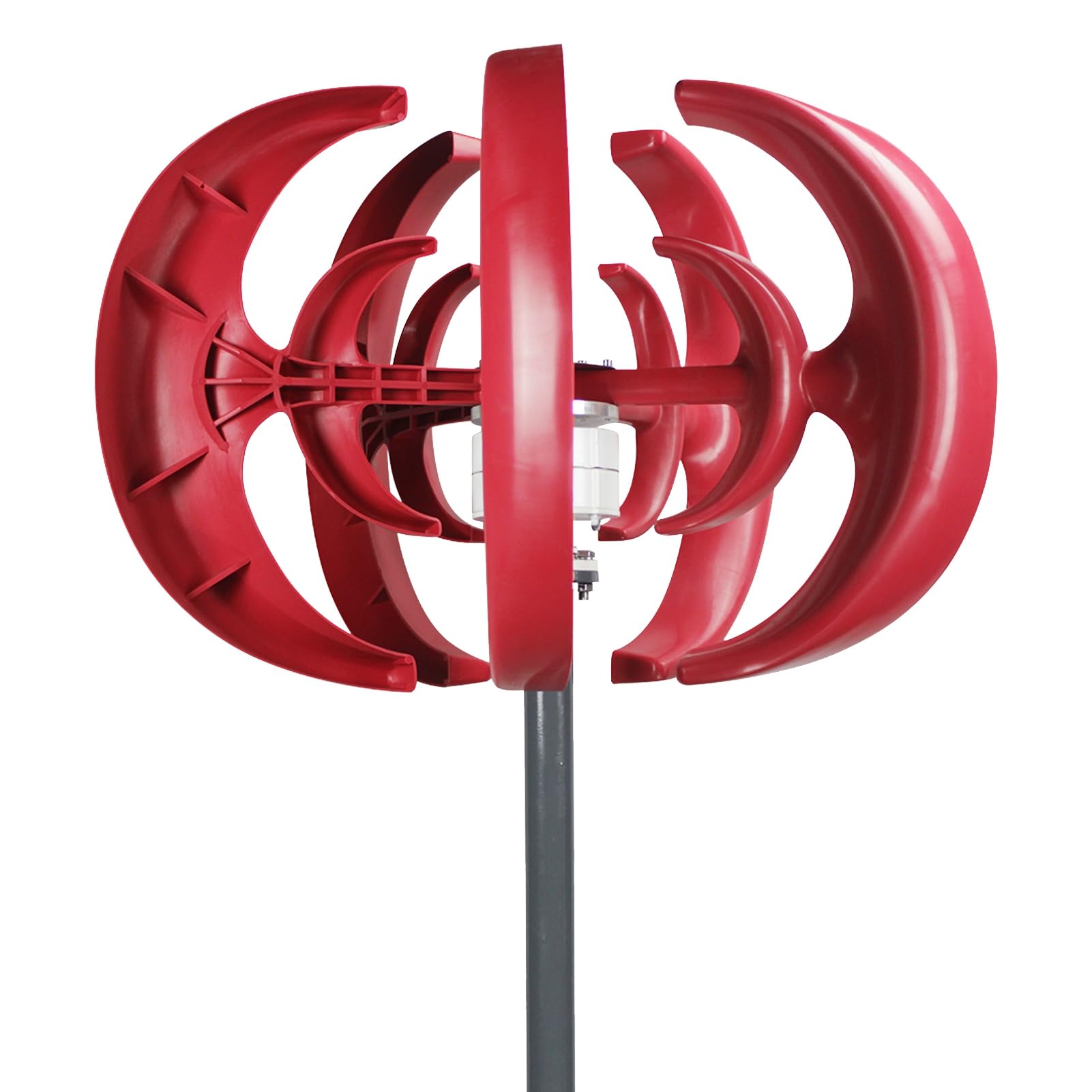
A 25.4-pound vertical kit rated 4500W — the biggest badge here and the lowest-rated pick in the group.
On paper the HEVIRGO wears the largest number in the roundup — 4500W — which will tempt anyone scanning for maximum watts. Under the shell, though, the engineering claims are modest and specific: precision injection-molded fan blades with an tune aerodynamic shape, a permanent magnet rotor AC generator with a special stator design to cut torque resistance, and a die-cast aluminum alloy shell with high-temperature spray treatment, UV protection and acid rain resistance. A double bearing design keeps operating vibration low and adds wind resistance. The body mixes ABS and metal, and it weighs 25.4 pounds.
It’s built for hybrid household systems, street-lighting and monitoring rigs, and private farms and remote sites — the sort of place where you want quiet operation and 360° pickup from a vertical design that needs no yaw. Assembly feedback is genuinely warm: buyers call it easy to put together, good-looking, and simple to wire, with a few noting it delivers steady incoming power and arrives quickly.
Now the honest caution. This is the lowest-rated pick in the group, and the skepticism centers on the power number itself: reviewers describe the generator as unable to produce anywhere near its advertised rating, with internal wiring that arrives loose or misconnected. It’s the one kit here where the 4500W figure should be treated as marketing rather than a specification, and it’s best bought by someone comfortable checking their own wiring and setting realistic expectations. If dependable output is what you need, the top picks deliver that far more predictably for the same effort to install.
What it has going for it
- Easy assembly and simple wiring
- Double bearing design for low operating vibration
- Die-cast aluminum shell with UV and acid rain resistance
Where it falls short
- Advertised output is far above what owners measure
- Some units arrive with loose or misconnected internal wiring
- Lowest-rated pick in this lineup
The right buyer: a hobbyist who enjoys the build, will inspect the wiring, and treats output claims with heavy skepticism.
Better served by the top pick: anyone who wants reliable low-wind charging without the guesswork.
Understanding the Specs
Rated Power vs Real Output
The wattage on the box is measured in ideal wind, so a 1200W rating often translates to far less in a backyard. Look at cut-in speed instead — a turbine that starts at 2.5 m/s will spend more hours charging than one that only wakes up in strong gusts. Treat the rated number as a ceiling, not a promise.
Blade Count and Rotor Diameter
More blades and a wider rotor generally catch lighter wind and start turning sooner, while fewer, larger blades can be heavier and slightly noisier. A 59-inch rotor sweeps more area than a 47-inch one, so it can harvest more from the same breeze — but it also adds weight and mounting load you need to plan for.
FAQ
What is the difference between rated watts and what a turbine actually produces?
Why does cut-in wind speed matter so much for a 12 volt turbine?
Do these kits include the tower, wiring and battery?
What size battery bank works with a 12V wind turbine?
How high does a 12 volt wind turbine need to be mounted?
Is a vertical axis turbine better than a horizontal one?
Do I need an MPPT charge controller and why?
Can a 12 volt wind turbine run alongside solar panels?
Is a small wind turbine noisy enough to bother neighbours?
How much maintenance does a 12V turbine need?
Final Thoughts: The Verdict
Among these 12 volt wind turbine picks, the Automaxx Windmill 600W wins on the thing that matters most here — a 4.5 mph cut-in speed, the lowest on the list, plus a complete MPPT controller in the box. If quiet and light matters, the VEVOR 500W at 55dB and 15.3 lbs is the tidy mid-range pick. And for hybrid solar setups where you want a compact helper, the Pikasoak 400W kit is the one to reach for. Match the cut-in speed to your average wind, budget for a serious mast, and you’ll get far more out of any of these than the badge number suggests.
How We Picked
We do not accept paid placement. Every pick is matched to a real buyer and a real use-case; we do not hands-on test units.
Sources & Methodology
Specifications: manufacturer listings and product documentation. Review insights: verified customer reviews, as of September 2026. Pricing: not shown on this page (it changes often); check the current price via the retailer link.
As an Amazon Associate, KitchPrep earns from qualifying purchases. This does not affect which products we feature.
Related Guides
