
Specs are compiled from manufacturer listings and verified buyer reviews and can change over time — please confirm the key details on the product page before buying.
You walk out to your truck, camper, or boat, turn the key, and get nothing but a click. That silent battery drain from alarms, clocks, and computers is a slow killer — and a 12 volt solar battery charger is the cheapest insurance you can buy. This guide cuts through the marketing noise to find the real panels that keep your batteries alive through weeks of storage, extreme cold, and cloudy days.
I’m Mohammad Maruf — the founder and writer behind KitchPrep. This guide is built by comparing the manufacturers’ published specifications and the patterns across verified customer reviews, so you get each pick’s real strengths and trade-offs instead of marketing spin.
We looked at wattage, charge controller type (the brain inside the panel), cable options, and real owner experiences to find the very best 12 volt solar battery charger for your specific vehicle, boat, or off-grid battery setup.
Our Picks at a Glance


How To Choose The Best 12 Volt Solar Battery Charger
A 12V solar charger is a simple tool with a few critical specs that determine whether it saves your battery or leaves you stranded. Here are the real buying filters.
Wattage: The Power to Do the Job
Wattage (W) is the raw power your panel can produce in full sun. For basic maintenance — keeping a parked car battery topped off — a 10W to 15W panel is usually enough. For larger loads like a deep-cycle RV battery or a boat that sits for months, you’ll want 20W to 30W or more. A 100W kit is for full off-grid battery charging, not just maintenance.
Charge Controller Type: PWM vs. MPPT
The charge controller is the brain that stops your battery from overcharging. A standard PWM (Pulse Width Modulation) controller is fine for small trickle chargers. An MPPT (Maximum Power Point Tracking) controller is smarter — it squeezes more energy out of the panel, especially in low light or cloudy weather. If you see “tracking efficiency of up to 99%,” that’s an MPPT at work.
Connector Compatibility: How It Hooks Up
Most panels come with an SAE connector (a round two-pin plug) and several adapter cables. You’ll want alligator clips for direct battery connection, ring terminals for permanent installation, and a cigarette lighter plug for dashboard use. An OBDII connector is handy for modern cars since it plugs into the diagnostic port under the dash.
Build Quality and Mounting
Flexible panels are easy to mount on windshields with suction cups, while rigid panels with aluminum frames are more durable for outdoor mounting on an RV roof or shed. Look for an IP65 or IP67 waterproof rating — IP67 means it can handle rain, snow, and dust without issue. Tempered glass and corrosion-resistant frames handle extreme weather much better than cheap plastic.
Quick Comparison
| Model | Best For | Wattage | Controller Type | Key Connectors | Amazon |
|---|---|---|---|---|---|
| SUNER POWER 10W★ Best Overall | Smart compact maintainer | 10W | MPPT | SAE, Clips, O-Rings | Amazon |
| FlexSolar 20WAlso Great | Ultra-thin dashboard charging | 20W | Smart (built-in) | SAE, OBDII, Clips | Amazon |
| SUNAPEX 20WBest Value | Versatile all-weather use | 20W | Smart (built-in) | SAE, Clips, O-Rings | Amazon |
| Sun Energise 20W | Rigid frame outdoor mounting | 20W | MPPT | SAE, Clips, Lighter | Amazon |
| OYMSAE 30W | High-power dashboard maintenance | 30W | Smart (built-in) | Barrel, Clips, Lighter | Amazon |
| POWOXI 15W | Premium MPPT small panel | 15W | MPPT | MC4, Clips, Lighter | Amazon |
| Renogy 10W | Budget-friendly portable | 10W | Standard (built-in) | SAE, Clips, Lighter | Amazon |
| Sunway Solar 8W | Simple lawn tractor maintainer | 8W | Standard (built-in) | Lighter plug, Clips | Amazon |
| Topsolar 100W | Off-grid full battery charging | 100W | 30A PWM (included) | MC4 | Amazon |
In‑Depth Reviews
1. SUNER POWER 10W 12V Solar Battery Charger with MPPT
Our pick — 4.5★ from 800+ verified ratings; the strongest balance of quality and price.
A surprisingly smart 10W panel with MPPT that punches well above its power class.
Most 10W panels use a simple PWM controller, but SUNER POWER packs an MPPT (Max Power Point Tracking) controller into this compact 13.8″ x 9.2″ frame. The aluminum frame and tempered glass make it feel sturdier than flexible panels, and the adjustable swivel mounting bracket with a ball joint lets you aim the panel directly at the sun — a feature many owners call the best stand they have ever used. The three-stage charging algorithm (Bulk, Absorption, Float) safely recharges 12V batteries including flooded, gel, AGM, and even LiFePO4 lithium. One owner reported it keeps a five-year-old deep-cycle boat battery perfectly maintained year-round.
It comes with SAE cables including alligator clips, ring terminals, and bare-end wires, plus full safety protections like reverse polarity, over-charge, and short circuit. The owner consensus says it installs in about five minutes. The honest limitation is that 10W is not enough for all applications — one owner found it worked fine for a lawnmower battery but could not keep their motorcycle battery charged, eventually swapping to the 30W version. If your battery has a heavy parasitic drain or you park in deep shade, you may need the 20W or 30W picks above. For a boat, small tractor, or seasonal vehicle stored in moderate sun, this is a tiny, capable brain.
The clever detail: an adjustable swivel bracket with a ball joint lets you rotate the panel to follow the sun, extracting every possible watt from the 10W cell.
Where it falls short: 10W is too little for motorcycles with parasitic drains or vehicles parked in very low light — the 20W FlexSolar or OYMSAE 30W will handle those loads better.
Reach for this if: you need a rugged, glass-panel maintainer for a boat, camper, or small tractor and want MPPT efficiency at 10W.
Consider stepping up if: your vehicle has significant parasitic draw or you park in limited sunlight — you will need the extra wattage of a 20W panel.
2. FlexSolar 20W 12V Solar Panel Battery Charger
The coin-thin panel that clings to your windshield and never lets a battery die.
At just 0.11 inches thick — thinner than most smartphone cases — this panel fits curved surfaces like a second skin. You stick it on your windshield with the included suction cups, plug the SAE cable into the OBDII port or your battery terminals, and walk away. The 20W monocrystalline core (20%-25% photoelectric conversion efficiency) pumps out 20W versus a 10W competitor, which matters when your truck has a parasitic drain from telematics or an alarm. One owner who drives a Honda Civic and a Dodge Ram noted the FlexSolar saved them from buying new batteries every year; they bought a second unit as a gift.
It ships with four connection methods: a cigarette lighter plug, alligator clips, an OBDII adapter, and ring terminals. That means you can charge your car through the dash port or hardwire it to a marine battery — no extra shopping. Performance is what owners praise most (over 50 mention it), and battery life is right behind it. The built-in smart controller halts charging when the battery is full and reactivates when voltage drops, so you never overcharge. The honest trade-off is that it is a panel designed for battery preservation, not deep-cycle recovery; if your battery is completely flat, you will need to pre-charge it first. Owners also recommend covering the panel before plugging the OBDII connector to avoid blowing a fuse — a small caution for a great tool.
What Wins Owners Over
- Ultra-thin flexible design conforms to any curved dash or deck
- 4 plug-and-play cables in the box — truly universal
- Smart controller prevents reverse current discharge at night
- Consistently keeps seldom-driven vehicles ready to start
The One Real Constraint
- Not for reviving deeply discharged batteries alone
- Performance drops behind window glass; direct sun is best
Your go-to if: you want a set-and-forget panel for any car, truck, boat, or RV that sits for days or weeks — it handles OBDII, clips, or lighter with equal ease.
Think twice if: you need to bring a totally dead battery back to life; this is a maintainer, not a resuscitator.
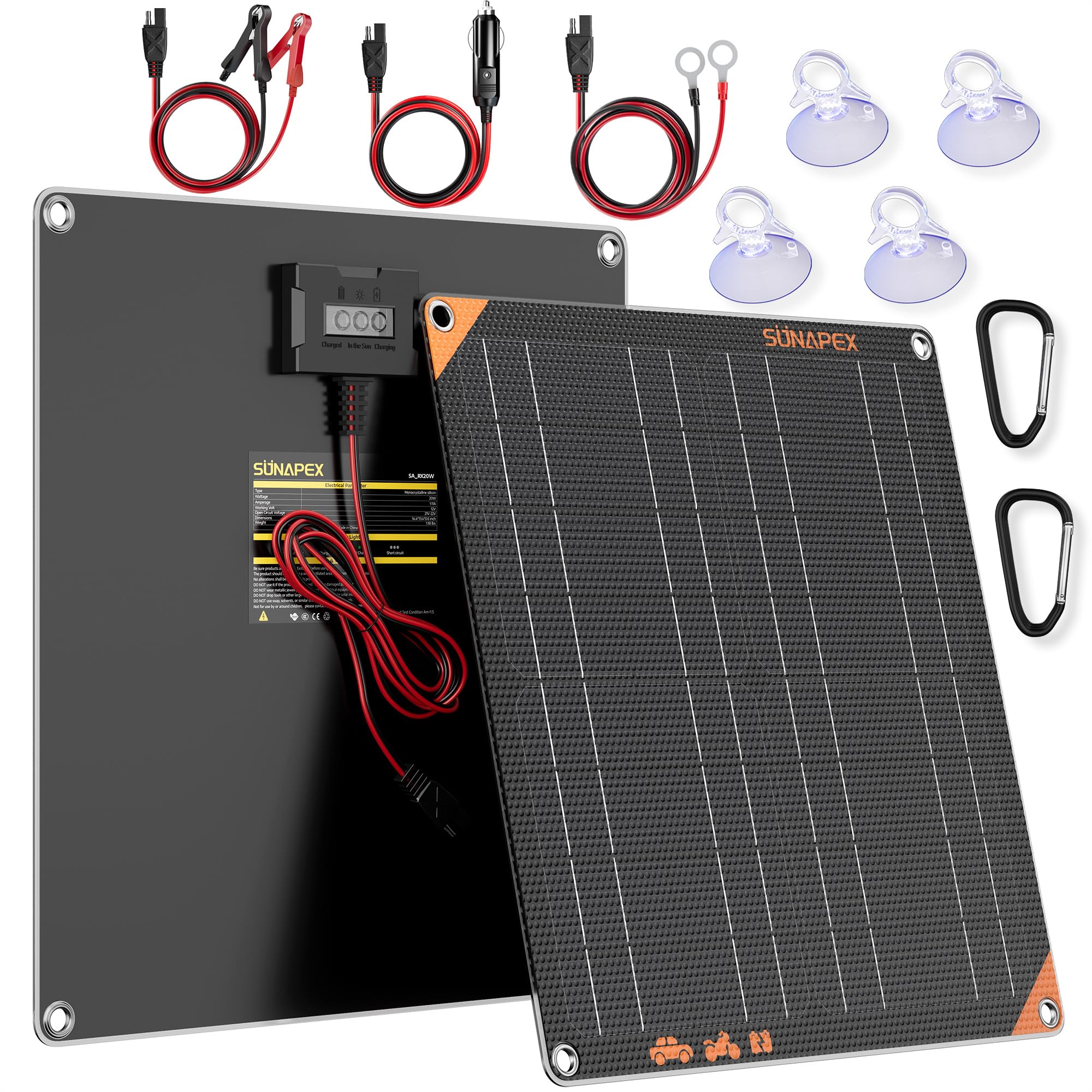
3. SUNAPEX 20W 12V Solar Car Battery Trickle Charger
A fully sealed 20W panel that shrugs off rain, snow, and harsh weather.
Performance is the standout here — over 100 owners single it out — and the 1.11 amp capacity handles everything from a commuter car to a camper van battery. The secret is its IP67 waterproof rating, which means it is fully sealed against dust and can sit in heavy rain without issue. An RV owner mentioned it keeps their chassis battery topped off during boondocking, attaching to the windshield with four suction cups and a lead running under the hood. Another owner left their vehicle unused through a cold winter and reported it started with no hesitation. The three LED indicators — blue for sun detected, red for charging, green for full — give you real-time feedback without guessing.
The panel uses premium monocrystalline cells and an ETFE surface coating (a tough fluoropolymer) that resists UV damage better than standard plastic. The built-in smart controller manages the full charging cycle automatically, stopping when full and resuming when voltage drops. Like many flexible panels, it gets quite hot in direct sun, and owners recommend disconnecting it before starting the engine to protect the controller. It also won’t recover a deeply discharged battery overnight — it is tune for keeping a healthy battery alive, not jump-starting a stone-dead one. For the wattage, sealing, and owner satisfaction, this is one of the strongest mid-range picks you can buy.
The core strength: IP67 sealing makes it a true all-weather panel — rain or shine, it keeps charging without a cover.
One honest note: panels that need to recover a dead battery from below a certain voltage will find this one won’t; it is a maintainer first.
Best for: anyone parking a vehicle outdoors in all weather — this panel lives on the dash and handles heat, cold, and moisture without complaint.
Consider the FlexSolar instead if: you absolutely need an OBDII connector for a modern car’s diagnostic port.
4. Sun Energise 20W 12V Solar Battery Charger

A rigid, tempered-glass panel with a true MPPT controller for maximum sun harvest.
Where most dashboard solar chargers use flexible plastic, the Sun Energise goes the other way: a rigid frame with A+ mono solar cells under strong tempered glass, rated for 2400 Pa wind pressure and 5400 Pa snow load. That is serious overkill for a windshield, but perfect for mounting on an RV roof, pontoon boat railing, or shed. One owner mounted it on a pontoon railing to charge three deep-cycle batteries, running 12-plus hours of stereo use daily, and reported it kept everything charged for over two years through rain and snow. Another used it to prevent their Ford Transit RV battery from deep sleep, maintaining 12.6V over eight days in winter inside the windshield.
The MPPT (Maximum Power Point Tracking) controller is the real story here — it delivers up to 99% tracking efficiency and 98% peak conversion, which means you get more usable power from the same sunlight, especially on cloudy days. The three-stage charging algorithm (Bulk, Absorption, Float) safely brings a battery up to full and holds it there without cooking the cells. It works with AGM, gel, flooded, and LiFePO4 lithium batteries. The honest caveat: if a battery drops below about 9V, the controller flashes a green light and stops charging — it will not recover a completely dead battery. A few owners also noted the panel can warp on a hot dash within a week, so this one is best used for outdoor or semi-permanent mounting rather than daily dashboard use.
The reason to buy it: a true MPPT controller at 20W is rare at this build quality — you get near-panel-rated power even on hazy days.
Watch for: it is a rigid glass panel designed for outdoor mounting, not bending into a curved windshield — mount it flat on a railing, roof, or deck.
Reach for this if: you need a permanent outdoor solar maintainer for an RV, boat, or off-grid battery bank and want MPPT efficiency in a weatherproof glass package.
Skip if: you need a flexible panel that tucks against a curved windshield — the FlexSolar or SUNAPEX panels are better for dashboard use.
5. OYMSAE 30W 12V Solar Trickle Charger

The 30W powerhouse that keeps even dual-battery trucks ready to crank.
For vehicles with heavy parasitic draws — think a Dodge Ram with an aftermarket alarm and dual Odyssey AGM batteries — a standard 10W panel won’t cut it, especially in winter. This OYMSAE panel delivers 30W of monocrystalline power. One owner who runs a 2015 Ram Dually reported that a single unit maintains summer voltage at 12.2-12.4V, and two panels wired in parallel with a splitter keep it at 12.2V even when snow covers the windows. That is enough power that you can stop running your vehicle weekly just to keep the battery alive. The panel uses ETFE (a tough fluoropolymer film) with 95% light transmittance and a 22% conversion rate, so it pulls solid charge even on overcast days.
The built-in smart controller blocks overcharging during full sun and prevents reverse discharge at night — the blue/red/green LED indicators let you see status at a glance. The included SAE cables give you a cigarette lighter plug and alligator clips, making it plug-and-play for most vehicles. The company backs it with a 2-year manufacturer warranty, which is better than the typical one-year. One owner in Florida noted the panel can get hot enough to melt into a dash in direct summer heat; a simple folded piece of thick paper underneath solved the problem. If you have a large vehicle, a boat, or a tractor that sits idle for weeks, the extra wattage means you never find a dead battery on a cold morning.
What You Get
- 30W output handles heavy parasitic loads and dual battery banks
- ETFE coating and 22% efficiency means good performance in low light
- 2-year warranty is longer than most competitors
- Compact enough for dashboard or windshield mounting
Keep in Mind
- Panel can get very hot on a dark dashboard in direct summer sun
- A single unit may be borderline for winter on large diesel trucks
Who this is for: owners of large vehicles, boats, or equipment with high parasitic drain who need more sun power than a 10W or 15W panel can deliver.
Who might look elsewhere: anyone on a tight budget who only needs light maintenance for a single small car battery — a 20W panel is plenty.
6. POWOXI 15W 12V Solar Car Battery Charger with MPPT
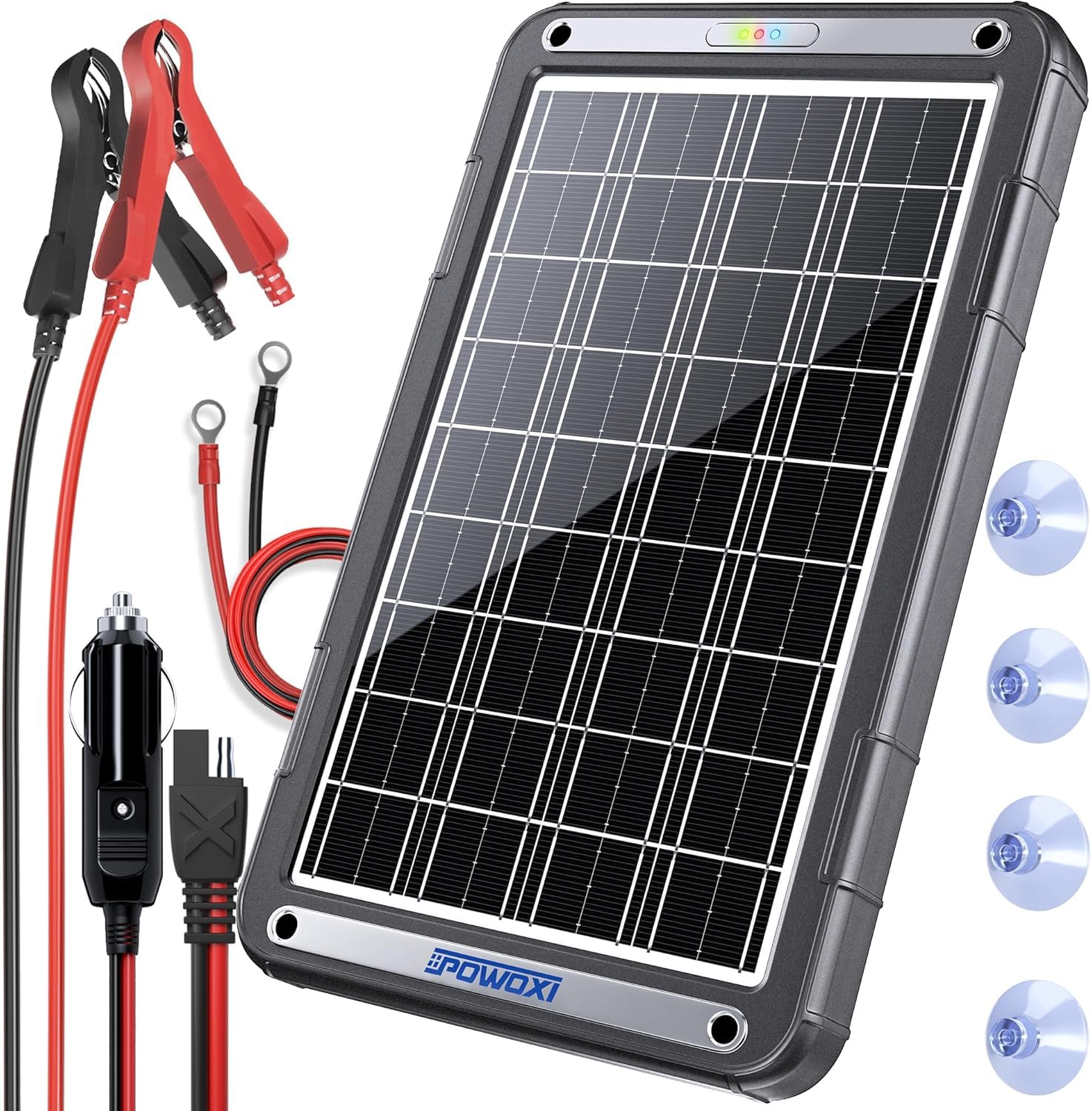
A compact, rigid panel with a genuine MPPT controller that tracks the sun for maximum power.
At 15W, this panel sits between the 10W entry-level units and the 20W powerhouses, but the MPPT controller makes it punch above its wattage. The POWOXI uses Maximum Power Point Tracking to dynamically adjust to changing sunlight — on a cloudy day, it pulls noticeably more power than a standard PWM controller at the same wattage. The panel is built with a PC+ABS frame and tempered glass, rated IP65 waterproof, meaning it can handle heavy rain and temperatures from -40°C to 137°C. Reliability is the most-praised aspect among owners (over 55 mention it), and the easy installation gets consistent praise. One owner mounted it on their bedroom window glass and reported it worked exactly as advertised, keeping a battery topped off without any fuss.
The package includes both battery clamps and a 12V power socket adapter, so you can use it on a windshield or wire it directly. The three LED lights (blue for sun, red for charging, green for full) update every two seconds as the MPPT recalculates. The honest downside is that some owners received units with incorrect polarity on the wiring — black and red wires reversed — which made them non-functional from the start. That appears to be a batch issue, but it is worth checking polarity with a multimeter before full installation. For a compact, weatherproof panel that boost every photon, this is a smart pick for cars and small RVs.
The standout feature: a real MPPT controller in a panel gives you near-99% tracking efficiency, outperforming PWM units in anything less than perfect noon sun.
One honest check: verify the wire polarity before permanent mounting — a small batch had reversed colors.
Ideal for: someone who wants MPPT efficiency without paying -plus and needs a weatherproof, rigid panel for a car, boat, or small camper.
Better options exist if: you need more than 15W for a large RV or dual-battery setup — step up to the OYMSAE 30W or Sun Energise 20W.
7. Renogy 10W Solar Trickle Charger Portable Battery Maintainer

The tireless little panel that thousands of owners trust for seasonal battery care.
Renogy is the most recognizable name in solar hardware, and this 10W portable maintainer is the entry-level workhorse. It comes with three connection options — ring terminals, alligator clips, and a cigarette lighter plug — all on a quick-disconnect SAE plug. Buyers report it keeps car and tractor batteries charged even in Colorado’s extreme cold, high UV, and snow, with the suction cups and straps making it easy to install on a windshield or dash. The monocrystalline cells are laminated with multi-layered sheets that enhance performance and long service life, and the panel weighs just 14.23 ounces, making it genuinely portable between vehicles.
The honest feedback is that the included cables are the weak point. The alligator clip cable is only five feet long, which may not reach the engine bay on some vehicles, and the cigarette lighter adapter only works if your outlet is not ignition-switched. Owners also note this is strictly a maintainer — it raises a battery by roughly 0.1V per day, so it cannot fully recharge a deeply discharged battery. Several owners mention units that failed to hold a charge, though the 1-year manufacturer warranty covers defects. For the price, this is the most-tested, most-reviewed budget panel on the market, and if you have a simple car or tractor battery to keep alive, it does the job thousands of times over.
Why Thousands of Owners Pick It
- Proven monocrystalline efficiency in a lightweight 14.23 oz package
- Quick-disconnect SAE plug with three adapters works on most vehicles
- Renogy brand has the most extensive owner feedback — you know what you are getting
Where It Shows Its Budget Roots
- Short 5-foot alligator clip cable may not reach the battery in larger engine bays
- Cigarette lighter outlet must be constant-on, not ignition-switched
- Too low-power to recover a deeply discharged battery from flat
Best for: anyone who needs a cheap, proven, lightweight panel for maintaining a single car or tractor battery through storage seasons.
Upgrade if: your battery has a heavy drain, your engine bay is large, or you need to recover a dead battery — the 20W panels above are worth the extra money.
8. Sunway Solar 8W Car Battery Trickle Charger

The ultra-simple, no-app, no-hassle plug-in panel for lawn tractors and weekend cars.
At 8W, this is the smallest panel on the list, and it is designed for one job: keeping a battery from dying when a vehicle sits. It is built with an ABS plastic housing and tempered glass, so it is more durable than thin flexible panels but heavier at 2.7 pounds. The cigarette lighter plug is the primary connection — you mount the panel on the dash or windshield with the four included suction cups, plug it into your 12V port, and the built-in diode prevents reverse charging at night. Customers note it works well for older cars and trucks parked in driveways that get daily sun, and it keeps lawn tractor batteries ready through the off-season. The package includes both a lighter adapter and alligator battery terminal clamps for direct battery connection.
The honest limitation: there is no charging indicator light on this model, so you cannot quickly tell if it is actively charging or if the sun is too weak. Several owners noted that the lack of any LED status light was a minor frustration, though the panel itself works. It is also important to know that an 8W panel is only suitable for small parasitic loads — a clock, an alarm, an ECU. If you have a large battery bank or a vehicle with heavy draw, you need more wattage. For a simple, cheap, reliable way to keep a lawn mower, trailer, or weekend car battery alive, this is as simple as it gets.
The simplicity point: no controller programming, no Bluetooth app, no fuses to wire — just suction cups to the glass and plug into the lighter port.
The missing piece: no LED indicator means you cannot confirm charging activity; you rely on the battery holding voltage.
Grab this for: a lawn tractor, utility trailer, or winter-stored car with minimal parasitic drain — it is the easiest plug-and-maintain system available.
Pass if: your vehicle has a security system, telematics, or high parasitic draw — it needs the extra power of a 20W or 30W panel.
9. Topsolar 100W 12V Solar Panel Kit

A full 100W off-grid starter kit that can actually recharge batteries, not just maintain them.
This is a different category from the trickle chargers above. The Topsolar kit includes a 100W monocrystalline panel, a 30A intelligent charge controller, two 16-foot MC4 cables, two 5-foot battery cables, and V-shape mounting brackets — everything you need to set up a permanent solar charging station for a cabin, RV, shed, or boat. The panel outputs 23 volts (open circuit) and 4.5 amps, which is enough to actually recharge a deeply discharged 12V battery in reasonable daylight, not just maintain a topped-off one. One owner reported it charged their Class A motorhome engine battery in about four hours. Another wired two in parallel to charge the batteries on several tractors and buggies, calling it reliable.
The 30A charge controller handles 12V or 24V systems automatically (though some owners found switching from 24V to 12V mode tricky — the auto-detect works best if you connect the battery first, then the panel). The panel itself is 46.5″ x 21.8″ and weighs 15.84 pounds with a heavy-duty anodized aluminum frame and tempered glass, so it is built for permanent outdoor mounting. Performance is the most praised aspect, followed by battery life and quality. The honest trade-offs: the included mounting brackets may not have bolt holes that perfectly line up with every surface (owners simply drilled through the aluminum frame), and the instructions are minimal. For a true off-grid setup or a large RV bank, this kit delivers serious solar power at a fraction of the cost of premium brands.
What Makes This Different
- Real 100W output can recharge a battery from flat, not just maintain a full one
- Full kit with controller, cables, and brackets — no extra parts needed
- 30A charge controller works with 12V and 24V battery banks
- Aluminum frame and tempered glass handle snow loads and extreme weather
What to Expect
- Mounting holes may not align perfectly; expect to drill one or two
- Instructions are basic — you will need some DIY expertise for best results
- Large panel (46.5″) requires significant space for mounting
Who it serves: off-grid enthusiasts, RV owners, and cabin operators who need a full solar charging system to keep deep-cycle batteries alive without shore power.
Not the right pick if: you just want a simple dashboard maintainer for a car — stick with the 10W to 20W panels above; this kit is designed for permanent installation.
Understanding the Specs
MPPT vs. PWM Charge Controllers
The charge controller is the brain that stops your battery from overcharging. PWM (Pulse Width Modulation) controllers are simpler and cheaper — they essentially connect and disconnect the solar panel to hold a target voltage. MPPT (Maximum Power Point Tracking) controllers are smarter: they constantly adjust the electrical load to pull the maximum available power from the panel, especially in low light or partial shade. An MPPT can deliver up to 99% tracking efficiency, meaning you get close to the panel’s full rated power even when the sun is not overhead. For a small maintainer, PWM is fine. For maximum performance from a small panel, MPPT is worth the extra cost.
Watts, Amps, and 12V Compatibility
Wattage (W) is the total power the panel can produce in full sun. Amps (A) tell you the charging current. For a 12V battery, the relationship is simple: Watts ÷ 12V = Amps. So a 20W panel delivers about 1.67 amps, while a 10W panel delivers about 0.83 amps. For basic maintenance — keeping a battery topped off against parasitic drain — 10W (0.83A) is usually enough. For a battery that also powers lights or accessories, 20W (1.67A) or higher is better. The key is that the panel’s nominal voltage (12V) matches your battery; these panels can output higher voltage (up to 23V open circuit), but the controller regulates it down to safe charging levels.
FAQ
Can a 12 volt solar battery charger fully recharge a dead battery?
How do I know if the charger is working?
Will a solar charger work through a windshield or window glass?
What is the difference between a trickle charger and a maintainer?
Can I use a 12V solar charger on a lithium (LiFePO4) battery?
How long does a solar trickle charger take to charge a battery?
Will the solar charger drain my battery at night?
Can I connect multiple solar panels together?
What does IP65 and IP67 waterproof rating mean?
Is a cigarette lighter plug or direct battery connection better?
Final Thoughts: The Verdict
If you want one dependable pick, the 12 volt solar battery charger winner is the FlexSolar 20W because its coin-thin profile, OBDII connector, and four charging cables make it the most versatile and simple to use panel for cars, trucks, boats, and RVs — it simply works from the start. If you need a fully sealed panel that handles rain and snow without worry, the SUNAPEX 20W with its IP67 waterproofing and strong owner satisfaction (performance praised by over 100 owners) is your best mid-range value. And for anyone building a true off-grid system or needing to fully recharge deep-cycle batteries, the Topsolar 100W Kit delivers real power with its 30A controller and full mounting kit — a proper solar system for a fraction of traditional brand prices.
How We Picked
We do not accept paid placement. Every pick is matched to a real buyer and a real use-case; we do not hands-on test units.
Sources & Methodology
Specifications: manufacturer listings and product documentation. Review insights: verified customer reviews, as of July 2026. Pricing: not shown on this page (it changes often); check the current price via the retailer link.
As an Amazon Associate, KitchPrep earns from qualifying purchases. This does not affect which products we feature.
Related Guides
