
Specs are compiled from manufacturer listings and verified buyer reviews and can change over time — please confirm the key details on the product page before buying.
If your current battery dies halfway through a fishing trip or one night of boondocking, you are ready for a lithium upgrade. Before you pick a brand, you need to settle two things: which size fits your tray (Group 24 vs Group 31) and if you want Bluetooth monitoring or a rugged trolling-motor case. A modern LiFePO4 battery delivers roughly twice the usable energy of lead-acid at a fraction of the weight, so you can carry more gear and run longer without the sag.
I’m Mohammad Maruf — the founder and writer behind KitchPrep. This guide is built by comparing the manufacturers’ published specifications and the patterns across verified customer reviews, so you get each pick’s real strengths and trade-offs instead of marketing spin.
Here is the distilled truth about the 12 volt lithium battery 100ah landscape, from the most-reviewed trolling motor workhorse to the new compact Bluetooth models that fit where lead-acid never could.
Our Picks at a Glance


How To Choose The Best 12 Volt Lithium Battery 100Ah
Buying a 100Ah lithium battery is a durable-goods decision — you will likely keep it for a decade. The key is separating the marketing wattage from what actually affects your daily use, starting with how you plan to drain it.
Understand the Physical Size: Group 24 vs Group 31
The “Group” number tells you the standard size that fits your battery box. Group 24 is more compact and lighter, so it often slips into a spot made for a smaller lead-acid battery — a common fit for RVs and camper vans with tight spaces. Group 31 is larger and heavier, usually delivering higher capacity in a box that matches older, bigger trolling motor batteries. Measure your battery tray before buying: a Group 31 battery will not fit a Group 24 box without modification, though a Group 24 battery can often drop into a larger Group 31 or 27 tray with a spacer.
Look For The BMS Specs, Not Just The Chemistry
Every 100Ah lithium battery has a Battery Management System (BMS) — the internal circuit board that protects the cells. The rating you care about is the continuous discharge, usually stamped as “100A BMS.” A 100A continuous rating means it can deliver about 1,280 watts (12.8V × 100A = 1,280W), enough to run a 1,000W inverter or a large trolling motor. Check for low-temperature protection, which stops charging at freezing temperatures to prevent permanent cell damage in winter.
Weigh Your Need For Bluetooth And Monitoring
A Bluetooth-equipped battery lets you check voltage, current, and remaining capacity on your phone, taking the guesswork out of estimating runtime on a long day. It is a genuinely useful feature when you are running a fridge or a trolling motor and want a precise percentage. If you do not want an app or extra electronics to fail, a non-Bluetooth battery is simpler, but you are fine reading a voltage meter. Also, be sure to confirm the exact amp-hour capacity you need — 100Ah works for many, but heavy users often step up.
Quick Comparison
| Model | Best For | Weight | Physical Size | Bluetooth | Amazon |
|---|---|---|---|---|---|
| Litime Trolling Motor★ Best Overall | Marine/Rough Water | 22.1 lbs | Group 31 | No | Amazon |
| MARSENERGY Group 24Best Value | RV Upgrade & Value | 21 lbs | Group 24 | Yes | Amazon |
| WattCycle MiniTech Smart | Compact Bulk Power | 20.94 lbs | 9 x 5.4 x 8.2 in | Yes | Amazon |
| ECO-WORTHY Group 24 | Solar & Off-Grid | 23.2 lbs | Group 24 | Yes | Amazon |
| Renogy Core Mini | Tight Spaces | 22.7 lbs | Group 22NF | Optional | Amazon |
| Power Queen Group 31 | Trolling Motors | 24.3 lbs | Group 31 | No | Amazon |
| Redodo Group 31 | High-Cycle Life | 22 lbs | Group 31 | No | Amazon |
| Litime Group 24 BT | RV & App Monitoring | 21.9 lbs | Group 24 | Yes | Amazon |
In‑Depth Reviews
1. Litime 12V 100Ah Trolling Motor LiFePO4 Battery
Our pick — over 4.5★ from 550+ verified ratings; the strongest balance of quality and price.
The marine workhorse with triple-layered protection for salt spray, rough water, and voltage spikes.
This battery was engineered around the trolling motor, which shows in the protection details. It carries triple-layer safeguards against dust, water, and salt spray, plus a built-in TVS (a small component that absorbs voltage spikes) to shield 12V-36V motors from damage in choppy conditions. That marine focus also brings the ABYC E-13 standard (a safety guideline for DC electrical systems on boats), so it is a sensible pick if your battery lives in a wet, vibrating bilge area.
You will feel the weight difference the moment you lift it. At 22.16 lbs in a standard Group 31 footprint, it is 64% lighter than a 12V 100Ah lead-acid battery of similar capacity — buyers report that cutting that much weight off the transom noticeably improves how a boat handles. The smart low-temp protection stops charging below 32°F and stops discharge below -4°F, so the cells stay safe in cold weather.
Owners have pushed this battery hard, with one reporting 14 days of use on a 200W solar setup during smoke and low-sun conditions without needing a generator. It lasts through 3-plus fishing trips without a charge, and the company’s support desk answers in 1-2 days. The maker claims a 10-year life (4000+ cycles at full 100% discharge depth), assuming steady, correct use.
Why It Earns Top Billing
- Ultra-light 22.16 lbs in a full Group 31 size — the single biggest handling upgrade a fisherman can make
- Hardened for wet, shaking marine environments, unlike general-purpose batteries
- Owners mention multi-day fridge and trolling runtime, some pushing weeks off-grid
The Real-World Catch
- No Bluetooth — you monitor voltage with a meter or app-free shunt
- It is for storage and trolling, not starting engines or golf carts — the maker says so plainly
Ideal mount: A boat, RV, or off-grid solar bank where marine-rated toughness matters most — and you are happy to check power via voltage rather than an app.
The trade-off: Skipping phone monitoring means you lose that instant state-of-charge percentage widget on your dash; you will rely on a simple voltage test.
2. MARSENERGY 12V 100Ah Lifepo4 Battery, Bci Group 24 Size
A featherweight 21 lb Group 24 that drops into your old lead-acid box and runs all day on half a charge.
If your RV or boat already has a Group 24 battery box, this is the battery that swaps in with zero wiring changes. It measures 10.16 x 8.46 x 6.54 inches to match the BCI (Battery Council International) Group 24 standard, and at just 21 lb it is dramatically lighter than the lead-acid block you are pulling out. Owners have noted it shaving real weight off their trailer’s tongue, where every pound matters for towing stability.
The power math works in your favor because of the 100% depth of discharge. Owners happily report a full day of use and still having half a charge left — the phrase “lasted all day only used half a charge” comes up repeatedly in review data. This is the core advantage over lead-acid, which typically only lets you safely use about 50% of its rated capacity before damage occurs.
The chemistry here uses A-grade cells with additional low-temp additives, allowing the cells to technically function at -40°F, though the BMS cuts discharge at -4°F and charging at 32°F to preserve life. It comes with a 5-year after-sales service commitment, a longer safety net than many competitors offer.
The upgrade math: You get 4X the usable capacity of the lead-acid battery in the same box and a massive weight cut. If your wallet is on fire and you need one do-it-all battery that fits an existing standard tray, this is the smartest dollar spent.
A wiring note: Buyers found it pays to fully charge and balance the battery before install, and to use terminal blocks if you are connecting multiple units in parallel.
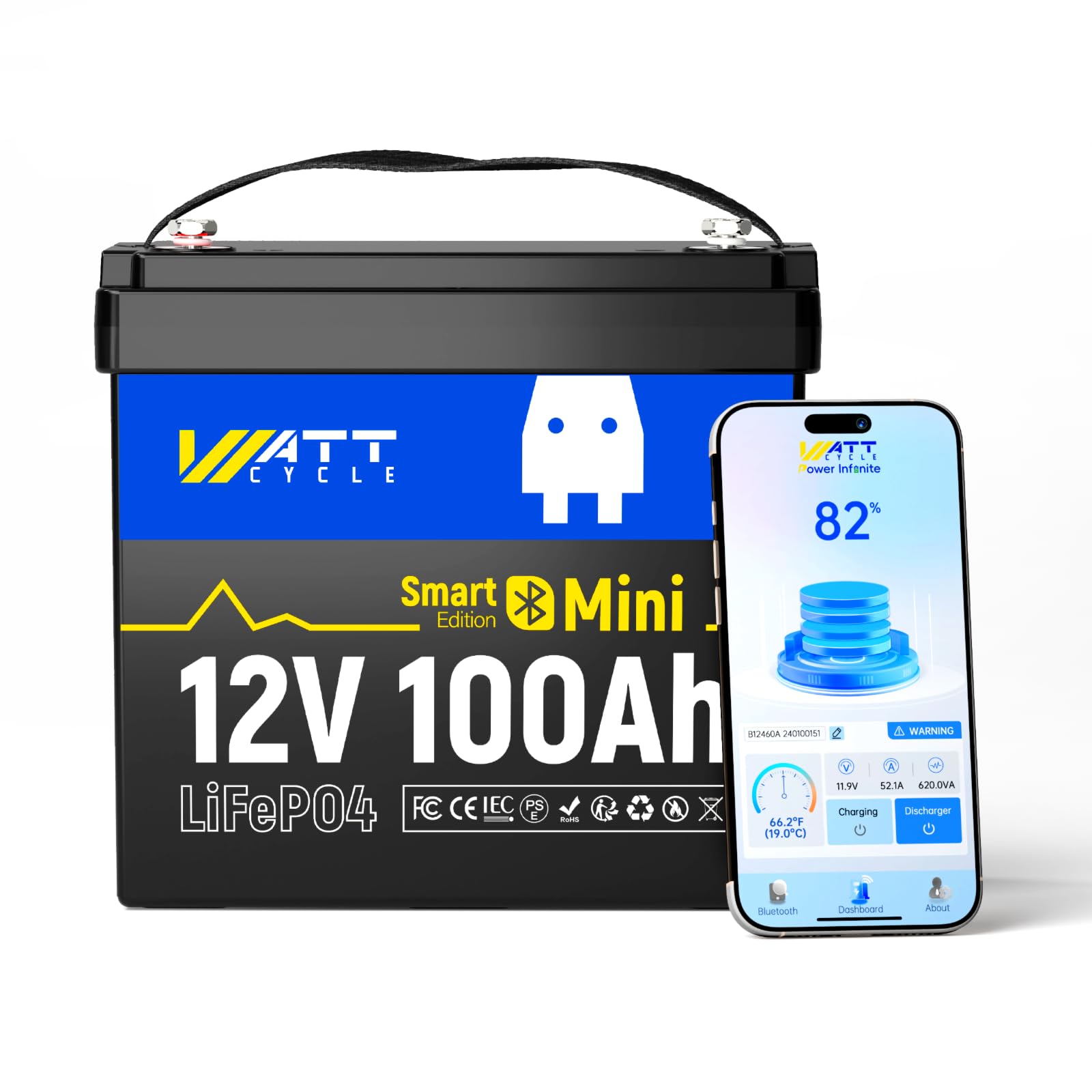
3. WattCycle 12V 100Ah Mini LiFePO4 Battery with Bluetooth
A compact lithium cell that crams large capacity into a space 39% smaller than its predecessor.
This is the battery that fits where others physically cannot. It weighs just 20.94 lbs and measures 9 x 5.4 x 8.2 inches, a 39% volume reduction over the first generation that makes it a favorite for kayaks, small sailboats, and pop-up campers. Customers note it feels like one-third the weight of the lead-acid unit it replaces, making manual lifts out of tight compartments genuinely easy. It also delivers a solid 13-volt output under load in owner reports.
The phone app is the key differentiator — you download the WattCycle app, name your battery, and read live voltage, charging and discharging current, temperature, and alarm prompts. That live telemetry takes the guesswork out of a long day on the water. The internal EV-grade A+ cells are rated for up to 15,000 cycles and a 10-year lifespan, with a 100A BMS managing overcharge, deep discharge, and short circuits.
What wins people over is the outright quality of the cells — it is the single most-discussed trait in the data by a wide margin. Owners note it delivers more than its rated capacity in practice, running a 2kW inverter with a fridge, TV, and microwave without complaint. The warranty support gets strong marks too, with responsive service that replaced units quickly and professionally.
Everything To Like
- Pocket-friendly size opens up install spots other 100Ah batteries can’t reach
- Bluetooth app shows live voltage, current, and temperature in real time
- High praise for the cell quality and the 5-year assurance behind it
It Pays To Read This
- As a newer brand, long-term reliability does not have the years of proof behind it that older rivals can show
- A few owners note that after a very cold shutdown, the BMS needed the temperature to climb back to around 58°F before it would restart
Reach for it if: You are fitting power into a compact boat, teardrop camper, or cargo van where physical inches are the limiting factor.
Keep looking if: You regularly charge in sustained sub-freezing weather without a heated space — the low-temp cutout is protective but can be an annoyance in deep winter.
4. ECO-WORTHY 12V 100AH LiFePO4 Lithium Battery with Bluetooth

A solar-system specialist with phone-based telemetry that tells you when it is truly time to charge.
This is the battery to choose when your setup is built around solar and you want the app to be your dashboard. It uses Bluetooth 5.1 (a modern, power-efficient wireless version) to relay voltage, current, and capacity straight to your phone, along with an estimate of your remaining working time. For an off-grid cabin or an RV running on panels, that estimate removes the anxiety of wondering whether you will make it to morning. Owners love watching the state of charge and the time-to-empty numbers.
The cells are automotive-grade lithium iron phosphate, and the battery is the UL and IEC tested, CE and RoHS certified option on this list — a meaningful safety marker if that matters to you. Its low-temp cutoff stops charging when the cells drop below 19.4°F, protecting the battery through a cold winter. A smart detail is its support for a 4P2S configuration, letting you scale up from 1.28kWh to a max of 10.24kWh as your energy needs grow.
Buyers praise how it holds a charge for weeks at 100%, making it a favorite for seasonal use. It runs serious loads — an 80A leaf shredder draws on it fine, and it met capacity specs in owner capacity tests, delivering roughly 90-98% of rated energy through an inverter. The happy downside is a wait: some reviewers point out 3-week delivery windows.
The Strong Suit
- Bluetooth 5.1 telemetry with live voltage, current, and remaining life estimates
- Certified cells and a 100A BMS that guards against all the usual failure modes
- Retains a 100% charge for weeks in storage, ideal for seasonal cabins
Weigh This
- Heavier than competitors at 23.2 lbs, with a slightly larger footprint
- Slow shipping on some orders — plan ahead if you need it soon
- Bluetooth is not for everyone; some wish it was optional to trim cost
Best home: A solar-powered trailer, cabin, or golf cart bank where app-based monitoring and certified cells are your priority.
Consider alternatives if: You need the absolute lightest unit for a hand-carry setup, or you need it delivered within days, not weeks.
5. Renogy 12V 100Ah LiFePO4 Lithium Battery Mini Size, Core Series
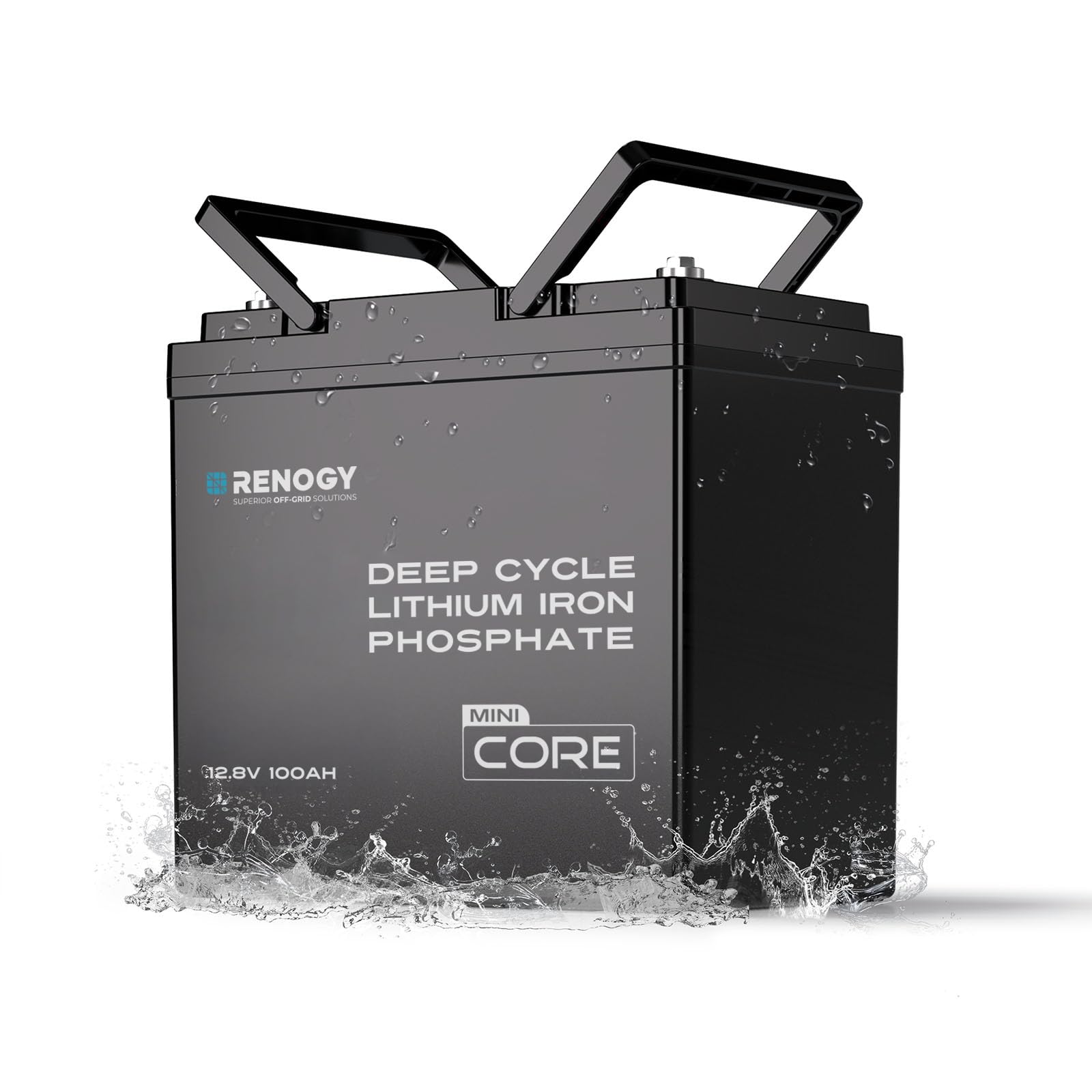
From the solar giant: a mini lithium cell that is 13% smaller than other modern 100Ah packs.
Renogy is a heavyweight in solar and off-grid gear, and this Core Mini packs that engineering into a very small footprint. At just 9.02 x 5.43 x 8.39 inches — up to 50% smaller than a standard Group 31 battery — it fits teardrop trailers, kayaks, or any compartment where a full-size battery will not slide in. The 22.7 lb weight is easy to carry one-handed.
What distinguishes this pick is its optional remote monitoring. While the battery does not have built-in Bluetooth, you can pair it with a Renogy 300A Battery Shunt (sold separately) to track it through the DC Home app or the Renogy ONE monitor. For anyone who already runs Renogy solar gear, this is plug-and-play convenience that fits an existing ecosystem — this battery talks to your other Renogy components instead of requiring a separate app.
The safety engineering is thoughtful. The 100A BMS blocks low-temperature charging, high temperature, overvoltage, undervoltage, overcurrent, and short circuits. Metallic cell spacers hold the UL-listed EV-grade cells in place on rough roads, and the IP65-rated casing shrugs off splashes and dust. Owners running a 200W solar panel with Renogy’s controller describe a near plug-and-play experience and rapid charging.
The verdict: If you own Renogy solar panels or a Renogy monitor, this is the battery that slots into your setup with zero friction — it reports over-charge alerts directly to your phone through the existing Renogy app.
Who it skips: Anyone wanting out-of-the-box Bluetooth monitoring without buying optional add-on hardware will want to look at the all-in-one models with an app built in.
6. Power Queen 12V 100Ah Group 31 LiFePO4 Lithium Battery
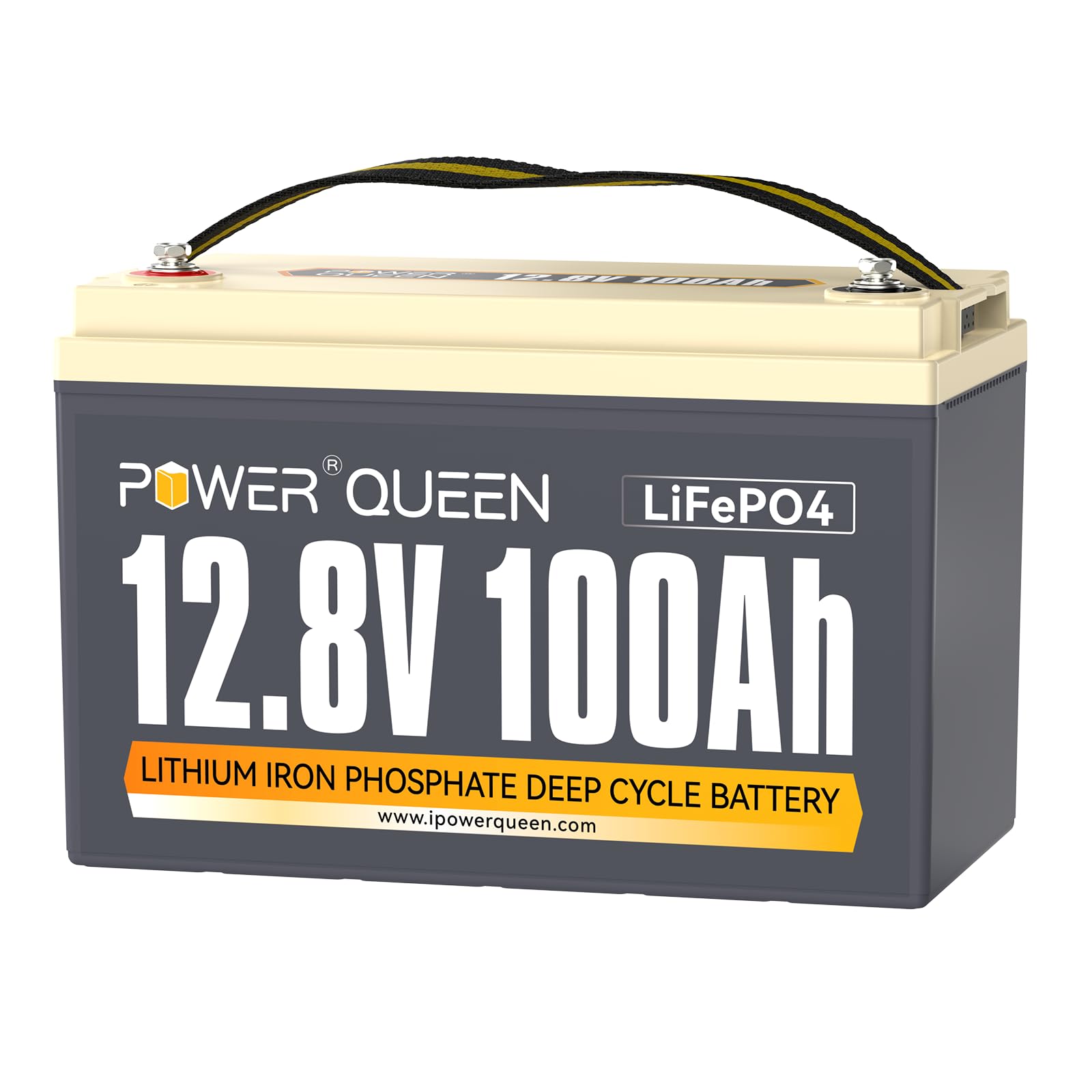
A proven Group 31 troller known for relentless all-day runtime that flattens thick grass at max speed.
Power Queen has earned a following among serious anglers, and this Group 31 battery is why. It is sized at 24.3 lbs in the full Group 31 footprint, and owners running 55lb-thrust trolling motors report roughly 6 hours of hard use, charging back up in about 3 hours. It has powered boats for roughly 6 miles over 3 separate trips without needing a charge, with plenty in reserve — and one long-term owner says it is still working great after 1.5 years.
The power delivery is consistent enough that owners describe it as “a nuclear power plant for their shed,” running a 300-watt guitar amp and an 85-watt PA system for a full 6 hours. That stable voltage matters for sensitive electronics like fish finders, which prefer clean power to flickering. Setup is straightforward, and the battery is a clean drop-in for a 30-70 lb trolling motor or home backup role.
It is built on Grade-A lithium iron phosphate cells that hold a low self-discharge rate, so it stays ready between trips. Buyers with arthritis note the Group 31 is easy to lift and position — a real quality-of-life win when you are hefting it out of a boat hull.
The run-time story: The recurring owner experience is remarkably consistent — a 55lb motor runs for hours, recharges in a few hours, and the battery handles thick vegetation without slowing down.
The honest caveat: One owner hit a dead-battery event after 4 days and flagged a fragile M8 terminal bolt — treat mounting hardware gently and you will likely never see the issue.
7. Redodo 12V 100Ah LiFePO4 Battery, Group 31
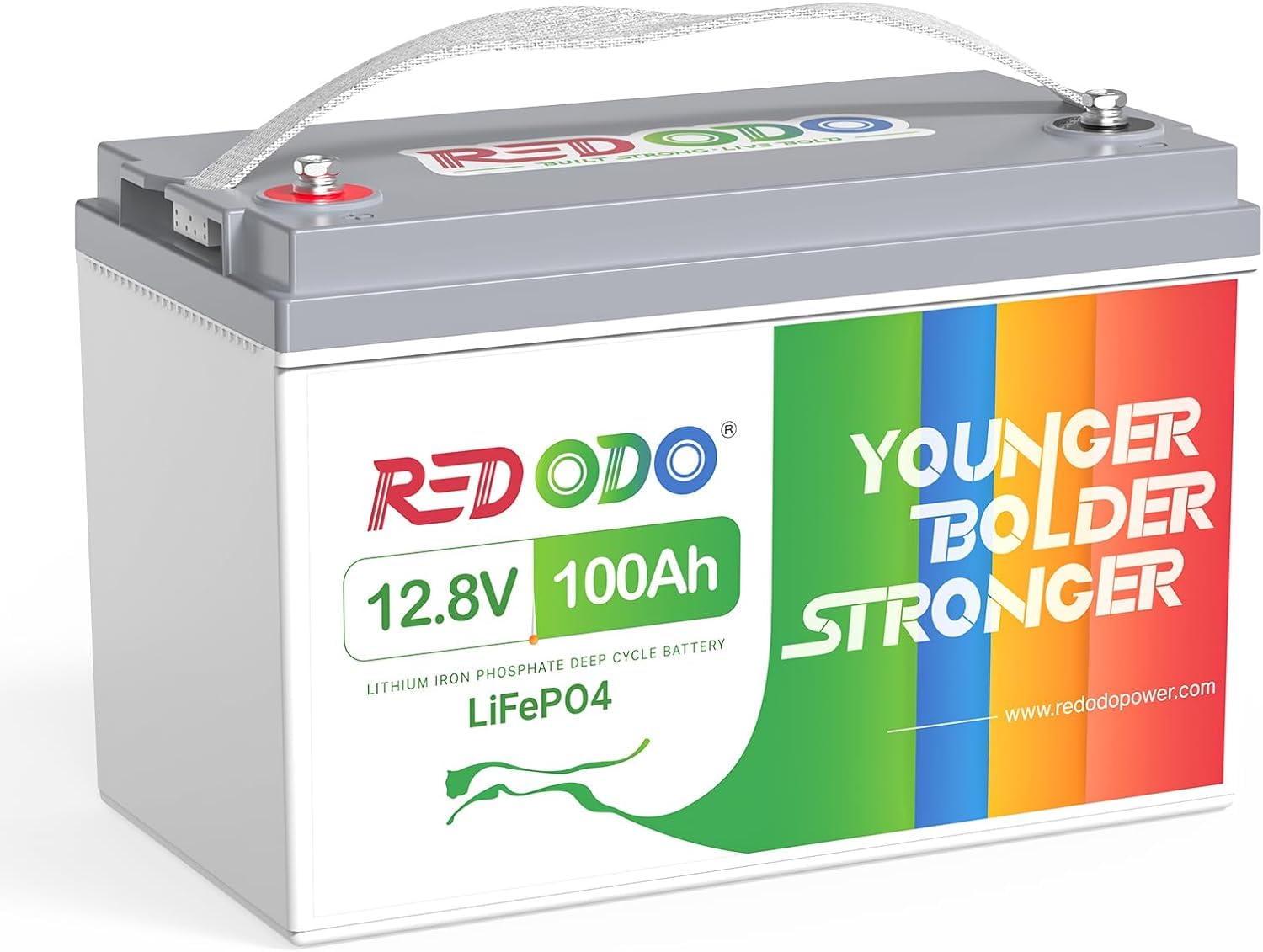
The high-cycle workhorse that held up through years of daily van-life abuse and still demanded a second purchase.
Redodo’s Group 31 battery has the deepest long-term owner stories on this list. One full-time van dweller ran it for a full year on 200W of solar with a 1000W inverter, drawing 40-60Ah daily, and found it actually output 105Ah — 5Ah more than its rated capacity. A pool-maintenance company switched from lead-acid batteries (which they replaced every 3-4 months) to these for their vacuums and got full-day runtime with no mid-day battery swaps. That is real-world proof of the value of deep-cycle longevity.
At 22.04 lbs, it is 60% lighter and 5% smaller than a comparable lead-acid unit, dropping into the standard Group 31 box while removing over 60 lbs from your rig. The spec sheet claims a low 3% self-discharge rate, meaning it holds its charge for months in storage. The 100A BMS provides standard protection against overcharge, over-discharge, over-current, short circuit, and high temperature.
It is not a starter or golf cart battery — the maker recommends it for 30-70 lb thrust trolling motors, RVs, and solar installations. A four-year kayak trolling owner whose battery eventually stopped charging notes the company replaced it under warranty promptly, a signal that the after-sales support is genuinely responsive.
What Owners Prove
- Real-world capacity tests show it often exceeds its 100Ah rating
- Daily solar recharging in about 5 hours of sun keeps van-lifers powered
- Multiple long-term owners bought a second unit after years of flawless service
The Math On Downsides
- At 22.04 lbs it is no longer the featherweight in the category
- No built-in Bluetooth — you need to add a shunt for app monitoring
The pick if: You want a proven, budget-friendly Group 31 that can handle daily deep cycling and comes with warranty service that actually answers the phone.
Not for: Anyone who insists on app-based monitoring without buying extra hardware, or who wants the lightest possible carry.
8. Litime 12V 100Ah LiFePO4 Battery, Group 24 Bluetooth
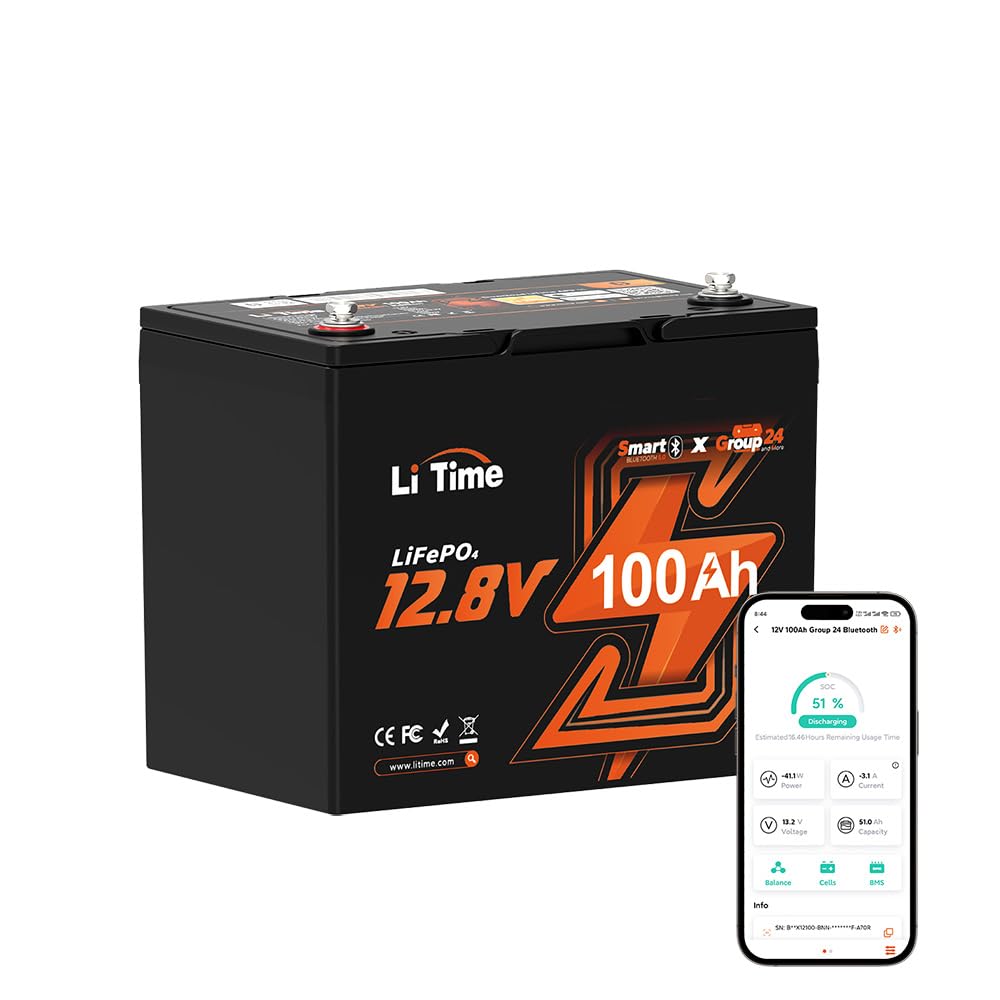
A Bluetooth-enabled Group 24 that pairs with your phone in seconds to show every electron flowing.
Litime’s premium entry takes the brand’s proven reliability and adds the modern convenience of real-time monitoring. The smart Bluetooth 5.0 pairs instantly with the LiTime App via QR code, letting you watch voltage, charge rate, and discharge rate live from your phone. For an angler running fish finders — say, 10 and 12-inch screens plus a Mega Live unit — that live data is a standout. One owner ran that exact setup for up to 11 hours and never dropped below 65%.
It is the drop-in replacement that RV owners love. At 21.9 lbs and 63% lighter than lead-acid, it freed up 130Ah of usable power compared to the two lead-acid units it replaced in a double battery box. The compact Group 24 footprint means it fits perfectly in standard double-box configurations where heavier units physically would not go. A camper owner says it charges to 99% with a stock RV charger and holds roughly 99% between trips thanks to low self-discharge.
The 100A BMS includes over 20 safeguards, including low-temperature cutoff, and the A+ automotive-grade cells are rated for a 10-year lifespan with 4,000+ deep cycles. It comes with a clean 5-year warranty and a 24/7 support line, so you get the most low-maintenance ownership on this list.
The App Advantage
- Live Bluetooth telemetry shows charge and discharge rates without guesswork
- Bluetooth range reaches 50+ feet — check power from inside your tent or cab
- Durable enough to live in a truck bed for 2 years, per owner reports
Small Gripes
- The app can show stale status while charging, needing a reconnect now and then
- At the premium end of the price spectrum, you pay for that monitoring feature
The pick if: You run sensitive electronics — fish finders, fridges, compressors — and want a precise percentage readout instead of guessing from a voltage chart.
Look elsewhere if: You are on a strict budget and do not care about phone monitoring; the non-Bluetooth Litime at position one covers your needs for less.
Understanding the Specs
BMS Discharge Rate — The Real Limit
The BMS (Battery Management System) is the internal computer that keeps the battery alive. The number that matters most is its continuous discharge rating, usually shown as “100A”. A 100A BMS can continuously supply about 1,280 watts, which is plenty for a large trolling motor, a 1000W inverter, or a fridge and TV combo. If you plan to run a 2000W inverter at full tilt, you are pushing the limit of a single 100Ah battery — you would need to confirm the battery’s peak surge rating or step up to a 200Ah model. Overcurrent protection means the BMS will shut things down before the cells are damaged.
Low-Temperature Charging Cutoff — Your Winter Safety Net
Lithium iron phosphate cells can be permanently damaged if you try to charge them below freezing — the lithium plates out on the anode instead of cycling through safely. Every serious battery includes a low-temp cutoff, which simply refuses to accept a charge until the cells warm up, typically to just above 32°F. It is not a bug; it is the battery protecting itself. If your rig sits in freezing conditions while connected to solar, confirm the battery has this circuit. It also means if your battery seems “dead” on a frigid morning, it may just be asleep waiting for warmth, which is a feature, not a failure.
FAQ
Will a 100Ah lithium battery fit in my existing battery box?
How many watts can a 100Ah 12V lithium battery deliver?
Can I use a 100Ah lithium battery to start my boat engine or truck?
Why does my lithium battery lose charge slower than my old lead-acid?
What does Depth of Discharge (DOD) mean and why does 100% matter?
How many charge cycles will a 100Ah LiFePO4 battery last?
Is a Group 24 battery powerful enough for a 55lb trolling motor?
Can I connect multiple 100Ah lithium batteries together for more capacity?
Is Bluetooth monitoring worth paying extra for?
Is LiFePO4 safer than lead-acid for use inside my RV or boat?
Final Thoughts: The Verdict
For most buyers, the clear winner for the 12 volt lithium battery 100ah category is the Litime Trolling Motor battery because it is purpose-built for the harsh marine environment with triple-layer protection and a smarter weight-saving design than the competition. If you want the most affordable way to get a full 100Ah of usable power in a featherweight, drop-in package for your existing RV box, the MARSENERGY Group 24 is the value buy. And if you want phone-based telemetry guiding every drain, the Bluetooth-enabled Litime Group 24 is the premium pick that shows you the exact state of your power in real time. Whichever you choose, you are leaving the heavy, half-capacity lead-acid era behind for something lighter, safer, and dramatically more usable.
How We Picked
We do not accept paid placement. Every pick is matched to a real buyer and a real use-case; we do not hands-on test units.
Sources & Methodology
Specifications: manufacturer listings and product documentation. Review insights: verified customer reviews, as of September 2026. Pricing: not shown on this page (it changes often); check the current price via the retailer link.
As an Amazon Associate, KitchPrep earns from qualifying purchases. This does not affect which products we feature.
Related Guides
