
Specs are compiled from manufacturer listings and verified buyer reviews and can change over time — please confirm the key details on the product page before buying.
If you have ever spent a summer night in a camper van or a semi sleeper, you already know the real problem: the engine has to idle for hours just to keep the bunk livable. A 12 volt air conditioner runs straight off your vehicle’s battery instead, so you can sleep cool with the motor off. The catch is that not every unit labeled “12V” actually fits your roof, your battery bank, or your wiring — and that mismatch is where most buyers get burned.
I’m Mohammad Maruf — the founder and writer behind KitchPrep. This guide is built by comparing the manufacturers’ published specifications and the patterns across verified customer reviews, so you get each pick’s real strengths and trade-offs instead of marketing spin.
Some units here are rooftop drop-ins that fit a standard ceiling vent opening with basic tools. Others are split systems that need refrigerant lines routed through a wall and a technician’s help. That single difference decides most of the picks below. This rundown separates the rooftop bolt-ons from the split systems so you can choose the 12 volt air conditioner that matches your rig and your install skills.
Our Picks at a Glance



How To Choose The Best 12 Volt Air Conditioner
Buying a DC air conditioner is really three separate decisions wearing one label: what fits your roof, what your battery bank can actually feed, and who is going to install it. Get those three right and the rest is detail. Get one wrong and the unit either won’t mount, won’t run through the night, or ends up on a shelf because the wiring defeated you.
Start With The Roof Opening, Not The BTU Number
Rooftop units are built around a ceiling vent hole, and most campers and vans already have one. You need to measure the inside edge of that opening before anything else. Several units here are made to drop into a standard 14×14 inch vent frame, which means the hard part — cutting a hole in a roof that already leaks enough when it rains — is already done for you.
Not every rooftop unit is a direct fit though. One slim model calls for a roof opening no smaller than roughly 12.6 by 10.24 inches, and another asks for an opening somewhere between 12.20 x 6.5 inches and 19.29 x 23.0 inches. Both numbers are in the specs, so measure yours and compare before you order rather than after the box arrives.
Then Match BTU To Your Space And Your Sun
BTU stands for British Thermal Unit, and it is just a way of counting how much heat the unit can pull out of the air. A bigger number cools a bigger space, but it also pulls more current from your battery. A 10,000 BTU rooftop unit is a common fit for a van or small trailer, while a 9,000 BTU split system can be enough for a truck cab that you only need cool at night.
The honest variable here is insulation and sun. A well-shaded van at night is a very different job from a metal box baking in direct afternoon sun. Someone running a 10,000 BTU roof unit in Florida summed it up well: night cooling is easy, and daytime direct sun just takes longer.
Finally, Do The Amp Math On Your Battery
Every 12V unit quotes an operating current, and that number, not the BTU rating, decides whether you sleep cool or wake up to a dead house bank. Look for how many amps the unit pulls in its low-power mode, because that is the figure you will actually live with overnight.
Lithium (LiFePO4) house banks tolerate deep discharge far better than old lead-acid batteries, so a big lithium bank paired with a low-draw unit is the combination that makes all-night cooling realistic. One reviewer noted running a 10,000 BTU unit from 98 degrees down to 80 in 45 minutes on max cool, using only a small slice of a 600Ah battery. That is the kind of real number worth planning around.
One Wiring Warning That Catches People Out
DC air conditioners pull serious current, and the factory wiring in most vehicles is not built for it. One unit here explicitly asks for 4-gauge or larger cable, and another ships with a 100A fuse and 15 feet of 6AWG cable in the box. If a listing does not include the cable, budget for it separately, because undersized wire is the classic reason a new AC cuts out under load.
Quick Comparison
| Model | Best For | Cooling Power | Form Factor | Rated Power / Current | Amazon |
|---|---|---|---|---|---|
| RV Air Conditioner 12V 10000 BTU Rooftop (w/heater)★ Best Overall | Four-season van and camper builds | 10,000 BTU | Portable rooftop | 960 W annual energy | Amazon |
| 12V RV Air Conditioner Split Type 9000 BTUBudget Split Pick | Trucks, excavators, and oddball cabs | 9,000 BTU | Split system | 800 W / 75A start | Amazon |
| Aspligo 9000 BTU 12V Thin RV ACBest Slim Build | Slim roof builds fighting height limits | 9,000 BTU cooling / 4,500 BTU heat | Packaged roof mount | 750 W / 30–62A | Amazon |
| Treeligo 12V Truck Cab AC 12000 BTU | Semi cabs and large vehicles | 10,000 BTU | Mini-split | 960 W / 60–80A | Amazon |
| 12V Truck Cab AC 10000 BTU Split System | Heavy trucks and construction cabs | 10,500 BTU | Split system | 800 W / 60–80A | Amazon |
| Treeligo Universal 12V DC Mini Split 12000 BTU | Wide vehicle compatibility | 9,500 BTU | Mini-split | Up to 12 hrs on 480Ah | Amazon |
| Gidrox 10000 BTU 12V DC Rooftop AC | Quiet overnight van cooling | 10,000 BTU | Rooftop | ~350 W nighttime | Amazon |
| Outequip RV Air Conditioner 12V 10000 BTU | Off-grid parking with a big lithium bank | 10,000 BTU | Rooftop | 960 W annual energy | Amazon |
| ICECOSMOS Ultra-Slim Low-Profile 12V RV AC | Low-clearance and low-draw setups | 10,000 BTU / 4,500 BTU heat | Rooftop | 900 W annual energy | Amazon |
| 12V RV Rooftop Air Conditioner with Heater 10000 BTU | Roof space and solar-friendly layouts | 10,000 BTU | Rooftop | ~650 W max draw | Amazon |
In‑Depth Reviews
1. RV Air Conditioner, 12V 10000 BTU Rooftop Air Conditioner for RVs, Trucks, Vans, Campers, Tractor, Low Profile Quiet AC Unit(w/heater)
Our pick — over 4.5★ from 150+ verified ratings; the strongest balance of quality and price.
Heat pump plus a 4,500 BTU heater in one roof box — the four-season choice for full-time van dwellers.
This is the unit to buy if you camp in shoulder seasons and want both directions of temperature control from a single rooftop box. It delivers 10,000 BTU of cooling plus 4,500 BTU of PTC heating, so one rooftop install covers both a July afternoon and a chilly October morning in a camper van. The maker says that 10,000 BTU cools a typical van-sized space in about 15 minutes, which is the window most people care about after a hot drive.
What wins people over is how quietly it runs and how little it sips. Brushless copper motor fans and spring-supported mounts keep the noise down, and owners running it off a battery bank report draws in the region of 250 watts an hour, enough to run it entirely off battery power for 8-9 hours. It packs three modes — eco, sleep, and turbo — plus a remote and temperature monitoring, so you can nudge the setting without climbing on the roof.
The build is built around weather exposure: UV-stabilized ABS, an EPDM foam gasket, and a zinc-coated condenser, which is the right set of materials for something that lives outside in the sun and rain. It handles low voltage gracefully too, cutting the compressor before it drains your battery flat. The recurring gripe is the factory gasket — one owner had to replace it with a universal kit — so set aside a few minutes to check the seal before you bolt the unit down.
Rooftop 10000 BTU
- Cools and heats from one rooftop unit, with 10,000 BTU cooling and 4,500 BTU PTC heating in mild-to-cool conditions
- Around 250 watts an hour of draw lets a full battery run it through the night
- Quiet operation is the feature buyers talk about most, with brushless copper fans and spring mounts doing the work
Rooftop Cutout Needed
- Some buyers found the factory gasket under-par and swapped it for a universal one
- The heater is supplementary warmth, not a primary source for very large vans or deep winter
- Requires the standard 14×14 roof vent opening to be cut or already present
Four Season Ready: If you camp in more than one climate and want cooling and heating from a single unit, this is the one that covers the calendar.
Check Roof Fit: You need a split system for a truck cab or a vehicle with no roof opening to work with.
2. 12V RV air conditioner,split type 9000btu truck air conditioner, suitable for camping vehicles, trucks, RVs, trailers, excavators, vans and other 12V DC AC (12, Volts (DC))
A DIY split system that cools hard and demands you do your homework first.
If your vehicle is a truck, an excavator cab, or a van with no roof vent, a split system sidesteps the whole roof-cutting problem. This one runs off 12V DC battery power at 800 watts and delivers 9,000 BTU, which the maker says is enough for more than 6 hours of cooling if your battery capacity is large enough. It ships with indoor and outdoor units, high- and low-voltage pipes, and an aluminum joint, so it is a real project rather than a bolt-on.
The honest picture is mixed, and the mixed signal comes from the documentation as much as the hardware. Buyers report the labels and manuals are often in Chinese rather than English, which turns what should be a straightforward install into research work. A couple of owners reported replacing the thin drain hose and the compressor power connectors, and one found the wiring undersized for the current draw — an E2 error that turned out to be low-voltage on the max setting, which cleared on normal mode with a bigger battery. When it works, it works well: one owner running it off a LiFePO4 setup reported 850W average draw, quiet operation, and serious cold, roughly a third the cost of comparable name-brand splits.
Treat the install like wiring a workshop, not plugging in a fan. Use a large lithium bank, get the cable gauge right, and be ready to translate the manual. Do that and it is one of the cheapest ways to get genuine truck-cab cooling without touching the engine.
Split Truck Layout: At 800 watts and a 75A start current, you need a large battery bank and heavy cable — not a standard 12V starting battery.
Split Install Work: The quality signal is genuinely mixed, and the Chinese labeling is the recurring frustration, so this suits tinkerers more than anyone wanting a drop-in kit.
Truck Cab Fit: You want split-system truck cooling on a budget and are comfortable sourcing parts and reading between the lines of a translated manual.
Avoid If Unsure: You want something you can unpack, mount, and use the same afternoon.
3. 9000BTU 12V Air Conditioner, Aspligo RV Air Conditioner 12 Volt Thin Electric Quiet A/C Unit ,Parking Air Conditioning for RV Motorhome Camper Van Truck Boat Fast Cooling Scroll Compressor
Seven inches tall, so height-restricted bridges stay on your route.
Low bridges and covered parking are the quiet killers of rooftop AC ownership, because a tall unit can effectively raise your vehicle past a clearance you used to clear. This Aspligo sits at just 7 inches of overall thickness, and the maker points out that wind resistance stays almost unchanged after a top mount. That matters if you drive a route with height restrictions or you simply care how the roof behaves at highway speed.
Inside the slim shell is a DC variable-frequency compressor giving 9,000 BTU of cooling and 4,500 BTU of heating. The maker claims that on a 200Ah lithium battery it runs continuously in ECO mode for 8-10 hours at night and around 5 hours in high daytime heat. That is the real selling point for overnight parking: five hours of daytime cooling on a 200Ah bank is a genuinely useful number to plan around. Five-gear fan speeds, modes, and temperature all sit on the remote and the digital display.
It also watches its own power supply. Voltage monitoring with a protection point of 10.5V ± 0.5V cuts the unit before it strands you with a flat battery, which is the kind of safeguard that turns a nice AC into a trustworthy one. The one thing owners consistently flag is the install instructions, which are confusing and thin on this brand across the lineup. This is a solid unit for someone comfortable with basic wiring, less so for a first-time installer.
Small Cab Use: A camper van or truck that has to pass under height restrictions and can afford the footprint of a slim roof unit.
Not For Big Rigs: You want step-by-step installation guidance in the box, because the manual here is famously light on detail.
4. Treeligo 12V Truck Cab Air Conditioner 12000BTU, Mini Split 12 Volt DC Electric Split ac Unit, 45dB Low Noise, Fast Cooling AC Unit Universal dc Air Conditioning for semi trucks RV Camper
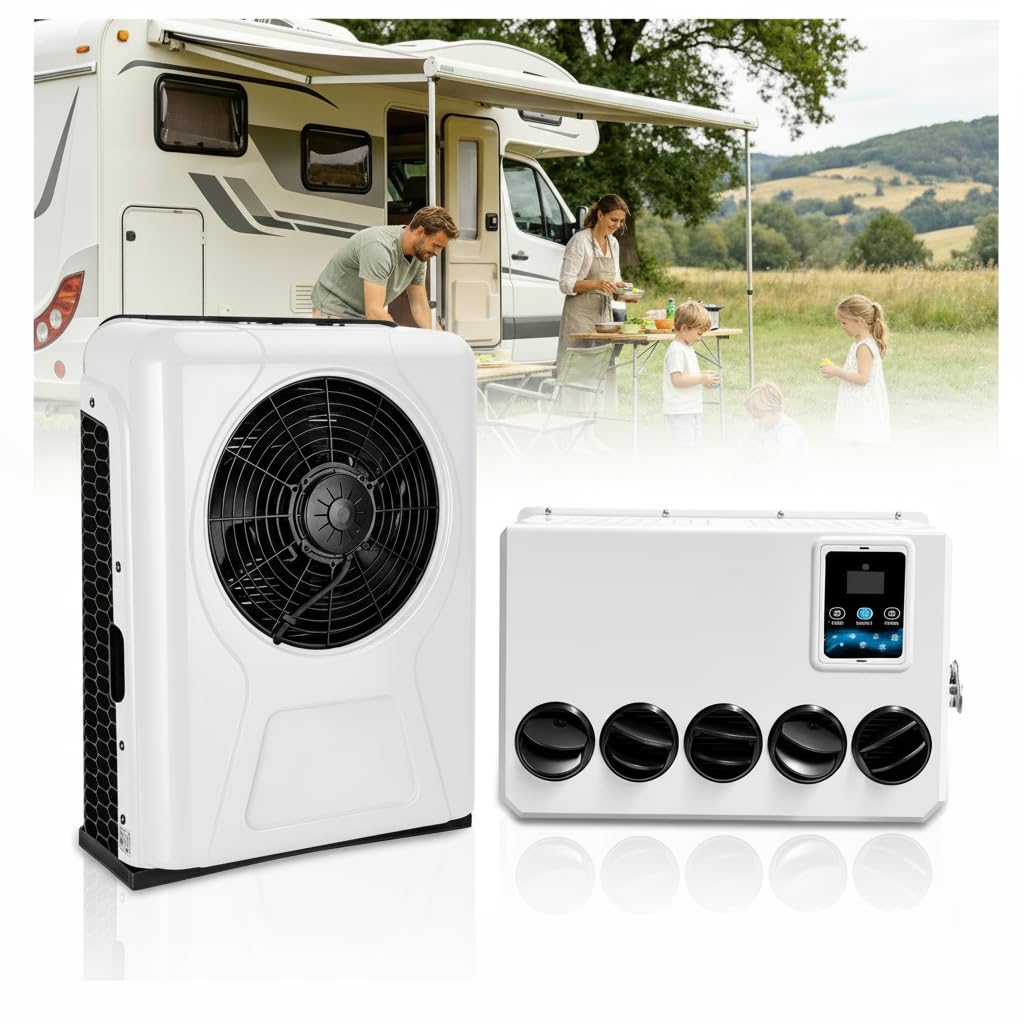
A 20CC scroll compressor aimed squarely at the semi-sleeper cab market.
Long-haul drivers burn fuel idling just to sleep cool, and this unit is built to kill that habit. The 20CC variable-frequency scroll compressor pushes cooling capacity up to 3000W, and the 8-hour endurance figure assumes a standard 480AH auto battery when parked, dropping to 3-4 hours while driving. The idea is that the air conditioner runs on the battery bank instead of the engine, so you stop paying for diesel you are not using.
It offers three modes — fast cooling, sleeping, and energy saving — and the maker claims it beats the smaller 8,800 BTU units common in this category. In practice, an owner running this on a 314Ah battery reported it carried through 10-11 hours overnight and kept a 1996 Freightliner cabover cool, with the loudest noise coming from moving air rather than the compressor. A Ford Transit 250 install drew around 40A at full load with 70+A at startup, which is why Treeligo specifies 4-gauge cable or better.
Set the purchase against that wiring requirement honestly. This is not a plug-and-play unit, and it uses R134a refrigerant, so if you are not comfortable with evacuation and recharge you will want to budget for a mechanic’s time. For a big rig doing real nights in hot climates, the trade-off is worthwhile.
12000 BTU Mini Split
- Big cooling capacity with 10,000 BTU from a 20CC scroll compressor, positioned as stronger than the 8,800 BTU units in the category
- Owners mention 10-11 hours of overnight use on a properly sized lithium bank
- Quiet enough that airflow, not compressor noise, is the loudest element in the cab
Mini Split Complexity
- Needs 4-gauge or larger cable and a lithium or large AGM bank to handle the ~40A running draw and 70A startup
- Requires R134a evacuation and recharge, which usually means professional help
- A small number of units have failed outright, with one reporting a unit that died after a year and another unable to hold a charge
Owner Reports: You drive a semi or large RV and want to stop idling fuel just to stay cool in the bunk.
Stay Cautious: Your build cannot supply a large lithium bank and 4-gauge wiring, because this unit will simply overwhelm a small system.
5. 12V Truck Cab Air Conditioner 10000BTU 12 volt Universal dc Air Conditioning Electric Split ac Unit for semi trucks RV Crane Tractor Bus Boat Automotive Camper Van Motorhome New Energy
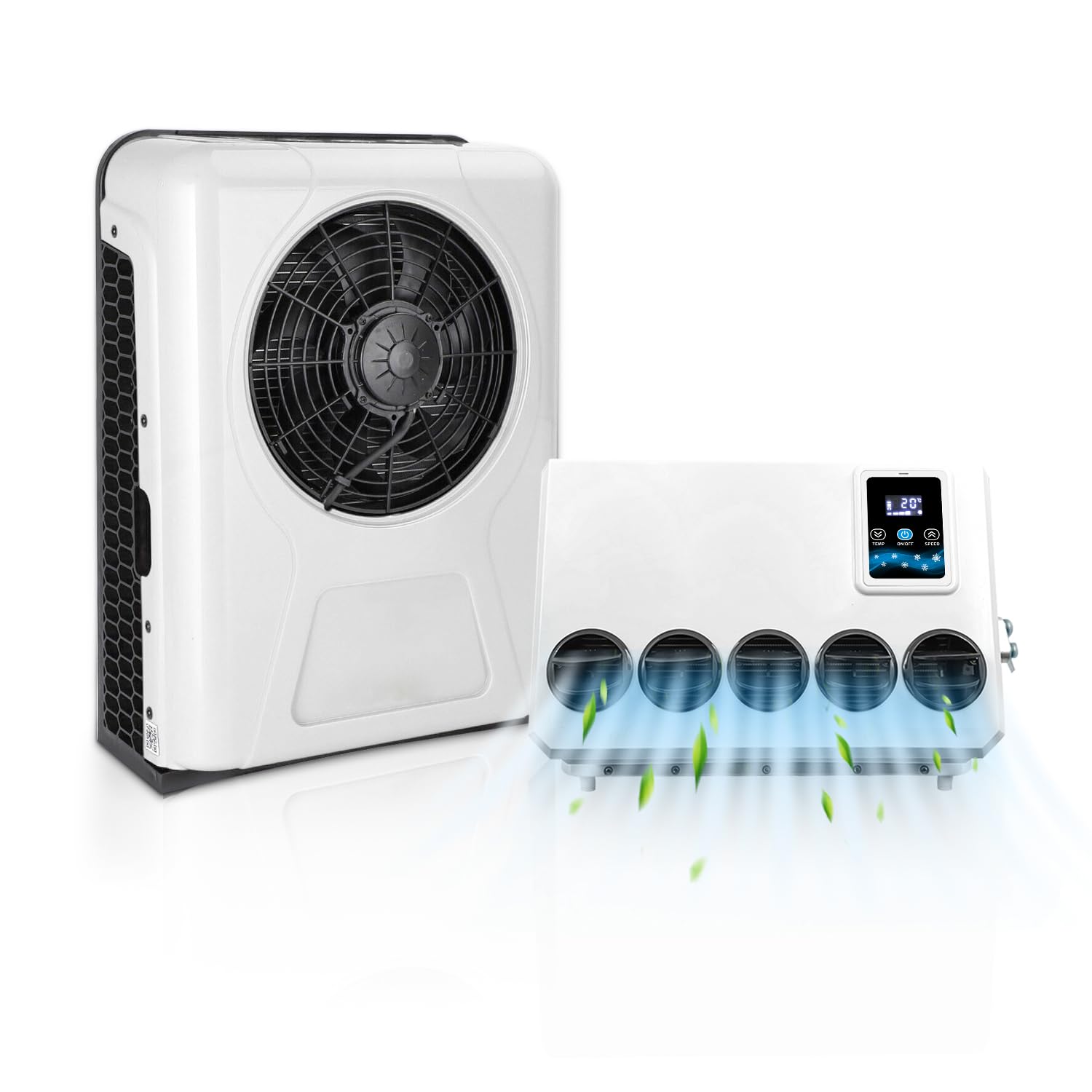
Heavy-gauge copper wiring and a universal fit for the widest range of cabs.
The defining move here is the wiring, and it is worth understanding why. This unit uses 12mm² pure copper wire with thickened PVC insulation, which is spec’d for lower resistance and higher current load than standard cable — exactly what a 60-80A draw deserves. That makes it a smarter choice for the buyer who plans to wire the unit properly rather than cobble it together, especially in cold or noisy environments where voltage fluctuation is common. Cooling is 10,000 BTU with a claimed 15% uplift over competing AC power cooling systems, in a split format for trucks, RVs, cranes, tractors, and buses.
The split format also means refrigerant lines, and this unit is supplied without R134a refrigerant, so a technician’s recharge is part of the setup. Reviewers point out the unit arrives neatly packed with everything accounted for, installs cleanly, and blows hard and quiet once running. Two buyers hit problems in higher-demand applications — one in a crane cab where it kicked out under load until a second “tender” battery was added, and another where the unit froze roughly every two hours — so if your cab has particularly heavy-duty demands, size the battery bank generously and make sure airflow around the outdoor unit is unobstructed.
For standard truck and RV duty, it is a well-built split system at a fair price — lighter on the wallet than comparable roof units. It just wants a proper install and a battery that will not sag under the 800W draw.
Universal 10000 BTU: The 12mm² pure copper core is a genuinely better cable than typical split systems here, so the unit maintains stable operation even when your 12V bus is not.
Universal Fit Issues: Refrigerant is not included, and in space-limited cabs like a crane the unit can shut down under peak draw unless you add battery margin.
Wiring Wins: You want a split system with real wire gauge and an accurate 10,500 BTU number to actually count on.
Skip If Wiring Weak: Your cab cannot support the 790mm x 490mm outdoor footprint or you are unwilling to pay for a refrigerant recharge.
6. Treeligo Universal 12V DC Air Conditioner 12 Volt Mini Split AC Unit 12000 BTU 960W Fast Cooling System with Remote Control for Semi Truck RV Camper Van UTV Off-Road Vehicles
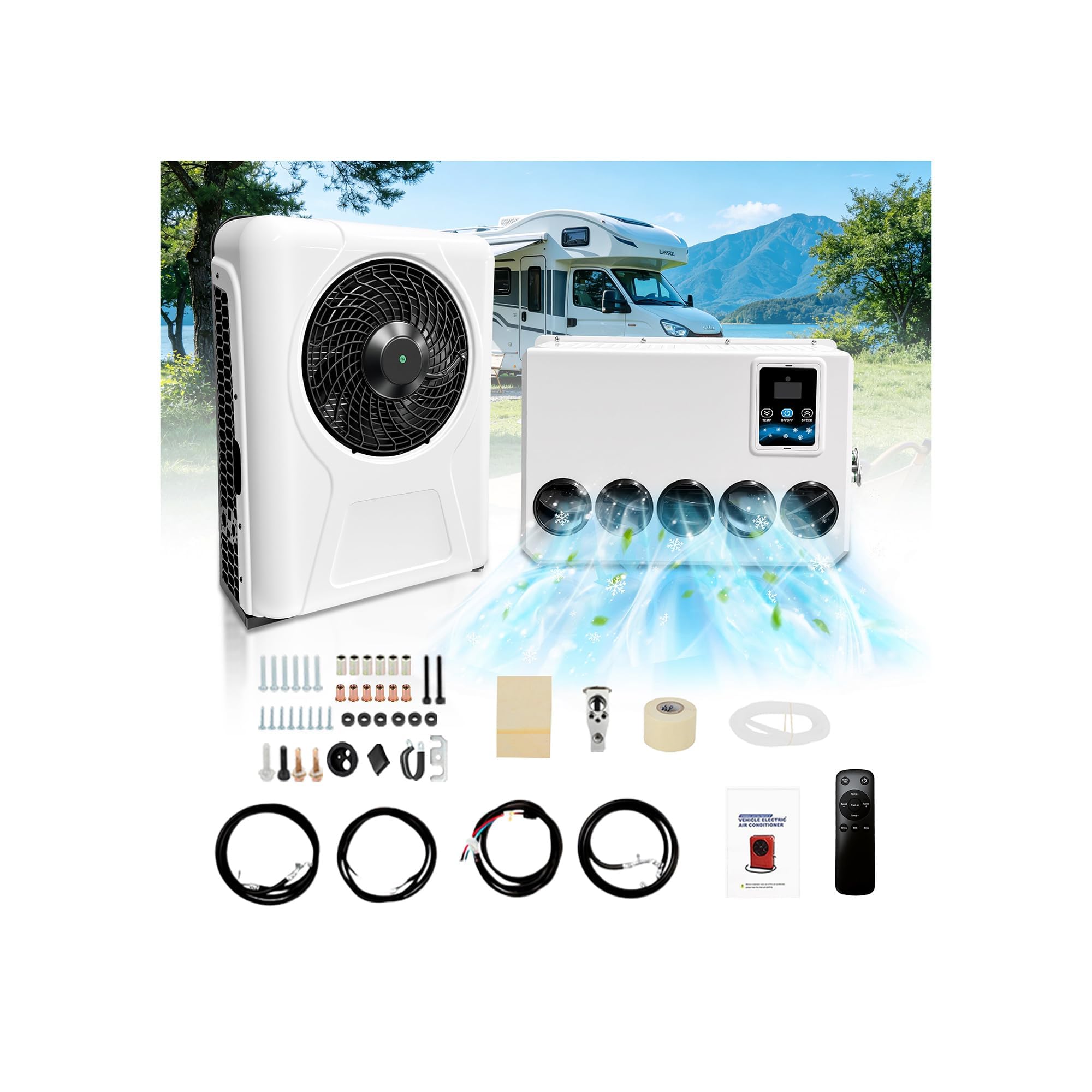
Four modes, 350 CFM airflow, and compatibility that reaches past trucks into UTVs and boats.
Not every cooling problem lives in a van. This unit is engineered for the max-compatibility end of the market, working in RVs, semi trucks, tractors, UTVs, harvesters, forklifts, and boats alike. It cools at 9,500 BTU with 350 CFM airflow (cubic feet per minute — a measure of how much air the fan moves), so the cooling is distributed across the cabin rather than blasted at one spot. That airflow number is the one to watch if you are cooling a long cab where air needs to travel.
The 4 operating modes — Fan Only, Manual, Eco, and Turbo — and the inverter compressor mean the unit can scale back when cooling is not needed. Treeligo quotes up to 12 hours of running off a 480Ah battery depending on mode, the strongest runtime claim in this price bracket. Below-45dB operation keeps the cab quiet enough for conversation or sleep while the compressor works.
The 12V requirement is strict though — this is not a dual-voltage unit, and the 9,500 BTU output is the lower of the two 12,000 BTU-labeled Treeligos in this lineup, so if pure BTU is the goal, look elsewhere. What you get instead is the widest vehicle coverage and a proven all-night runtime in a quiet package. Real-world reports place it in the 25-50% of a 280Ah bank for a full night’s cooling in a Florida van, which is exactly the kind of efficient number you want to see.
Built For Oddballs: A UTV, tractor, or mixed fleet where one AC has to make itself fit many different cabs.
Look Elsewhere: Your priority is maximum cooling power — the two 12,000 BTU-labeled units in this list outmuscle this one.
7. 10000 BTU 12V DC RV Air Conditioner – Battery Powered, Low Power Consumption, Ultra Quiet & Fast Cooling Upgraded Rooftop AC Unit with APP Remote for Camper Van and Truck (Cooling Only)
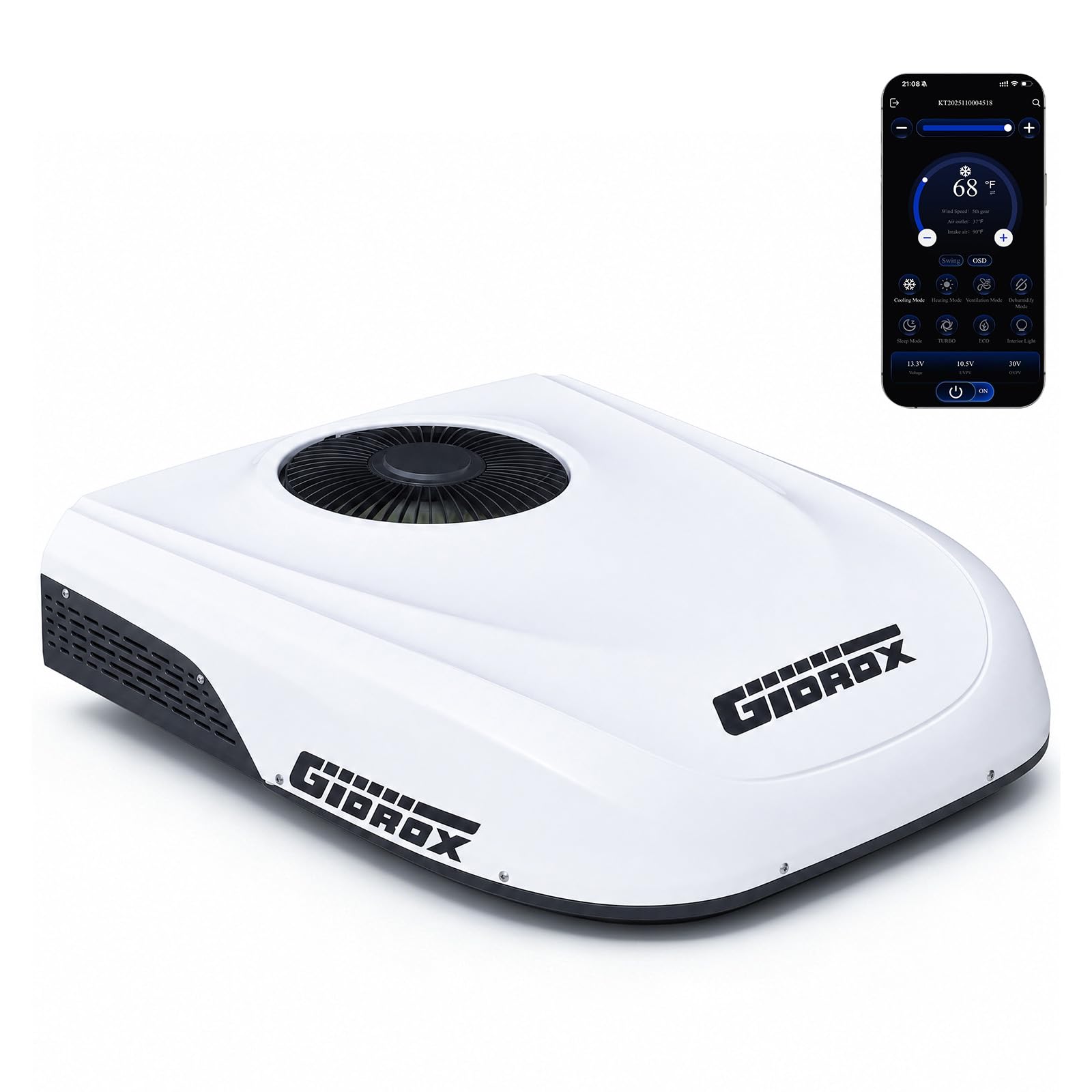
A rooftop AC tuned around one thing: getting you through the night on a normal battery bank.
If the single question you care about is “will it run all night without flattening my batteries,” this is the unit built to answer yes. The maker’s tested average nighttime consumption is around 350W at 30°C ambient, with a claimed 60% energy saving versus a traditional AC. That is the number that turns a 12V air conditioner from a daytime-only luxury into an overnight one, and paired with a 400Ah battery the maker says all-night use is well within reach.
The 10,000 BTU cooling output uses inverter technology to cool a space in about 3 minutes and hold temperature, and there are three modes — Turbo for rapid cooling, ECO for efficiency, and Sleep for quiet. Sleep mode runs at a library-quiet 40dB thanks to a brushless fan and sound insulation, which is the sort of figure you notice when sleeping two feet from the unit. Three control paths — Bluetooth app, infrared remote, and physical buttons — plus a °C/°F toggle give you plenty of ways in.
Installation is friendly too: at 54 pounds it is on the lighter side of rooftop units, includes a 19.7 ft power cable, and is made to drop into a common 14×14 inch roof cutout, working with roof thicknesses between 1.5″ and 3.5″. The consistent note is that the controls are somewhat rigid — ECO mode is fixed at 79F and there is no battery-cutoff adjustment — so if you want fine control over the shutdown threshold, factor that in.
Made For Off Grid: Overnight off-grid cooling where the battery bank, not the BTU rating, is the limiting factor.
Worth Knowing: The controls are limited — ECO sits at a fixed temperature and the battery cutoff is not user-adjustable, so hands-on tinkerers may want more granularity.
8. Outequip RV Air Conditioner, 12V 10000 BTU Rooftop Air Conditioner for RVs, Trucks, Vans, Campers, Tractor, Low Profile Quiet AC Unit, OutEquipPro 12V AC (12 voltage w/o heater)
The rooftop unit that quietly dominates its price class on real owner outcomes.
This sibling to the top pick drops the heater and focuses entirely on cooling, and its owner base has rewarded that focus. It runs off your vehicle’s 12V system to deliver 10,000 BTU, and the maker is specific about runtime: 8 hours of cooling on a 480Ah power source and 10 hours on a 600Ah source when parked. That is the honest version of an off-grid cooling claim — tied to your battery size, not a fantasy figure — and it is what lets a van dweller sleep through a warm night without running the engine.
Performance is the thing owners notice most. There are reports of up to a 20°F temperature difference inside the cabin, and the unit drawing around 55 amps on high and roughly 20 amps in ECO mode. That ECO figure is what makes all-night running realistic, and the 55-amp high setting is what you want for the first hot half hour after a long drive. A Class B owner also noted the low-profile 28x28in roof footprint clears a Promaster 2500 high roof, which is a genuinely useful compatibility point if that is your platform.
Inside the shell it is UV-stabilized ABS, EPDM gasket, zinc-coated condenser, and brushless copper motor fans, the same weather-resistant recipe as the top pick. One consistent install note: the gasket and torque instructions are vague, and the unit can end up tilting a quarter to three-eighths of an inch, so take extra care sealing the opening before you tighten everything down.
Outequip 10000 BTU
- 10,000 BTU cooling with an honest, battery-sized runtime promise: 8 hours on 480Ah, 10 hours on 600Ah
- Owner-reported 20°F temperature swing and very low ECO-mode power draw keep it viable overnight
- Slim, low-profile roof mount fits high-roof vans like the Promaster 2500 without roof modifications
Owner Watch Points
- Installation instructions on gasket seating and bolt torque are vague, so the seal is on you to get right
- Rooftop format means you need an existing vent opening to work from
- Cooling only — if you want heat in shoulder seasons, order the heated sibling instead
Best If Recommended: You want the highest-rated cooling-only rooftop on the list and already have a lithium bank sized to match.
Skip If Not: You need winter heating from the same unit — this is the no-heater version, and the heated variant exists for exactly that reason.
9. Ultra-Slim Low-Profile 12V RV Air Conditioner with PTC Heating

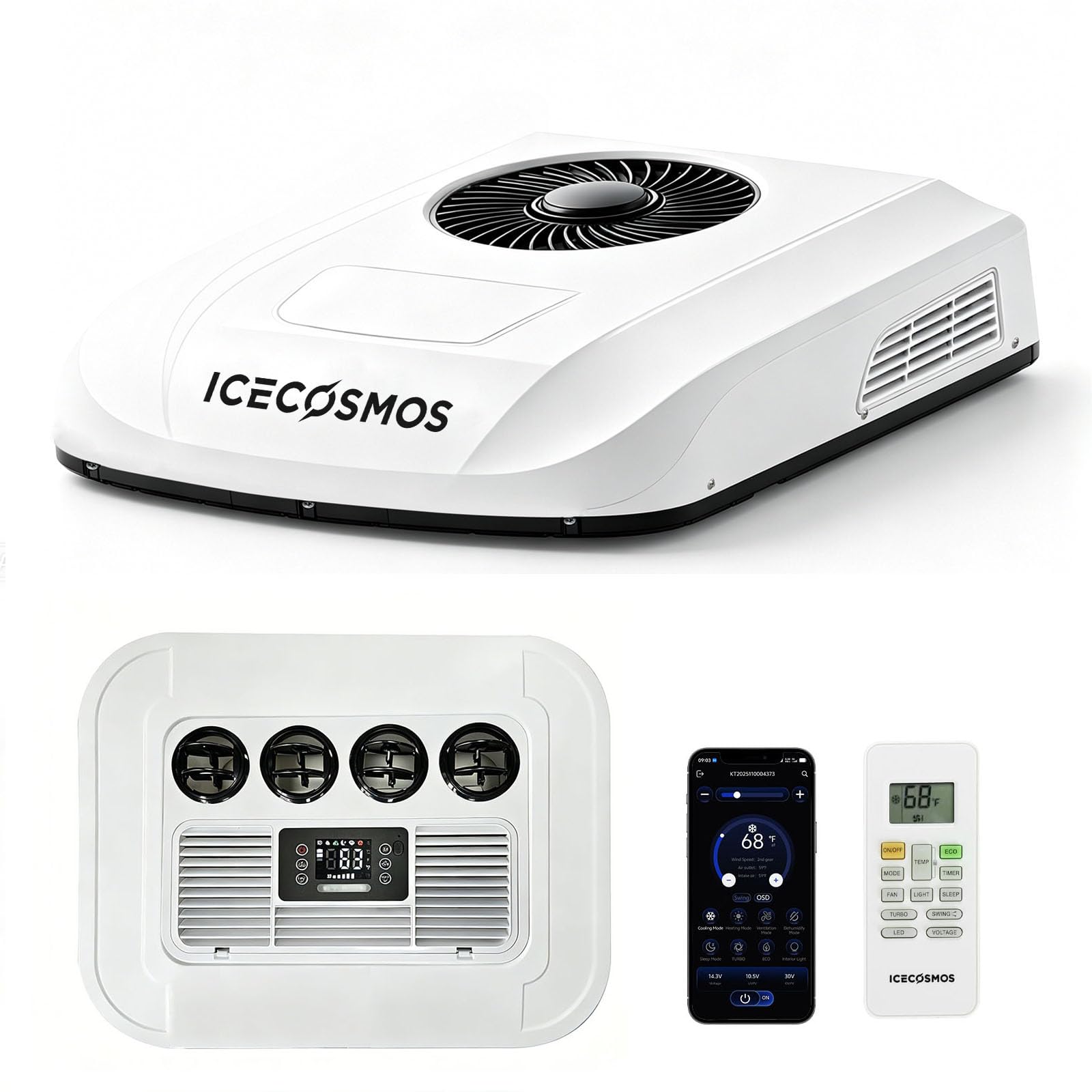
Five and a half inches of roof presence with a 39dB whisper mode and heating built in.
The ICECOSMOS takes the slim-roof idea and pushes it further than most, with a body just 5.5 inches thick that fits standard 14.1″ x 14.1″ roof openings. On top of being low-profile, that thin body reduces wind resistance and helps with height-restricted routes — a genuine advantage if you drive under low bridges or park in covered garages. The maker also rates the fan IPX6 waterproof, which is the highest water-jet resistance rating on this list and a sensible choice for a unit living in the elements.
Inside is a 10,000 BTU high-efficiency cooling system matched to a 4,500 BTU PTC heater, so it handles both directions. The maker quotes 12% more power than standard models and says it still delivers 80% of standard performance above 113°F outdoor temperatures. On the quiet front, it hits 39dB in Eco mode — the lowest figure on this list — which is a soft, close-to-silent hum. Runtime is quoted at over 12 hours in ECO mode on a 12V 400AH LFP battery, near the top of this list for all-night cooling efficiency.
Owner experience is broadly positive, with repeated reports of cooling large RVs in Florida heat, efficient battery use, and replacing old 110V units. A minority have hit reliability problems after short runs, and some owners found the roof opening needed filing to fit cleanly. If you value silence and a low roof profile more than maximum BTU, this is a strong pick — just confirm the fit at the opening before install day.
Ultra Slim PTC Heat: Five and a half inches of body thickness plus an IPX6 fan means less wind drag and a proper weather seal on the roof.
Slim Design Limits: The 14.1″ x 14.1″ opening sometimes needs light filing and a trimmed roof cushion, so plan for a half-day rather than a drop-in.
Choose For Slim: A rooftop build that needs the lowest possible profile, quietest overnight operation, and heating from the same unit.
Worth Checking: A minority of owners have hit reliability issues on the electronics side, and the roof cutout may need minor hand fitting.
10. 12V RV Rooftop Air Conditioner with Heater, 10,000 BTU Low Profile DC AC Unit – Quiet Cooling for Camper, Van, Truck, Trailer, Boat – Sleek Black Housing
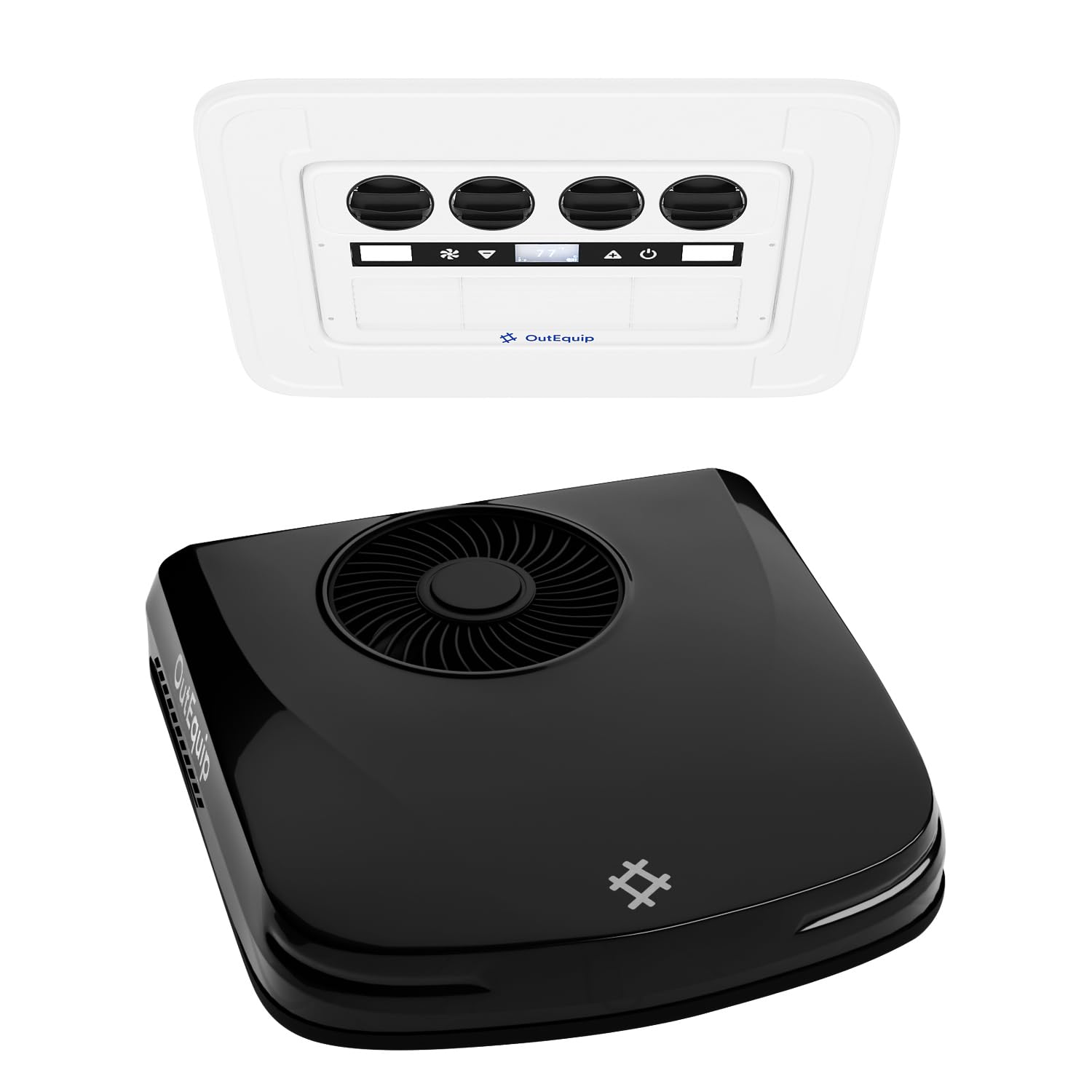
Black housing, white interior, and roof space preserved for solar.
Two things make this unit stand out in the current lineup: it comes in black exterior with white interior, so it does not clash with dark camper builds, and it is deliberately compact enough to leave roof room for other hardware. Owners fitting 600W of solar alongside it report gaining roof space back, and several say the low-profile design no longer shades their panels. If your build plan involves both AC and solar, that real-world breathing room is a genuine asset.
The cooling spec is 10,000 BTU and the heater adds dual-season coverage. Power draw sits around 650W at max, dropping significantly, with ECO mode in the region of 250W — a spread that makes overnight use realistic without overloading the house bank. For running equipment, the unit uses dual brushless copper motor fans and anti-vibration mounting, keeping noise low while still moving air efficiently. Smart control comes through a remote, a temperature display, and Eco/Sleep/Turbo modes.
The catch is that equipment access varies by trim. The remote controls temperature well, but there is no Bluetooth app option on this model, so drivers who want live monitoring while on the road should plan around that. Otherwise the honest picture is a solid, compact unit with one of the best rooftop footprints in this price bracket for anyone balancing AC and solar.
Heater Rooftop 10000: Black exterior, white interior, and a slender profile that lets severalhundred watts of solar panels share the roof rather than fighting over it.
Heater Packaging Catch: No Bluetooth on this trim — the remote handles temperature fine, but live monitoring while driving is not part of the package.
Reach For Heat: You want a compact, low-profile rooftop unit that leaves roof space for solar, and prefer a dark exterior that matches your build.
Look Elsewhere: You want app-based monitoring while on the road, since this model relies on the physical remote.
Understanding the Specs
BTU and Cooling Capacity
BTU (British Thermal Unit) measures how much heat the air conditioner can pull out of the air per hour. A higher number cools a larger space faster, but it also pulls more current from your battery. The units on this list range from 9,000 to 11,000 BTU. As a rough guide, a 10,000 BTU rooftop unit fits most camper vans and small trailers comfortably, while a 9,000 BTU split system handles a truck cab you mostly cool at night. Direct sun and thin insulation can easily add 20-30% to your real cooling demand, so bigger is not always better if your battery bank cannot feed the extra draw.
Amp Draw and Battery Runtime
Amp draw tells you how hard the unit is pulling from your 12V system in practice. The lower the amps, the longer your battery bank lasts between charges. This matters because a unit drawing 20 amps on ECO mode can run all night off a 400Ah battery, while one that sips 80 amps at high will drain the same bank in a couple of hours. Multiply amps by volts to get watts, and watts by hours to get the watt-hours you actually need from your battery. Match the unit’s ECO-mode draw to your bank size rather than its peak draw, and overnight cooling stops being wishful thinking.
FAQ
Will a 12V air conditioner run all night on battery power?
Do I need an inverter to run a 12V air conditioner?
What roof opening size does a 12V rooftop air conditioner need?
Can I install a 12V air conditioner myself?
How many amps does a 12V air conditioner draw?
What wire gauge does a 12V air conditioner need?
Is a split system or a rooftop unit better for a truck?
Do any 12V air conditioners include a heater as well as cooling?
How long does a 12V air conditioner last?
Is a 12V air conditioner as cold as a traditional RV air conditioner?
Final Thoughts: The Verdict
For most buyers ready to stop idling an engine just to sleep cool, the 12 volt air conditioner to start with is the RV Air Conditioner 12V 10000 BTU Rooftop with heater, because it delivers both 10,000 BTU cooling and 4,500 BTU PTC heating from a single low-profile rooftop install. If you want the highest-rated cooling-only rooftop on the list, the Outequip RV Air Conditioner 12V 10000 BTU is the one that quietly wins over its owners with an honest 8-hour runtime on 480Ah and a slim vertical footprint. And for a truck, crane, or equipment cab with no roof vent, the 12V Truck Cab Air Conditioner 10000BTU Split System puts 10,500 BTU behind the best wiring in this class. Match the unit to your battery bank, measure your roof opening, and pick the one whose install you are comfortable tackling — that is the real work, and everything else follows.
How We Picked
We do not accept paid placement. Every pick is matched to a real buyer and a real use-case; we do not hands-on test units.
Sources & Methodology
Specifications: manufacturer listings and product documentation. Review insights: verified customer reviews, as of September 2026. Pricing: not shown on this page (it changes often); check the current price via the retailer link.
As an Amazon Associate, KitchPrep earns from qualifying purchases. This does not affect which products we feature.
Related Guides
