
If you cook for a crowd, love doing big‑batch meal prep, or dream of pressure‑canning your own soups and stocks, a roomy 12‑quart pressure cooker is a total game changer. Whole chickens, giant pots of beans, bone broth, and jars of homemade chili all fit in one pot instead of juggling multiple pans.
This guide is built to help you choose the best 12 quart pressure cooker for how you actually cook, not just what looks pretty on the product page. We’ll talk about which models can safely handle pressure canning, which ones are better as everyday cookers, and where stainless steel is really worth the extra money over aluminum.
Below you’ll find a clear breakdown of what to look for, a quick comparison table, and then deep‑dive reviews of fourteen large‑capacity pots—from simple budget aluminum cookers to pro‑grade stainless canners and a fully digital electric option that walks you through every step. By the end, you should feel confident picking one pot and thinking, “Yep, that’s mine.”
In this article
- How to choose the right 12‑quart pressure cooker or canner.
- Quick comparison table of fourteen standout models.
- In‑depth reviews of each cooker, with expert pros and cons.
- What a 12‑quart pressure cooker really changes in your kitchen.
- Answers to common safety, canning, and stove‑compatibility questions.
How to Choose the Best 12 Quart Pressure Cooker for Your Kitchen
Before you fall in love with any one model, it’s worth getting crystal‑clear on how this pot will actually earn its space. A 12‑quart cooker is big, heavy, and powerful—amazing when you choose the right one, annoying if you don’t.
1. Start with how you really cook (and can)
Run through a few quick questions:
-
Are you mostly batch‑cooking meals or pressure canning jars?
If it’s primarily stews, beans, broth, and whole chickens, almost any sturdy stovetop cooker here can work. If you want to can low‑acid foods (meats, most vegetables, soups), you need something that behaves like a true pressure canner, not just “a big pot that happens to pressurize.” -
How often will it live on your stove?
Daily workhorse? Look for smooth one‑hand lid systems and easy‑clean interiors. Something you pull out a few weekends a year for canning marathons? Jar capacity, stable pressure and clear gauges matter more than fancy looks. -
Who else will be using it?
If partners, parents, or older kids will be cooking too, simple controls, clear pressure indicators, and obvious safety locks make life much less stressful.
2. Decide if you need a cooker, a canner, or both
Most 12‑quart pots here fall into one of three buckets:
-
Big stovetop pressure cooker (everyday cooking first)
These excel at fast stews, beans, and stocks. They may reach 10–15 PSI but aren’t always marketed or tested as canners. Perfect if you want “huge Instant‑Pot style meals,” but you still follow traditional canning recipes only occasionally or stick to high‑acid foods (jams, pickles). -
Classic pressure canner / cooker combo
Models like the Granite Ware and Buffalo are built to hold jars on a rack and hit canning‑style pressures, but they’re still totally usable as oversized soup or stock pots. They’re ideal if you want one pot to both batch‑cook and preserve. -
Digital electric pressure canner
The Presto digital unit senses temperature and walks you through each stage, which is a huge confidence boost if you’re new to canning or nervous about hitting the right pressure and venting steps every time.
If your main non‑negotiable is safe pressure canning of low‑acid foods, look for gear that can hold at least four quart jars and run in the 10–15 PSI range with reliable regulation and clear instructions for canning, not just cooking.
3. Match size, stove and storage
“12‑quart” sounds straightforward, but there are a few realities to check:
- Footprint vs burner size – Some of these pots are wide and squat, others tall and narrow. Make sure the base actually fits your strongest burner without overlapping knobs or handles.
- Weight when full – A 12‑quart stainless pot full of jars and water can be seriously heavy. If you have a glass‑top stove or wrist issues, a lighter aluminum model or the digital Presto (which never needs to be lifted when full) may be kinder on your body.
- Height under cabinets – Measure clearance under your range hood. A tall canner plus rocking pressure weight should have breathing room—no one wants steam blasting straight into cabinetry.
- Where will it live? – These are not tiny pots. If you don’t want to resent it, know exactly which shelf, drawer, or corner of the pantry it will call home between batches.
4. Pay attention to PSI, valves and safety
Here’s where a lot of buyers glaze over—but this is the part that makes food safe and keeps you relaxed while the pot is hissing away.
- PSI (pressure) range – For everyday cooking, 10–12 PSI gives fast results. For low‑acid canning, extension services generally expect canners to hold 10–15 PSI and be large enough for at least four quart jars so the food can reach 240–250°F long enough to kill botulism spores.
-
Type of regulator
Weighted regulators “jiggle” or rock at pressure, which is very easy to read once you know the sound. Spring‑valve designs are quieter and more modern, but they rely on thicker manuals and tiny indicators. Digital canners manage this all for you. -
Redundant safety systems
Look for at least a main pressure‑limiting valve, an emergency safety valve, and some type of lock that physically prevents opening while pressure is present. Many of the stainless models here add safety windows that vent if anything ever goes wrong, plus one‑hand knobs that can’t be turned under pressure. -
Instructions you can actually follow
A powerful pot with a flimsy or badly translated manual is not what you want for your first canning season. When in doubt, pair the manufacturer booklet with a trusted canning resource from a university extension or the National Center for Home Food Preservation.
5. Choose your material: stainless vs aluminum
Both have a place; the trick is picking the right one for you:
-
Aluminum (Hawkins, WantJoin aluminum, Fulgutonit, BreeRainz, Granite Ware)
Heats quickly, costs less, and is noticeably lighter at this size—great if you’re moving the pot around a lot. However, plain aluminum can discolor with very acidic foods and is usually hand‑wash only. Most aluminum canners here are fantastic for stocks and low‑acid canning when used with tested recipes, but double‑check your stove’s compatibility if you have a flat glass top. -
Stainless steel (Magefesa, Buffalo, Deeluban, Peterboo, NYTRX, WantJoin stainless, RVGMBO, SVKLHY)
More durable and non‑reactive with tomato‑heavy dishes, chilis, and acidic bone broths. A thick, multi‑layer base spreads heat evenly and resists scorching, which matters if you brown meat directly in the pot. Stainless is heavier and pricier, but if you cook in it weekly, the upgrade often pays off in flavor and longevity. -
Hybrid or clad designs (Buffalo)
Multi‑layer “clad” constructions push heat quickly up the sides as well as the base. They cost more but behave closer to restaurant gear—especially nice if you’re doing a lot of beans and broth.
Once you’ve decided what you’re cooking, how serious you are about canning, and which material suits your stove and budget, narrowing down to a single pot gets much easier.
Quick Comparison: Fourteen Best 12 Quart Pressure Cooker Picks
Here’s a bird’s‑eye look at the fourteen large‑capacity pressure cookers and canners in this guide. Skim for the models that match your stove, budget, and goals, then jump to their full reviews below.
On smaller screens, swipe or scroll sideways to see the full table.
| Model | Type | Capacity | Best match | Amazon |
|---|---|---|---|---|
| Hawkins Classic CL12 | Stovetop – Aluminum | 12 L (~12.7 qt) | Budget big‑batch curries & beans | Amazon |
| WantJoin 13Qt Aluminum | Stovetop – Aluminum | 13 qt | Large families on a budget | Amazon |
| Fulgutonit 12 Qt Aluminum | Stovetop – Aluminum | 12 qt | Beginner‑friendly canning pot | Amazon |
| BreeRainz 12 Qt Aluminum | Stovetop – Aluminum | 12 qt | Affordable multi‑use cooker/canner | Amazon |
| Peterboo 12 Qt Stainless | Stovetop – Stainless | 12 qt | Entry‑level stainless upgrade | Amazon |
| Deeluban 12 Qt Stainless | Stovetop – Stainless | 12.68 qt | Best‑value all‑round stainless | Amazon |
| WantJoin 12.6 Qt Stainless | Stovetop – Stainless | 12.6 qt | High‑intensity stainless workhorse | Amazon |
| NYTRX 12 Qt Stainless | Stovetop – Stainless | 12 qt | Safety‑focused stainless cooker | Amazon |
| Granite Ware F0732‑2 | Canner – Aluminum | 12 qt | Budget UL‑style small‑batch canner | Amazon |
| Magefesa Star 12.7 Qt | Stovetop – Stainless | 12.7 qt | European‑style family cooker | Amazon |
| RVGMBO 18/8 12 Qt | Stovetop – Stainless | 12 qt | 3‑in‑1 stainless with 15 PSI | Amazon |
| SVKLHY 3‑in‑1 13 Qt | Stovetop – Stainless | 13 qt | Flexible 3‑pressure stainless pot | Amazon |
| Buffalo QCP412 12 Qt | Stovetop – Clad Stainless | 11.36 L (~12 qt) | Pro‑grade stocks & canning | Amazon |
| Presto 02144 Digital | Electric digital canner | 12 qt | Guided, USDA‑style canning | Amazon |
In‑Depth Reviews: Finding Your Best 12 Quart Pressure Cooker Match
Now let’s zoom in on each pot. Use these reviews to match specific strengths—like price, material, PSI, and jar capacity—to what matters most in your kitchen, so you land on a single clear winner instead of fourteen open tabs.
1. Hawkins Classic CL12 – Tall Workhorse for Big Everyday Meals

If you grew up around Indian kitchens, you’ve probably seen a Hawkins on the stove. The CL12 is the oversized version of that same classic: a tall, pure‑aluminum pressure cooker with an inner‑fitting lid that locks like an airplane door and a regulator tuned for fast pulses of steam rather than continuous hissing. It’s built to feed 12–16 people, so think big batches of dals, beans, rice, and braised meats.
Why it earns its fan club
- Trusted inner‑lid safety design – The lid fits inside the rim, so internal pressure actually helps it seal more tightly, and it won’t open until pressure drops.
- Excellent for legumes and curries – The regulator is tuned to keep foamy foods (like dals) from sputtering everywhere while still cooking them in just a couple of whistles.
- Light for its size – Aluminum construction makes this big pot easier to lift and maneuver than a comparable stainless model.
Good to know
- Not a canner replacement – It’s fantastic for cooking, but it’s not marketed or UL‑tested as a pressure canner for low‑acid foods.
- Aluminum is reactive – Long tomato‑heavy cooks can discolor the interior; if you do a lot of acidic sauces, stainless is a better long‑term partner.
- Learning curve on the lid – Inner‑lid pots feel awkward the first few times; closing and opening becomes second nature with a little practice.
Ideal for: cooks who mainly want a big, fast everyday pressure cooker for beans, rice, and curries, and who might can only occasionally—or not at all.
2. WantJoin 13Qt Aluminum – Big‑Batch Aluminum with Serious Safety

WantJoin’s 13‑quart aluminum cooker is all about capacity and safety without the boutique price. It’s large enough to cook for 8–12 people in one go and comes with a canning rack plus a long list of built‑in safeguards—self‑locking valve, limit valve, safety window, and more—designed to prevent over‑pressure even when you’re running it hard.
Where it shines
- Huge volume – Great for big families, batch cooking beans, or making enough stew to freeze in multiple containers.
- Eight‑point safety system – Multiple independent valves and a safety window give plenty of redundancy if something clogs or you accidentally crank the heat too high.
- Gas & induction compatible – Unusual for aluminum; it’s designed to work on both traditional gas burners and modern induction cooktops.
Trade‑offs
- Not a dedicated USDA‑tested canner – It can reach canning‑style pressures, but you won’t find it in official processing charts. Use it for cooking, and lean on tested recipes if you pressure‑can.
- Sticker and valve quirks – Some users mention stubborn labels and a learning curve seating the top weight correctly; watch a quick video once and you’re set.
- Big footprint – On smaller ranges it may hog your prime burner and crowd nearby pots.
Ideal for: households who want maximum capacity, plenty of safety features, and mostly plan to use it for cooking rather than hardcore, rule‑bound canning.
3. Fulgutonit 12 Qt Aluminum – Friendly First Pressure Canner

If you’ve been canning‑curious but nervous, this Fulgutonit 12‑quart canner hits a nice sweet spot: big enough for meaningful batches, small enough to handle on a normal stove, and simple enough that first‑time canners are reporting smooth, drama‑free sessions with 60+ pints under their belt.
Why new canners like it
- Purpose‑built for canning – Comes with a rack and step‑by‑step instructions tailored to jars, not just “cooking beans faster.”
- Light but sturdy – The aluminum–manganese–titanium alloy keeps weight down while still heating evenly.
- Clear pressure behavior – Once the top weight starts spinning, you know you’re at pressure; there’s no guessing if a digital display is telling the truth.
Good to know
- Handle quality varies – A few users have seen handle failures; check yours on arrival and don’t overload it beyond the instructions.
- Aluminum interior – Great heat transfer but not ideal if you want non‑reactive cooking for very acidic tomato sauces.
- Manual still assumes some canning basics – Pair it with a trusted canning book or extension guide and you’ll feel much more confident.
Ideal for: beginners who want a true canner/cooker combo that doesn’t feel intimidating, and who like the idea of doing 4–7 jars at a time instead of giant All‑American‑style batches.
4. BreeRainz 12 Qt – Lightweight Canner for Stews, Stocks & Jars

BreeRainz takes a very similar approach to Fulgutonit—same 63–77 kPa pressure range, same lightweight alloy, same multi‑valve safety setup—but leans a bit more into “everyday kitchen all‑rounder” than “strict canning tool.” Think big pots of soup, stews, beans, then canning those leftovers while everything is still hot.
Why it’s easy to live with
- Versatile rack included – Useful both for canning jars and for steaming big piles of vegetables or dumplings.
- Good heat transfer – Aluminum walls and base bring water up to pressure quickly and recover heat fast after you add food.
- Reassuring safety layers – Separate working valve, safety valve, pressure sensor, and safety window give multiple paths for steam to escape if anything goes wrong.
Trade‑offs
- Food can stick – A few owners mention needing a bit more soaking and scrubbing if you scorch something; deglaze as you go if you brown meat in the pot.
- Still aluminum – If you want a showpiece you can scrub aggressively or run through the dishwasher, stainless is a better bet.
- Not a named‑brand canner in official charts – Use it with care and tested recipes; if you want plug‑and‑play USDA language, look at Granite Ware or Presto.
Ideal for: home cooks who want one lightweight pot for big soups and stews that can also pull canning duty, without spending stainless‑steel money.
5. Peterboo 12 Qt – Budget Stainless with Spring‑Valve Safeguards
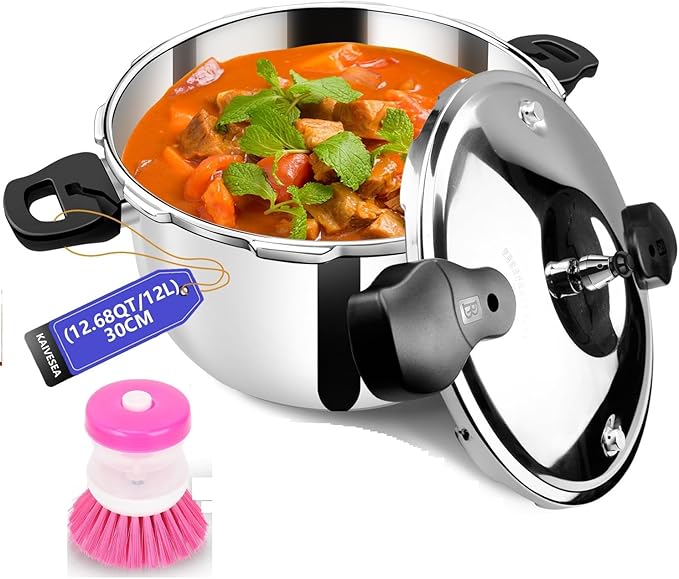
Peterboo’s 12‑quart pressure cooker is one of the more affordable ways to jump into stainless at this size. It uses a classic spring‑valve system with multiple safeguard devices, a thickened base, and three bakelite handles that make maneuvering a full pot more secure.
Why it’s appealing
- Stainless interior – Non‑reactive with tomato‑heavy dishes and easier to keep looking nice over years of use.
- Multi‑step safety – Pressure indicator, regulator, emergency release and gasket‑based seal are all designed to fail safely if something clogs.
- Induction‑ready base – Works across gas, electric coil, ceramic and induction stoves.
Things to keep in mind
- Steel gauge isn’t the thickest – A few reviewers expected heavier construction; it’s sturdy, but not in Buffalo‑level territory.
- Some debate over steel grade – Most buyers are happy, but at least one noted discoloration and questioned whether it’s truly 304; hand‑washing and avoiding harsh cleaners helps.
- Better cooker than canner – You can process jars in it, but if canning is your main goal there are more purpose‑built designs below.
Ideal for: home cooks who mainly want stainless for big‑batch stews and braises, and only occasionally pressure‑can high‑acid foods.
6. Deeluban 12 Qt – 304 Stainless, 15 PSI & One‑Hand Locking

Deeluban’s 12‑quart cooker feels like it was designed by someone who actually pressure cans and cooks a lot. It’s made from food‑grade 304 stainless steel, has a thick encapsulated base for even heating, and reaches around 15 PSI—meaning it can hit true canning‑style temperatures when used with tested recipes. The one‑hand locking knob is intuitive and locks in any position, yet refuses to open while pressure is present.
Why it stands out
- High pressure, fast cooking – Shortens cooking time by roughly 70% compared with a regular pot, while keeping meats tender and beans creamy.
- Serious safety stack – Easy‑lock lid, pressure‑limiting valve, safety valve, locking valve, and reinforced dual clamps work together to prevent misuse.
- Stove flexibility + dishwasher‑safe – Works on induction, gas, ceramic, and electric coil, and the stainless body can go in the dishwasher (gasket and valve by hand).
Minor drawbacks
- Lid mechanism can feel different – If you’re used to a basic twist‑on lid, the knob‑locked design takes a couple of runs to feel natural.
- Heavy when full – It’s robust stainless with a thick base; great for heat, but you’ll feel it when you’ve loaded it with jars or stew.
- Brand is newer – You’re not buying a century‑old name like Presto or Hawkins, but early feedback on build quality is very positive.
Ideal for: cooks who want one stainless pot that can do both big weeknight meals and serious, guideline‑style pressure canning without spending Buffalo‑level money.
7. WantJoin 12.6 Qt Stainless – High‑Intensity Base for Daily Use

This WantJoin model is what happens when you take a commercial‑leaning stainless pot and trim it just enough for home kitchens. The 2200‑ton impact‑bonded sandwich base is designed to spread heat evenly and resist warping, while the large 12.6‑quart body easily handles family‑sized stews, giant bean batches, or whole chickens with room to spare.
What users love
- Solid, confidence‑inspiring build – Heavy base, thick walls, and a good‑feeling lid clamp make it feel like a serious tool, not a flimsy pot.
- Good everyday pressure – Around 11–12 PSI is more than enough for fast stews, beans, and braises while staying easy to control.
- Thoughtful accessories – Often arrives with an extra silicone gasket and rack, which is a nice touch at this price.
Worth noting
- Instructions are basic – The manual isn’t as hand‑holding as Presto’s; if you’re brand new to pressure cooking, plan on a little YouTube support.
- Not a fully documented canner – Great for cooking and high‑acid jars, but if you want explicit low‑acid canning directions you’ll still be pairing it with outside recipes.
- Big and bold on the counter – The wide handles and tall lid make it not‑subtle; plan storage before you buy.
Ideal for: heavy home use—families, small cafés, or serious batch‑cookers who want a stainless pot that feels closer to restaurant gear in hand.
8. NYTRX 12 Qt – Explosion‑Proof Design with One‑Hand Lid

NYTRX leans hard into safety language: “explosion‑proof,” rotary locking system, intelligent safety valve that locks the lid when under pressure and vents if anything goes wrong. Underneath the marketing, what you get is a large stainless cooker with a thickened body, three‑layer base, and one‑hand lid opening that genuinely is nicer to live with than old two‑handle clamp systems.
Why it’s compelling
- One‑hand lid operation – The rotary lock lets you open and close the lid without weird wrestling matches, especially helpful on a tall pot.
- Strong safety story – Dual valves, safety window, thick clamps, and an anti‑scald handle stack the odds in your favor.
- Fast, efficient cooking – The thick base and stainless body cook food quickly while keeping scorching in check when you brown first, then seal.
Where it can frustrate
- Pressure indicator isn’t obvious – Unlike cookers with a clear pop‑up pin, there’s no super‑obvious “we’re at pressure” cue; you’ll learn it by sound and steam behavior.
- Rubber ring alignment matters – Several users note that if the silicone ring isn’t seated perfectly, closing the lid can be fiddly.
- Customer service is hit‑or‑miss – Some buyers report quick help; others say emails about replacement rings went unanswered.
Ideal for: confident home cooks who value stainless and strong safety features, and don’t mind a tiny learning curve on the lid in exchange for a sleek everyday workhorse.
9. Granite Ware F0732‑2 – Compact Weighted‑Gauge Canner & Steamer

Granite Ware’s 12‑quart canner is legendary among small‑batch canners: it holds four quart jars or seven pints, has a UL‑recommended 3‑piece weight that lets you choose 5, 10, or 15 PSI, and doubles as a pressure cooker and steamer when canning season is over. Many people who own giant All‑American canners still buy this as their “baby canner” for weeknight projects.
Why canners adore it
- True weighted‑gauge operation – Set the weight for your altitude and listen for the gentle, steady jiggle; no dial calibration or guesswork.
- Great size for real life – Big enough to be worth the time, small enough to heat up and cool down much faster than 16–23 quart behemoths.
- 3‑in‑1 functionality – Works as pressure canner, pressure cooker, and steamer without imparting flavors or colors thanks to the hard‑anodized finish.
Things to watch
- Finish can show wear – Some long‑time users report the dark interior finish eventually getting cloudy or marked; it’s cosmetic but worth knowing.
- Aluminum body – Lightweight and fast, but not stainless—use wood or silicone tools to preserve the finish.
- Not ideal on some glass‑tops – As with many canners, manufacturers are cautious about recommending it on fragile glass stoves; check your range manual.
Ideal for: canners who want a safe, compact, weighted‑gauge canner for 4 quarts or 7 pints at a time, plus a lightweight pressure cooker/steamer the rest of the year.
10. Magefesa Star 12.7 Qt – Spanish 18/10 Stainless for Gentle Pressure

Magefesa is a long‑standing Spanish brand, and the Star line is aimed squarely at families who want European‑style stainless quality and gentler pressure. Instead of running at 15 PSI, this model tops out around 8 PSI, making it more of a “fast braiser” than a hardcore canner. In return, you get incredibly even heating from its 5‑layer Induxal base and a refined, almost old‑school look.
Why it’s special
- High‑quality 18/10 stainless – Resists rust, cleans up beautifully, and handles acidic foods without flinching.
- Thick 5‑layer base – Stainless, aluminum and silver layers work together for fast, uniform heat across gas, electric, ceramic and induction stovetops.
- Triple safety system – Independent clamps, safety valve, and rotating pressure valve plus a progressive lock that won’t open under pressure.
The flip side
- Lower operating pressure – Great for delicate foods and pressure‑fried chicken, but slower for very dense cuts and not intended as a USDA‑style canner.
- Shipping & QC hiccups – Some buyers report bent rims, broken handles, or even used units arriving via third‑party sellers; inspect yours carefully on arrival.
- Customer support can be distant – U.S. support for a Spanish‑made pot can mean email tag; buying through Amazon with easy returns helps.
Ideal for: families who want a large, beautiful 18/10 stainless cooker for day‑to‑day meals and occasional pressure‑fried chicken, but who will rely on other gear for low‑acid pressure canning.
11. RVGMBO 18/8 12 Qt – 3‑Level Pressure & 3‑in‑1 Versatility
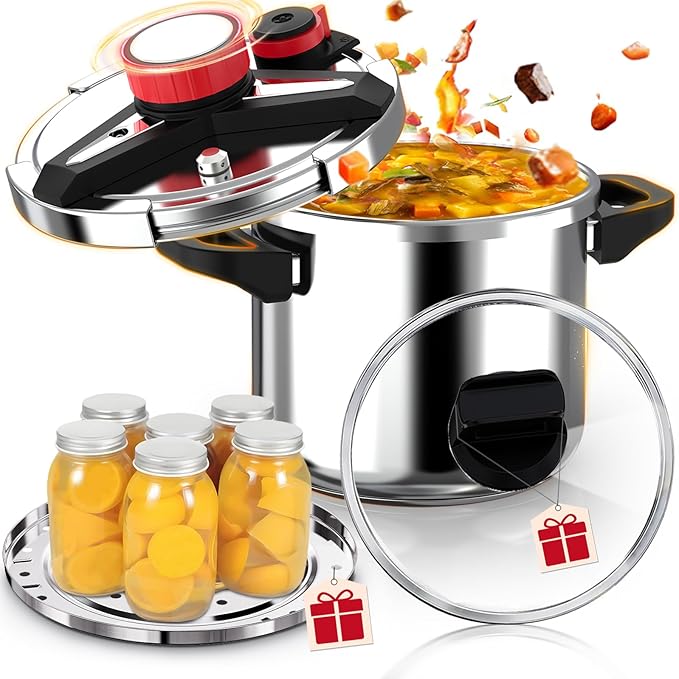
RVGMBO’s 12‑quart 18/8 stainless cooker reads like a checklist of “nice to haves”: 3‑level pressure adjustment (low, medium, high up to 15 PSI), one‑hand locking knob, induction‑ready encapsulated base, plus a tempered glass lid and steamer basket so it can moonlight as a regular stock pot or stacked steamer. It’s very much a modern, do‑everything design.
What makes it compelling
- Adjustable pressure – Run delicate foods at 10 PSI, hearty stews higher, and still have access to canning‑style pressures when recipes call for them.
- 3‑in‑1 function – Swap on the glass lid and you’ve got a classic soup pot; drop in the steamer basket and it becomes a high‑capacity steamer.
- Safety and support – Locking lid, multiple valves, and a brand that actually responds to customers if anything goes wrong.
Good to know
- Still relatively new – It doesn’t have decades of track record like Presto or Hawkins; long‑term durability looks good so far but isn’t battle‑tested.
- Noise level varies – Some owners note a noticeable hiss on higher settings; others call it pleasantly quiet.
- Big learning upside – Those three pressure levels are great once you understand them, but they add a notch of complexity compared with a single‑weight canner.
Ideal for: tinkerers and serious home cooks who want to dial in pressure levels for everything from fish to chickpeas, and appreciate having a glass‑lid stock pot and steamer in the same footprint.
12. SVKLHY 3‑in‑1 13 Qt – 304 Stainless with Three PSI Settings
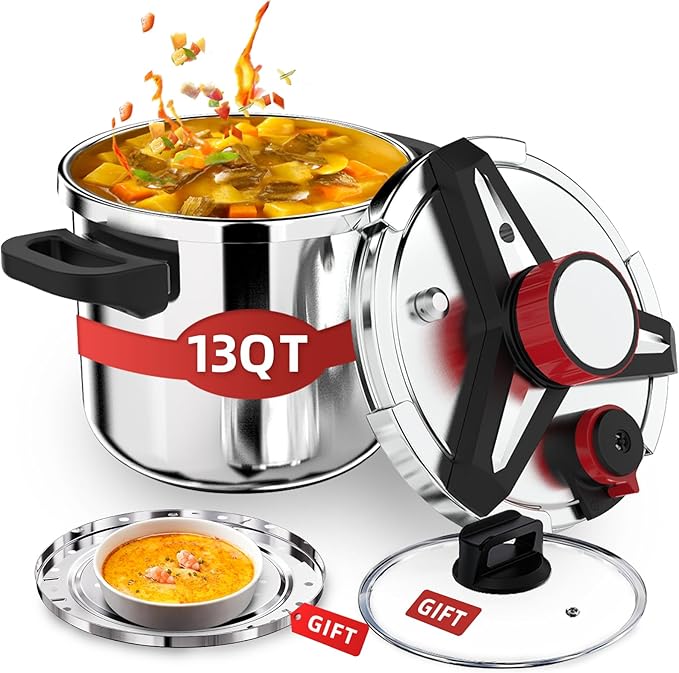
SVKLHY’s big 13‑quart pressure cooker is another 3‑in‑1 design: pressure pot, classic pot (with glass lid), and steamer in one. The star feature is its three clearly defined pressure settings, ranging roughly from 10 to 15 PSI, chosen with a twist of the knob so you don’t have to guess what “high” means for delicate vs dense foods.
Why people warm up to it fast
- Beginner‑friendly behavior – Reviews from first‑time pressure‑cooker owners are very upbeat; once you follow the manual once or twice, it becomes “routine kitchen gear.”
- Generous capacity – 13 quarts gives you room for big stock and stew batches plus canning jars when you want to preserve.
- Nice kit in the box – Tempered glass lid and steamer rack make it feel like a full cooking system, not just a single‑purpose pot.
Potential downsides
- Stainless quality fears from a few buyers – Most are happy, but at least one reported persistent marks on the base and questioned whether it’s true 304.
- Pressure markings on dark knob are hard to see – You may find yourself grabbing a flashlight the first couple of uses until you memorize positions.
- Not a dedicated electric canner – If you want “push one button and walk away” canning, the Presto digital is still easier.
Ideal for: cooks who want one large stainless system that can sear, pressure‑cook, steam, and occasionally can, with more fine‑grained pressure control than most budget models offer.
13. Buffalo QCP412 12 Qt – Pro‑Grade Clad Stainless Powerhouse

Buffalo’s classic‑series 12‑quart pressure cooker is what many stock‑making and canning nerds graduate to when they’re done replacing cheaper pots. It’s made from the brand’s proprietary clad stainless, which conducts heat faster and more evenly than conventional single‑layer stainless, and carries both ISO 9001 and Japanese SG safety certifications. Users routinely cook two chickens’ worth of stock or load it with quart jars for pressure‑canning sessions.
Why it feels “next level”
- Excellent heat distribution – Buffalo’s clad construction pulls heat up the sides as well as across the base, helping beans and broths cook evenly without hot spots.
- Serious safety track record – Certified to international standards and built with robust valves and a strong locking lid.
- Easy to clean for its size – Owners routinely note that, despite its volume, the smooth stainless interior and removable gasket make cleanup simple.
Why it’s not for everyone
- Price jump – You’re firmly in premium territory; for some, the improvement over mid‑range stainless won’t justify the cost.
- Heavy when fully loaded – Especially with bones, water, and jars inside. Many people leave it on the same burner for the entire session rather than trying to move it hot.
- Manual isn’t glamorous – The English‑language instructions get the job done but feel dated; pair it with a modern canning guide and you’re golden.
Ideal for: serious batch‑cookers and canners who want a pro‑grade, non‑reactive pot that can live on the stove for decades and pull double duty as their main stock pot.
14. Presto 02144 12‑Quart Digital – Set‑and‑Forget Canning Confidence

If pressure canning makes you nervous, this is the one that changes that. The Presto Precise 02144 is the first digital pressure canner designed to meet USDA home‑canning guidelines for low‑acid foods while automatically managing temperature and process time for you. It doubles as an electric boiling‑water canner for jams and pickles and preheats jars so you aren’t juggling hot glass by hand.
Why it’s a game changer
- Truly guided canning – The digital interface walks you step‑by‑step with icons, beeps and prompts; you don’t have to babysit a gauge or weight.
- Automatic temperature sensing – Instead of just sensing pressure, it monitors and holds the precise temperature needed for safe canning at your altitude.
- Dual mode – Switch between pressure canning low‑acid foods and boiling‑water canning high‑acid foods like jams, fruit, and salsa in the same unit.
What to consider
- Up‑front investment – It’s one of the priciest options here, but you’re buying an appliance plus a safety net, not just a pot.
- Nonstick liner history – Early units saw some liner coatings peeling; Presto has since updated the pan and replaced affected units, but it’s still worth using only non‑metal tools inside.
- Not a daily soup pot – You can cook in it, but most people use it primarily as a canner and lean on simpler stovetop pots for weeknight stews.
Ideal for: anyone who wants to pressure‑can meats, stocks, and vegetables with maximum safety and minimum anxiety—and who likes the idea of freeing up their stovetop during long processing runs.
What a 12‑Quart Pressure Cooker Actually Changes in Your Kitchen
Moving up to a 12‑quart pot isn’t just about size; it changes what’s practical on a random Tuesday night. Suddenly whole chickens, giant batches of beans, and full pressure‑canning runs are on the menu without feeling like a full‑day project.
Why 12 quarts is a sweet spot
- Real batch cooking – Double or triple recipes without crowding the pot, then freeze or can the extra so future you can “cook” by opening jars.
- Room for bones and stock – Chicken, beef, or pork bones plus aromatics need space; 12 quarts lets you fully submerge them and still have headroom.
- Canning‑friendly volume – Pots in this range typically hold four quart jars or seven or eight pints on a rack—enough to be worth the effort, not so many that it’s intimidating.
If your current 6‑ or 8‑quart cooker always ends up packed to the brim, a 12‑quart upgrade feels like someone finally gave your recipes room to breathe.
PSI, timing & safety in plain English
- 10–15 PSI is the key canning zone – That’s the pressure range that lets low‑acid foods reach 240–250°F, hot enough to safely destroy botulism spores when held for the time your recipe specifies.
- Weighted vs dial vs digital – Weighted canners (like Granite Ware) rock or jiggle when they’re at pressure; dial gauges require watching a needle; digital units like the Presto handle temperature control for you.
- Respect the manual – Always follow your pot’s own instructions for how much water to use, how long to vent steam before adding weights, and how to cool it down.
- Pair with research‑based recipes – For low‑acid foods, use canning times from a university extension or trusted guide; don’t wing it with random blog recipes.
Once you’ve done a couple of runs, you’ll find that using a large pressure cooker or canner feels surprisingly routine—check the gasket, lock the lid, vent for the recommended time, then let the pot do its thing while you tackle something else.
FAQ: Big‑Batch Pressure Cookers & Canners, Answered
Is a 12‑quart pressure cooker too big for everyday cooking?
Can I use any of these pots as a pressure canner?
- Can hold at least four quart jars on a rack.
- Maintains steady 10–15 PSI with a weight, dial, or digital control.
- Has clear, tested instructions and venting steps.
Stainless vs aluminum at this size—what should I choose?
Will a 12‑quart pressure cooker work on my glass‑top stove?
Do I really need 15 PSI, or is 10–12 PSI enough?
How long should a good 12‑quart pressure cooker last?
Final Thoughts: Picking One Big Pot You’ll Actually Use
A 12‑quart pressure cooker or canner isn’t a cute little gadget—it’s a commitment. But once it’s in your kitchen and you’re comfortable with it, you suddenly have options: cooking huge batches in under an hour, turning sale‑meat into shelf‑stable jars, and filling your freezer with homemade stock instead of buying boxes.
If you’re still torn, here’s a quick way to translate all of this into one clear choice:
-
Want the most approachable, guided canning experience?
Go straight for the Presto 02144 digital canner. It’s like having a calm, experienced canning buddy living on your countertop. -
Want a stainless workhorse that can both cook and can?
Look closely at Deeluban 12 qt or RVGMBO’s 3‑level stainless. They give you true 304/18‑8 steel, strong safety features, and enough pressure to follow serious recipes. -
Want a compact, budget canner that still plays by canning rules?
Choose the Granite Ware F0732‑2. Its weighted gauge, clear PSI steps and small‑batch capacity make it wildly popular with new canners. -
Want a pro‑grade stainless pot to keep for decades?
Invest in the Buffalo QCP412. It’s overkill for casual users, but a dream machine for people who treat stock and canning days like a ritual. -
Need the most for the least money?
On a tighter budget, the Hawkins CL12 or BreeRainz 12 qt give you big‑pot speed and capacity with a very friendly price tag.
Any of the pots above can become your best 12 quart pressure cooker once you match its strengths to your stove, cooking habits, and appetite for canning. Measure your space, decide how often you really want to batch‑cook or preserve, choose the material that feels right, and then commit. After that, it’s just you, one big pot, and a lot of very good food coming out of your kitchen much faster than it used to.
