
Specs are compiled from manufacturer listings and verified buyer reviews and can change over time — please confirm the key details on the product page before buying.
Before you buy a 12-inch saw blade, ask yourself what you will cut most. A blade that slices crown molding cleanly will struggle on aluminum, while a metal-cutting blade can leave rough, burned edges on oak. This guide matches blades to your material—wood, non-ferrous metal, or both—so you pick the right one for your saw and projects without guesswork.
I’m Mohammad Maruf — the founder and writer behind KitchPrep. This guide is built by comparing the manufacturers’ published specifications and the patterns across verified customer reviews, so you get each pick’s real strengths and trade-offs instead of marketing spin.
For the best 12 inch saw blade, matching tooth count and kerf (the width of the cut) to your material saves you time and frustration. A fine-finish blade suits trim work, while a rugged one handles metal—this guide tells you which fits your saw.
Our Picks at a Glance


How To Choose The Best 12 Inch Saw Blade
The right blade makes your saw feel new. The wrong one causes burn marks, rough edges, and wasted material. Here’s what actually matters when you’re comparing 12-inch blades.
Match the teeth to the material
High tooth counts (80 to 100) produce smooth, splinter-free cuts, ideal for trim and finish work in wood. Lower counts (like 40) cut faster and remove more material but leave a rougher edge, which suits framing or general construction where you won’t see the cut.
Check the arbor and kerf
The arbor is the hole in the center that fits on your saw’s shaft. A 1-inch arbor is standard for most 12-inch miter and table saws. Kerf is the width of the cut the blade makes — a thin kerf removes less material, so your saw needs less power and you get less waste.
Quick Comparison
| Model | Best For | Teeth | Max RPM | Item Weight | Amazon |
|---|---|---|---|---|---|
| MASTEC 100-Tooth TCG★ Best Overall | Non-ferrous metal | 100 | — | 1.27 kg | Amazon |
| Luckyway 80TBest Value | Budget wood cutting | 80 | 4,500 | 1.07 kg | Amazon |
| WEN BL1200Top Performer | Best Overall (Finish wood) | 100 | 6,000 | 1.16 kg | Amazon |
| DEWALT DWA11240 | General purpose framing | 40 | — | — | Amazon |
| CMT Orange 255.096.12 | Ultra-fine trim & veneer | — | — | 2 pounds | Amazon |
| Diablo D1296N | Aluminum & non-ferrous metal | 96 | 5,000 | 4.8 ounces | Amazon |
| Makita B-67000 | Fast, smooth crosscuts | 100 | — | — | Amazon |
| Freud LU88R012 | Premium fine finish | 80 | — | — | Amazon |
In‑Depth Reviews
1. MASTEC 12-Inch 100-Tooth TCG
Our pick — over 4.5★ from 700+ verified ratings; the strongest balance of quality and price.
The metal-cutting specialist that turns aluminum into clean, chip-free powder instead of jagged edges.
This is the blade you reach for when a project calls for aluminum, plexiglass, or other non-ferrous metals. Its 100 carbide teeth use a Triple Chip Grind (TCG) — a tooth design that alternates a flat top with a chamfered edge, so each tooth takes a finer bite and leaves a burr-free finish. At 1.27 kg, it feels substantial in hand, and the 1-inch arbor fits standard miter, circular, and table saw setups.
The cutting performance is what wins owners over instantly. Buyers report it slices through 6061-T6 aluminum cleanly — one described running it at 4500 RPM on a Unisaw for deep milling over 4 feet without issue. Another praised how it handles aluminum T-trac with “very clean cuts” and planned to buy a backup before the current one dulls.
The honest caveat is durability. While many report the carbide stays strong, a recurring note is that the carbide tips can occasionally come off, so treat it gently on impact. It’s also a metal blade — if your shop is primarily wood, the WEN below is the better match. But for anyone who fabricates with aluminum, this is the crowd favorite, backed by a strong 4.7-star average across hundreds of owners.
What wins owners over
- Clean, burr-free cuts on aluminum and non-ferrous metals
- 100 carbide teeth for a fine TCG finish
- Easy to clean after use
Who should look elsewhere
- Woodworkers will get better results from a dedicated wood blade
- An occasional unit reports carbide tips coming off
Reach for it if: your shop regularly cuts aluminum, plastic, or other non-ferrous materials and you want a clean, finished edge.
Look elsewhere if: your primary material is wood — a wood-specific blade will give you a smoother result.
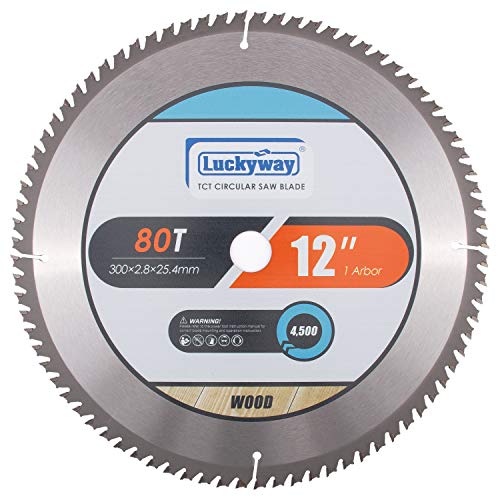
2. Luckyway 12 Inch Miter Saw Blade 80T
A throwaway-priced crosscut blade that still slices hardwoods and plywood with surprising smoothness.
If you’re tired of burning good money on premium blades for everyday cuts, this Luckyway is a smart budget play. It packs 80 tungsten carbide teeth into a thin 0.106-inch kerf (2.7 mm), which means less waste and an easier feed on your saw. The 12-inch diameter spins up to 4,500 RPM and pairs with DeWalt, Makita, Skil, and Metabo 12-inch miter saws.
The cutting feel is buttery from the first use. Buyers describe it as cutting like “a hot knife through butter,” delivering smooth, accurate crosscuts through hardwoods, softwoods, and plywood. It’s noticeably lighter than the MASTEC above at just 1.07 kg, making it easy to swap in and out.
The trade-off for that low cost is edge retention. As one owner put it, “this is a good throwaway blade. Does not stay as sharp as long as others, but for the money it’s a better value.” If you’re a weekend DIYer making a handful of cuts, this is a fantastic deal. If you’re a pro cutting daily, you’ll burn through it faster and may prefer the longer-lived WEN or Makita.
Why it’s a smart buy
- Smooth cuts on hardwoods, softwoods, and plywood
- Thin kerf means less waste and less motor strain
- Works with major 12-inch miter saw brands
The honest limit
- Sharpness fades faster than pricier rivals
- Best as a value blade, not a long-term workhorse
Perfect for: the DIYer who wants a clean cut without spending premium money.
Think twice if: you’re a contractor who needs a blade to stay sharp for months of daily use.
3. WEN BL1200 12-Inch 100-Tooth
The finish blade that delivers cabinetry-grade cuts at a price that undercuts the big names.
For woodworkers who demand a pristine edge, the WEN BL1200 is the standout pick. Its 100 carbide-tipped teeth are designed for ultra-fine finish work, and the ultra-thin 1/10-inch kerf (2.8 mm) removes less material, so your saw cuts efficiently and you keep more of your board. Rated up to 6,000 RPM, it handles both hard and softwoods with ease.
The cut quality rivals blades twice its price. Owners mention it outperforms “pricier rivals,” delivering ultra-fine finishes with no tear-out on pine, walnut, and plywood. One owner noted it’s still sharp after 3 years of use — proof of its C4 carbide and heat slots that keep the blade cool during long cuts.. It’s also the highest-rated blade on this list, with a stellar 4.7-star average.
The one nitpick from a review? It can leave more paint residue on painted boards compared to other blades. But for raw wood finishing, this is the best balance of price and performance here. Its 1.16 kg weight is comparable to the MASTEC, so it feels equally solid on the arbor.
Why it leads the list
- Ultra-fine finish with no tear-out on hard and softwoods
- 100 carbide teeth with heat slots for longer life
- Rated up to 6,000 RPM for fast, clean cuts
The small caveat
- May leave paint residue on painted boards
Grab it for: trim work, cabinetry, or any project where a splinter-free edge matters.
skip it if: you’re cutting metal — this blade is strictly for wood.
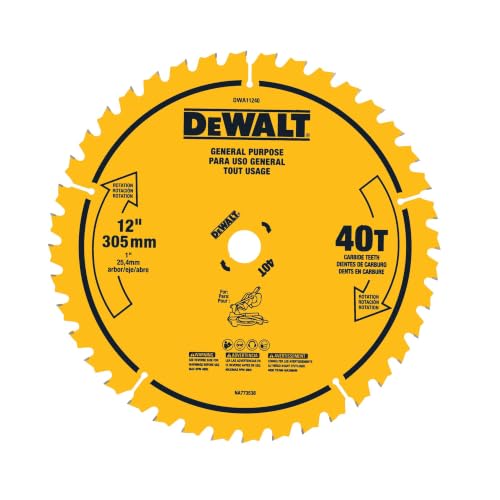
4. DEWALT 12 in. 40T General Purpose Saw Blade
The rugged everyday blade that keeps framing cuts clean without emptying your wallet.
Sometimes you don’t need a surgical finish — you need a blade that survives heavy use. The DEWALT 40-tooth blade is built for general construction on wood, with tune tooth geometry designed for accuracy and an ultra-sharp carbide edge that keeps cuts clean. It’s the lowest-tooth-count blade on this list, meaning it removes material fast for rough cuts.
That speed makes it a favorite among professionals. One general contractor who goes through blades quickly finds it performs “just as well as Diablo” at a more competitive price. Another owner used it 1-2 times a week for six months on a compound sliding miter saw and still got clean cuts with no splintering. With a strong 4.8-star average, it’s the highest-rated pick here.
The trade-off is precision. At 40 teeth, you won’t get the glass-smooth finish of the 80 or 100-tooth blades above. But if you’re chopping 2x4s and baseboards for a renovation, this is a reliable, long-lasting workhorse that won’t complain.
What makes it a daily driver
- Fast, clean cuts ideal for general construction
- 40 teeth remove material quickly
- High 4.8-star owner rating for durability
Not for fine work
- Lower tooth count means a rougher finish than 80-100T blades
Best suited for: contractors and DIYers who need a tough, fast-cutting blade for everyday wood.
Consider another if: you’re doing visible trim work that demands a splinter-free edge.
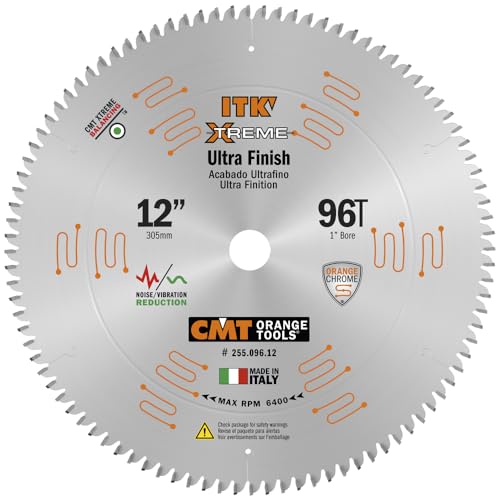
5. CMT Orange Tools 255.096.12 Ultra Fine
A premium trim blade where laser-cut engineering meets tear-out-free performance on veneers.
This CMT blade suits the woodworker who judges a cut by its reflection. It handles hardwoods, MDF, melamine, paneling, and veneered plywood, using a Hi-ATB (high alternate top bevel) grind—teeth angled in alternating directions to slice veneer fibers cleanly—for ultra-fine finishes on crosscuts and miters. A laser-cut steel plate body keeps it true and stable, so your cuts stay straight.
The engineering details set it apart. It features laser-cut heat expansion slots to keep the blade cool, polymer-filled sound dampening slots to reduce vibration, and a tensioning ring for stability. At 2 pounds, it carries real heft, and the industrial chrome carbide with mirror-finish sharpening shows in the cut quality.
Owners are consistently impressed for trim work. One noted it made “very sharp clean cuts” on baseboard, while another praised its lack of tear-out on red oak. The reviews are overwhelmingly positive on blade quality, with the main caveat being occasional wobble at speed for some users. If you do fine woodworking, this is a serious upgrade over stock blades.
The craft-grade strengths
- Exceptional finish on veneers, MDF, and hardwoods
- Laser-cut body with sound dampening for stability
- Long-lasting chrome carbide teeth
Who should pass
- Casual DIYers who don’t need premium trim finishes
- A few customers note wobble during use
Invest here if: you’re a finish carpenter or serious woodworker who needs flawless cuts on veneers and trim.
Save your money if: you only do rough framing cuts where a cheaper blade does the job.
6. Diablo D1296N 12″ 96-Tooth TCG

The heavy-duty aluminum blade that shrugs off impact and keeps cutting for years.
Where the MASTEC is a great value metal blade, the Diablo D1296N is the premium upgrade for serious fabricators. Its 96-tooth Triple Chip Grind (TCG) design is engineered for aluminum, copper, brass, plastics, and fiberglass, delivering clean, burr-free finishes that virtually eliminate rework. The Tri-Metal shock-resistant brazing lets it withstand extreme impact on tough jobs.
Durability here is exceptional. One owner reported 8+ years of life on thousands of cuts with a milled finish still intact.. Another used it extensively on aluminum fencing with hundreds of cuts and saw no dulling — proof of the Perma-SHIELD non-stick coating that resists heat, gumming, and corrosion.. At just 4.8 ounces with a 0.091-inch kerf and 5,000 max RPM, it’s remarkably light for its cutting power.
The main advice from experienced buyers is to use a lubricant like WD-40 for cleaner cuts on softer aluminum. A key caution: verify you receive the correct blade, as some owners received a mislabeled 100-tooth wood blade instead of this TCG version. But for clean, durable metal cutting, it’s a top-tier choice.
Why it’s a pro favorite
- Clean, burr-free cuts on aluminum and copper
- Tri-Metal brazing resists impact and dulling
- Perma-SHIELD coating prevents gumming
The fine print
- Slow feed needed on some materials to avoid grabbing
- Double-check you receive the right model
Choose this if: you regularly cut aluminum and want maximum blade life.
Maybe overkill if: your metal cutting is occasional — the MASTEC offers better value for light use.
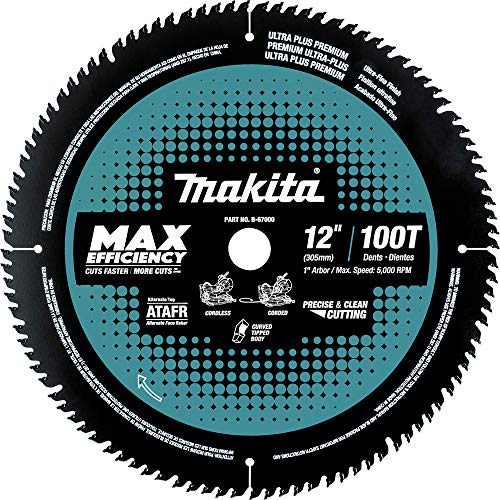
7. Makita B-67000 12″ 100T
The blade that makes pressure-treated lumber feel soft, cutting through in under a second.
Makita’s Max Efficiency design is claimed to cut up to 100% faster than standard blades., and owners say that claim holds up. Its 100 carbide teeth use a special ATAFR grind (alternate top alternate face with raker) — an advanced tooth geometry for smooth, fast cuts — and the thin kerf reduces drag on the motor while minimizing material loss.
The speed difference is dramatic in real use. One owner replaced an old blade and cut through a pressure-treated 2×8 in under a second, compared to 10 seconds before, with no smoke and a smooth edge. Another has run it daily since January and it stayed sharp for 6+ months until an apprentice accidentally cut a backer board.. Even long-time Freud fans have switched, noting they prefer this Makita blade.
At a 4.8-star average, it ties with the DEWALT for the highest rating here. The catch is availability and the occasional buyer who expects it to cut perfectly through everything. But for fast, tear-out-free crosscuts on hardwoods like mahogany, oak, and hickory, this is a brilliant performer.
Why owners rave
- Dramatically faster cuts than standard blades
- Smooth, clean finish with minimal tear-out
- Thin kerf reduces motor drag
The reality check
- Fast cutting requires careful handling to avoid mistakes
Buy it if: you want the fastest possible clean crosscuts on your miter saw.
Stick with the WEN if: budget matters more than cutting speed.
8. Freud LU88R012 12″ Thin Kerf

The top-shelf finish blade with premium TiCo carbide for the smoothest cuts in walnut and maple.
When only the finest cut will do, the Freud LU88R012 is the blade serious woodworkers eventually buy. Its 80 teeth use a premium TiCo (titanium-cobalt) hi-density carbide blend for maximum performance, and the ATB (alternate top bevel) grind with a 15° positive hook angle produces smoother cuts and allows a faster feed rate. The thin 0.094-inch kerf reduces waste and feeds easier.
The cut quality is the benchmark others are measured against. One owner who previously used a Diablo blade found the Freud “cuts extremely well, much better” with minimal wood resin build-up and zero burns even on thick 4x material. Another praised its smooth finish on walnut and maple for a DeWalt miter saw. The Perma-Shield non-stick coating keeps it clean and corrosion-free.
It’s the priciest blade on this list, and there’s a small trade-off: some owners note slight blade flutter visible in the cut. But for veneer plywood and fine hardwoods, it’s considered a worthy upgrade over stock blades. If you’re a pro who wants the best finish and doesn’t want to think about blade limitations, this is it.
The luxury strengths
- Premium TiCo carbide for exceptional longevity
- Zero wood burns even on thick material
- Thin kerf minimizes waste
The honest cost
- Premium price tag
- Some reviewers point out blade flutter on certain cuts
Go premium if: you’re a professional or serious hobbyist who demands the finest finish on expensive hardwoods.
Consider the WEN if: you want most of that quality without the premium price.
Understanding the Specs
Tooth Count and Grind
Tooth count is the single biggest predictor of cut quality. A blade with 40 teeth cuts fast but leaves a rough edge, making it ideal for framing. Blades with 80 to 100 teeth produce smooth, splinter-free finishes suited to trim work and cabinetry. The grind matters too — ATB (alternate top bevel) teeth are angled to slice wood fibers for a clean finish, while TCG (triple chip grind) teeth are designed for non-ferrous metals and plastics, leaving a flat-bottomed, burr-free cut.
Kerf and Arbor Fit
Kerf is the width of the slot the blade cuts. A thin kerf (around 0.09 to 0.10 inches) removes less material, which means your saw needs less power and you generate less waste — a win for most users. The arbor is the center hole that mounts on your saw’s shaft; a 1-inch arbor is the standard for 12-inch miter and table saws. Always verify both dimensions match your machine before you buy.
FAQ
What is the difference between a 40-tooth and 100-tooth saw blade?
Can I use a wood blade to cut aluminum?
What does the arbor size mean and will a 1-inch arbor fit my saw?
What is kerf and why does it matter?
How long should a 12-inch carbide saw blade last?
What does TCG mean on a saw blade?
Can I use a 12-inch blade on a 10-inch miter saw?
Why does my saw blade burn the wood?
Final Thoughts: The Verdict
The 12 inch saw blade winner for most woodworkers is the WEN BL1200 because its 100-tooth carbide design delivers a flawless finish at a fraction of the cost of premium rivals. If you’re cutting metal, the MASTEC TCG is the essential addition to your shop. And for contractors who need a fast, durable daily driver, the DEWALT DWA11240 is the reliable workhorse to reach for.
How We Picked
We do not accept paid placement. Every pick is matched to a real buyer and a real use-case; we do not hands-on test units.
Sources & Methodology
Specifications: manufacturer listings and product documentation. Review insights: verified customer reviews, as of September 2026. Pricing: not shown on this page (it changes often); check the current price via the retailer link.
As an Amazon Associate, KitchPrep earns from qualifying purchases. This does not affect which products we feature.
Related Guides
