
Specs are compiled from manufacturer listings and verified buyer reviews and can change over time — please confirm the key details on the product page before buying.
If your trim comes off the saw with fuzzy edges, burn marks, or torn-out grain, the blade is almost always the reason — not your technique and not your saw. A 12 inch miter saw blade with the right tooth count and a thin kerf (a narrow cutting width that removes less material) can turn the same cut from “needs sanding” into “ready to install.” This guide breaks down nine 12 inch miter saw blades that owners actually keep buying, sorted by what each one does best.
I’m Mohammad Maruf — the founder and writer behind KitchPrep. This guide is built by comparing the manufacturers’ published specifications and the patterns across verified customer reviews, so you get each pick’s real strengths and trade-offs instead of marketing spin.
Before you buy, decide if you need a general-purpose blade for framing lumber or a fine-finish blade for trim and cabinets. That choice narrows the field faster than any brand comparison, and it shapes every recommendation in this guide to the best 12 inch miter saw blade.
Our Picks at a Glance


How To Choose The Best 12 Inch Miter Saw Blade
Every 12 inch miter saw blade on this list spins at 12 inches across and mounts on a 1-inch arbor, which is the standard hole in the middle that slides onto your saw’s spindle. What separates them is everything else: how many teeth they carry, how wide a slice they remove, and how the teeth are angled. Get those three right and you will not need to think about blades again for a long time.
Tooth count is your first decision
A 32-tooth blade rips through framing lumber fast because each tooth takes a big bite, but those big bites leave rougher edges. An 80-tooth blade takes smaller, more frequent bites, so the cut comes out smoother — that is why 80T and 100T blades are the standard for trim, molding, and cabinet work. If you cut both framing lumber and finish trim, a two-pack with one 32T or 40T blade plus one 80T blade covers both jobs without changing blades mid-project.
Kerf width affects speed, waste, and strain
Kerf is the width of the groove the blade carves out of the wood. A thin kerf removes less material, which means the saw motor works less hard and you lose less of your board to sawdust. That matters most on a 12 inch blade, because a bigger blade has more tooth contact with the wood at any moment. Look for kerf figures like 0.091 inches or 0.094 inches if your saw is on the smaller-motor side, or full-kerf blades if you want maximum blade stiffness.
Hook angle and tooth grind decide cut quality
The hook angle is the tilt of each tooth relative to the blade body, measured in degrees. A positive hook angle pulls the blade into the wood aggressively and feeds faster. A negative hook angle holds back slightly, which reduces the blade’s tendency to climb toward you — a real safety consideration on a sliding miter saw. Tooth grind names how the tips are shaped: ATB (alternating top bevel) points teeth left and right in turn for clean crosscuts, while ATBR adds a flat raker tooth between them to clear chips faster.
Quick Comparison
| Model | Best For | Teeth | Arbor | Kerf | Amazon |
|---|---|---|---|---|---|
| DEWALT DWA112CMB Combo Pack★ Best Overall | Framing plus finish in one box | 40T and 60T | 1 inch | — | Amazon |
| WEN BL1200Budget Champion | Ultra-fine crosscuts on a budget | 100T | 1 inch | 2.8 mm (1/10 inch) | Amazon |
| FOXBC 80T Fine FinishChip-Free Specialist | Chip-free cuts in veneered plywood and melamine | 80T | 1 inch | 0.118 inch | Amazon |
| Luckyway 2-Pack (32T and 80T) | Two blades for mixed shop work | 32T and 80T | 1 inch | 0.106 inch (2.7 mm) | Amazon |
| DEWALT DWA11280 | Trim work on sliding miter saws | 80T | 1 inch | — | Amazon |
| CMT Orange Tools 253.072.12 | Hardwood and engineered wood | 72T | 1 inch | 0.102 inch | Amazon |
| Makita A-93734 | Mirror-smooth trim cuts | 100T | 1 inch | 0.091 inch | Amazon |
| Freud LU88R012 | Thin-kerf crosscuts with less waste | 80T | 1 inch | 0.094 inch | Amazon |
In‑Depth Reviews
1. DEWALT Miter Saw Blade Combo Pack, 12” Blades, 40 Tooth & 60 Tooth, Fine Finish, Ultra Sharp Carbide (DWA112CMB)
Our pick — over 4.5★ from 350+ verified ratings; the strongest balance of quality and price.
Two blades in one box so you can frame, then finish, without stopping to swap steel.
Most people buying a miter saw blade have the same problem: one blade rarely does both jobs well. This DEWALT combo pack solves that by shipping two 12 inch blades at once — a 40-tooth for fast cuts and a 60-tooth for cleaner ones — so you are covered from rough framing through trim. Both mount on a 1-inch arbor and spin at 12 inches across, matching the standard spindle on the vast majority of 12-inch miter saws.
What wins people over here is the build quality. DEWALT uses a patented body slot design (a set of laser-cut openings in the steel plate) that keeps the blade from vibrating as it spins, plus an tune tooth geometry aimed at more accurate cuts. The teeth themselves are ultra-sharp carbide, the hard tip material that does the actual cutting and keeps its edge far longer than plain steel. Buyers report the 60T blade “cuts through 2×8 pressure treated lumber with ease,” which is a solid real-world sign for a blade marketed toward finish work.
The durability story holds up on harder material too. One owner built a 2,800 sq ft IPE Brazilian hardwood deck and wore out only the 40T blade — the 60T had barely started. That is a demanding test, since dense hardwood eats cheap blades alive. At 4.9 pounds, the pair also feels substantial in the hand, and the 0.6-inch item thickness is notably chunky compared with the 0.12-inch plate on the FOXBC 80T below.
What earns its place here
- Two tooth counts cover both framing and finish, so you are not rebuying for a second job
- Patented body slot design for low vibration keeps cuts steadier
- Real owner feedback confirms the 60T handles 2×8 pressure treated lumber easily
Where it asks something of you
- Higher tooth count fine-finish blade is not included, so glass-smooth trim still needs a separate 80T or 100T purchase
- At 4.9 pounds the pair is heavier to store and handle than a single thin-kerf blade
Reach for this if: you want one purchase that covers a mixed workload of framing lumber and everyday trim.
Look elsewhere if: your saw work is finish-only and you would rather have a single high-tooth-count blade for cabinetry and molding.
2. WEN BL1200 12-Inch 100-Tooth Carbide-Tipped Ultra-Fine Finish Professional Woodworking Saw Blade for Miter Saws and Table Saws, Silver
The budget blade that turned a skeptical woodworker into a repeat buyer.
If you cut trim, this is where the value lives. The WEN BL1200 packs 100 carbide-tipped teeth onto a 12-inch plate, which is the tooth count you want for ultra-fine finish work — more tips means each one shaves off a smaller slice, so the surface comes out noticeably smoother. It runs on a 1-inch arbor (the center hole that mounts on the saw) and is rated to 6000 RPM (revolutions per minute, the speed the blade spins), matching what most 12-inch miter saws spin at under no load.
The standout number is the kerf: 2.8 mm, or roughly 1/10 inch. That is a genuinely thin slice, and it means less wood turned to sawdust and less drag on your saw’s motor. Owners describe cuts in pine, walnut, and plywood with no tearout, splinters, or burns — the three defects that send trim back to the sander. One owner reports it still sharp after three years, and others say it outcuts pricier blades on the same saw.
Cut quality is what wins people over here more than anything else, and the value keeps them coming back. Compare it to the FOXBC 80T below and the trade-off is tooth count versus price: the WEN carries 100 teeth against the FOXBC’s 80, but the FOXBC uses a thicker 0.118-inch kerf that adds stiffness. Weighing 1.16 kg, the WEN is also the lighter of the two, which makes it easier to swap in and out. The honest caveat is durability — some owners find it does not hold an edge as long as premium blades, so treat it as a blade you may replace sooner if you cut dense hardwood daily.
What separates it: a 100-tooth ultra-fine finish blade at a budget-tier position is unusual, and the thin 2.8 mm kerf keeps your saw motor working less hard on every cut.
The real trade-off: it fits the majority of 10-inch miter saws, jobsite saws, and table saws alongside 12-inch models, but the thin plate means you should let the blade do the cutting rather than forcing the feed.
Best for: a first fine-finish blade or a spare you keep mounted for trim days.
Think twice if: you cut dense hardwood all day and want the longest possible edge life from a single blade.
3. FOXBC 12 Inch Miter Saw Blade 80 Tooth Fine Finish Wood Crosscutting Saw Blade with 1 Inch Arbor
Built for the boards that chip if you look at them wrong — melamine and veneered plywood.
Melamine and veneered plywood are unforgiving: one wrong tooth and the face chip ruins the panel. FOXBC engineered this blade specifically for that job, marketing it for chip-free cuts in veneered plywood, melamine, and MDF, plus fine crosscuts in hardwoods and softwoods. The 80 carbide teeth are ground in an ATB pattern (alternating top bevel, where teeth point left and right in turn) with a 7-degree hook angle, a shallow tilt that feeds steadily rather than grabbing.
The geometry numbers back up the intent. A 0.118-inch kerf marks this as a thin-kerf blade, so it removes less material than a full-kerf blade and strains the motor less. Laser-cut stabilizer vents trap noise and vibration, which keeps the blade cooler and reduces blade warp — a real benefit on a 12-inch blade, where heat buildup and warping ruin cut accuracy. Owners mention perfectly clean cuts on soft pine 2×4 that outperformed a DEWALT replacement blade.
Two physical notes worth knowing. At 0.12 inches thick, this plate is dramatically thinner than the 0.6-inch DEWALT combo pack in the top spot — a slimmer, more flexible blade that rewards a steady, unhurried feed rather than force. And at 1.33 kg, it is the heavier blade against the 1.16 kg WEN BL1200 above, so you are trading a little heft for the wider 0.118-inch kerf. The recurring note on durability is that it will not hold an edge forever under constant hardwood use.
Why trim carpenters keep one on hand: the ATB grind and shallow 7-degree hook angle produce the kind of smooth, chip-free crosscut that panel goods demand.
One thing to watch: durability gets mixed feedback under heavy hardwood, so let this blade cool between long runs.
Choose this one: for melamine shelving, veneered plywood cabinets, and MDF moldings where chipping is the enemy.
Skip it for: demolition or rough framing, where a 32T general-purpose blade does the work faster.
4. Luckyway 12 Inch Miter Saw Blades 32T General Purpose & 80T Fine Finish with 1 Inch Arbor TCT (Tungsten Carbide Tipped) Saw Blade for Cutting Wood 2-Pack

A framing blade and a finish blade in one box, priced like a single mid-tier blade.
Two blades with different jobs is a genuinely useful pairing. The Luckyway 2-pack hands you a 32-tooth general-purpose blade for fast cuts through softwoods and a 80-tooth fine-finish blade for smoother surfaces — mount the 32T for dimensional lumber and break out the 80T when the cut will be seen. Both work on a 1-inch arbor (the center hole that mounts on the saw) at a maximum 4,500 RPM (revolutions per minute, the speed the blade spins).
Owners describe the cutting action simply: it “cuts like butter.” The blade quality gets the most favorable feedback, with the cutting performance close behind. The teeth are tungsten carbide, a tip material chosen for wear and heat resistance, and the blade is marketed as being able to handle embedded nails in wood — a real convenience on reclaimed or demolition lumber. At 0.106 inches (2.7 mm), the kerf is one of the thinner options here.
Set expectations on edge retention. Sharpness and durability both draw mixed reviews, with some owners finding the blades lose their edge faster than premium steel. That is the standard trade-off at this tier — a good-quality blade built to a price, not a blade built to be resharpened for a decade. The upside is real: if you want both a framing blade and a finish blade without paying premium prices twice, this is an efficient way to cover the shop.
Where it shines: the 80T blade gives you fine-finish capability on a budget, while the 32T handles the rough cuts for a small project.
A fair expectation: this is a practical starter set rather than a lifetime blade, so plan on replacing it more often if you cut constantly.
Reach for this if: you are outfitting a first miter saw and want both tooth counts without spending much.
Look elsewhere if: your project calls for glass-smooth mitered trim on expensive hardwood, where a dedicated finish blade earns its keep.
5. DEWALT 12 Inch 80T Carbide Circular Saw Blade, Fine Finish Saw Blade (DWA11280)
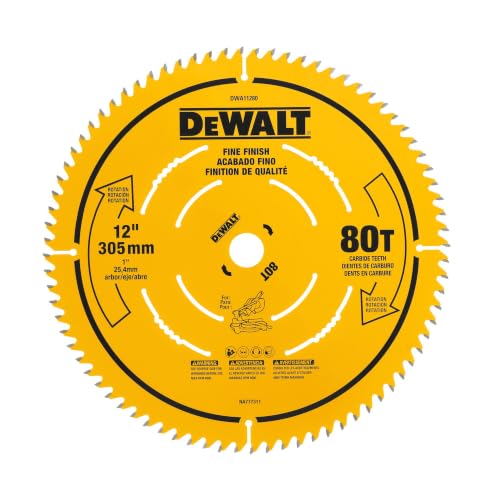
The single-blade workhorse for trim crews who cut wide boards on a sliding saw.
Trim carpenters spend their days cutting baseboard, casing, and shoe molding — mostly fine cuts on material that gets seen. This DEWALT 12 inch blade carries 80 carbide teeth, the balance for smooth trim work that still feeds at a reasonable pace. DEWALT rates it up to 3X longer blade life, with the same patented low-vibration body slot design as the top-pick combo pack.
The standout spec for sliding-saw owners is compatibility. Customers note it works great in both stationary and sliding miter saws for wider boards, which matters because a 12-inch sliding saw cuts boards wider than a standard miter saw can reach. The blade handles softwood, hardwood, chipboard, and plywood, and owners who run it on a DWS780 report it cuts far cleaner than the stock blade the saw ships with — no blowout on the back edge.
Vibration control is the recurring theme. Owners describe it running true with no vibration or singing on trim work, and one notes the thin kerf (a narrow cutting width that removes less material) works well for a fine finish cut. A single mixed note lands on longevity — a couple of owners put it in “okay, not great” territory, though the blade is still sharp enough to keep cutting after half a house of trim. It depends on what you expect from a mid-tier blade: this one trades a bit of edge life for consistent, clean cuts on a variety of woods.
Strengths worth noting
- Works in both stationary and sliding miter saws, so wide-board trim is covered
- Patented body slot design and low-vibration build keep cuts running true
- 80 carbide teeth deliver clean cuts on softwood, hardwood, chipboard, and plywood
- Cuts noticeably cleaner than the DEWALT DWS780 stock blade, per owners
The catch to weigh
- Some owners find it does not hold its edge as long as a dedicated premium blade
- Single blade only, so a rough-cutting tooth count is not included
Trusted pick for: finish carpenters running a sliding miter saw on trim packages.
Look past it if: you need one blade that also handles rough framing cuts.
6. CMT Orange Tools 253.072.12 – Fine Finishing Saw Blade D=12 B=1 ß=ATB 15 K=0.102 P=0.071 a=7
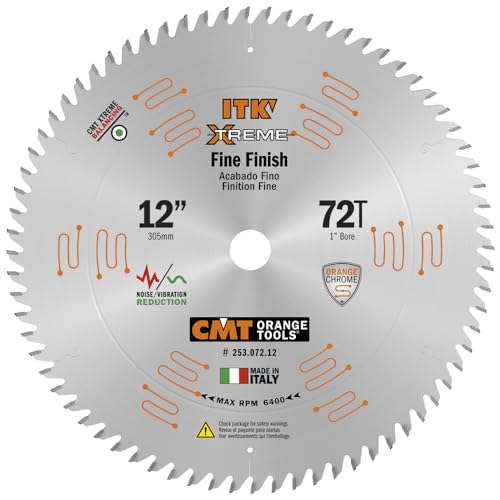
The blade that finish carpenters keep sharpening instead of replacing.
If you do high-end work in hardwoods, engineered wood, and molding, this is the one to know about. CMT builds this 12-inch blade with industrial chrome carbide teeth and a precision mirror finish sharpening — the mirror refers to how finely the tips are polished, which translates to a cleaner shearing action on the wood. The 15-degree ATB tooth grind and 0.102-inch kerf sit in the full-kerf territory, giving the plate more stiffness than the thin-kerf blades on this list.
CMT’s engineering shows up in the plate details. The steel body is laser-cut, and it carries laser-cut heat expansion slots and sound dampening slots filled with polymer to keep the blade cool and quiet at speed. A tensioning ring keeps the plate stable, and tri-metal brazing holds each carbide tip in place. Owners cutting hardwoods report butter-smooth cuts, minimal tearout and chipout, and better tracking than the thin-kerf blades here.
Two details give this blade real staying power. First, the teeth angles are etched into the plate for resharpening, and owners confirm the blade accepts a professional sharpening. Second, the mirror-polished finish resists pitch buildup, so resin from pine and oak does not stick to the plate and drag. A 35-year finish-work veteran bought a second CMT for a separate saw rather than switch brands. Its 0.11-inch plate thickness sits between the very thin FOXBC and the much thicker DEWALT combo pack.
Why it earns premium standing: hardness, stability, and resharpening-friendly etched angles make this the blade to buy once and send back for service.
Where it asks patience: full-kerf blades need a saw with adequate power, and you should feed steadily to get the smoothest possible surface.
Choose this one: for ongoing finish carpentry in hardwoods, MDF, and molding where resharpening beats replacing.
Skip it for: occasional weekend cuts, where a thinner, cheaper blade gets the job done.
7. MAKITA 12″ X 1″ 100T MICRO POLISHED MITER SAW BLADE, A-93734, Silver
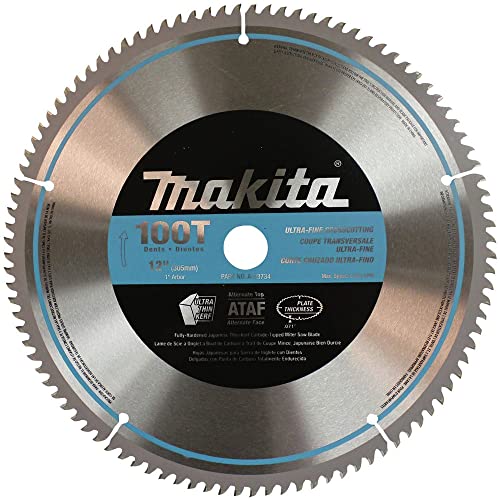
Cut surfaces so clean, owners compare them to sandpaper grit ratings you usually only hit by hand.
This is the smoothest-cutting blade on the list, and the numbers say so. Makita hones each carbide tooth with up to 600 grit for a mirror finish — a polish level that makes the tips glide rather than scrape. The blade runs a 100-tooth count on a 1-inch arbor, with an ultra-thin 0.091-inch kerf and a 0.071-inch plate, making it the thinnest-kerf blade here. The 5-degree hook angle is a shallow, controlled bite aimed at ultra-fine crosscutting in hardwood.
The results confirm the intent. Owners cutting walnut, oak, mahogany, poplar, and pine rate cross-grain smoothness at 120 to 220 grit — sanding-free, install-ready. The blade handles MDF, Baltic Birch plywood, and acrylic cleanly, and contractors call it the best blade they own, reporting it cuts oak like butter with a smooth finish. On Baltic Birch, owners rate it slightly better than the leading competitor blade, with less splintering.
What makes this blade distinctive: the steel plates are fully hardened and expertly hand tensioned to keep the cuts running true — a manufacturing step you will not find at every price point. The thin 0.091-inch kerf means less waste on expensive hardwood, which is real money on a big project. The trade-off to note: it needs a slower feed than thicker blades, and one owner reported a unit that did not run true, suggesting the tight tolerances deserve a quick check on install.
Why it scores high on cut quality
- 600-grit honed teeth leave a mirror finish that owners compare to 120-220 grit sanded surfaces
- Ultra-thin 0.091-inch kerf wastes less hardwood on every cut
- Fully hardened, hand-tensioned steel plates keep cuts running true
- Excellent on MDF, Baltic Birch plywood, and acrylic as well as solid hardwoods
Where it demands a slower pace
- Thin plate means you should feed slower and let the blade work rather than forcing it
- Restricted to wood and wood products, so acrylic and non-ferrous metals are outside its lane
Trusted pick for: finish carpenters and cabinet makers cutting show-quality hardwood trim and panel goods.
Look past it if: you want a blade for rough lumber or high-volume cutting where speed beats finish.
8. Freud LU88R012: 12″ Thin Kerf Fine Finish Crosscut Blade

A thin-kerf crosscut blade with a non-stick coating that shrugs off pitch and resin.
Veneered plywood is a legitimate test for any blade, and this is the Freud build for that cut. The 80-tooth crosscut blade runs a positive 15-degree hook angle — a steeper tilt than most blades here — which feeds faster and produces a smoother surface. It also uses Freud’s TiCo HI-Density Carbide blend, a tip formulation the maker designed for premium crosscutting performance, with a 0.094-inch kerf and 0.071-inch plate making it a thin-kerf blade.
The Perma-Shield coating is the standout feature: a non-stick surface that reduces blade drag, protects the blade from corrosion, and stops pitch from building up on the steel. If you cut resinous woods like pine or pressure-treated lumber, pitch buildup is what kills cut quality over time — it grabs the wood and leaves burn marks. Owners cutting thick 4x stock report zero burns and minimal resin buildup, and one user ran it two years with only occasional cleaning.
On fit and match: it works in circular saws, miter saws, and table saws, so it is more versatile than a miter-only blade. Compared to the Makita 100T above, it carries fewer teeth (80 versus 100) but has a much thinner 0.094-inch kerf and the non-stick coating the Makita data does not list. Owners do note one honest limit: on a 12-inch miter saw, some find it produces visible blade flutter and stops slightly short of glue-ready edges, preferring a dedicated table saw blade for final fit.
Where it shines: the Perma-Shield coating and thin kerf combine to keep cut quality consistent even on resinous wood.
A fair caveat: durability gets mixed feedback, with some owners finding the blade tears through wood over time rather than slicing cleanly.
Best for: crosscutting veneered plywood and thick stock on a miter saw where pitch buildup is the enemy.
Think twice if: you want glue-ready edges straight off the miter saw without a follow-up pass.
Understanding the Specs
Tooth Count and Grind
A blade’s tooth count tells you how smooth the cut can be. At 32 or 40 teeth, each tooth takes a large bite and clears wood fast, which suits framing lumber but leaves rougher edges. At 80, 100, or more teeth, each tooth takes a smaller bite, and the result is the glass-smooth surface you want for trim, cabinetry, and flooring. Tooth grind works alongside the count: ATB (alternating top bevel) points teeth left and right in turn for clean crosscuts, while ATBR adds a flat raker tooth to clear chips faster. A lower hook angle like -5 degrees holds the blade back, which is safer on sliding saws, while a positive angle like 15 degrees feeds faster and cuts smoother.
Kerf and Arbor
Kerf is how wide a slice the blade removes from the wood. A thin kerf like 0.091 inches or 0.094 inches means the blade takes out less wood, so the motor strains less and you lose less material to sawdust — valuable when you are cutting expensive hardwood. Full-kerf blades like the CMT’s 0.102-inch cut come with a stiffer plate, which holds accuracy better under load. Arbor size is the hole in the middle of the blade, and every blade on this list uses the standard 1-inch arbor for a 12-inch miter saw. Always check the RPM rating against your saw’s no-load speed, since a blade spinning faster than its rating is a real safety problem.
FAQ
How many teeth should a 12 inch miter saw blade have for trim work?
Will a 12 inch blade with a 1 inch arbor fit my miter saw?
Which tooth count is best for cutting pressure-treated lumber?
What is the difference between thin kerf and full kerf?
Can I sharpen a 12 inch carbide miter saw blade?
How do I stop my miter saw blade from chipping melamine?
What is the best 12 inch miter saw blade for hardwood?
Do I need a special blade for cutting luxury vinyl plank flooring?
Is a blade with 100 teeth always better than one with 80?
How long should a 12 inch miter saw blade last?
Final Thoughts: The Verdict
For most shoppers, the 12 inch miter saw blade winner is the DEWALT DWA112CMB Combo Pack because two tooth counts in one box cover both framing lumber and finish trim without a second purchase, and owners confirm the 60T blade powers through 2×8 pressure treated lumber with ease. If money is the deciding factor and you want a single fine-finish blade that punches far above its tier, grab the WEN BL1200 — its 100 carbide teeth and 2.8 mm kerf (the width of the cut it makes) turn budget-tier pricing into pro-grade cut quality. And for hardwood finish carpentry where resharpening beats replacing, the CMT Orange Tools 253.072.12 is the one to reach for. Whatever you pick, match the tooth count to your wood first — that single decision settles more of the buying question than brand loyalty ever will, and it is the one most owners get wrong when they buy a blade on price alone.
How We Picked
We do not accept paid placement. Every pick is matched to a real buyer and a real use-case; we do not hands-on test units.
Sources & Methodology
Specifications: manufacturer listings and product documentation. Review insights: verified customer reviews, as of September 2026. Pricing: not shown on this page (it changes often); check the current price via the retailer link.
As an Amazon Associate, KitchPrep earns from qualifying purchases. This does not affect which products we feature.
Related Guides
