
Specs are compiled from manufacturer listings and verified buyer reviews and can change over time — please confirm the key details on the product page before buying.
Cutting aluminum on a miter saw goes wrong in one of two ways: the blade grabs and throws the workpiece, or it leaves a ragged edge you spend twenty minutes filing. The fix is almost never technique — it is a blade built for non-ferrous metal (metal that contains no iron, like aluminum), with the right tooth count and the right tooth shape. This guide covers nine 12 inch blades that are actually designed for aluminum, and it tells you plainly which tooth count suits which thickness, what an arbor is (the hole in the blade that mounts on your saw’s spindle), and why a blade that eats wood will ruin your aluminum and your nerve.
I’m Mohammad Maruf — the founder and writer behind KitchPrep. This guide is built by comparing the manufacturers’ published specifications and the patterns across verified customer reviews, so you get each pick’s real strengths and trade-offs instead of marketing spin.
Below you will find a quick comparison table, nine full reviews, a plain-English spec walkthrough, and the answers to the questions that decide whether a blade is safe in your saw. Whether you are trimming deck railing or cutting 6061 plate, the right 12 inch miter saw blade for aluminum cuts cleanly instead of grabbing the workpiece.
Our Picks at a Glance


How To Choose The Best 12 Inch Miter Saw Blade for Aluminum
Most people buying their first aluminum blade assume any sharp carbide blade will do. That assumption is the single most common reason a miter saw kicks back on aluminum. Aluminum is soft and gummy compared to wood, so it grabs teeth instead of slicing cleanly, and a wood blade with the wrong tooth geometry loads up with metal chips in seconds. The four things that actually decide your result are tooth count, tooth geometry, kerf, and the arbor hole.
Tooth count follows the thickness you cut
More teeth means a finer, smoother cut — but more teeth also means a slower feed and a hotter blade in thick stock. The blades on this list run from 80 teeth to 120 teeth. For thin sheet and extrusions under 1/8 inch, a high count in the 100-to-120 range gives you the glassy edge you want. For solid plate and heavy bar, a lower count with a deeper chip channel clears the shavings faster.
Why triple chip grind beats a standard wood tooth
A triple chip grind, usually shortened to TCG, alternates a flat-topped raker tooth with a trapezoid tooth. That shape is what keeps soft metal from clogging the gullet between teeth. Every blade here uses TCG, which is the standard geometry for cutting aluminum, brass, copper, and plastic. If a blade you are considering is not TCG, it is not a non-ferrous blade, no matter what the listing title claims.
Kerf and arbor — the specs that decide fit
Kerf is the width of the slot the blade cuts. A thinner kerf removes less material, feeds faster, and pulls less power from the saw, which matters on a cordless miter saw. The arbor is the center hole that mounts on your saw’s spindle. Nearly every blade here uses a 1 inch arbor, which is the standard for 12 inch miter and table saws, but a handful of 12 inch circular saws use a smaller spindle, so measure yours before you buy.
Quick Comparison
| Model | Best For | Tooth Count | Arbor | Kerf | Amazon |
|---|---|---|---|---|---|
| MASTEC 12-Inch 100 Tooth TCG★ Best Overall | All-round aluminum cutting | 100 | 1 inch | — | Amazon |
| FOXBC 12 Inch 96-Tooth TCGBest Value | Extrusion and railing work | 96 | 1 inch | .094 inch | Amazon |
| CRALY C12100ALTop Performer | Thin and medium aluminum | 100 | 1 inch | 2.7 mm | Amazon |
| KURSTOL 12 inch 100T TCG | Corrugated panel and shed work | 100 | 25.4 mm | 3 mm cutting thickness | Amazon |
| TOMAX 12-Inch 120 Tooth TCG | Thin-wall railing and gutters | 120 | 1 inch | — | Amazon |
| Oshlun SBNF-120120 | Dedicated aluminum shop work | 120 | 1 inch | — | Amazon |
| Freud LU77M012 | Cold cut saw and chop saw use | 96 | 1 inch | .110 inch | Amazon |
| FOCSTOL 2-Pack 100 Tooth TCG | Two-blade value | 100 | 1 inch | 2 mm blade thickness | Amazon |
| Evolution 12BLADEAL | Low RPM Evolution saws | 80 | 1 inch | .083 inch | Amazon |
In‑Depth Reviews
1. MASTEC 12-Inch 100 Tooth TCG Saw Blade with 1-Inch Arbor
Our pick — over 4.5★ from 700+ verified ratings; the strongest balance of quality and price.
The do-everything aluminum blade that has earned the loudest following of the whole group.
A hundred carbide teeth on a 1 inch arbor is the specification that puts this blade at the front of the pack. For you that means one blade covers aluminum angle, T-track, plexiglass, and plastic without a swap. The triple chip tooth shape — a flat-topped tooth alternating with a trapezoid — is what lets soft metal clear out of the cut instead of gumming up the teeth.
What wins people over on this one is raw cutting performance, by a wide margin over every other praise point. The proof is in cuts like this, as buyers report: “Cut 6061-T6 aluminum, 3/8″ wall,.020″ cuts, 1″x.140″ over 4ft angle; ran true 1+hr at 4500 RPM on Rockwell Unisaw with water-soluble fluid.” That is a long production run on a table saw without the blade wandering. Buyers also clear it quickly after a job, and several mention they never had to file an edge afterward. At 1.27 kg it has real heft behind the cut, so you get more momentum through thick plate. Set it against the FOXBC below and it runs slightly heavier at 1.27 kg versus 1.19 kg.
Here is the honest catch: the blade’s own durability draws mixed feelings. The cutting edge holds, but carbide tips have been reported coming off for a small share of buyers. Treat it as a blade that rewards a steady feed and a lubricated cut rather than forcing it through heavy plate dry. The 4.7 rating across 700+ ratings says the overwhelming majority get exactly the results they paid for — this is still the blade to beat at the front of the list.
What it does brilliantly
- 100 carbide TCG teeth cut aluminum, plexiglass, and plastic with one blade
- 1 inch arbor fits miter saws, circular saws, and table saws
- Clean edges that most owners mention need no filing afterward
Where it asks for care
- Carbide tips have reportedly chipped on a small number of units
- Feed it steadily on thick stock rather than forcing the cut
Buy it if: you want one 12 inch blade that handles aluminum, plastic, and plexiglass on any saw in your shop.
Think again if: your cutting is almost entirely thin-wall extrusion, in which case a higher tooth count serves you better.
2. FOXBC 12 Inch 96-Tooth TCG Saw Blade with 1-Inch Arbor
An extrusion-eating blade with a narrow kerf and an appetite for railing track.
Most buyers never look past the tooth count, but the number that changes how this blade feels is the.094 inch kerf. Kerf is the width of the slot the blade cuts, and narrower means less material removed, a faster feed, and less drag on a cordless saw’s motor — so your battery lasts longer and you push through stock with less effort. At 1.19 kg, this one is the lightweight of the two direct rivals at the top of the list — the MASTEC above carries 1.27 kg, so the FOXBC is the lighter blade to hang on a sliding miter’s spindle. The 96 teeth sit just four below the MASTEC’s 100, so you give up almost nothing in cut smoothness for that lighter swing.
What owners talk about is how it eats aluminum extrusion without complaint. One buyer summed the experience plainly: it “Went thru an extruded aluminum stair lift track with the greatest of ease.” The blade is rated for thin stock up to 1/8 inch, medium stock from 3/32 to 1/4 inch, and thick stock from 3/16 to 7/16 inch, so it is genuinely a whole-job blade for railing and trim. The laser-cut stabilizer vents — small slots cut into the plate to trap noise and kill vibration — are the reason cuts land accurately on repeated passes, so your second cut matches your first. Its compatibility list covers DeWalt, Skil, Metabo, and Makita 12 inch miter, slide miter, and table saws, so the odds are high it drops straight onto your saw.
The trade-off a careful buyer should know: this is a newer blade with a smaller track record than the veterans on this list, so long-term durability is still an open question. It also asks you to respect the low hook angle and steady feed — lean on it and you will hear it. For a fresh blade at a value-tier price that handles railing and trim work cleanly, it is a smart buy rather than a gamble.
Track record in plain terms: With 86 ratings the sample is small but the pattern is tight — buyers consistently describe clean cuts with very little burr (the rough raised edge left after a cut) on the edges, which is exactly what a 96-tooth TCG geometry (trapezoidal carbide grind, a tooth shape that slices cleanly through metal) is built to deliver.
Where it leaves room: Long-term tip retention is unproven in the way the older blades’ records are, so treat it as a strong value buy rather than a decades-long tool.
Reach for this if: you cut railing, track, and trim all day and want the lightest of the top picks on your miter.
Look elsewhere if: you want the largest body of owner experience behind your purchase.
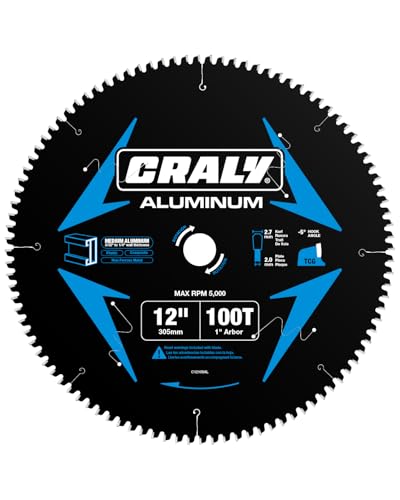
3. CRALY C12100AL 12 Inch 100 Teeth Aluminum Cutting Circular Saw Blade
Ultra-fine grain carbide and a non-stick shield, built for long runs through thin aluminum.
Sharpness is the defining trait here, and the CRALY backs it with a spec most blades on this list skip: ultra-fine grain carbide. Grinding the carbide particles finer makes the cutting edge keener and more uniform, which shows up as a smoother wall on the cut. The Black Ice shield — a non-stick coating on the plate — reduces friction and heat as you feed, so the blade keeps cutting cleanly rather than dragging as the work heats up. The 2.7 mm kerf is the thin-kerf design at work, letting the blade slice rather than scrape through medium aluminum.
What earns the most praise from owners is the edge staying sharp through a whole project. Customers note taking on large stacks of aluminum — an old pool cage is the oft-cited job — and the blade holding its bite from the first cut to the last. It handles carbon fiber sheets and acrylics too, so if your shop cuts more than aluminum, it earns its drawer space. The 1 inch arbor fits corded and cordless circular saws, and the fit has drawn zero complaints in the reviews on record.
The honest note is noise. Some buyers find it noticeably less noisy than an abrasive blade, while others describe a loud screech during operation — how loud it is depends a lot on your saw and your feed rate. Thin stock also wants a light hand, since the blade’s strength is precision rather than brute force. With 377 ratings and a strong fit record, though, this is among the most consistent performers on the list.
The case for CRALY
- Ultra-fine grain carbide holds a keen edge through long projects
- Black Ice anti-stick coating cuts friction, heat, and corrosion
- Fits corded and cordless circular saws with its 1 inch arbor
The honest trade-off
- Noise varies — some buyers hear a loud screech, others find it quieter than abrasive blades
- Best on thin and medium aluminum; it favors finesse over force
Shop owners should take note: if you cut thin and medium aluminum all day and need an edge that survives the run, this is the precision pick.
Skip past it if: your work is thick plate and you need a lower tooth count to clear heavy shavings.
4. KURSTOL Metal Circular Saw Blade 12 inch 100T TCG with 1″ Arbor
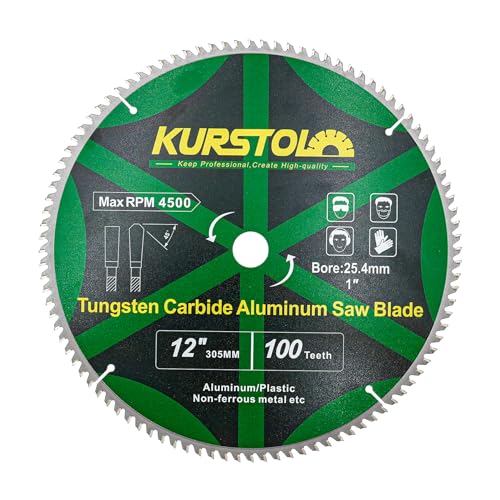
A 100-tooth cutter with laser-cut keyholes that keeps noise and vibration down on panel work.
The KURSTOL prints its speed ceiling right on the spec sheet: 4500 RPM (revolutions per minute, how fast the blade spins). That number matters because running an aluminum blade over its rated speed heats the tips and shortens their life. It mounts on a 25.4 mm arbor — the same as a 1 inch arbor expressed in metric — and uses a 3 mm cutting thickness with a 2 mm blade body, a narrow kerf that feeds fast through sheet and corrugated panels. The 45 degree trapezoidal teeth keep the edge smooth, and the laser-cut keyholes are slots that cut noise and stop lateral movement so the blade tracks straight.
Reviewers point out it cuts aluminum cleanly and mounts without fit issues. One detail stands out in the reviews, though, and it is worth reading before you buy — this blade has been used successfully when mounted backwards, a trick some cutters use for trimming corrugated metal panels. Note that reversing a blade is a personal choice, not a manufacturer instruction, so follow your saw’s manual for the correct orientation. Straight or reversed, it is a simple, dense little blade that covers aluminum, ferrous and non-ferrous metal, and plastic.
The thing to weigh: with 61 ratings, this is a smaller pool of experience than the leaders above. The feedback that exists is uniformly positive — sharp, fits right, cuts clean — but the long-term tipping track record is shorter. Treat it as a reliable everyday cutter for sheet and panel jobs rather than a blade you expect to outlast your saw.
The spec that matters most: The 4500 RPM rating is your ceiling, and staying under it is what keeps the carbide tips alive on thin, high-speed cuts.
The caveat worth knowing: Some buyers flip it backwards for corrugated panel work — a technique to use at your own discretion, not a factory recommendation.
Pick it for: sheet metal, corrugated panels, and shed work where a narrow kerf and a low noise cut save time.
Bring a second thought if: you want the longest possible durability record backing your blade choice.
5. TOMAX 12-Inch 120 Tooth TCG Thin Aluminum Saw Blade with 1-Inch Arbor

A 120-tooth smooth cutter aimed squarely at thin aluminum under 1/8 inch.
When your stock is thin, more teeth is the answer, and this TOMAX carries 120 of them. That high count puts more cutting edges in contact with the metal at once, which is exactly what produces the smooth, near-polished wall owners describe on deck railing. It is built for aluminum under 1/8 inch wall thickness, along with plastic and other non-ferrous metals. The electrophoretic coating — a baked-on finish on the plate — resists rust and corrosion, so the blade survives the humidity of a shop or a garage job site. Construction-grade carbide teeth back it up with a limited lifetime warranty.
Cuts on thin material are where the numbers do the talking. Shoppers say it cuts aluminum deck railing with a smooth, controlled finish, and it takes 1/8 inch aluminum plate without hesitation — a buyer using it on 1/8 inch plate stayed sharp after a run of roughly a dozen 24 inch cuts. One of the strongest patterns in the reviews is the absence of noise: the blade slices through gutters and box beams repeatedly without a shriek. Cutting performance and blade quality are clearly the two things owners prize here, both drawing strong marks.
The honest limit: thin is the mission. Push this into heavy solid bar and the very tooth density that makes it glide on sheet works against you — the gullets load and the cut slows. If most of your work is deck railing, gutters, and light channel, that trade never comes up. It is a purpose-built blade, and it does its purpose beautifully.
Why owners love it
- 120 TCG teeth leave a smooth, controlled cut on thin aluminum
- Electrophoretic coating resists rust and corrosion in a damp shop
- Backed by a limited lifetime warranty from TOMAX
Where to use caution
- Aimed at thin stock under 1/8 inch — heavy solid bar is not its job
- Wants a light, even feed rather than force
The railing and gutter cutter: if your work is thin-wall aluminum, the high tooth count here pays off every single cut.
Not your blade if: your projects are thick plate and solid bar that need fast chip clearance.
6. Oshlun SBNF-120120 12-Inch 120 Tooth TCG Saw Blade with 1-Inch Arbor

A professional-grade 120-tooth cutter built for the shop that cuts aluminum every day.
This is the blade you buy when aluminum cutting is not occasional. It runs 120 teeth with a negative hook angle — a tooth rake pitched away from the cut — which is what gives a controlled, non-grabbing cut on non-ferrous metal. The C-1 carbide tips are precision ground, and the expansion slots are copper-plugged, a detail that keeps the steel plate from warping as it heats during long runs. It is rated for aluminum, brass, bronze, and copper, and it carries real heft at 3 pounds, seventy-odd percent heavier than the MASTEC back at the top of the list — that mass is what helps it stay steady in thick stock. Expect to pay a premium-tier price for a blade with a shop-grade build.
Owners describe near-frictionless cutting on thick aluminum. A buyer cutting three stacked sections of 1/8 inch aluminum angle reported it “cuts through it like butter, clean edges,” with no buildup on the teeth at all. The blade also shines for self-cleaning: it keeps a consistent kerf without wandering, and it cuts thin, small pieces without biting or throwing them. Used on a miter saw, buyers report it stays sharp for weeks of work. Cut quality is the trait owners praise most, and value for money follows close behind.
One honest note about durability: this blade is rated as needing care under load. A small number of owners mention teeth coming off during sheeting work, while the majority find it long-lasting. The fix is technique — keep a steady feed, use a lubricant like stick wax rather than a wet cutter fluid, and let the blade do the work rather than pushing it. The mixed durability alongside strong cut quality is the trade-off of a high-tooth blade loaded hard.
The thing that earns the price: Copper-plugged expansion slots, precision-ground C-1 tips, and a negative hook angle combine into the smoothest-running blade on this list through thick aluminum.
What to accept: Professional-grade cutting means professional-grade feeding — steady pressure and a wax lubricant are what keep the tips intact.
The daily shop blade: buy it if you cut aluminum plate and thick extrusion as a regular part of your work.
Skip it for: occasional railing jobs where a mid-range blade does the same work for less.
7. Freud LU77M012 12″ Medium Stock Aluminum Blade
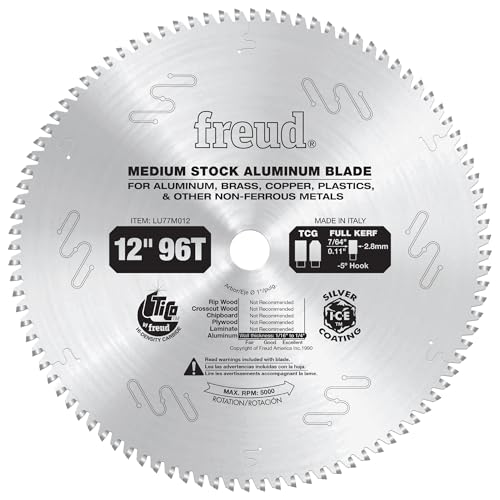
The thin-kerf specialist that cuts aluminum without wax, fluid, or a clog in sight.
Freud built this one around a thin kerf — the.110 inch slot width — which is the specification that lets it feed faster and waste less material than a standard-kerf blade. Fewer teeth means faster chip clearance too, so the 96-tooth count on this blade clears shavings out of the cut with less fuss than a 120-tooth design would. It uses a negative hook angle and a TiCo HI-Density Carbide blend built specifically for non-ferrous metal, which is what extends the tooth life. The Silver Ice coating resists corrosion and pitch build-up, keeping the blade clean between jobs.
In day-to-day use, buyers consistently land on the same description — the blade feeds through aluminum with less resistance than a wood blade would meet in oak. A buyer cutting 8020 extrusion and 6061 aluminum on a DeWalt chop saw reported “no deformation, minimal burrs.” Others run it on a Skilsaw cold-cut chop saw and note it cuts cleanly with no wax or lube needed and no chip clogging in the kerf. It is aimed at medium stock, so it is happiest on structural extrusion, plate, and tube rather than ultra-thin sheet.
The honest catch is blade balance. Thin-kerf blades carry less mass, so they demand a steady hand and a saw with a true spindle — force them and wobble can appear in the cut. This one rewards the deliberate cutter. For a shop with a chop saw or cold-cut saw and a steady feed, it is one of the cleanest aluminum cutters you can put on the arbor.
Where it earns its keep
- .110 inch thin kerf feeds faster and wastes less material
- Negative hook angle with non-ferrous TiCo carbide extends tooth life
- Cuts extrusion cleanly without wax or lube per owners
The balance to watch
- Thin kerf needs a true spindle and a steady feed to cut without wobble
- Tuned for medium stock — not the go-to for ultra-thin sheet
Ideal for the cold-cut crowd: pair this with a chop saw and medium extrusion for the cleanest finish here.
Steer clear if: your stock is thin sheet, where its lower tooth count is not the smoothest option.
8. FOCSTOL 12 Inch 100 Tooth TCG 2-Pack Aluminum Cutting Blade
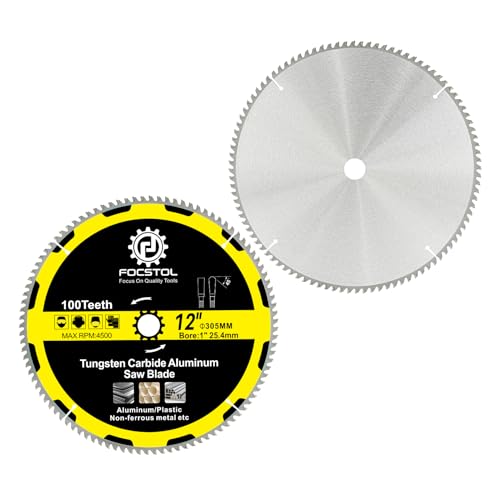
Two 100-tooth blades in one box — a spare sitting on the shelf for when the first dulls.
The headline here is the count: this pack contains two blades, not one. For a busy job that means you are not shut down mid-project when your only blade wears out. Each blade runs 100 TCG teeth with a 1 inch bore and a 2 mm blade body with a 3 mm cutting thickness, and each is capped at 4500 RPM. The 45 degree trapezoidal flat teeth cut aluminum, non-ferrous metal, and plastic, and the four laser-cut keyholes keep noise and vibration down so the blade tracks straight. It fits circular saws, miter saws, and table saws.
Customers note the blades cut aluminum well, and one buyer also cut cleanly through resin and wood. On the plus side of the two-blade format, the value math is straightforward — you get a working spare without another trip. Reviewers point out the blades arrive sharp and hold up through standard aluminum cutting.
The one thing to know before you order: the mounting hole does not fit every saw. Some circular-saw users, particularly Skil saw buyers, have found the knockout on the blade does not line up with their saw’s arbor. If your saw has an unusual spindle, measure it first. For most miter and table saw owners, that is a non-issue, and the two-blade pack is a solid value for a shop that goes through blades.
The value angle: Two identical 100-tooth blades means you always have a fresh cutter on the shelf, so a dull blade no longer stalls the job.
The catch to check: A few circular-saw shoppers say the knockout will not fit their spindle — confirm your arbor before you count on it.
Best for the working shop: if you cut often and want a spare blade ready, the two-pack format is genuinely useful.
Not for you if: you run a circular saw with a non-standard spindle and need a guaranteed fit.
9. Evolution Power Tools 12BLADEAL Aluminum Cutting Saw Blade 12-Inch x 80-Tooth
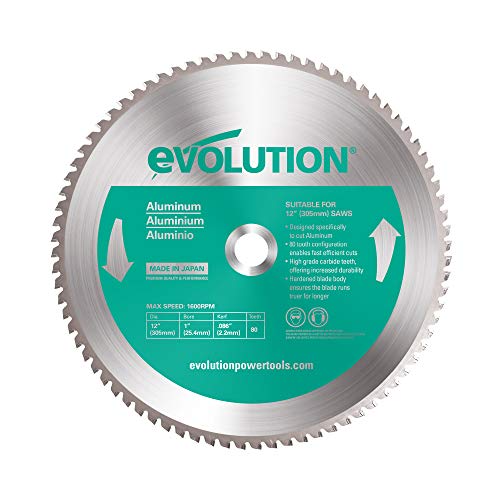
A low-rpm blade with the fewest teeth here and a razor-narrow kerf to match.
The number that decides whether this blade belongs on your saw is printed right in the spec: 1600 RPM. That is the speed ceiling it is built for, and it is far below the 4500 RPM blades elsewhere on this list. This blade is designed for use with Evolution saws or other low RPM saws — put it on a high-speed miter and it will overheat and shed teeth. Where it does belong, it runs 80 carbide teeth with a.083 inch kerf, the narrowest slot of the group, which means it cuts fast and wastes almost nothing. The 1 inch arbor fits standard 12 inch spindles.
On the right saw, owners describe it doing exactly what a low-rpm aluminum blade should. Buyers report it cuts aluminum cleanly and leaves a smooth finish. Used on a lot of aluminum, it holds up without issues for the majority of buyers. It is also comfortable cutting through thicker stock, because 80 teeth leave big gullets for chip clearance — that is the whole reason a low-tooth-count blade exists in the first place.
The catch is real but easy to manage: with only 80 teeth on a low-speed blade, the finish is rougher than the 120-tooth options, and a small number of buyers have lost a tooth early, particularly on thick 1 inch aluminum. It is a specialist tool for a low-rpm saw, not a universal blade. Match it to the correct machine and it performs; mismatch it and it will not.
What it nails on the right saw
- 1600 RPM rating pairs perfectly with Evolution and other low-rpm saws
- .083 inch narrow kerf cuts fast and wastes little material
- 80 teeth clear chips fast through thicker aluminum
The limiting factor
- Only rated for low-rpm saws — a high-speed miter will cook it
- Fewer teeth means a rougher finish than 120-tooth blades
The specialist pick: buy it if you own an Evolution or another low-rpm saw and cut thick aluminum regularly.
Do not buy it if: your miter runs at standard high speed — it is the wrong machine for this blade.
Understanding the Specs
Tooth Count and Tooth Geometry
Tooth count is the number of cutting tips around the blade, and it decides how smooth your edge comes out. A 100-tooth blade sits in the middle — smooth enough for most aluminum work and fast enough to keep feeding. Push to 120 teeth and you get the cleanest surface but a slower, more delicate cut. Drop to 80 and you clear metal chips faster, which helps on thick stock but leaves a rougher wall. Every blade on this list uses a triple chip grind, or TCG, where a flat-topped raker tooth alternates with a trapezoid tooth so soft metal does not load up between the teeth.
Kerf, Arbor, and RPM Rating
Kerf is the width of the slot the blade carves — thin kerfs like the.083 inch on the Evolution cut faster and pull less power from your saw. The arbor is the center hole that mounts on your saw’s spindle, and nearly every blade here uses a 1 inch arbor, which is standard for 12 inch miter and table saws. The RPM rating is the speed ceiling the blade is built to handle, and the.083 inch blade’s 1600 RPM ceiling tells you at a glance it belongs on a low-speed saw, never on a high-speed miter.
FAQ
Can I use a 12 inch aluminum blade on my miter saw?
What is a triple chip grind and why does it matter for aluminum?
Do I need to lubricate the blade when cutting aluminum?
What is the difference between 100-tooth and 120-tooth blades?
Can I cut steel with a 12 inch aluminum blade?
How do I keep an aluminum blade from clogging?
How long does a 12 inch aluminum blade last?
What kerf should I pick for cutting aluminum on a miter saw?
Can I sharpen a carbide-tipped aluminum blade?
Will a 12 inch aluminum blade fit a 10 inch saw?
Final Thoughts: The Verdict
If you only own one blade for aluminum, the MASTEC 12-Inch 100 Tooth TCG is the one to own — its 100 teeth and 1 inch arbor cover everything from thin angle to T-track, and its performance advantage over the rest of the field is the widest on the list. If your work leans toward thin-wall extrusion and you want the lightest top pick, the FOXBC 96-Tooth TCG is the blade to reach for. And if cutting aluminum is a daily shop task and you want the smoothest, most durable edge, the professional-grade Oshlun SBNF-120120 earns its premium price. Match the tooth count to your thickest common stock, and confirm the arbor and RPM rating before you order.
How We Picked
We do not accept paid placement. Every pick is matched to a real buyer and a real use-case; we do not hands-on test units.
Sources & Methodology
Specifications: manufacturer listings and product documentation. Review insights: verified customer reviews, as of September 2026. Pricing: not shown on this page (it changes often); check the current price via the retailer link.
As an Amazon Associate, KitchPrep earns from qualifying purchases. This does not affect which products we feature.
Related Guides
