
Specs are compiled from manufacturer listings and verified buyer reviews and can change over time — please confirm the key details on the product page before buying.
If you are running a trunk line, a dryer exhaust, or a blower hose, the thing that actually decides whether your setup works is the diameter and the insulation — not the brand name on the box. A 12 inch flex duct (a flexible, bendable tube used to move air from one place to another) has to slide over your fitting without a two-person wrestling match, and it has to hold the temperature of the air inside it so you are not paying to heat or cool the attic. This guide walks you through eight real options and tells you plainly which one fits your job.
I’m Mohammad Maruf — the founder and writer behind KitchPrep. This guide is built by comparing the manufacturers’ published specifications and the patterns across verified customer reviews, so you get each pick’s real strengths and trade-offs instead of marketing spin.
Some of the picks below come in a listed size that is close to twelve inches rather than exactly twelve, so check the spec line on every product before you buy. Read on for the honest breakdown of the 12 inch flex duct options that actually hold up on the job.
Our Picks at a Glance


How To Choose The Best 12 Inch Flex Duct
Before you order anything, you need to answer one question honestly: is this duct carrying heated or cooled air through a hot attic, or is it just moving air from a blower in a workshop? That single answer eliminates half the options on this page. An insulated duct holds temperature; a plain PVC hose just moves air and saves you money doing it.
Insulated or not insulated
An insulated duct wraps the inner tube in a blanket of fiberglass, which is what gives it an R-value — a number showing how well it resists heat passing through the wall. Higher is better here. Standard duct sits around R-4.2, and stepping up to R-6 gives you noticeably more heat-blocking per foot of run. If your duct travels through an unconditioned attic or a hot garage, insulation is not optional — it is the whole point.
Inner diameter versus outer diameter
This is where most people get burned. On an insulated duct, the listed 12 inches is the inner diameter — the hole the air actually travels through. The outside of the tube is bigger because the insulation sits around it. So a duct sold as 12 inch inner diameter will not slip neatly onto a fitting that is itself 12 inches wide. Measure your collar with a tape measure before you order, and check the size field carefully.
Kink resistance and bend radius
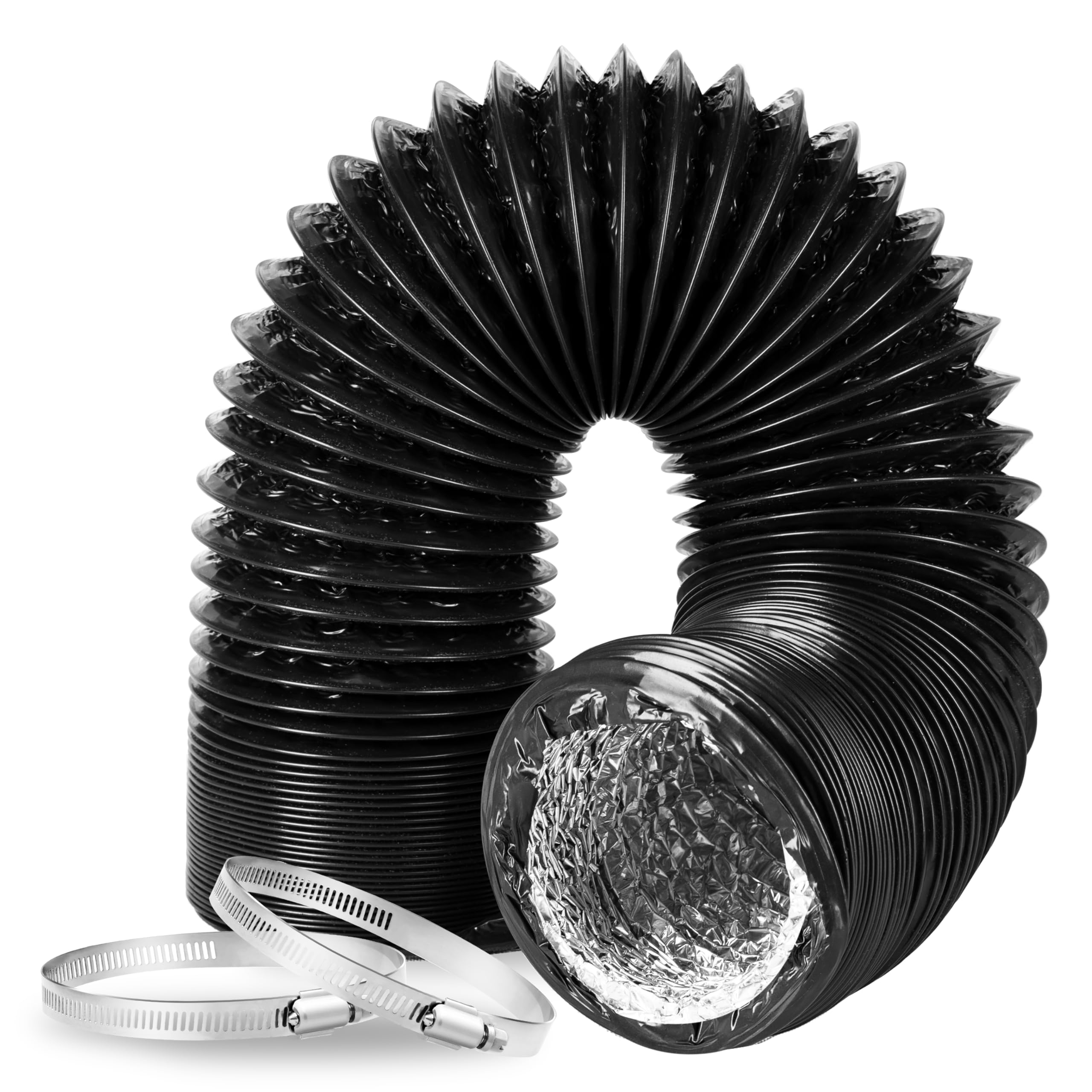
Flex duct exists so you can route it around corners and through joists. The catch is that if you bend it too sharply, the inner wall collapses and chokes your airflow. Look for a duct with a steel wire helix — a coiled wire spine built into the wall — because that spine is what keeps the tube open when it bends. A duct that kinks means your fan works harder and moves less air.
Quick Comparison
| Model | Best For | Length | Material | Diameter | Amazon |
|---|---|---|---|---|---|
| HVAC Premium 12″ Insulated R-4.2★ Best Overall | Attic HVAC runs | 25 ft | Aluminum | 12 in | Amazon |
| GAF Master Flow 12″ x 25′ R6Best Insulation | Cold-climate trunk lines | 25 ft | Aluminum | 12 in | Amazon |
| InfiniPower 12″ Insulated 25FTQuietest Run | Quiet dryer exhaust runs | 25 ft | PVC | 12 in | Amazon |
| YANBORUI 16FT PVC Duct Hose | Paint-booth venting | 16 ft | PVC | 12 in | Amazon |
| HYITCL 12Inch × 32FT PVC Duct Hose | Long blower runs | 32 ft | PVC | 12 in | Amazon |
| Rubber-Cal HVAC Insulated-Flex | Portable AC units | 25 ft | Aluminum | 12 in | Amazon |
| FICBXRA 12″ 4-Layer Ducting | Tight-space dryer venting | 8.7 ft | Aluminum | 8 in listed | Amazon |
| Rubber-Cal Air Ventilator Yellow | Blower applications | 25 ft | Rubber | 12.02 in | Amazon |
In‑Depth Reviews
1. HVAC Premium 12″ Insulated R-4.2 Aluminum Flex Duct, 25 ft
Our pick — 4.5★ from 250+ verified ratings; the strongest balance of quality and price.
The sealed inner core that keeps fiberglass dust out of your airstream
If you are replacing a duct in an attic that feeds a whole-house air handler, this is the one to put in your cart. The reason is the long list of 25 feet — enough to reach across most single-story attic runs — paired with an R-4.2 insulation value, which is a number that tells you how strongly the fiberglass blanket resists heat leaking through the wall. For a duct crossing a hot summer attic, that wrapper is what keeps your cooled air cool by the time it reaches the vent.
What makes this duct different from the cheaper foil hoses is its construction: aluminum on both the outside and the inside, with a sealed inner core. That sealed core is the part that matters most day to day, because it stops fiberglass particles from being blown into your living space — no shedding into the airstream, as the spec sheet puts it. The reinforced metallized polyester jacket adds tear and puncture resistance on top, and it is rated under UL 181, which is the safety standard governing flexible air duct. Two clamps ship in the box, so you can finish the connection without a separate trip to the hardware store.
At 7.03 kg, this is a genuinely heavy roll of duct, and you will notice the weight hauling it up a ladder alone. For context, the same-sized HYITCL PVC duct below weighs 7.33 kg while running seven feet longer, so the HVAC Premium packs more mass per foot — mostly fiberglass. That is the honest trade: you carry more weight up the ladder, and in exchange the air arrives closer to the temperature you paid for. Buyers report it swapped straight onto the old duct’s collar without adapters.
What earns its keep
- Sealed aluminum inner core keeps fiberglass out of the air you breathe
- R-4.2 fiberglass blanket resists heat loss across long attic runs
- 25-foot length handles a full trunk replacement in one piece
- UL 181 listed, with two clamps included for a finished connection
- Reinforced jacket stands up to bends and sharp turns without kinking
What to plan around
- Heavier than it looks on paper — awkward to handle solo on a ladder
- Not the tool for a workshop blower; PVC hose serves that job better
Buy it for: replacing a factory or damaged duct that ferries conditioned air through a hot attic.
Measure first if: your collar is exactly 12 inches — the listed size on this insulated duct refers to the inner bore, so the outside of the tube is wider.
2. GAF Master Flow 12″ x 25′ Insulated Flexible Duct, R6 Silver Jacket
For long trunk runs where heat loss shows up on the energy bill
Here is the number that decides it: R6 insulation, which the maker says offers around a third more heat-blocking than the standard R4.2 ducts that fill most shelves. If your duct has to cross a cold crawlspace or a steamy attic, that extra blanket is the difference between warm air reaching the room and warm air warming the rafters instead. It is also ETL listed to the UL181 standard and sits under a heavy-duty silver jacket, so the insulation stays put rather than fraying apart at the first sharp turn.
The 25-foot roll is sized for real trunk work, and the outer jacket is the tough part of the design. Buyers converting portable AC units found the jacket stretches under strain instead of tearing open. Reviewers repeatedly advise cutting and taping the whole run on the ground first, since assembling it in a hot attic is where jobs go wrong. Cutting it on the ground first turns a frustrating afternoon into a short one.
The honest catch is edge care. Where the inner tubing and outer jacket meet the collar, the fiberglass insulation can tear if you handle it roughly, and the outer sleeve has to fully overlap the clamp or it will slip free under pressure. Neither is a flaw in the duct — it is how insulated flex behaves, and foil HVAC tape fixes a small snag cleanly. At 19 pounds the roll is light enough for one person to manage on a ladder, which is a real advantage over heavier foil-wrapped options when you are working overhead.
Where it wins outright: R6 is the highest insulation value on this list, and for a duct running through an unconditioned space that is not a small edge — it is the entire purchase decision.
Fit it carefully: the fiberglass can tear at the connectors if you force it, and the silver jacket must cover the clamp completely. Prefabricate on the ground, tape the seams, and you will avoid the two things buyers flag most often.
Reach for this if: your duct run crosses a cold zone and you want the thickest heat barrier available on this page.
Look elsewhere if: you are just moving air from a blower fan — you would be paying for insulation you never use.
3. InfiniPower 12″ Insulated Dryer Vent Duct, 25FT with 2 Clamps
Four layers of foil and a noise claim you can actually hear the difference on
Noise is the reason to consider this duct. According to the maker, the four-layer wall is designed to cut fan and carbon-filter noise from the run — a real benefit if your setup sits near a living space rather than out in a detached shop. That wall stacks three layers of aluminum foil with a layer of PET (a tough plastic film) and wraps the whole thing around a steel wire helix, the coiled spine that keeps the tube from collapsing when you bend it around a corner.
The temperature range is the other practical detail: the duct is rated from -30 to 150 degrees, which covers a cold garage in winter and a hot dryer exhaust in summer without complaint. It also ships with two clamps, so the connection is a one-stop job. The 25-foot length gives you enough slack to route through floor joists and around obstacles without splicing two pieces together, and staying in one unbroken run matters because every joint is a place where lint collects and airflow drops.
Here is where it differs from the R4.2 aluminum duct above: this one carries a PVC outer layer rather than a metallized polyester jacket, and the trade-off shows up in long-term lint handling. Over years of heavy dryer use, a duct like this can start collecting lint inside, so plan on checking it periodically and keeping the run as straight as your space allows. The physical footprint on the shelf is compact for a 25-footer, which makes it easy to store a spare.
Reasons to pick this one
- Four-layer wall built to dampen fan and filter noise
- Steel wire helix holds the tube open through tight bends
- Rated from -30 to 150 degrees for year-round use
- Two clamps included, so no separate hardware run
Worth knowing before you buy
- Collects lint over years of heavy use — check it periodically
- The PVC outer layer is less heat-reflective than a foil jacket
Best matched to: a dryer or fan setup where you want the noise knocked down and the connections handled from the start.
Think twice if: the run sits in a hard-to-reach spot, because the lint check-ups get harder the less accessible it is.
4. YANBORUI 16FT PVC Flexible Duct Hose, 12 Inch
The workshop hose that collapses down and hides in a closet between jobs
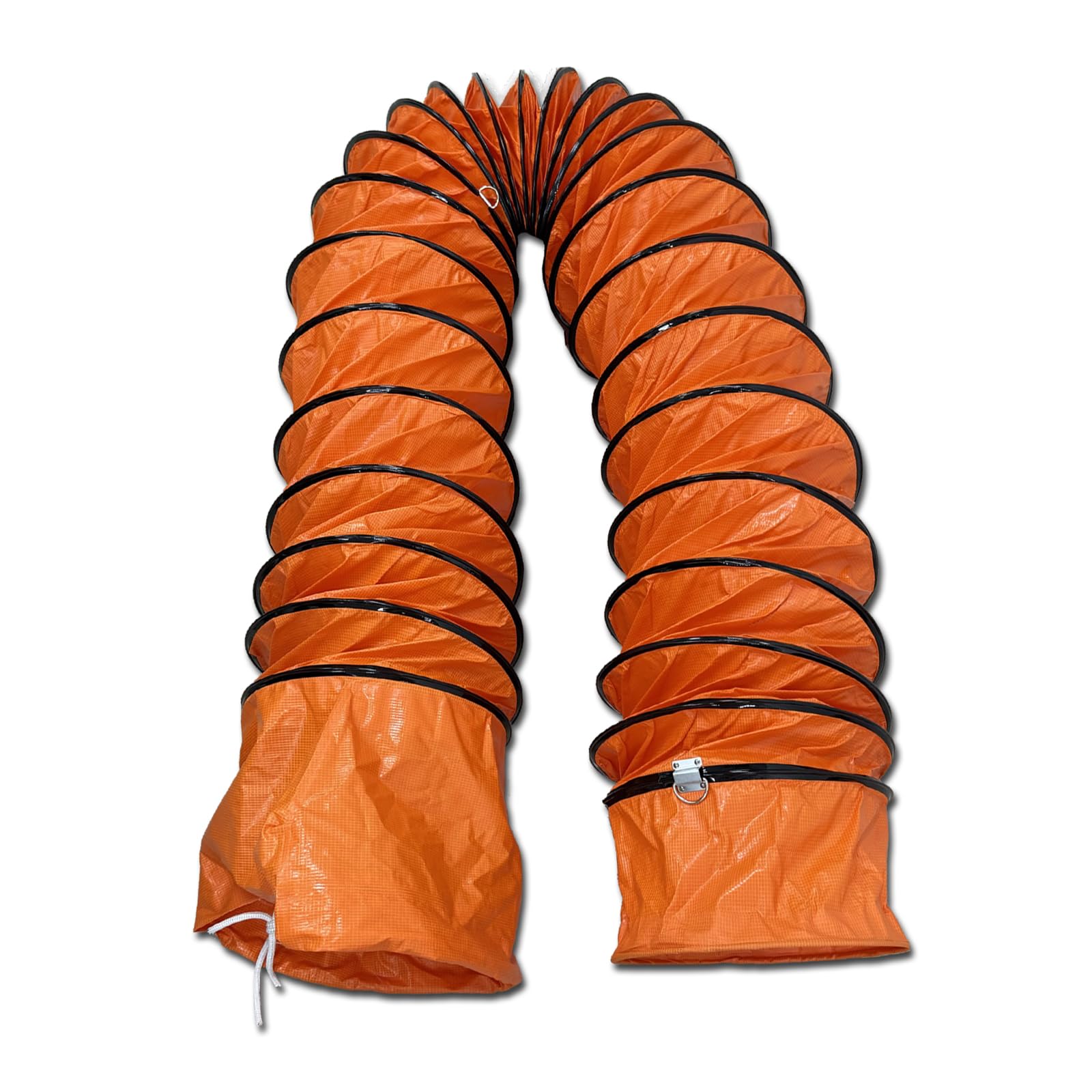
This one is not an HVAC duct and does not pretend to be. It is a PVC blower hose — a plain, uninsulated tube built to move air, not to hold temperature — and for tented paint work or fume exhaust it does that job cleanly. The material is premium PVC rated to handle temperatures from -25 to 80 degrees, and it resists the abrasion and tearing that a foil duct would suffer if you dragged it across a concrete floor. There is no fiberglass anywhere in it, so nothing sheds into the air you are moving.
What sells it for workshop use is the collapse. The whole 16-foot hose folds down to a compact bundle when the job is done, which means it stores in a garage corner instead of eating shelf space all year. The double-layer wall is built to survive wear, and the stretchable length bends around tight corners without choking the airflow. It fits standard blowers, vacuums, HVAC systems, and power tools, so it is a genuine multi-job hose rather than a single-purpose one.
Weighing 2.85 kg, it is one of the lightest ducts on this page — noticeably lighter to carry around than the HYITCL PVC hose below at 7.33 kg, even though that one runs sixteen feet longer. That weight difference is the thing you feel every time you haul it out. It is also the shortest roll here at 16 feet, so measure your run before you commit; if you need more reach, the HYITCL gives you double the length in the same material family. For a kitchen venting job with a blower, the length is usually plenty.
The workshop case: PVC construction shrugs off abrasion, folds into a bundle for storage, and skips the fiberglass entirely. For paint spraying, dust extraction, or fume exhaust, this is the right material at the right length.
The honest limit: there is no insulation value here at all, and 16 feet is the shortest run on this list. If your duct crosses a hot attic or needs to cover a long span, this is the wrong pick.
Reach for this if: you spray paint, sand, or vent fumes indoors and want a hose that tucks away when the job ends.
skip it if: you are connecting a heating or cooling system, because uninsulated PVC will not hold the air temperature across the run.
5. HYITCL 12Inch × 32FT PVC Duct Hose for Utility Blowers
Thirty-two feet of hose with rings built in for hanging overhead
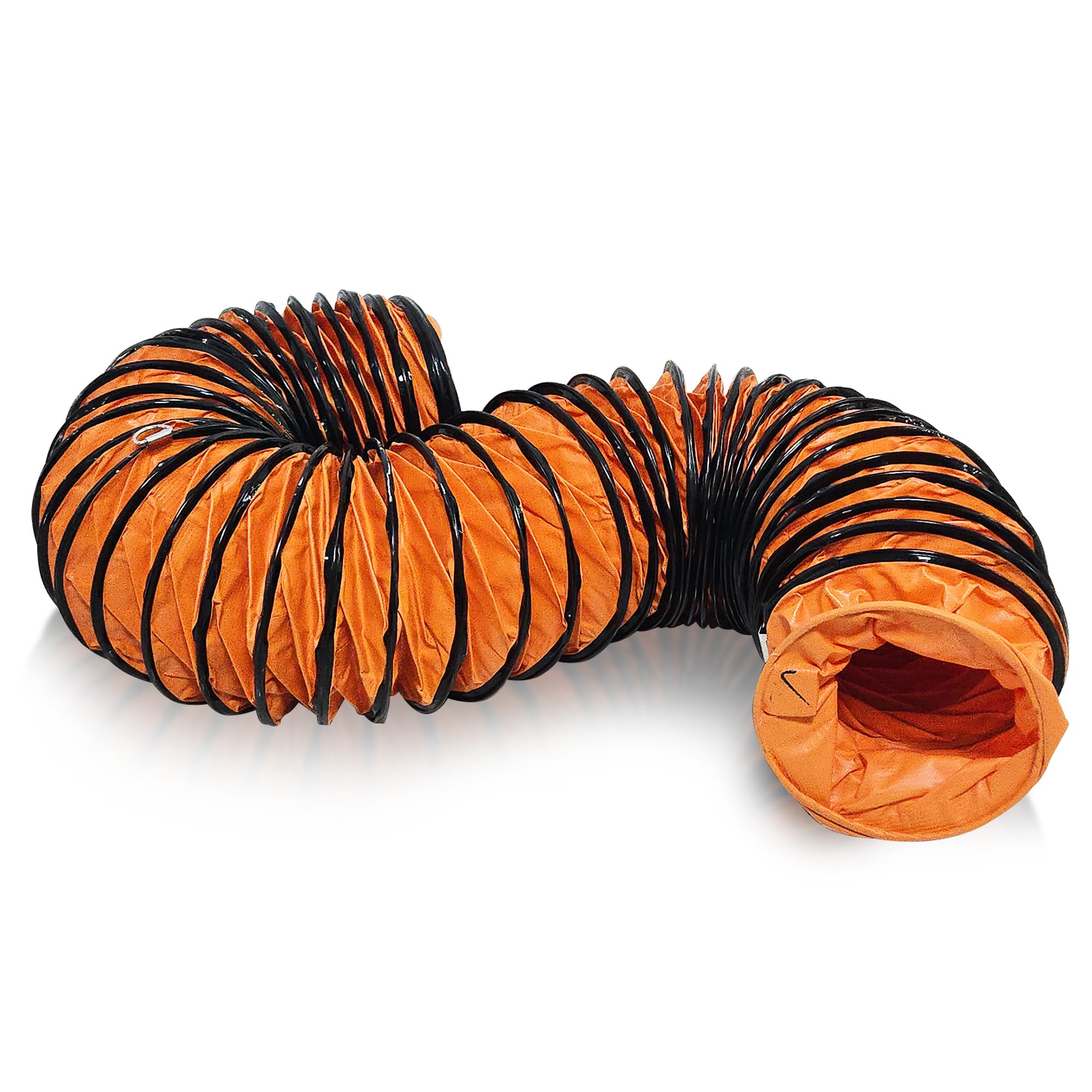
When your blower sits at one end of a warehouse and the work is at the other, reach is everything — and 32 feet is the longest run in this lineup. That is double the YANBORUI hose above, so it covers a span those shorter rolls simply cannot. The build is PVC with a smooth inner wall and a high-carbon wire spring inside, which keeps the tube open while still letting it flex, and the material is both waterproof and flame retardant.
The feature set is aimed squarely at professional work. D-rings are stitched into the wall so you can hang the hose overhead instead of dragging it across the floor, and the strong load-bearing capacity means those rings hold up under pull. An adjustable rope lets you lock the connection to a blower utility fan and keep it from shifting mid-job. There is also an industrial adhesive tape layer bonded into the construction, which is the kind of reinforcement that matters when the hose gets hauled around job sites day after day.
The application list is wide: duct fans and exhaust vents in chemical plants, basements, factories, farms, tunnels, and auto manufacturing. That breadth tells you what this hose is built for — moving large volumes of air in rough environments. It weighs 7.33 kg, and with 32 feet of tube coiled up, storing it takes genuine space, so plan where it lives between jobs. A few buyers add tie-offs at the rope end, since the cord has no lock.
Why it holds up on site
- 32-foot run reaches across large rooms in one piece
- D-rings let you suspend the hose overhead and keep floors clear
- Adjustable rope locks the hose to the blower during use
- Waterproof, flame-retardant PVC with a high-carbon wire spring
- Industrial adhesive tape adds a durability layer to the wall
Points to weigh
- 32 feet of hose needs real storage space between jobs
- The rope end has no cord-lock, so tie it off on both sides
Built for: contractors and workshop owners running a utility blower over long distances who want the hose hung rather than dragged.
Know going in: the rope-tightening end could use a lock, and you will want a couple of tie-offs to keep the connection steady.
6. Rubber-Cal HVAC Insulated-Flex Duct Hose, 12″ x 25 ft

Squashes down for transport and quiets the unit while it runs
Portable air conditioners are loud, and this duct is built with that in mind. It provides acoustical insulation as well as thermal insulation — meaning it tackles both the heat and the sound coming off the unit — and the design is aimed at permanent and mobile air conditioning setups alike. The aluminum construction keeps the air inside at temperature, which is the whole reason an insulated duct exists over an uninsulated one.
The compressible build is the other headline feature. You can squash the hose down for transport, which is what makes it workable for a mobile AC unit that gets moved between rooms or packed away seasonally. That same compressibility is why it packs into a smaller footprint than the 25-foot length would suggest. In portable AC service it holds the air at temperature and muffles the unit’s fan noise.
Now the part you need to know before ordering: fit. This duct has a reputation for running tight, and that pressure point turns up repeatedly — buyers trying to slip it over a 14-inch steel duct describe the process as a wrestling match that took well over half an hour and a second set of hands. Measure your collar carefully. The tight fit means it seals without extra tape or straps once it is on, so it is a trade of installation effort for a leak-free connection.
The portable-AC case: acoustic and thermal insulation in one hose, and it compresses for storage — two things that matter a lot for a unit that moves around.
The tight-fit reality: getting it over a slightly larger collar can take serious effort and a helper. Measure twice, and if your fitting runs wide, budget the extra time for install.
Right call for: portable and permanent AC setups where you want to cut both the heat and the noise the unit throws off.
Measure before you order: the fit runs tight, so a collar that is larger than the listed size will make installation a two-person chore.
7. FICBXRA 12″ 4-Layer Aluminum Ducting, 8.7 ft

A short, tough duct for the tight spot where PVC simply will not fit
Short runs are this duct’s whole reason for existing. At 8.7 feet, it is about a third the length of the 25-foot rolls above — so it will not cover a trunk line, but it handles a short dryer exhaust or a bathroom vent with length to spare. The four-layer wall stacks aluminum foil, a PET film, a second foil layer, and an outer PVC skin, which is what keeps the tube free of the rips and pin holes that kill airflow over time. High-temperature and corrosion resistance come from the aluminum, and the two included stainless steel clamps are rustproof and heavy-duty for a solid junction.
Flexibility is where this one shines, and it is built to slide straight onto a duct fan, vent exhaust, carbon filter, or light reflector. Tightening the clamps is a screwdriver job, and the hose bends to any angle you need it to. Reviewers repeatedly call the four-layer wall heavy-duty flexible, and it bends to any angle without kinking. It pours that effort into handling rather than reach, which is the honest trade for the shorter roll.
The one thing to read the spec line on: this listing is sold as a 12-inch product but shows an 8-inch outside diameter, so check the size field against your actual collar before ordering. The people who ran into trouble were the ones pushing it onto a fitting that was meaningfully larger than the duct. Get the sizing right and this is a straightforward, budget-friendly piece of duct that does a tight job well.
What it does well
- Four-layer wall resists rips and pin holes over time
- Ships with two rustproof, heavy-duty stainless steel clamps
- Super flexible and easy to tighten onto most fittings
- Short 8.7-foot roll handles a dryer or bathroom run without waste
Where it falls short
- Sold as 12 inch but shows an 8-inch outside diameter — verify the size field
- Too short for a long trunk run; look at the 25-foot rolls
Fits best when: you need a short, budget-friendly stretch of flexible duct for a laundry or bathroom vent.
Check the size field first: the listed dimensions lean smaller than the headline number, so match it to your actual fitting before you buy.
8. Rubber-Cal Air Ventilator Yellow Ducting, 12″ x 25 ft

Rubber-walled, retracts small, and built to be hauled across job sites
Rubber instead of foil is the defining choice here, and it pays off in two places: compression and toughness. The hose retracts to a fraction of its 25-foot extended length, which makes storage and transport far easier than a rigid roll, and the rubber wall comes with a wear strip that adds abrasion resistance on the outside where drag and scraping do their damage. Built for blower applications, it is the pick when the duct lives on a truck or gets moved from site to site.
The cuffs are a genuinely useful detail: built-in fasteners sit at both ends, so you can cinch the hose down to the fan without hunting for a separate strap. The rubber wall shrugs off drag and scraping, and the hose stays light enough to carry one-handed. Put a blower on one end and you feel the airflow at the other.
The honest limit is the collar fit. Rubber does not stretch onto a larger fitting the way foil will, and buyers trying to work it over a smaller duct have had to buy an adapter to bridge the gap. The nominal wall thickness is just 0.02, and the outside diameter measures 12.02 inches. If your fittings match the listed size you are in good shape, but do not assume this hose will squeeze onto something meaningfully smaller.
What makes it worth it: a wear strip for abrasion resistance, built-in cuff fasteners at both ends for a quick hookup, and a rubber build that retracts for easy transport between jobs.
The collar caveat: the rubber will not stretch onto a smaller fitting, so an adapter may be needed if your duct runs inch-and-a-half small. Match the sizes and this hose is straightforward.
Choose this when: the hose travels with you and needs to survive rough handling without falling apart.
Sorry fit if: your fitting is smaller than the listed size — rubber has almost no give, so plan on an adapter.
Understanding the Specs
R-Value in plain terms
R-value is a number that measures how well a material blocks heat from passing through it. An R-4.2 duct resists heat leakage at a baseline level, which is fine for a short run in a moderate space. An R-6 duct blocks noticeably more — the maker says around a third more than R-4.2 products — and that shows up on long runs through a hot attic or a cold crawlspace. For a plain PVC blower hose, there is no R-value at all because it is not insulated, and it is not meant to be.
Inner diameter versus outer diameter
The size printed on an insulated duct is usually the inner diameter — the bore the air travels through. The outside of the tube is wider because the fiberglass or foam insulation wraps around it. That is why a duct listed as 12 inch will not always slide onto a fitting you measured at 12 inches. Always check the outside diameter field on the listing, and measure your collar before ordering. A tight fit seals without extra tape, but it costs you installation effort and sometimes a second set of hands.
FAQ
Will a 12 inch flex duct fit my existing 12 inch duct collar?
What does R-value mean on an insulated flex duct?
Can I use a PVC duct hose for HVAC heating and cooling?
How long does a flexible duct typically last?
Is an uninsulated duct ever the right choice?
What are the clamps for, and do I need more than the ones included?
Will a flexible duct collapse if I bend it around a corner?
Can I cut a flexible duct to a shorter length?
Does a four-layer duct wall really make a difference?
What is the difference between a dryer vent duct and an HVAC flex duct?
Final Thoughts: The Verdict
For most people running a heating or cooling line, the winner is the HVAC Premium 12″ Insulated R-4.2 Duct. It pairs a sealed aluminum inner core that keeps fiberglass out of your airstream with 25 feet of length and an R-4.2 blanket — the whole package for a single attic run, clamps included, and the crowd of owners who have put it to work on real installs backs that up. If you want the thickest heat barrier in this lineup, grab the GAF Master Flow R6. And for tented paint work or fume exhaust, the YANBORUI 16FT PVC Hose is the one to reach for — it moves air, folds away, and asks nothing of your insulation budget.
How We Picked
We do not accept paid placement. Every pick is matched to a real buyer and a real use-case; we do not hands-on test units.
Sources & Methodology
Specifications: manufacturer listings and product documentation. Review insights: verified customer reviews, as of September 2026. Pricing: not shown on this page (it changes often); check the current price via the retailer link.
As an Amazon Associate, KitchPrep earns from qualifying purchases. This does not affect which products we feature.
Related Guides
