
Specs are compiled from manufacturer listings and verified buyer reviews and can change over time — please confirm the key details on the product page before buying.
A 12-inch sliding compound miter saw sets the pace of every trim, deck, and framing job on your bench. The right one crosscuts 7-1/2-inch nested crown, 4×6 posts, and wide stair stringers square in a single pass. The wrong one leaves you fighting blade deflection, vague detents, and a sticky slide on every board. The picks below span budget benchtop sliders, mid-range front-rail saws, and premium cordless kits, all true 12-inch sliding compound saws.
I’m Mohammad Maruf — the founder and writer behind KitchPrep. This guide is built by comparing the manufacturers’ published specifications and the patterns across verified customer reviews, so you get each pick’s real strengths and trade-offs instead of marketing spin.
You will see what separates a saw that holds its angle after a hundred cuts from one that drifts, and which rail design keeps your bench clear. The list below ranks 11 saws from the pro-grade DEWALT DWS780 to the beginner-friendly WEN MM1214T, so you can match one to your shop, material, and budget. Here is what separates a reliable 12 in compound sliding miter saw from the rest.
Our Picks at a Glance

How To Choose The Best 12 in Compound Sliding Miter Saw
The one thing that decides everything on a 12-inch slider is the rail system — the bars that let the saw head slide forward through the cut. There are two families: rear rails, where the head travels backward behind the base, and forward (or axial) rails, where it travels above the base so you can park the saw flush against a wall. On a shallow bench, forward rails let the saw sit flush to the wall instead of eating the depth behind the base. Everything else — bevel range, stops, dust — you layer on top of that core choice.
Motor and blade: matching the cut to the material
Every saw on this list runs a 15-amp motor, which is the standard for a 12-inch blade and enough for pressure-treated lumber, dimensional framing, and most hardwood with the right blade. The number that matters more than raw amps is blade tooth count. A 40-tooth blade rips through framing and decking fast, while a 60- or 80-tooth blade leaves a smoother, less torn edge on trim and finish work. A few picks ship with a 60-tooth or 80-tooth carbide blade, which suits trim right away. If your saw arrives with a coarser blade, a fine-tooth upgrade is the single biggest change you can make for clean cuts.
Bevel, miter, and stops: how precise the angles really are
Dual bevel means the head tilts left and right, so you can cut a compound angle without flipping a long board end-over-end. That is a huge time saver on crown molding and picture frames. Positive miter stops are the fixed click positions — most saws here use nine of them across 0°, 15°, 22.5°, 30°, and 45° on both sides — and they keep repeat cuts consistent. One detail to watch: some budget saws print their degree markers as stickers rather than engraving them into the table, and stickers can peel. Check that spec before you buy if you care about long-term accuracy.
Footprint, weight, and the bench you actually have
A 12-inch slider is a heavy, wide tool, and the rail layout sets its real footprint. Rear-rail saws need enough depth behind the base for the head to travel, which can push you off a narrow bench. Forward-rail saws trade that for a taller, more compact profile that sits tight to the wall. Weight ranges widely across this group, from the mid-40s up past 80 pounds, so if you move between job sites, plan for handling and a solid stand rather than a benchtop you set on sawhorses.
Quick Comparison
| Model | Best For | Power | Bevel Type | Weight | Amazon |
|---|---|---|---|---|---|
| DEWALT DWS780★ Best Overall | All-round shop workhorse | 15-amp, 3,800 rpm | Dual bevel | 58 lbs | Amazon |
| DOVAMAN 12-InchBudget Champion | Budget-friendly deck building | 15-amp, 3,800 rpm | Dual bevel | 53.9 lbs | Amazon |
| VEVOR Sliding CompoundSpace Saver | Space-tight home workshops | 15-amp, 5,000 rpm | Dual bevel (0–45°) | 46.4 lbs | Amazon |
| WEN MM1215 | Beginners needing wide crosscuts | 15-amp | Dual bevel | 24.25 kg | Amazon |
| WEN MM1214T | Laser-guided light trim work | 15-amp | Dual bevel | 56 lbs | Amazon |
| Metabo HPT C12RSH3 | Narrow-bench professionals | 4,000 rpm no-load | Dual bevel | 53.6 lbs | Amazon |
| DEWALT DCS785B | Cordless jobsite mobility | 20V MAX XR cordless | Dual bevel | 51.7 lbs | Amazon |
| King Canada 8390N | Twin-laser fine carpentry | 15-amp, 3,600 rpm | Dual bevel | 55 lbs | Amazon |
| FLEX FX7141A-1J | Cordless runtime plus rapid charging | 24V, 10.0Ah battery | Dual bevel | 53.6 lbs | Amazon |
| Makita LS1219L | High-capacity shop and trim | 15-amp, direct drive | Dual bevel | 81.6 lbs | Amazon |
In‑Depth Reviews
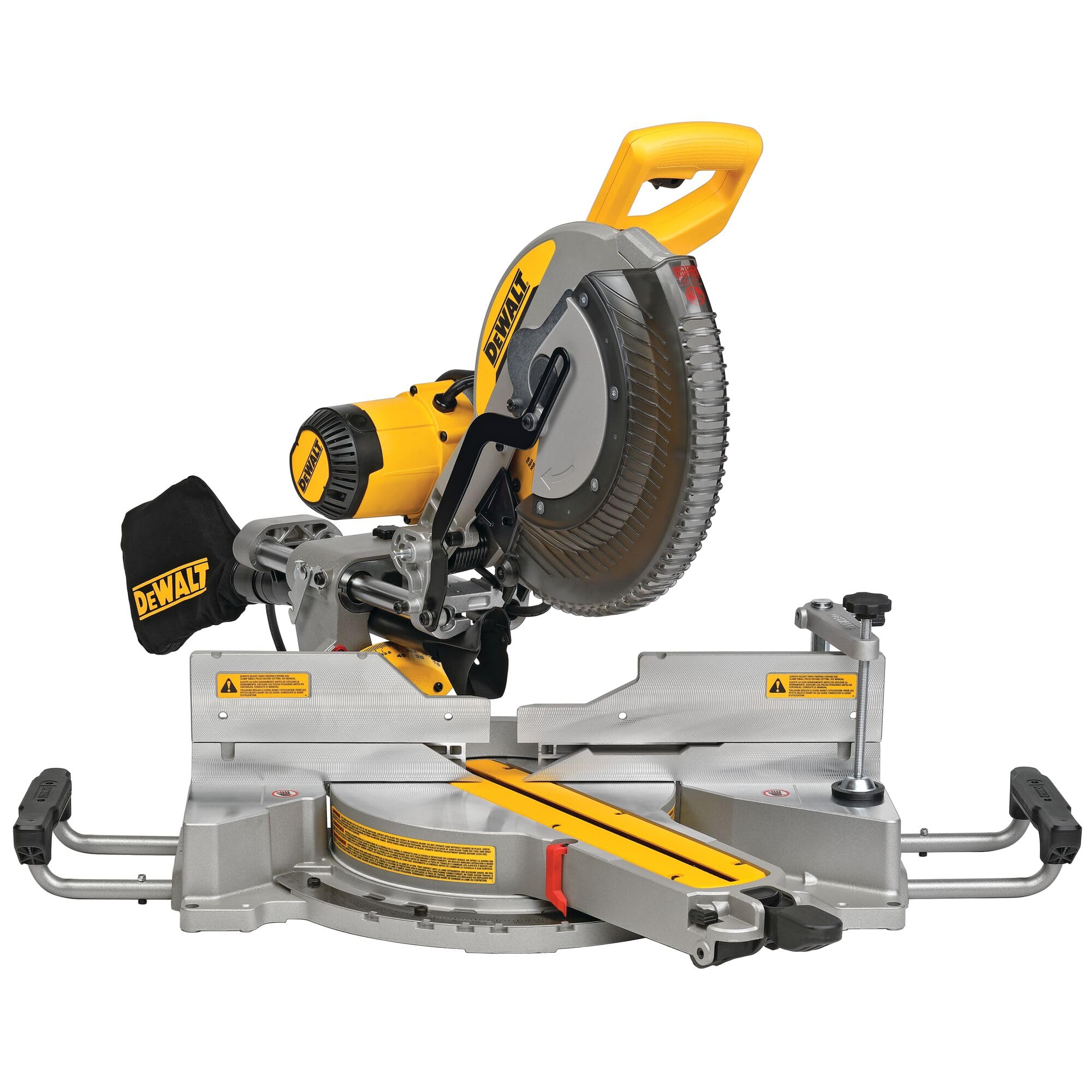
1. DEWALT Miter Saw, 12-inch Double Bevel Sliding Compound Miter Saw with XPS LED Shadow Light System (DWS780)
Our pick — over 4.5★ from 2,500+ verified ratings; the strongest balance of quality and price.
The 15-amp beast that cuts 2×14 framing lumber at 90° and still leaves trim-grade edges.
If you want one saw to handle a whole renovation — framing, decking, crown molding, the lot — this is the 12-inch slider the trade reaches for. The numbers back it: a 15-amp, 3,800 rpm motor, cuts up to 2×14 at 90° and 2×10 at 45°, and a fence that swallows 7-1/2-inch nested crown molding. What wins people over is the XPS LED shadow line (a light that casts the blade’s own shadow as your cut mark), which stays true to the blade rather than drifting like a laser can. Down at the cutting stage, it takes a 16-inch crosscut, and buyers report pulling repeat cuts within a fraction of an inch, with one buyer describing a 16″ cut accurate within 0.002″.
Set against the DOVAMAN slider, this saw swings a full 90-degree cutting angle against the DOVAMAN’s 45 degrees, and its footprint of 32.57″L x 23″W x 19.5″H stays snugger front-to-back than the DOVAMAN’s 35″L x 22″W x 21″H. The stainless-steel detent plate carries 10 positive stops, which is what makes repeat trim cuts land in the same spot every time. The bevel scale is oversized for easy reading, and the cam-lock miter handle with detent override lets you slip past a stop when a job needs an off-angle.
It is not a light saw. At 58 lbs the DOVAMAN’s 53.9 lbs reads lighter on paper, and the DWS780 does demand the kind of bench depth a rear-slide saw always asks for. Owners also mention the sawdust tends to sit on the table, and the stock dust bag does little without a shop vac hooked up. But as an every-day anchor for a shop, the trade-off is a small one. With 4.8 stars across 2,500+ ratings, it is the crowd favorite for a reason, and what it does best is simply cut square, fast, in almost any material you feed it.
What Makes It the Bench Standard
- XPS shadow line stays locked to the blade for accurate cut marks
- Full 90° cutting angle, versus 45° on the DOVAMAN
- Cuts 2×14 at 90° and 2×10 at 45°, plus 7-1/2″ nested crown molding
- 10 positive miter stops and an oversized bevel scale for repeatability
- Miter reach of 60° right and 50° left for flexible angle work
Where It Asks More of You
- 58 lbs — heavier than the DOVAMAN’s 53.9 lbs
- Rear-slide layout needs generous bench depth
- Stock dust bag is limited; a shop vac or collector does the real work
Built for the long haul: pros, remodelers, and serious home woodworkers who want a single saw to cut framing and trim without fussing over alignment.
Reconsider if: your bench is shallow or you need something you can carry up stairs daily — this is a stationary anchor, not a portable one.
2. DOVAMAN 12-Inch Dual-Bevel Sliding Compound Miter Saw, 15-Amp
The value slider that rips through 4×6 posts and 20-foot decks without draining your savings.
For a first serious saw or a second bench setup, the DOVAMAN does the biggest job on the list for the least commitment. Its 15-amp, 3,800 rpm motor bites into pressure-treated 4×6 without straining, and the 4.2″ x 13″ crosscut capacity covers wide dimensional lumber in one pass. What truly separates it from a big-name slider is the double-bevel head — owners call that feature a time-saver, because it lets you swing the head left and right instead of spinning long boards around. A laser guide and nine miter presets (the common stops like 0°, 15°, 22.5°, 30°, and 45° on both sides) make setup quick for a newer user.
Owners building a 20×20 deck found this saw took the beating without complaining, describing how it “has put up with me building a 20×20 deck,” though a plastic handle eventually snapped off. That is the honest read on this class of saw: it is a real performer, just a touch less refined than the premium competition in the fit and finish. Angle adjustments after shipping are common and easy, and the included 40-tooth blade handles framing fine; a finer blade upgrades it for trim. Compared to the DWS780 above, the DOVAMAN is a lighter carry at 53.9 lbs versus 58 lbs, and it actually has the larger cutting angle of the two at 45 degrees versus the DEWALT’s 90.
Two things worth knowing before you buy. First, the blade lock can’t always be locked fully, so treat the blade-change mechanism gently. Second, the saw may need a square-and-angle check from the start, which the manufacturer notes happens in shipping. Neither spoils the deal, and for the money this saw asks for, it makes a very strong case as the budget pick that still does serious work.
The value angle: a 15-amp, 3,800 rpm motor plus a 4.2″ x 13″ cut for a fraction of the premium names, with plenty of owners running one on real job sites.
Set your expectations honestly: get a miter square handy for first setup, and reserve fine trim work for a sharper blade than the stock one.
Worth grabbing if: you are a serious DIYer or occasional pro who wants dual-bevel capability and real power without a name-brand price.
Look elsewhere if: you need factory-perfect calibration from the start — plan on a ten-minute tune-up first.
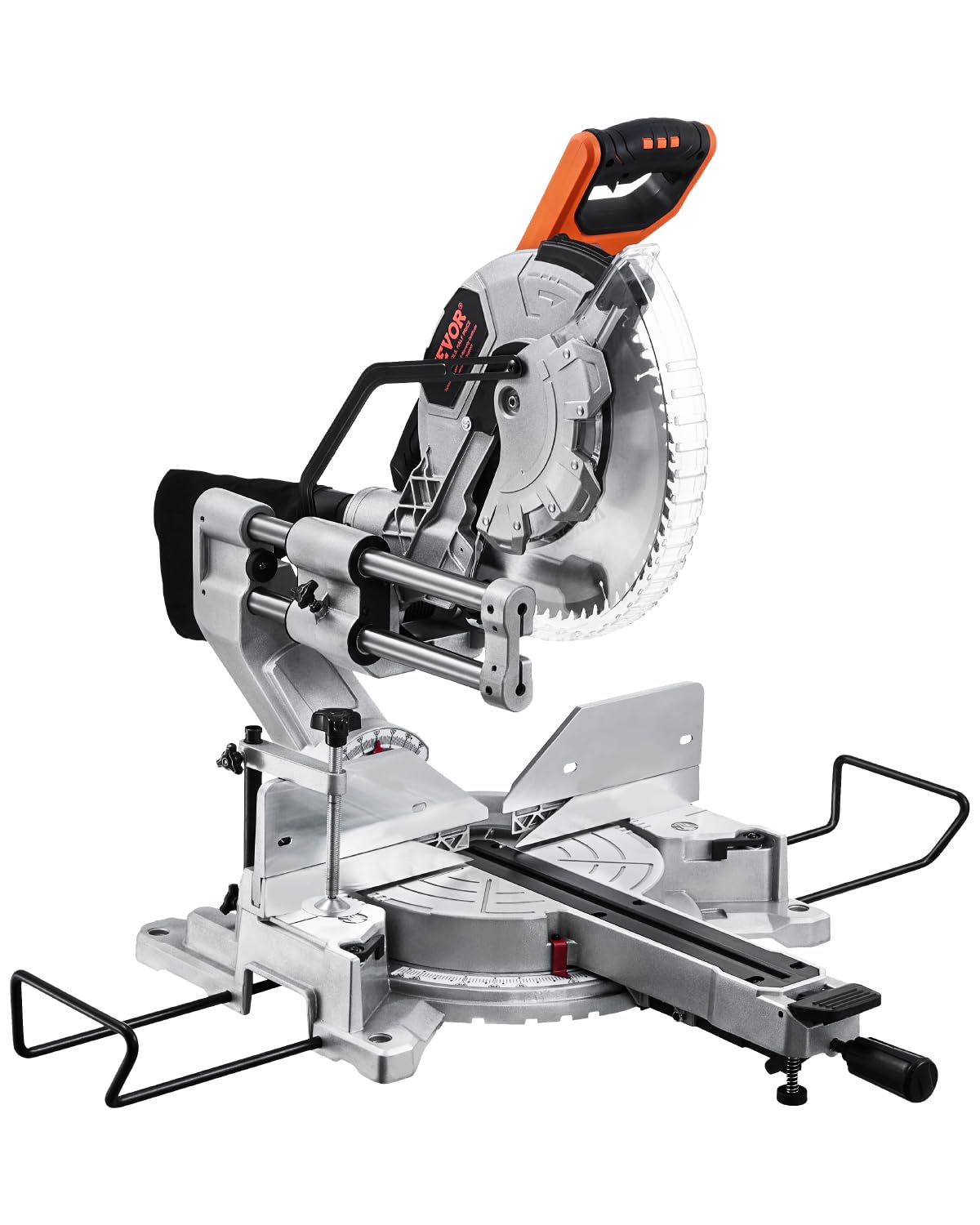
3. VEVOR Sliding Compound Miter Saw, 12-Inch Blade, 15 Amp Motor, 60-Tooth, Corded Double Bevel
The forward-slide saw that parks against a shop wall and never eats your bench depth.
The VEVOR is the pick for anyone who works in a tight shop or garage where every inch of bench counts. Its axial sliding system runs the head forward and back above the base instead of behind it, so you can push the whole saw flush to the wall and reclaim the space a rear-slide machine would eat. Owners absolutely love that detail — the saw that “does not take up rear room with slide that travels backward,” as one home-shop user put it. And it’s the lightest full-size saw here at 46.4 lbs, which takes real strain out of moving it onto a bench or a stand.
Under the hood you get genuine power and a very fine blade from the start. It spins up to 5,000 rpm and ships with a 60-tooth blade, which drives clean crosscuts through hardwood and composite decking. The LED guide projects a visible cut line, and the 0–45° dual bevel handles both directions for picture-frame and trim joints. What people praise most is the sheer value — the machine’s quality feel at this price point is the strongest thing going for it.
Two honest caveats. First, the aluminum base and plastic knobs mean the fit and finish won’t match a premium saw, and the flexibility shows over heavy use. Second, the saw has some mixed reports about adjustability and the shadow-line alignment, so plan on checking square before a fine-trim job. Neither changes the core value of a 5,000 rpm saw with a 60-tooth blade and a space-saving slide system for a competitive price.
Where it shines: 5,000 rpm, a 60-tooth blade, and a forward-only slide that keeps your wall clear — all in a 46.4 lb package.
What to keep in mind: check the bevel alignment after shipping, and treat the base and knobs as a friendly-use item rather than a daily-production one.
Perfect for: home-shop woodworkers and garage builders who want serious performance without sacrificing bench depth.
skip it if: you run a high-volume commercial shop — the aluminum base and plastic fittings won’t take daily abuse the way a cast-iron premium saw will.
4. WEN MM1215 15-Amp 12-Inch Dual Bevel Sliding Compound Miter Saw with LED Cutline

A wall-hugging slider with an 80-tooth blade that turns wide boards into clean crosscuts.
If you cut wide, thick lumber, the WEN MM1215 is built for exactly that job. Its 15-amp motor crosscuts boards up to 13.25 inches wide and 4.5 inches thick, so it handles a huge range of dimensional stock. It ships with an 80-tooth carbide-tipped blade (carbide tips stay sharp far longer than plain steel) — the smoothest stock blade in this group, which means cleaner edges on trim. The dual-rail slide (two rails that let the head glide forward and back) lets it sit flush against the wall for a compact footprint. The bevel (tilt of the blade) and miter (rotation of the table) both travel 45° in either direction, with nine miter stops (pre-set angles that click into place).
An onboard LED cutline guide (a light that shines on your mark) lets you line up in low light. The accessory kit is thorough: two quick-lock table extension arms, two support fences, a quick-clamp, a dust port, a dust bag, a carrying handle, and a two-year warranty. The 80-tooth blade plus the 13.25-inch crosscut capacity is what makes this the pick for cutting trim, cabinet parts, and sheet goods to a finished edge. Owners mention a compact rail design and a hard-wired LED shadow light that lines up with the blade kerf (the width of the cut) and needs no batteries.
The honest limitation is calibration on fine work. A few long-slide cuts have shown deflection, and the right fence has needed a small tweak from the start on some units. This is a general-building-trades saw — decks, framing, shelves — not a fine-woodworking instrument, and its own users say so. Read the manual carefully on blade changes (the arbor bolt uses a left-hand thread), and plan on a quick square check before the first cut. For the money, it does a huge amount of work.
The wide-capacity case: 13.25″ crosscuts and 4.5″ thickness cover big dimensional lumber, with an 80-tooth carbide blade in the box for smooth edges.
One honest trade: the fence and long-slide alignment may need a small tuning from the start, so verify squareness before fine-trim work.
Choose this for: general building work where the widest crosscut, the smoothest stock blade, and a compact wall-hugging design matter more than precision finishing.
Pass if: your job is high-end cabinetry — you’ll want a saw that holds tighter tolerances on long slides.
5. WEN MM1214T 15-Amp 12-Inch Dual Bevel Sliding Compound Miter Saw with Laser

A laser-and-LED slider built for the occasional trim job, priced for a home bench.
The MM1214T is a light-duty carpenter’s saw aimed at the home user who needs a laser line, a light, and a wide crosscut without the premium spend. It runs the same 15-amp motor family as the other WEN, cutting boards up to 13-3/8 inches wide and 3-1/2 inches thick. The class II laser guide (a fine line projected onto the material) plus an LED work light are the standout features — the laser helps mark the cut, and the LED lights the work surface for low-light shops. Nine miter stops and a 45° bevel range both directions handle most angles a trim job throws at you.
For crown and base molding the saw is well spec’d too, with 7-1/2-inch nested crown capacity and 6-3/4-inch baseboard vertical capacity — enough for common crown sizes. The 60-tooth carbide blade, retractable table extensions with work stops, and included clamp cover what most installers need. Customers note the angle detents arrived exact from the start, which is a strong point for a saw at this level.
Be realistic about the finish level here. Several owners note that the degree markers on the miter and bevel scales are thin glued-on decals rather than engraved into the table, and that the plastic detent lever is fragile during shipping and job-site handling. The laser also proves short-lived on some units. If your work is a few cuts a weekend around the house, these are minor concerns, but for daily professional use expect to double-check the angles yourself.
The Case for It
- Laser guide plus LED work light for visible cut lines
- 13-3/8″ wide, 3-1/2″ thick crosscut capacity
- 7-1/2″ nested crown and 6-3/4″ baseboard capacity
- 9 miter stops and a 45° dual bevel
Known Limitations
- Angle markings are decals, not engraved — they can lift over time
- Plastic detent lever is a fragile spot during shipping
- Laser has been reported to fail after a few uses on some units
A fit for: home DIYers cutting baseboard, small crown, and shelves who want a laser guide at a modest outlay.
Think twice if: you need engraved, stays-true angle markings for daily pro work — that’s the upgrade the MM1215 delivers.
6. Metabo HPT 12-Inch Dual Bevel Sliding Miter Saw, C12RSH3
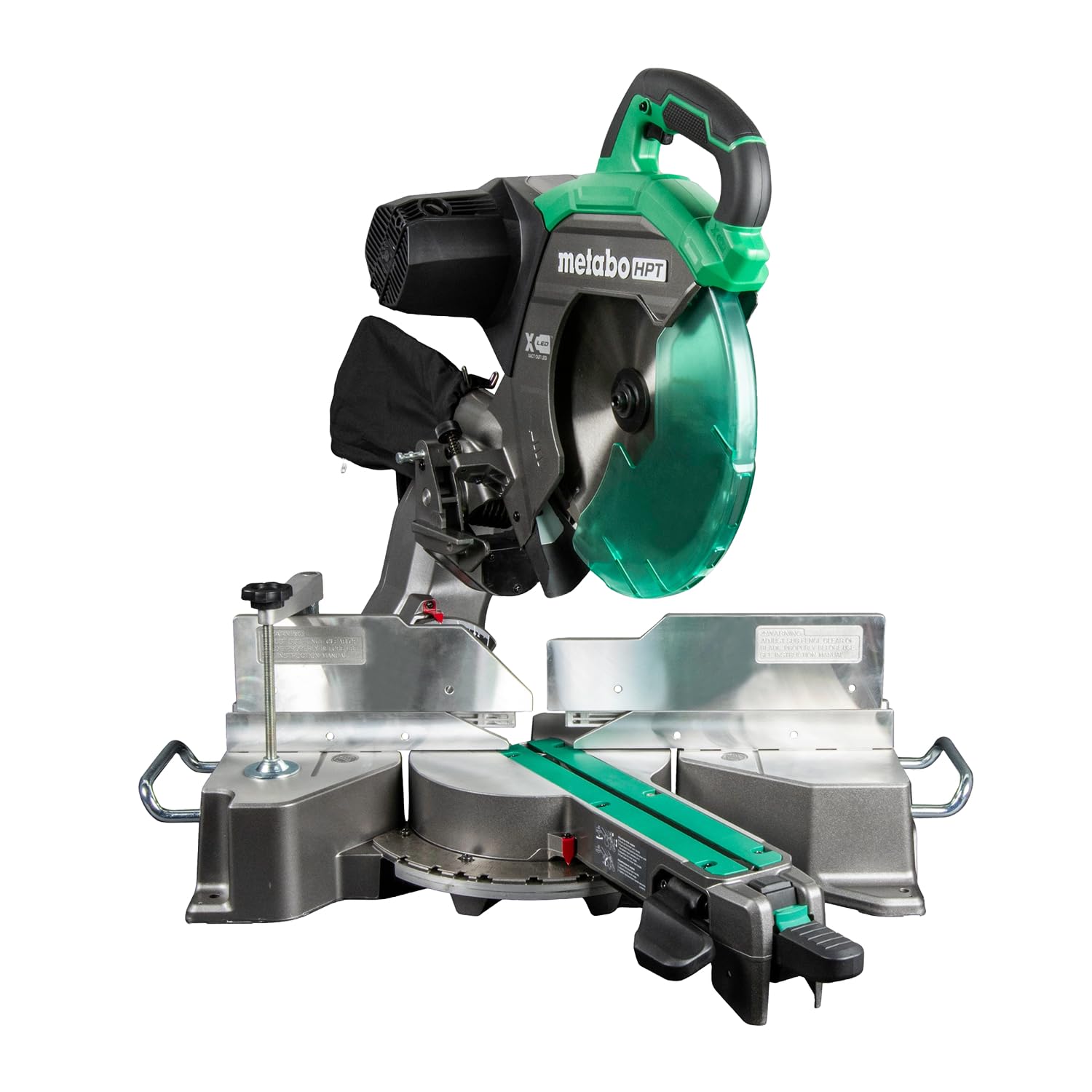
Japanese-engineered power in a forward-rail slider that fits on the narrowest bench.
For a carpenter who works out of a small shop or a rig with a constrained bench, the C12RSH3 is the pick because of its forward-rail design and its solid build. The 12-inch dual-bevel head runs a no-load speed of 4,000 rpm, and the miter range is generous — 0 to 45° left and 0 to 57° right, which open up compound cuts a standard 45° saw can’t reach. The Xact Cut Shadow Line marks the cut clearly in any light, and the adjustable bevel paired with a one-touch bevel and miter lock makes angle changes quick. Most importantly, it cuts perfectly square from the start, which owners repeatedly note.
The forward-slide rails are the standout physical trait here, letting the saw sit tight against the wall and reducing the bench footprint. Soft start keeps the head from jerking when you pull the trigger, and the depth-of-cut lock handles lap joints and slot cuts. Nine miter detent stops cover the common angles for repeat trim. Owners note the LED cut line stays visible in daylight, and the front bevel adjust is easy to reach. The build quality and reliability of the machine are its strongest selling points, backed by a five-year Metabo HPT warranty.
The honest trade-off is the sliding mechanism itself. Some owners find the slide is not as silky smooth as premium saws, requiring the head to be kept clear of debris to run freely, and a few mention light resistance mid-slide. The dust bag also works fine outdoors but is weaker when paired with a vacuum without a proper coupler. Neither is a deal-breaker, and for shop use with a little care the Metabo gives you premium performance at a mid-range spend.
Why it competes: 4,000 rpm, a 57° right miter, soft start, front-rail compactness, and a five-year warranty at a mid-range price.
The one thing to mind: the slide is not the smoothest in the group, so keep the rails clean and expect a touch of resistance on some passes.
Reach for this if: you work mostly out of one shop, want factory-square cuts from the start, and need forward-rail compactness with room to spare on the bench.
Look elsewhere if: you need a silky-smooth glide on every pass or a long-lived dust bag for interior work.
7. DEWALT 20V MAX XR 12 inch Double Bevel Sliding Miter Saw, Cordless, Tool Only (DCS785B)

A battery saw with real muscle — 12-inch capacity with no cord trailing behind you.
Cutting trim on a second floor or out on a deck with no outlet nearby is exactly the scenario this DEWALT owns. The DCS785B is a cordless 12-inch double-bevel sliding saw running on the brand’s 20V MAX XR batteries. It carries the largest cut capacity in the lineup — up to 14 inches horizontally, 6-1/2-inch baseboard standing, and 6-1/2-inch crown nested. On the runtime front, DEWALT’s own figures list up to 371 cuts in 3-1/4-inch MDF molding and up to 153 cuts in pressure-treated 4×4 timber per charge. Owners describe it as a battery-powered powerhouse and report long runs of cuts with no problems.
A few features set it apart from the corded crowd. Regenerative braking helps the blade stop and sends energy back to the battery, which is where that long cut count comes from. An integrated wireless tool control lets the saw turn on a compatible vacuum with a trigger pull, which keeps the work area cleaner. And the Cutline blade positioning system delivers adjustment-free cutline indication — no laser to drift out of alignment. At 51.7 lbs, it’s lighter than the Metabo HPT slider above, so moving it between floors is realistic. The full spec includes a 12-inch 60T carbide blade, blade wrench, and dust bag.
Two things to plan around. First, its dust collection relies on a vacuum or dust system to be effective — the stock bag alone leaves sawdust behind. Second, it needs the right battery: owners say the wider 20V/60V MAX packs bring out the saw’s best performance, which is worth knowing before you buy into a battery platform. This is the saw for the carpenter who values mobility over everything.
Why It Belongs Here
- 14″ horizontal cut capacity — the biggest on this list
- Up to 371 cuts in 3-1/4″ MDF and up to 153 in PT 4×4 timber per charge
- Regenerative braking recovers energy through the cut
- Wireless tool control syncs with a compatible vacuum
- 51.7 lbs, lighter than the corded Metabo HPT slider
What to Plan For
- Best performance needs a large 20V/60V MAX battery pack
- Dust collection is poor without a vacuum or dust system
- Sold as tool-only, so you supply the battery and charger
The right call for: finish carpenters and remodelers who already run DEWALT 20V MAX batteries and need a 12-inch saw wherever the work is.
The catch to weigh: this is a bare tool — if you don’t own the batteries, factor in the full kit or the DCS785WW1 below.
8. King Canada 12-Inch 15 Amp Sliding Dual Compound Mitre Saw, with Twin Laser

A twin-laser Canadian-built slider aimed at trim carpenters who want both cut edges marked.
The King Canada 8390N is the saw for a trim carpenter who wants both sides of the blade visible before the cut. Its twin laser system projects two lines bracketing the cut path, which helps align both edges of a molding joint instead of guessing on a single line. The dual-bevel head swings 45° left and right with crown-molding stops, and the cast aluminum table carries nine positive stops for repetitive trim work. Speed sits at 3,600 rpm, and the swiveling table helps with long runs of same-angle cuts. Owners praise it as a match for the bigger brands on power and accuracy.
The finer points are where this saw stands out. The bevel adjustments sit right up front and are easy to reach, the miter and bevel scales are large and legible, and the detent system (pre-set angle stops) locks onto common angles fast. Reviewers point out the machine is built robustly, and they call the dual laser a genuinely useful feature. One owner compares its power and precision directly to the household names and finds it competitive. The cast aluminum base gives it a solid, stays-put feel, and the Canadian manufacturing is a point of pride in the owner reviews.
There is one honest note on this saw: it’s a lighter-duty machine that heats up under production-level run time. Owners say that running it six to eight hours a day can warm the motor, so it lands in the “great for bricolage and weekend work” bracket rather than daily industrial output. An occasional unit has also arrived with shipping damage to the base legs, so inspect the crate carefully. And its calibration is a fiddly operation — access to the bevel adjustment screws is through small ports, so you’ll want hex keys long enough to reach inside. Treat those as pre-purchase facts and the King Canada delivers on its promise.
The draw: twin lasers marking both cut edges, a smooth 3,600 rpm motor, 9 stops, and cast-aluminum durability at a mid-range price.
What it’s not: a production shop saw — the motor heats under hours-long continuous cutting, so plan your day around it.
A natural fit for: weekend woodworkers and trim installers who want twin-laser alignment without moving up to a premium-tier machine.
Head elsewhere if: you need a saw for nonstop, all-day production cutting — this one wants breaks.
9. FLEX 24V Brushless Cordless 12-Inch Dual Bevel Sliding Miter Saw Kit (FX7141A-1J)
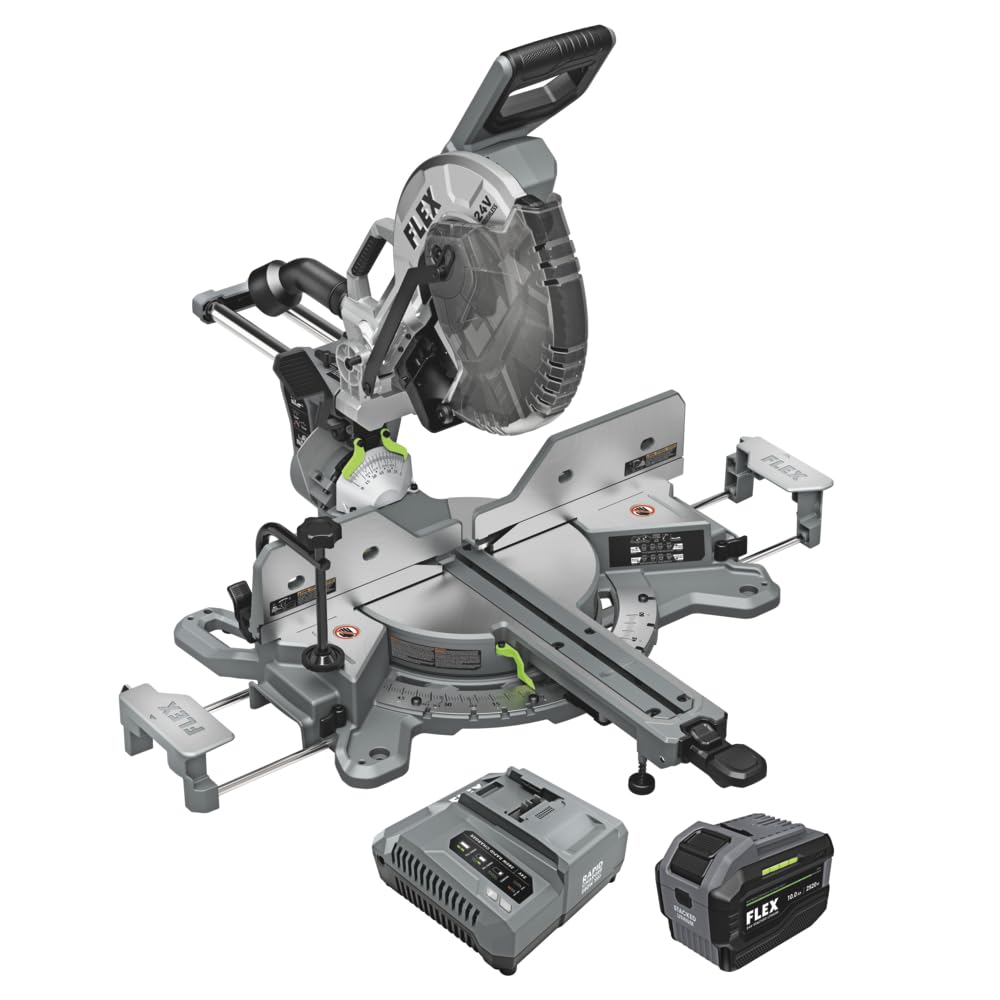
The cordless saw that refuses to quit — 10.0Ah of stacked lithium and up to 630 cuts per charge.
If runtime anxiety has kept you from buying a cordless 12-inch saw, the FLEX numbers are meant to settle it. The kit comes with a 10.0Ah Stacked Lithium battery (amp-hours measure how much charge it holds) and a 280W Rapid Charger, and the rated runtime is up to 630 crosscuts in 3-1/4-inch MDF (medium-density fiberboard) on a single charge. The 24V brushless motor (no carbon brushes to wear out) is the other half of that. FLEX claims its Stacked Lithium delivers 200% more power, 300% longer runtime with THERMA-TECH+ heat management, and 100% faster charging, plus 100% cross-compatibility with all FLEX 24V tools and chargers. That battery platform matters — one 10.0Ah battery carries over to the brand’s other tools.
The saw’s design details are all aimed at a working carpenter too. A patented FASTSHIFT bevel lever handles the bevel adjustments through 0, left and right 22.5, 33.9, 45, and 47 degrees. A spindle stop shaft lock makes blade changes fast while preventing accidental startups, and a quick miter lock sets miter angles precisely. The LED shadow light aligns the blade to your cut line, the adjustable depth stop allows dado and slot cuts, and the table extensions support longer material. There’s also a power adapter that open up AC power for extended runtime when paired with the brand’s separate FLEX 24V Power Adapter. Owners note the saw fits other FLEX tools in the lineup and describe the build quality as excellent, cutting 12-inch material in one pass without needing calibration from the start.
One clear trade-off is the fit-and-finish cost: the FLEX is a very pricey cordless option, roughly double some competitors in this category, and the optional corded adapter is also expensive. The dust collection also lags — owners note the port is not well-designed for any 2-1/4-inch hose and the bag outperforms most vacuums. Weigh that against the 630-cut runtime and the fact that this is the newest cutting technology on the list, and the FLEX is the right call for a cordless-first shop.
Runtime king of the cordless group: up to 630 crosscuts in 3-1/4″ MDF with a 10.0Ah Stacked Lithium battery and 280W charger, plus a patented FASTSHIFT bevel leverand a spindle lock system for fast blade changes.
The price reality: this is the most expensive cordless option here, and the dust port needs a workaround hose — budget for a shop vac adapter too.
Worth the outlay for: cordless-first shops and pros who want a huge single-charge runtime and a battery that runs the brand’s other 24V tools.
Think again if: you are a price-sensitive buyer or routinely cut damp, dust-heavy material without a shop vacuum on hand.
10. Makita LS1219L 12″ Dual-Bevel Sliding Compound Miter Saw with Laser

The tall-cut specialist — 8-inch nested crown and 15-inch crosscuts in a tight footprint.
A finish carpenter working mostly in crown molding and baseboard will find more headroom here than almost anywhere else on the list. The LS1219L carries an 8-inch nested crown capacity, 6-3/4-inch baseboard vertical capacity, and a 15-inch crosscut at 90° — the deepest crosscut here. The unique 2-steel-rail sliding system runs single slide-glide operation, and the direct-drive motor with its guard system is engineered to build vertical cutting capacity while saving bench space. The two rails let the saw sit flush against a wall, and a front bevel lock means you reach the bevel adjustment from the operator side. What makes this saw special is how it delivers that depth of cut without a giant footprint.
Dual dust collection ports (two ports working together) provide the best dust extraction in the group according to the saw’s own users, and the laser stays adjustable side-to-side. Owners describe the machine as a stable, precise workhorse — one saying the saw is a joy to use day after day, with a soft start, smooth glide, minimal blade deflection, and an accurate motor. A few make particular note of the detent override for slipping past an angle stop when needed, and the bevel knob being easy to reach. The ability to tune the saw to cut exactly 90° true is something fine-carpentry builders appreciate.
It is heavy — 81.6 lbs, the heaviest on this list — so moving it between jobs takes effort. Thick kerf sawdust (the wider cut makes more debris) likes the machine’s two dust ports, but the stock bag fills fast. One design detail worth knowing: the aluminum graduation ring on the miter scale can wear over years of steel lock-pin contact. This saw also needs real calibration from the start — plan on a digital level and some patience before the first cut. Once dialed in, though, the Makita holds its angles, glides without flex, and is very tough to top for high-capacity trim work.
What Makes It Special
- 15″ crosscut at 90° — the deepest on this list
- 8″ nested crown and 6-3/4″ baseboard capacity
- Unique 2-steel-rail single slide-glide for a tight footprint
- Dual dust collection ports for strong extraction
- Front bevel lock for easy operation from the operator side
Weigh Before You Buy
- 81.6 lbs — the heaviest saw here, not job-site portable
- Requires calibration from the start: digital level and patience
- Stock dust bag fills fast even with the dual ports
Best for: high-end finish carpenters and woodworkers who cut crown, baseboard, and wide trim all day and want the deepest cut capacity from a compact footprint.
Think twice if: you move saws between job sites or need out-of-box calibration — the weight and tuning time are the price of that capacity.
Understanding the Specs
Amperage, RPM, and Blade Tooth Count
A 15-amp motor is the working standard for a 12-inch sliding saw, and most picks here run one — it’s enough draw for pressure-treated lumber and most hardwood with the right blade. RPM tells you how fast the blade spins at free load, ranging from 3,600 to 5,000 rpm across this group, and a higher number generally means a faster cut through dense material. Blade tooth count is what actually controls finish: a 40-tooth blade clears framing and decking fast, a 60-tooth blade smooths trim, and an 80-tooth blade leaves a fine edge on cabinet parts and finish work.
Bevel vs Miter: The Two Axes of a Miter Saw
Miter cuts turn the table so the blade meets the board at an angle across its face — the movement you use for corner trim. Bevel cuts tilt the saw head so the blade leans into the cut, creating an angled edge — the movement you use for baseboard against a wall or crown under a ceiling. Dual bevel means the head tilts both left and right so you don’t have to flip a long board, and it’s the single biggest productivity feature for compound work. Positive stops are the locked click points at 0°, 15°, 22.5°, 30°, and 45° on each side that make repeat cuts consistent.
FAQ
Will a 12-inch sliding miter saw cut a 2×12 in a single pass?
What is the difference between dual bevel and single bevel on a sliding miter saw?
Do I need a laser or shadow line on a 12-inch compound miter saw?
Can a 12-inch sliding miter saw cut metal or plastic?
How much bench depth does a rear-rail sliding miter saw need?
How do I keep a 12-inch sliding miter saw cutting square after hundreds of cuts?
Is a cordless 12-inch miter saw as powerful as a corded one?
What is the difference between a compound and a sliding compound miter saw?
What blade should I put on a 12-inch sliding compound miter saw for trim work?
Final Thoughts: The Verdict
For most buyers, the winner is the DEWALT DWS780 because it cuts 2×14 at 90°, runs a 15-amp 3,800 rpm motor, and backs it with the kind of accuracy that keeps a shop cutting square year after year. If you want dual-bevel capability without maxing out the budget, the DOVAMAN 12-Inch Slider delivers a 4.2″ x 13″ cut and real power for far less commitment. And for a high-capacity shop that needs the deepest crosscut with a compact slide, the Makita LS1219L is the one to reach for. All three are genuine 12-inch sliding compound saws with dual bevel and 15-amp-class motors, not fixed chop saws.
How We Picked
We do not accept paid placement. Every pick is matched to a real buyer and a real use-case; we do not hands-on test units.
Sources & Methodology
Specifications: manufacturer listings and product documentation. Review insights: verified customer reviews, as of September 2026. Pricing: not shown on this page (it changes often); check the current price via the retailer link.
As an Amazon Associate, KitchPrep earns from qualifying purchases. This does not affect which products we feature.
Related Guides
