
Specs are compiled from manufacturer listings and verified buyer reviews and can change over time — please confirm the key details on the product page before buying.
Buying 12 gauge wire is really a question of what the wire has to survive. A 20-amp household circuit, a low-voltage landscape run, a car audio build, and a direct-burial line to a shed all want different jackets, different flexibility, and different conductor types. This guide breaks the picks down by job, so you can match the cable to the project in front of you instead of guessing at the shelf.
I’m Mohammad Maruf — the founder and writer behind KitchPrep. This guide is built by comparing the manufacturers’ published specifications and the patterns across verified customer reviews, so you get each pick’s real strengths and trade-offs instead of marketing spin.
Every pick below earns its spot by matching a real job, not a spec sheet. The short answer: buy for the installation, not for the spool. That is the whole game with 12 gauge wire.
Our Picks at a Glance
How To Choose The Best 12 Gauge Wire
Twelve gauge is the workhorse size for anything that pulls real current. It is the wire electricians reach for on 20-amp branch circuits, and it is also what landscape installers step up to when a run is long enough that thinner wire starts dropping voltage. Before you compare listings, figure out three things: where the wire lives, whether it bends or stays put, and how many conductors you actually need.
Where the Wire Lives Decides the Jacket
Indoor NM-B cable (the flat yellow stuff) is rated for dry locations only — it goes through studs, joists, and wall cavities, and it does not belong in wet ground or direct sun. UF cable (underground feeder) is built for direct burial without conduit, so it handles moisture and soil contact. Low-voltage landscape wire sits on a different rung entirely: it runs outdoors in the open and is sized for a transformer-fed lighting system rather than a household branch circuit. Match the jacket to the environment first, because that single choice eliminates most of the wrong options.
Solid Versus Stranded: It Changes How the Run Feels
Solid copper is stiff, holds a shape, and terminates cleanly under a screw terminal or wire nut — ideal when the wire is stapled in place and never moves again. Stranded wire is made of many fine strands and bends easily, which matters for car audio, RC models, and anything routed through tight loom. One trade-off worth knowing: when you strip stranded wire with a standard stripper, it is easy to nick a few strands, so an auto-adjusting stripper earns its keep on fine-strand cable.
Quick Comparison
| Model | Best For | Conductors | Strands | Voltage Rating | Amazon |
|---|---|---|---|---|---|
| 12/2 NM-B Electrical Wire 100 ft Coil★ Best Overall | Whole-room indoor rough-in | 3 (2 insulated + ground) | 1 (solid) | 600 V | Amazon |
| Fermerry 12 AWG Stranded Wire SpoolMost Flexible | Car audio, RC, tight quarters | 6 colors | 680 (tinned copper) | 600 V | Amazon |
| Energeaster 12/2 W/G NMB Cable 25 ft | Small indoor branch circuits | 2 (+ ground) | 3 (solid) | 600 V | Amazon |
| HONENCN 12 AWG 2 Conductor CCA Wire | Low-voltage 12V–24V projects | 2 | 106 (CCA) | 24 V | Amazon |
| ARIZONA ELECTRICAL SOLUTIONS 12/2 NM-B 50 FT | Kitchen and laundry circuits | 2 (+ ground) | 3 (solid) | 600 V | Amazon |
| SUNVIE 100FT 12/2 Landscape Wire | Outdoor low-voltage lighting | 2 | 65 (pure copper) | 300 V | Amazon |
| FIRMERST 12/2 UF Direct Burial Cable | Buried runs to sheds and pumps | 3 (2 + ground) | 100 (solid copper) | 600 V | Amazon |
In‑Depth Reviews
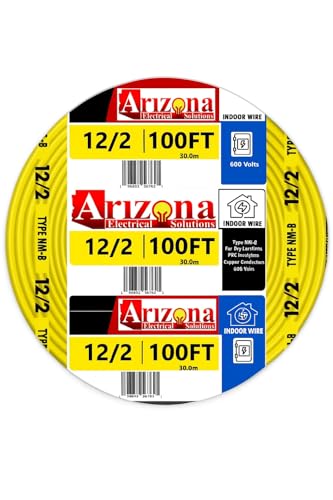
1. 12/2 NM-B Electrical Wire with Ground, 100 ft Coil – 12 AWG Solid Copper
Our pick — over 4.5★ from 350+ verified ratings; the strongest balance of quality and price.
The hundred-footer that finishes a whole room without a splice.
If your project is a full room of outlets, lights, or a basement finish, this is the spool to start with. You get 100 feet of 12/2 NM-B cable — that is two insulated 12 AWG conductors plus a bare copper ground, all in a yellow non-metallic sheath. The conductors are solid bare copper with PVC insulation and a nylon jacket, rated 600 volts and 20 amps. That rating is why this wire is the standard pick for kitchen small-appliance circuits, laundry rooms, and garage receptacles: 20 amps is the load people actually put on a workbench or a fridge outlet.
The sheath is built for dry indoor locations, either exposed or concealed — through studs and joists, or inside the air voids of masonry block or tile that stay dry. It staples flat against framing and strips cleanly, which is the part that saves you time at rough-in. It arrives professionally coiled so it does not tangle while you pull. If you have ever fought a tangled spool halfway through a wall, you know why that packaging decision matters.
What buyers notice most is simply that it behaves like the wire they already know. A homeowner running it for their own house summed it up well: “I am not an electrician but noticed no difference between this wire and the national brands available locally.” Others report it running clean for ceiling pancake lights, with the full coil length checked out. There is one honest note worth sizing correctly — an occasional delivery goes missing in transit, and the fix came through a quick replacement rather than a fight. Treat the order tracking like any other online shipment.
Why This Earns The Top Spot
- 100 feet of 12/2 with ground covers a whole room’s branch circuits in one coil
- 600V, 20A rating makes it correct for the circuits people actually wire
- Solid copper with PVC insulation and a nylon jacket strips cleanly at rough-in
- Yellow sheath is easy to spot in a dark stud bay
Where It Stops Working
- Dry indoor locations only — it has no business in wet ground or direct sun
- Solid conductor is stiff, so tight bends inside a small box take patience
- One parcel reported going missing in transit before a replacement arrived
Reach for this if: you are wiring an entire room or basement and want one continuous 100-foot run of 20-amp-rated indoor cable.
Look elsewhere if: the wire is headed underground or outside, because this sheath is rated for dry indoor use only.
2. Fermerry 12 AWG Stranded Wire Spool 5ft Each 6 Colors
Six colors, 680 strands each, and it bends like a shoelace.
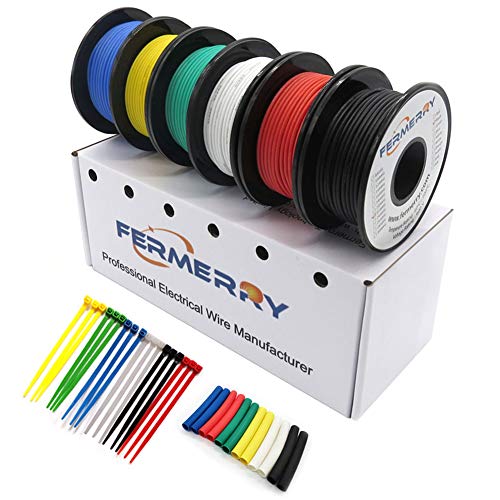
Nothing else on this list bends the way this kit does. Each of the six 5-foot lengths carries 680 strands of 0.08mm tinned copper inside silicone insulation, and that strand count is the whole point. Fine strands mean the wire stays soft, takes a tight radius without kinking, and survives vibration — which is why the car-audio and RC crowd keeps it on hand. The set covers black, red, blue, white, green, and yellow, so you can color-code a harness instead of taping ends.
Silicone insulation is the other half of the story. It shrugs off temperatures from -60 to 200 degrees and stays pliable where ordinary PVC would stiffen, so soldering and crimping terminals go quickly. You also get heat-shrink tubing and wire ties bundled in matching colors. Compare the strand count here to the single solid conductor in the 100-foot NM-B coil above: this one measures conductor flexibility in the hundreds of strands, while that one measures it in exactly one.
Owners who bought it for RC motors and ESC connections call the insulation soft enough to route however you want. The kit’s standout service is the included shrink tubing and zip ties, which saves a separate trip. One realistic caveat shows up in how the wire strips: a standard stripper can cut a few of those fine strands, while an auto-adjusting stripper gives a clean cut with no strand damage. Fine-strand wire rewards the right tool.
The value read: six labeled colors with matching heat-shrink and ties in one box is a lot of finishing hardware for a hobby kit, and it means you are not buying five separate spools to build one harness.
Best for: hobbyists and installers who need short, color-coded flexible runs for RC, audio, and internal equipment wiring.
skip it if: you need long continuous pulls or a jacketed cable for household branch circuits — this is a 5-foot-per-color hookup kit, not a rough-in spool.
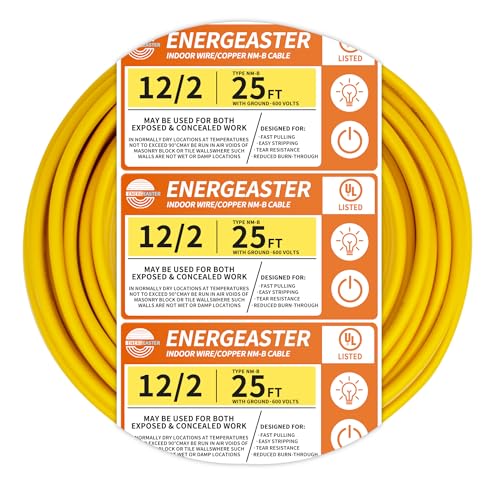
3. Energeaster Solid Indoor 12/2 W/G NMB Cable 25ft
A twenty-five-foot coil sized for the one job you actually have.
Most people buying 12/2 for the first time are adding one outlet, one switch, or one fixture — not finishing a basement. For that, a 25-foot coil is the smarter buy than dragging a hundred-footer into a space where you will use a quarter of it. This Energeaster cable is two 12 gauge solid conductors plus a bare ground, rated 600 volts, with a yellow jacket that pulls, strips, and installs easily.
Wiring someone to a remote attic is where the length and flexibility pay off. This cable maneuvers in cramped space where stiffer wire fights back, and the bright yellow jacket is easy to see in a dark joist bay. Installers running it through wall cavities and attics report getting the length they ordered rather than a shorted coil.
If you are deciding between this and the 100-foot coil above, the honest split is length against price-per-foot — and the 100-footer scales the length by roughly four times if your project turns big. The physics trade-off is consistent: solid 12 gauge is stiff, and a few builder-minded owners find the insulation on the firm side. Others describe the jacket as surprisingly easy to work with for the same reason. Both are true, and it depends on whether your run is a straight pull or a tight crawl.
What the room decides: for a single-project coil, buying four times more wire than you need is the wrong economy; buy the 25-foot length when the job is a single circuit and the hundred-footer when the whole wall is coming open.
Think of this as: the tidy, no-waste choice for a single outlet, switch, or attic fixture.
Size up if: the job will grow past one circuit — a 25-foot coil runs dry fast once you start adding receptacles down a wall.
4. HONENCN 12 Gauge Wire 2 Conductor, 12 AWG 3.3mm² PVC Cord, 12V/24V DC CCA Flexible Wire

Red-and-black low-voltage cord that slips through tight tubing.
This is the pick for 12V and 24V DC work — automotive accessories, LED strip runs, marine wiring, and landscape lamps. It is a two-conductor cable with 106 strands of 0.2mm copper-clad aluminum (CCA — a lighter aluminum core wrapped in copper) inside each circuit, wrapped in red and black PVC. The cord measures 9.5mm across the outer jacket, and that slim profile is why it threads through conduit and loom without hanging up.
Here is the honest catch before you buy, and it is the one spec that separates this from everything else on the list. CCA is copper-clad aluminum, not solid copper. It is lighter, more flexible, and lower cost, and for short low-voltage runs that is completely fine. Over a long run at a real 12-amp load, though, aluminum carries current less efficiently than copper, so voltage sags faster. If your run is a few feet to an LED strip, you will never notice. If it is a long outdoor circuit, spend the copper on SUNVIE or FIRMERST instead.
For its intended job, owners put it to work without drama. The wire routes through tight spaces without developing bare spots, and the tough PVC insulation holds up where it is dragged. Boat wiring and speaker runs come up as common wins in the reviews. A buyer who ordered more than they needed still called the value solid, which is the usual story with a 100-foot low-voltage spool when you only need twenty feet.
Installation note: CCA is ductile and light, so it bends around obstacles and strips without fighting back — it is the opposite feel of the solid 12/2 NM-B above, which holds its shape and resists tight curves.
Pick this for: short 12V–24V DC hookups where you want two clearly marked conductors and easy routing.
Skip it for: long runs or 120V household circuits — copper-clad aluminum drops more voltage than pure copper over distance.
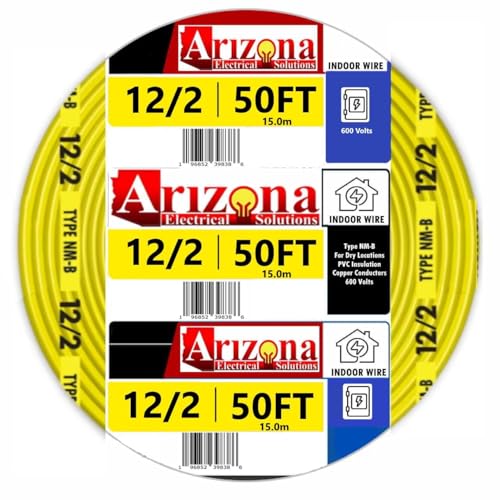
5. ARIZONA ELECTRICAL SOLUTIONS 12/2 NM-B Wire 50 FT, 12 AWG Solid Copper
Fifty feet of code-grade 12/2 for a kitchen or garage circuit.
The job this wire was built for is a single appliance circuit: a garbage disposal, a dishwasher, a garage receptacle, a smoke detector run. You get two 12 AWG solid bare copper conductors — one black hot, one white neutral — plus a bare copper ground, all inside a color-coded yellow PVC sheath. It is rated 600 volts and 20 amps, which is the number that makes it the right call for the appliances that trip a 15-amp breaker.
The spec that separates it from the 100-foot coil is the insulation. This cable carries 90 degree C rated PVC with a nylon coating that resists nicks and abrasion during long pulls, though the code still limits ampacity to 60 degree C conductor ratings. In plain terms: the jacket tolerates heat and rough treatment better than basic insulation, so you are not re-pulling a run because you scuffed it through a stud. It meets ASTM B-3 and B-8, Federal Specification A-A-59544, and NEC NFPA 70 Article 334, and is REACH and RoHS compliant. That is the paperwork a picky inspector wants to see.
Buyers report it arriving tightly coiled and undamaged, cutting easily with lineman’s pliers, and bending smoothly without kinking. One honest note: it ships rolled off a larger reel with minimal labeling, which a couple of owners found odd even though the wire checked out fine.
Why the middle size wins here: a 50-foot roll is calibrated to one appliance circuit, so you finish the run with slack to spare rather than money left coiled in a box.
Made for: the homeowner or electrician running one 20-amp circuit to a kitchen, laundry, or garage appliance.
Not the one if: you are finishing a whole room — the 100-foot coil above covers more ground, and this one runs out mid-wall on a full rough-in.
6. SUNVIE 100FT 12/2 Low Voltage Landscape Wire ETL Listed Copper Wire 12AWG
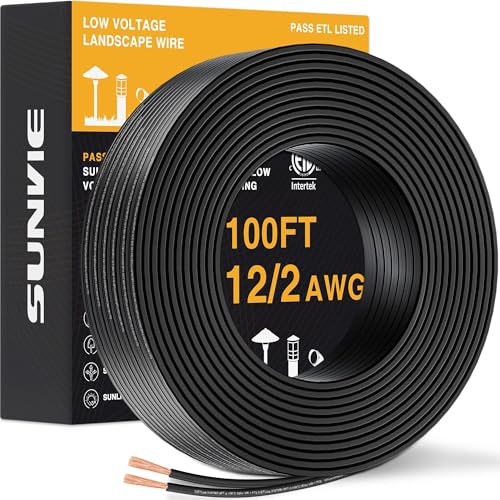
Pure copper for landscape lights that stay bright to the last one.
If your yard lights flicker or the far end of the run goes dim, the wire is usually the culprit. This SUNVIE spool is 100 feet of 12/2 with 65 strands of 100% pure copper per conductor, and pure copper is the reason it holds voltage where copper-clad aluminum sags. It carries a 300V maximum working rating — far above a low-voltage lighting transformer’s output — and an ETL Listing that confirms testing to a recognized standard.
The black SPT-2 PVC jacket is VW-1 fire resistant and rated for sunlight, abrasion, moisture, and direct burial without conduit. It stays flexible in both hot and cold weather, so it strips easily and lies flat when you lay out a lighting circuit. Visible in the data is a strong link between this wire and real installs: owners who swapped a thinner gauge for this 12 gauge report the flickering and shut-offs stopping and the lights running flawlessly.
Compare this to the CCA low-voltage cord, and the split is clean. Both have two conductors; only this one is 100% pure copper, which is why it is the one to buy for a long outdoor circuit where brightness at the end matters. The recurring theme in the owner feedback is ease of use — the jacket strips and separates without a fight, and the fine strands do not spring back into a coil while you are laying them out. For a system that spends its life in the weather, that combination is what you want.
The one for: homeowners running landscape lighting to path lights, spotlights, and in-ground fixtures across a yard.
Wrong tool for: indoor household circuits — it is a low-voltage landscape cable rated to 300V, not a 20-amp branch-circuit wire.
7. FIRMERST 12/2 UF Wire Outdoor Direct Burial Underground Feeder Cable 100ft
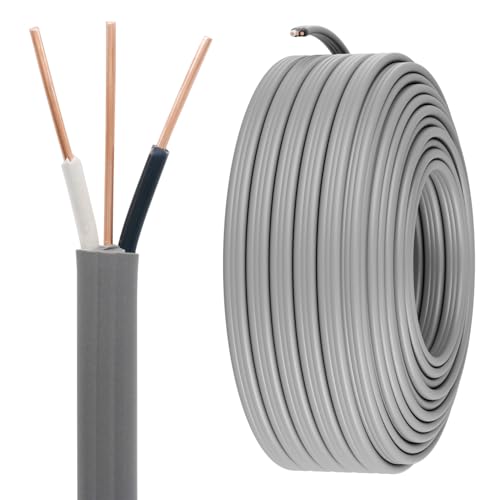
UF cable you drop in a trench and forget about for years.
When the run is going to a shed, a pump, or an outdoor outlet, this is the cable to reach for. It is UF-B underground feeder cable: 12 AWG solid copper conductors plus a ground wire, 100 feet long, rated 600 volts. It is ETL Listed for direct burial and rated for wet and dry locations. That wet-location rating is the dividing line: the indoor NM-B cables on this list cannot go in the ground, and this one is made for it.
PVC jacket construction is what makes it hold up. The PVC jacket resists corrosion and UV exposure, and its direct-burial rating lets you skip conduit entirely. Dig a trench, lay the wire, and fill it back in. The 12/2 format gives you a black hot, a white neutral, and a bare ground, so a standard 20-amp circuit in a detached building has everything it needs. Owners running power to a remote shed call the tough outer casing a confidence booster, and the full three-wire construction means no separate ground run.
There is one downside the reviews surface honestly, and it is a handling note rather than a defect. Because the conductors are solid copper rather than stranded, repeated bending can eventually work-harden them, and a few owners mention the copper turning brittle if it is flexed too many times. Route it once, keep the bends gentle, and that concern disappears. The rest of the feedback centers on how simply it installs — it can be pushed through conduit easily when a run needs protection, and it works as a dependable power source for remote sheds.
The proven job: a forever-run to a shed or a pump is the exact task this cable was built for, and its direct-burial listing means you dig once and are done — no conduit, no conduit access panels, no re-digging.
Reach for this if: you need to run power underground to a shed, a pump, or an outdoor receptacle and want to skip conduit.
Look elsewhere if: the run is entirely inside a dry wall — an indoor NM-B cable handles that job for less, since UF is overbuilt for dry indoor work.
Understanding the Specs
Gauge (AWG) And What Amperage It Carries
AWG stands for American Wire Gauge — a standard sizing scale where a LOWER number means a THICKER wire. Twelve gauge sits at a useful middle point: it is the size the code allows for 20-amp household branch circuits, which is why so many of these cables carry a “20 A” rating. A 20-amp circuit is enough for kitchen appliances, garage tools, and most lighting and outlet runs, so 12 gauge tends to be the safe default when you are not sure. Thicker wire (lower AWG number) handles more current with less voltage drop over distance; thinner wire (higher AWG) is easier to bend but sags more.
Solid Versus Stranded Conductors
The conductor construction changes how a wire feels and where it belongs. Solid wire is one stiff copper core — it holds its shape, staples flat against framing, and terminates cleanly under a screw, which makes it the standard for indoor branch wiring in NM-B and UF cable. Stranded wire is built from many fine strands, so it bends easily and survives vibration, making it the choice for auto, marine, RC, and tight-cable routing. Neither is better overall — the environment and the movement decide. Solid for fixed runs in walls and ground; stranded for anything that bends, moves, or has to squeeze through a tight path.
FAQ
Can I use indoor 12/2 NM-B cable outside or underground?
What is the difference between 12 gauge and 14 gauge wire?
Is copper-clad aluminum (CCA) wire as good as pure copper?
Do I need a ground wire in my 12/2 cable?
How many strands should 12 AWG stranded wire have?
How do I strip 12 gauge stranded wire without cutting the strands?
Can I bury 12/2 wire without conduit?
What does 600V or 300V on the jacket actually mean?
Can I mix solid and stranded 12 gauge wire in one project?
Final Thoughts: The Verdict
For most indoor wiring, the 12 gauge wire to start with is the 12/2 NM-B 100 ft Coil. Its 100-foot coil covers a whole room’s 20-amp circuits in one pull, and it holds 4.8 stars across 370+ ratings. If your project is a single appliance circuit, grab the ARIZONA ELECTRICAL SOLUTIONS 50 FT with its heat-resistant 90 degree C insulation. For a run headed underground, the FIRMERST 12/2 UF is the one built to bury, and for a flexible low-voltage hookup, the Fermerry stranded kit bends where the others will not.
How We Picked
We do not accept paid placement. Every pick is matched to a real buyer and a real use-case; we do not hands-on test units.
Sources & Methodology
Specifications: manufacturer listings and product documentation. Review insights: verified customer reviews, as of September 2026. Pricing: not shown on this page (it changes often); check the current price via the retailer link.
As an Amazon Associate, KitchPrep earns from qualifying purchases. This does not affect which products we feature.
Related Guides
