
Specs are compiled from manufacturer listings and verified buyer reviews and can change over time — please confirm the key details on the product page before buying.
A 12-inch sliding compound miter saw is the tool you reach for when a straight chop saw just won’t span the board. The sliding rails let you pull the blade through wide material, so cutting a 2×12 or a piece of trim for crown molding in a single pass becomes routine. But with the blade sliding on rails, you introduce a new problem: play and flex that can turn a supposedly square cut into a frustrating gap.
I’m Mohammad Maruf — the founder and writer behind KitchPrep. This guide is built by comparing the manufacturers’ published specifications and the patterns across verified customer reviews, so you get each pick’s real strengths and trade-offs instead of marketing spin.
The right 12 compound sliding miter saw balances motor power, slide smoothness, and how accurately it holds its angles so your joints fit tight the first time.
Our Picks at a Glance

How To Choose The Best 12-inch Sliding Miter Saw
A 12-inch blade gives you deep vertical cuts, but the sliding feature is what lets you cut wide boards. The trade-off is that a sliding saw takes up more space and the rails can introduce play. Understanding the specs below helps you pick the right saw the first time.
Motor Power and Speed
Most 12-inch models run on a 15-amp motor, which provides the torque to cut through hardwood and pressure-treated lumber without bogging down. No-load speed, measured in RPM, tells you how fast the blade spins when it’s not cutting—common figures you will see are 3,800 RPM and 4,200 RPM. A higher number can mean faster cuts in softer material, but it doesn’t determine how well the saw handles a heavy 2×12.
Crosscut Capacity and the Rails That Enable It
The crosscut capacity is the widest board the saw can cut through at a 90-degree angle. A sliding saw typically cuts material that is both wider and thicker than a non-sliding model. Keep in mind a bigger capacity usually means longer rails. Some brands use a two-steel-rail system that lets the saw sit flush against a wall, which is a major space saver in a small shop.
Dual-Bevel vs. Single-Bevel Tilting
A bevel tilts the blade head left or right. A dual-bevel saw lets you tilt in both directions without flipping the workpiece over. This will make cutting crown molding and other compound angles significantly faster because you can keep the board on the same side of the fence for every cut.
Cutline Guides: Shadow Light vs. Laser
You need to know exactly where the blade will land. A laser projects a red line onto the wood, while an LED shadow light casts a dark shadow of the blade’s kerf. The shadow light never needs adjustment because it reflects the blade’s actual thickness and position, whereas a laser can drift out of alignment over time.
Quick Comparison
| Model | Best For | Motor Power | No-Load Speed | Weight | Amazon |
|---|---|---|---|---|---|
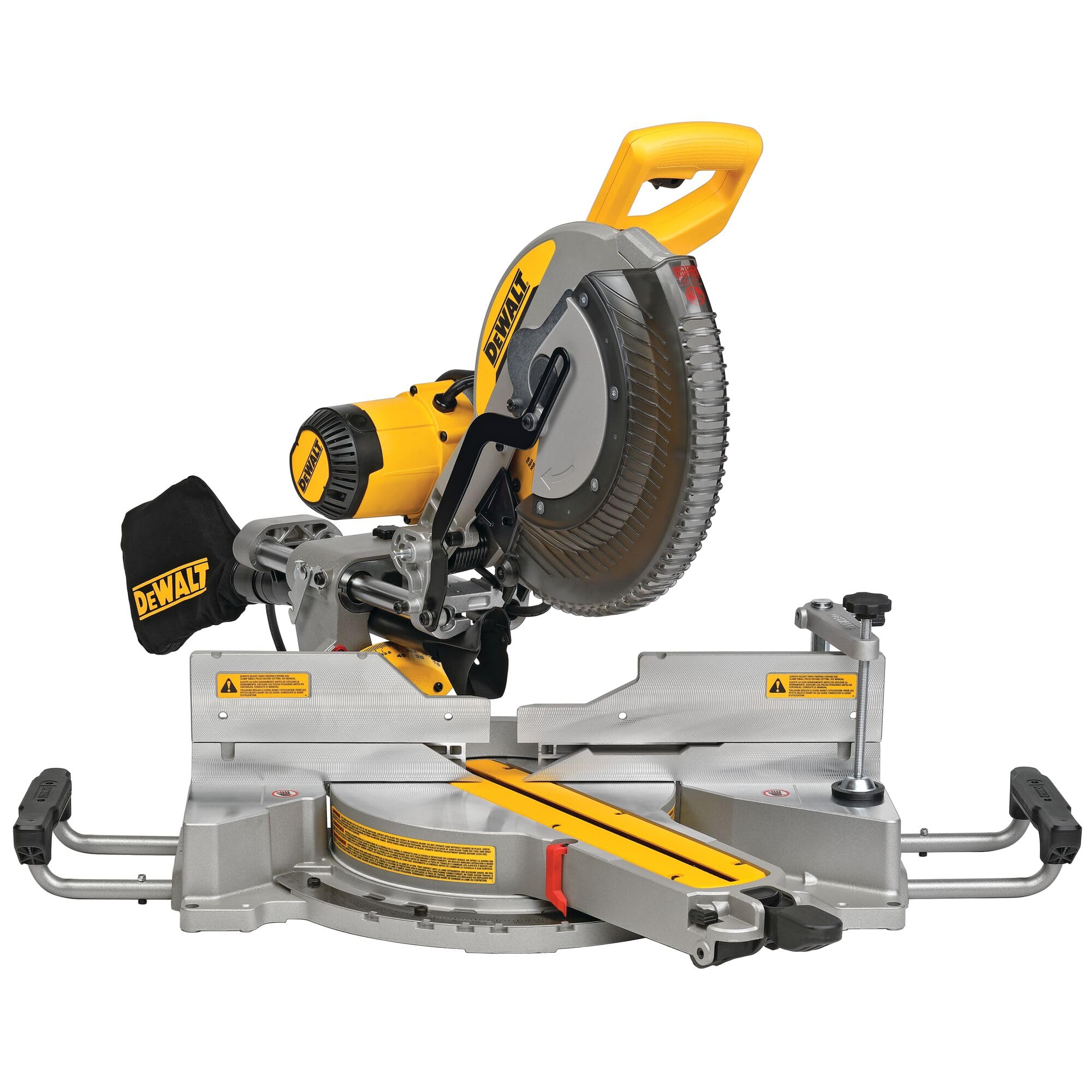
| DEWALT DWS780★ Best Overall | Best Overall | 15 Amp | 3,800 RPM | 58 lbs | Amazon |
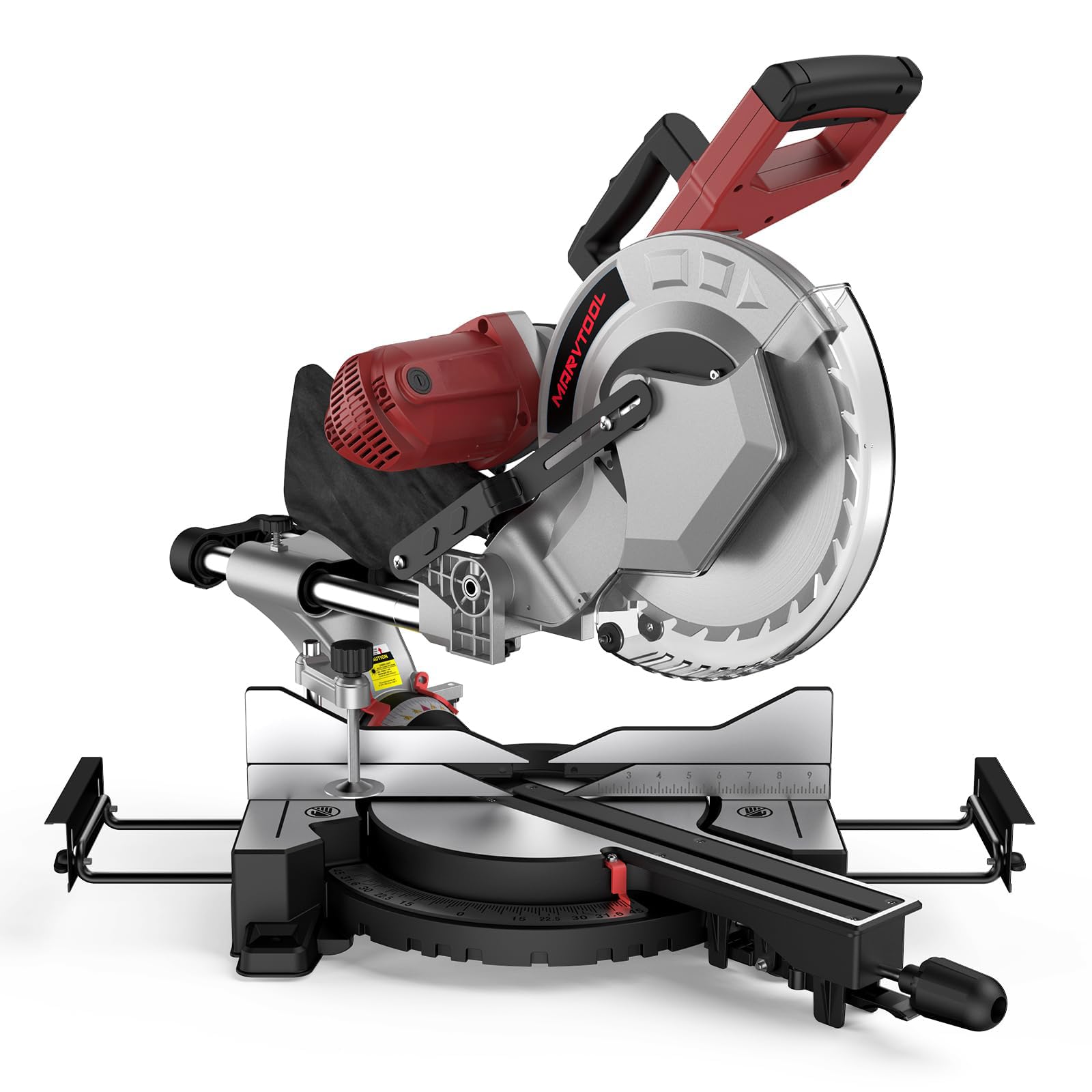
| MarvTool JS-1013C4Best Value | Budget Value | 15 Amp | 3,800 RPM | 39.6 lbs | Amazon |
| DOVAMAN DMS03GMid-Range Power | Mid-Range Pick | 15 Amp | 3,800 RPM | 53.9 lbs | Amazon |
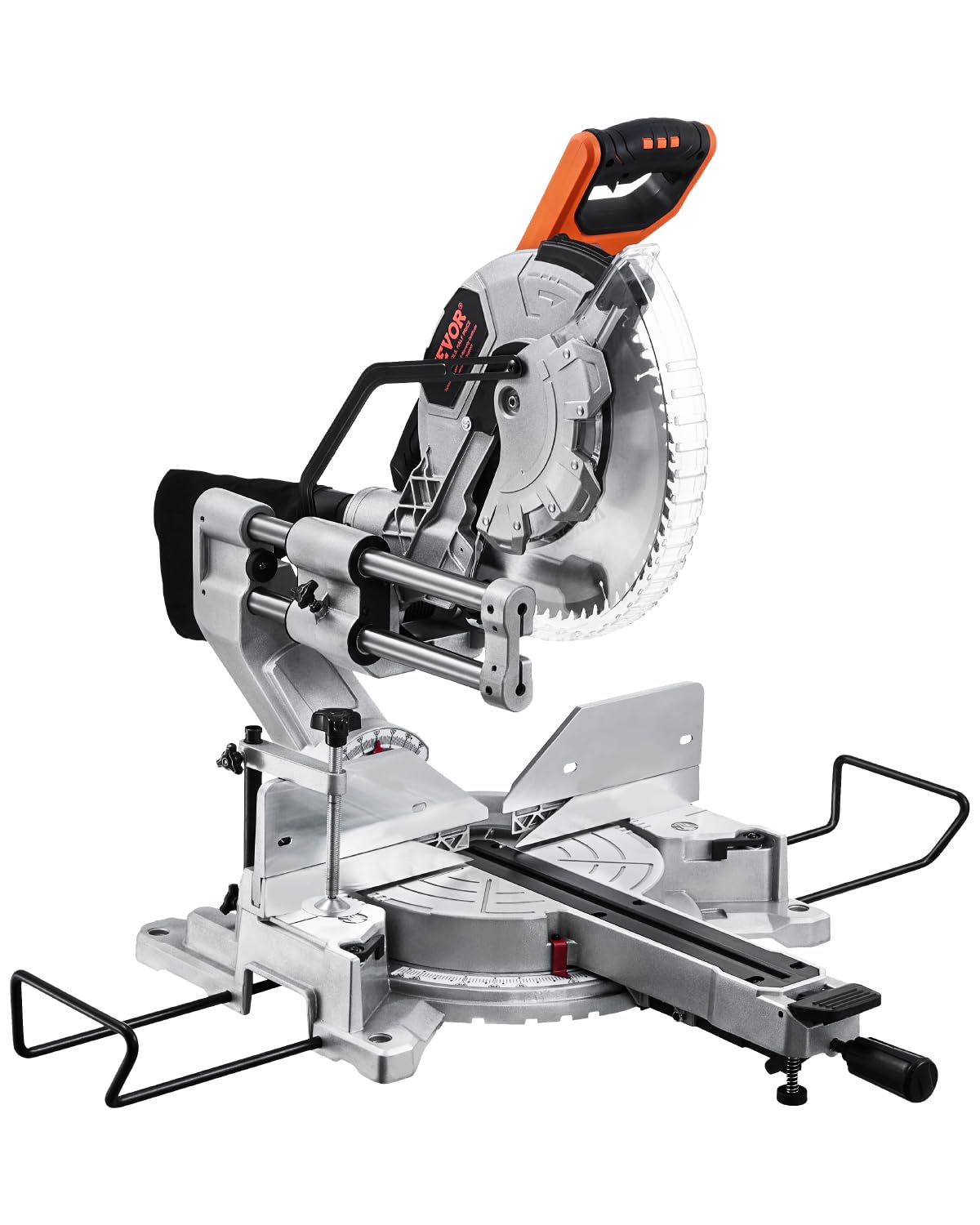
| VEVOR J1G-ZP11-K305 | High-Speed Cutting | 15 Amp | 5,000 RPM | 46.4 lbs | Amazon |
| General International MS3008 | Entry-Level Laser | 15 Amp | 4,200 RPM | 46 lbs | Amazon |
| WEN MM1215 | Compact Front-Slide | 15 Amp | — | 53.4 lbs | Amazon |
| WEN MM1214T | LED & Laser Combo | 15 Amp | — | 56 lbs | Amazon |
| FLEX FX7141A-1J | Cordless Freedom | 24V Brushless | — | 53.6 lbs | Amazon |
| Makita LS1219L | Premium Precision | 15 Amp | — | 81.6 lbs | Amazon |
| Truper SINCO-12X | Heavy-Duty Workhorse | 2 3/4 HP | — | — | Amazon |
| Makita LS1219LX | Saw & Stand Combo | 15 Amp | 3,200 RPM | — | Amazon |
In-Depth Reviews
1. DEWALT DWS780
Our pick — over 4.5★ from 2,500+ verified ratings; the strongest balance of quality and price.
The shop-grade standard that combines dead-on accuracy with a shadow light that never needs calibrating.
The crowd favorite — 4.8 stars across 2,000+ owners — earns its reputation with an integrated cutline system that projects a shadow showing the blade’s exact path. Buyers report the accuracy is exceptional from the start, with one measuring error at less than 0.002 inches over a 16-inch cut. The 15-amp motor spins at 3,800 RPM, delivering the power to slice through pressure-treated 2x12s and pine cleanly without bogging down.
You get a precise cut line every time with the XPS LED shadow light (a system that casts a dark shadow from the actual blade onto the wood), which owners call “excellent” and “simple to use” compared to lasers that drift. The tall sliding fences let you stand crown molding vertically up to 7-1/2 inches nested, so you can make precise compound cuts without extra setup. The dust collection system captures over 75% of generated dust, keeping your shop cleaner than most competing saws.
The honest trade-off is weight and bulk. At 58 lbs, it is a full 46% heavier than the 39.6-lb MarvTool, and its 32.57-inch depth means you need a workbench that can handle it. Owners mention the included dust bag is essentially useless — plan on connecting a shop vac to the 4-inch port instead. The dual horizontal steel rails with linear ball bearings keep the slide smooth, though some customers note the bearings are stiff initially and need oiling.
Why It Earns The Top Spot
- XPS shadow line projects the blade’s true path with zero calibration drift
- Cuts up to 2×14 dimensional lumber at 90° and 2×10 at 45°
- Miters 60° to the right and 50° to the left for wide angle range
What To Expect Before Buying
- Heavy at 58 lbs and roughly 4 feet deep, so it needs a permanent bench spot
- The included dust bag is ineffective — use a shop vac instead
- Startup kickback can jump the saw, so keep your hands above the trigger
The professional’s choice: If you want a saw that stays square for years and cuts wide trim flawlessly, this is the one.
Consider the space first: It is huge and heavy, so measure your bench and plan for a shop vac connection before you commit.
2. MarvTool JS-1013C4
A featherweight dual-slider that proves you don’t need to empty your wallet for clean compound cuts.
Reviewers point out this is a “great value” workhorse for basement framing and trim work. It handles 6-inch boards effectively and cuts smoothly through wood, and the whole unit weighs just 39.6 lbs — dramatically lighter than the 58-lb DEWALT, making it the easiest saw here to lift onto a stand or carry between job sites. The 15-amp motor spins at 3,800 RPM for solid cutting power.
The head locks securely into the base using the release knob, which keeps it compact for storage. Pressing the head down slightly makes the release knob easier to pull out. Both left and right bevel adjustments range from 0° to 45°, giving you the flexibility for compound angle cuts without flipping the board. The included 36-tooth TCT blade, two extension tables, and Allen key cover most of what you need to start.
The recurring complaint is that the saw lacks a laser guide, so you’ll rely on the blade’s edge or your own layout marks for alignment. Durability gets mixed feedback, and there is no direct manufacturer contact for replacement parts — shoppers say the Amazon seller handled their issues instead. This is a DIYer’s saw, not a daily-use professional tool.
Pound-for-pound champion: The 39.6-lb weight makes it the most portable dual-bevel slider on this list, and buyers report it’s “perfect for the DIY that don’t need to break the bank.”
The trade-off: skip it if you demand a laser guide or need heavy daily durability — this is built for occasional use.
3. DOVAMAN DMS03G
An affordable dual-bevel slider with a laser guide that rips through a 4×6 pressure-treated post without hesitation.
Owners mention this saw is “an animal, very powerful” that rips through a 4×6 pressure-treated post with ease. The 15-amp pure copper motor hits 3,800 RPM, and the maximum cutting capacity of 4.2 inches by 13 inches handles the wide boards that frustrate smaller saws. The laser guide projects a line to help you align cuts precisely, and one owner notes it cuts a 1×12 without any strain.
This is a dual-bevel saw, meaning you can tilt the head both left and right from 0° to 45°. Owners call the dual-bevel feature “a huge time-saver” because you don’t have to flip the workpiece for compound cuts. The base features nine common angle presets — including 0°, 15°, 22.5°, 30°, and 45° on both sides — so you can click into common angles quickly.
The honest caveat is that quality control on the blade lock gets mixed feedback, with some units failing to lock fully in place. The durability also draws mixed reviews: some find it sturdy while others say it feels flimsy compared to premium brands. It weighs 53.9 lbs, so it’s not the lightest option, but it’s solidly mid-range for a workshop that won’t be moved daily.
Power for the price: Customers note it’s “quieter than my last one” and cuts accurately — one calls it a great value that cuts very accurately.
Who should pass: pass on it if you need a tool that takes daily job-site abuse; this is a shop saw for serious DIYers and light pros.
4. VEVOR J1G-ZP11-K305
The fastest spinner here at 5,000 RPM, built on a lighter aluminum base that won’t fight you when you move it.
Most 12-inch sliders spin around 3,800 RPM, but this VEVOR hits 5,000 RPM — the highest no-load speed in this lineup — which translates to faster, cleaner cuts through hardwood and composite decking. The 15-amp motor delivers 2,500W of straight-cutting power and 3,000W for bevel cuts. Reviewers point out it “works well with treated 6×6 materials” and describe it as solid and accurate.
Instead of a heavy cast-iron base, VEVOR uses an upgraded aluminum base that’s lighter and dissipates heat better, which shoppers say makes the saw easier to move around a home shop. The blade brake stops the blade quickly after you release the trigger — a safety feature that gets consistently praised. The axial sliding system lets you place this saw flush against a wall when not in use, saving valuable floor space.
The plastic knobs are the weak point, with buyers noting they may wear over time. The included dust bag is small, and blade installation can be awkward on first setup. A few note the shadow line feature gets mixed reviews. Overall, buyers call it a “SOLID” tool that gives you name-brand capability at a budget-friendly price, though they acknowledge it’s not pro-grade.
Speed demon: At 5,000 RPM, this is the fastest blade speed in the roundup, with buyers praising the tight turntable arm and quick blade brake.
The catch: Plastic components and a small dust bag mean this is a hobbyist’s saw, not a daily professional workhorse.
5. General International MS3008

A 46-lb slider with a battery-powered laser that delivers clean 45° miters for the weekend DIYer.
This General International saw runs a powerful 15-amp motor at 4,200 RPM with a 6-foot electrical cord. Buyers report it cuts great with perfect 45° angles and slides easily for larger boards. The 1mW Class II laser alignment system projects a red cut line, though owners note it’s battery-operated and must be manually toggled — a detail that separates it from the hardwired shadow lights on pricier models.
The sliding blade extends your crosscut capacity for bigger boards, and the dual slide rails support smooth operation. It includes a 12-inch carbide-tipped saw blade and a table clamp, with a 2-year warranty from the manufacturer.
Check the weight: at 46 lbs, it’s mid-pack here, but owners mention it must be screwed to a board for stability. The laser’s accuracy is “not very accurate” per one owner, and the blade keeps spinning briefly after you release the trigger, so you must wait before touching the workpiece. This is a home DIYer’s saw, not for daily professional use — but customers note it’s tough to top at this price.
The DIY balance: Reviewers point out it handles bigger boards with ease and delivers “perfect 45° angles” for a home hobby room.
Know before you buy: The battery laser needs manual toggling, and you’ll wait for the blade to stop — minor quirks at this price.
6. WEN MM1215

The front-slide design that hugs the wall and still crosscuts boards up to 13.25 inches wide.
WEN’s unique dual-rail slide system pulls the blade forward instead of pushing it back, so the saw operates flush against the wall with a minimal footprint. This is the smartest space-saving design on the list. The 15-amp motor crosscuts boards up to 13.25 inches wide and 4.5 inches thick, and shoppers say it “cuts 2×10 deck lumber easily” — comparable to a DEWALT in power.
The onboard LED cutline guide illuminates your line of cut, and buyers report it’s “accurate to 1/16 inch” and aligns with the kerf without needing a battery. It includes an 80-tooth carbide-tipped blade, two quick-lock table extension arms, two adjustable support fences, and a quick-clamp assembly. The dust port gets high marks, and the blade stops fast after trigger release.
The duality here is striking in the reviews. Many buyers call it a “great value” that’s “solid” and recommend it for general trades and small businesses. But a minority report long cuts deflect over 8 inches, the right fence arrives slightly off-square, and the bevel isn’t repeatably accurate at fine tolerances. One long-term owner had the brake fail after 9 months. This is why the overall rating sits lower than the DEWALT — it’s a general-purpose saw, not a fine woodworking instrument.
What Owners Rave About
- Front-slide design eliminates rear overhang, saving significant shop space
- Dust collection “on par with DeWalt” when connected to a shop vac
- 80-tooth carbide blade included — a higher tooth count than most rivals
What To Watch For
- Not for fine woodworking — long cuts can deflect over 8 inches
- Fence squareness and bevel repeatability need checking and adjustment
- Included dust bag is poor; plan to use a shop vac
Space-saver supreme: If your shop is tight and you need a saw that works flush against a wall, this front-slide design is the one.
Set your expectations: It’s a general trades saw, not a precision instrument for musical instruments or fine furniture.
7. WEN MM1214T

Dual guidance with a class II laser plus an LED work light, but check the gauge quality before you commit.
The 15-amp motor on this WEN cuts boards up to 13-3/8 inches wide and 3-1/2 inches thick, and it combines an onboard class II laser guide with an LED work light for maximum cut-line clarity. The dual-bevel head tilts 45° in either direction with nine miter stops. Buyers who love it say it’s “comparable to much more expensive models,” with angle detents that were “exact right from the start.”
Its capacity numbers are strong: a 7-1/2-inch crown molding nested capacity and a 6-3/4-inch baseboard vertical capacity. The package includes a 12-inch 60-tooth carbide-tipped blade, two retractable table extensions, a clamp assembly, and a dust bag. At 56 lbs it’s mid-weight, and the included extensions give you support for longer materials.
The recurring and serious complaint is that the miter and bevel gauges are thin plastic decals rather than engraved metal. Owners mention these stickers peel after as little as two weeks of non-use, which makes the angle scales unreadable. There are also reports of the laser failing on the second use and of plastic miter detent levers breaking in shipping. The reviews split sharply: daily users love it, but multiple buyers returned it after the gauges failed.
Strong when it works: Buyers call it comparable to pricier models, with exact angle detents straight from the box.
The deal-breaker risk: The cheap glued-on angle gauges and plastic levers are the reason to look at the DEWALT or Makita instead.
8. FLEX FX7141A-1J
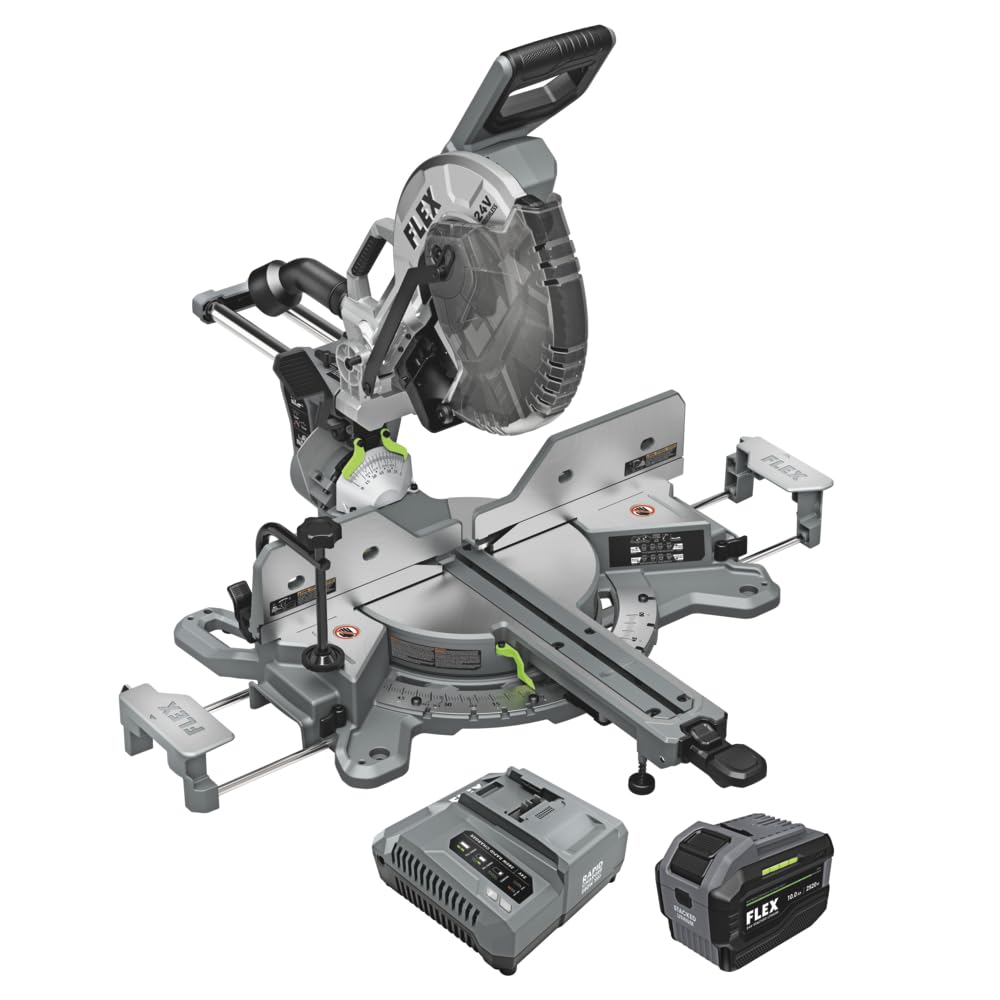
A cordless 12-incher that’s genuinely pro-grade, delivering up to 630 cuts per charge with no cord to trip over.
This is the only cordless saw in the roundup, built on FLEX’s 24V platform with a 10.0Ah Stacked Lithium battery. FLEX claims 200% more power, 300% longer runtime, and 100% faster charging via its Stacked Lithium cells and THERMA-TECH+ heat management. Buyers who use it professionally call it the “best miter saw” they’ve used, with one reporting it cuts 12-inch material in a single pass and the battery still shows a full charge afterward.
The patented FASTSHIFT bevel lever switches between 0°, left and right 22.5°, 33.9°, 45°, and 47° angles instantly — a feature pros will appreciate for crown molding. An LED shadow light aligns the blade to the cut line, and an adjustable depth stop lets you do dado and slot cuts. The spindle stop shaft lock system makes blade changes fast and prevents accidental startups. It includes table extensions to support longer materials.
This is a premium tool with a premium price, costing roughly double the corded competition. It’s also loud and heavy at 53.6 lbs — heavier than several corded 12-inchers despite being cordless. Dust collection is the weak spot, with bags not fitting well and the vacuum port needing an adapter for a standard 2.25-inch hose. If you’re not already in the FLEX 24V ecosystem, the battery investment adds up.
The Cordless Advantage
- Up to 630 crosscuts in 3-1/4-inch MDF on a single 10.0Ah charge
- Smooth, accurate cuts from the start with no calibration needed
- FASTSHIFT bevel lever hits common crown angles instantly
Before You Commit
- Premium price — expect to pay roughly double a comparable corded saw
- Heavier than many corded 12-inchers at 53.6 lbs
- Dust collection needs a hose adapter, and the bag isn’t great
The pro’s cordless dream: If you’re invested in FLEX tools and need job-site portability without losing power, this is the one.
Stay corded if cost matters: The price premium is steep, and you’ll still deal with weight and dust quirks.
9. Makita LS1219L

The 40-year carpenter’s verdict: the best miter saw ever, with a dual-rail slide that saves serious shop space.
Makita’s unique 2-steel-rail system lets the saw sit flush against the wall while still sliding smoothly for wide cuts. A 40-year carpenter calls it the best miter saw he’s ever used, praising the double-slide space savings and fine-tunable bevels. The capacity is outstanding: up to 8-inch crown molding vertically nested, 6-3/4-inch baseboard, and 15-inch crosscuts at 90 degrees. Customers note it’s accurate to 15 inches with zero head play.
The in-front bevel lock makes angle adjustments convenient, and dual dust collection ports provide strong extraction performance. The laser is notably precise, with buyers praising its accuracy. The direct-drive motor and guard system add vertical cutting capacity up to 6-3/4 inches. One builder chose it specifically for the 5-1/4-inch vertical baseboard capacity, the flush slide, and the high rigidity.
Buyers consistently call it a “shop saw” rather than a job-site tool, noting it’s a real lift to move. The aluminum detent ring can wear from the steel pin if you slam it into stops, so owners advise easing gently into angles. Some note mediocre stock cut quality and mixed dust collection performance, though the aftermarket support is strong.
Engineering Excellence
- Dual-rail slide operates flush against the wall, saving significant space
- 8-inch nested crown molding capacity — the best here
- Buyers call it dead accurate with a precise laser
The Heavy Price
- 81.6 lbs is shop-bound — this isn’t a tool you carry daily
- Premium price sits at the top of the range
- Aluminum detent ring can wear; handle the stops gently
For the serious woodworker: If the saw lives in a shop and precision is non-negotiable, this is the pinnacle pick.
Grab the DEWALT instead if you move around: At 58 lbs vs 81.6 lbs, the DEWALT is far more portable with similar accuracy.
10. Truper SINCO-12X

A muscular 2 3/4 HP slider with a telescopic arm that reviewers point out competes with foreign brands head-to-head.
The Truper is built around a 2 3/4 HP motor, stepping above the typical 15-amp class for raw cutting authority. The telescopic arm increases cutting capacity, and the transparent retractable protective guard keeps the blade visible while you work. Buyers whose reviews appear in Spanish call it a high-quality tool with “buena potencia” (good power) and “un buen corte” (a good cut), stating it competes with foreign brands “al tu por tu” — on equal terms.
Vertical and horizontal presses firmly hold the workpiece during cutting, which reduces vibration and improves accuracy. The table extension with rails supports wider workpieces for better control. Positive stops click in at 0°, 15°, 22.5°, 30°, and 45° on both left and right sides, and a laser line helps with alignment. Buyers describe the packaging as clean and well-organized, calling the overall quality “excelente.”
The main complaint involves the included accessories: the box advertises two blades but only one arrives, which led one buyer to return it. The handle is plastic, and there’s a note that the saw is sturdy but heavy. The cutting reach of 35mm width has proven useful for buyers, though you’ll want to verify the package contents on arrival.
Lots of muscle: At 2 3/4 HP, this out-muscles the standard 15-amp class and handles wide cuts with a telescopic arm.
Check the box: Some units ship with fewer accessories than advertised, so verify contents immediately on delivery.
11. Makita LS1219LX

The LS1219L plus a folding stand with wheels, ready to roll between job sites at 3,200 RPM.
This is the full kit version of the Makita LS1219L, bundling the saw with a durable compact folding stand that has transport wheels and a side handle. The stand uses an aluminum tubular design weighing just 33.7 lbs and supports up to 500 lbs — so you can load the 81.6-lb saw and still wheel it around. Buyers call it “super nice and easy to use,” with one noting the stand is very useful if you’re strapped for space.
The saw itself keeps the same direct-drive motor, spinning at 3,200 RPM, and the dual dust collection ports. Shoppers say completing two big building projects with alignment still perfect, and the saw never bogs down. One hobbyist upgraded from a DEWALT and notes this takes up “so much less room,” calling it worth the money for the space savings alone.
The recurring complaint is weight and balance. The full setup is heavy and hard to maneuver solo, with small, closely-spaced wheels creating imbalance when transporting. Some buyers report the thin base can fracture on first mount, and the stand isn’t truly portable despite the wheels. Buyers recommend leaving it on a cart in the shop rather than treating it as a true job-site traveler. A rare factory defect with blade wobble was resolved with a free replacement saw.
Complete workshop setup: The folding stand with wheels and 500-lb capacity makes this a ready-to-work kit for space-conscious shops.
Set expectations on portability: Despite the wheels, this rig is heavy; plan to keep it assembled rather than breaking it down daily.
Understanding the Specs
Cut Capacity (Crosscut & Vertical)
Crosscut capacity is the widest board the saw can cut at 90 degrees — the DEWALT handles 2×14 lumber while the WEN MM1215 manages 13.25 inches. Vertical capacity tells you how tall material can be when stood against the fence, which is what matters for baseboard and crown molding. The Makita handles 6-3/4-inch baseboard vertically, and the DEWALT supports crown molding up to 7-1/2 inches nested against its tall sliding fences.
Dual-Bevel vs. Single-Bevel
Dual-bevel means the blade head tilts both left and right — typically up to 45° — without flipping the workpiece. On crown molding or picture frames, this saves time because you keep the board on the same side of the fence. The FLEX FASTSHIFT lever even clicks into preset bevel angles of 22.5°, 33.9°, and 47° for common crown angles, while most dual-bevel saws let you dial in any angle from 0° to 45° in both directions.
Shadow Line vs. Laser Guide
A laser projects a red line onto the wood to show where the blade will cut, but it can drift and needs battery power or manual toggling. An LED shadow light casts a dark shadow from the actual blade, so it shows the exact kerf width and never needs calibration. The DEWALT XPS system is the benchmark here — buyers call it “excellent” and “simple to use” compared to lasers that shift.
RPM and Motor Class
No-load speed, measured in revolutions per minute, indicates how fast the blade spins. You’ll see 3,800 RPM on most 15-amp saws like the DEWALT and DOVAMAN, while the VEVOR tops out at 5,000 RPM and the General International runs 4,200 RPM. The Makita runs 3,200 RPM. Higher RPM doesn’t automatically mean better cuts — torque from the 15-amp motor matters more when pushing through hardwood.
FAQ
Will a 12-inch sliding miter saw cut a 2×12 in one pass?
What is the difference between a single-bevel and dual-bevel saw?
Which is better, a shadow line or a laser guide?
How heavy is too heavy for a sliding miter saw?
Can a cordless miter saw match the power of a corded one?
What does the sliding feature actually do for me?
How much bench space do I need for a sliding miter saw?
What is crown molding nested capacity and why does it matter?
Is a 40-tooth blade or a 60-tooth blade better for a miter saw?
Can I use my shop vacuum instead of the dust bag?
How do I know if a sliding miter saw is accurate from the start?
Final Thoughts: The Verdict
For most buyers, the 12 compound sliding miter saw winner is the DEWALT DWS780 because it combines a 15-amp motor, an XPS shadow light that never needs calibration, and accuracy measured under 0.002 inches — all backed by thousands of owners. If you want a budget-friendly dual slider at just 39.6 lbs, grab the MarvTool for value that buyers call tough to top. And for job-site work without a cord, the FLEX FX7141A delivers up to 630 cuts per battery charge, making it the pro’s cordless pick.
How We Picked
We do not accept paid placement. Every pick is matched to a real buyer and a real use-case; we do not hands-on test units.
Sources & Methodology
Specifications: manufacturer listings and product documentation. Review insights: verified customer reviews, as of September 2026. Pricing: not shown on this page (it changes often); check the current price via the retailer link.
As an Amazon Associate, KitchPrep earns from qualifying purchases. This does not affect which products we feature.
Related Guides
