
Specs are compiled from manufacturer listings and verified buyer reviews and can change over time — please confirm the key details on the product page before buying.
Buying wire for a ceiling fan is simpler than most people fear — you need 12-gauge, three-conductor cable with a ground, and the right length for your run. The fan itself is the easy part. The wire is where people second-guess themselves, because a normal fan-plus-light setup needs that third wire for the second switch, and a two-wire roll simply will not do the job. This guide cuts straight to the five rolls worth your money, sorted by what each one actually does well.
I’m Mohammad Maruf — the founder and writer behind KitchPrep. This guide is built by comparing the manufacturers’ published specifications and the patterns across verified customer reviews, so you get each pick’s real strengths and trade-offs instead of marketing spin.
Roughly, you are weighing length, gauge, and how easily the jacket slides through a crowded ceiling box — the three things that decide whether your project goes smoothly. Every pick below is a real copper NM-B cable rated for dry indoor use, which is exactly what feeds a fan box. The full picture of the 12/3 wire for a ceiling fan is covered so you can pick once and stop second-guessing.
Our Picks at a Glance

How To Choose The Best 12/3 Wire for a Ceiling Fan
Almost every mistake people make here depends on three numbers: the gauge (the wire’s thickness), the conductor count (how many separate wires run inside the cable), and the roll length. Get those right and the rest is detail. Here is what each one means for your fan run.
Gauge: why 12 AWG and not 14
The gauge number (AWG, a standard size scale where a lower number means a thicker wire) tells you how much current the copper can carry safely. A 12-gauge conductor is thicker than 14-gauge, so it handles a heavier electrical load before it heats up. Many fan circuits are wired on a 20-amp breaker, which pairs with 12-gauge copper rather than the thinner 14. If your circuit was built for 12/3, sticking with 12/3 keeps everything matched and code-friendly.
Three conductors plus ground: the fan-and-light setup
This is the part that trips people up. A fan with a built-in light usually gets two separate switch legs — one for the fan, one for the light — plus a shared neutral and a bare ground. That is three current-carrying conductors (black, red, white) and a ground, which is exactly what “12/3” means. A 12/2 roll only gives you two conductors and a ground, so it cannot split the fan and light onto separate switches. If you plan to control them independently, 12/3 is the one to buy.
Length: match the roll to the run
Measure from the breaker panel to the fan box, add a comfortable margin for routing around joists and into the box, and buy slightly more than you need. Wire is cut to length by the seller in some cases and sold in fixed coils in others, so check whether you are buying a coil or a cut-to-order length. Running short means a second order and a splice; running long just leaves you spare wire for the next small job.
Quick Comparison
| Model | Best For | Length | Gauge & Conductors | Voltage Rating | Amazon |
|---|---|---|---|---|---|
| Southwire Romex Simpull 12/3 W/G NMB (25ft)★ Best Overall | Most fan-on-a-single-switch jobs | 25 ft | 12 AWG, 3 conductor + ground | 600V | Amazon |
| Southwire 63947826 Romex SIMpull NM-B (15 ft)Compact Run | Tight, short ceiling runs | 15 ft | 12 AWG, 3 conductor + ground | 600V | Amazon |
| Wirenco 12/3 NM-B Sheathed Cable (50ft Cut) | Custom cut-to-length flexibility | 50 ft | 12 AWG, 20A capacity | 600V | Amazon |
| Cerrowire 147-1603BR 12/3 NM-B Solid with Ground | Longer indoor fan-and-light runs | 50 ft | 12 AWG, 3 conductor + ground | UL listed, dry indoor | Amazon |
| Southwire #13058355 250′ 12/3 W/G UF Cable | Whole-home and outdoor feeder runs | 250 ft | 12 AWG, 3 conductor, multi strand | 600V | Amazon |
In‑Depth Reviews
1. Southwire Romex Brand Simpull™ Solid Indoor 12/3 W/G NMB Cable 25ft Coil
Our pick — over 4.5★ from 700+ verified ratings; the strongest balance of quality and price.
A 25-foot coil of 12/3 solid copper with Southwire’s SIMpull jacket for a standard fan-and-light run.
If your fan and its light share one switch — or you just need a short, clean run to the ceiling box — this 25-foot Southwire roll is the one most people should buy. It carries three conductors plus a ground, all in 12-gauge solid copper, so it fits the standard fan-plus-light wiring setup where the red wire is the second switch leg. The 600-volt rating covers any residential ceiling circuit you will run into.
The SIMpull jacket is what sets this roll apart. It wears Southwire’s patented SIMpull jacket, a smooth outer coating that lets the cable slide through drilled joists, tight stud bays, and crowded boxes instead of catching on the wood. That is the difference between a run that fights you and one that feeds through cleanly, and it is the single feature that separates this roll from a plain-jacket cable.
Buyers report the copper and the jacket (the outer protective skin) are the best things about this roll, with value close behind, since a 25-foot coil often lands cheaper than a shorter length from a big-box shelf. The catch is length. At 25 feet, a long attic-to-panel run that eats more than 20 feet of cable will leave you short, so measure generously before you commit. If your run is genuinely short, this is the easiest 12/3 to work with, full stop.
Where the Southwire Leads
- SIMpull jacket pulls through studs and joists with noticeably less effort than a standard jacket.
- Three conductors plus ground — exactly the fan-plus-light wiring pattern that needs a second switch leg.
- 25-foot coil covers most single-ceiling-box jobs with a little to spare.
- 600-volt rated for residential branch circuits feeding lights and switches.
What to Know First
- 25 feet runs short on long panel-to-attic pulls.
- Rated for dry, above-ground locations only — not for damp or buried runs.
Grab this one if: your ceiling box is within 25 feet of the supply and you want the smoothest pull on the list.
Step up in length instead if: you are running all the way from a far-off panel — the longer coils below solve that cleanly.
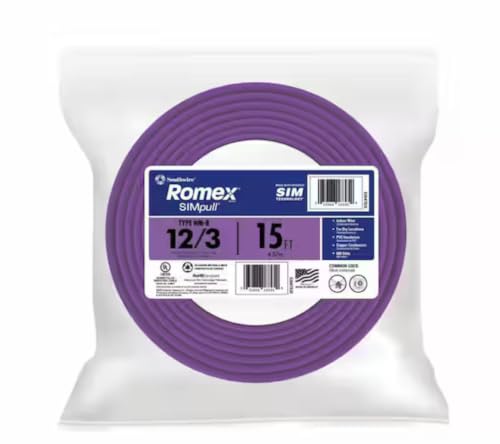
2. Southwire 63947826 Romex SIMpull NM-B Cable, Purple Jacket, 12-3 AWG, 600V, 15 Feet
A 15-foot, 1.7-pound coil of 12/3 solid copper for fan boxes that sit close to the supply.
This is the roll for a short hop — a fan box that sits close to its supply, or a small remodel where you only need a few feet past the switch. It is 12-gauge solid copper with three conductors and a ground, cut to a 15-foot coil. Weighing 1.7 pounds, it is the lightest coil here, and it is noticeably lighter than the 5.5-pound Cerrowire 50-footer — a real plus when you are holding it overhead on a ladder.
The jacket slides past existing staples and a stuffed box without snagging, which is where short stub runs usually fight you. The copper stays supple and pulls through joists and studs without kinking, and it also passes cleanly through a PVC pipe if your route runs that way. For a three-way switch leg in a kitchen-style remodel, this coil has the right conductor count to do the job.
Here is the honest split: fans of this roll prize the copper quality and the value, and the handling is praised for being genuinely easy to pull. The obvious limitation is the 15 feet — that covers a closet or a short ceiling drop, not an attic-spanning run. If your measurement lands under about a dozen feet with room to spare, this compact coil is the tidy choice.
The short-run specialist: at 1.7 pounds and 15 feet, this is the coil to reach for when the supply box is close and you want minimal leftover.
Weigh the length honestly: it beats the heavier Cerrowire on carry weight, but a longer span will send you back to a 25- or 50-foot roll.
Reach for this if: your run is genuinely short and you would rather not fight a bulky 50-foot coil on a ladder.
Look elsewhere if: the distance from panel to fan is anything more than a hop — size up to a longer coil.
3. Wirenco 12/3 NM-B Sheathed Cable, Residential Indoor Wire (50ft Cut)
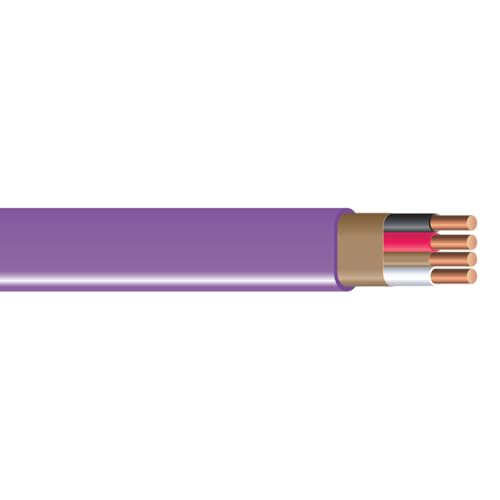
A 50-foot 12/3 NM-B roll sold cut-to-length, so you order the exact footage your run needs.
The Wirenco angle is flexibility. It carries a 600-volt maximum rating and an allowable ampacity of 20 amps, and since it is 12-gauge copper, that 20-amp pairing is the exact match for a typical fan circuit on a 20-amp breaker. The sheath is rated for dry locations up to 90 degrees Celsius (that is 194 degrees Fahrenheit, far hotter than any ceiling box ever gets), which covers both exposed and concealed indoor work.
Its real draw is the ordering model. This roll is sold as a cut-to-length option, so you can ask for the exact footage your run needs, and buyers like it enough that custom-length ordering gets called out repeatedly as the smart reason to buy here. One owner noted ordering it in non-standard lengths and reasoned it is likely cut from a large spool — exactly what a ceiling fan run benefits from when you need something between the fixed 25- and 50-foot coils.
Fit-wise, it is 12 AWG residential wire meant for outlets, switches, and other loads, runs fine exposed or concealed in dry spaces, and the 20-amp capacity lines up with what a 12-gauge fan circuit expects. Buyers widely report it meets current standards and works as expected, with the seller’s responsiveness and fast FedEx shipping also getting steady mentions. One quirk worth knowing: the block lists four conductors by count while the product description calls it 3-conductor, so confirm the configuration matches your wiring plan before you order.
Why it earns its slot: a true cut-to-length option for anyone tired of buying a fixed coil and tossing the remainder.
The one thing to verify: double-check the conductor count against your fan-and-light plan, since the listing presents both a three-conductor description and a four-wire count.
Best for: the buyer whose run length sits awkwardly between standard coil sizes.
Not for: anyone who wants a single fixed coil delivered with zero back-and-forth on footage.
4. Cerrowire 147-1603BR 50-Feet 12/3 NM-B Solid with Ground Wire
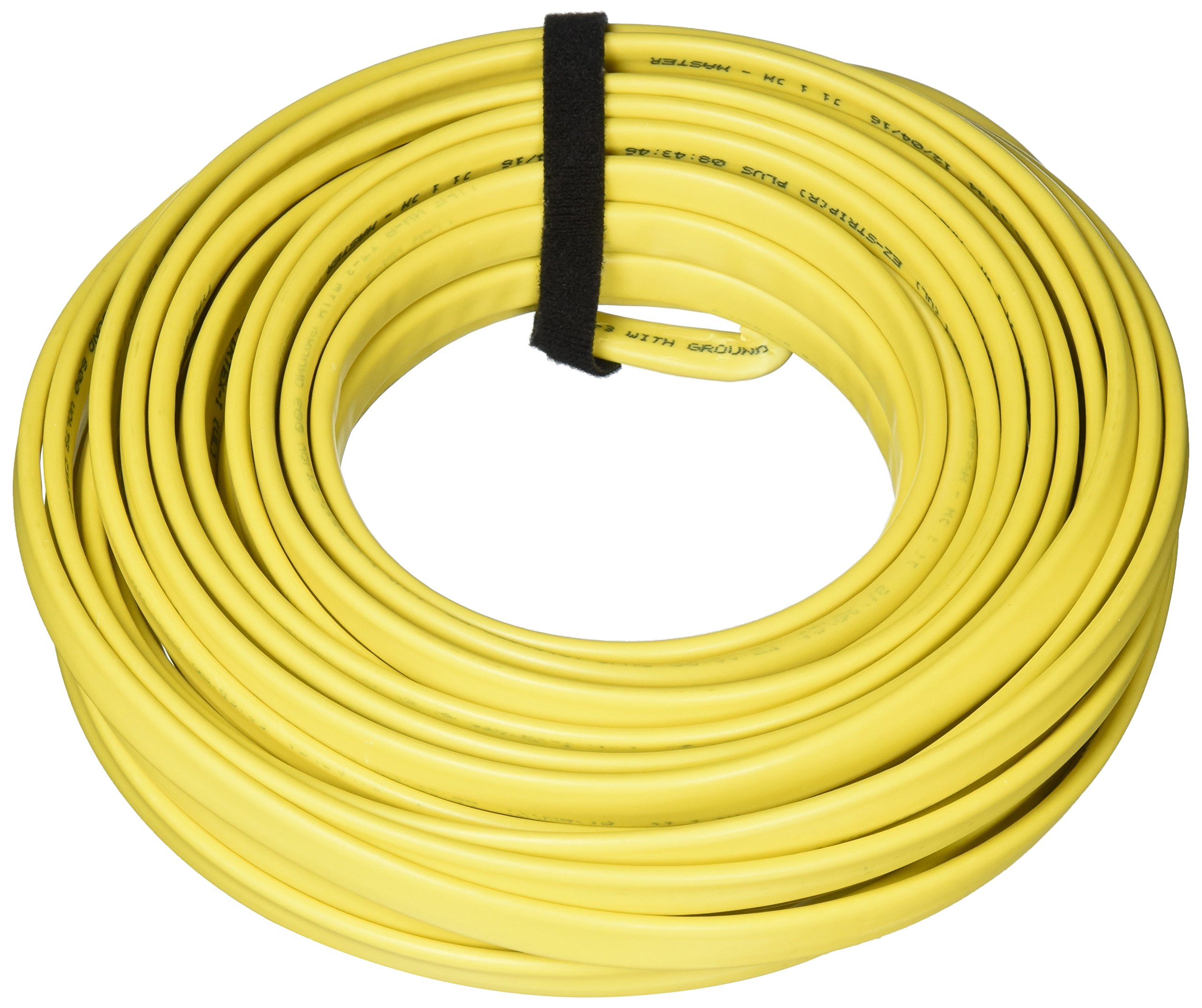
A 50-foot UL-listed 12/3 solid copper coil for panel-to-fan runs that outgrow a 25-footer.
When the fan box is a real distance from the supply, this 50-foot Cerrowire coil ends the guessing. It is 50 feet of solid 12-gauge UL-listed copper with three conductors and a ground, built for exposed and concealed dry indoor work. At 5.5 pounds the coil is bulky to carry up a ladder, but that weight buys you enough length to reach across an attic without splicing, which is exactly the trade-off a longer coil should make.
The jacket is a 30 mil-thick PVC (that thickness is the clear plastic-and-vinyl outer wrap that shields the copper), and every package carries the Underwriters Laboratories listing label for non-metallic sheathed cable. That label matters if your local inspector wants to see a recognized listing on the cable feeding a fan. The one comfort detail: it is a solid strand, not stranded, so it holds its shape when you bend it into the box.
Buyers repeatedly report it costs roughly half what local home-improvement stores charge for the same copper. Multiple reports describe it running at roughly half what the local home-improvement stores charge for the same copper, and the extra footage on the coil is a pleasant surprise. One recurring point of confusion is color: the description says yellow, but the wire is actually purple — the standard hue for marking 12/3 so it is visually obvious during inspection. A few owners wonder whether the wire runs a touch thin for 12-gauge, so eyeball it against your strip gauge if you are picky.
Compared with the 15-foot Southwire above, this coil carries 35 more feet to work with — more than triple the length — and weighs a matching 3.8 pounds more, so it is the pick when reach beats portability. Not for direct burial, and dry locations only.
The verdict: buy this when your ceiling run is long enough that a short coil would leave you spliced.
Mind the color note: expect purple wire in the box even though the listing says yellow, and confirm the gauge reads full 12 to your eye.
5. Southwire #13058355 250′ 12/3 W/G UF Cable

A 250-foot roll of 12/3 UF-B copper rated for direct burial and outdoor feeder runs.
This is the bulk roll — 250 feet of 12-gauge, three-conductor copper UF-B cable rated at 600 volts. UF-B stands for underground feeder (a tougher cable built for outdoor and buried runs), and unlike the indoor NM-B coils above, this one may be used underground, including direct burial. That means it doubles as both your indoor feeder stock and the cable for a run out to a shed, post lamp, or pump.
For a ceiling fan specifically, the practical point is simple: 250 feet is far more than one ceiling box needs, but it earns its place if you are wiring several fixtures, feeding a detached space, or just want one roll that covers the whole project. It is generally used as a feeder (the main line that carries power out to a spot) to outside post lamps, pumps, and similar loads, and it is multi-strand rather than solid, so it bends and routes differently than the solid indoor coils.
Value is the headline buyers keep coming back to — it lands well below what the same cable runs at the usual local suppliers, and it is the kind of bulk purchase that pays off across a whole shop build. If your project is genuinely just one indoor ceiling fan, this is overkill and a standard NM-B coil (indoor-rated cable) is the smarter buy. If the fan is one stop on a larger wiring plan, this is the roll that avoids a second order.
What Stands Out
- 250 feet of 12-gauge three-conductor copper covers a whole-project wiring plan.
- UF-B rated for direct burial and underground use — the indoor-only coils cannot do this.
- 600-volt rating matched to the rest of the category.
- Bulk length lands well under local supplier pricing for the same copper.
The Practical Catch
- Absurd overkill for a single indoor ceiling fan run.
- Multi-strand construction handles differently than the solid NM-B coils.
Choose this when: the ceiling fan is part of a bigger wiring job and you want one roll to cover all of it.
Skip for: a single indoor fan box, where a shorter NM-B coil is the sensible buy.
Understanding the Specs
What “12/3” Actually Means
The first number is the wire gauge — 12 AWG — and it tells you how thick the copper is. Thicker copper carries more current safely, which is why 12-gauge pairs with a 20-amp circuit. The second number is the count of current-carrying conductors: three of them, typically black, red, and white. Add the bare ground and you have a full 12/3 cable. For a ceiling fan with a light on two switches, that third wire is what lets the fan and the light run on separate controls.
NM-B vs UF-B: Which Cable for a Fan
NM-B is the standard indoor sheathed cable, and it is the right pick for a dry ceiling box. UF-B is a tougher underground feeder cable rated for direct burial and wet locations. Both come in 12/3 configurations and both carry the same conductor layout, so the choice is about where the cable goes, not the fan itself. Keep NM-B indoors and dry, and reach for UF-B only when the run heads outside or into the ground.
FAQ
Do I really need 12/3 wire for a ceiling fan?
Can I use 12/3 wire on a 15-amp circuit?
How long does 12/3 wire last once installed?
Is 12/3 wire the same as 12/2 wire?
Can I run 12/3 wire outside or underground?
What colors are the wires inside 12/3 cable?
Why is my 12/3 wire purple instead of yellow?
How much 12/3 wire do I need for one ceiling fan?
Can I use 12/3 wire for a ceiling fan on a 20-amp breaker?
Is stranded or solid 12/3 wire better for a fan?
Final Thoughts: The Verdict
For most ceiling fan projects, the 12/3 wire for a ceiling fan winner is the Southwire Romex Simpull 25ft Coil, because its patented SIMpull jacket feeds through joists and studs with far less effort and the 25-foot length covers a typical single-ceiling run. If your fan box sits close to the supply and you want the lightest coil to carry up a ladder, reach for the 15-foot Southwire. And when the run stretches across an attic or the fan is one stop on a bigger job, the 50-foot Cerrowire is the one that reaches without a splice (a joint where two cable ends meet).
How We Picked
We do not accept paid placement. Every pick is matched to a real buyer and a real use-case; we do not hands-on test units.
Sources & Methodology
Specifications: manufacturer listings and product documentation. Review insights: verified customer reviews, as of September 2026. Pricing: not shown on this page (it changes often); check the current price via the retailer link.
As an Amazon Associate, KitchPrep earns from qualifying purchases. This does not affect which products we feature.
Related Guides
