
Specs are compiled from manufacturer listings and verified buyer reviews and can change over time — please confirm the key details on the product page before buying.
If you have ever run a circular saw or a snow blower at the far end of a thin orange cord, you already know the feeling: the motor bogs, the cord warms in your hand, and you stop trusting the setup. A 12/3 cord fixes that by using three thick copper conductors that carry 15 amps and 1875 watts to the end of a full 100-foot run without the voltage sag that makes motors strain. That is why a homeowner with a big yard and a contractor on a jobsite reach for the same 12-gauge spec.
I’m Mohammad Maruf — the founder and writer behind KitchPrep. This guide is built by comparing the manufacturers’ published specifications and the patterns across verified customer reviews, so you get each pick’s real strengths and trade-offs instead of marketing spin.
You will see which cord handles big draws, which ones light up so you can find them after dark, and where each option gives something up. The picks below are all genuine 12-gauge, three-conductor, 100-foot cords — this is what separates the reliable options from the ones that only look the part when you are shopping for the 12/3 extension cord 100 feet.
Our Picks at a Glance

How To Choose The Best 12/3 Extension Cord 100 Feet
The numbers on the jacket look like code, but each one answers a real question: will this cord power my tool, will it survive my yard, and will it still work next winter. Read the label as a set of promises.
Gauge: The Part That Decides Everything
The gauge number tells you the thickness of the copper inside. Lower numbers mean thicker wire, and 12 gauge is the balance for a 100-foot run drawing up to 15 amps. A thinner 14 or 16 gauge cord forces the same current through less copper, which builds heat and drops voltage before it reaches your tool. That is why a heavy-duty cord weighs more: the copper is what you are carrying.
Length and Voltage Drop
Every foot of cord adds a little resistance, so a 100-foot run is where gauge starts to matter in a way you can actually feel. Voltage drop is the term for the power lost along the way. On a short cord you would never notice it, but stretch a long one across a yard and a thin gauge leaves your motor running below its rated voltage. That is why 12 gauge is paired with 100-foot lengths and 15A, 125V service.
Jacket and Connectors
The letters on the cord describe the jacket. SJTW is a service-grade thermoplastic weather-resistant jacket, which is the rating you want for outdoor use. A PVC or vinyl jacket resists rain, sunlight, and abrasion, and stays workable in cold instead of turning rigid and cracking. Look for a three-prong grounded plug, and a female end with a light inside if you plan to work after the sun goes down.
Quick Comparison
| Model | Best For | Outlets | Amps / Watts | Jacket Rating | Amazon |
|---|---|---|---|---|---|
| PLUGTUL 100Ft 12 Gauge 3-Outlet★ Best Overall | Garage and multi-tool jobs | 3 | 15A / 1875W | SJTW, ETL listed | Amazon |
| UBOORY 100 FT Black 12/3 SJTWBest Value | Electric mowers and tillers | 1 | 15A / 1875W | SJTW, cold-resistant | Amazon |
| Thonapa 100 Ft Yellow 12/3Best for Winter | Snow blowers and log splitters | 1 | 15A / 1875W | SJTW, UL Certified | Amazon |
| Conntek 20251-100 12/3 | Jobsites and appliances | 1 | 15A / 1875W | SJTW, ETL/cETL | Amazon |
| LifeSupplyUSA 3-Outlet 12/3 | Generators and EV charging | 3 | 15A / 1875W | SJTW, waterproof | Amazon |
| PLUGTUL 12 Gauge 100FT Lighted | Appliances and A/C units | 1 | 15A / 1875W | SJTW, ETL listed | Amazon |
| PlugSaf 100ft 12/3 Waterproof | Yard work in freezing temps | 1 | 15A / 1875W | IP65, SJTW | Amazon |
| ISLEWIRE 100 FT 3-Outlet | Garage heaters and workshops | 3 | 15A / 1875W | SJTW, ETL certified | Amazon |
| GEARit 100 Ft SJTW OFC Copper | Long-run pro tool layouts | 1 | 15A / 1875W | SJTW, weather-resistant | Amazon |
In‑Depth Reviews
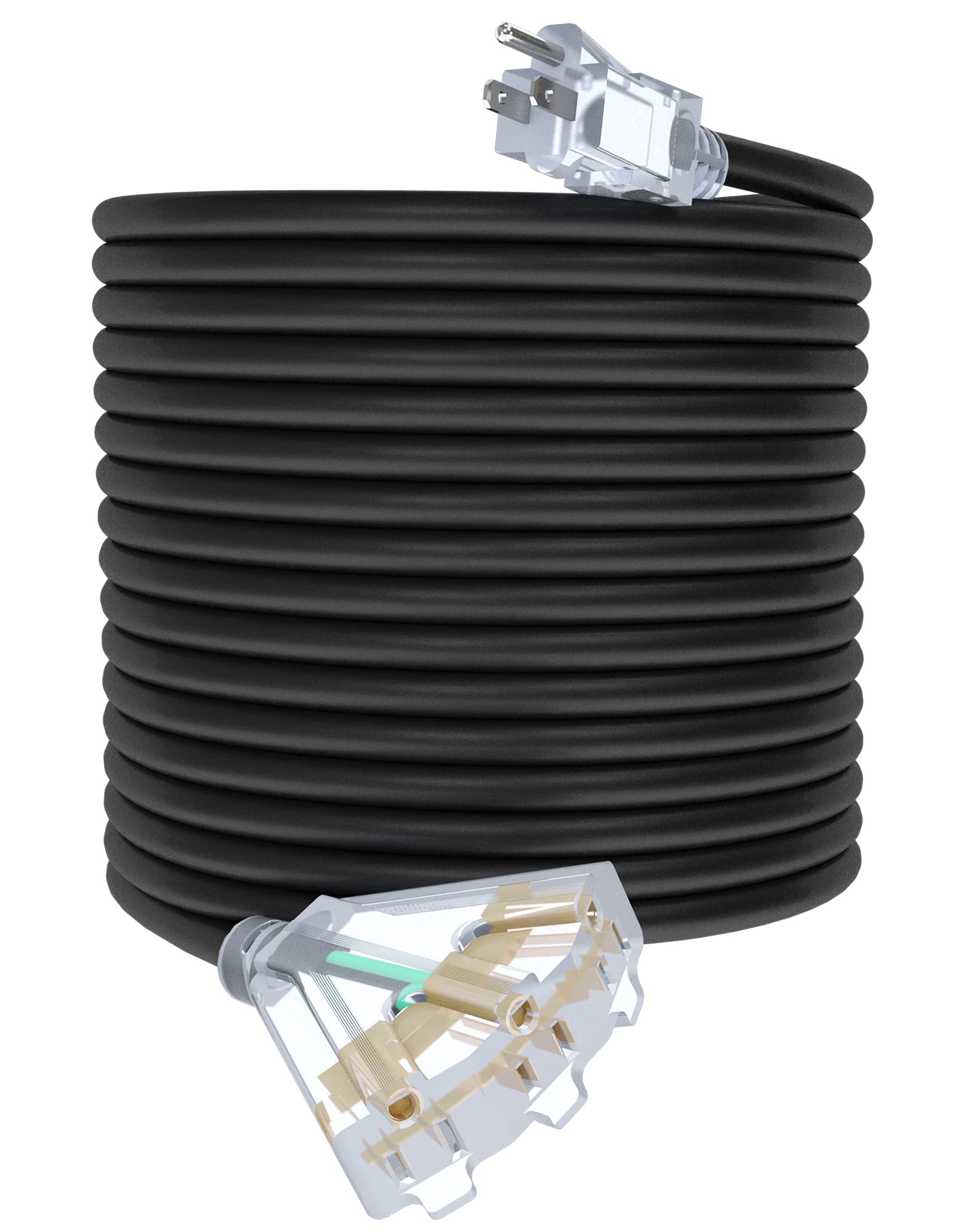
1. 100Ft 12 Gauge Extension Cord with 3-Outlets by PLUGTUL
Our pick — over 4.5★ from 900+ verified ratings; the strongest balance of quality and price.
Three tools running from one 100-foot run, at the top of the class.
Here is the pitch in a single number: three outlets. Most 100-foot cords this thick give you one socket at the end, so every time you swap from the saw to the sander you unplug and re-plug. PLUGTUL built this one as a mini power strip on a 100-foot leash, which means the saw, the light, and the charger can all stay plugged in while you work. Nothing about the wire changed — it is still 12 gauge, 15 amps, 125 volts, 1875 watts — you just get more sockets to spread that load across.
The draw itself is the standard 15A, 125V, 1875W with three conductors and NEMA 5-15P to 5-15R ends, so it plugs into any normal household outlet and accepts any standard three-prong tool plug. The jacket is SJTW, the weather-rated flexible PVC type that shrugs off rain, sunlight and abrasion, and the unit carries ETL listing. Treat it as water-resistant, not submersible — the maker explicitly warns against soaking the cord in water for long stretches, so leave it draped across the lawn rather than dropped in a bucket.
What keeps people coming back is the durability of the build — the cord runs cool under a load, which is exactly the trait that separates a real 12-gauge from a thin cord pretending to be one. One buyer charges a hybrid car off it: “I use this to charge my hybrid car, works great.” A beer fridge in the garage, a bank of holiday lights, a jobsite full of tools: the pattern reads the same way every time. The only consistent knock is weight — this is a heavy cord, and it is heavy because the copper is really there.
What earns its keep
- Three outlets on the female end, so three tools share one run without constant swapping
- 15A / 1875W ceiling with 12-gauge copper that stays cool under load
- ETL-listed SJTW jacket built for rain, sun, and abrasion
- Lighted female end shows power status at a glance
Where it asks for patience
- Heavy and awkward to coil compared to a thin 16-gauge cord
- Water-resistant only — not meant to sit submerged
Grab this one if: you run several tools or devices from a single far-off outlet and want them all live at once.
Look elsewhere if: you only ever power one item and want the lightest cord you can carry.
2. UBOORY Outdoor Extension Cord Waterproof 100 FT, Black 12/3 SJTW
A no-frills black runner that behaves like a cord twice its asking tier.
UBOORY keeps it simple: one grounded female socket, 100 feet of 12-gauge copper, 15 amps, 125 volts, 1875 watts, and a weather-resistant jacket rated for cold down to -50°C — meaning it does not turn stiff and cracking when you drag it out on a January morning. The strain relief at the plugs is built for a great many bends before it gives out, which is the failure point on cheap cords. No indicator light, no extra outlets. If you want one clean power path and nothing else, that focus works in its favor.
The value story shows up in how owners talk about it. The judgment that comes up again and again is that the cord is flat-out well made for the money — its quality reputation has real backing, and the value-for-money angle is right behind it. What that means in practice: a PVC jacket that stays pliable rather than turning rock-hard and oily, and a cord that lays flat quickly after you unfold it instead of holding a coil memory for an hour.
Where it fits specifically: the outdoor power crowd. It is regularly paired with electric mowers and cultivators, and the pattern is that it handles long grass-and-dirt duty without complaint. One owner left it out in the rain and it kept working. The thing to understand before you buy is that this is a plain cord — there is no light in the end, so if you routinely work in the dark at the far end of the yard, the PlugSaf or ISLEWIRE below gives you that for a little more.
The stand-out: a -50°C cold-flex rating on a cord at this price point is the sort of spec you normally only see higher up the shelf.
Reach for it if: you want the strongest plain cord for the money and mow, till, or trim on a big property.
skip it if: you need multiple sockets or a lighted end at the far plug.
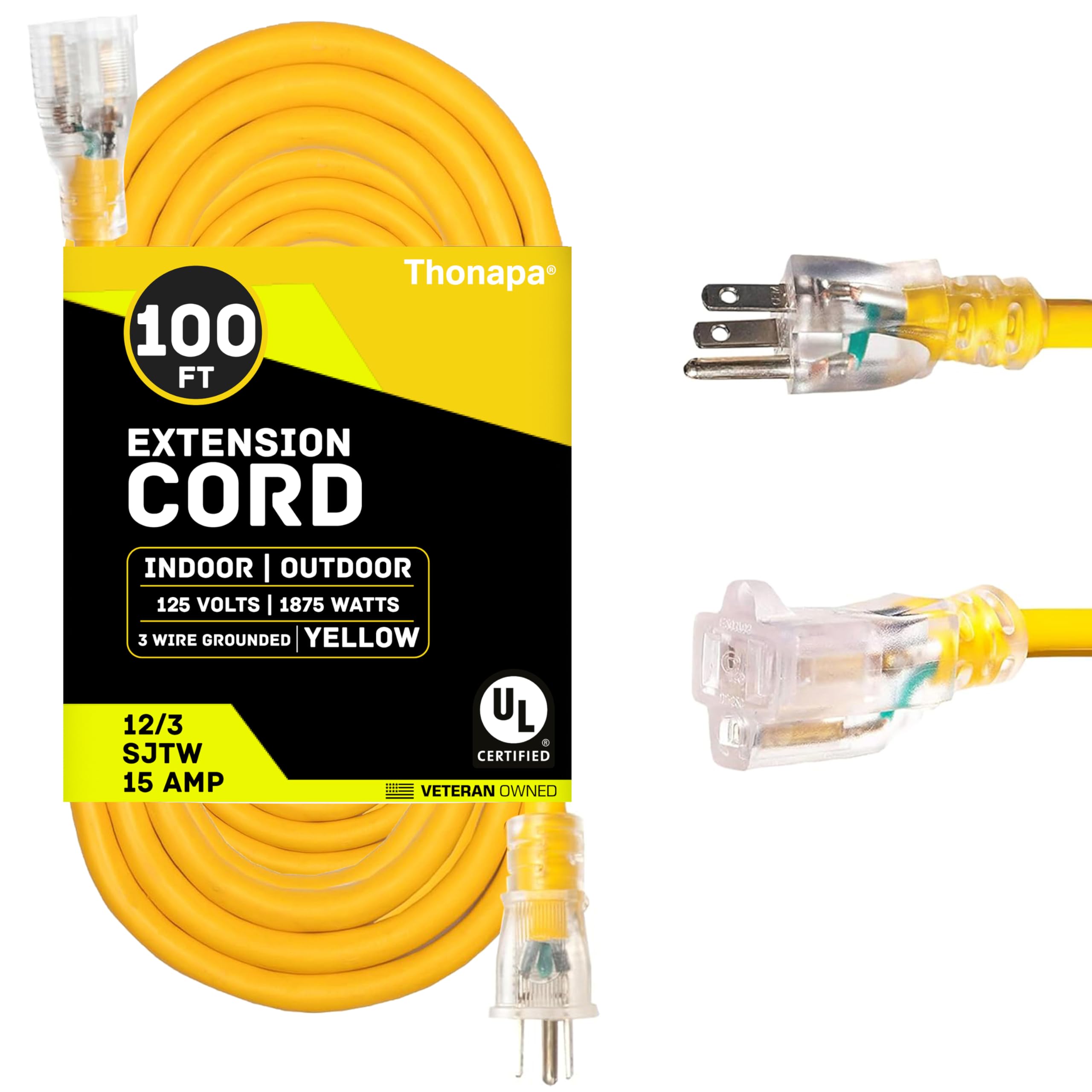
3. Thonapa 100 Foot Outdoor Extension Cord, 12/3 Yellow
The snow-blower cord that stays visible against a white driveway.
Nobody buys this cord for its looks — but they notice the color. The bright yellow jacket is the whole reason it is the natural pick for a snow blower, because you can see it lying across a plowed drive in flat winter light. Add a temperature range of -40°F to +140°F, a flame-resistant SJTW jacket, and nickel-coated blades that resist corrosion, and you have a cord built for the coldest, wettest work a homeowner does.
The stated rating is 15 amps, 125 volts, 1875 watts, with a grounded three-wire plug and a single outlet — 100 feet of 12-gauge run. The nickel-plated blades are the detail worth caring about: plain brass corrodes in damp weather and eventually builds the kind of resistance that makes a connection warm up. Thonapa is also a U.S. Veteran owned company that backs the cord’s construction.
Owners of snow blowers, log splitters, and other high-draw yard machines are exactly the people who keep this cord around, and the safety benefit is the reason — the heavy gauge delivers full amps without overheating on a long run. The lit ends are a genuine convenience in the dark, big enough to see where you are plugging. Worth one honest note: quality control is not perfect on every unit — One buyer’s cord arrived with the female end only crimped, while the male end was also soldered. A rare slip, not a pattern, but it is a reminder to eye the connector when the cord arrives.
Best for: snow blowers, log splitters, and any winter machine you need to see and reach in the cold.
pass on it if: you want multiple outlets — this is a single-socket cord end to end.
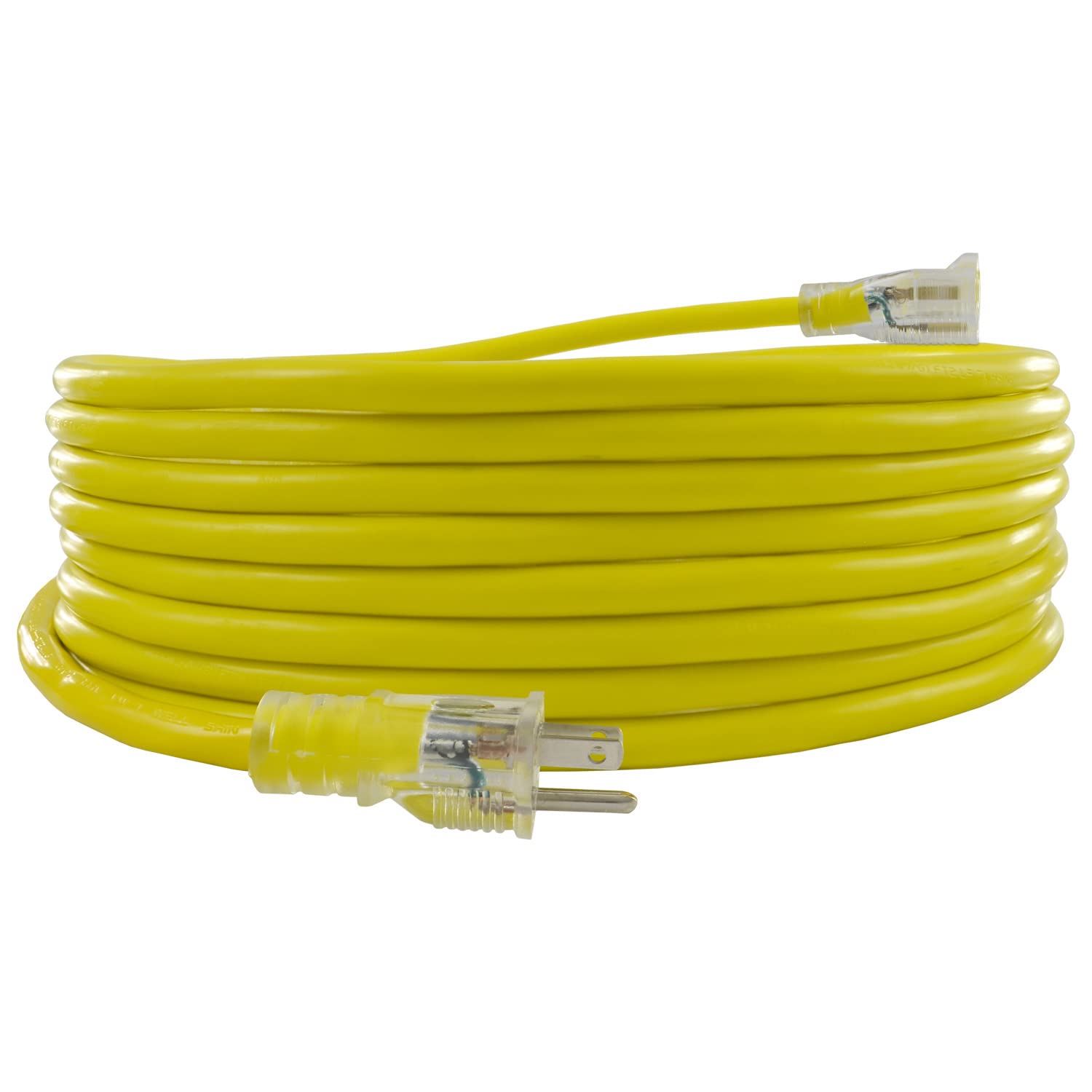
4. Conntek 20251-100 15 Amp Indoor/Outdoor SJTW 12/3 Extension Cord
The construction-grade cord that behaves like an appliance extension.
Conntek sells into a different world than the yard crowd. This is the cord that gets a string of block heaters going, backs a jobsite with a circular saw, or ties a washer to a distant outlet. The spec sheet reads like a checklist of the things tradespeople do not have patience for: 15A, 125V, up to 1875W on a 100-foot 12-gauge run, ETL and cETL certified, and each cord high-voltage tested at 1500V before it ships. That last figure is a proof test, not a marketing line — every unit gets it at the factory.
The build details are where this earns its keep. The vinyl jacket resists heat up to 140°F and stays flexible down to -40°F, so it lives outdoors year-round. Reinforced strain relief at the plugs prevents the breakage that kills cords at the connector, and the yellow PVC jacket keeps it visible across a construction site or a dark garage. A power indicator light in the receptacle confirms the cord is live before you plug in.
The buyers who lean on this cord are the ones running serious loads — appliance power and jobsite duty are what it keeps being bought for. If you spot the cord on the shelf, the honest note is the length rating: a full 100 feet of 12-gauge copper is a substantial physical load, and there is no getting around that when you move it. The flip side is the point — that copper is what lets a heavy tool run without the cord warming up.
Better than most at: connector strength — reinforced strain relief plus a 1500V high-voltage test on every unit is the sort of thing that matters when the cord lives in a truck bed.
Buy this if: you need a single-outlet cord that can take the abuse of a jobsite or back a heavy appliance.
Think twice if: you want to split one outlet three ways — this cord ends in a single socket.
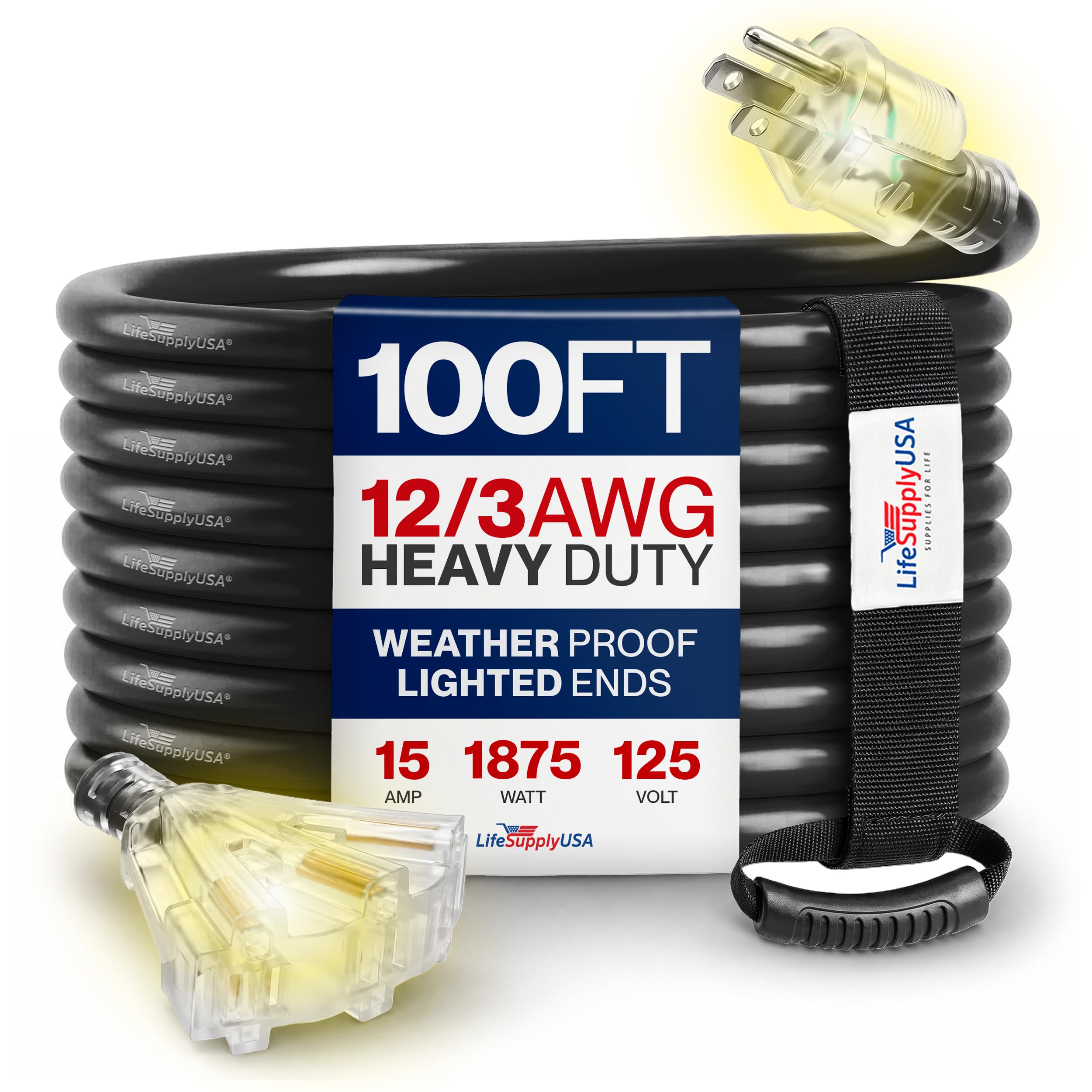
5. LifeSupplyUSA 100ft Outdoor/Indoor Extension Cord 3-Outlet 12/3
A black three-outlet 100-footer that a gas generator can lean on.
What makes this cord pull its weight is the combination of three outlets and a genuinely rugged jacket. Every socket is grounded, the running rating is 15 amps, 125 volts, up to 1875 watts, and the cable itself is the same 12-gauge/3-conductor spec you want for a long run. Owners put it in front of gas-powered generators and EV chargers, and it takes the load without fuss. Three appliances running at once is the normal duty for this cord, not the exception.
The jacket is the reason it survives. It is a vinyl jacket engineered to shrug off oil, grease, moisture, and abrasion — the daily reality of a garage or a jobsite. The cord is built to hold up in extreme temperatures too, so it can stay out across seasons. The lighted female end is a practical touch: the glow and the bright jacket color help you spot the plug in a dark garage or across a yard, so nobody trips on an unseen cable.
If you are the sort of person who needs power to reach the back of the shop, the driveway, or a camping setup, the three outlets are the whole story — no swapping tools and no second cord. The catch is that a black cable on dark grass is harder to see than a yellow one, so if visibility is your priority, the Thonapa or ISLEWIRE above has the color for it. Weight is the other honest point: this is a substantial cable, and moving it around is a two-handed job.
Reads like a tool, not an accessory: the vinyl jacket’s resistance to oil, grease, moisture, and abrasion is what a home workshop or construction job actually needs.
Good match for: a garage or generator setup where three items need power and the cord lives in a tough environment.
Less suited to: someone who wants the lightest possible 100-foot cord for occasional mowing.
6. PLUGTUL 12 Gauge Extension Cord 100FT with Lighted End
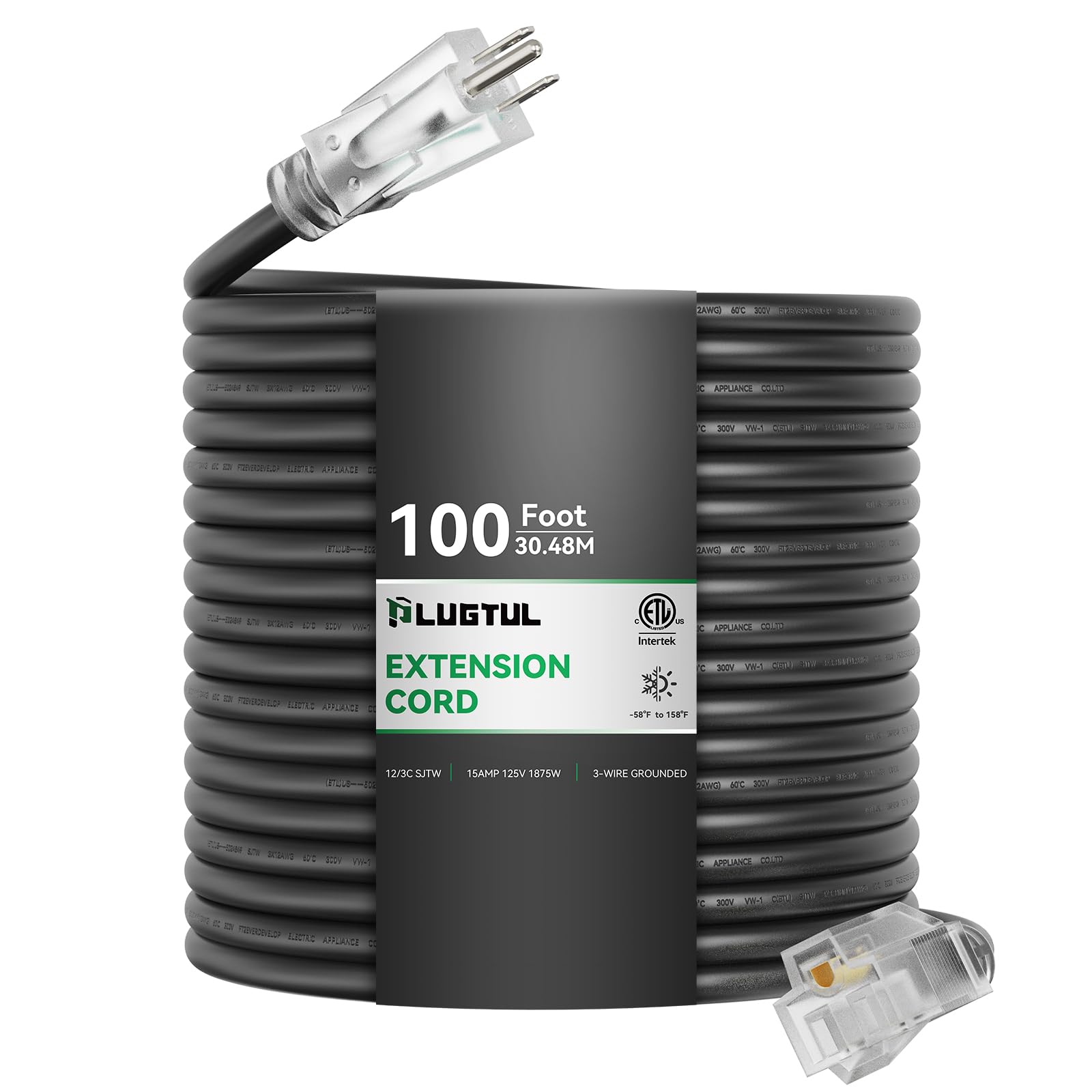
A one-socket cord that keeps appliances happy on long runs.
Read the label on this plug and you see the anti-slip texture on the female end. That is a small thing that pays off when you have cold hands in winter and need the plug to grip. Otherwise it is the standard 12 AWG spec — 15A, 125V, 1875W, NEMA 5-15P to NEMA 5-15R, SJTW, ETL listed — with a single outlet at the end. A lighted female end tells you power is on the moment you plug in. The jacket is weather-resistant flexible PVC, and the maker’s note stands: do not leave it soaked in water for long periods.
What this cord keeps getting bought for is the appliance crowd. Portable AC units, dehumidifiers, and EV chargers all show up in what owners power with it, and the cord handles the draw without issue. The lighted end is mentioned again and again as the feature people appreciate most in low-light conditions — One owner put it plainly: “Works as described – heavy duty- good value for the price- it was just the right size- the lighted end is a nice touch.”
Compare it to the PLUGTUL three-outlet above and the choice depends on sockets. If you never need to run multiple items at once, this simpler version is the right one — less bulk, same 12-gauge copper, same ETL listing. And because it is the same brand’s lighter build, it tends to be the easier one to wind up and hang. The trade-off to be honest about: no splitter means one plug at a time, so plan your tool rotation accordingly.
The right cord if: you want a straightforward, well-made single-socket 12-gauge run for an appliance or charger.
Not the right cord if: you need to power more than one thing at once — there is no second outlet here.
7. PlugSaf 100ft 12/3 Outdoor Extension Cord Waterproof
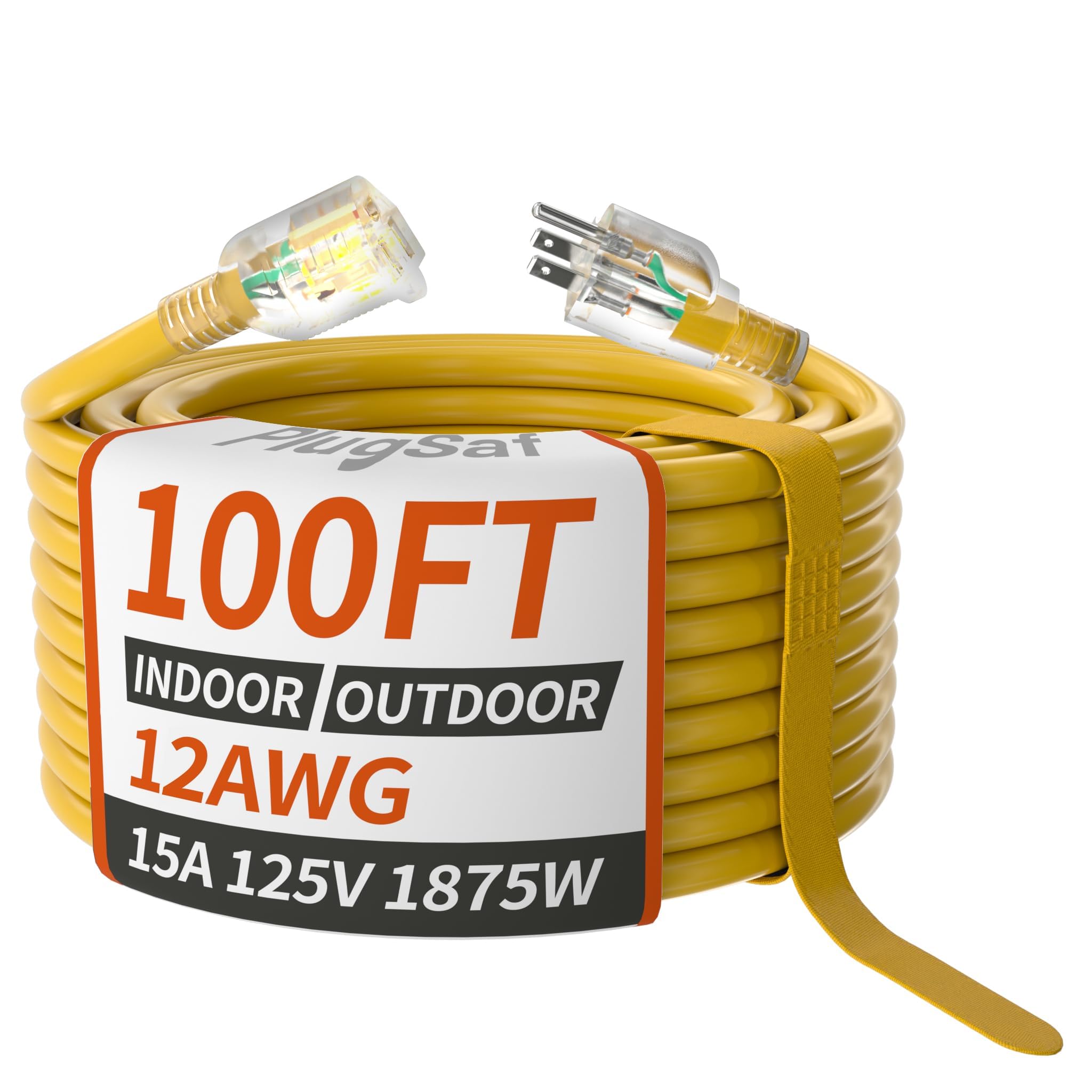
Built for the freezing end of the yard, with a jacket to match.
It is IP65-rated, the standard for protection against dust and water spray — meaning it is built to handle real weather, not just a sprinkle. And it is bend-tested past 20,000 flexes without breaking, a claim about the strain relief rather than the cord. Add a heat-resistance rating of 100°C and flexibility down to -40°C, and you have a cord that behaves the same in January as in June.
The core spec is the standard 12-gauge build: 15 amps, 125 volts, 1875 watts, NEMA 5-15P to 5-15R, SJTW jacket, ETL/cETL listed, and a high-voltage test to 1500V. The plug and socket are reinforced with long strain relief, and the yellow jacket keeps the cord visible. A power indicator light on the socket tells you the cord is live before you commit a tool to it.
Owners who work big properties are the natural fit here — this is a cord for people who need 100 feet to reach a whole yard for leaf blowing, which is exactly the sort of long-distance outdoor job it gets bought for. It also shows up on battery chargers and other shop equipment. The honest trade-off: this is not a lightweight cord, and moving 100 feet of 12-gauge around a big yard takes a little effort.
Perfect for: freezing, wet outdoor work — where an IP65 rating and a -40°C flex figure are exactly what you want behind a leaf blower or mower.
it’s not for you if: you only need a short power drop inside the garage.
8. ISLEWIRE 100 FT Outdoor Extension Cord with 3 Outlets
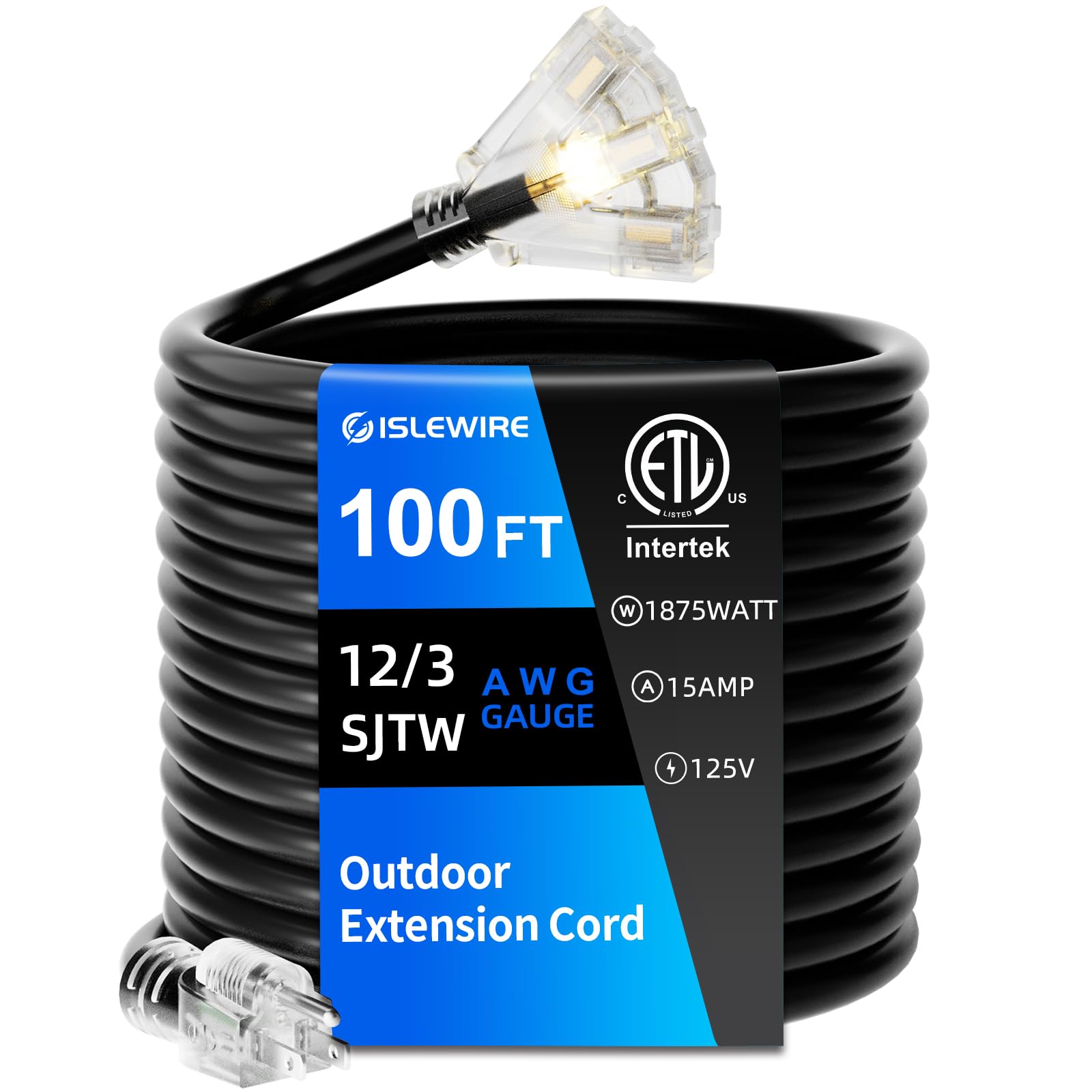
Three angled sockets built for a garage that never has enough outlets.
The detail that sets this cord apart is the geometry of the female end: three grounded outlets set at different angles so three chunky plugs can sit side by side without shouldering each other out. On a standard triple tap, two fat tool plugs will often block the third socket — the angled layout is the fix. Same 15A, 125V, 1875W ceiling, same 12-gauge, 100-foot run, but the goal is running a bench full of equipment from a single distant outlet.
The jacket is upgraded SJTW wire chosen for longevity, and the cord stays flexible and tangle-free from -40°F to 140°F — meaning it does not stiffen in a cold garage or bake into a shape in summer heat. The high-density PVC is built to resist breakage when you drag the cord the length of the shop. A single LED indicator at the plug end shows whether the cord has power, which is handy on an overcast day or after dark. The cord is ETL certified and comes with a 3-year replacement and return guarantee plus lifetime technical support.
Where it earns regular use is a garage or workspace where a heater, a compressor, and a work light all want power from the same wall socket. Owners describe it as a cord that solves the outlet problem — running at high load without heating, with the indicator lights confirming live power at a glance. Sitting near the top of the value tier for the build, the ISLEWIRE is the pick when the third socket has to be usable, not just present. The main trade-off is the same as every 100-foot 12-gauge: it is a heavy coil to store.
Big wins
- Angled three-outlet end lets bulky plugs sit side by side
- Full -40°F to 140°F flexibility range, so no cold stiffness
- Built-in LED indicator confirms live power
- ETL certified with a 3-year replacement guarantee and lifetime support
Consider before buying
- Heavy to coil and store at 100 feet of 12-gauge
- Bulky enough that tight storage space is a real constraint
For the workshop owner: a garage or bench where three tools need power from one distant outlet.
Not for the minimal user: if you only ever power one item, the cheaper single-socket picks above are simpler.
9. GEARit 100 Ft 12 Gauge Extension Cord SJTW OFC Copper
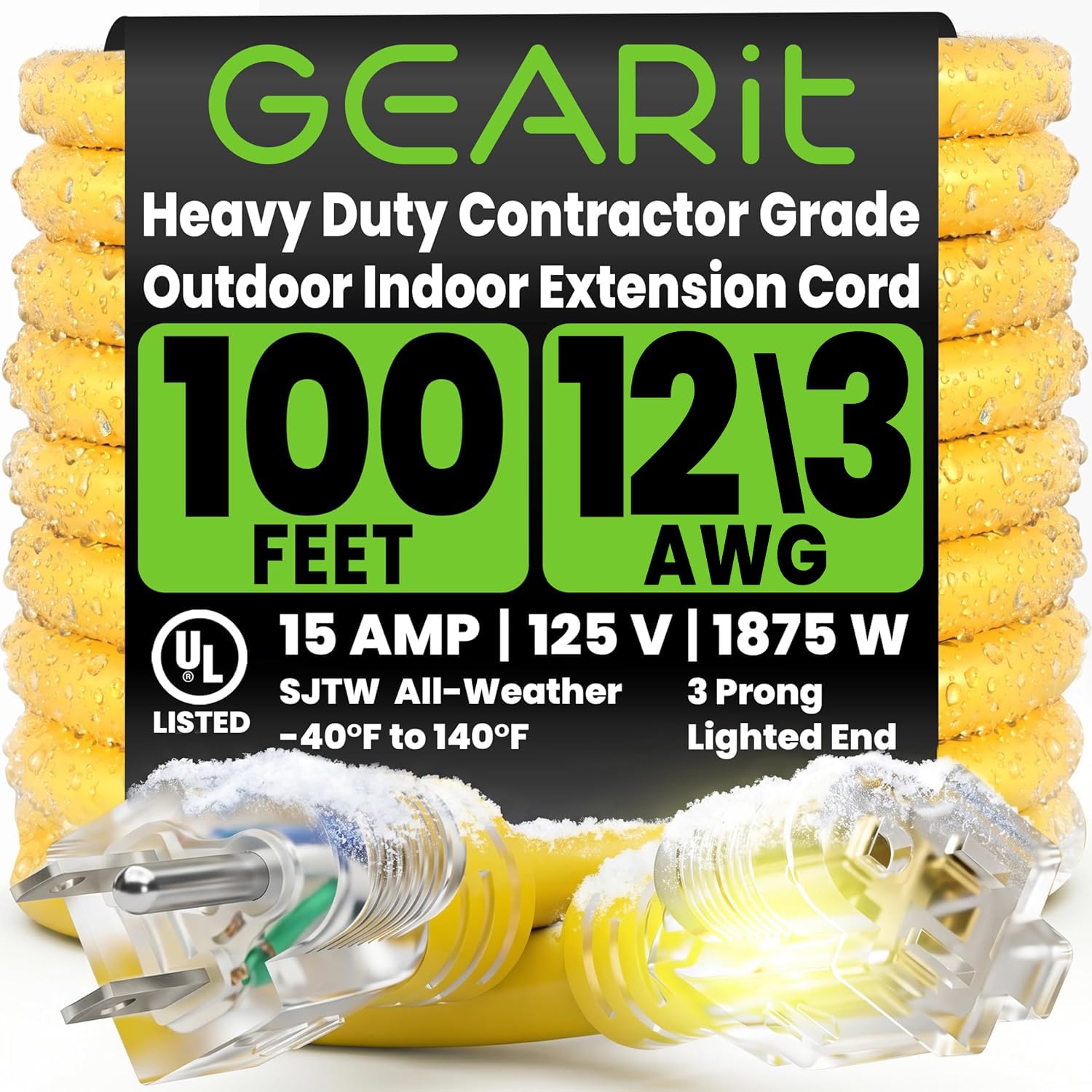
A pro-grade 12-gauge run with a lifetime-warranty handshake.
GEARit is the cord you buy when the job is power tools at the far edge of a property and the run is a full 100 feet. The build targets that exactly: 12/3 gauge, 15A, 125V, grounded male-to-female connection, and a weather-resistant SJTW jacket meant for yards, garages, workshops, and jobsites. The lighted female end gives you a quick visual that power has arrived at the far plug, and the bright yellow jacket makes the cable easy to spot across grass, concrete, or a cluttered work area. The maker backs the line with a Lifetime Warranty.
The one number that tells the story here is weight. At 12.7 pounds for the 100-foot roll, this is a serious coil of copper — and that mass is the point. A buyer running 1750 watts reported no heat from the stretched-out cord, with warmth only on the coiled section left bundled. That matches the physics of the job: 12-gauge copper carries the current with headroom to spare on a long run, which is exactly why this cord is the pick for pressure washers, mowers, and circular saws drawing 13 to 15 amps.
The trade-off shows up before you even run it: 12.7 pounds is a hefty thing to unroll and wind back up every time, and the cord is stiff enough to make neat coiling a chore. That weight, though, is the difference between a cord that stays cool and a thin one that heats up — and for a long 15-amp run, the copper is not optional.
For the jobsite: at 12.7 pounds with a Lifetime Warranty, this is the cord you keep in the truck year after year rather than replacing each season.
Worth it if: you run high-draw tools or a long power drop on a yard, jobsite, or detached building and want a cord that can stand up to years of use.
Overkill if: your longest run is a short hop across the patio.
Understanding the Specs
Gauge and Conductor Count — the Number That Sets the Ceiling
On a cord labeled 12/3, the 12 is the wire gauge and the 3 is the number of conductors. That means three separate copper wires run the length of the cable — hot, neutral, and ground. The gauge number is the thickness of each conductor, and lower numbers mean thicker copper. A 12-gauge cord has roughly 3.31 mm² cross-section conductors, which is enough to carry 15 amps and up to 1875 watts of power with room to spare on a 100-foot run. Drop to 14 or 16 gauge and that same current runs through thinner copper, which builds heat and lets voltage sag at the far end — the exact problems 12-gauge cord is designed to avoid.
SJTW Jacket and Lighted Ends — the Weather and Visibility Story
SJTW is a code for what makes a cord outdoor-safe. It means the cord is service-grade, thermoplastic, and weather-resistant — the industry shorthand for a PVC or vinyl jacket built to handle rain, sunlight, and abrasion without cracking. It also stays flexible in the cold, and the cords here are rated as low as -40°F or -50°C. A lighted female end is a separate but related feature: a small LED inside the socket that glows whenever the cord has power. That lets you check status from where you are standing instead of walking back to the outlet, and it makes the plug easier to find in the dark.
FAQ
Why choose 12/3 instead of 14/3 or 16/3 for a 100-foot cord?
Will a 12/3 extension cord handle a table saw or circular saw?
Are these cords safe to use outdoors in the rain?
What is the difference between SJTW and SJT cord jackets?
How much power does a 12/3 100-foot cord deliver at the end of the run?
Can I use a 12/3 cord to charge an EV or plug in a portable air conditioner?
What does the lighted end on an extension cord actually tell me?
How should I store and coil a 100-foot 12-gauge cord?
Will a 12-gauge cord stay flexible in freezing weather?
Do I need a three-prong grounded cord for my equipment?
Final Thoughts: The Verdict
The 12/3 extension cord 100 feet that earns the top spot is the PLUGTUL 100Ft 12 Gauge 3-Outlet cord — because three live sockets on one 100-foot 12-gauge run is the kind of practical upgrade you notice every single time you work. If you want a plain, no-frills cord that behaves like it costs more, grab the UBOORY 100 FT 12/3 SJTW. And for cold-weather yard work that needs a visible, freezing-flexible cord, the Thonapa 100 Foot Yellow 12/3 cord is the one to reach for. Match your tool’s draw to the 15A and 1875W rating, keep the cord stretched out while it is in use, and any pick here will serve you for years.
How We Picked
We do not accept paid placement. Every pick is matched to a real buyer and a real use-case; we do not hands-on test units.
Sources & Methodology
Specifications: manufacturer listings and product documentation. Review insights: verified customer reviews, as of September 2026. Pricing: not shown on this page (it changes often); check the current price via the retailer link.
As an Amazon Associate, KitchPrep earns from qualifying purchases. This does not affect which products we feature.
Related Guides
