
Specs are compiled from manufacturer listings and verified buyer reviews and can change over time — please confirm the key details on the product page before buying.
For weekend trips and emergency backup, a 110W solar panel hits the balance—it’s big enough to top up a power station, yet small enough to toss in the car. The catch: most foldable panels advertise a wattage they rarely hit in real sunlight, so real-world output is what separates a good one from a waste of space.
I’m Mohammad Maruf — the founder and writer behind KitchPrep. This guide is built by comparing the manufacturers’ published specifications and the patterns across verified customer reviews, so you get each pick’s real strengths and trade-offs instead of marketing spin.
Sizing up the 110w solar panel market means weighing real efficiency against folded size and connector compatibility for your power station.
Our Picks at a Glance
How To Choose The Best 110W Solar Panel
Before you buy, you should know that this list uses flexible matching for wattage. Most of these are true 110W panels, but a couple are highly-rated 100W models that serve the same purpose for power stations — we flag those clearly so you are never misled.
Real Output vs. Rated Wattage
That “110W” is the panel’s absolute ceiling in perfect lab conditions. In normal sun, you will see 60-90W depending on angle and cloud cover. The efficiency rating (typically 23-26%) tells you how well the panel converts sunlight, and higher efficiency usually means faster top-ups in limited daylight.
Connector Compatibility
Your power station’s input port decides which cable you need. Jackery often uses DC8020 or Anderson, EcoFlow uses XT60, and Bluetti commonly takes DC7909 or XT60. A panel with a 4-in-1 or 5-in-1 cable kit saves you buying separate adapters.
Weight and Folded Size
Portable panels range from about 4 lbs to over 12 lbs. A lighter panel with a smaller folded footprint is easier for hiking, while a heavier one with larger cells tends to gather more sun and charge faster. Consider where you will actually carry it.
Quick Comparison
| Model | Best For | Max Power | Efficiency | Weight | Amazon |
|---|---|---|---|---|---|
| ZOUPW 110W★ Best Overall | High Efficiency & USB Hub | 110 watts | 25.6% | 8.02 lbs | Amazon |
| Ecosonique 100WBudget Champion | Budget Folding Value | 100 watts | 24% | 6 lbs | Amazon |
| FlexSolar 100WCompact Pick | Ultra-Light Travel | 100 watts | 23%+ | 4.1 lbs | Amazon |
| MHPOWOS 110W | Adjustable Angle Output | 110 watts | 23.5% | 9.9 lbs | Amazon |
| MHPOWOS 110W v2 | Balanced Portable Power | 110 watts | 23.5% | 8.5 lbs | Amazon |
| VTOMAN VS110 | VTOMAN Ecosystem | 110 watts | 23% | 12.5 lbs | Amazon |
| E-POWO 110W Bifacial | Reflected Light Harvest | 110 watts | 23.5% | 7.7 lbs | Amazon |
| BougeRV 100W | Fridge & Camping Power | 100 watts | 25% | 6.9 lbs | Amazon |
| Nature Power 110W Kit | Off-Grid Home Setup | 110 watts | High Efficiency | 19 lbs | Amazon |
In-Depth Reviews
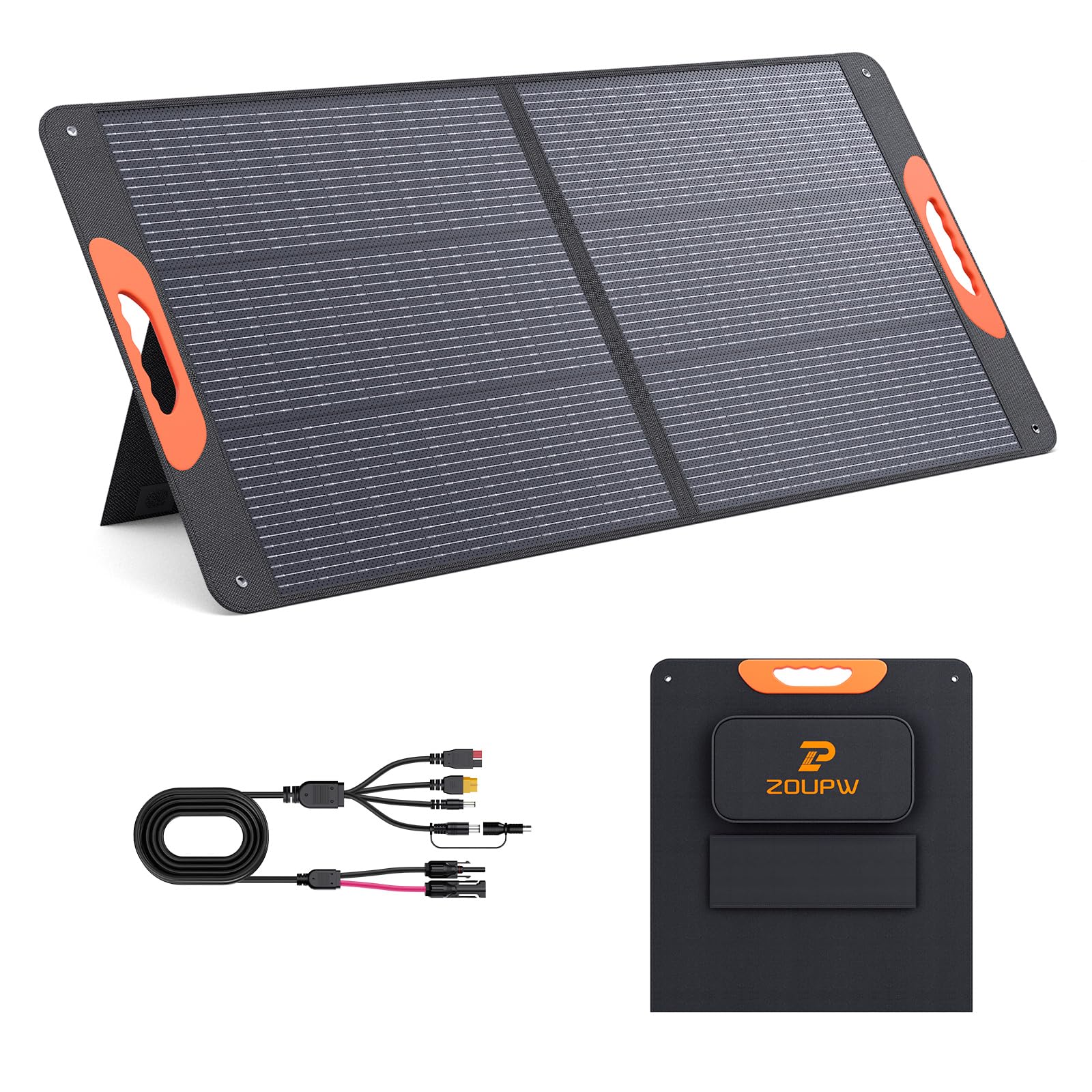
1. ZOUPW 110 Watt Portable Solar Panel
Our pick — over 4.5★ from 100+ verified ratings; the strongest balance of quality and price.
The crowd favorite that pairs the highest efficiency here with a built-in USB hub for direct device charging.
What wins people over is the portability and build — owners call it easy to use and a fraction of the price of Jackery-branded panels. The real standout is the charging capability, with users reporting it matches OEM performance when paired with a Jackery Explorer 1000 v2.
Its 25.6% efficiency N-Type 16BB cells outpace conventional polycrystalline panels. The panel pushes 5.55 A at 19.8 volts, and buyers report it outperforms a Goal Zero Boulder 100W (69-70% vs 64-65% wattage), while being lighter with a longer cable.
The integrated output hub has 1x USB-C (PD Fast Charge) and 2x USB-A ports, so you can charge your phone directly in the sun without a power station. It folds down to 24.45 x 22.99 x 1.57 inches and weighs just 8.02 lbs, with a magnetic handle for carrying. The IP67 waterproof ETFE coating handles rain, and the 5 distinct connectors fit 99% of power stations.
What owners love
- High 25.6% efficiency for faster top-ups
- Built-in USB-C and USB-A for direct charging
- Lightweight at 8.02 lbs with easy-carry handle
Keep in mind
- Output is rated as mixed by some — real-world wattage depends on sun angle
- Folded size is larger than some 100W rivals
Reach for this if: you want the best blend of efficiency, direct USB charging, and broad power station compatibility in one folding panel.
Look elsewhere if: you need the absolute lightest panel — the 8.02 lb weight is mid-pack here.
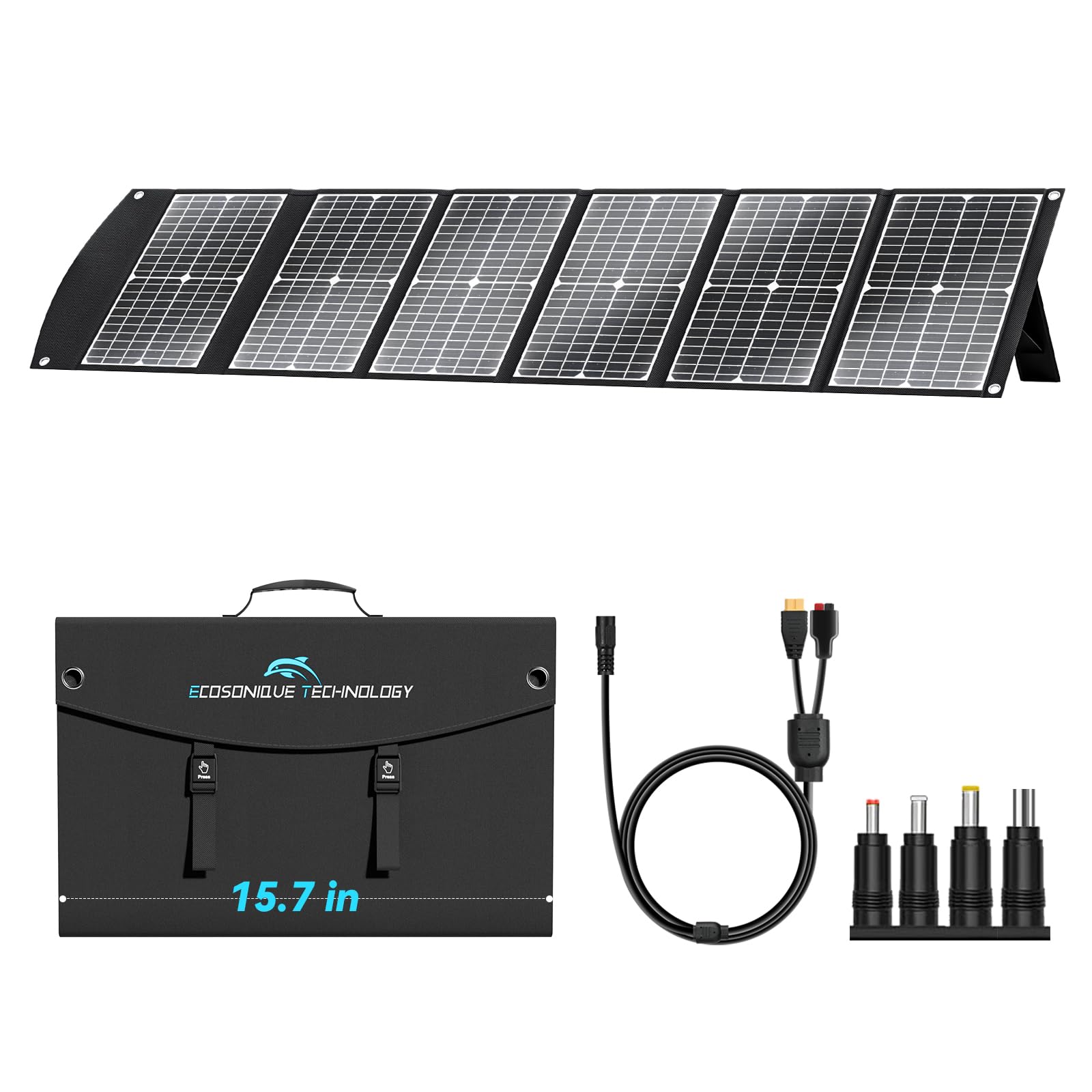
2. Ecosonique 100W Portable Solar Panel
The budget-friendly 6-panel folder that folds to laptop-bag size and still delivers its rated output.
At just 6 lbs and folding to 15.7×10.5 inches, this panel is among the most travel-friendly options here—you can slip it into a backpack for a hike. Owners describe it as a “killer little panel” that folds up small and delivers full 100W on a sunny day, while staying forgiving in less lit environments.
CPC A+ monocrystalline cells yield 24% efficiency, outputting 5 A at 20V—higher voltage than the ZOUPW’s 19.8V but lower amperage. The 3-meter DC5521 extension cable lets you keep your power station in the shade while the panel soaks up sun.
The smart chip protects against over-current, over-voltage, and short-circuit, with an auto-reboot feature that adapts to changing light. It has QC3.0 USB-A (Max 24W), PD3.0 USB-C (Max 45W), and a 20V DC port, plus connectors for EcoFlow, Bluetti, Jackery, and Anker stations.
Why it’s a value pick
- Light 6 lbs with compact 6-fold design
- Delivers full 100W in direct sun per owners
- Includes 3m extension cable for flexible setup
The honest trade-offs
- Kickstands work but feel basic to some
- Fabric can get dirty when set on the ground
Best for: hikers and campers who prioritize a small folded footprint and light carry weight over raw efficiency.
skip it if: you need the higher 5.55 A output of the ZOUPW for very large power stations.
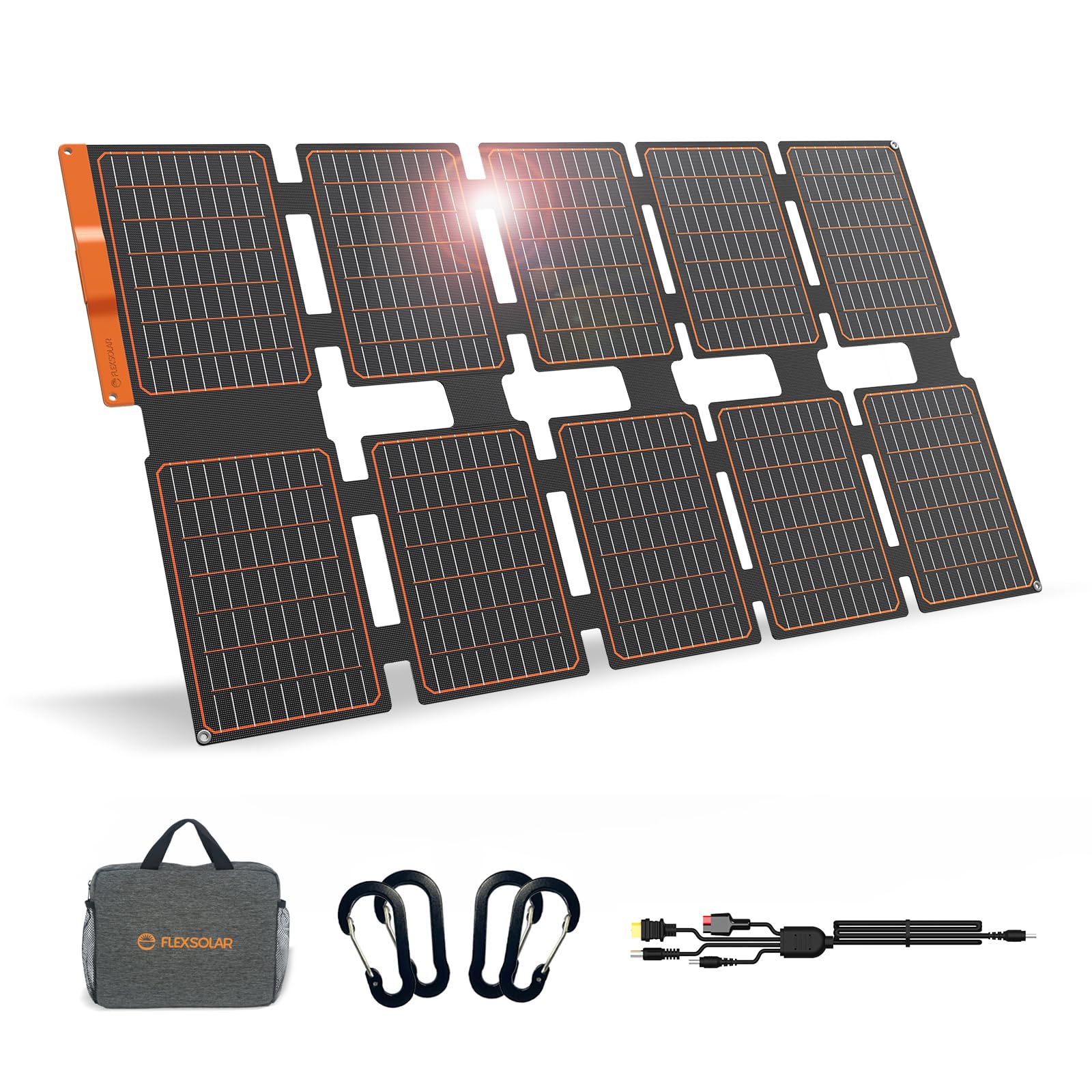
3. FlexSolar 100W Foldable Solar Panel
The lightest panel on this list at 4.1 lbs with a sleek 0.59-inch profile that slips into any bag.
At 4.1 lbs (1.85 kg) with a folded size of 12.99 x 10.43 x 2.17 inches, this is engineered for serious portability. The thing everyone raves about is the quality and power output — owners mention real-world figures like 84 watts and performance comparable to rigid panels.
One owner charged an iPad from 9% to 95% in 7 hours, and another saw max 80W at noon with 60-70W from 10am-6pm. It uses premium monocrystalline silicon cells with E-Film lamination for 23%+ conversion efficiency, and the durable build is backed by an IP67 waterproof rating.
The 3-in-1 output includes PD 3.0 45W USB-C, 18W USB-A, and 100W DC outputs, with a 4-in-1 cable covering DC5521, DC7909, Anderson, and XT60. It unfolds to 45.47 x 26.18 inches for maximum power capture — notably larger than the MHPOWOS below, so it gathers more sun when spread out.
The big wins
- Ultra-light 4.1 lb carry weight
- Solid 84W real-world output per owners
- IP67 waterproof and dustproof build
Watch out for
- No easy angling system — you lose efficiency without propping it up
- Orange DC/USB housing can get hot at 60W+
Reach for this if: every ounce counts and you want a panel that disappears into a backpack until you need it.
Think twice if: you want built-in angle adjustment — this one needs a rock or prop to tilt toward the sun.
4. MHPOWOS 110W Portable Solar Panel
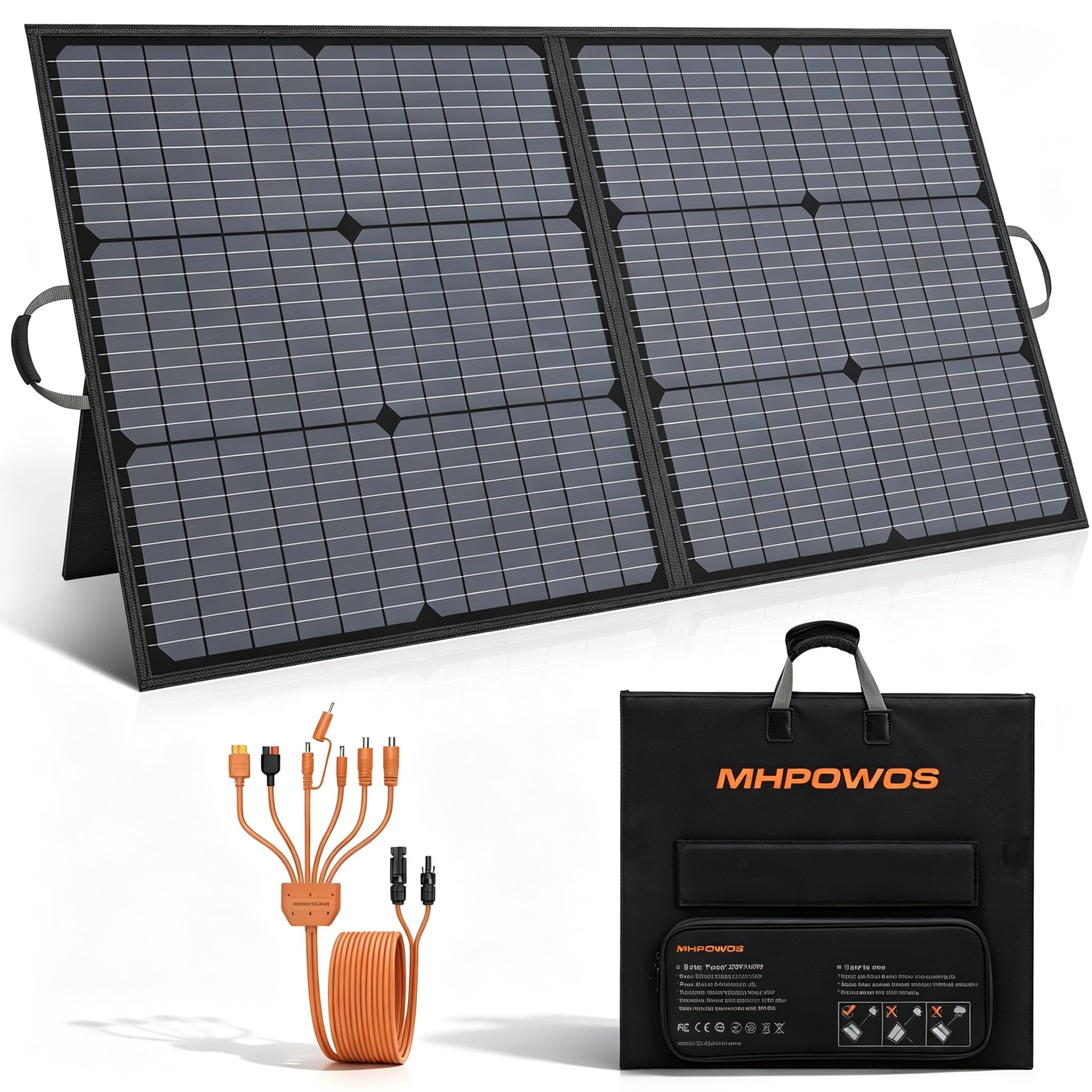
A 110W folder with adjustable brackets that let you chase the sun and record 105 watts in perfect conditions.
This MHPOWOS panel hits 23.5% conversion efficiency, delivering 5.5 A at 20V. Owners recorded “105 watts max output in perfect conditions,” which is right at the rated spec and confirms the mono-crystalline cells are doing their job.
You can angle this bifold panel to follow the sun for maximum output, thanks to its adjustable devices—a feature that boosts your charge on long afternoons. It weighs 4.5 kg (9.9 lbs) and folds to 23.5 x 21.3 x 1.6 inches, while two kickstands hold it steady on any flat surface. The IP67 rating (meaning it’s fully protected against dust and can handle brief immersion in water) means rain and dust won’t stop it.
It comes with a solar extension cable covering Anderson/XT60/DC7909/DC5521/DC8020/DC35135/DC5525 connectors — the widest compatibility set here. One helpful note from owners: if your power station is already full, the panel will appear not to charge, but that’s just overcharge protection working as intended.
What stands out
- 105W real-world max output recorded by owners
- Adjustable brackets for optimal sun angle
- 7 connector types for broad compatibility
Consider this
- Heavier than the ZOUPW at 9.9 lbs
- Check your power station’s max input limit before buying
Pick this if: you want to manually angle the panel through the day and own a power station with any mainstream connector.
Pass if: weight matters — at 9.9 lbs it’s a car-camping panel, not a hiking one.
5. MHPOWOS 110W Portable Solar Panel v2
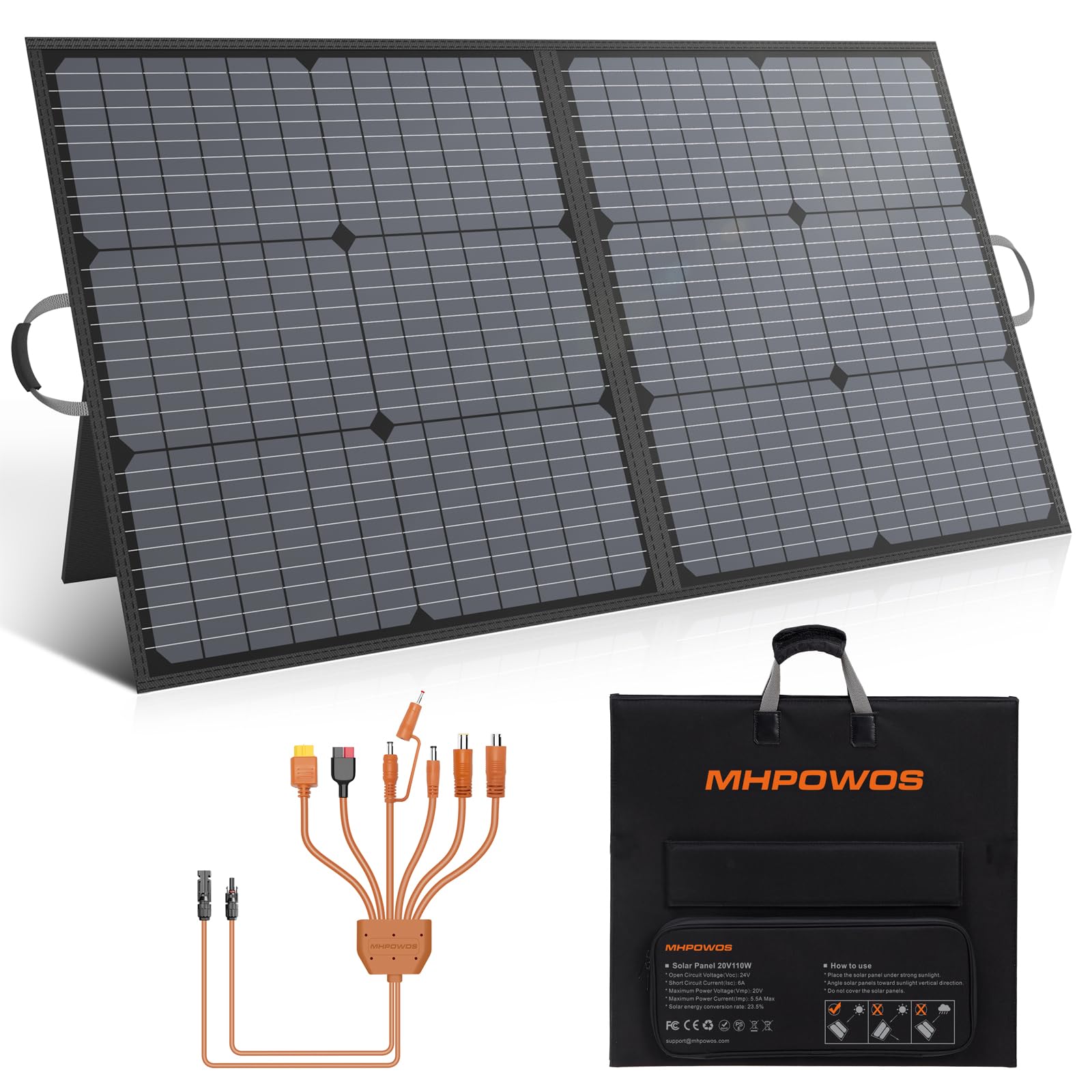
The leaner MHPOWOS sibling that trims 1.4 lbs off the original while keeping the same 23.5% efficiency.
Sitting at 8.5 pounds with a folded size of 23.46 x 21.25 x 1.57 inches, this version is notably lighter than the 9.9 lb model above. The charging capability impresses owners, with one reporting it efficiently powers both Westinghouse iGen160s and iGen300s power stations.
Monocrystalline silicon cells achieve 23.5% efficiency, with owners reporting roughly 82W in full sun. It carries an IP67 waterproof rating with a thickened handle and a one-piece foldable structure that sets up in seconds — just unfold, snap out the 2 kickstands, and connect.
This panel connects to your power station via a 4-in-1 cable interface that covers Anderson, XT60, DC7909, and DC5521 connectors, and the whole kit runs at 20V. It lacks USB ports entirely—so it’s a pure power-station panel, which keeps things simple if you already own a solar generator. The 18-month warranty adds confidence over the 12-month standard.
Why it works
- Lighter than the other MHPOWOS at 8.5 lbs
- Reliable 82W output in full sun
- 18-month warranty included
Keep in perspective
- No USB ports — power stations only
- Won’t work well in dim light or shade
Best suited to: power station owners who want a straightforward, no-frills panel that just works with their generator.
Not for: anyone hoping to charge phones directly from the panel without a station in between.
6. VTOMAN VS110 Portable Solar Panel

The rugged 12.5 lb panel built to pair perfectly with VTOMAN Jump power stations, backed by a 2-year warranty.
This VTOMAN panel is the natural match for anyone in the VTOMAN ecosystem, working with Jump 600X, Jump 1000, Jump 1500X, and Jump 1800 stations (though not the FlashSpeed 1500). With a 19V working voltage and MC-4/Anderson/XT60/DC5521 interfaces, it also reaches other stations with matching ports.
The build quality is what wins owners over — it’s compact, portable, and well-constructed. Real-world testing shows it outperforms on cloudy days, with one owner reporting peak 102W and roughly 200Wh on a cloudy or rainy day. That cloudy-day performance is the standout here.
Monocrystalline cells hit 23% efficiency, and its 6 A output is the highest amperage here. It measures 25.6 x 23.7 x 1.4 inches folded and weighs 12.5 lbs, with 4 circular holes for hanging and 2 adjustable kickstands. The IP67 rating protects against splashing, though VTOMAN advises against leaving it out in heavy rain.
The strengths
- Highest amperage here at 6 A
- Performs well on cloudy days per owners
- 2-year warranty — double the standard
The weight to note
- Heaviest folding option at 12.5 lbs
- Not rain-soak safe despite IP67 — treat gently
Choose this if: you own a VTOMAN Jump station and want a guaranteed match with the longest warranty here.
pass on it if: you’ll carry the panel far — 12.5 lbs is substantial for a folding design.
7. E-POWO 110W Bifacial Solar Panel
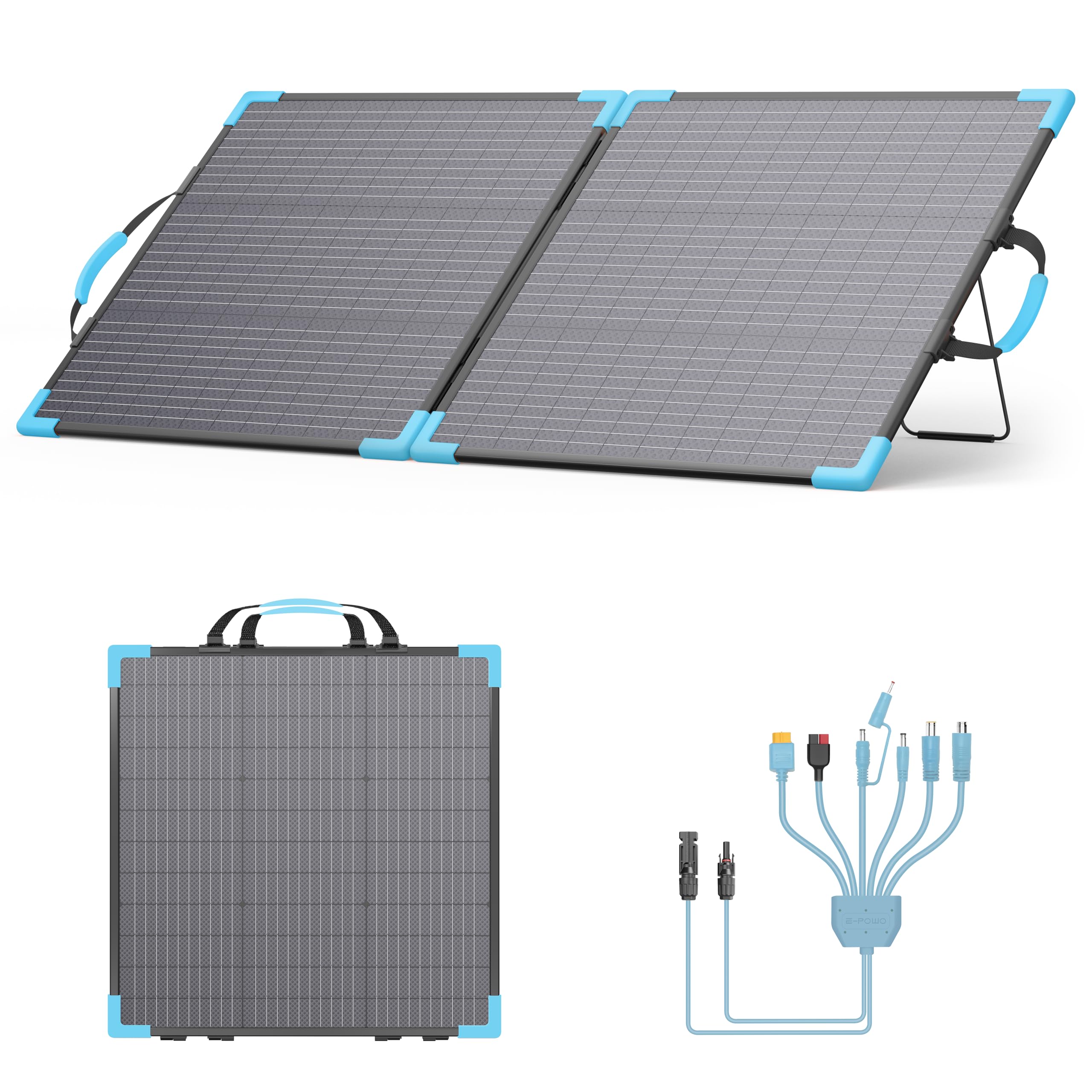
The rare bifacial folder that harvests reflected light from the back, pushing owners to report 88% of rated power.
This is the only bifacial panel here, meaning it generates electricity from both sides — direct light on the front and reflected light on the back from snow, sand, or white roofs. That design can boost overall generation by 10% to 30% versus single-sided panels, depending on the surface beneath it.
The power efficiency impresses early users, with one reporting around 88% of rated power on first use with an Anker Solix C300 (74-97W). Another owner in the Arizona mountains at 5,600 feet pulled 200+ watts from two panels on a clear day. Premium A+ monocrystalline cells deliver 23.5% conversion efficiency.
It weighs 7.7 lbs and folds to 24 x 23.6 x 1.3 inches, with an IP68 waterproof rating — the highest here, beating the IP67 units above. The 3-angle adjustment (40°/50°/60°) and anti-corrosive aluminum frame keep it stable in wind. The 7-in-1 cable covers DC8020/DC7909/DC35135/XT-60/Anderson connectors.
What makes it special
- Bifacial design captures reflected light
- Highest IP68 waterproof rating on this list
- 88% of rated power achieved in real use
The trade-offs
- No carrying case included — buy one separately
- Cable is on the shorter side, and one connector lacks click feedback
Grab this if: you camp on snow or sand where reflected light gives you a real output edge over every other panel here.
Reconsider if: you want a plug-and-play kit with a case included — this one is barebones by design.
8. BougeRV 100W Foldable Solar Charger
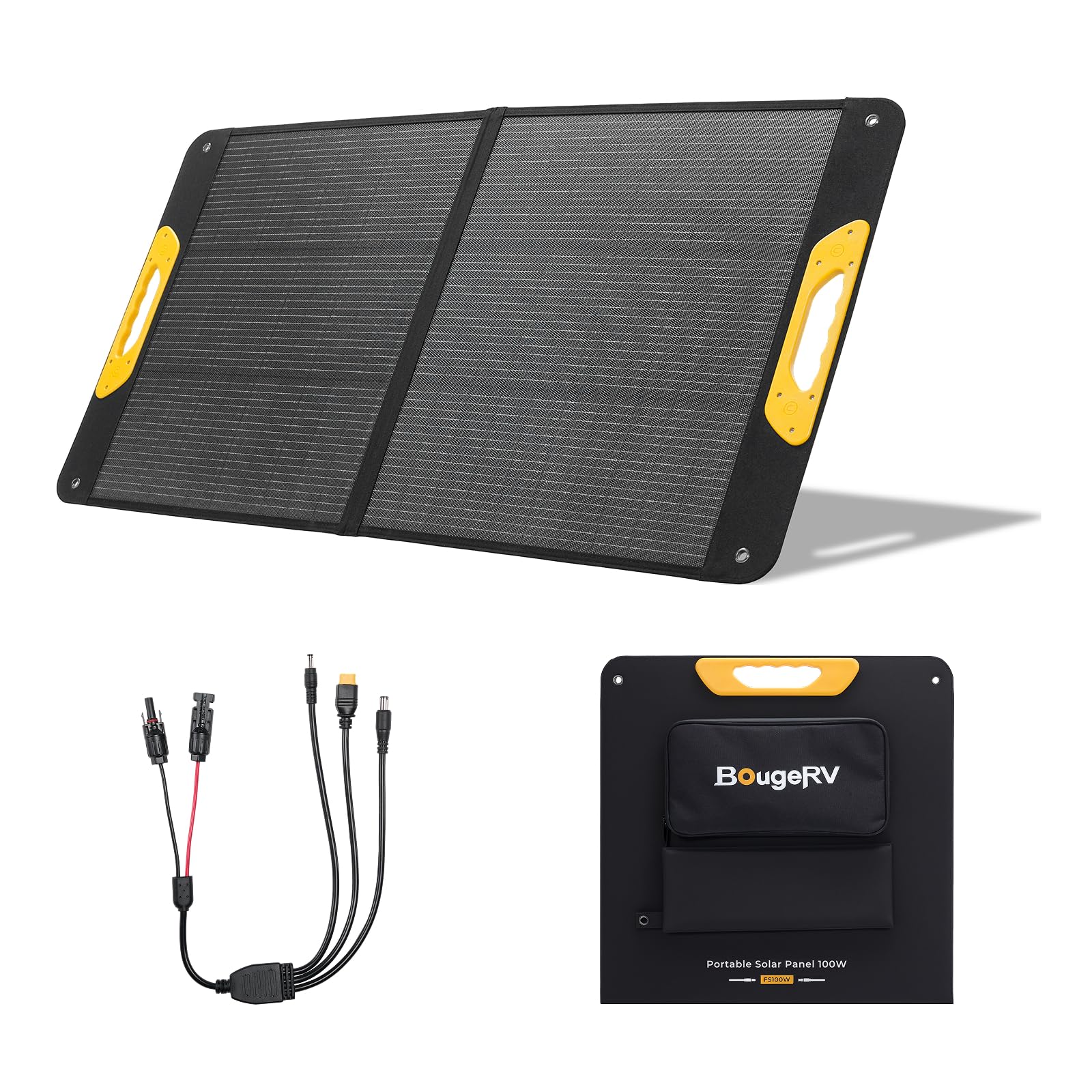
The fridge-friendly 100W panel with a fiberglass core that one owner caught putting out 115W on a Colorado trip.
Reliability is the theme here — customers note the panel keeps their BougeRV fridge running flawlessly when paired with the brand’s battery. The fiberglass reinforcement resists cracking and surface abrasion, so it’s built for the repeated setup and takedown of camping life.
Its N-Type cells reach 25% efficiency, trailing only the ZOUPW’s 25.6% on this list. One owner caught it putting out 115W on a camping trip, charging a Bluetti 300 in less than 3 hours. The 6.9 lb weight and built-in side handles make it easy to carry.
The plug-and-play setup includes XT60, DC7909, and DC5521 connectors, plus an 8.2 ft extension cable for flexible placement between panel and power station. It’s IP65 rated for water and dust resistance — slightly lower than the IP67 units here, but adequate for rain exposure during RV trips.
What owners confirm
- 115W surge recorded in real-world use
- Fiberglass layer adds impact resistance
- Charges a 300W battery in under 3 hours
Honest notes
- Cables could use thicker jacketing per owners
- IP65 rating is lower than the IP67/IP68 picks
Best for: overlanders running a 12V fridge who want a durable panel that pairs smoothly with BougeRV batteries—if you don’t own a BougeRV setup, you might find the connector limiting.
Not ideal if: you demand the top waterproof rating — the IP65 here trails the IP68 E-POWO.
9. Nature Power 110 Watt Solar Panel Kit
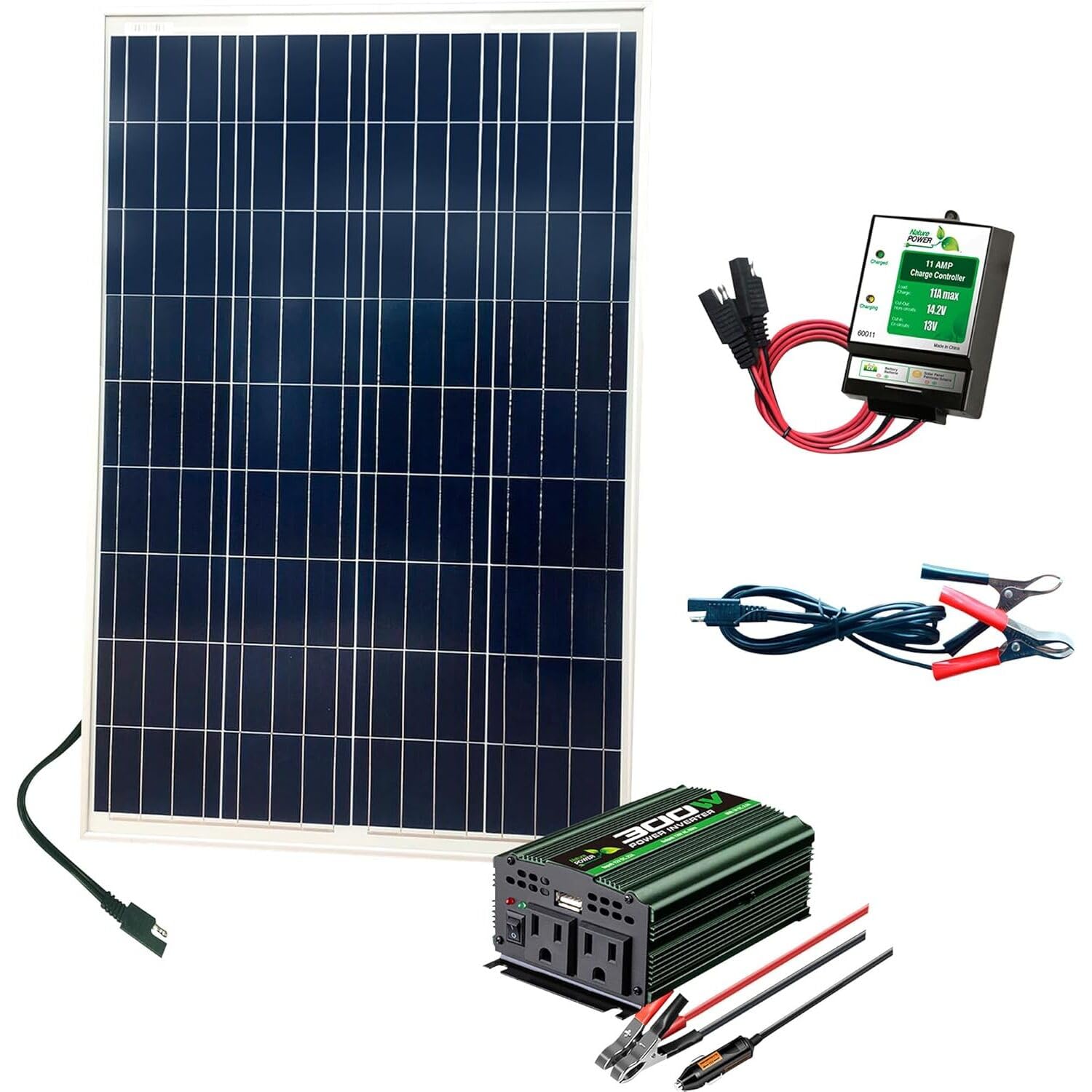
The fixed, rigid 110W kit that brings its own charge controller, inverter, and 25-year panel warranty.
This is a completely different animal — a rigid polycrystalline panel built for semi-permanent setups like cabins, sheds, and camp bases, not backpacks. It’s a full kit that includes an 11A charge controller, solar connecting cables, a 300W power inverter, wiring, and a 5V/2A USB charger.
Its 25-year warranty guarantees at least 80% efficiency retention, underscoring its permanent-mount design. At 19 pounds and 41 x 27 x 2 inches, it’s firmly in “mount it once” territory. It runs at 12 volts with 11 A capacity — a very different electrical profile from the 19-20V folding panels above.
Buyers here split into two clear camps: some run two deep-cycle batteries with LED lights and phone chargers daily with no issues, while others hit snags with the included hardware. The recurring note is that reliability is mixed — some units worked great, others stopped working after about 7 months, so this is the riskier pick for the money.
The upside
- Complete kit — controller and inverter included
- 25-year panel efficiency warranty
- Rigid design suits permanent mounts
The honest reality
- Reliability is genuinely mixed — some units fail early
- Instructions are hard to follow, per owners
- Heavy 19 lb build isn’t portable
Consider this if: you want one box with everything to run a small off-grid cabin setup with deep-cycle batteries.
Look elsewhere if: you need a dependable portable panel for a power station — the folding options above are far more consistent.
Understanding the Specs
Conversion Efficiency
This percentage (23-26% on these panels) tells you how much sunlight becomes usable electricity. A 25.6% panel like the ZOUPW turns more sun into power than a 23% panel of the same size — so in limited daylight, the higher-efficiency panel tops up your station faster. Real-world output always runs below the rated wattage.
Cable Connectors
The connector is the physical plug that matches your power station’s input port. XT60 fits EcoFlow and Bluetti, Anderson fits older Jackery models, and DC7909/DC8020 fit Jackery and Bluetti variants. A 5-in-1 or 7-in-1 cable kit means you won’t need separate adapters for different brands.
FAQ
Will a 110W panel fully charge my power station in one day?
What is the difference between IP65, IP67, and IP68 ratings?
Can I plug a 110W solar panel directly into my phone or laptop?
Why does my panel show lower wattage than 110W on sunny days?
What does bifacial mean in a solar panel?
Are the cables and connectors universal across power station brands?
How long does a folding solar panel last?
Is a heavier panel with more cells worth carrying?
Final Thoughts: The Verdict
For the best balance of efficiency, weight, and versatility, the 110w solar panel winner is the ZOUPW 110W because its 25.6% efficiency and built-in USB hub make it the most complete folding panel here. If you want the lightest carry for hiking, grab the FlexSolar 100W. And for a rigid off-grid cabin setup with controller and inverter included, the Nature Power kit is the one to reach for — just keep expectations realistic given its mixed owner history.
How We Picked
We do not accept paid placement. Every pick is matched to a real buyer and a real use-case; we do not hands-on test units.
Sources & Methodology
Specifications: manufacturer listings and product documentation. Review insights: verified customer reviews, as of September 2026. Pricing: not shown on this page (it changes often); check the current price via the retailer link.
As an Amazon Associate, KitchPrep earns from qualifying purchases. This does not affect which products we feature.
Related Guides
