
Specs are compiled from manufacturer listings and verified buyer reviews and can change over time — please confirm the key details on the product page before buying.
Here is the short answer: for a 110V stick welder you want the most amps your household outlet can actually feed without tripping a breaker, a stable arc that fires on the first tap, and a weight you can carry with one hand. Anything heavier than about 120 amps on a standard household circuit is often more marketing than muscle, because the outlet itself is the bottleneck. That single fact decides most of the picks below.
I’m Mohammad Maruf — the founder and writer behind KitchPrep. This guide is built by comparing the manufacturers’ published specifications and the patterns across verified customer reviews, so you get each pick’s real strengths and trade-offs instead of marketing spin.
You don’t need to become an engineer to buy one of these. You just need to know which amperage range suits your outlet, whether the machine takes standard rods, and how much it weighs in your hand — all of which decide whether a 110v stick welder earns its place on your bench or sits in the corner gathering dust.
Our Picks at a Glance
How To Choose The Best 110V Stick Welder
Most people shopping for a 110V stick welder are fixing a trailer, mending a gate, or patching a lawnmower deck in a home garage. The machine has to run off the wall socket you already have. That constraint shapes every choice below.
Match the amperage to your outlet, not the spec sheet
A stick welder’s amperage is how much current it pushes through the rod to melt metal. Higher amps mean deeper penetration on thick steel, but a standard household circuit can only supply so much before the breaker trips. Machines that run off 110V generally land in a useful range for light fabrication, repair, and hobby work — not for structural steel.
Rod size tells you what the machine will actually weld
Welding rods come in diameters, and the rod size sets how thick a piece of metal you can fuse in one pass. A machine rated for 3/32-inch rods handles thinner sheet and light repair work well. A machine that accepts up to 1/8-inch rods gives you more reach into heavier metal — but only if your outlet can feed the current it needs to fire them.
Weight matters more than you think
These machines get carried up ladders, onto rooftops, and out to the back fence. A handheld gun-style welder weighs almost nothing and works with one hand. A traditional box-shaped unit runs heavier, in the 9 to 15 pound range, and comes with a shoulder strap so you can haul it between jobs without setting it down every few steps.
Beginner helper functions are worth having
Hot start boosts current for a split second to make the rod strike easier. Arc force pushes extra current when the rod gets close to the metal so the arc doesn’t die. Anti-stick cuts power briefly if the rod fuses to the workpiece. None of these replace practice, but they shorten the learning curve noticeably on a first machine.
Quick Comparison
| Model | Best For | Amperage | Input Voltage | Carry Weight | Amazon |
|---|---|---|---|---|---|
| TOOLIOM 135A★ Best Overall | Beginners wanting stick plus lift TIG | 0–135A | 110V | 10.98 lb | Amazon |
| Harukiku 130A MMABest Value | Longer cable reach on remote jobs | 20A–130A | 110V | 1.84 kg | Amazon |
| SOARFLY 250AMost Versatile | Dual-voltage flexibility | 250A output | 110V/220V | 9.06 lb | Amazon |
| YesRight Handheld | One-handed work at height | 120A | 110V | 3.9 lb | Amazon |
| Saker GJ76085 | Gun-style welding with a 5-speed dial | 20A–120A | 110V | 3.3 lb | Amazon |
| Sakerplus SK-PWM110B | Complete kit for first-time welders | 20A–120A | 110V | 3.75 lb | Amazon |
| Lihao Handheld Arc Welder | Trunk-and-tool-bag portability | 20A–120A | 110V | 3.8 lb | Amazon |
| ARCCAPTAIN ARC205 Pro | Power and app control | 20A–150A (120V) | 120V/240V | 8.2 lb | Amazon |
In‑Depth Reviews
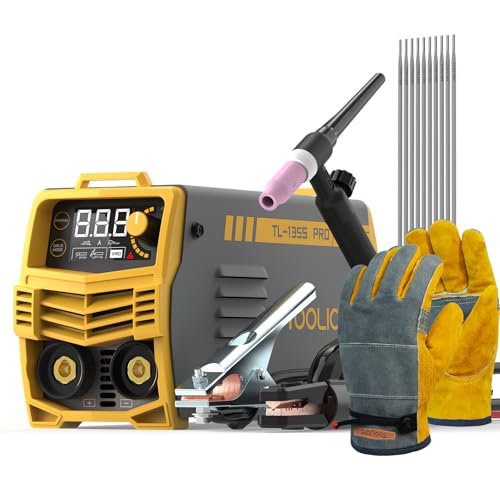
1. TOOLIOM 135A 110V Stick Welder Kit with Lift TIG Torch, rods & Gloves
Our pick — 4.5★ from 250+ verified ratings; the strongest balance of quality and price.
Two welding modes, one compact box, and a shoulder strap that turns a garage tool into a job-site tool.
The TOOLIOM 135A earns the top spot by doing something most machines in this range won’t: it welds stick and lift TIG. Stick welding feeds a flux-coated rod into the metal — the simple, forgiving method you’d use on a fence post or a trailer frame. Lift TIG swaps in a tungsten torch for a cleaner, more controlled arc on thin metal, and it’s a genuinely easier technique for a beginner to learn, though it does require gas. That two-in-one capability is why this kit comes with a torch, E6013 rods, and gloves in the box.
On a standard household circuit it runs 0–135 amps, which covers the rod sizes that matter for home repair. The amp range is set by a single dial, and there’s a VRD safety function plus Hot Start and ARC Force — the helpers that make the rod strike more easily and keep it from sticking to the workpiece. The LCD display is the practical upgrade here: it reads clearly even when you’re wearing a helmet, so you’re not pulling it off every time you want to check where the current sits.
It weighs 10.98 pounds, which is heavier than the handheld guns further down this list, and it arrives with a shoulder strap to balance that out. Compared to the Harukiku 130A MMA it holds a wider range, though the Harukiku runs lighter at 1.84 kg. Buyers praise its build quality most, with value for money a close second. The honest catch is durability — the long-term picture draws mixed signals, so treat the machine well and store it dry.
What It Gets Right
- Two modes in one unit — stick plus lift TIG with the torch included
- 0–135A adjustable on standard 110V household current
- VRD, Hot Start and ARC Force make rod striking more forgiving
- LCD display is readable through a helmet
- Shoulder strap for carrying between jobs
What To Keep In Mind
- At 10.98 lb it’s the heaviest pick here — the strap helps, but it’s not a one-hand tool
- Durability across the long haul is uneven; store it dry and treat it gently
- Lift TIG needs shielding gas, which isn’t in the box
Reach for this if: you want one machine that covers stick repair work now and lets you grow into cleaner TIG welding later, all off a normal outlet.
Look elsewhere if: you need something light enough to hold overhead one-handed — the handheld guns further down weigh a fraction of this.
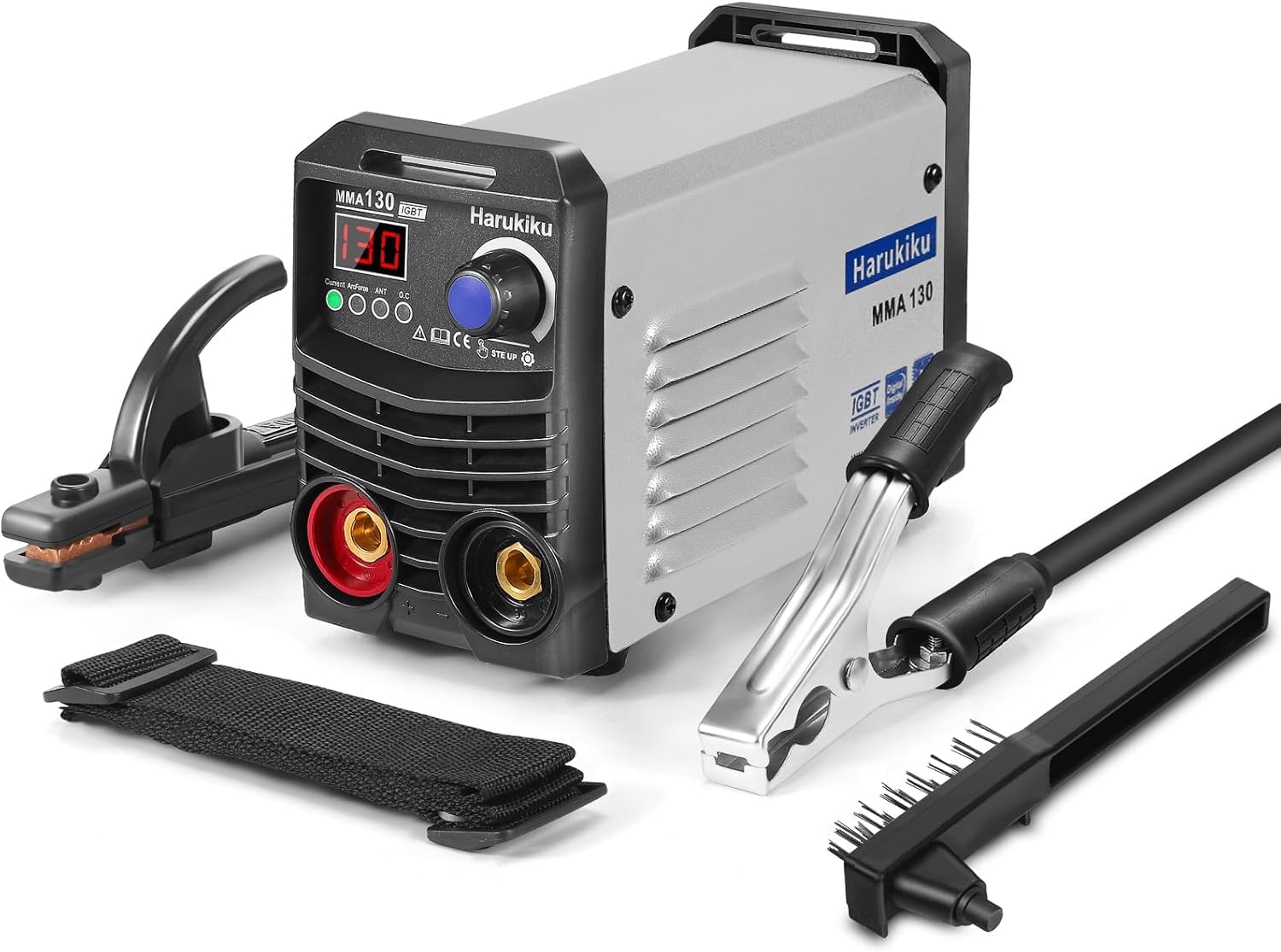
2. Harukiku 130A MMA Stick Welder, 110V Portable IGBT Inverter
One dial, a synergic brain that does the thinking, and cable runs long enough to reach the far end of the yard.
The Harukiku 130A is built around a single control knob, and that’s the whole point. You turn the dial to set the welding current, and the machine automatically tune the output voltage to match — a setup called synergic control. For someone who has never struck an arc, that removes the guesswork. The range runs 20A to 130A, with a clear digital display showing you exactly where you are.
The cable lengths are what make it useful beyond the bench. The electrode holder cable runs 3 meters and the ground cable 2 meters, with a 1.8-meter power cord — enough reach for vehicle body repairs, fence mending, or roof touch-ups without dragging extension cords around. It handles rods from 1.6mm to 3.2mm, which covers common electrodes on steel and cast iron. One owner laid 6.5-inch clean beads on a galvanized boat trailer fender bracket with the correct electrode grade. Buyers report it runs on a standard outlet, even off a power strip.
At 1.84 kg it’s one of the lightest proper machines here, and the removable shoulder strap lets you carry it one-handed. Weighing it against the TOOLIOM above, this one is far lighter but gives up the lift TIG mode. There’s an anti-stick feature and adjustable arc force to keep the arc from breaking mid-pass. The auto anti-stick is described as weak by one experienced farmer, and the included manual is light on actual welding guidance — so budget time to learn the basics yourself, or watch a few videos.
Where the money goes: synergic control, the 20A–130A range, and long cables — practical features for remote repair work off a household outlet.
The one thing to plan for: that manual won’t teach you to weld, and the auto anti-stick feature is on the gentle side, so you’ll want a little self-education first.
The smart buy for: a first-timer who wants the machine to handle the settings and needs cord reach to get to the work.
Not your machine if: you specifically want lift TIG capability — this one is stick-only.
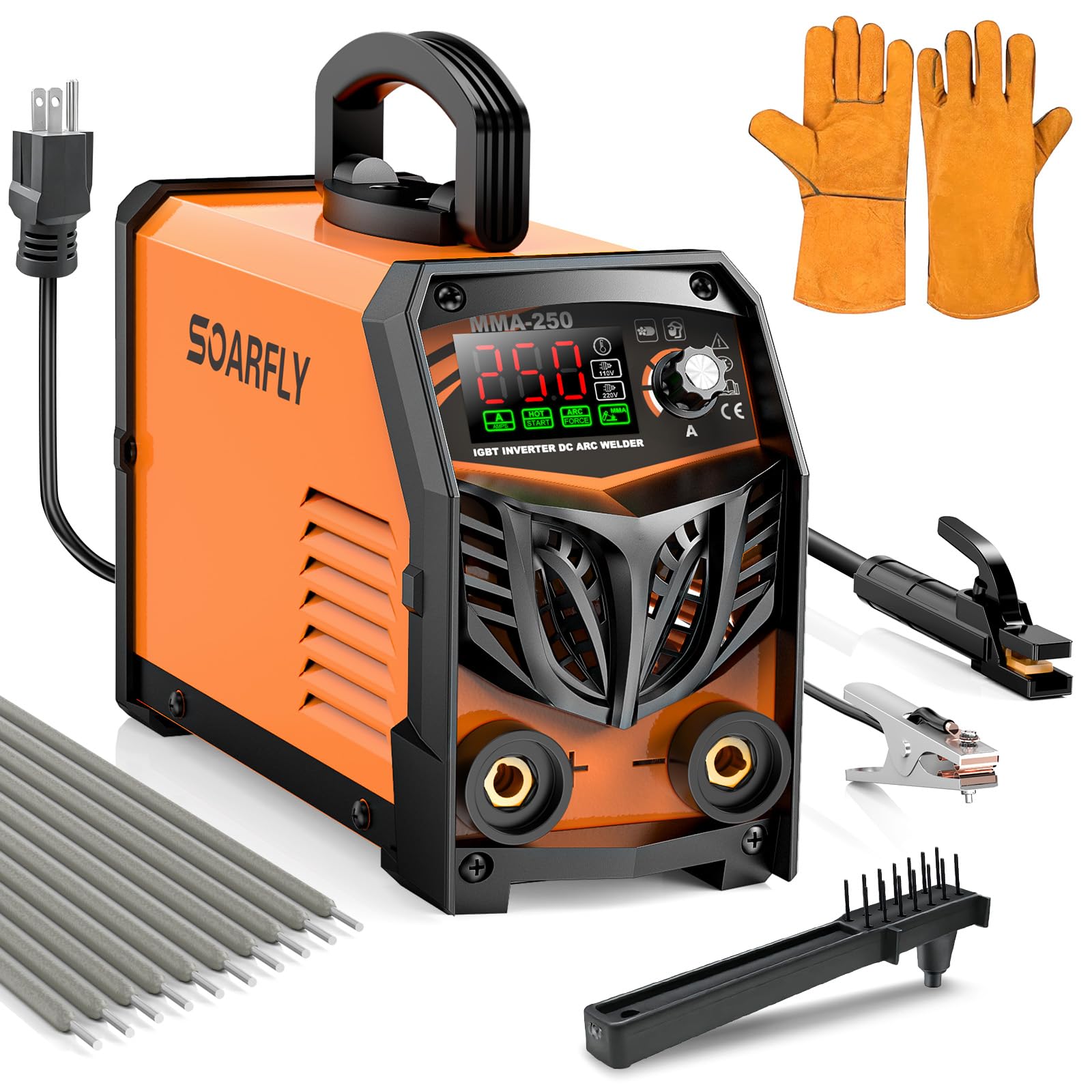
3. SOARFLY Stick Welder, 110V/220V Dual Voltage
One machine that follows you from the garage outlet to the job-site 220V feed without a switch in your workflow.
The headline number on the SOARFLY is its 250-amp output, which makes it the most powerful machine on this list by a wide margin. Where the Harukiku tops out at 130A, the SOARFLY claims 250A — a real gap in headroom for heavier work. It accepts electrodes from 2.5 to 3.2mm (about 3/32 to 1/8 inch), and it works across stainless steel, carbon steel, and cast iron.
The dual-voltage design is the real selling point. It automatically adapts to a 110V or 220V input, so it runs off your household socket at home and off a jobsite 220V feed when you have one. One caveat baked into the specs: using 220V requires an adapter that isn’t included. It packs IGBT inverter control for a stable arc and less spatter, plus Hot Start, Arc Force, and Anti-Stick functions. The large LED screen is bright enough to read without lifting your helmet, which several buyers highlight as a genuine convenience.
It weighs 9.06 pounds and has a built-in handle. Set against the TOOLIOM 135A at 10.98 pounds, it’s the lighter of the two despite the bigger amp claim. Buyers praise its build quality most, with value for money a close second. For a home and small-workshop machine that can also be carried onto a roof for a quick repair, its size and weight balance well. It comes with 10 welding rods, an electrode holder, a ground clamp, a steel brush, gloves, and a manual.
Pick this one when: you want maximum amperage headroom and the flexibility to use either household or jobsite power.
Go lighter if: you’ll never touch 220V and want the smallest machine that fits a cramped shelf.
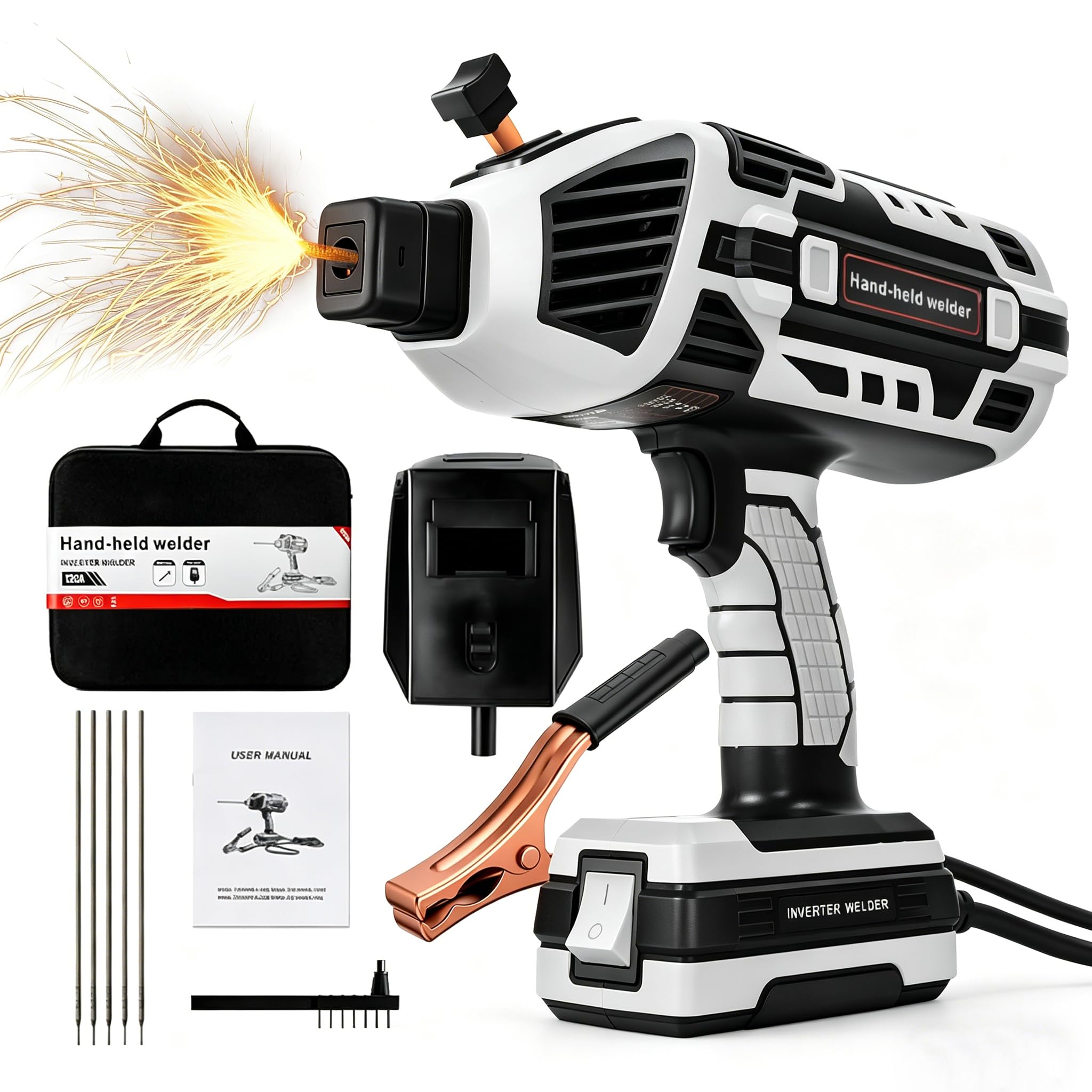
4. YesRight Welding Machine Handheld 110V 120Amp Portable ARC Welder Gun
A gun-shaped welder light enough to hold overhead with one hand — the pick for ladder work and cramped corners.
The YesRight is the answer to a very specific problem: welding somewhere you can’t set a machine down. It weighs 3.9 pounds and shaped like a gun, so you grip one handle and work with the other hand free. That makes it the natural choice for overhead welds, tight framing, and anything up a ladder where a box-style unit would be awkward to balance. It fits rods from 1/16 to 1/8 inch (1.6–3.2mm) and runs a hot arc start function to make striking easier.
Inside, IGBT inverter technology improves current stability and efficiency, giving smoother arc initiation and less spatter. There’s 360-degree cooling plus overheat protection to guard the internal circuit during extended use. The kit is complete from the start with the gun, five welding rods, a ground wire, a brush, a mask, and a toolbox. It handles stainless steel, mild steel, and iron. A welder with 20 years of metalworking experience ran vertical welds on thin car-seat frame tubing at the third power setting and reported it worked perfectly.
Be honest about what it is: a light-duty tool. It’s well suited to short bursts of hobby and repair work rather than production runs, and the mask in the kit is a handheld style that leaves you one hand short. A non-welder found it easier to use than their MIG machine, with cleaner welds and less grinding. An occasional unit has arrived dead or stopped sparking early, so test yours thoroughly within the return window.
The Case For The Gun Shape
- 3.9 lb and one-handed — genuinely useful at height
- Hot arc start plus IGBT inverter for smoother striking
- Full kit including gun, rods, ground wire, brush, mask and toolbox
- Handles stainless, mild steel and iron
Where It Falls Short
- The handheld mask isn’t hands-free, so it eats one of your hands
- Built for light duty, not production work
- A rare unit arrives faulty — test yours right away
Best matched to: anyone welding off a ladder or in a spot where there’s no room to rest a machine.
skip it if: you need long continuous runs — this is a burst-work tool, not a duty-cycle workhorse.
5. Saker Portable Electric Welding Machine, 110V Handheld with IGBT Inverter

The featherweight of the group — 3.3 pounds with a five-speed dial and a high no-load voltage for easy arc starting.
Weighing just 3.3 pounds and measuring 9.8 by 9.45 inches, the Saker is designed to live in a home, workshop, or car trunk without taking up room. That size is the whole appeal: it slips onto a shelf, travels to a job site, and gets stored in seconds. It runs 20 to 120 amps through a five-speed knob, giving you a simple ladder of settings to climb as your project changes.
The IGBT inverter inside provides high no-load voltage — the voltage sitting on the electrode before you strike — which is what makes arc initiation easier. It’s set up for 3/32-inch rods and includes a Hot Start Arc Ignition function for smoother, more reliable starts. A high-efficiency air intake paired with an automated thermal management system and 360-degree cooling keeps it running during longer sessions, with overheat protection guarding the internals. For a first-timer, the plug-and-play nature is the draw: one buyer repaired a fire-ring leg on the very first try after being skeptical.
The kit ships with a handheld face mask that you have to hold, which leaves you without a free hand and can let light leak in at the sides. Replacing that mask with a proper hood is a worthwhile upgrade if you’ll use the machine often. That aside, the lightweight build, stable arc, and clean welds on small jobs are what keep it in the conversation.
Why it holds its place: genuine one-handed portability at 3.3 lb, a 20A–120A range on a five-speed dial, and high no-load voltage for easier starting.
The honest workaround: swap the handheld mask for a real hood, and this becomes a much more comfortable machine to actually use.
Suits you if: storage space is tight and you want something that disappears onto a shelf until you need it.
Think twice if: you weld for long stretches — the handheld mask will wear you down fast.
6. Sakerplus Portable Welding Machine, Handheld 110V with 5 Current Settings
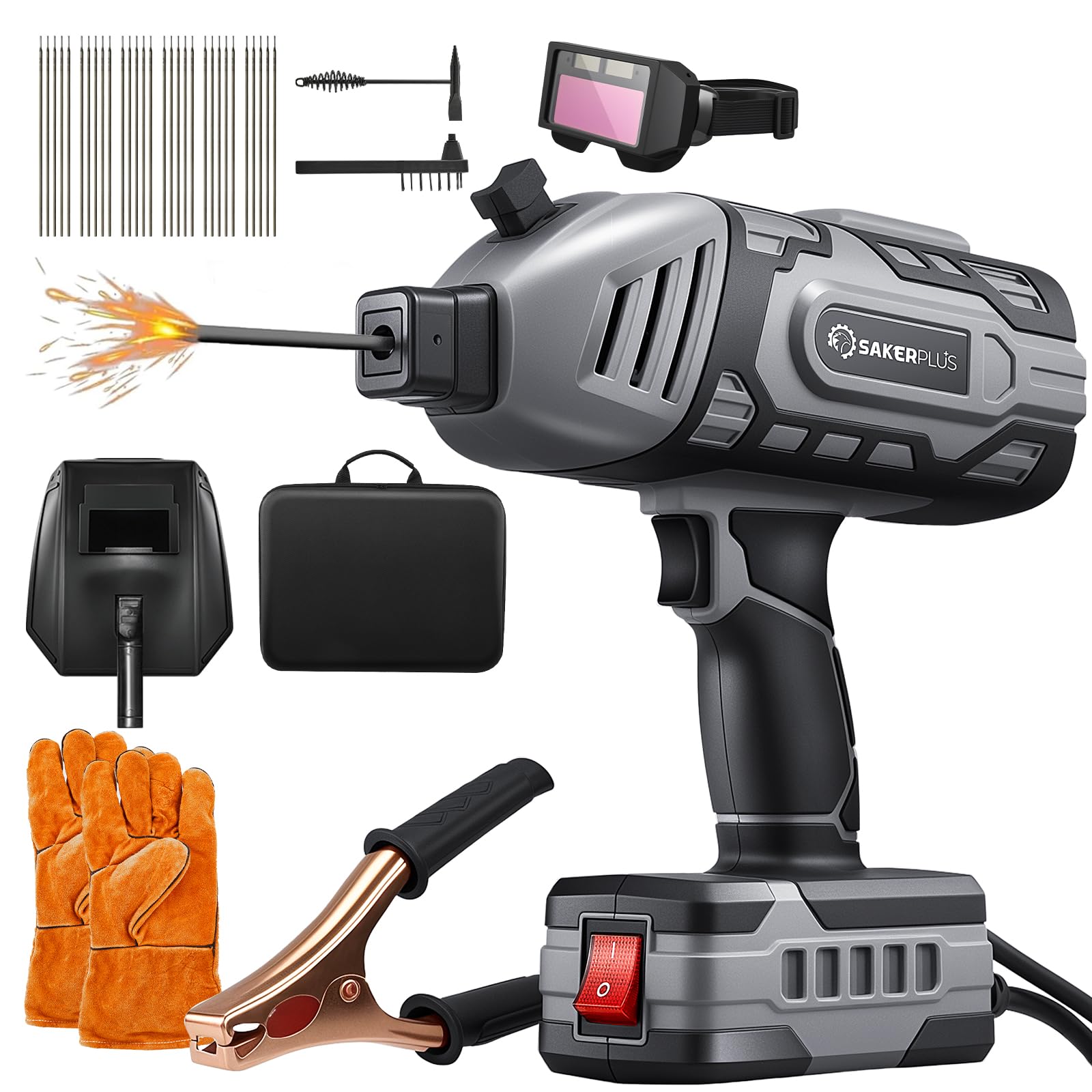
Five numbered power levels that spell out exactly which setting matches your metal thickness — a first machine that teaches as you go.
What sets the Sakerplus apart is how clearly it explains its own settings. The five amperage levels are labeled 20A, 45A, 70A, 95A, and 120A, and the design intent is spelled out: the lower three settings (20A–70A) deliver gentler heat for thin sheet metal to avoid burn-through, while the upper two (95A–120A) provide deeper penetration on thicker steel. For a beginner who doesn’t yet know how much current a given thickness needs, that mapping removes a lot of trial and error.
It weighs 3.75 pounds, and the maker states that’s 60 percent lighter than older models. IGBT and inverter technology inside keeps the arc controlled, and it runs on household 110V — or a generator, which matters if you’re working somewhere without power. The rod clamp fits 3/32 to 1/8 inch electrodes, and it handles alloy steel, carbon steel, and iron. The kit is genuinely complete: 30 welding rods, a helmet, ground wire, brush, chipping hammer, gloves, safety goggles, and a hard carry case.
Power source flexibility is the mixed part of the story. It runs well on a 20-amp 115-volt outlet, but a fair share of users note the ceiling of what 110V can do — one owner summed up the frustration plainly: “110 sucks for stick welding, full stop.” Buyers praise its build quality most, with value for money a close second. It welds smaller jobs very well; it is not built for large-structure work.
The whole-kit answer for: a true beginner who wants every accessory in one box and clearly labeled power levels to learn on.
Look past it if: you already weld and know your settings — you’ll be paying for a helmet and rod set you don’t need.
7. Handheld Arc Welder Portable Welding Machine 110V, 3/32″–1/8″ Rods
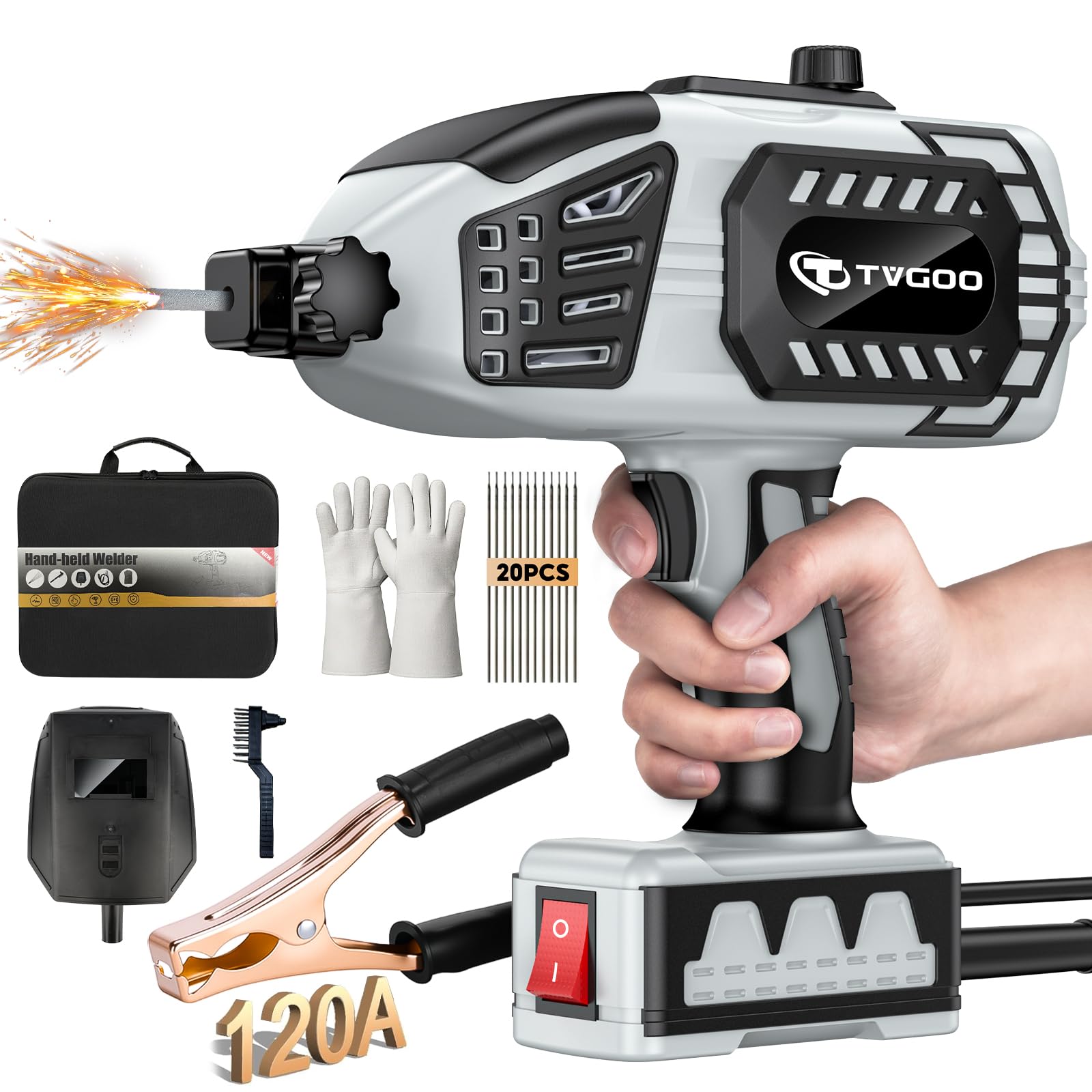
A trunk-and-tool-bag welder built for grabbing on the way out the door, with five current settings and anti-stick built in.
At 3.8 pounds, this handheld unit is designed to be stashed in a trunk, tool bag, or on a shelf so it’s ready when a repair comes up. It runs 20A to 120A across five variable current settings, letting you dial down to a gentle setting for thin sheet metal or step up for heavier repair work. The rod clamp takes standard 3/32 to 1/8 inch electrodes, so you’re not hunting for an oddball size.
IGBT technology keeps the arc smooth and stable, and the machine pairs that with hot arc start and anti-stick functions — the two helpers that reduce sticking rods and spatter, especially for someone new to the process. A 360-degree cooling system and overheat protection round out the durability story. The practical tip that comes up repeatedly: run it straight into a wall outlet rather than an extension cord, and if you must use a cord, keep it short. Use a 1/16-inch rod in 6011, 6013, or 7018 and it welds up to 1/8-inch thick metal without trouble.
This is a home and homeowner machine, and it’s honest about that. Buyers praise its build quality most, with its light weight a close second. The mixed part is value and long-run durability — a few owners felt it didn’t work hard enough for their money, and the machine rewards being used rather than sitting idle for long stretches. For rebuilding parts of an old truck or quick farm fixes, it does the job it’s designed for.
What it delivers: a grab-and-go 3.8 lb welder with five current settings, anti-stick, and 360-degree cooling for quick repair jobs.
What to know first: skip the extension cord where you can — run it on a short, 12-gauge cord if you have no direct outlet nearby.
A natural fit for: a homeowner who wants a small welder stowed and ready for occasional truck, trailer, or gate repairs.
Neither here nor there if: you expect precision on a production schedule — this is a convenience tool, not a fabrication machine.
8. ARCCAPTAIN 205A Stick Welder, ARC/Lift TIG, 120V/240V

The pro-grade end of the list — 205 amps on 240V, MCU-controlled arc, and a phone app that monitors the machine for you.
The ARCCAPTAIN ARC205 Pro is the most capable machine here, and the specs show why. On 120V it delivers 20A to 150A; switch to 240V and it climbs to 20A to 205A, giving it more working range than any 110V-only unit on this list. It runs most 6010, 6011, 6013, and 7018 rods, and an enhanced MCU (the control chip that manages welding parameters) with digital technology keeps the arc stable and consistent. One thing to note: it needs a break between voltage switches — let the screen turn off before changing over.
The app connection is a genuine differentiator. It pairs with your phone to adjust parameters within 10 meters, monitor machine status in real time, and answer common questions — helpful both for learning the machine and for keeping it running. For a beginner, the auto-matching feature is the best part: select your electrode diameter or workpiece thickness and the machine sets the current and voltage for you. The LED interface uses imperial units and fewer buttons, so you can read it without pulling off your helmet.
At 8.2 pounds it’s lighter than the TOOLIOM 135A at 10.98 pounds, despite the bigger power ceiling. Safety coverage includes VRD plus over-current, overload, and overheat protection, and it carries FCC and ANSI certifications. It comes with 10 E6013 rods, a 240V-to-120V adapter, a dust cover, a 10-foot electrode holder, and a 10-foot ground clamp. The one real limitation to weigh: on a 110V outlet, running 3/32-inch 7018 rods at higher current could trip a heavy breaker before you finish the rod, so those who mostly weld on household power should size their expectations accordingly.
What Makes It The Most Capable
- 20A–150A on 120V, up to 205A on 240V
- App connection for remote parameter changes within 10 meters
- Auto-matches current and voltage from electrode size or metal thickness
- 8.2 lb with shoulder strap and dust cover included
- FCC and ANSI certified, with VRD and full protection set
What To Factor In
- High-current 7018 work on a 110V outlet can trip a heavy breaker
- Lift TIG torch isn’t included
- You must let the screen power down before switching 120V to 240V
The right machine for: someone with 240V access who wants a compact, app-connected unit with real headroom for heavier steel.
Wrong pick if: your only power is a standard 110V outlet — you won’t tap most of what this machine can do.
Understanding the Specs
Why Amperage Isn’t The Whole Story
A welder’s amperage rating tells you how much current it can push, but your outlet sets the real limit. A standard household circuit can only feed so much before tripping a breaker, which is why machines that claim high output often fall short when you actually run them on 110V. The useful question isn’t the peak number — it’s how much current the machine delivers steadily on the power you have.
Rod Size And Metal Thickness
Welding rods are measured by diameter, and the rod you choose matches the thickness of the metal you’re joining. Thin rod diameters handle sheet metal and light repairs, while larger rods need more current to fire properly. If you run a rod that’s too thick for your machine’s output, it simply won’t strike a stable arc — which is why matching rod size to your machine’s amperage is the first skill to learn.
Duty Cycle And Cooling
A welder generates heat as it works, and its cooling design (often a fan plus internal airflow) determines how long you can weld before it needs to rest. Overheat protection shuts the machine down before it damages itself, so the cycle of welding and cooling is normal, not a fault. Machines with better airflow can sustain longer sessions before that pause.
IGBT Inverter Technology
IGBT inverter technology is a circuit design that converts your household power into a controlled, high-frequency current for welding. In practice it means a more stable arc, less spatter, and easier striking, all in a lighter machine than the bulky transformer welders of the past. It also makes these units small enough to carry and store easily.
FAQ
What size rod can a 110V stick welder run?
Will a 110V welder trip my breaker?
Can I weld thick steel with a 110V welder?
What is the difference between stick and lift TIG welding?
Do I need a welding helmet with a handheld stick welder?
Does a 110V stick welder work on a generator?
What does IGBT inverter mean on a welding machine?
How much does a 110V stick welder weigh?
Is 220V better than 110V for stick welding?
What is the duty cycle and why does it matter?
Final Thoughts: The Verdict
For most people shopping for the 110v stick welder, the winner is the TOOLIOM 135A because it gives you both stick and lift TIG welding off a standard outlet, with a full kit in the box and helper functions that shorten the learning curve. If you want a lighter machine with synergic control that handles the settings for you, the Harukiku 130A is the smart pick. And for maximum versatility with dual-voltage power and the biggest amperage number here, reach for the SOARFLY.
How We Picked
We do not accept paid placement. Every pick is matched to a real buyer and a real use-case; we do not hands-on test units.
Sources & Methodology
Specifications: manufacturer listings and product documentation. Review insights: verified customer reviews, as of September 2026. Pricing: not shown on this page (it changes often); check the current price via the retailer link.
As an Amazon Associate, KitchPrep earns from qualifying purchases. This does not affect which products we feature.
Related Guides
